
Life, 1916-11-16 · page 18 of 46
Life — November 16, 1916 — page 18: what you’re looking at
What you’re looking at
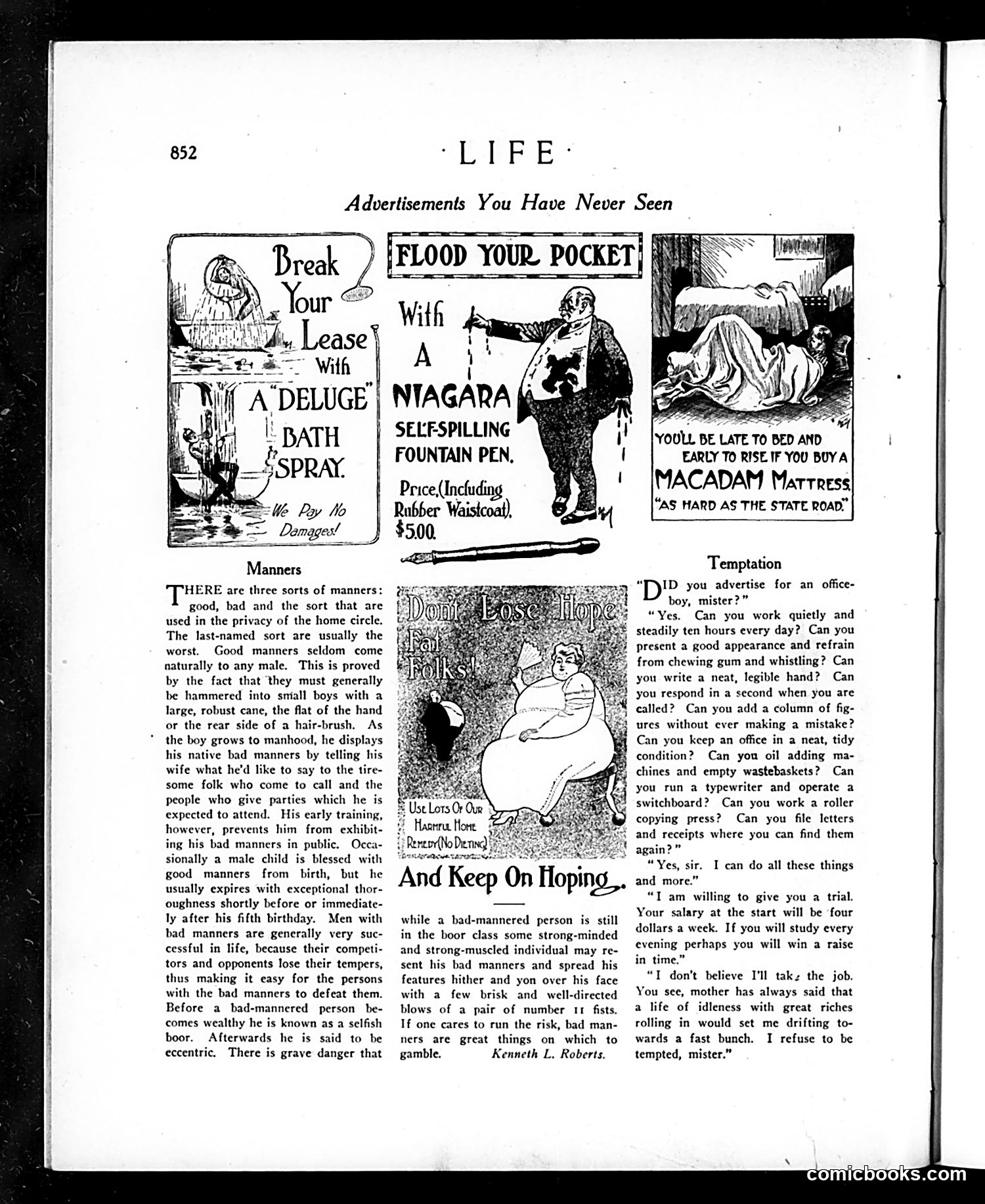
This page contains **fake advertisements** satirizing consumer products and a dialogue mocking job-seeking desperation. The fake ads ridicule absurd products: a bath spray claiming "no damages," a fountain pen that "self-spills" (defeating its purpose), and a mattress "as hard as the state road" (a complaint, not a feature). These mock aggressive marketing of obviously flawed goods. The main article, "Manners," offers cynical social commentary: it argues bad manners paradoxically succeed in business because they provoke anger in competitors, while good manners are rare and those born with them mysteriously die young. The piece suggests hypocrisy in polite society—people hide crude behavior in public while being genuinely rude at home. The "Temptation" dialogue satirizes youth unemployment and unrealistic expectations. A boy refuses a four-dollar-weekly office job because his mother warned him that idleness with wealth corrupts—the joke being that four dollars weekly is poverty, not riches, exposing the absurdity of his reasoning. Together, these pieces mock consumerism, social pretense, and economic hardship with dark humor typical of 1920s satirical magazines.
📄 Transcribed text from this page (OCR, searchable)
Machine-transcribed from the original scan — historical spelling and the odd misread are preserved.
‘LUPE: Advertisements You Have Never Seen We Pay No : Damages! ; = Manners 'HERE are three sorts of manners: good, bad and the sort that are used in the privacy of the home circle. The last-named sort are usually the worst. Good manners seldom come naturally to any male. This is proved by the fact that they must generally be hammered into small boys with a large, robust cane, the flat of the hand or the rear side of a hair-brush. As the boy grows to manhood, he displays his native bad manners by telling his wife what he'd like to say to the tire- some folk who come to call and the people who give parties which he is expected to attend. His early trainin however, prevents him from exhibit- ing his bad manners in public. Occa sionally a male child is blessed with good manners from birth, but he usually expires with exceptional thor- oughness shortly before or immediate- ly after his fifth birthday. Men with bad manners are generally very suc- cessful in life, because their competi- tors and opponents lose their tempers, thus making it easy for the persons with the bad manners to defeat them. Before a bad-mannered person be- comes wealthy he is known as a selfish boor. Afterwards he is said to be eccentric. There is grave danger that A | NIAGARA SELFSPILLING FOUNTAIN PEN, Price,(Including Rubber Waistcoal), a Fs yi ——— YOULL BE LATE TO BED AN! EARLY TO RISE IF YOU BUY A MACADAM Martress “AS HARD AS THE STATE ROAD.” Temptation ‘D? you advertise for an office- boy, mister?” “Yes. Can you work quietly and § steadily ten hours every day? Can you 3 present a good appearance and refrain ; chines and empty wastebaskets? }Renenr(No Denn) beeueraagwe And Keep On Hoping,. while a bad-mannered person is still in the boor class some strong-minded and strong-muscled individual may re- sent his bad manners and spread his features hither and yon over his face with a few brisk and well-directed blows of a pair of number 11 fists. If one cares to run the risk, bad man- ners are great things on which to gamble. Kenneth L, Roberts. from chewing gum and whistling? Can you write a neat, legible hand? Can you respond in a second when you are called? Can you add a column of fig- ures without ever making a mistake? Can you keep an office in a neat, tidy condition? Can you oil adding ma- Can you run a typewriter and operate a switchboard? Can you work a roller copying press? Can you file letters and receipts where you can find them again?” “Yes, sir. and more.” “TI am willing to give you a trial. Your salary at the start will be four dollars a week. If you will study every evening perhaps you will win a raise in time.” “I don’t believe I'll takz the job. You see, mother has always said that a life of idleness with great riches rolling in would set me drifting to- wards a fast bunch. I refuse to be tempted, mister.” I can do all these things