
Life, 1916-11-16 · page 28 of 46
Life — November 16, 1916 — page 28: what you’re looking at
What you’re looking at
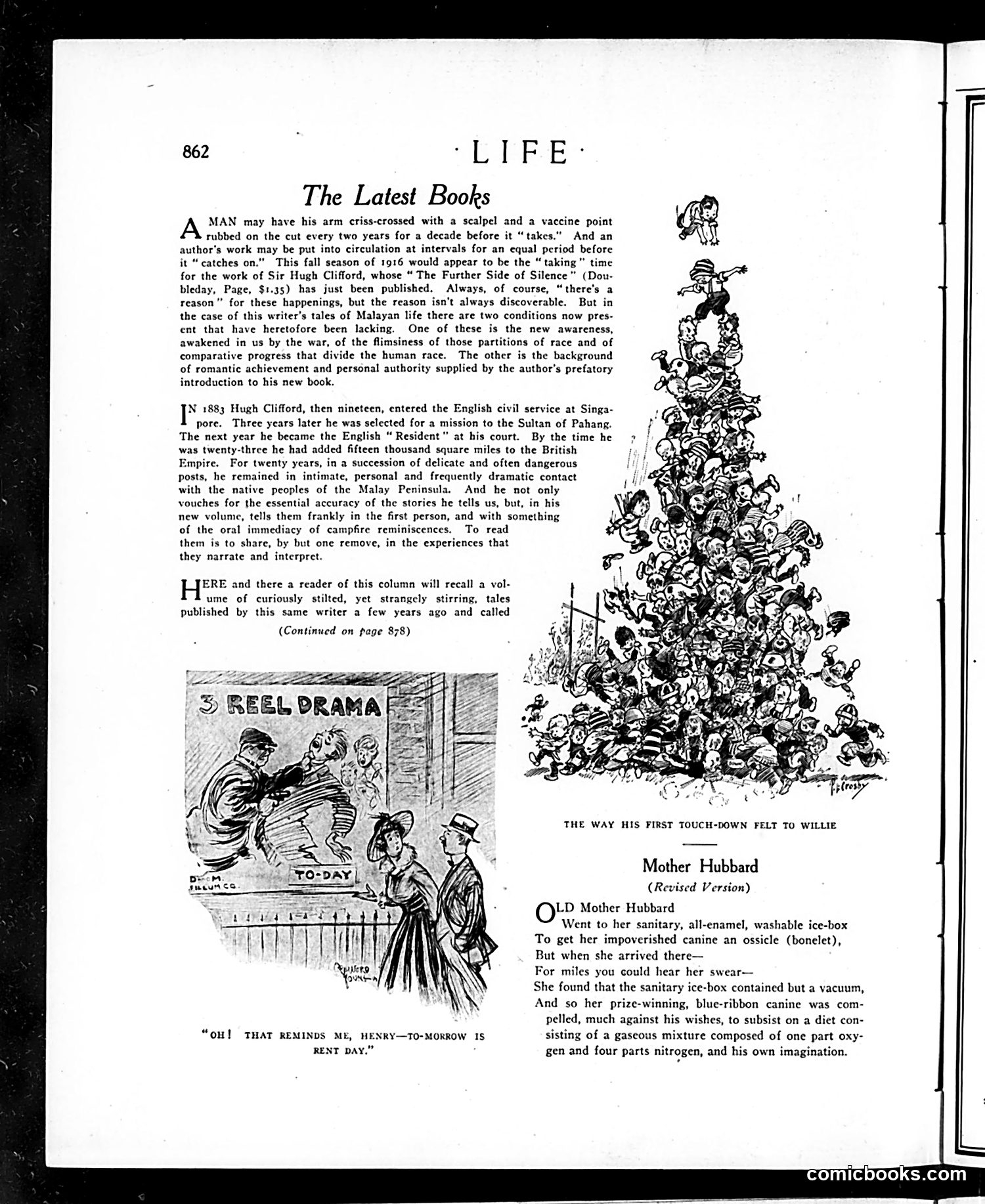
This page contains a book review of Hugh Clifford's "The Further Side of Silence" (1916), a collection of Malayan tales. The text explains Clifford's credibility: he served in the British colonial administration in Malaysia starting in 1883, becoming a "Resident" at age 22 and personally expanding British imperial territory. His firsthand experience with indigenous peoples lends authority to his fiction. The humor piece "Mother Hubbard (Revised Version)" is a satirical nursery rhyme update. It mocks modern domestic consumerism: the old rhyme's "bare cupboard" becomes a fancy "sanitary, all-enamel, washable ice-box" that's equally empty. The punchline—the starving dog must survive on "oxygen and four parts nitrogen" (air) and imagination—ridicules how advertising promises modern conveniences that don't actually improve people's material lives. The sidebar cartoon appears unrelated editorial commentary on contemporary events.
📄 Transcribed text from this page (OCR, searchable)
Machine-transcribed from the original scan — historical spelling and the odd misread are preserved.
[| PE The Latest Books MAN may have his arm criss-crossed with a scalpel and a vaccine point rubbed on the cut every two years for a decade before it “takes.” And an author's work may be put into circulation at intervals for an equal period before it “catches on.” This fall season of 1916 would appear to be the “taking” time for the work of Sir Hugh Clifford, whose “ The Further Side of Silence” (Dou- bleday, Page, $1.35) has just been published. Always, of course, “there's a reason” for these happenings, but the reason isn’t always discoverable. But in the case of this writer's tales of Malayan life there are two conditions now pres- ent that have heretofore been lacking. One of these is the new awareness, awakened in us by the war, of the flimsiness of those partitions of race and of comparative progress that divide the human race. The other is the background of romantic achievement and personal authority supplied by the author's prefatory introduction to his new book. Ik 1883 Hugh Clifford, then nineteen, entered the English civil service at Singa- pore. Three years later he was selected for a mission to the Sultan of Pahang. The next year he became the English “ Resident” at his court. By the time he was twenty-three he had added fifteen thousand square miles to the British Empire. For twenty years, in a succession of delicate and often dangerous posts, he remained in intimate, personal and frequently dramatic contact with the native peoples of the Malay Peninsula. And he not only vouches for the essential accuracy of the stories he tells us, but, in his new volume, tells them frankly in the first person, and with something of the oral immediacy of campfire reminiscences. To read them is to share, by but one remove, in the experiences that they narrate and interpret. ERE and there a reader of this column will recall a vol- ume of curiously stilted, yet strangely stirring, tales published by this same writer a few years ago and called (Continued on page 878) THE WAY HIS FIRST TOUCH-DOWN FELT TO WILLIE Mother Hubbard (Revised Version) LD Mother Hubbard Went to her sanitary, all-enamel, washable ice-box To get her impoverished canine an ossicle (bonelet), But when she arrived there— For miles you could hear her swear— She found that the sanitary ice-box contained but a vacuum, And so her prize-winning, blue-ribbon canine was com- pelled, much against his wishes, to subsist on a diet con- “ou! THAT REMINDS ME, HENRY—TO-MORROW IS sisting of a gaseous mixture composed of one part oxy- RENT DAY.” gen and four parts nitrogen, and his own imagination. comicbooks.com