
Life, 1916-11-16 · page 25 of 46
Life — November 16, 1916 — page 25: what you’re looking at
What you’re looking at
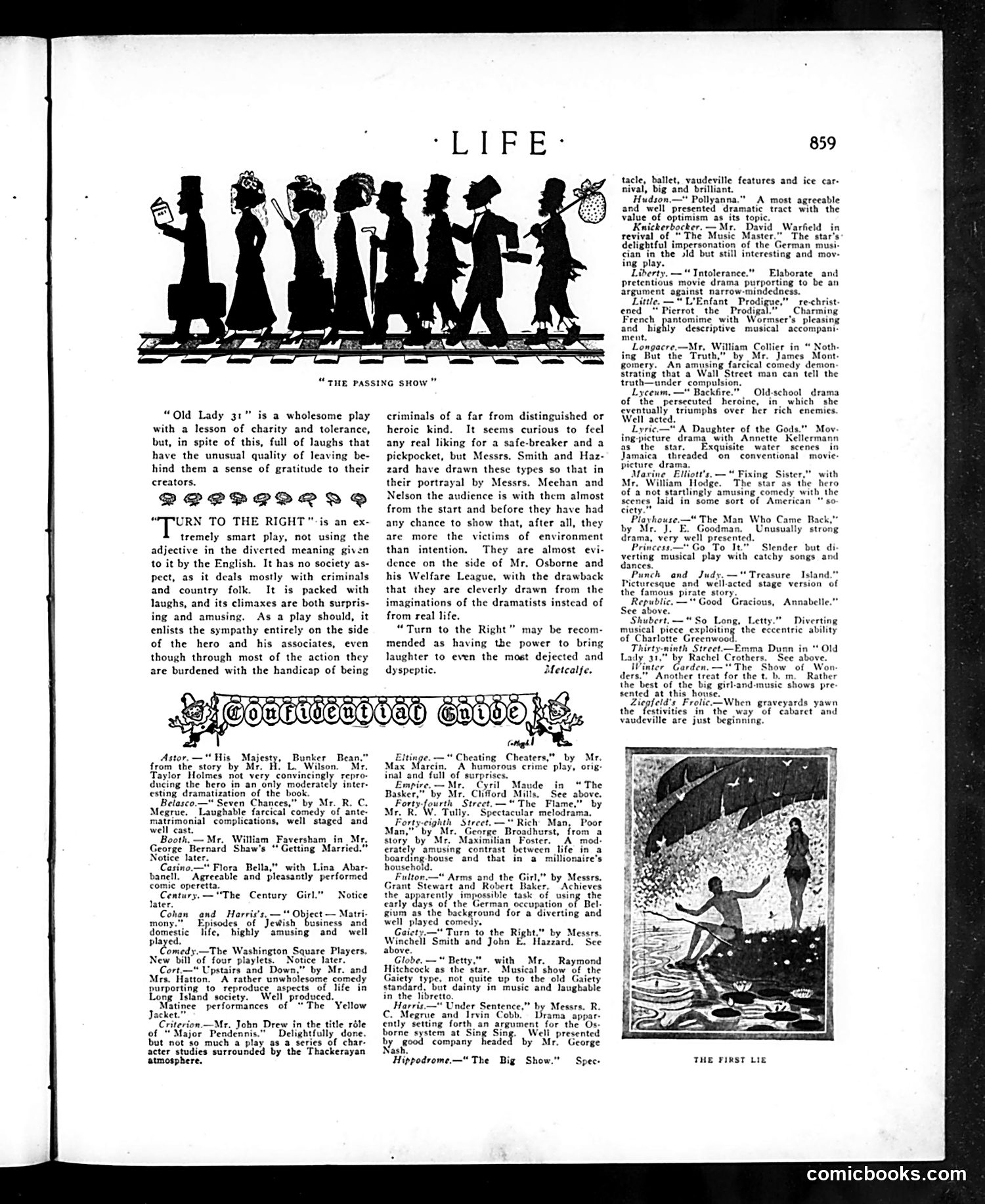
This page contains theater reviews from Life magazine's arts section. The silhouette illustration at top depicts a procession of elegantly dressed figures in top hats and formal wear—a visual representation of Broadway society and theatergoers of the era. The reviews critique several contemporary plays, focusing on character-driven comedies and melodramas. The critic notably praises "Turn to the Right" for its sympathetic portrayal of criminals and petty thieves (a safe-breaker and pickpocket) as victims of circumstance rather than inherent villainy—reflecting Progressive-era social attitudes about environmental determinism versus moral judgment. "Old Lady 31" receives praise for combining humor with "charity and tolerance." The page functions as a guide for affluent readers seeking entertainment recommendations, with reviews organized by theater venue (Astor, Belasco, Booth, Casino, etc.), reflecting New York's active early-20th-century theatrical district.
📄 Transcribed text from this page (OCR, searchable)
Machine-transcribed from the original scan — historical spelling and the odd misread are preserved.
“Old Lady 31” is a wholesome play with a lesson of charity and tolerance, but, in spite of this, full of laughs that have the unusual quality of leaving be- hind them a sense of gratitude to their creators. RQQVASDAEQRDE “TURN TO THE RIGHT "is an ex- tremely smart play, not using the adjective in the diverted meaning given to it by the English. It has no society as- pect, as it deals mostly with criminals and country folk. It is packed with laughs, and its climaxes are both surpris- ing and amusing. As a play should, it enlists the sympathy entirely on the side of the hero and his associates, even though through most of the action they are burdened with the handicap of being Astor. —"' His from the story by Mr. H. L. Wilson. Taylor Holmes not very convinci ducing the hero in an only moder: esting dramatization of the book. Belasco.—" Seven Chances,” by Mr. R. C. Megrue. Laughable farcical comedy of ante- matrimonial complications, well staged and well cast. Booth. — Mr. William Faversham in George Bernard Shaw's “Getting Married Notice later. Casino." Flora Bella,” with Lina Abar- banell. Agreeable and pleasantly performed comic operetta. Century. —"The Century Girl. later. Cohan and Harris's, —“ 01 mony.” Episodes of Jewish business and domestic life, highly “amusing and well played. ‘omedy.—The Washington Square Players. New bill of four playlets. Notice later. Cort.—* Upstairs and Down,” by Mr. and Mrs. Hatton. A rather unwholesome comedy purporting to reproduce, aspects of life in Island society. Well. produced. performances of "The Majesty, Bunker Notice ‘ellow Criterion Mr. John Drew in the title réte of “Major Pendennis.” Delightfully done. but not so much a play as a series of char- acter studies surrounded by the Thackerayan atmosphere. criminals of a far from distinguished or heroic kind. It seems curious to feel any real liking for a safe-breaker and a pickpocket, but Messrs. Smith and Haz- zard have drawn these types so that in their portrayal by Messrs. Meehan and Nelson the audience is with them almost from the start and before they have had any chance to show that, after all, they are more the victims of environment than intention. They are almost evi- dence on the side of Mr, Osborne and his Welfare League, with the drawback that they are cleverly drawn from the imaginations of the dramatists instead of from real lif “Turn to the Right” may be recom- mended as having the power to bring laughter to even the most dejected and dyspepti Metcalfe. Eitinge. —" Cheating Cheaters,” by Mr. Max Marcin. A humorous crime play, orig: nal and full of surprises. . Cyril Maude in “The | Clifford Mills, See above, Forty-{ourth Street. —“ The Flame," by R. W. Tully. Spectacular melodrama, eighth Street. —" Rich Man, Poor by Mr. George Broadhurst, from a story by Mr. Maximilian Foster. A mod- erately amusing contrast between life in a boarding-house and that in a millionaire’s houschold. Fultor.—" Arms and the Girl,” by Messrs. Grant Stewart and Robert Baker, Achieves the apparently impossible task of using the carly days of the German occupation of Bel- gium as the background for a diverting and well played comedy. Gaicty.—" Turn to the Right,” by Messrs. Winchell Smith and John E. Hazzard. Sce above. Globe. —* Betty," with Mr. Raymond Hitchcock as the star. Musical show of the Gaiety type. not quite up to the old Gaiety standard, but dainty in music and laughable in the libretto. Harris." Under Sentence,” by Messrs. R. C. Megrue and Irvin Cobb. Drama appar: ently setting forth an argument for the Os- borne system at Sing Sing. | Well presented by good company headed by Mr. George Nash. Hippodrome.—" The Big Sho Spece 859 tacle, ballet, vaudeville features and ice car- nival, bi brilliant. Pollyanna.” A most agreeable and well presented dramatic tract with the value of optimism as its topic. Knickerbocker. — Mr. David Warfield in revival of “The Music Master.” The star's delightful impersonation of the German musi- cian in the Jld but still interesting and mov- ing play. Liberty. —“ Intolerance.” Elaborate and pretentious movie drama purporting to be an Srgument against narrow-mindedness. Little. —“ L'Enfant Prodigue,” _re-christ: ened “Pierrot. the Prodigal.” Charming French pantomime with Wormser’s pleasing and bighly descriptive musical accompane rent, Longacre.—Mr. V jam Collier in “ Noth- ing But the Truth,” by Mr. James Mont- gomery. An amusing farcical comedy demon Strating that a Wall Street man can tell the truth—under compulsion. Lyceum. —" Backfire.” Old-school drama of the persecuted heroine, in which she eventually triumphs over her rich enemies. Well acted. Lyric.—" A Daughter of the Gods.” Mov- ing-picture drama with Annette Kellermann as the star. Exquisite water scenes in Jamaica threaded on conventional movie- picture drama. Marine Elliott's. — ing Sister,” with Mr, William Hodge. The star as the hero of a not startlingly amusing comedy with the scenes laid in some sort of American “ so- ciety.” Playhouse.—“ The Man Who Came Back,” by Mr. J. E. Goodman. Unusually strong drama, very well presented. Princess.—" Go To It. Slender but d verting musical play with catchy songs and dances. Punch and Judy. —* Treasure Island.” cturesque and well-acted stage version of the famous pirate story. Republic, —** Good Gracious, Annabelle.” See above. ‘Shubert. —"'So Long, Letty.” Diverting musical piece exploiting the eccentric ability of Charlotte Greenwood. Thirty-ninth Street—Emma Dugn in ‘Old by Rachel Crothers. See above. Carden —"The SI of Won. Another treat for the t. b. m. Rather the best of the big gitland-music shows pre sented at this house. Ziepfeld's Frolic—When graveyards yawn the festivities in the way of cabaret and vaudeville are just beginning. FIRST LIE comicbooks.com