
Life, 1916-11-16 · page 20 of 46
Life — November 16, 1916 — page 20: what you’re looking at
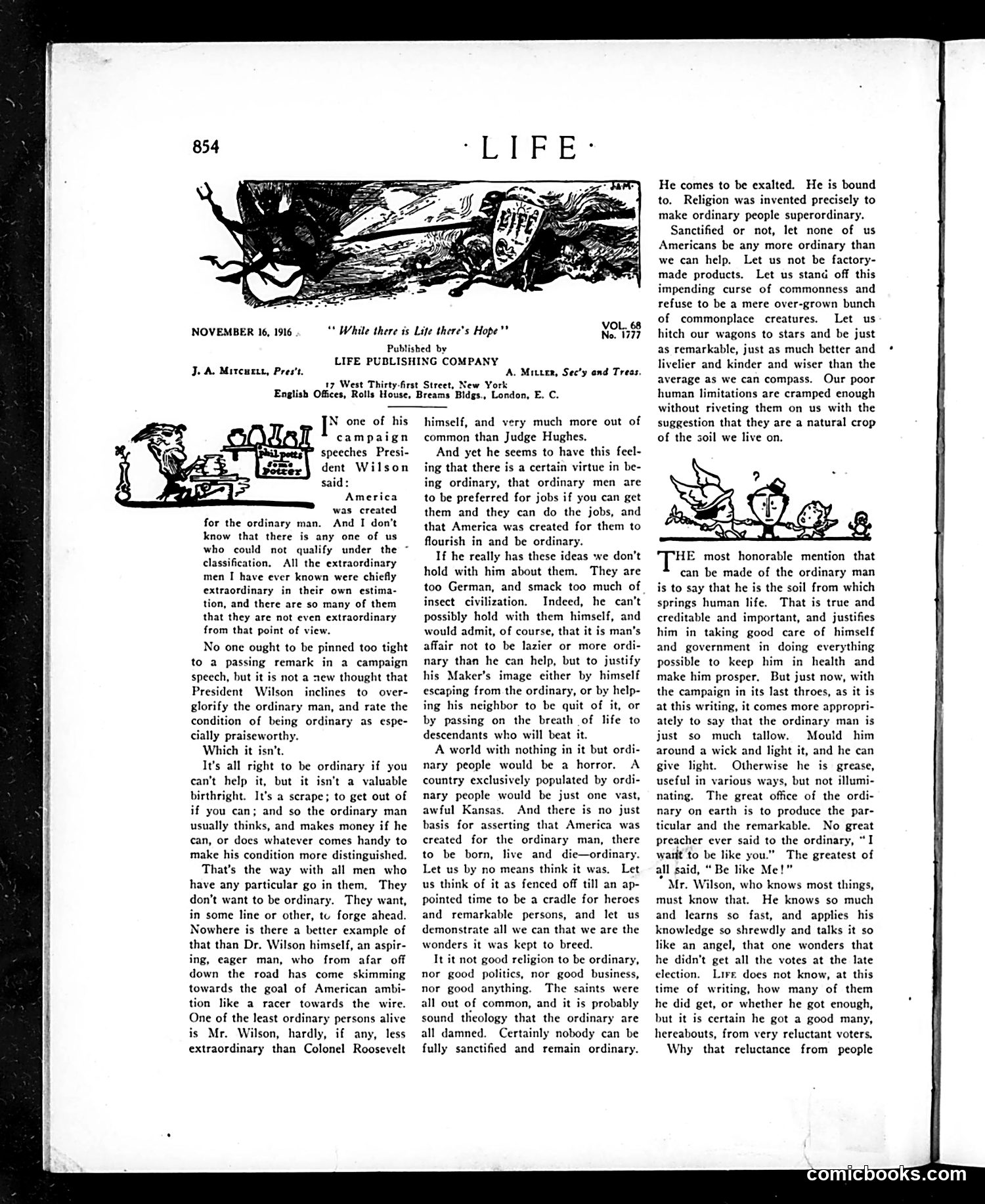
What you’re looking at
This is a satirical editorial critiquing President Wilson's campaign rhetoric celebrating "the ordinary man." The cartoonist argues Wilson's praise of ordinariness is hypocritical—Wilson himself is ambitious and extraordinary, having climbed from academic to presidential heights. The piece mocks Wilson's claim that America was created for ordinary people, calling such ideas "too German" (a damning reference during WWI era) and arguing that ordinariness is something to escape, not celebrate. The author contends a nation of only ordinary people would be "a horror" and "just one vast, awful Kansas"—mocking middle America. The satire's core point: Wilson romanticizes the common man while embodying ambition himself. The editorial advocates that Americans should aspire beyond ordinariness through religion, business, and personal achievement—rejecting the leveling ideology the author attributes to Wilson.
📄 Transcribed text from this page (OCR, searchable)
Machine-transcribed from the original scan — historical spelling and the odd misread are preserved.
NOVEMBER 16, 1916 “* While there is Life there's Hope"* Published by LIFE PUBLISHING COMPANY J. A. Mircurtt, Pres’t. A. Mitten, Sec’y and Treas. '7 West Thirty-first Street, New York English Offices, Rolls House, Breams IX one of his campaign speeches Presi- dent Wilson America was created for the ordinary man. And I don’t know that there is any one of us who could not qualify under the ~ classification. All the extraordinary men I have ever known were chiefly extraordinary in their own estima- tion, and there are so many of them that they are not even extraordinary from that point of view. No one ought to be pinned too tight to a passing remark in a campaign speech, but it is not a new thought that President Wilson inclines to over- glorify the ordinary man, and rate the condition of being ordinary as espe- cially praiseworthy. Which it isn’t. It’s all right to be ordinary if you can’t help it, but it isn't a valuable birthright. It's a scrape; to get out of if you can; and so the ordinary man usually thinks, and makes money if he can, or does whatever comes handy to make his condition more distinguished. That's the way with all men who have any particular go in them, They don’t want to be ordinary. They want, in some line or other, tu forge ahead. Nowhere is there a better example of that than Dr. Wilson himself, an aspir- ing, eager man, who from afar off down the road has come skimming towards the goal of American ambi- tion like a racer towards the wire. One of the least ordinary persons alive is Mr. Wilson, hardly, if any, less extraordinary than Colonel Roosevelt iIdgs., London, E. C. himself, and very much more out of common than Judge Hughes. And yet he seems to have this feel- ing that there is a certain virtue in be- ing ordinary, that ordinary men are to be preferred for jobs if you can get them and they can do the jobs, and that America was created for them to flourish in and be ordinary. If he really has these ideas we don’t hold with him about them. They are too German, and smack too much of Indeed, he can’t possibly hold with them himself, and would admit, of course, that it is man’s affair not to be lazier or more ordi- nary than he can help, but to justify his Maker’s image cither by himself escaping from the ordinary, or by help- ing his neighbor to be quit of it, or by passing on the breath of life to descendants who will beat it. A world with nothing in it but ordi- nary people would be a horror. A country exclusively populated by ordi- nary people would be just one vast, awful Kansas. And there is no just basis for asserting that America was created for the ordinary man, there to be born, live and die—ordinary. Let us by no means think it was. Let us think of it as fenced off till an ap- pointed time to be a cradle for heroes and remarkable persons, and let us demonstrate all we can that we are the wonders it was kept to breed. It it not good religion to be ordinary, nor good politics, nor good business, nor good anything. The saints were all out of common, and it is probably sound theology that the ordinary are all damned. Certainly nobody can be fully sanctified and remain ordinary. He comes to be exalted. He is bound to. Religion was invented precisely to make ordinary people superordinary. Sanctified or not, let none of us Americans be any more ordinary than we can help. Let us not be factory- made products. Let us stand off this impending curse of commonness and refuse to be a mere over-grown bunch of commonplace creatures. Let us hitch our wagons to stars and be just as remarkable, just as much better and livelier and kinder and wiser than the average as we can compass. Our poor human limitations are cramped enough without riveting them on us with the suggestion that they are a natural crop of the soil we live on. 'HE most honorable mention that can be made of the ordinary man is to say that he is the soil from which springs human life. That is true and creditable and important, and justifies him in taking good care of himself and government in doing everything possible to keep him in health and make him prosper, But just now, with the campaign in its last throes, as it is at this writing, it comes more appropri- ately to say that the ordinary man is just so much tallow. Mould him around a wick and light it, and he can give light. Otherwise he is grease, useful in various ways, but not illumi- nating. The great office of the ordi- nary on earth is to produce the par- ticular and the remarkable. No great preacher ever said to the ordinary, “I wartt to be like you.” The greatest of all said, “ Be like Me!” Mr. Wilson, who knows most things, must know that. He knows so much and learns so fast, and applies his knowledge so shrewdly and talks it so like an angel, that one wonders that he didn't get all the votes at the late election. Lire does not know, at this time of writing, how many of them he did get, or whether he got enough, but it is certain he got a good many, hereabouts, from very reluctant voters, Why that reluctance from people Ccomicbooks.com