
A complete issue · 44 pages · 1916
Life — September 21, 1916
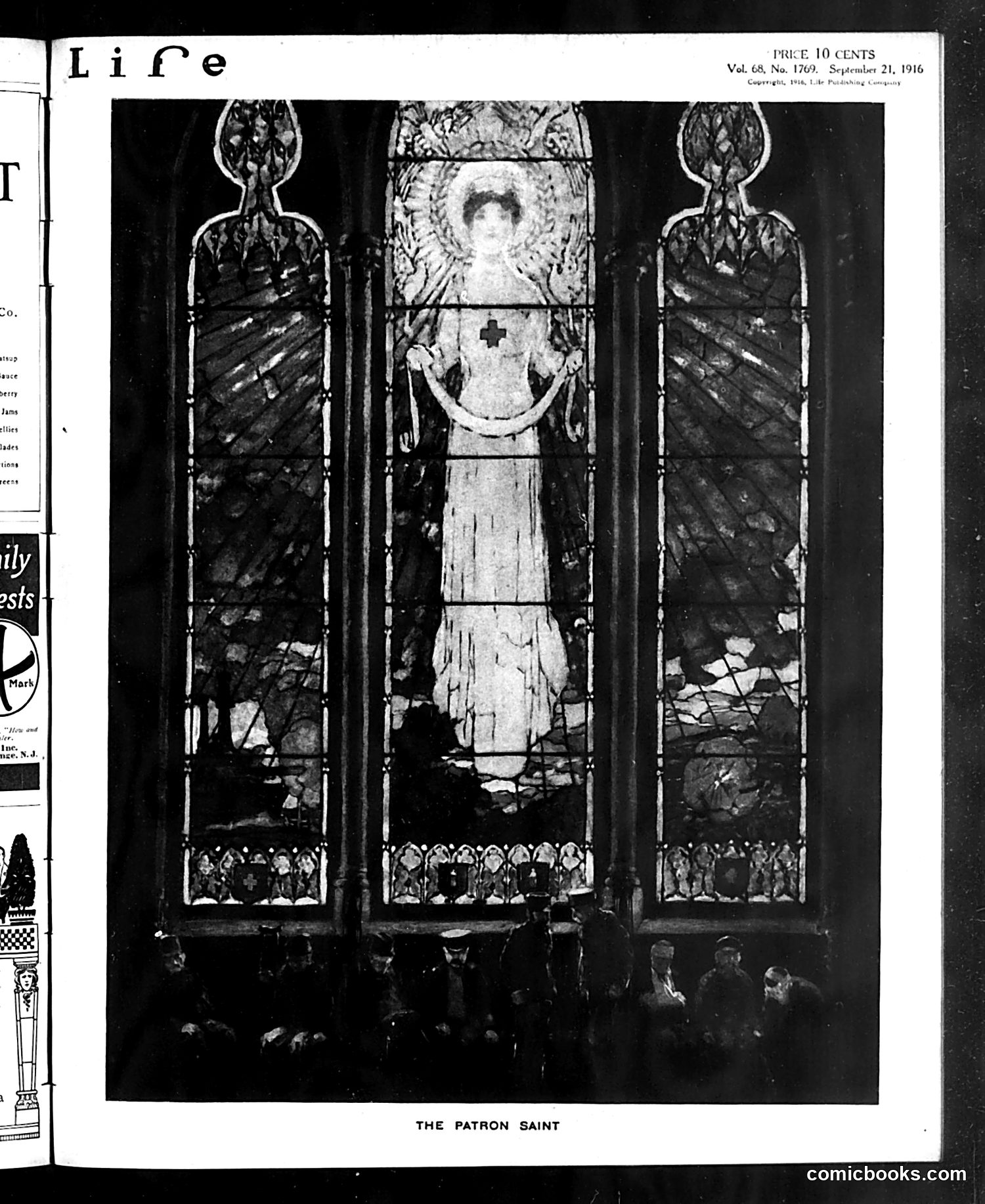
This 1916 *Life* magazine page shows a stained-glass window depicting a robed female figure with a halo, flanked by two dark panels with ornamental tops. The caption labels it "THE PATRON SAINT." The image appears to be satirical religious artwork, likely commenting on a contemporary political or social figure being treated with quasi-religious reverence by supporters. The stained-glass format—typically used for holy figures in churches—suggests mockery of excessive veneration or idealization. Without additional context text on the page, the specific identity of who is being satirized remains unclear. However, the composition critiques the tendency to elevate certain public figures to saint-like status, a common *Life* magazine theme during this era of American politics.
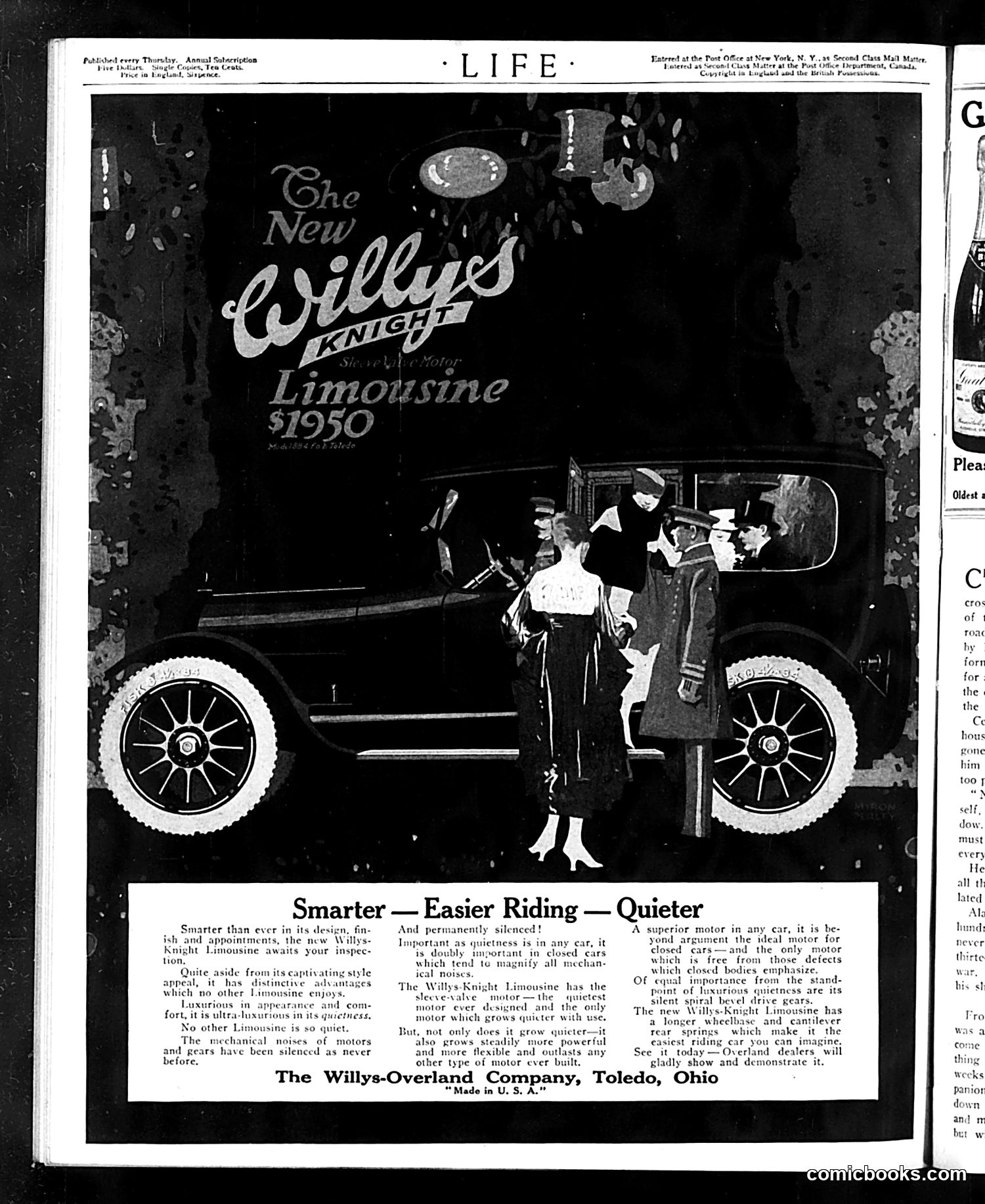
This page is **primarily an advertisement**, not satire or political commentary. It promotes the "New Willys-Knight Limousine" priced at $1950, manufactured by the Willys-Overland Company in Toledo, Ohio. The ad features an illustration of a woman and well-dressed men examining the vehicle, emphasizing three selling points: "Smarter — Easier Riding — Quieter." The text highlights the car's mechanical innovations, particularly its silent motor and superior engineering compared to competing limousines. There is no political cartoon or satire present. This is straightforward automotive marketing from what appears to be a 1920s-era Life magazine, leveraging the publication's high-end readership to sell luxury vehicles.
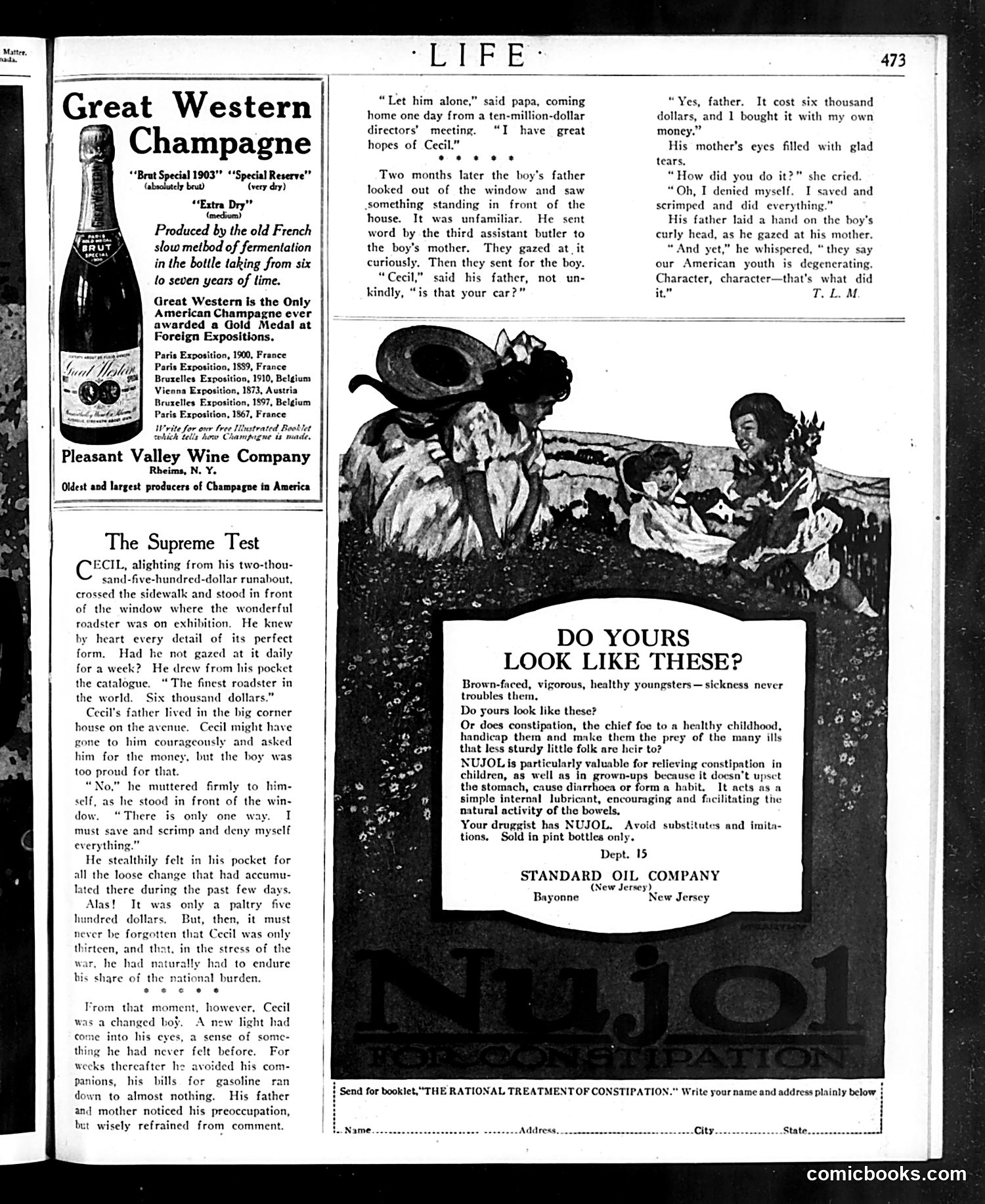
This page is primarily **commercial advertising** rather than satire or political commentary. The left side features a champagne advertisement for "Great Western Champagne" by Pleasant Valley Wine Company, emphasizing its Gold Medal awards at international expositions. The main narrative text, "The Supreme Test," appears to be a short story about a boy named Cecil who resists his father's pressure to view an expensive ($6,000) prize rooster, instead saving his modest earnings. The story illustrates a moral lesson about character and integrity. The central image shows what appears to be a pastoral or rural scene, though details are unclear in this reproduction. Below is a **Standard Oil Company advertisement** for "Nujol," a laxative product marketed for children's health, featuring the slogan "Do Yours Look Like These?"—promoting healthy, vigorous-looking children.
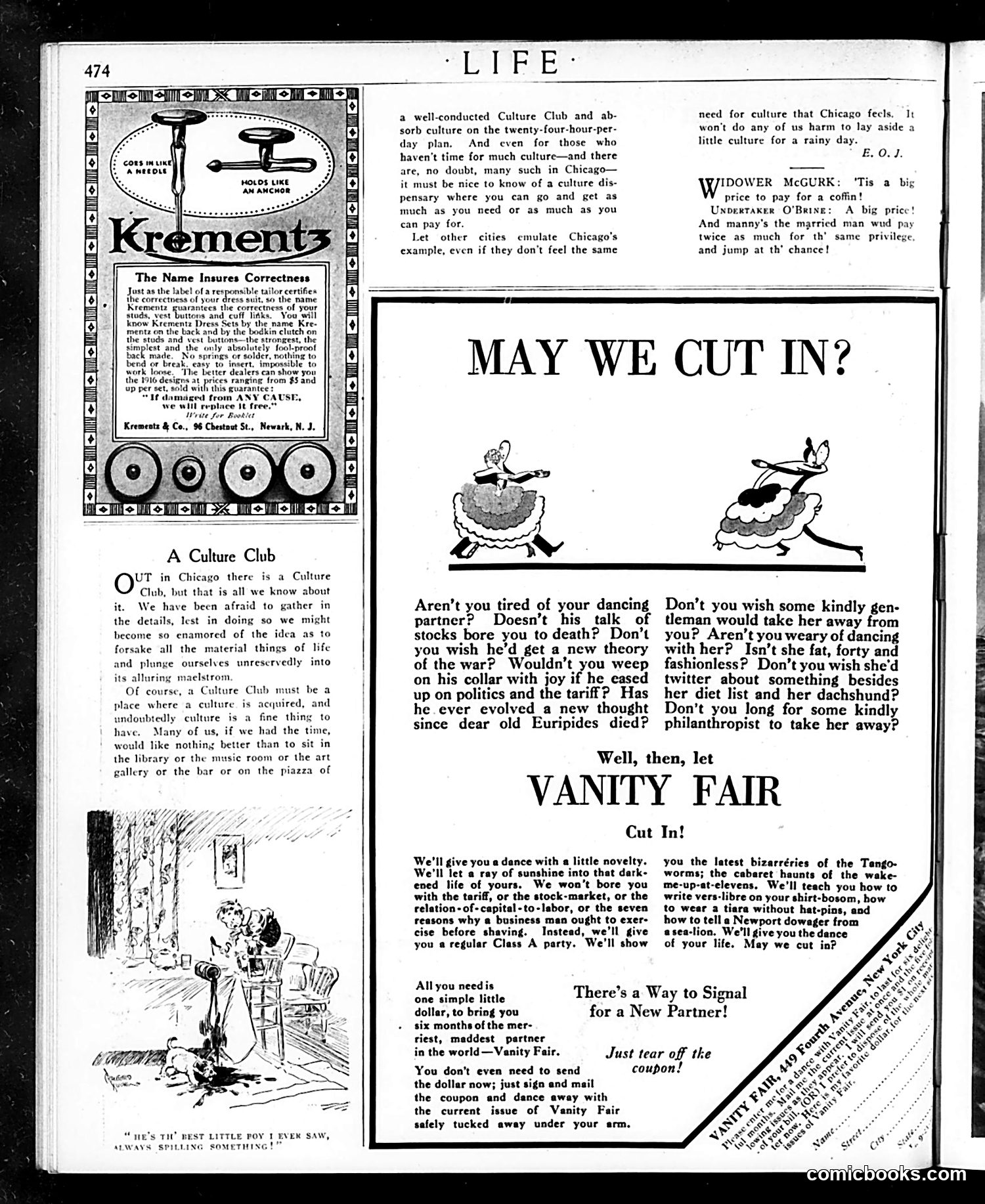
This page mixes advertising with social satire. The **Krementz jewelry ad** (left) promotes dress studs and cufflinks as reliable, quality goods. The main satirical content is **"May We Cut In?"** — a Vanity Fair advertisement disguised as social commentary. The cartoon depicts two figures on clouds, with text mocking men's complaints about their dancing partners. The satire targets married men who tire of their wives' company and desire novelty. Vanity Fair advertises itself as a solution: for one dollar, readers can join a "Class A party" and find new dance partners, complete with lessons in Tango and cabaret entertainment. The satire implies that boredom in marriage is endemic enough to warrant a commercial service — a lighthearted jab at both marital dissatisfaction and consumer culture's commodification of social life.
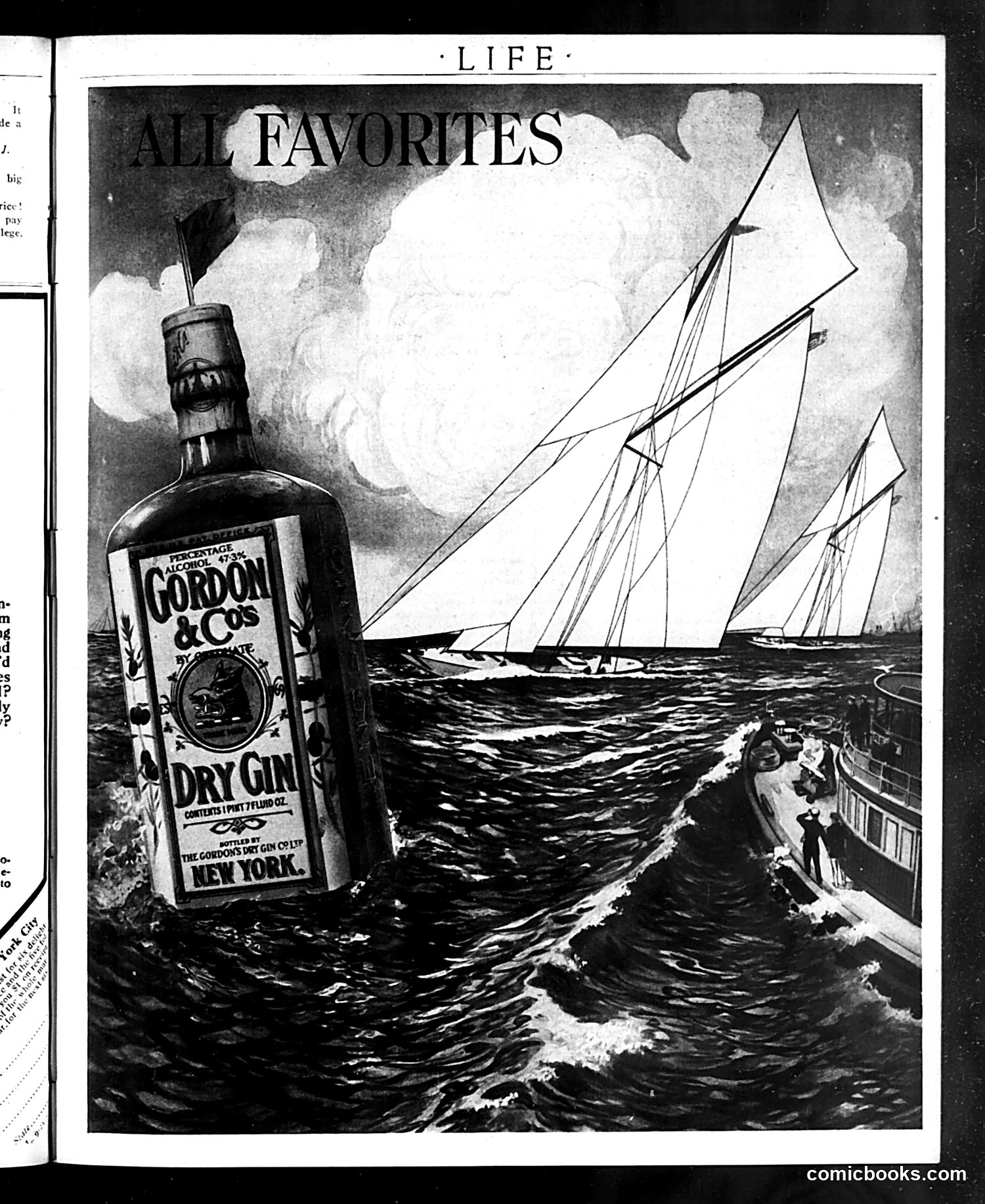
This is a **full-page advertisement**, not political satire. The image shows a bottle of Gordon's Dry Gin prominently displayed amid ocean waves and sailing vessels, titled "ALL FAVORITES." The ad uses a nautical theme—sailboats racing and turbulent seas—to associate the gin brand with adventure, sophistication, and maritime tradition. The bottle's label is clearly legible, showing it's "bottled in New York" by "The Gordon's Dry Gin Co Ltd." This appears from the early-to-mid 20th century, before alcohol advertising restrictions. The "favorites" headline suggests the gin was popular among consumers. The dramatic maritime imagery was typical advertising strategy for spirits, evoking elegance and worldliness.
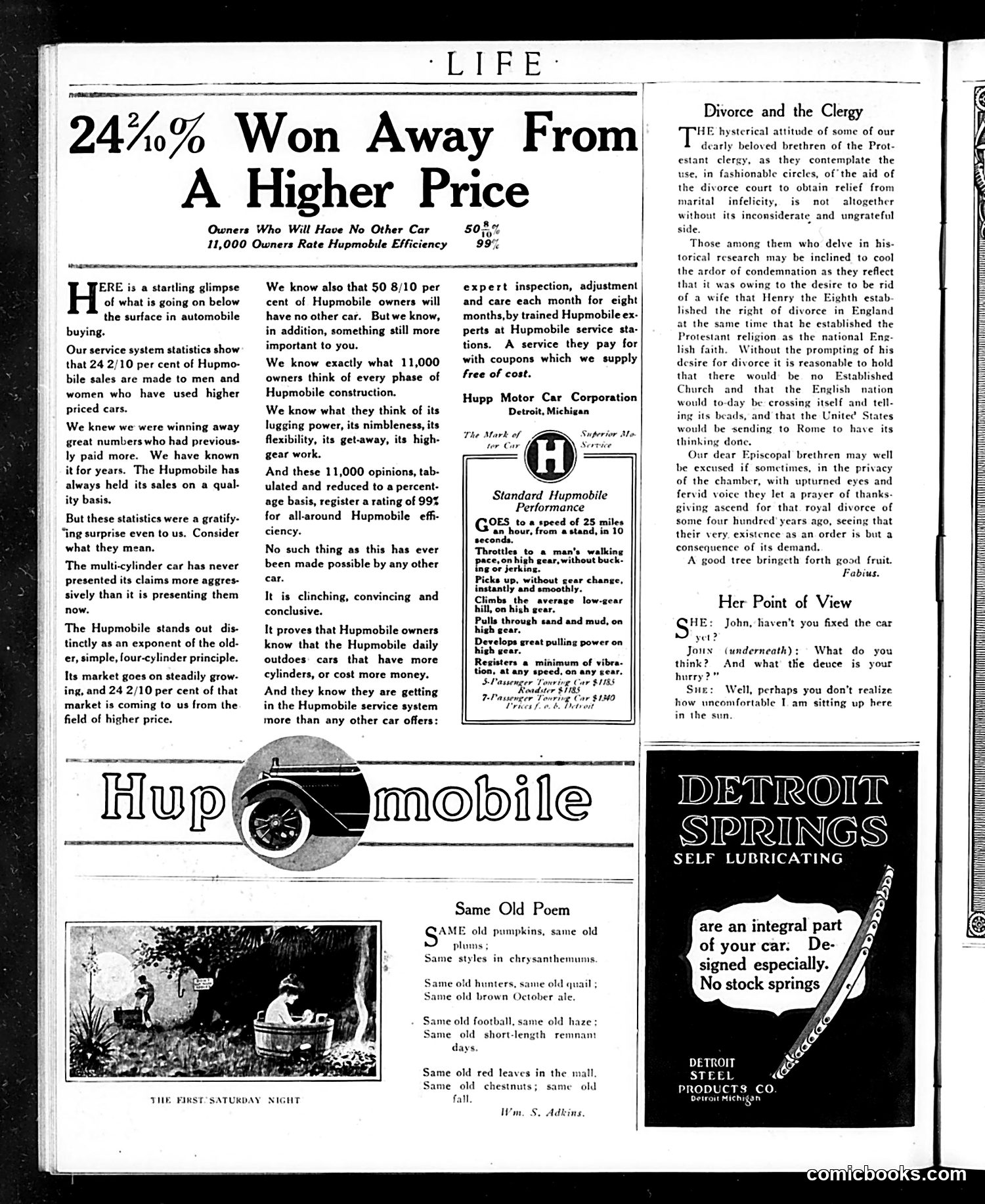
This page is primarily **advertising and promotional content** rather than political satire. The dominant feature is a Hupmobile automobile advertisement claiming that 24 2/10 percent of buyers won't pay higher prices, emphasizing the car's value and service efficiency. The small illustrated cartoon titled "The First Saturday Night" (bottom left) appears to depict a couple in a romantic outdoor setting, likely humorous commentary on courtship or dating—common satirical subjects for Life magazine. The right side includes unrelated content: a piece on "Divorce and the Clergy" discussing Protestant attitudes toward divorce, and a dialog titled "Her Point of View" about marital tension. A Detroit Springs advertisement also appears. **Overall:** This is a typical early-20th-century magazine layout mixing advertising with light social commentary.
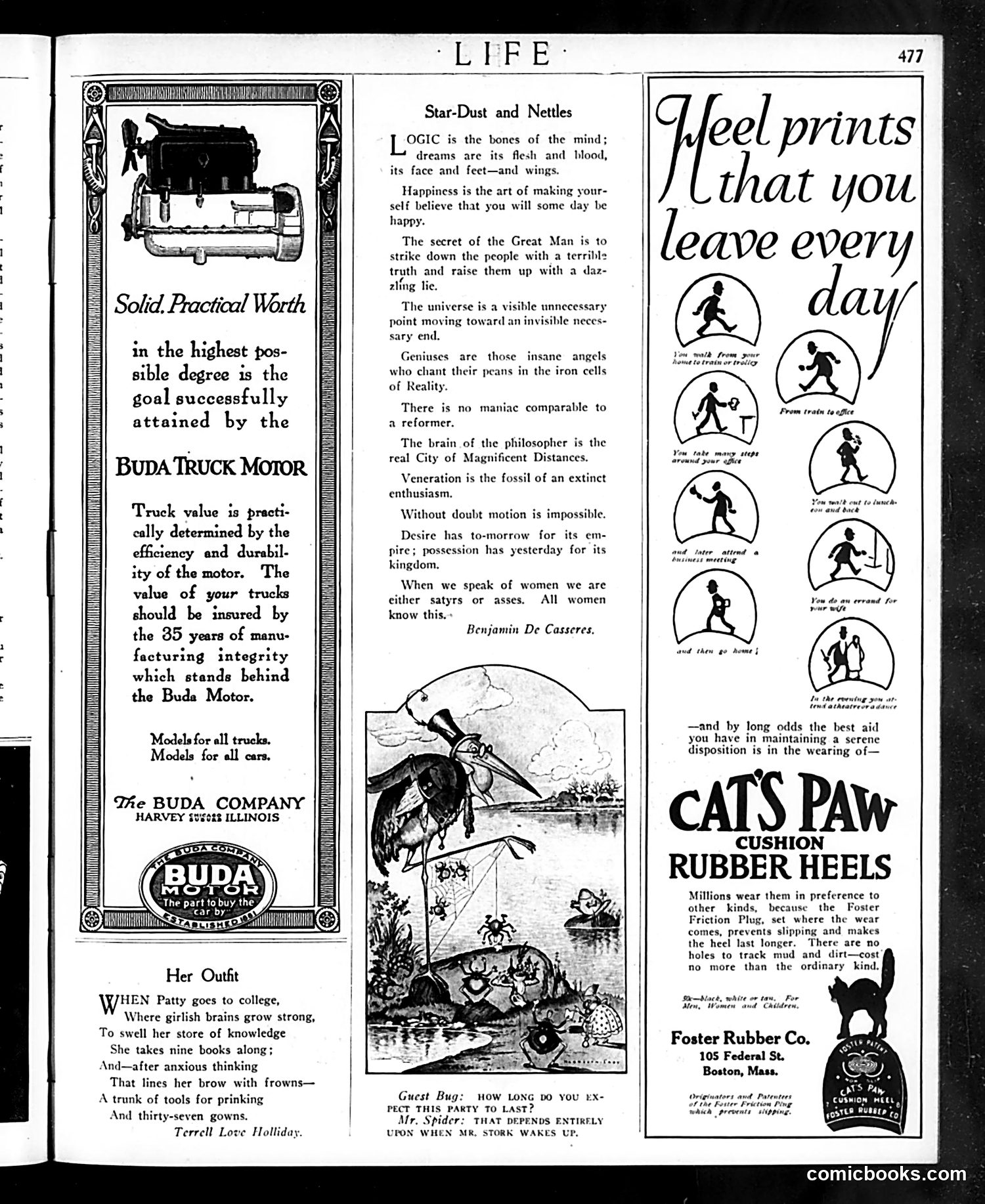
This page is primarily **advertising with some literary content**, not political satire. The main visual element is an illustration of a large stork or crane examining aquatic creatures, captioned as a "Guest Bug" joke about how long a party will last—likely a visual pun playing on the bird's association with delivery/arrival. The advertisements include: - **Buda Truck Motor** (left): emphasizing engine reliability and durability - **Cat's Paw Cushion Rubber Heels** (right): promoting practical footwear that prevents slipping and dirt tracking The center contains philosophical quotations attributed to Benjamin De Casseres about logic, happiness, and women—characteristic of Life's literary content from this era. There is **no political cartoon or satire** visible on this page. It reflects early 20th-century consumer advertising and middlebrow cultural discourse.
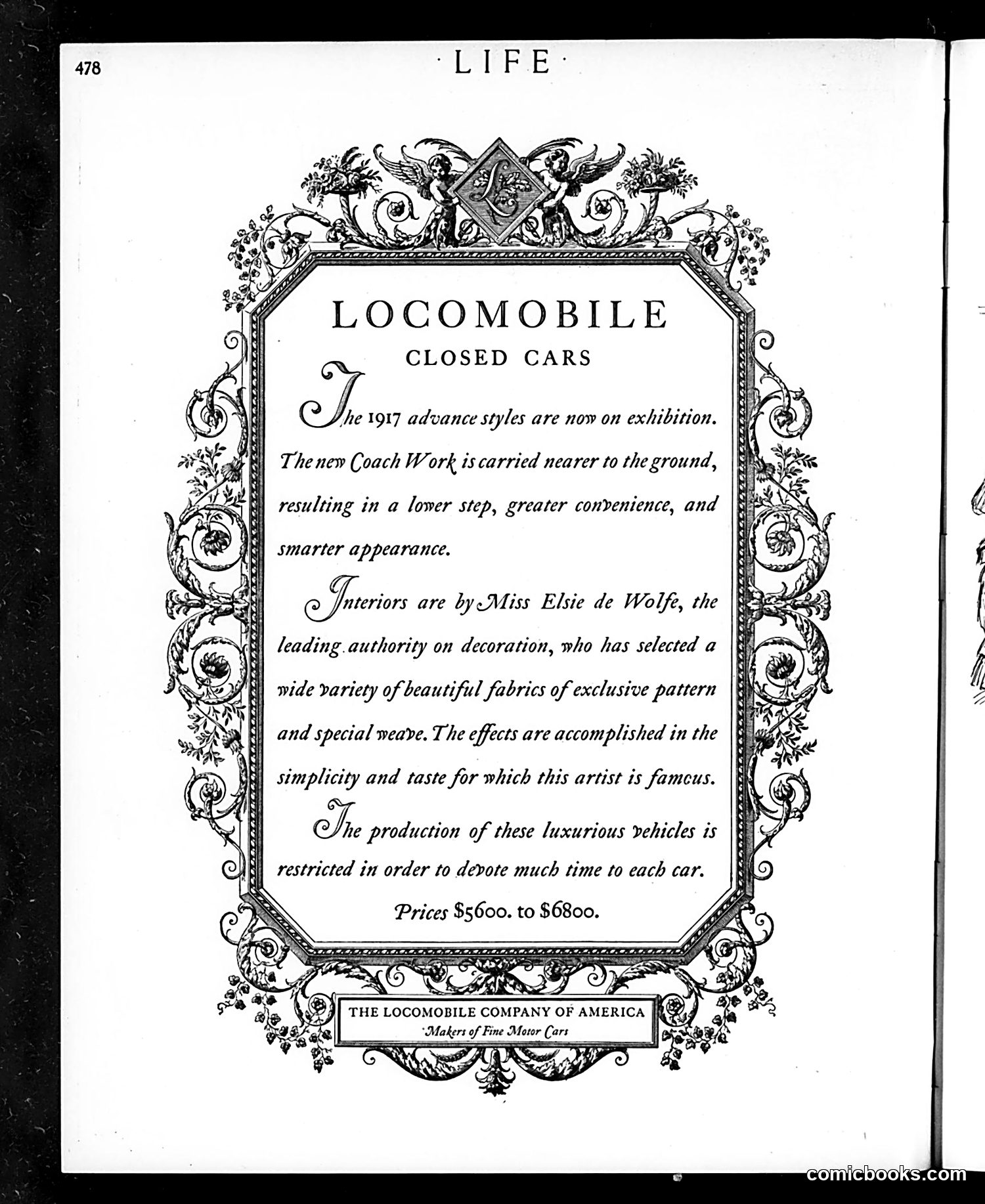
This is a **Locomobile automobile advertisement**, not political satire. The page promotes the company's 1917 closed-car models, emphasizing luxury features: lower coach work for easier entry, refined interiors designed by "Miss Elsie de Wolfe" (a famous decorator of the era), and exclusive fabrics. The ornate decorative border and formal language ("luxurious vehicles," "simplicity and taste") reflect the high-end marketing typical of early automobile advertising, positioning Locomobiles as luxury goods for wealthy buyers. The $5,600-$6,800 price range was substantial for 1917—equivalent to roughly $150,000+ today. The elaborate visual presentation itself conveys exclusivity: limited production, artistic design, and premium pricing.
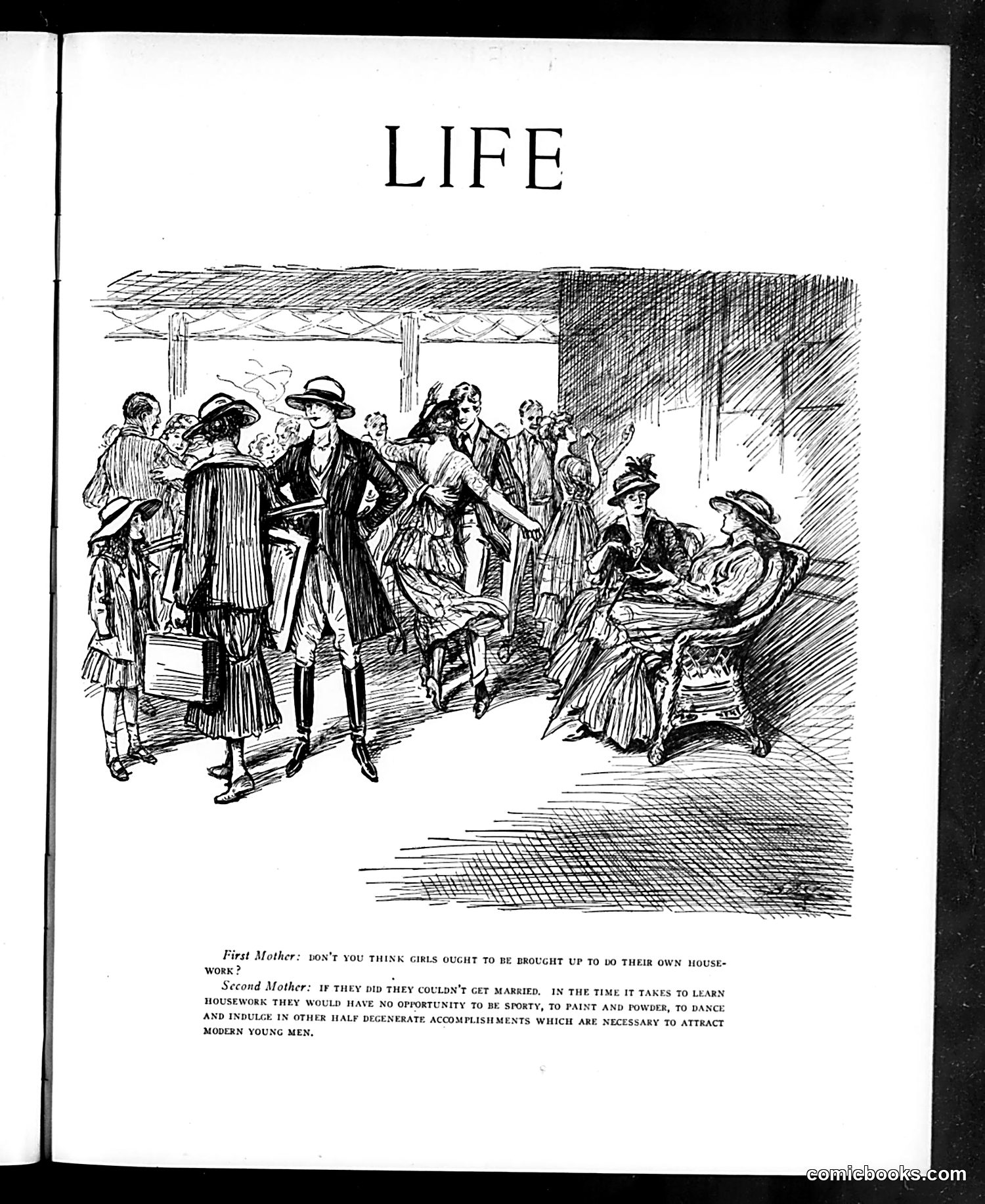
This satirical cartoon depicts a social debate about women's education and domestic roles. Two mothers discuss whether girls should be trained for housework. The **First Mother** advocates practical domestic training, while the **Second Mother** argues against it—suggesting that if girls learn housework, they'll lack time for accomplishments needed to "attract modern young men": skills like painting, dancing, and socializing. The cartoon satirizes the tension between traditional domestic expectations and emerging modern courtship practices. It mocks the absurdity that women must choose between being competent homemakers or being socially accomplished enough to find husbands. The joke critiques both mothers' logic: one prioritizes marriageability through refinement, the other through domestic competence—neither considers a woman's own interests or agency.
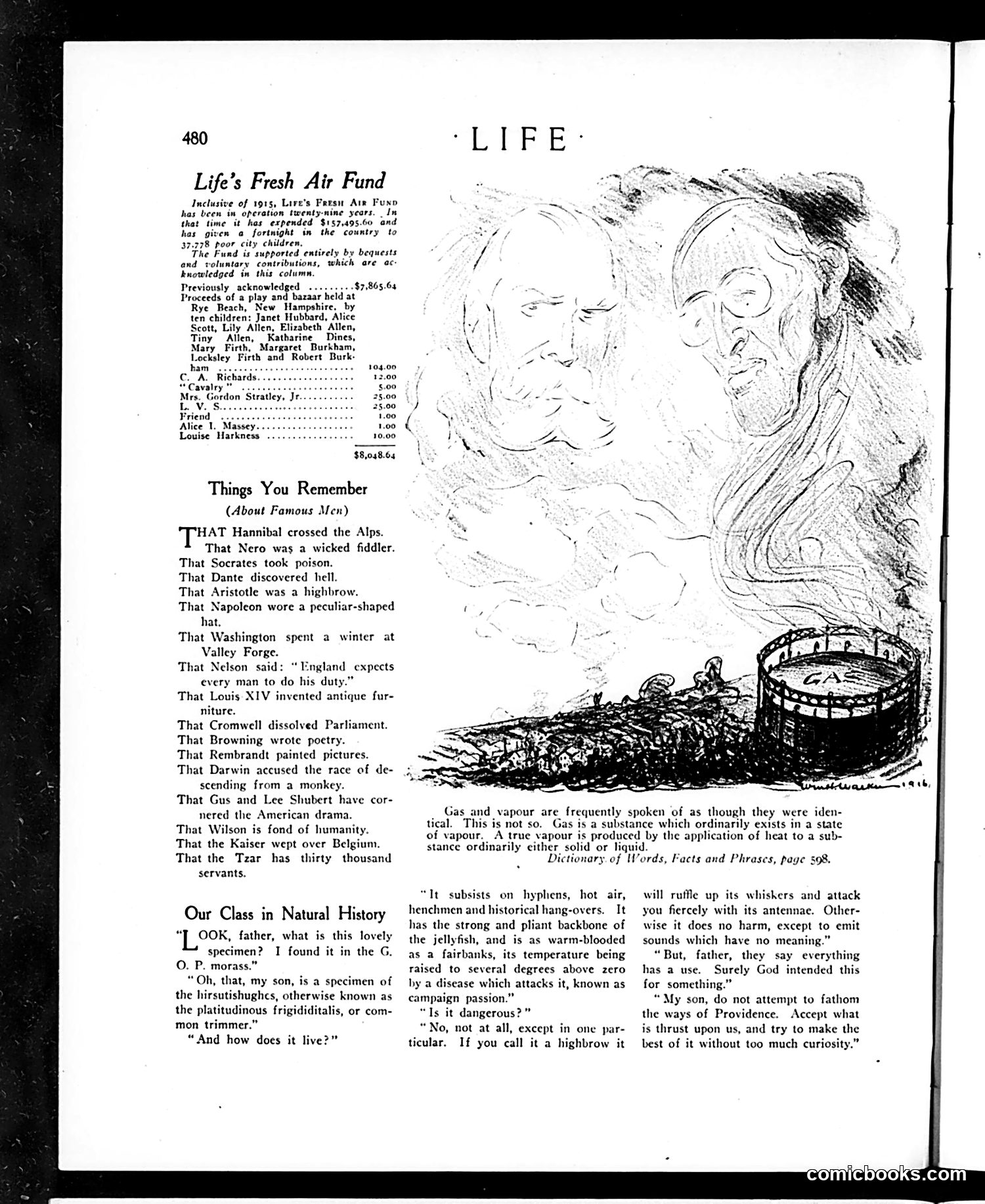
This page contains three distinct sections: 1. **Life's Fresh Air Fund** - A charitable fundraising announcement listing donors and contributions for children's fresh air outings, a Progressive Era charitable initiative. 2. **"Things You Remember (About Famous Men)"** - A humorous list of historical facts/trivia about famous figures (Hannibal, Nero, Socrates, Napoleon, etc.), presented as memorable anecdotes rather than serious history. 3. **"Our Class in Natural History"** - A dialogue between a father and son about a specimen, appears to be a comedic naturalist exchange, possibly poking fun at amateur naturalists or overly-serious scientific pedagogy. The page includes sketch illustrations accompanying these pieces. The overall tone suggests light satirical humor typical of early-20th-century Life magazine—mixing charitable announcements with gentle mockery of historical pretension and educational pomposity.
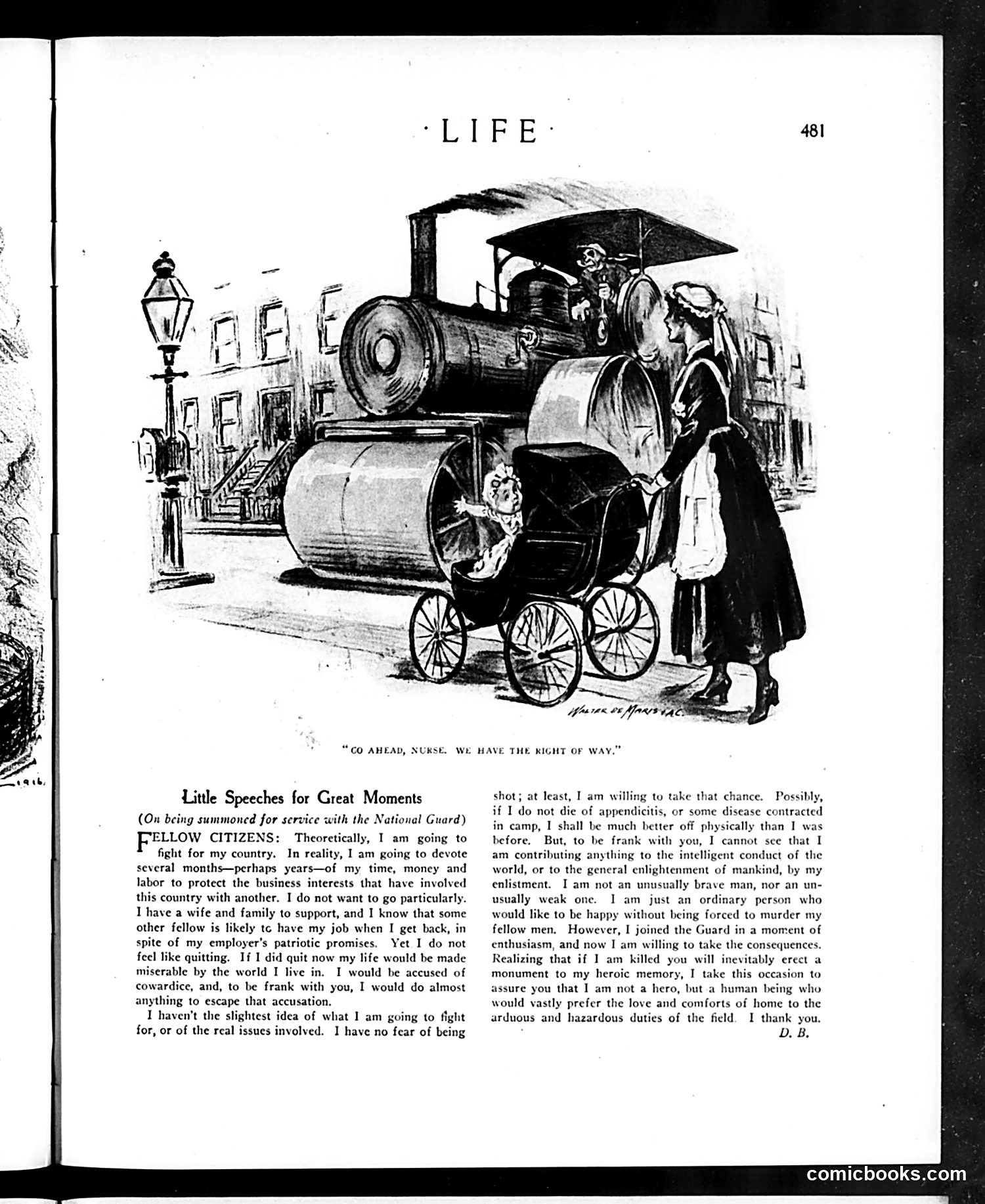
The cartoon depicts a steam roller on a city street with an operator and passengers. A nurse with a baby carriage stands before it, and the operator says, "Go ahead, nurse. We have the right of way." The accompanying text is titled "Little Speeches for Great Moments (On being summoned for service with the National Guard)." It's a satirical monologue from a draftee justifying his military service to his wife and family—claiming he's not a coward, acknowledging he's "just an ordinary person," but explaining he joined the Guard despite his reservations. The cartoon likely satirizes military conscription or draft obligations, with the steam roller symbolizing the unstoppable force of military/governmental authority crushing individual resistance, while the nurse's baby carriage represents vulnerable civilian life. The juxtaposition mocks the rhetoric used to rationalize compulsory service.
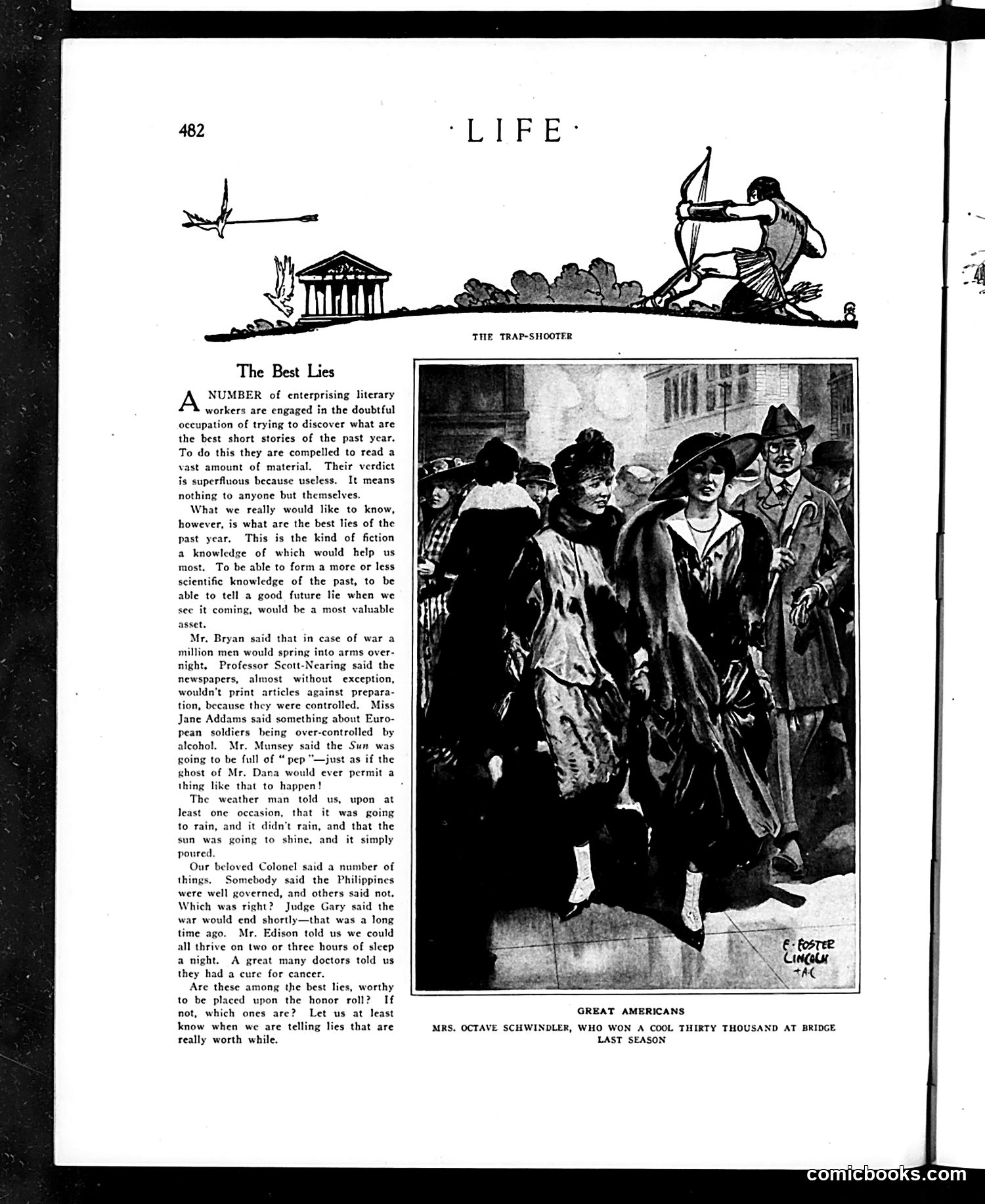
This page satirizes contemporary public figures' false predictions and misleading statements. The article references several named individuals—Colonel [unnamed], Professor Scott-Nearing, Miss Jane Addams, Mr. Munsey, Mr. Bryan, Mr. Edison, and Judge Gary—who made inaccurate claims about war preparedness, newspaper control, European soldiers' alcohol consumption, weather, Philippine policy, and cancer cures. The photograph below, captioned "Mrs. Octave Schwindles, Who Won a Cool Thirty Thousand at Bridge Last Season," appears to mockingly illustrate "Great Americans"—likely satirizing wealth and social status among the upper class. The overall piece critiques how influential public figures spread misinformation, questioning which "lies" deserve remembering and whether such statements represent worth celebrating.
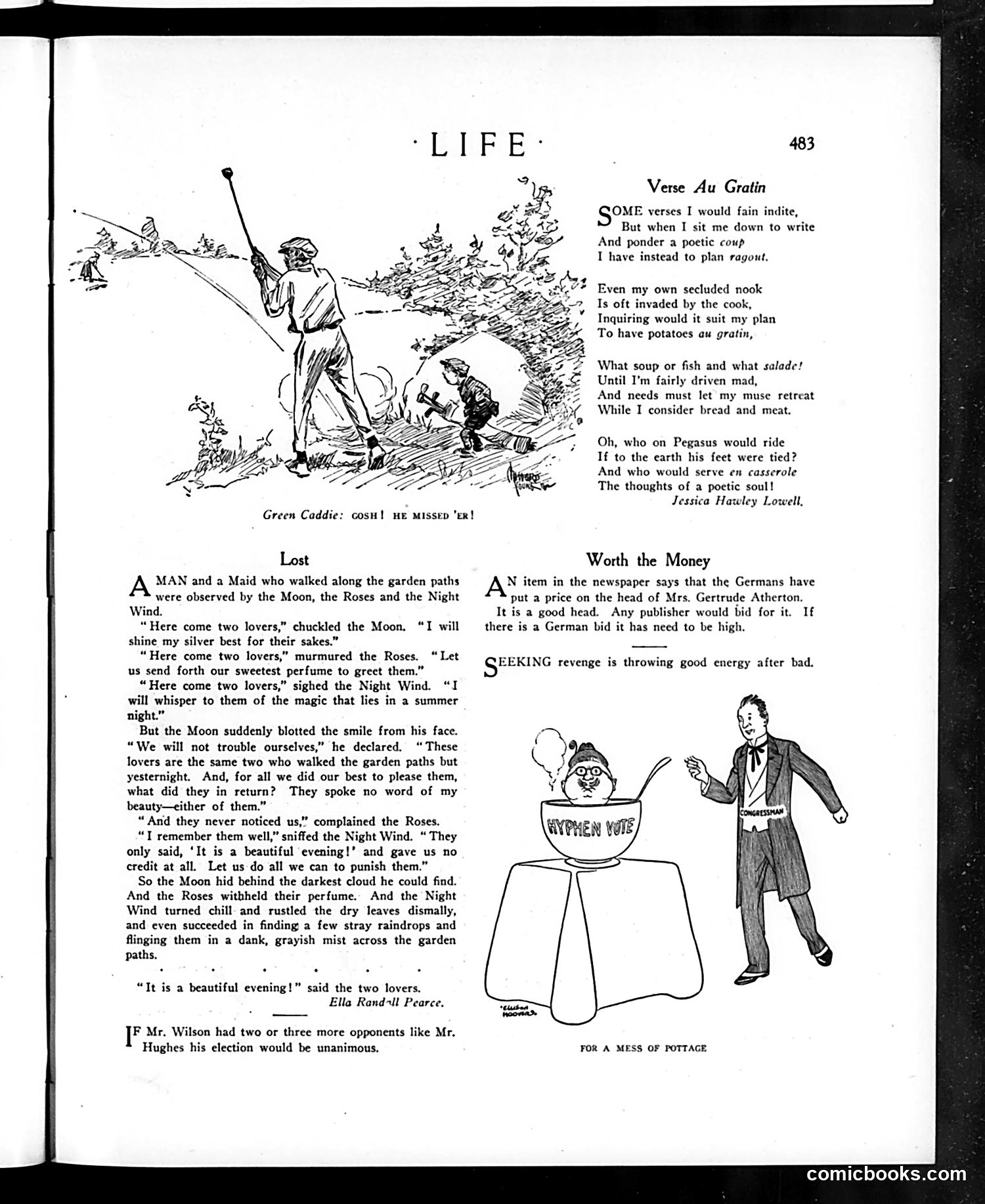
This page contains three separate humorous pieces: 1. **"Verse Au Gratin"** (top): A poem by Jessica Hawley Lowell about a writer struggling to compose while domestic interruptions (a cook asking about potatoes) prevent concentration. It's light satire on the difficulty of intellectual work amid household demands. 2. **"Lost"** (left): A romantic narrative poem by Ella Rands'll Pearce where the Moon, Roses, and Night Wind observe two lovers in a garden, then spitefully ensure the couple receives no credit or magic from nature. It's whimsical verse satire. 3. **"Worth the Money"** (right): A cartoon with caption "For a Mess of Pottage" showing a man gesturing at a large cauldron labeled "HYPHEN VOTE." This appears to reference selling political votes cheaply—a commentary on electoral corruption or voter manipulation.
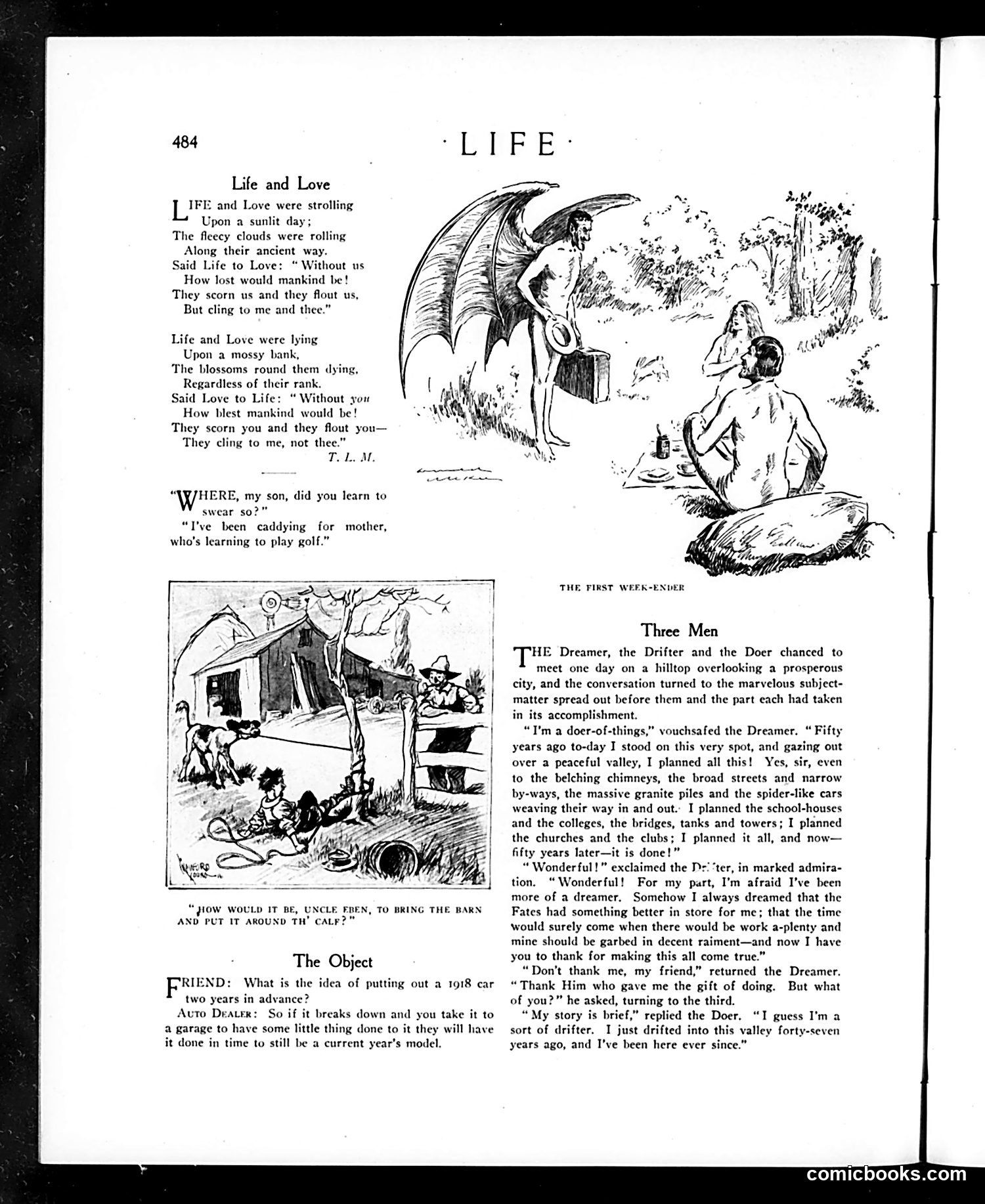
This page contains three distinct pieces of humor: 1. **"Life and Love"** (poem by T.L.M.): A romantic allegory where Life and Love are personified characters strolling together, with Love reassuring Life of their interdependence. 2. **"The First Week-Ender"** (illustration): Shows what appears to be a winged devil or imp meeting a human, likely satirizing weekend leisure activities and perhaps the moral concerns about how people spent their free time. 3. **"Three Men"** and **"The Object"**: Two brief comedic dialogues—one about three archetypes (the Dreamer, Drifter, and Doer) comparing their life accomplishments, and another mocking the practice of storing cars in advance, treating automobiles as status symbols. The page reflects early 20th-century American preoccupations with materialism, leisure, and personal ambition.
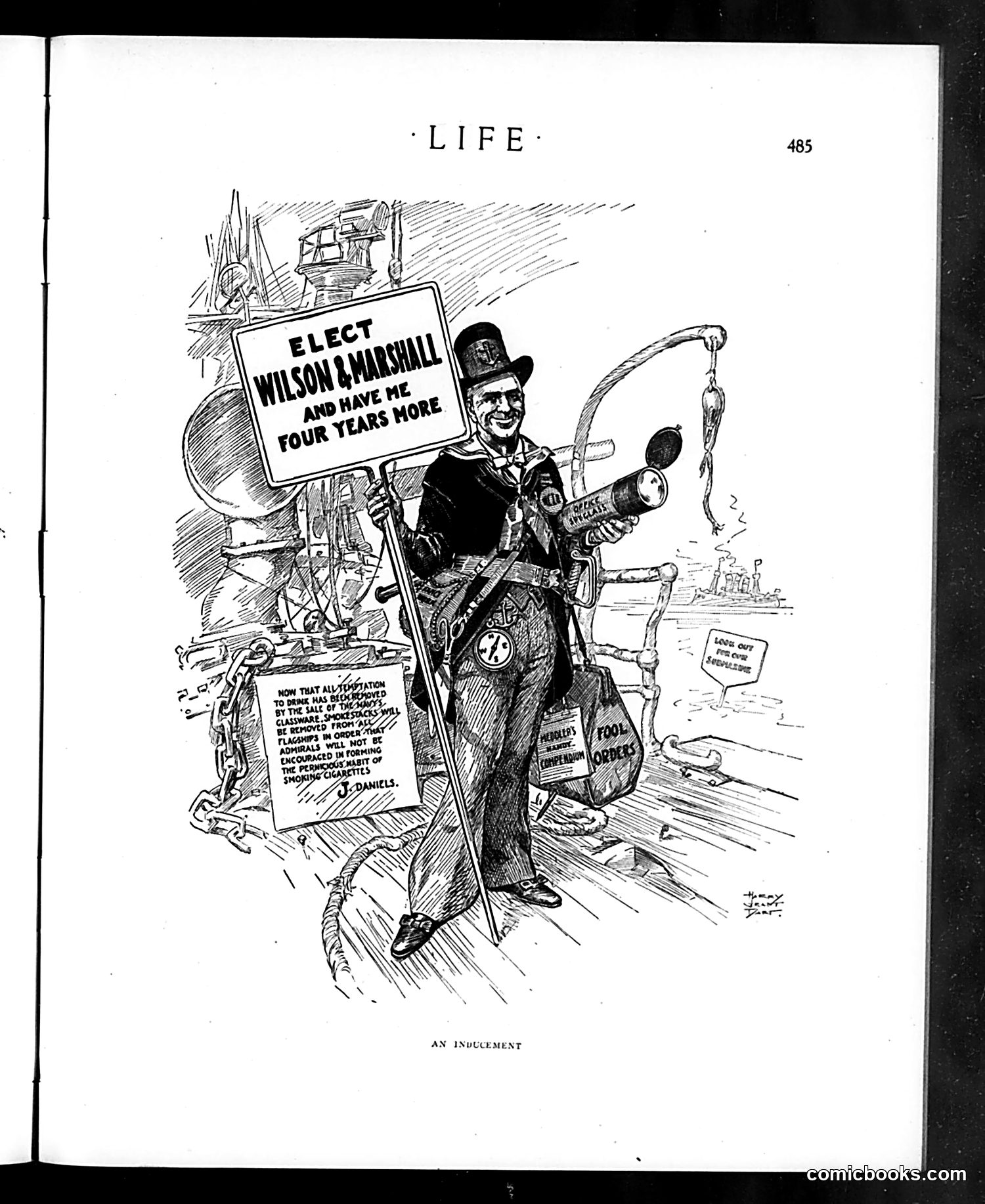
This political cartoon depicts a fisherman-like figure holding a sign reading "ELECT WILSON & MARSHALL AND HAVE ME FOUR YEARS MORE." The character appears to represent a political operative or party functionary using various "tools" (fishing rod, nautical equipment) to "catch" voters. The cartoon satirizes the 1912 or 1916 presidential campaign promise-making, suggesting that politicians use deceptive "bait" to lure voters. The nautical setting and fishing imagery metaphorically represent campaign manipulation—casting hooks to snare the electorate's support. A quote from "J. Daniels" (likely Josephus Daniels, Wilson's Navy Secretary) appears on a attached document, though the text is largely illegible in this image. The title "An Inducement" underscores the satirical critique of electoral persuasion tactics.
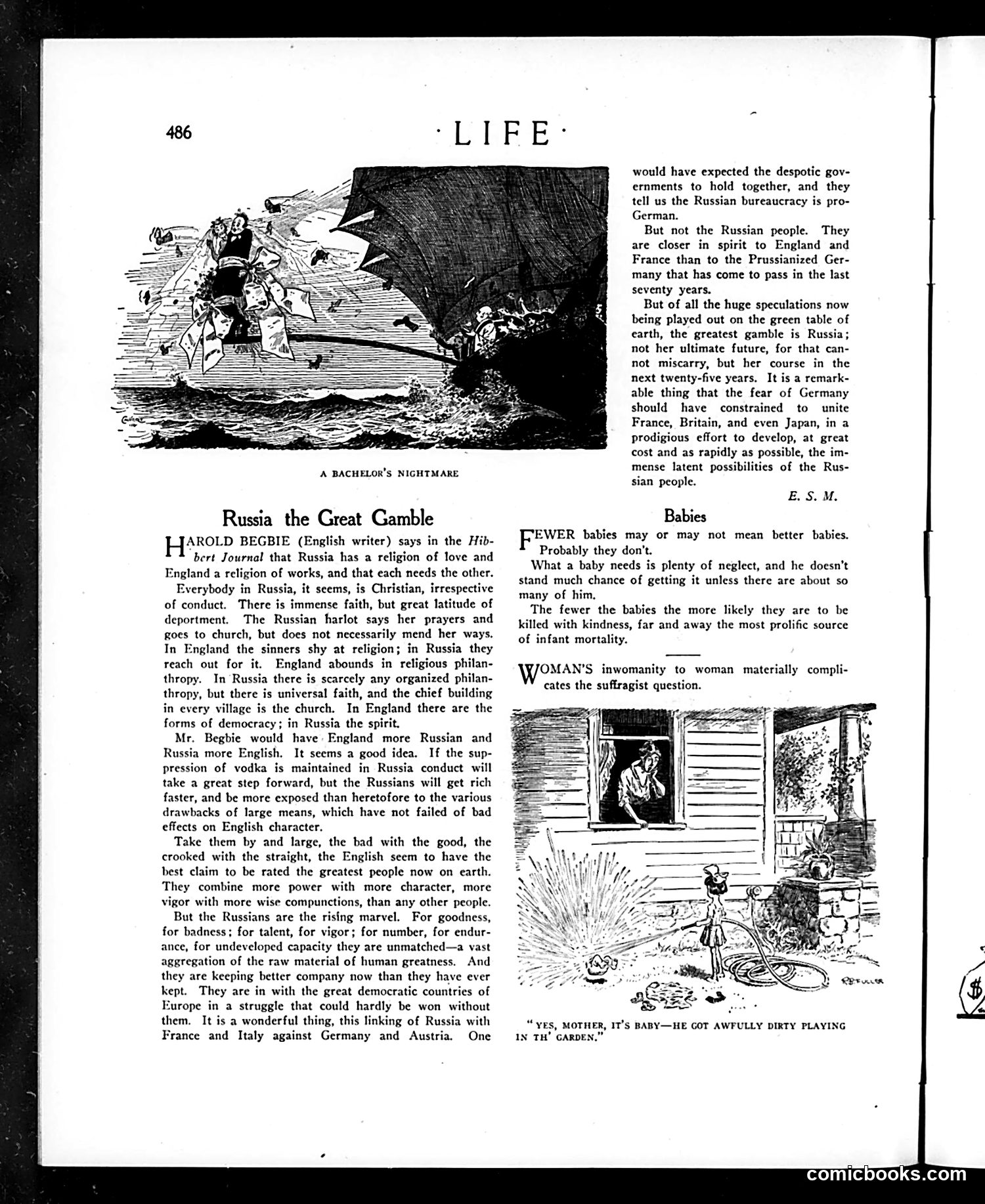
**Top Illustration ("A Bachelor's Nightmare"):** A dark, nightmarish engraving shows a man seemingly attacked or threatened by a large shadowy figure or creature—likely depicting anxieties about marriage or domestic life, a common satirical theme of the era. **"Russia the Great Gamble":** Harold Begbie's essay compares Russian and English character, written during WWI (referenced by Russia's alliance with France, Britain, and Japan against Germany). The satire praises Russia's spiritual faith while noting its moral inconsistency, and questions whether rapid modernization will benefit or corrupt Russian society. The "gamble" refers to uncertainty about Russia's future trajectory over the next 25 years—prescient given the Russian Revolution occurred in 1917. **"Babies" Section:** A satirical piece suggesting that fewer babies paradoxically leads to worse outcomes because parents over-indulge remaining children with excessive care, causing harm. The accompanying cartoon shows a mother's exasperation with her child playing outdoors—mocking contemporary anxieties about child-rearing.
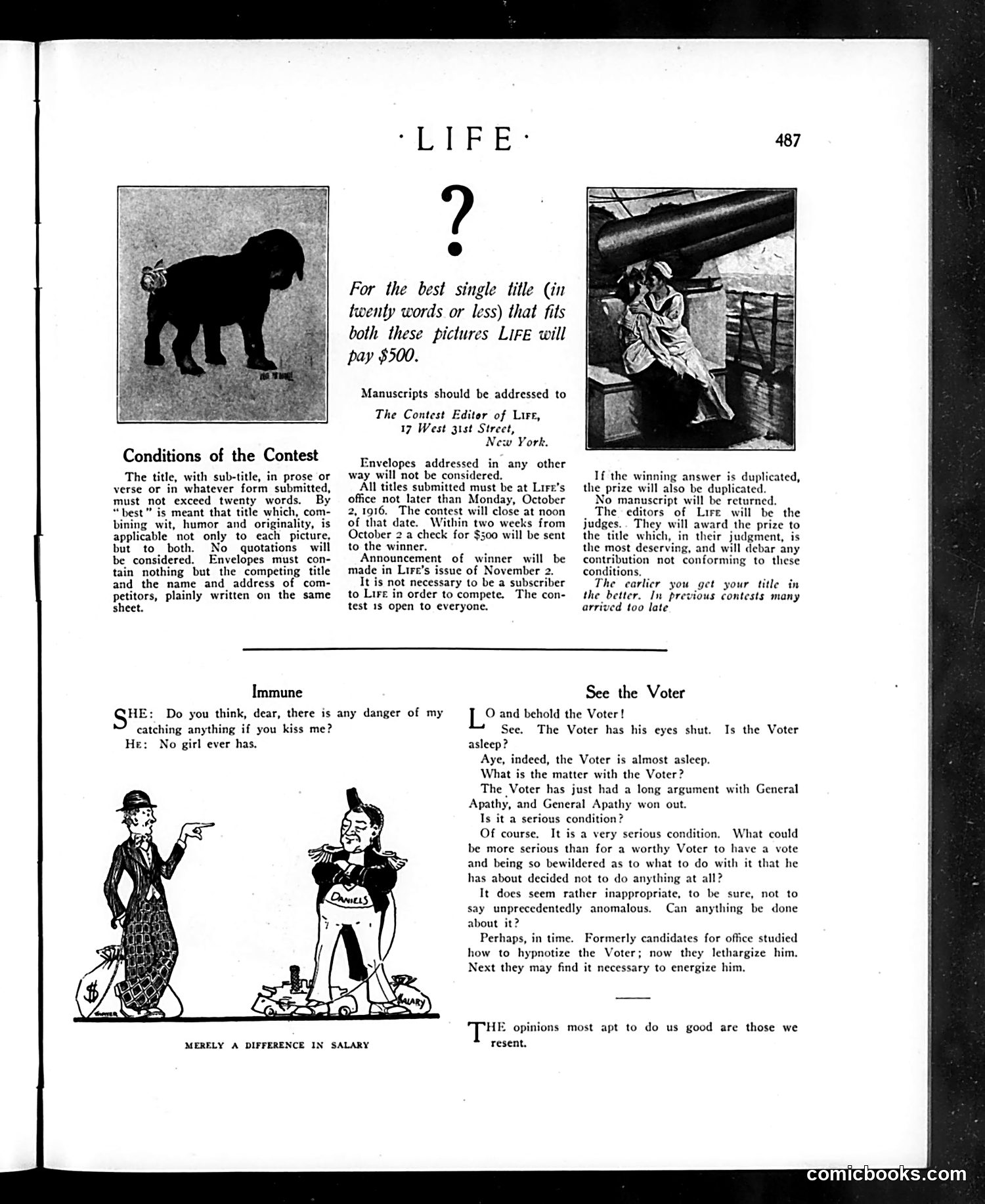
This 1916 *Life* magazine page contains two distinct satirical elements: **The Contest:** A $500 prize for readers to title two images—a dog scratching and a person under a cannon—applicable to both pictures. **"See the Voter" Section:** A mock-serious dialogue mocking voter apathy. It personifies "General Apathy" as defeating the Voter, suggesting citizens are so confused or exhausted by political campaigning that they've become lethargic and disengaged. The critique suggests politicians have shifted from "hypnotizing" voters to deliberately making them passive ("lethargizing"). This reflects Progressive Era concerns about voter participation and suggests political manipulation is deliberately inducing voter indifference. **"Immune" Cartoon:** A gender-based joke about kissing safety, playing on contemporary anxieties about disease transmission. **"Merely a Difference in Salary" Cartoon:** Satirizes wealth inequality—depicting a wealthy man and laborer as opposites, suggesting their vastly different circumstances stem only from salary disparity rather than systemic differences.
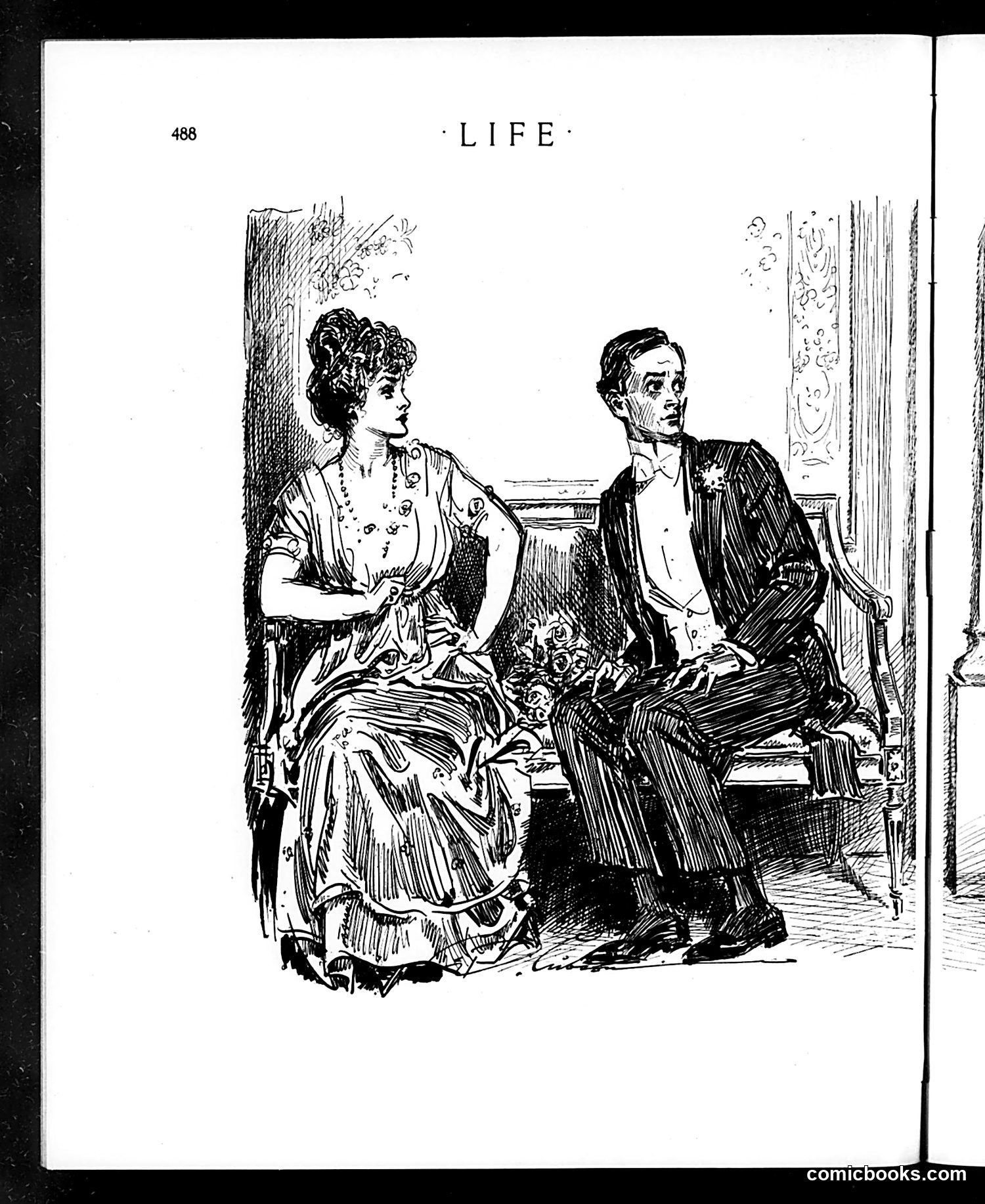
This page from *Life* magazine (page 488) shows a single illustration depicting a well-dressed couple in what appears to be an elegant interior setting. The woman wears an ornate gown with jewelry and elaborate upswept hair, while the man is in formal evening wear with a pinstriped suit. Both figures gaze away from each other with somewhat distant or disengaged expressions. Without additional visible text or captions on the page itself, the specific satirical point is unclear. The illustration likely comments on upper-class social dynamics, marital relations, or romantic disconnection among the wealthy elite—common *Life* magazine themes. However, the exact subject, date, and intended message cannot be determined from the image alone.
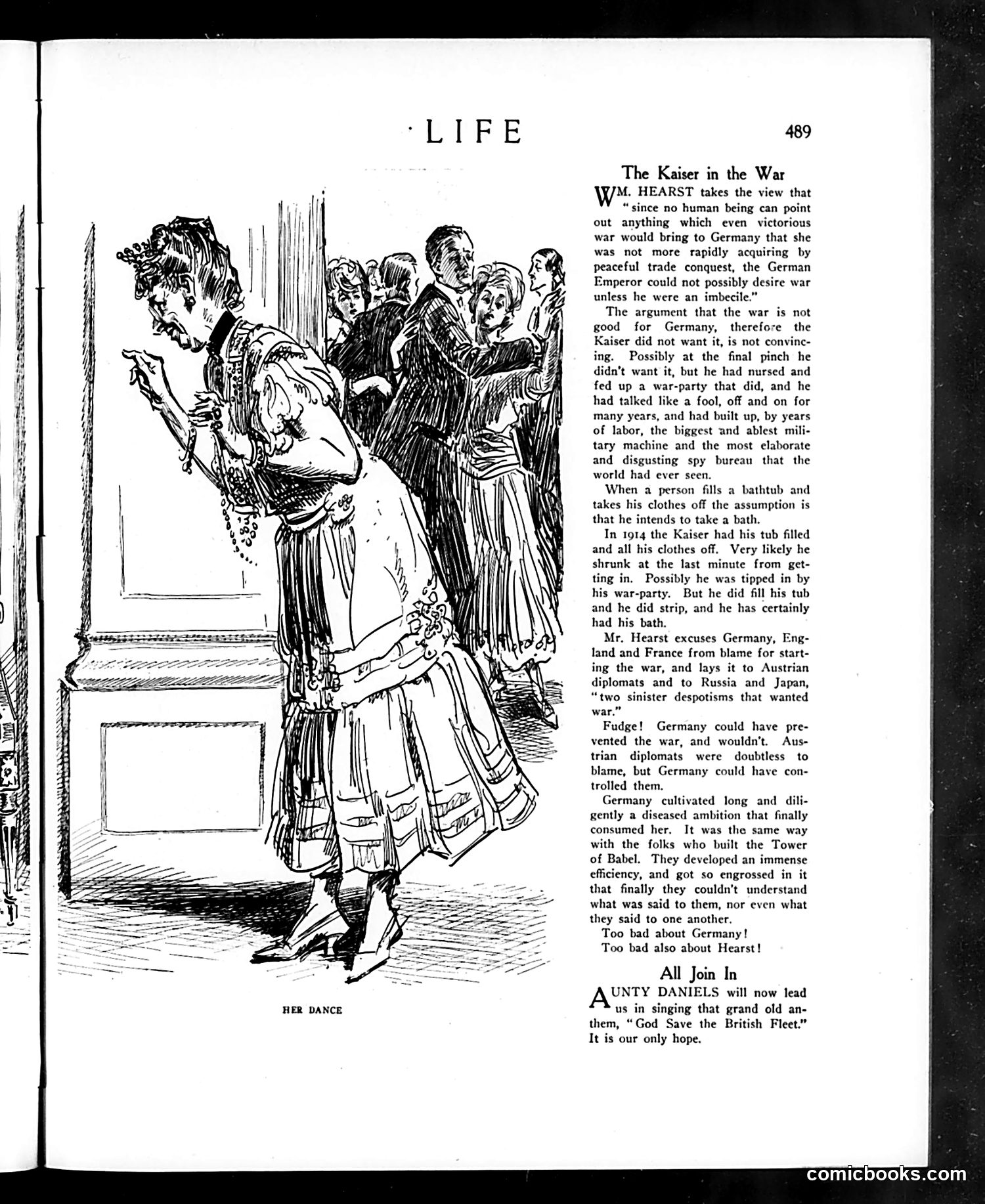
This page critiques both German Kaiser Wilhelm II and American newspaper magnate William Randolph Hearst. The illustration shows a woman (representing Germany) dancing with military officers, captioned "Her Dance." The article rebuts Hearst's argument that the Kaiser wouldn't have wanted war since Germany was already gaining through peaceful trade. The author uses a bathtub metaphor: the Kaiser "filled his tub and stripped"—building up military power and warmongering rhetoric—so he bears responsibility regardless of last-minute hesitation. The piece compares Germany's ambition to the Tower of Babel, suggesting obsessive efficiency blinded her to consequences. It dismisses Hearst's blame-shifting to Austria, Russia, and Japan, insisting Germany could have controlled events but didn't. The closing sarcastically suggests America's "only hope" is British naval power, implying American security depends on Britain's military dominance—a reference to WWI naval concerns.
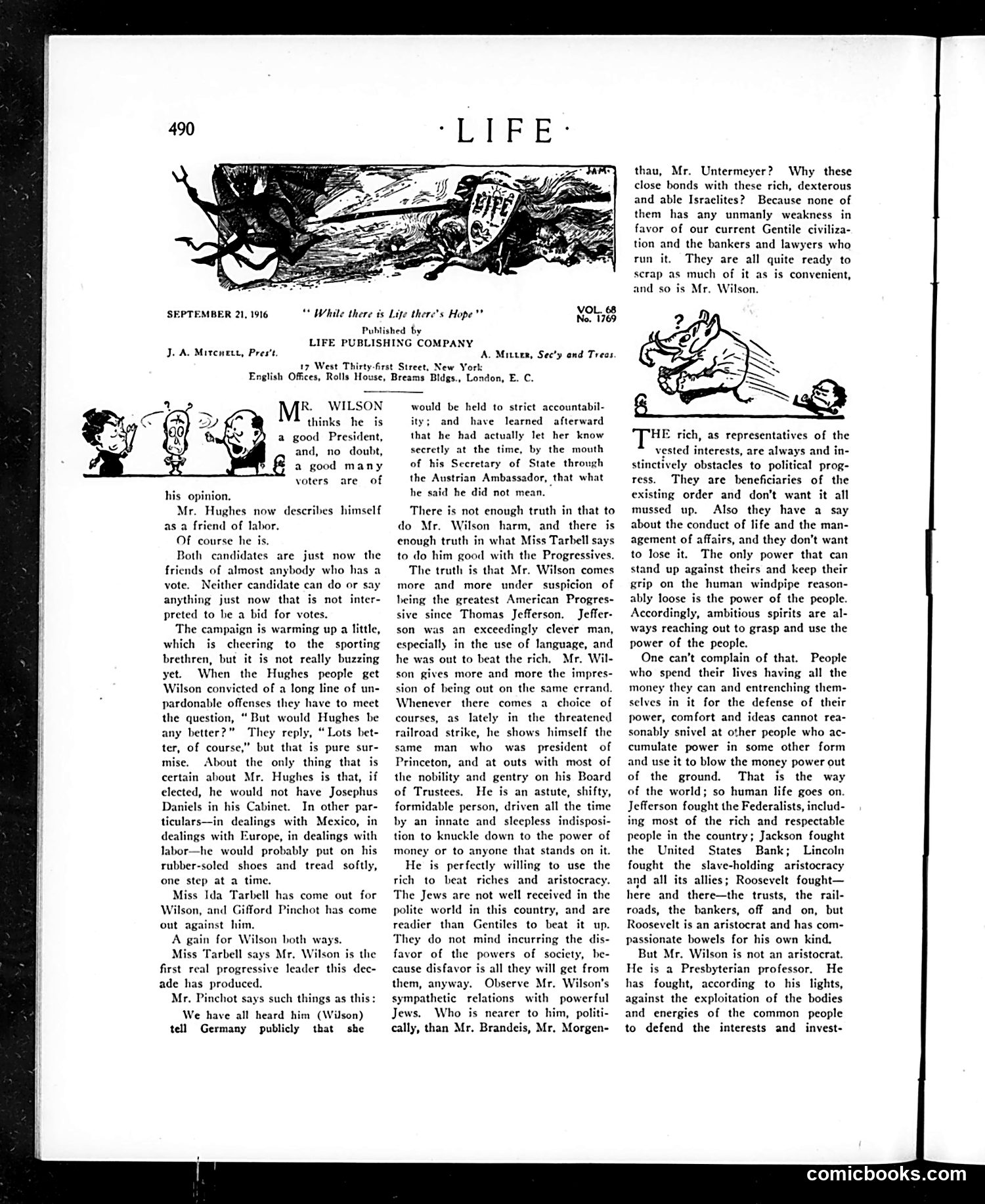
This article defends President Woodrow Wilson against Republican challenger Charles Evans Hughes during the 1916 election. The cartoons (small illustrations at left) show politicians courting voters. The text argues Wilson is genuinely progressive—more so than Hughes—comparing him favorably to Thomas Jefferson. It claims Wilson opposes entrenched wealth and power, evidenced by his willingness to challenge Princeton's board of trustees and his sympathetic relationships with prominent Jewish progressives like Louis Brandeis and others. The piece dismisses critic Gifford Pinchot's accusations that Wilson secretly contradicted public statements to Germany. It characterizes Wilson's progressive stance as driven by an internal opposition to "the power of money," distinguishing him from typical politicians merely bidding for votes. The article's tone is notably antisemitic, portraying Jewish supporters as useful allies precisely because they lack "unmanly weakness" favoring "current Gentile civilization"—a jarring reflection of 1916 prejudices.
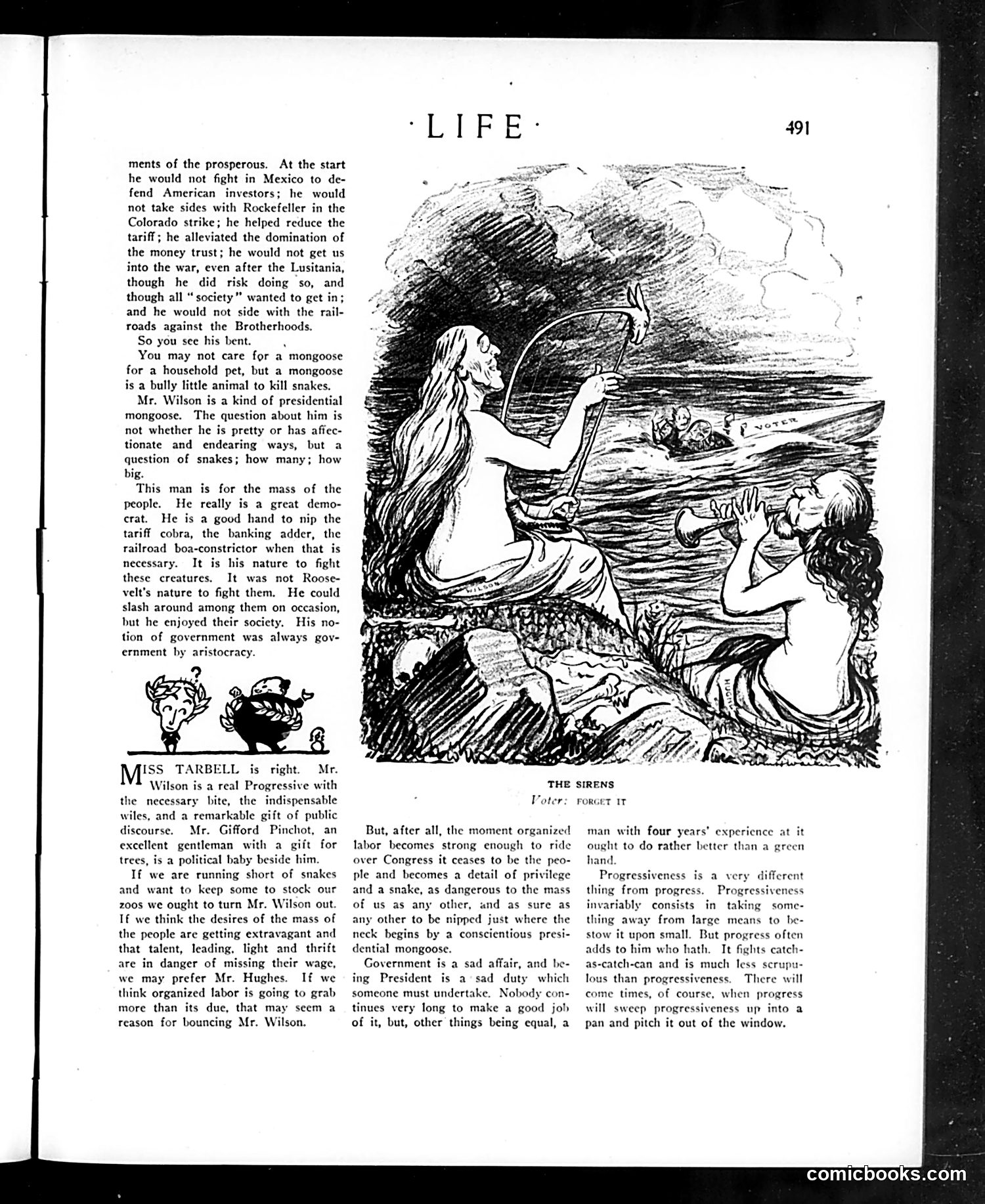
This page defends President Woodrow Wilson's re-election (likely 1916) against challenger Charles Evans Hughes. The text uses an extended metaphor comparing Wilson to a "mongoose"—useful for killing dangerous "snakes" (monopolies, corrupt banking, railroad power, the tariff system). The cartoon titled "The Sirens" shows a voter tempted by alluring female figures representing distractions from his duty—likely references to competing political appeals or scandals meant to sway his vote. The author (possibly Ida Tarbell, mentioned by name) argues Wilson genuinely represents ordinary people's interests, unlike Theodore Roosevelt, who merely occasionally fought corruption while socializing with the wealthy elite. The piece contends that Wilson's four years of presidential experience and proven progressive action outweigh Hughes's inexperience, despite both candidates claiming progressive credentials. The final section warns that unchecked labor power could itself become a "snake" requiring presidential restraint.
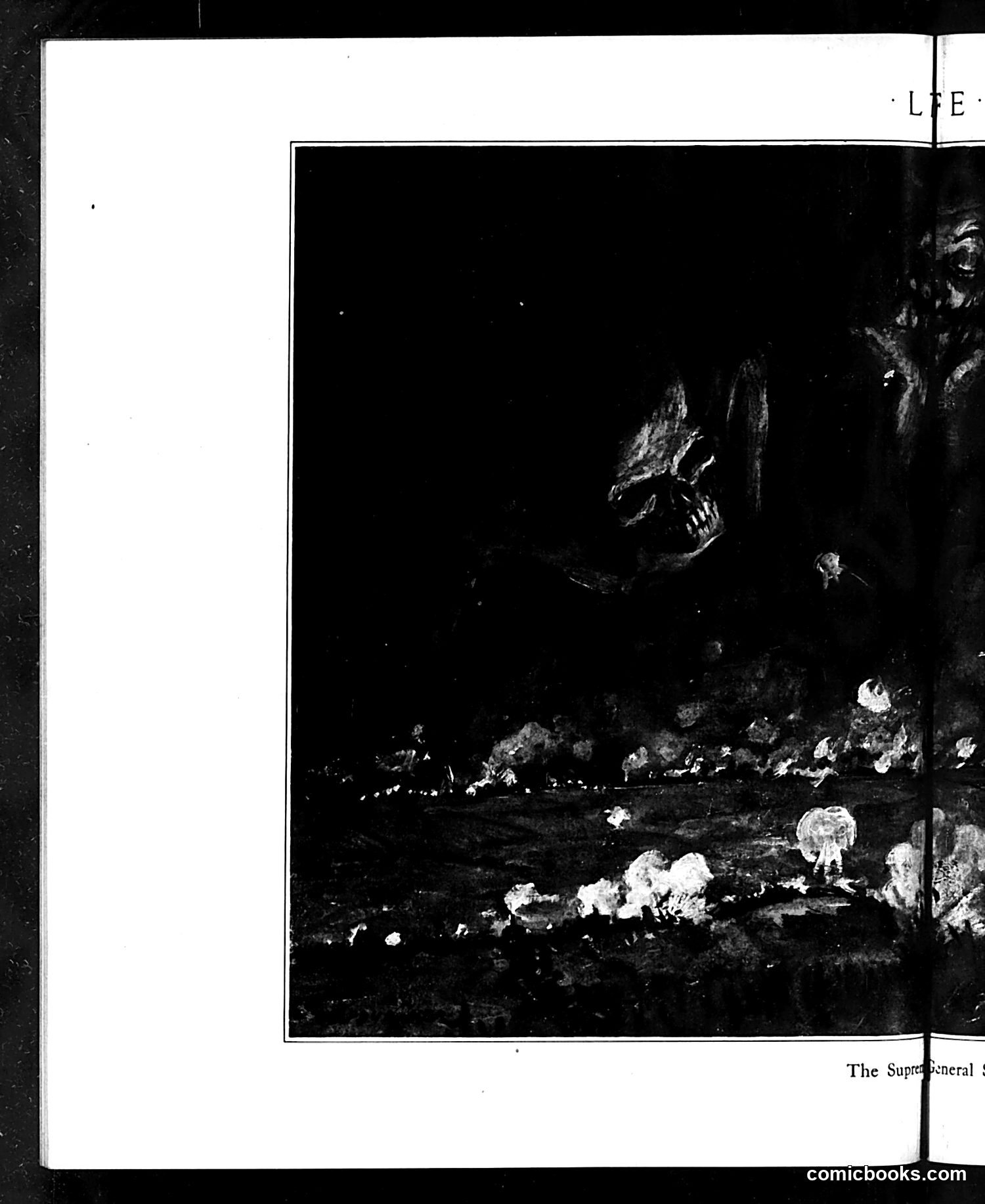
This appears to be a page from *Life* magazine showing a dark, atmospheric illustration. The image depicts what seems to be an underground or cavernous scene with skeletal or ghostly figures visible in the upper portion and luminescent mushrooms or similar organisms glowing in the lower foreground against dark ground. The caption reads "The Supra-General" (partially visible), suggesting this may be satirical commentary on a military or political figure, though the specific identity is unclear from the visible text alone. The gothic, underground setting and supernatural imagery suggest social or political satire, possibly critiquing leadership or authority figures as otherworldly or out-of-touch. However, without additional context or complete caption text, the precise target and message of this satire cannot be definitively determined.
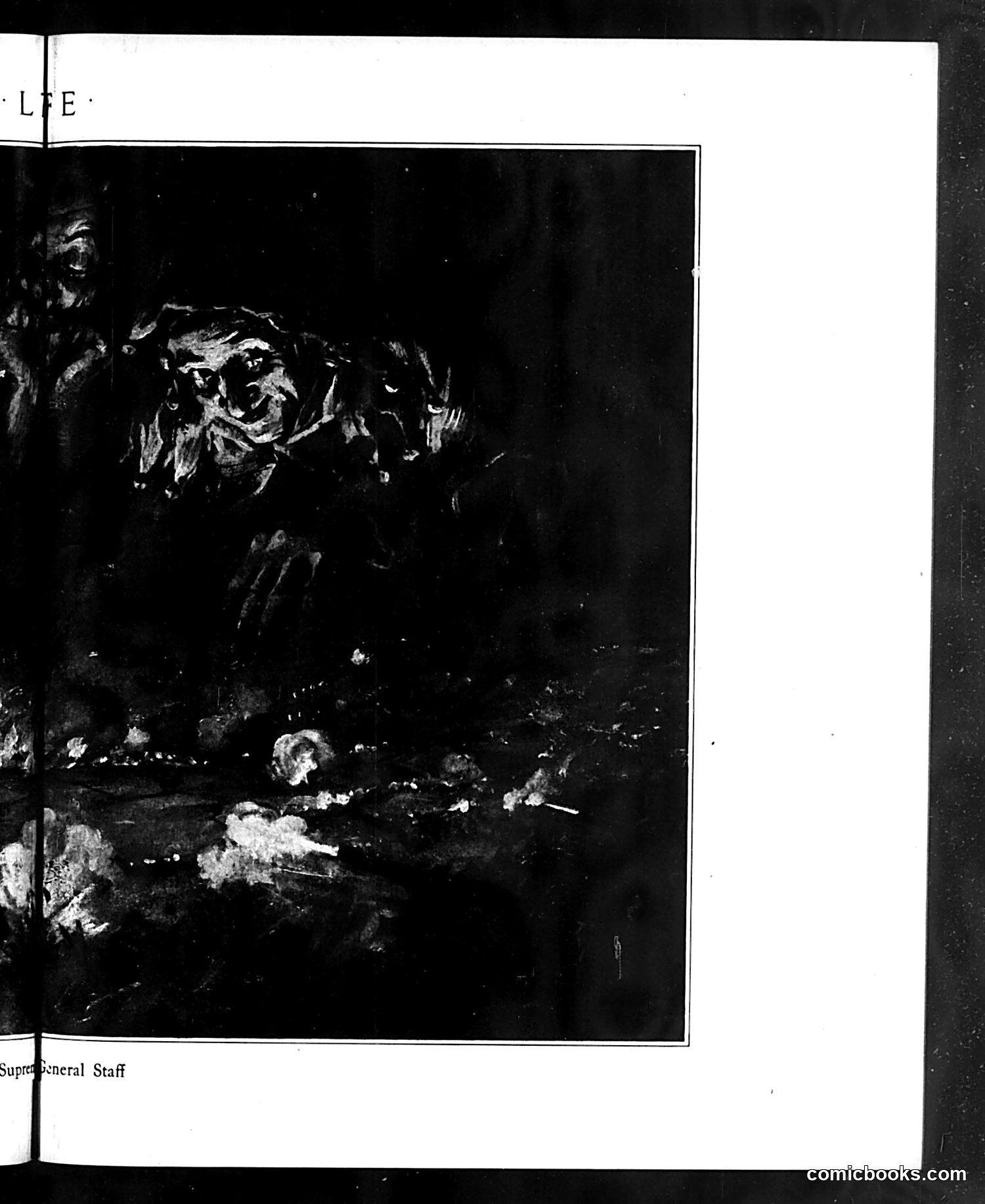
This appears to be a dramatic political illustration from Life magazine, showing what looks like a military or governmental scene. The image is quite dark and heavily shadowed, making specific details difficult to discern with certainty. The caption reads "Superintendent Staff" at the bottom, suggesting this depicts some kind of administrative or military hierarchy. However, without clearer visibility of the figures' faces or additional contextual text on the page, I cannot definitively identify the specific political figures being caricatured or the particular historical event being satirized. The artistic style—dark, shadowy, expressionistic—suggests serious political commentary rather than lighthearted humor. To accurately explain the satire's specific target and point to a modern reader, I would need either clearer image resolution or additional text identifying the subjects and date of publication.
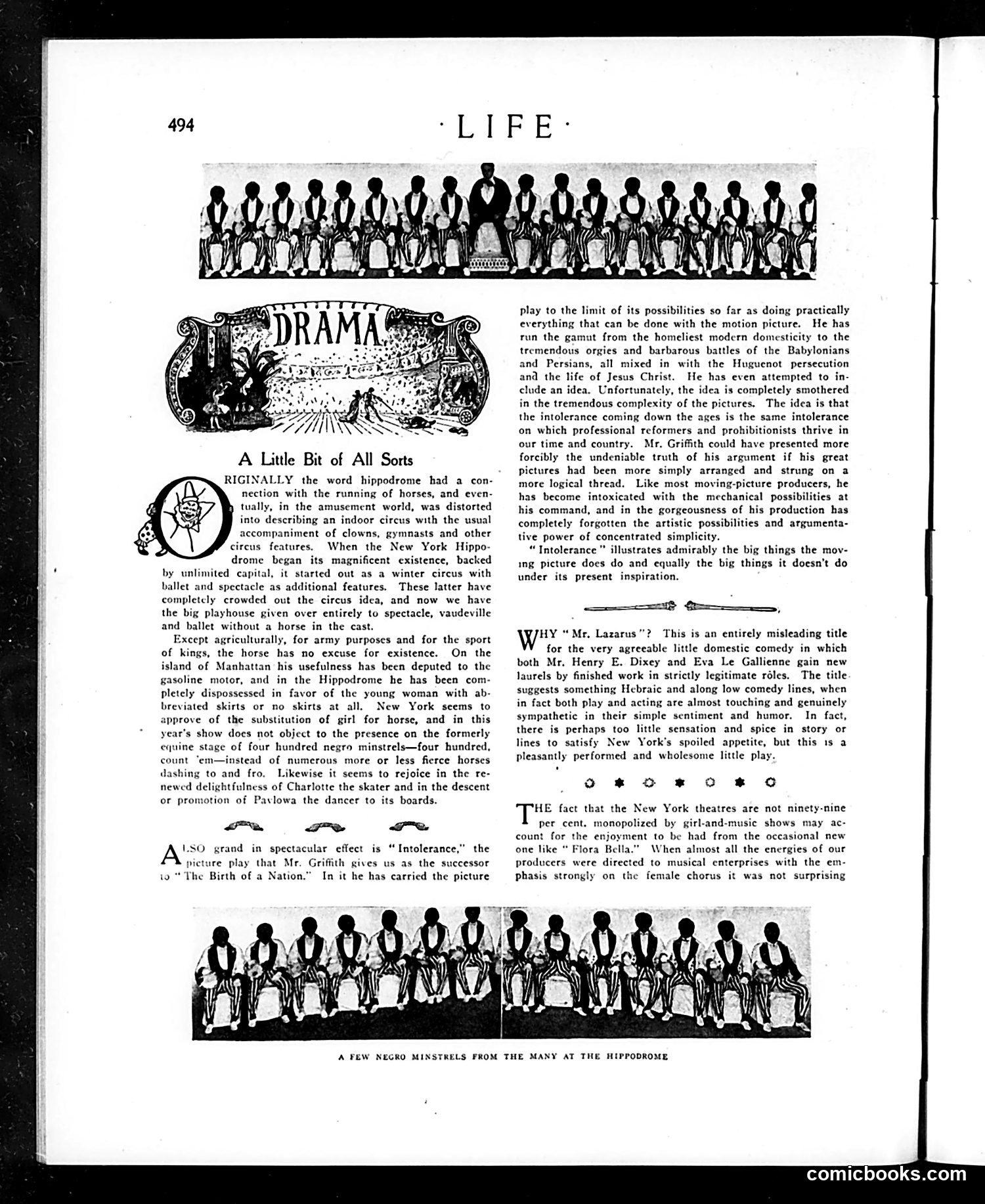
This page reviews New York theatrical productions with period-specific cultural commentary. The main subjects are: **"A Little Bit of All Sorts"** (Hippodrome): The critic praises the venue's shift from traditional circus to spectacle and ballet, notably celebrating the replacement of horses with "four hundred negro minstrels" and female dancers like Charlotte the skater and Pavlova. By modern standards, this casually racist language reveals how African Americans were viewed as novelty entertainment rather than serious performers. **"Intolerance"** (D.W. Griffith film): The review critiques Griffith's ambitious historical epic, noting it overwhelms its message about intolerance with visual spectacle—a prescient observation about form overshadowing substance. **"Why Mr. Lazarus?"**: A favorable review of a domestic comedy starring Henry E. Dixey and Eva Le Gallienne, praising its restraint against New York's preference for sensational entertainment. The page reflects early 20th-century entertainment tastes and attitudes toward race that modern readers would find deeply offensive.
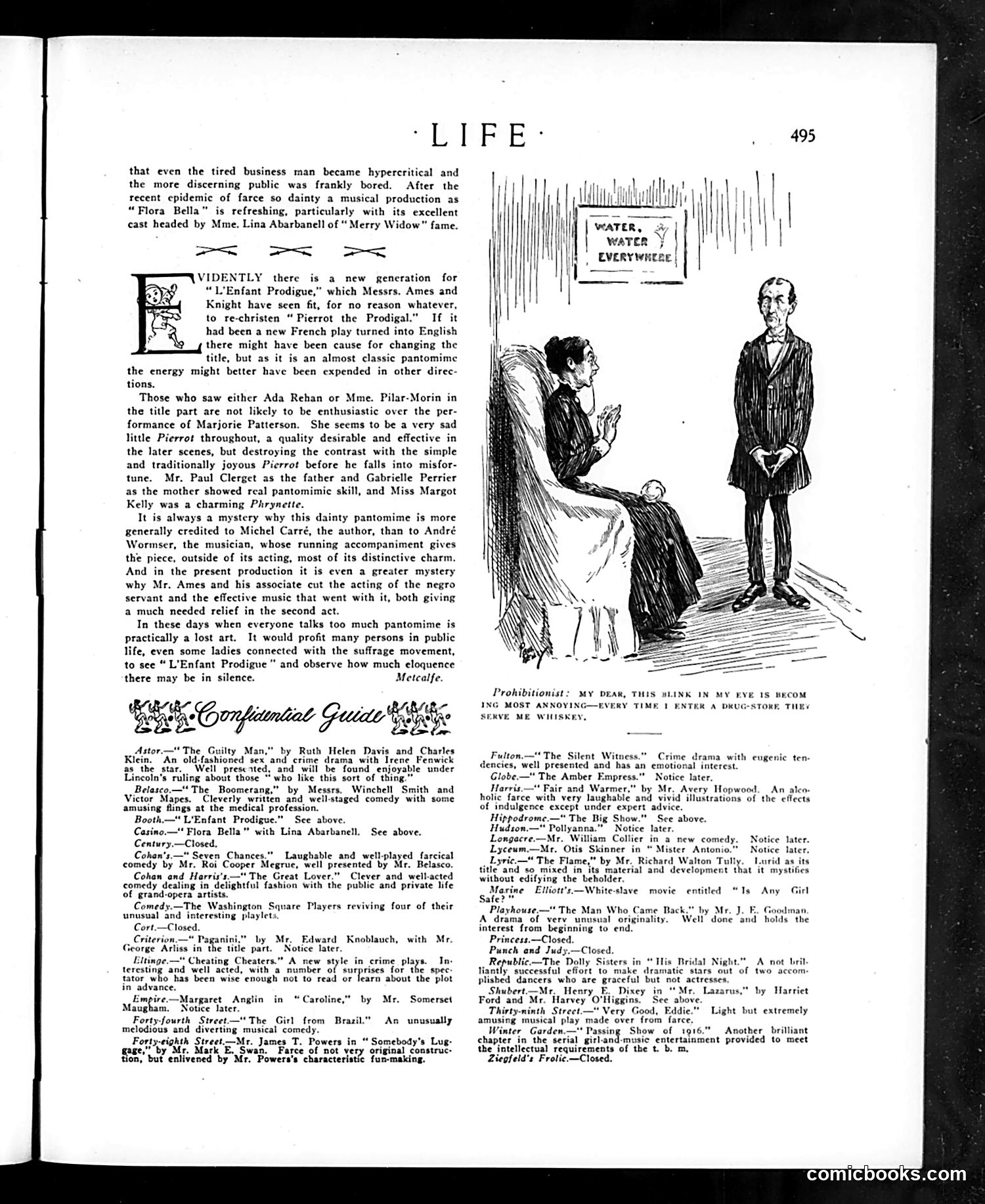
This page is a theater review section covering Broadway productions. The main illustration shows two figures in what appears to be a scene from "L'Enfant Prodigue" (retitled "Pierrot the Prodigal")—likely depicting the title character and another actor. The cartoon's implicit satire concerns the **renaming of a classic French pantomime**. The critic (Metcalfe) questions why producers Ames and Knight changed the traditional title, suggesting the energy wasted on this unnecessary alteration could have improved the actual production. The review also contains **subtle social commentary**: it suggests that pantomime's value—communicating through silence rather than words—would benefit "persons in public life, even some ladies connected with the suffrage movement," implying that suffragettes talk too much. This reflects the era's anti-suffrage sentiment among some cultural critics. The page primarily functions as theater criticism rather than political satire, evaluating various Broadway shows with mixed reviews.
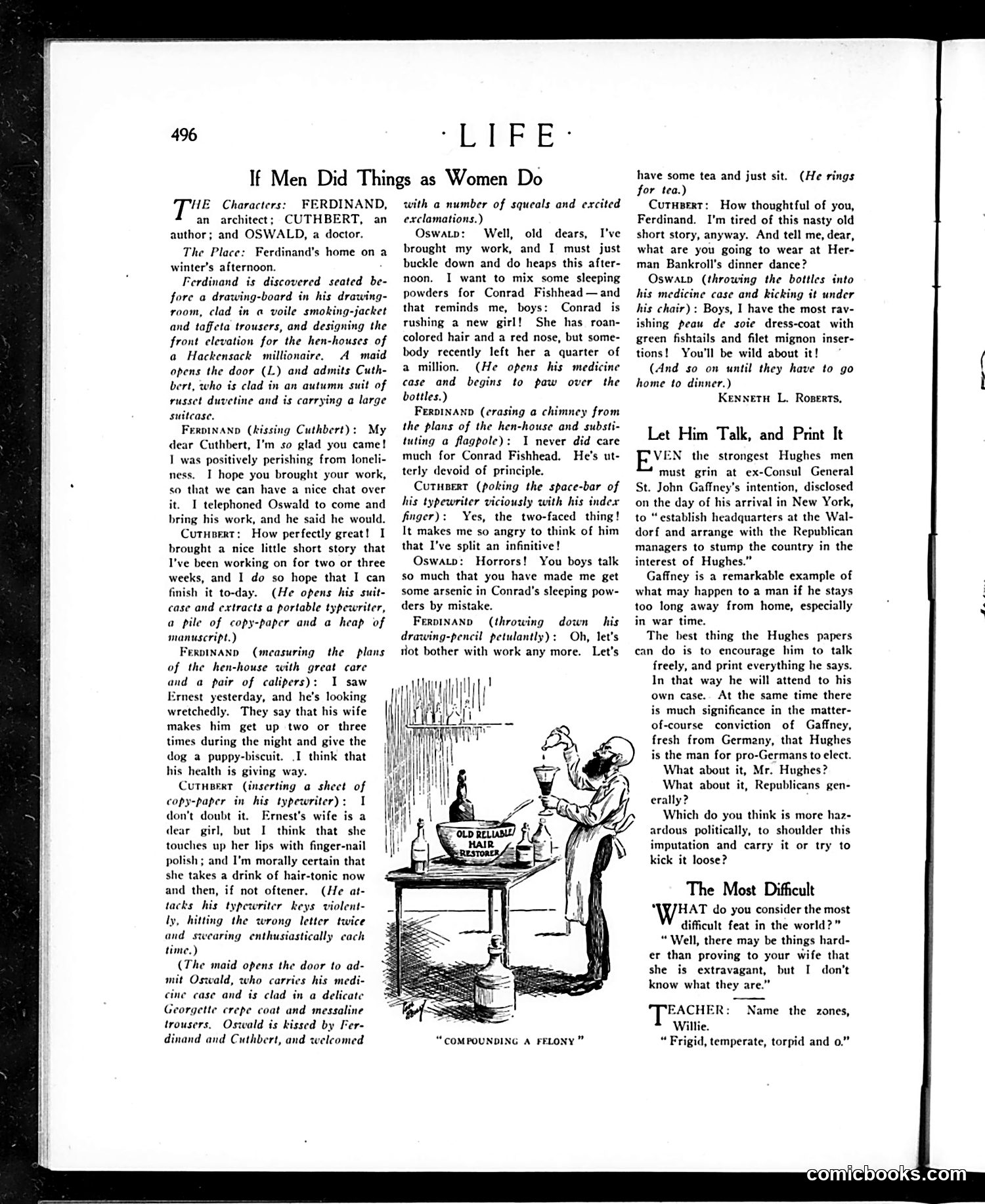
This satirical sketch from Life magazine mocks early 20th-century gender roles by depicting three professional men—an architect, author, and doctor—behaving stereotypically like gossiping women. They wear feminine clothing (voile smoking-jackets, taffeta trousers, Georgette crepe), kiss each other in greeting, discuss others' personal scandals, abandon work for tea, and obsess over clothing for social events. The humor relies on the premise that these behaviors—chatting idly, spreading rumors, prioritizing socializing over productivity—were considered distinctly "feminine" and therefore ridiculous when performed by men. The cartoon's title "Compounding a Felony" suggests that combining such "unmanly" behavior constitutes a serious transgression. The satire critiques rigid gender stereotypes of the era by exaggerating them to absurdity, though it does so without questioning whether these traits were actually inherently feminine or genuinely negative.
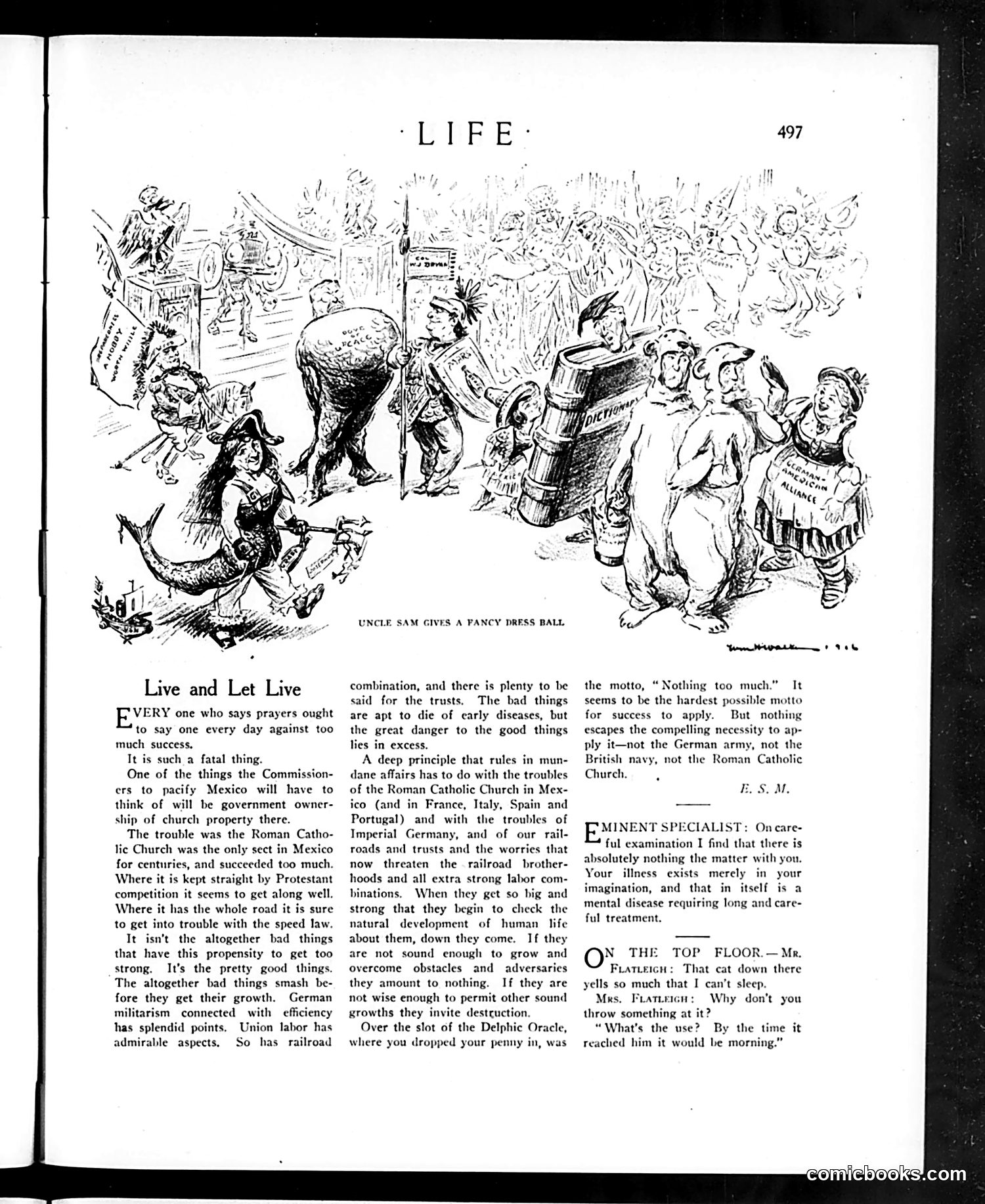
The cartoon depicts a chaotic ball or formal gathering where Uncle Sam (representing the U.S. government) hosts various figures in costumes or disguises. The satire appears to mock American diplomatic efforts, likely referencing the Mexican Commission mentioned in the essay—U.S. commissioners sent to "pacify Mexico." The accompanying essay argues that institutions become dangerous when they grow too powerful without restraint. Using the Roman Catholic Church's dominance in Mexico as the primary example, the author warns that "pretty good things" become destructive through excess. The text references trusts, German militarism, and labor unions as parallel cases where concentrated power invites collapse. The cartoon likely satirizes government interference abroad and the naiveté of American diplomatic missions, while the essay's central metaphor—the Delphic Oracle's motto "Nothing too much"—suggests that unchecked power, regardless of its initial virtue, inevitably fails. This reflects Progressive Era anxieties about monopolies and institutional overreach.
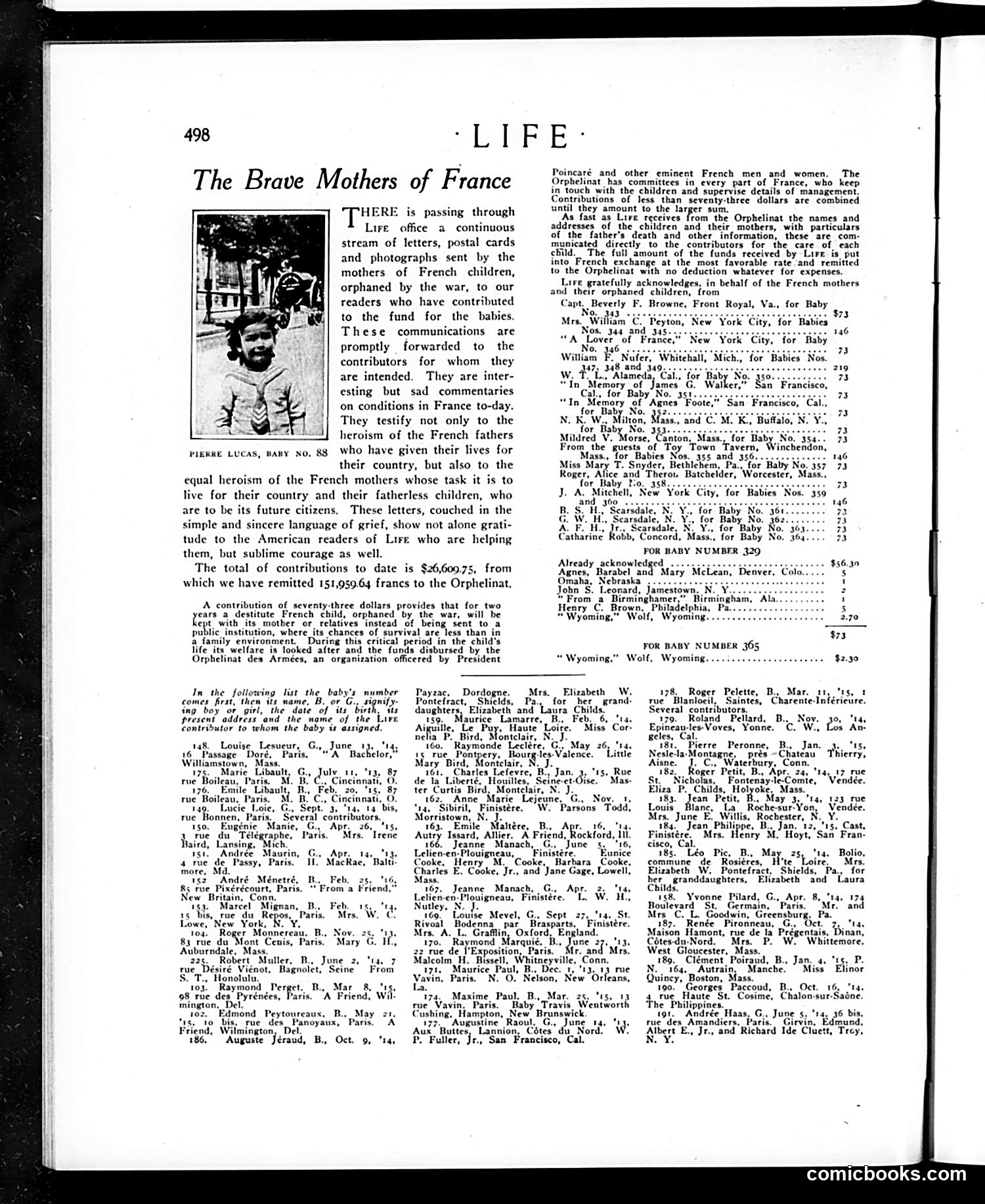
This is not a cartoon but rather a humanitarian fundraising article. The page features a photograph of **Pierre Lucas, Baby No. 88**, a French orphan, and describes Life magazine's ongoing charitable effort to support children orphaned by World War I. The article explains that Life receives letters and photographs from French mothers of war orphans, which are forwarded to American donors who sponsor individual children. A $73 contribution ensures two years of support, keeping orphans with family rather than institutional care—improving survival chances during wartime's "critical period." The bulk of the page lists donors and the specific baby numbers they sponsor, demonstrating the magazine's transparent accounting of funds ($26,609.75 raised, remitted to the French Orphelinat des Armées). This represents earnest wartime charity work, not satire.
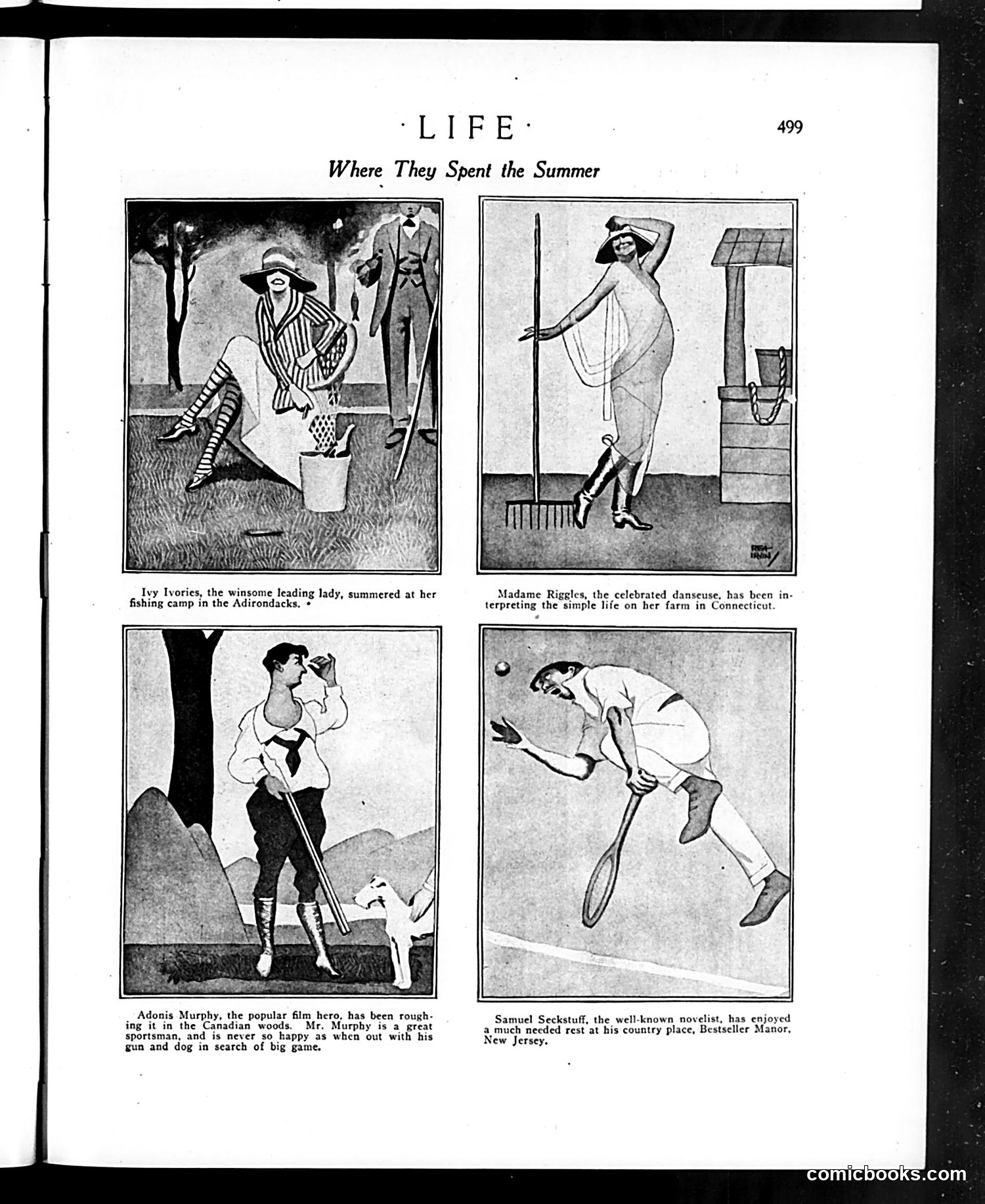
This Life magazine feature satirizes wealthy celebrities' claims of "roughing it" during summer vacation. The four panels showcase famous figures who ostensibly sought simple, rustic getaways—yet the illustrations reveal their actual leisure activities remain leisured and refined. Each caption pairs a celebrity name with a modest-sounding retreat (fishing camp, farm, Canadian woods, country place), but the drawings show them engaged in genteel pursuits: fishing, farming, hunting, and tennis. The satire targets the hypocrisy of the wealthy performing humility—pretending to embrace "the simple life" while maintaining comfort and leisure. The joke relies on readers recognizing these celebrities and understanding that their "roughing it" is fundamentally different from actual working-class labor. It's gentle mockery of upper-class affectation and the gap between public personas and actual privilege.
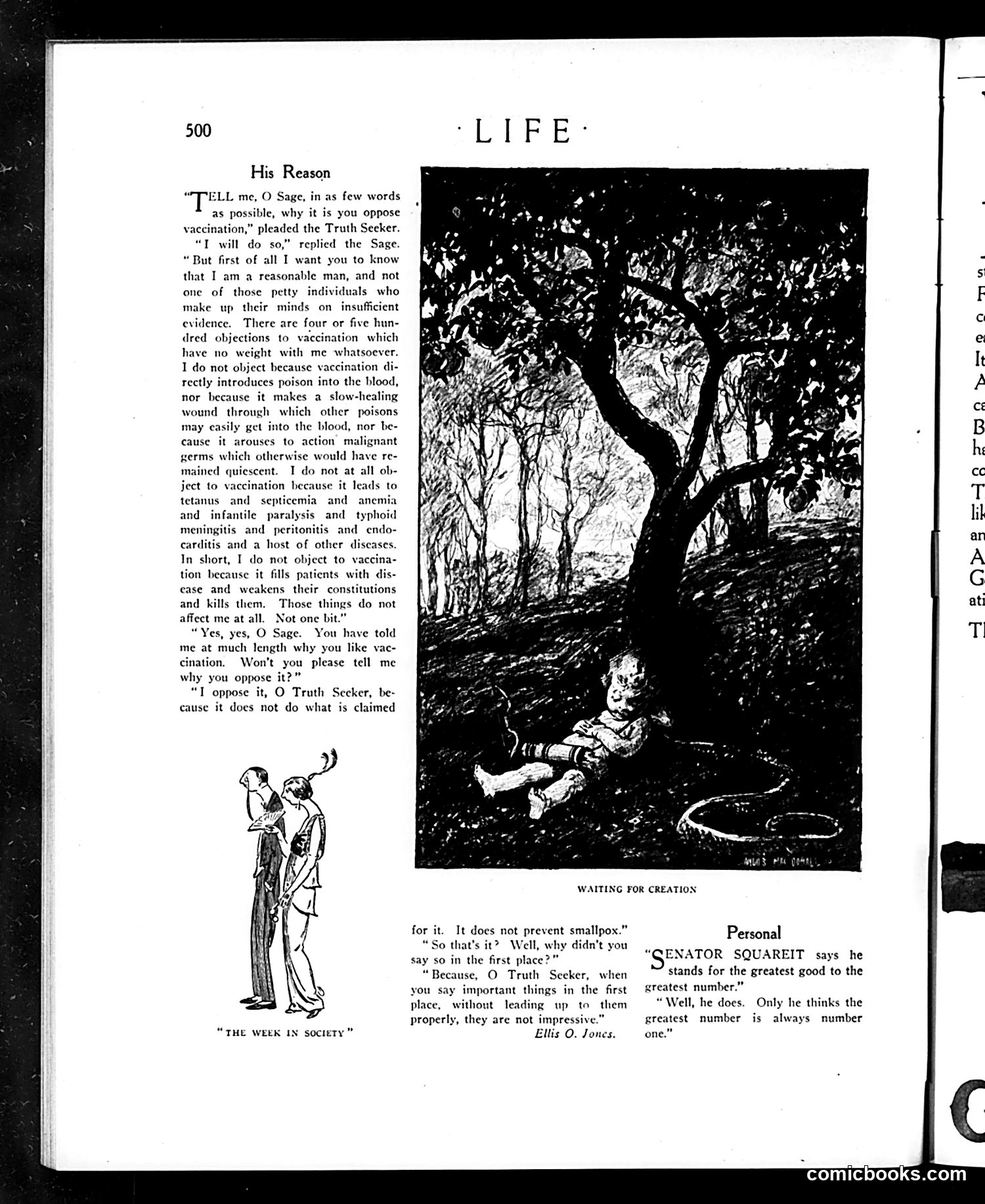
This 1920s-era Life magazine piece satirizes anti-vaccination rhetoric through a dialogue between a "Truth Seeker" and a self-proclaimed "Sage." The joke exposes the logical fallacy of anti-vaccine arguments: the Sage elaborately lists supposed dangers of vaccination (poison in blood, infections, paralysis, meningitis, etc.)—dismissing each as irrelevant to his actual objection. His real reason? Vaccination "does not prevent smallpox"—the one claim that would actually matter medically. The satire mocks how anti-vaccine advocates pad their arguments with lengthy pseudo-scientific complaints to sound impressive, when their fundamental objection lacks merit. The accompanying cartoon "The Week in Society" and Senator Squareit quip are separate items. The Sage character represents the contradictory reasoning Life's editors saw in contemporary vaccination skeptics.
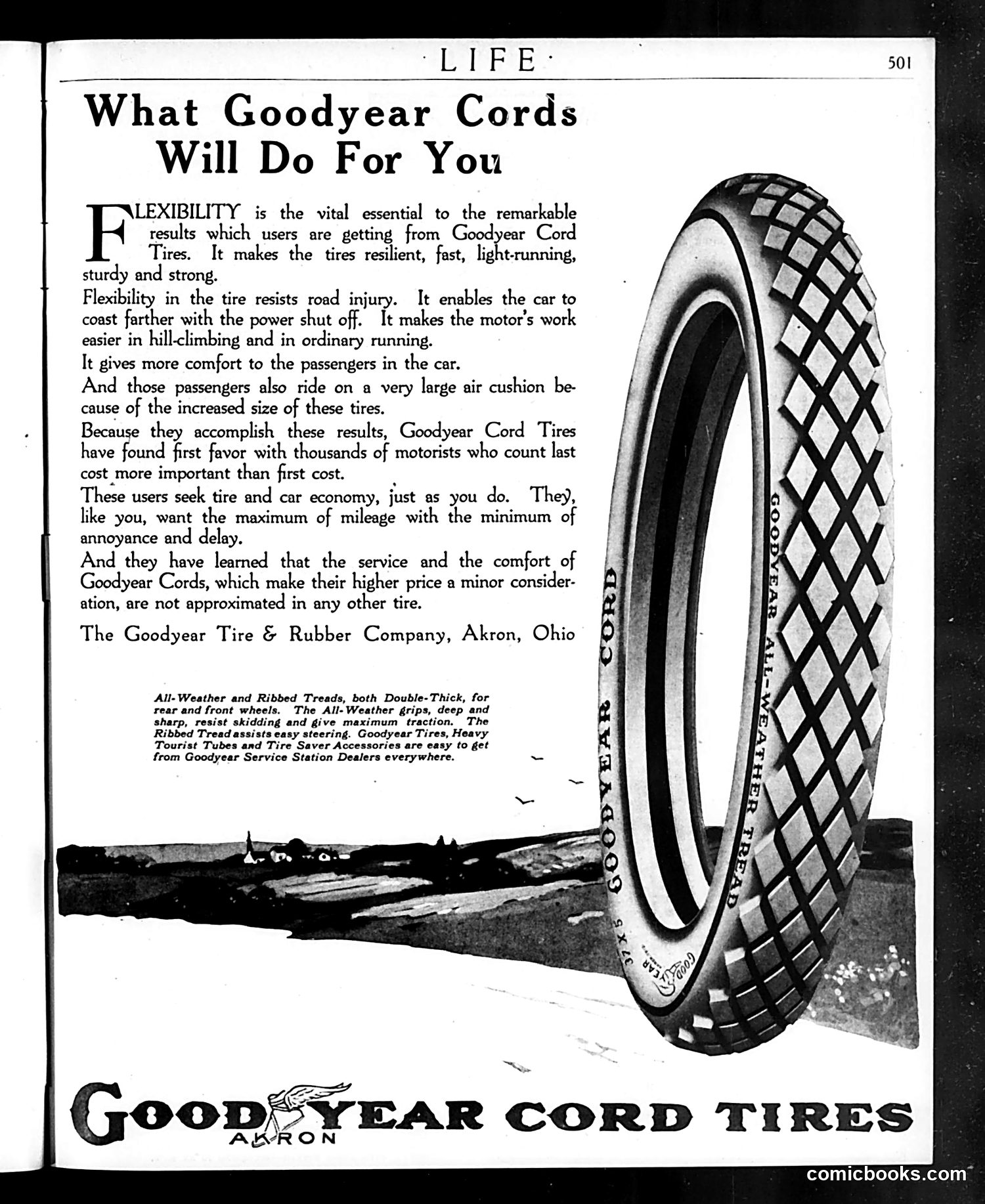
This is **not a cartoon or satire** — it's a straightforward advertisement for Goodyear Cord Tires from *Life* magazine (page 501). The page promotes Goodyear's tire technology to early automotive consumers, emphasizing "flexibility" as the key innovation. The ad targets economically-minded drivers who prioritize long-term value ("last cost more important than first cost") over initial purchase price. The large tire image on the right showcases the product's distinctive diamond-pattern tread design. The text highlights practical benefits: better fuel efficiency, improved comfort, resistance to road damage, and better steering control. This reflects the early 1920s automotive era when tire quality was still a significant consumer concern and advertising focused on technical specifications rather than lifestyle branding. The messaging assumes readers understand car mechanics and prioritize durability and economy — typical of the period's more utility-focused advertising approach.
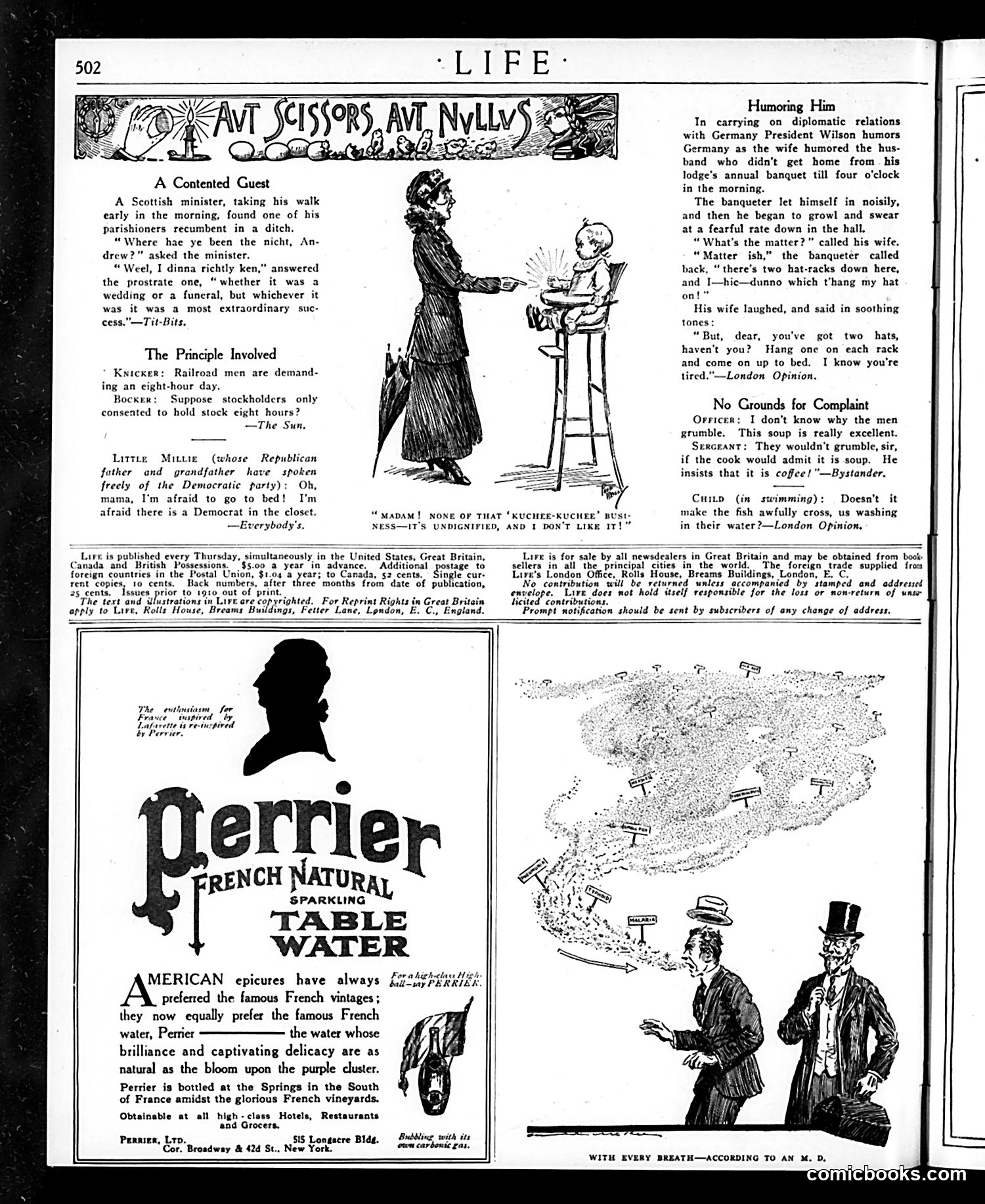
This page contains several brief satirical pieces typical of early 20th-century Life magazine humor: **"A Contented Guest"** mocks a Scottish minister's encounter with a drunk parishioner who can't remember whether he attended a wedding or funeral—the joke being his indifference to the occasion. **"The Principle Involved"** presents a labor debate: workers demand eight-hour days; a counterargument suggests stockholders should only hold stock eight hours. It's political commentary on labor disputes of the era. **"Humoring Him"** appears to reference President Wilson's diplomatic relations with Germany (pre-WWI context), comparing it to a wife tolerating her drunk husband's complaints. **"Little Millie"** jokes about a Republican child afraid of Democrats in the closet—partisan political humor suggesting deep ideological divisions. The remaining pieces mock military food quality and other everyday absurdities. The Perrier water advertisement occupies the lower portion, typical of period magazine layouts mixing content and ads.
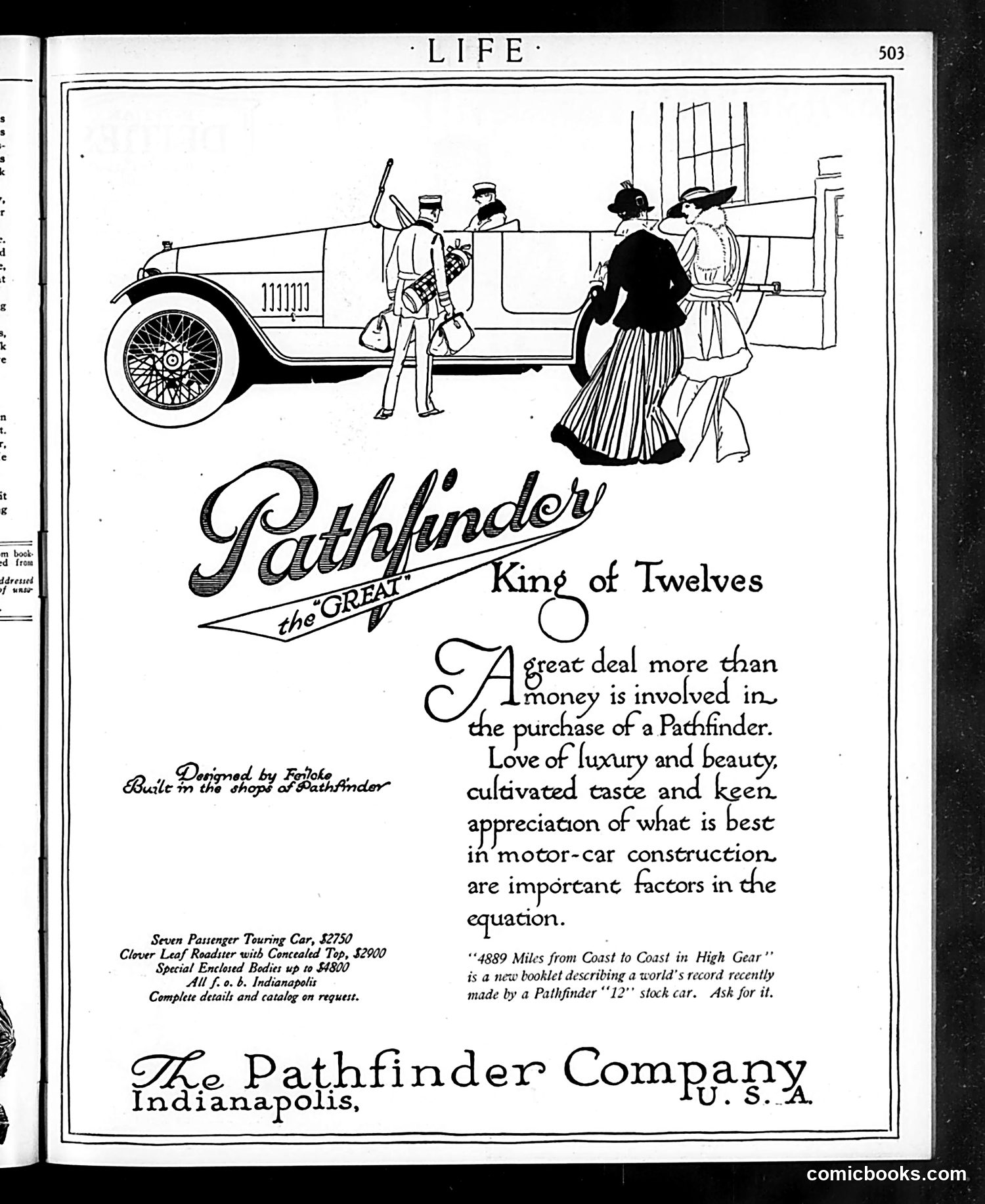
This is primarily a **automobile advertisement**, not political satire. It advertises the Pathfinder car, manufactured in Indianapolis. The page shows a stylized illustration of an elegant touring car with well-dressed figures (women in period dress, men in suits and caps) admiring or boarding the vehicle—a typical marketing approach of the era. The advertisement's text argues that purchasing a Pathfinder involves more than mere financial transaction; it reflects "love of luxury and beauty" and "cultivated taste." This appeals to aspirational buyers seeking social status through automobile ownership. The tagline "King of Twelves" likely refers to the car's twelve-cylinder engine, positioning it as superior to competitors. A footnote mentions a cross-country distance record achieved by a Pathfinder "12" stock car, serving as proof of quality and performance. **Pricing context**: The seven-passenger touring car cost $2,750—substantial money in the early 1900s, indicating this was marketed to wealthy consumers. This reflects the era's emerging car culture and how automobiles functioned as status symbols.
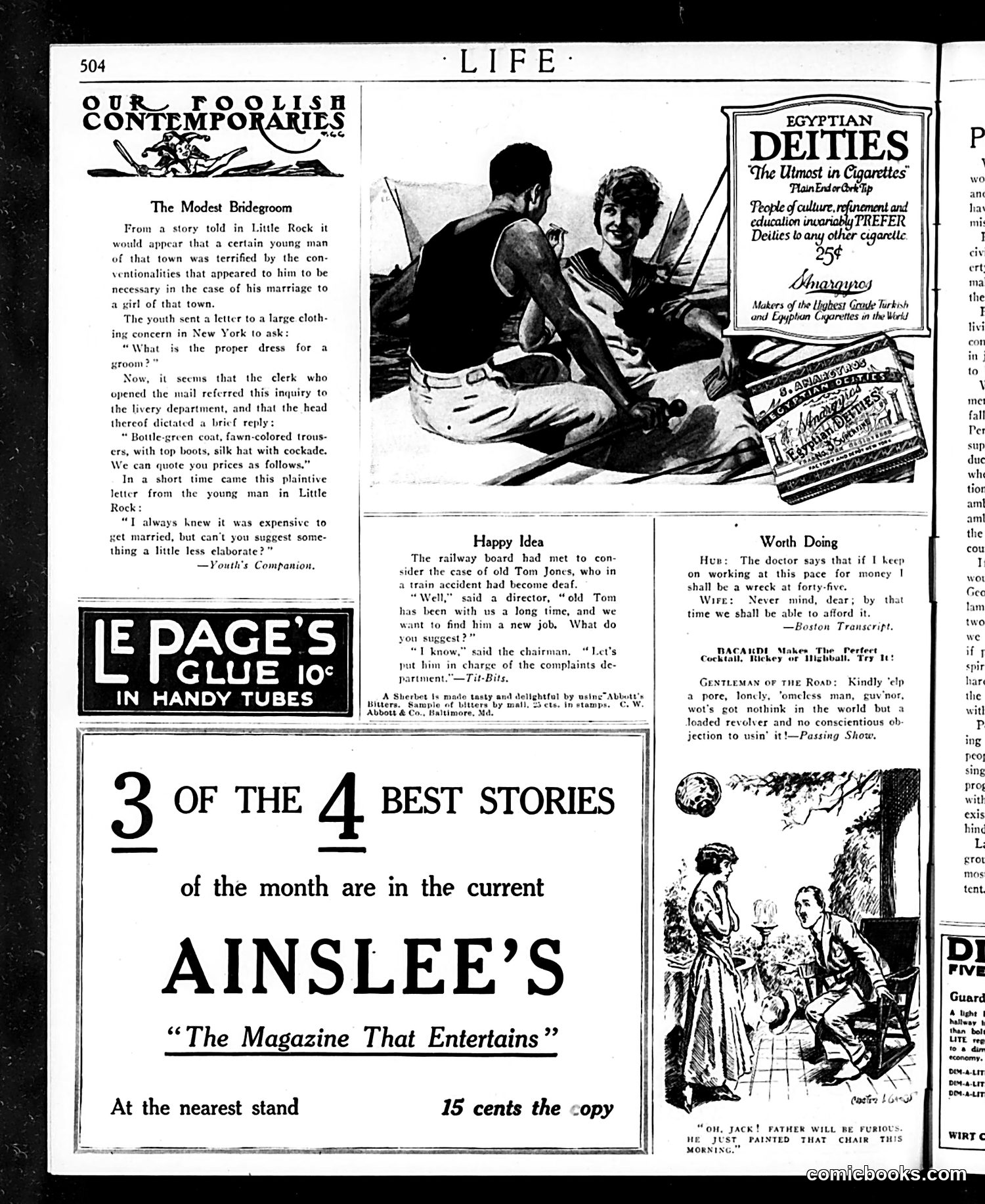
This humor piece mocks a young man from Little Rock, Arkansas who writes to a New York clothing retailer asking what to wear for his wedding. The clerk mistakenly routes the inquiry to the livery department (which rents horses and carriages), which responds with absurdly formal instructions: "Bottle-green coat, fawn-colored trousers, with top boots, silk hat with cockade"—essentially formal equestrian attire. The joke: the groom expected practical wedding advice but received over-the-top, elaborate clothing specifications. His plaintive reply—"I always knew it was expensive to get married, but can't you suggest something a little less elaborate?"—reveals both his anxiety about wedding costs and his embarrassment at needing such guidance. The satire targets provincial ignorance of urban conventions and the groom's presumed social insecurity about proper dress.
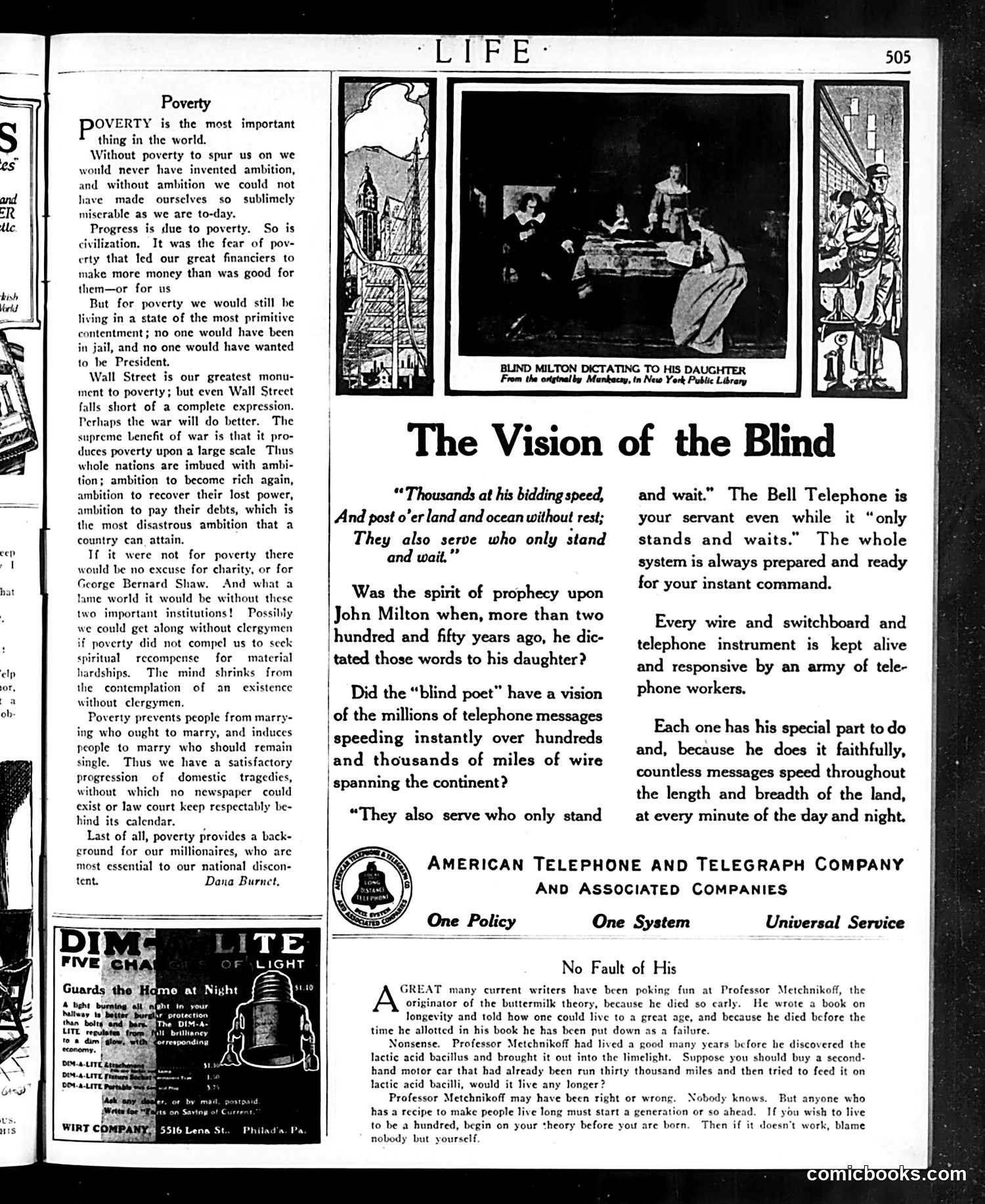
This page contains two distinct pieces: **"Poverty" Essay (left):** A satirical column by Dana Burnet arguing that poverty is socially beneficial—it motivates ambition, drives financiers, justifies charity and clergy, and provides a "background" for millionaires. The satire is deadpan: by praising poverty's role in creating war, debt, and domestic tragedy, Burnet critiques wealthy society's hypocrisy in valorizing poverty while benefiting from others' desperation. **"The Vision of the Blind" (center/right):** An AT&T advertisement comparing John Milton's 250-year-old poetry about service to the telephone system's reliability. The image shows "Blind Milton Dictating to His Daughter," invoking the poet's famous blindness while claiming he somehow prophetically envisioned instantaneous telephone communication. It's corporate advertising dressed as literary appreciation. **"No Fault of His" (bottom):** A brief defense of Professor Metchnikoff, whose buttermilk longevity theories failed because he died young—absurdly blaming the subject rather than the flawed theory.
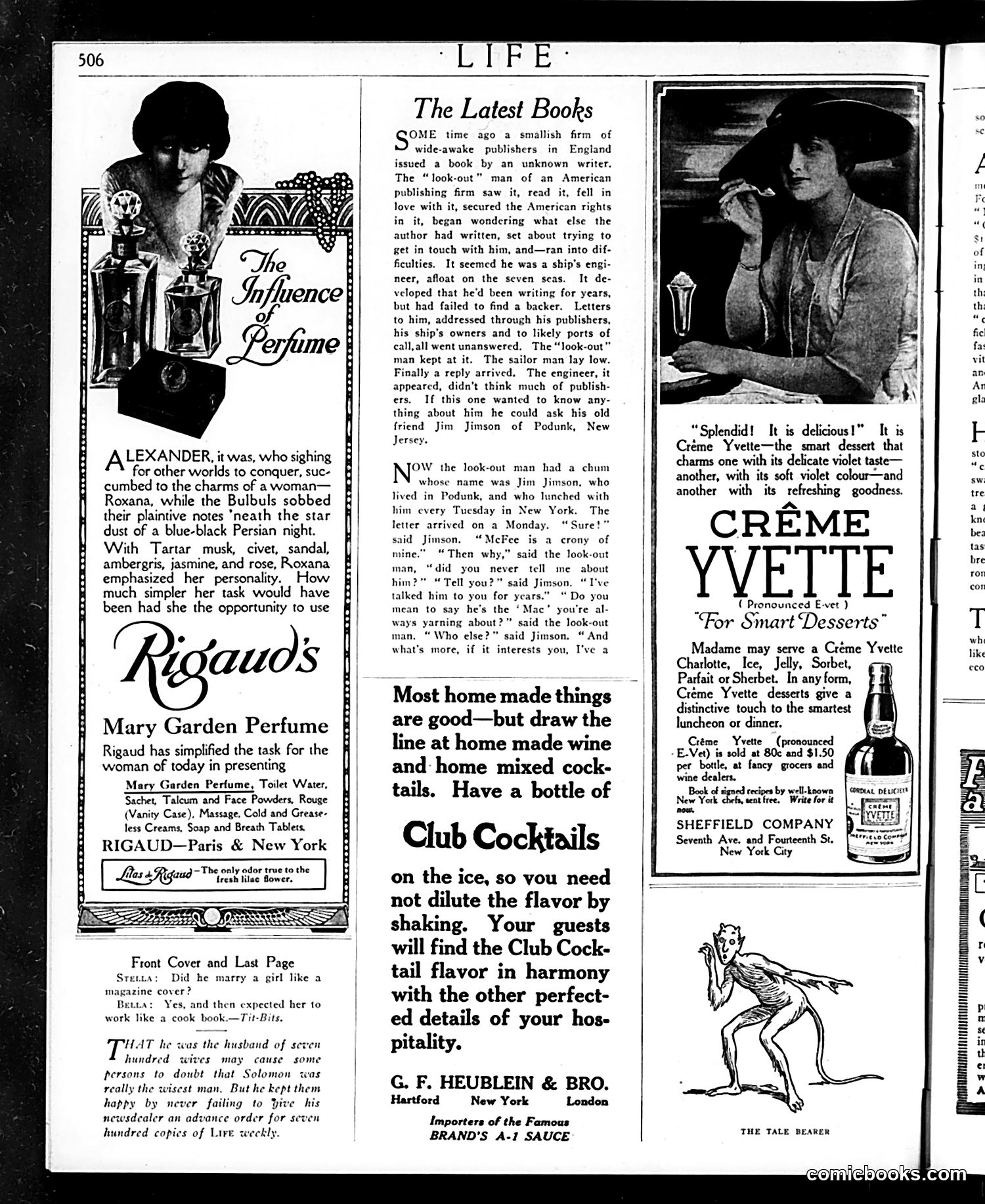
This page is primarily **advertising** with one brief editorial anecdote. The main content includes: **"The Latest Books"** — A short humorous story about a publisher's scout searching for an unknown author who turns out to be a ship's engineer. The payoff: the engineer's old friend Jim Jimson knew him all along but never mentioned it. This is a light anecdote about chance encounters and publishing, not satire. **The advertisements** dominate the page: - **Rigaud perfume** — Playfully references Alexander the Great and Roxana, comparing ancient seduction via exotic scents to modern perfume's simplified approach - **Club Cocktails** — Promotes ready-made cocktails for home entertaining - **Crème Yvette** — A violet-flavored liqueur marketed as a dessert ingredient for sophisticated hostesses The small joke at bottom mocks husbands who expect wives to balance magazine-cover looks with cookbook-quality housework—social commentary on unrealistic domestic expectations. Overall, this reflects 1920s consumer culture and gender expectations rather than political satire.
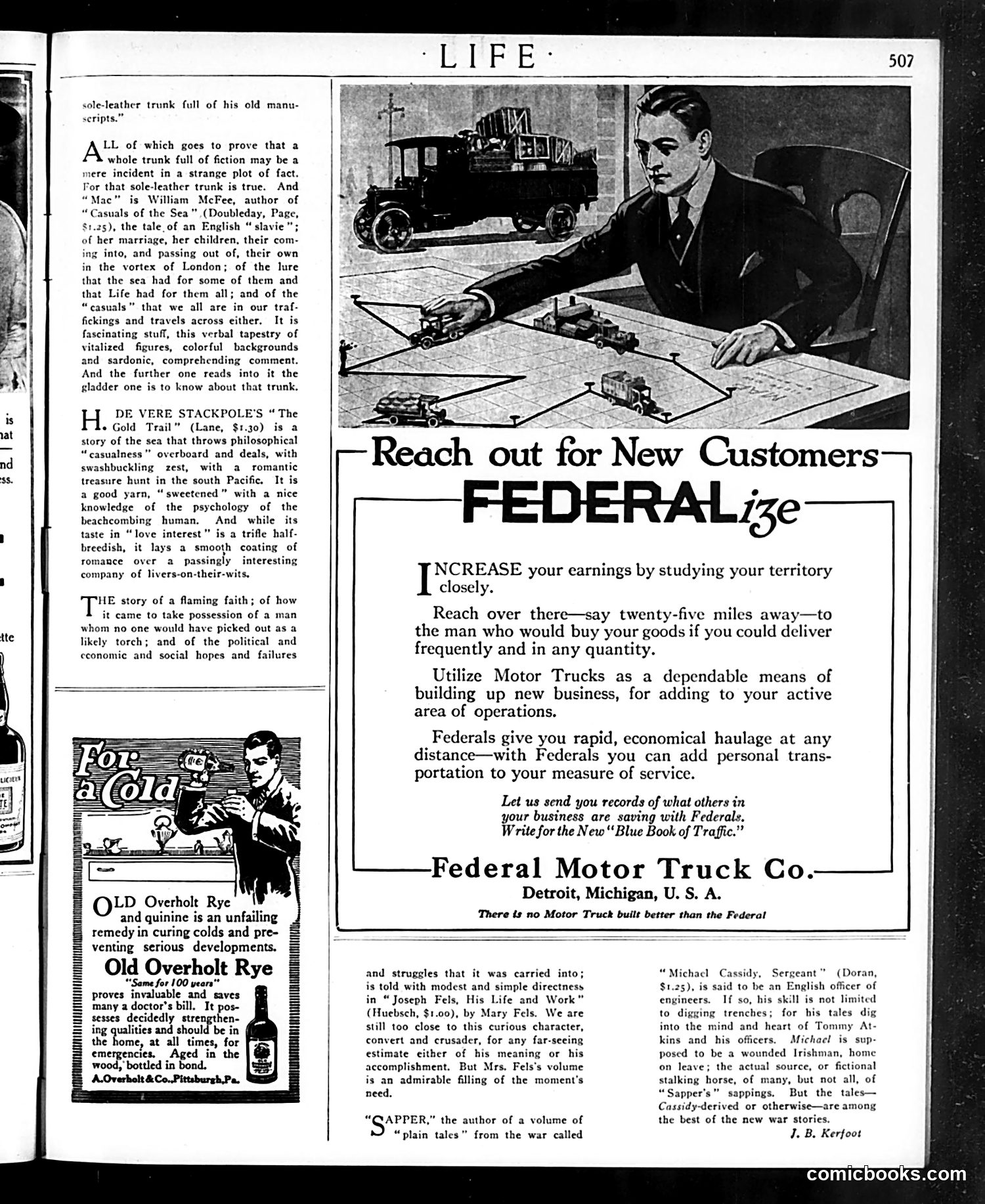
This page is primarily a **book review section** with an embedded advertisement—not a political cartoon. The reviews discuss three novels: William McFee's *Casuals of the Sea* (about English working-class life), De Vere Stackpole's *The Gold Trail* (a romantic sea adventure), and Mary Fels's biography of Joseph Fels (a labor reformer and "convert and crusader"). The main visual content is a **Federal Motor Truck Company advertisement** showing a businessman studying maps and toy trucks, promoting commercial vehicle sales by encouraging salesmen to expand their delivery territories. A smaller advertisement for **Old Overholt Rye whiskey** recommends the liquor as a home remedy for colds—reflecting pre-Prohibition era marketing. The page also reviews a war story collection attributed to "Sapper," purportedly told by a wounded Irish soldier named Michael Cassidy, though the author's identity appears somewhat obscured or fictionalized.
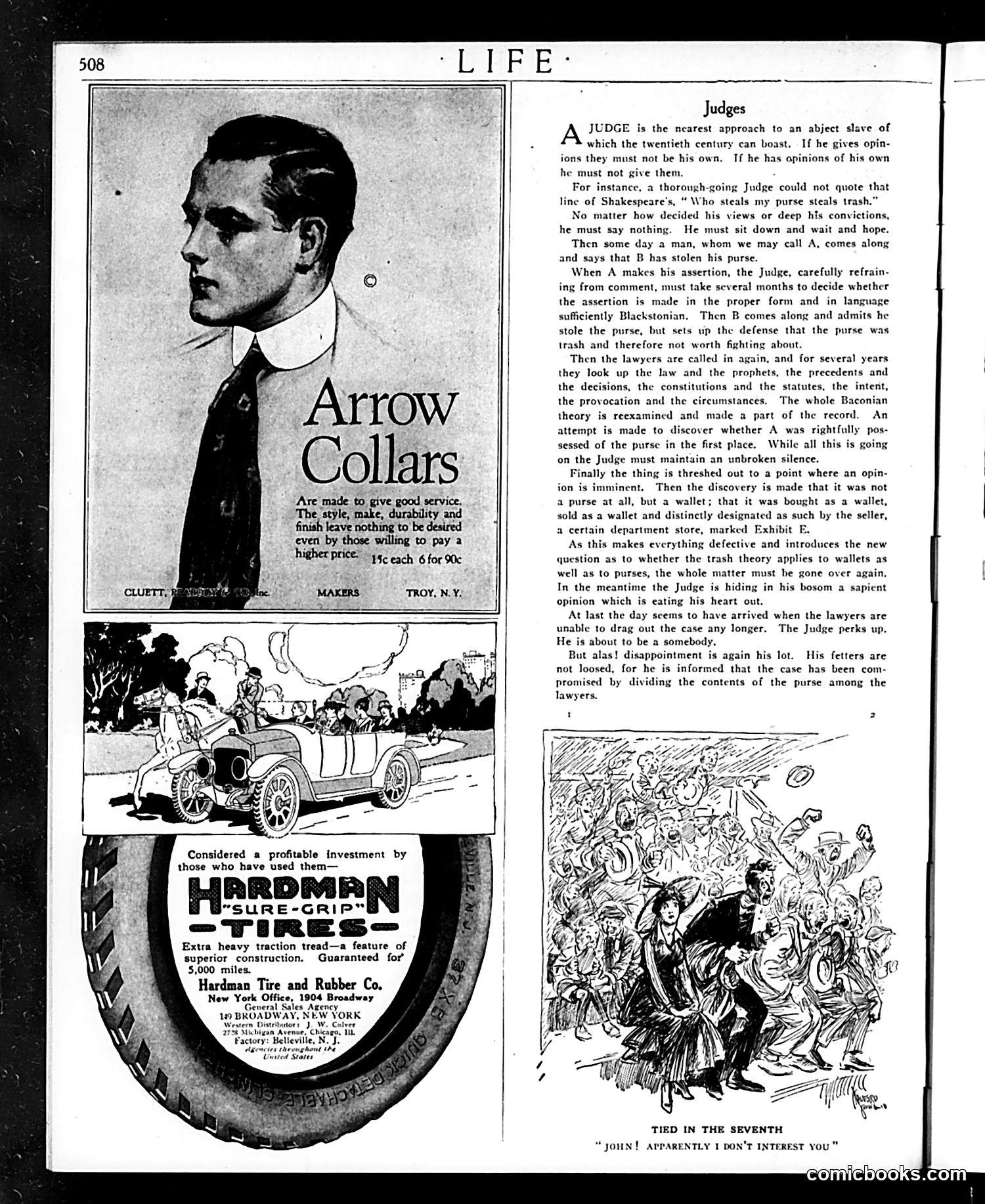
This article satirizes judicial restraint and the frustration of judges forced to remain silent throughout lengthy legal proceedings. The author uses a hypothetical case—person A accuses person B of stealing a purse—to illustrate how judges must suppress their opinions while lawyers conduct exhaustive research into precedents, constitutions, and circumstances over years. The satire's point: by the time a judge might finally render judgment, the case is often resolved through compromise (here, the lawyers dividing the purse's contents), leaving the judge's hard-won wisdom uselessly suppressed. The cartoon below ("Tied in the Seventh") visually reinforces this—showing a chaotic crowd scene with the caption about someone apparently disinterested, likely illustrating the public's frustration with judicial delays and non-involvement. The page also includes period advertisements for Arrow Collars and Hardman tires, typical of Life's commercial content.
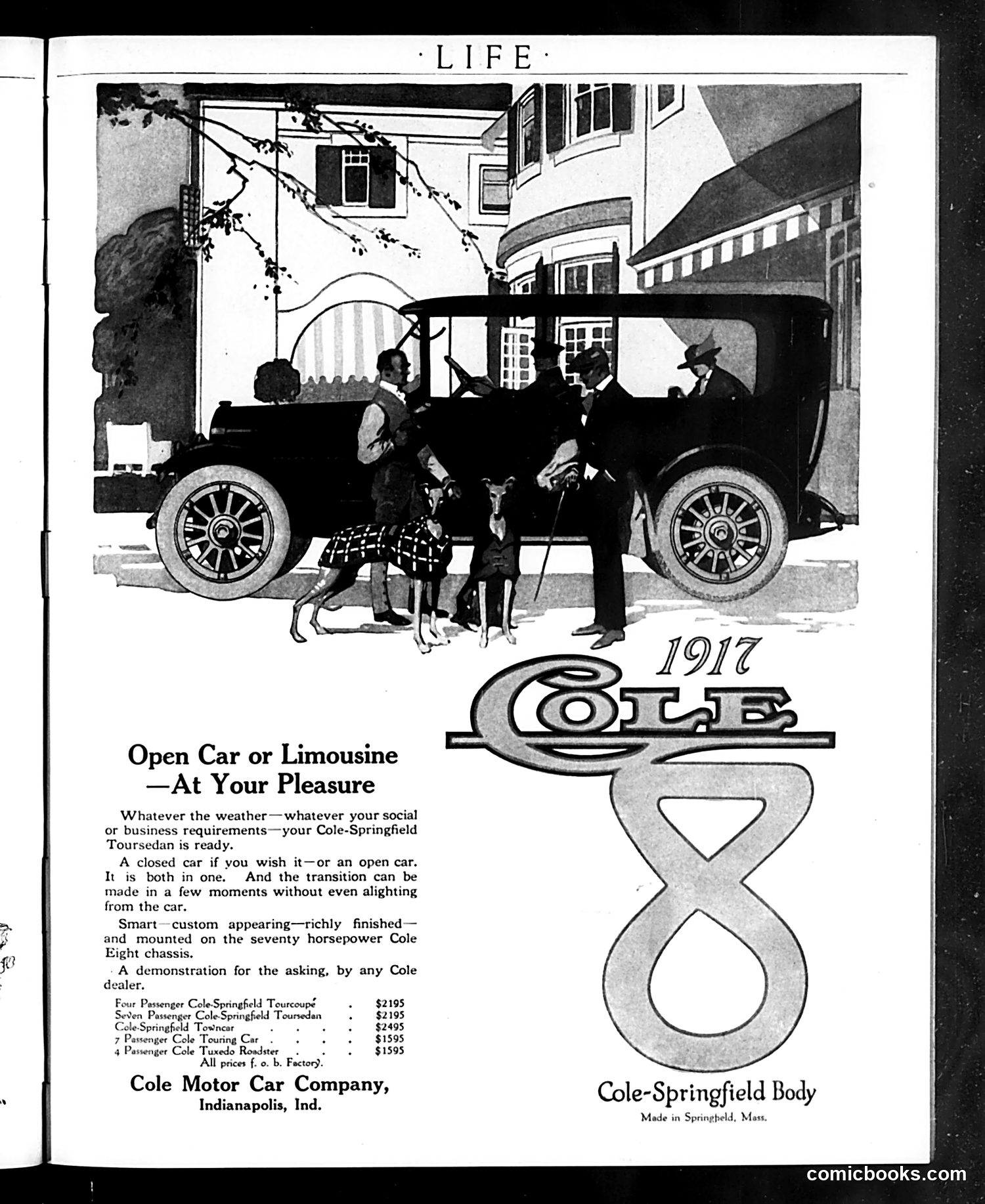
This is primarily a **1917 automobile advertisement**, not political satire. It promotes the Cole-Springfield Toursedan, a convertible vehicle with a retractable roof that could function as either an open car or enclosed limousine. The illustration shows a well-dressed family and chauffeur examining the vehicle in front of an upscale home, emphasizing the car's luxury and versatility. The advertisement's appeal targets affluent buyers by highlighting the practical advantage: owners could switch between open and closed configurations "without even alighting from the car." The "Cole-8" logo and pricing ($1,595–$2,495) indicate this was a premium product. There is no discernible political or satirical content—this is straightforward commercial promotion typical of *Life* magazine's advertising sections during the 1910s. The page demonstrates how early automotive innovations (convertible design) were marketed to wealthy consumers as status symbols and practical conveniences.
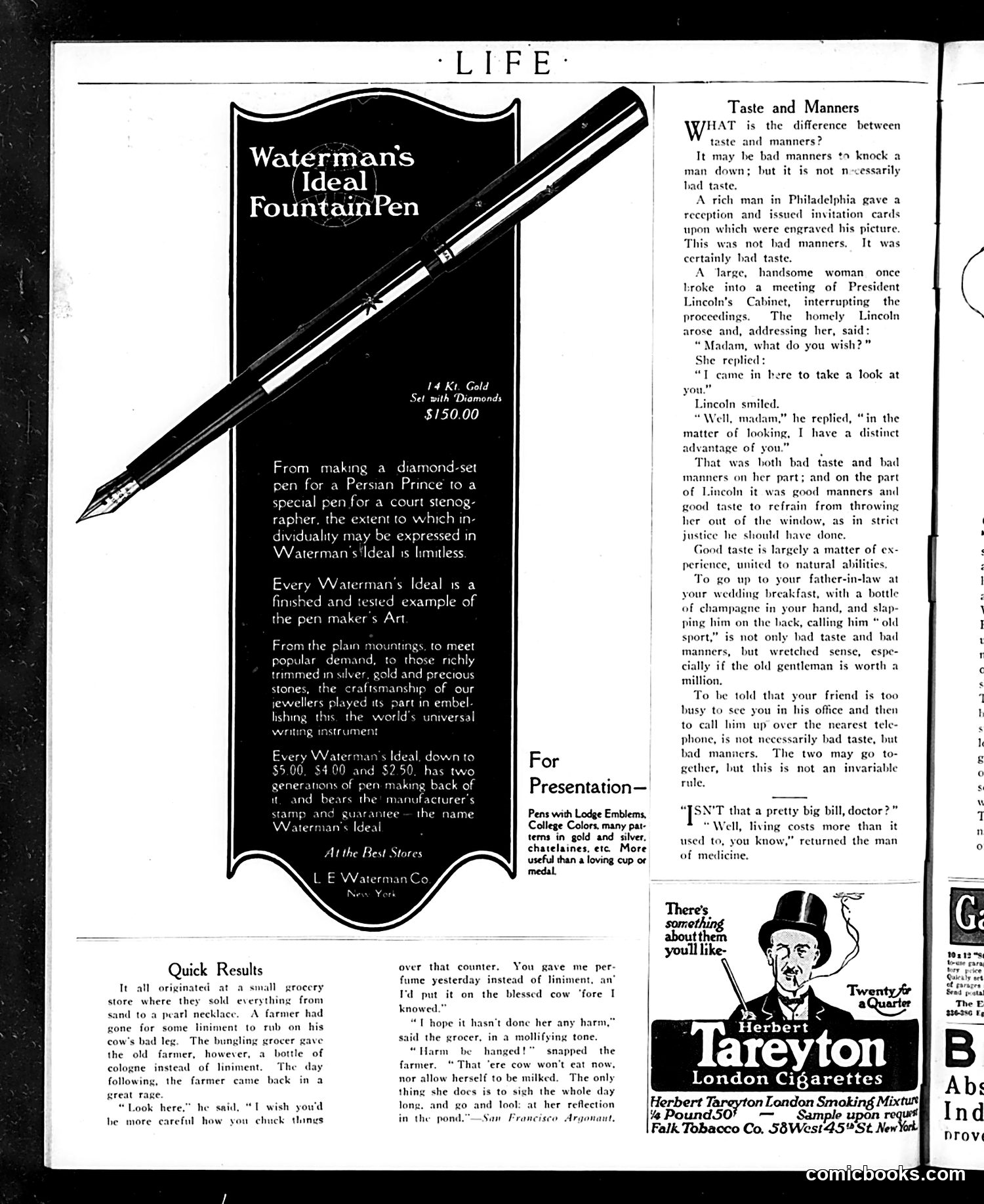
This page is primarily **advertising** for Waterman's fountain pens, occupying the left column with a luxury product pitch ($150 for a 14K gold pen set with diamonds). The pen is presented as a customizable gift for the wealthy. The right side contains **three distinct pieces**: 1. **"Taste and Manners"** — An essay distinguishing these concepts through anecdotes, notably featuring **Abraham Lincoln** receiving an interruption from a woman at his Cabinet meeting. Lincoln's witty, dignified response ("I have a distinct advantage of you") exemplifies good taste masking bad manners. The piece uses this historical incident to illustrate that good taste involves restraint and social grace. 2. **"Quick Results"** — A short humorous story about a farmer whose cow is accidentally given cologne instead of liniment, causing the cow to become vain and stop eating—a mild joke about vanity. 3. **Herbert Tareyton cigarette advertisement** at bottom right. The page represents typical *Life* magazine content: satirical essays mixed with luxury advertising and humor, aimed at educated, affluent readers.
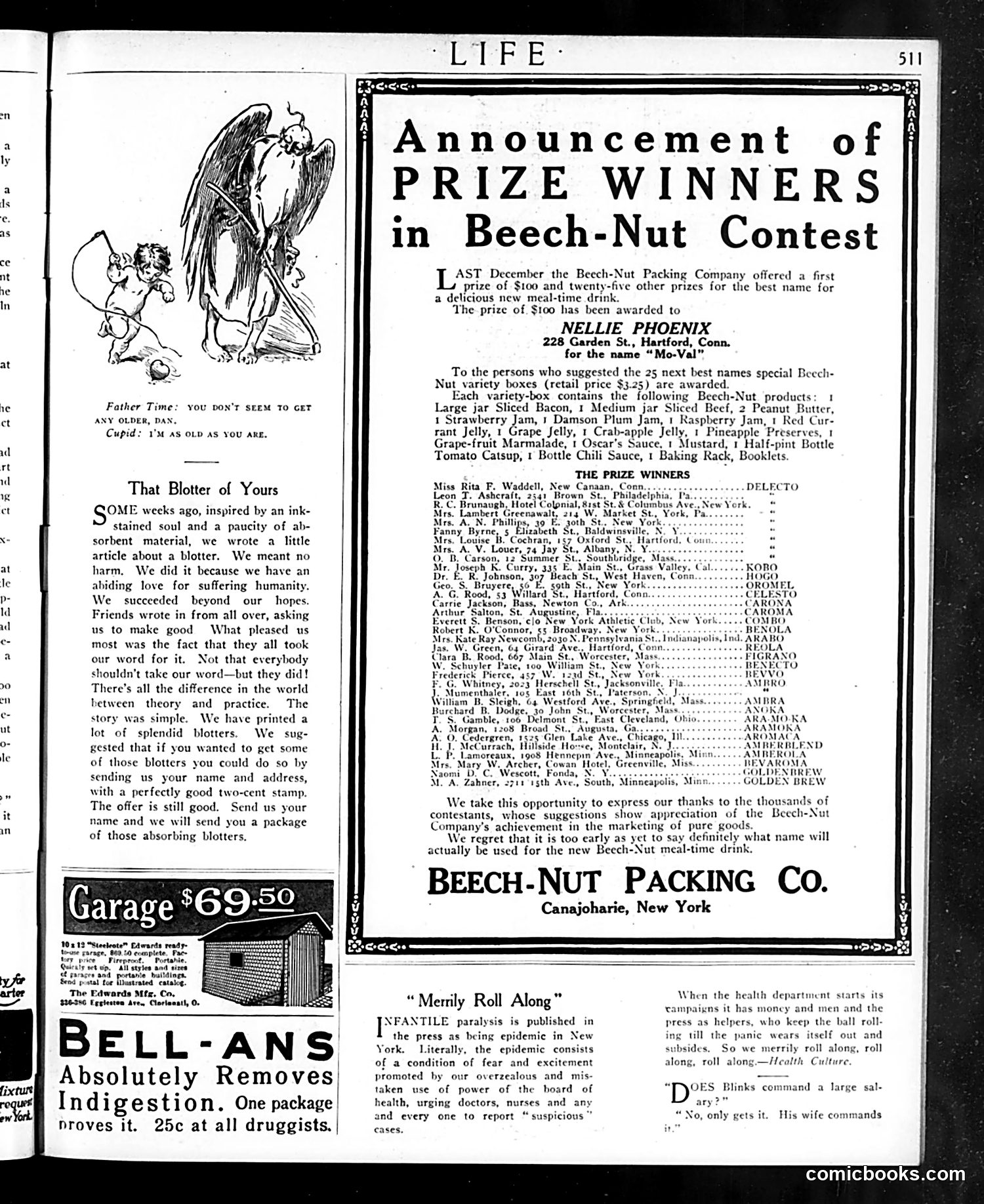
This page is primarily **advertising and contest announcements** rather than political satire or editorial cartoon content. The dominant feature is a **Beech-Nut Packing Company contest announcement** awarding prizes for naming a new meal-time drink. The $100 grand prize went to Nellie Phoenix of Hartford, Connecticut, for the name "Mo-Val." Twenty-five runners-up received variety boxes of Beech-Nut products. The small cartoon at upper left shows **Father Time and Cupid**—classical allegorical figures—with a brief joke about aging, unrelated to the advertisements below. The rest of the page contains typical period advertisements: a garage ($69.50), Bell-Ans indigestion remedy (25¢), and an article titled "That Blotter of Yours" inviting readers to request free blotters by mail. **This is a standard commercial page** with minimal satirical or political content—representative of how Life magazine balanced editorial humor with substantial advertising revenue.
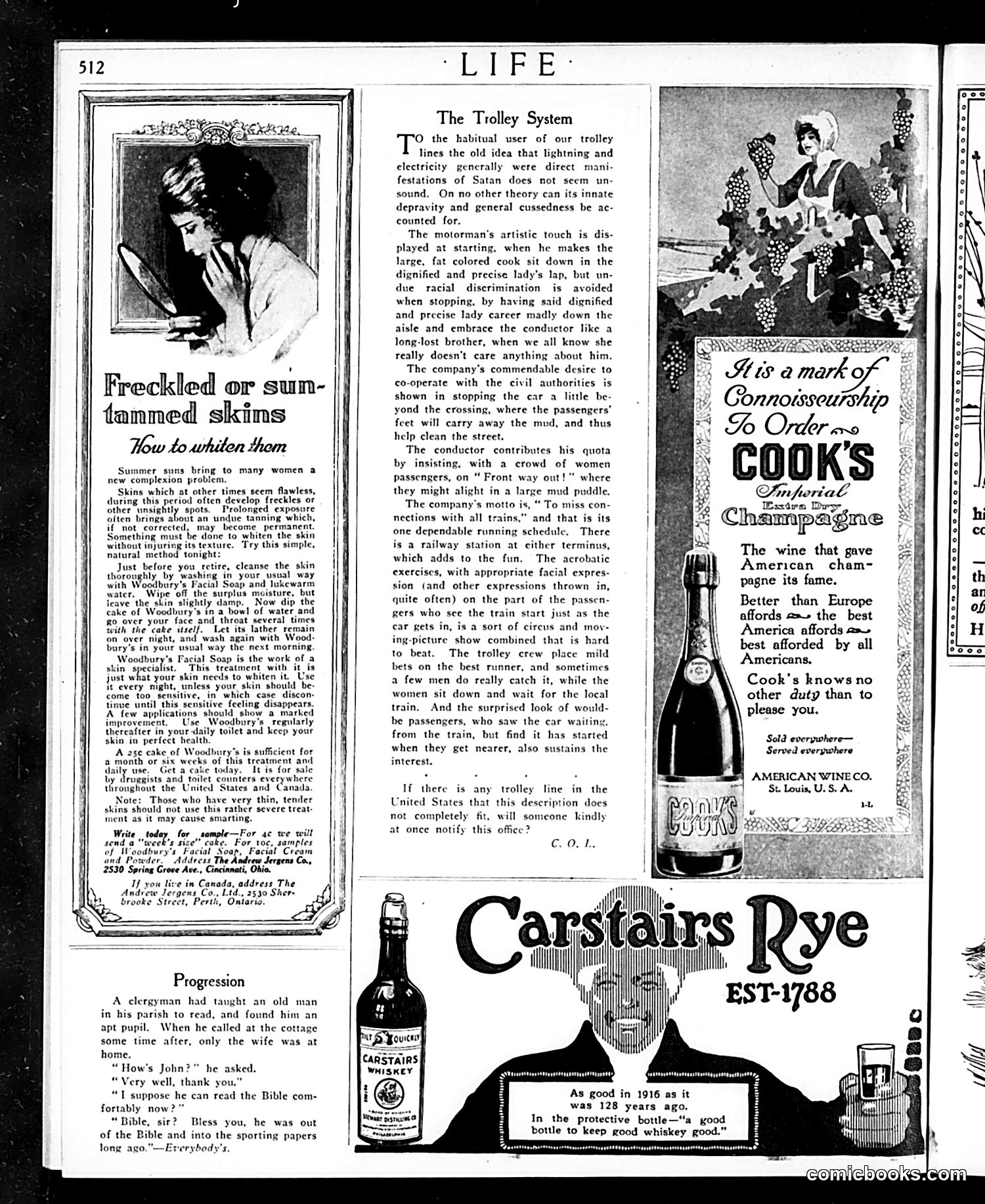
This piece is a sardonic critique of electric trolley/streetcar systems—then modern public transportation. The author uses exaggerated praise to expose actual failures: **The satire targets:** - **Dangerous acceleration**: The motorman causes passengers to tumble into each other regardless of race/class - **Poor stopping placement**: Cars stop beyond crossings, forcing passengers into mud puddles - **Unreliable scheduling**: The company's actual motto is missing connections with trains - **Incompetent staff**: Conductors deliberately direct passengers toward mud **The joke's mechanics**: By describing these flaws as "commendable" and "artistic," the author highlights their absurdity. References to Satan and electricity suggest the system feels chaotic and uncontrollable to riders. This reflects early-20th-century American frustrations with inadequate public transit infrastructure and indifferent operators—complaints that oddly remain relevant today.
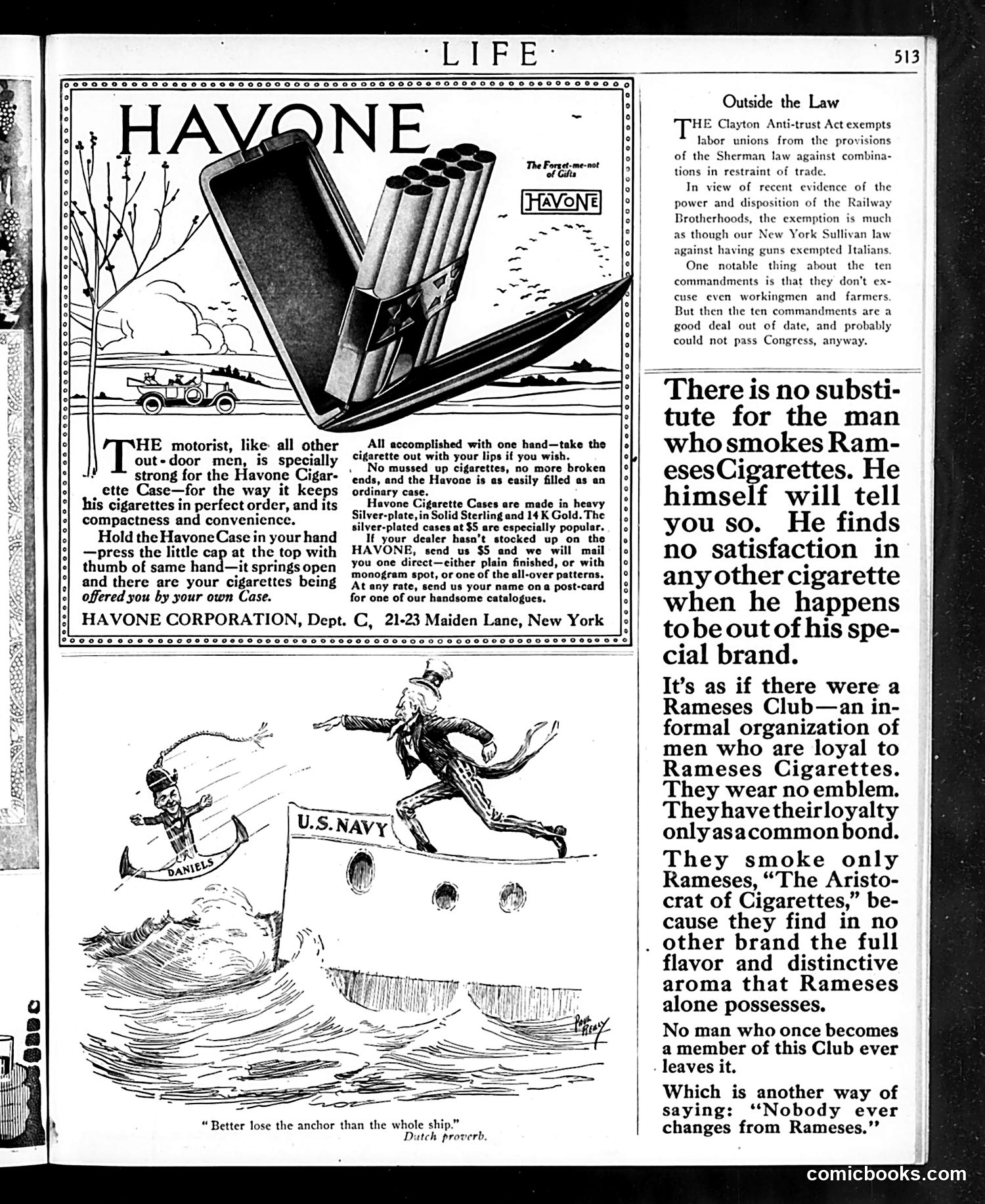
This page combines **two distinct elements**: a Havone cigarette case advertisement and a political editorial commentary. **The Advertisement** (left): Promotes a spring-loaded cigarette case for motorists and outdoor men, emphasizing convenience and cigarette preservation. The product imagery shows the mechanical case design. **The Editorial "Outside the Law"** (right): Critiques the Clayton Anti-trust Act's exemption of labor unions from restraint-of-trade laws. The author argues this exemption is dangerously excessive, comparing it to exempting Italians from gun restrictions under New York's Sullivan law. The piece sarcastically suggests even the Ten Commandments couldn't pass Congress in its current form—a jab at both labor unions' power and Congressional dysfunction. **The Naval Cartoon** (lower left): Depicts sailors in rough seas with the caption "Better lose the anchor than the whole ship" (Dutch proverb), apparently illustrating a military/nautical lesson about sacrifice. The **Rameses Cigarettes advertisement** (right column) uses brand loyalty rhetoric, claiming smokers become devoted club members who never switch brands.
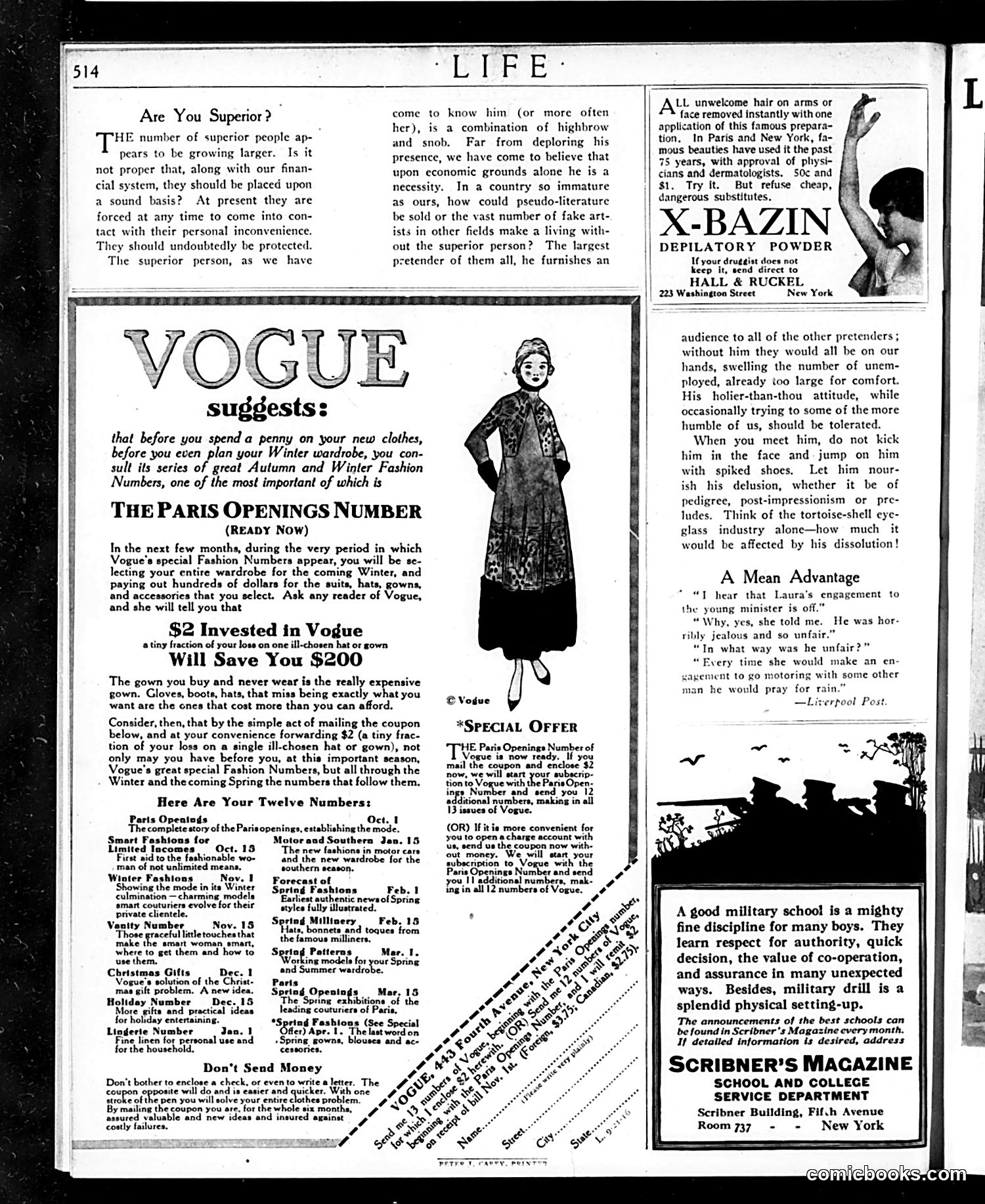
This page satirizes **social snobbery and class pretension** in early 20th-century America. The opening article "Are You Superior?" mocks the emerging "superior person"—someone defined by highbrow affectations and snobbish behavior. The satire suggests that while such people are economically unnecessary and socially inconvenient, they've become a fixture of immature societies like America's. The piece critiques how pseudo-intellectuals and fake artists thrive by catering to this superior class, which lacks genuine merit but maintains social power through attitude alone. The author sarcastically notes their "holier-than-thou" pretensions should be tolerated, then suggests humiliating them—kicking them, mocking their delusions—to expose the tortoise-shell eyeglass industry's dependence on their vanity. The surrounding **Vogue advertisements** ironically reinforce the satire by targeting exactly this demographic: wealthy women obsessed with fashion authority and exclusivity, willing to spend lavishly ($2 for a magazine to save $200 on clothes) to appear superior.