
Life, 1916-09-21 · page 10 of 44
Life — September 21, 1916 — page 10: what you’re looking at
What you’re looking at
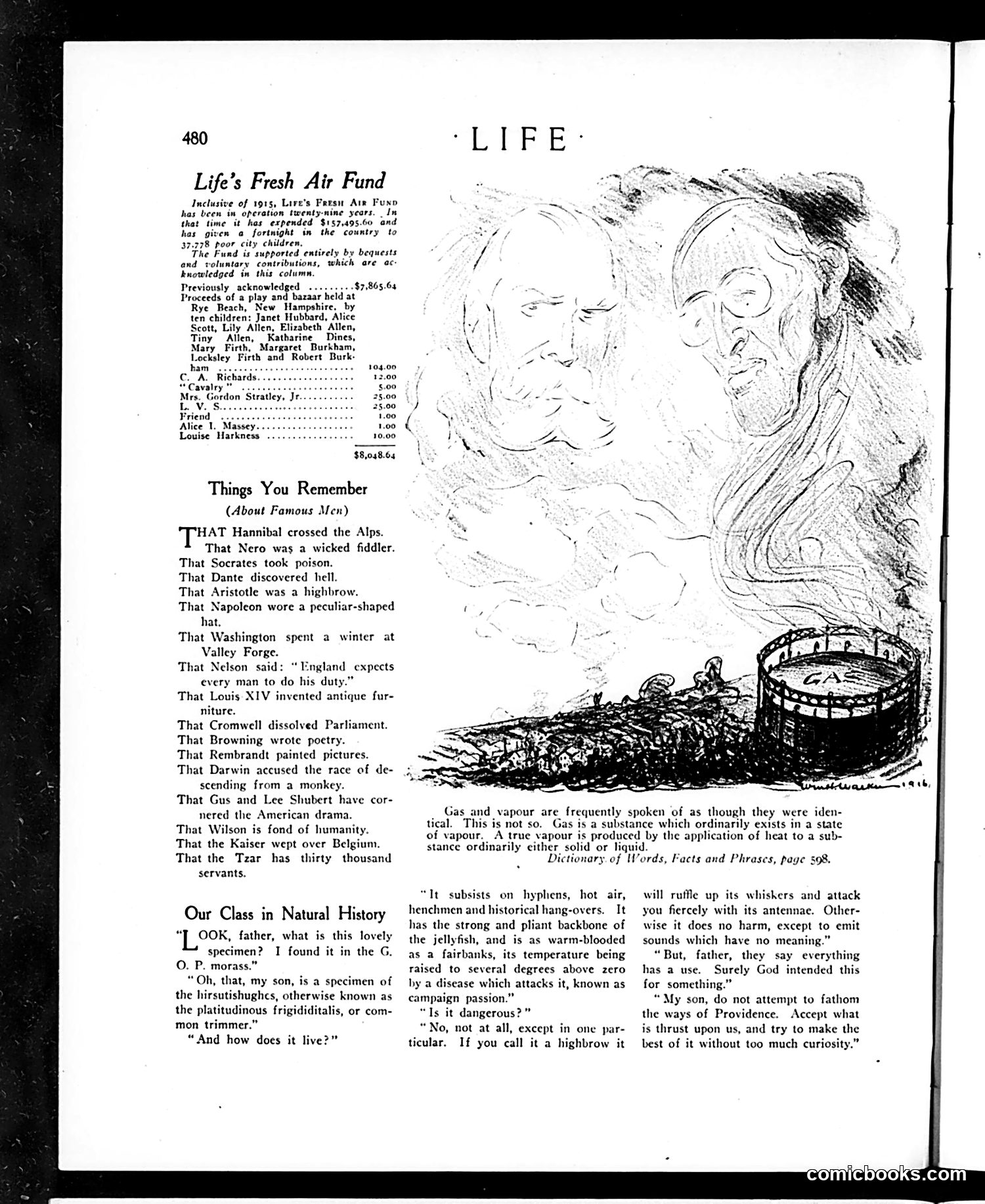
This page contains three distinct sections: 1. **Life's Fresh Air Fund** - A charitable fundraising announcement listing donors and contributions for children's fresh air outings, a Progressive Era charitable initiative. 2. **"Things You Remember (About Famous Men)"** - A humorous list of historical facts/trivia about famous figures (Hannibal, Nero, Socrates, Napoleon, etc.), presented as memorable anecdotes rather than serious history. 3. **"Our Class in Natural History"** - A dialogue between a father and son about a specimen, appears to be a comedic naturalist exchange, possibly poking fun at amateur naturalists or overly-serious scientific pedagogy. The page includes sketch illustrations accompanying these pieces. The overall tone suggests light satirical humor typical of early-20th-century Life magazine—mixing charitable announcements with gentle mockery of historical pretension and educational pomposity.
📄 Transcribed text from this page (OCR, searchable)
Machine-transcribed from the original scan — historical spelling and the odd misread are preserved.
480 Life’s Fresh Air Fund Inclusive of 1915, Live’s Fees Ate Fux has Veen in operation twenty-nine years. . In thet time it has expended $157,495.60 and has given a fortnight in the country to 37.778 poor city children, The Fund is supported entirely by bequests and voluntary contributions, which are ac- knowledged in this column, Previously acknowledged . Proceeds of a play and bazaai Rye Beach, New Hampshire. by ten children: Janet Hubbard, Alice Scott, Lily Ailen, Elizabeth Allen, Tiny’ Allen, Katharine Dine Mary Firth,” Margaret Burkha $7,865.64 Locksley Firth and Robert Burk- Mrs. Gordon Stratley, y Louise Harkness $8,048.64 Things You Remember (About Famous Men) 'HAT Hannibal crossed the Alps. That Nero was a wicked fiddler. That Socrates took poison. That Dante discovered hell. That Aristotle was a highbrow. That Napoleon wore a peculiar-shaped hat. That Washington Valley Forge. That Nelson said: “England expects every man to do his duty.” That Louis XIV invented antique fur- niture. That Cromwell dissolved Parliament. That Browning wrote poetry. That Rembrandt painted pictures. That Darwin accused the race of de- scending from a monkey. That Gus and Lee Shubert have cor- nered the American drama. That Wilson is fond of humanity. That the Kaiser wept over Belgium. That the Tzar has thirty thousand servants. spent a winter at Our Class in Natural History “I OOK, father, what is this lovely specimen? I found it in the G. O. P. morass.” “Oh, that, my son, is a specimen of the hirsutishughcs, otherwise known as the platitudinous frigididitalis, or com- mon trimmer.” “And how does it live?” d_vapour are f quently spoken of as though they were iden- tical. This is not so. Gas is a substance which ordinarily exists in a state of vapour. A true vapour is produced by the application of heat to a sub- stance ordinarily cither solid or liquid. Dictionary. of Words, Facts and Phrases, page 308. “Tt subsists on hyphens, hot air, henchmen and historical hang-overs. It has the strong and pliant backbone of the jellyfish, and is as warm-blooded as a fairbanks, its temperature being raised to several degrees above zero by a disease which attacks it, known as campaign passion.” “Is it dangerous?” “No, not at all, except in one par- ticular, If you call it a highbrow it will ruffle up its whiskers and attack you fiercely with its antennae. Other- wise it does no harm, except to emit sounds which have no meaning.” “But, father, they say everything has a use. Surely God intended this for something.” “My son, do not attempt to fathom the ways of Providence. Accept what is thrust upon us, and try to make the best of it without too much curiosity.”