
Life, 1916-09-21 · page 37 of 44
Life — September 21, 1916 — page 37: what you’re looking at
What you’re looking at
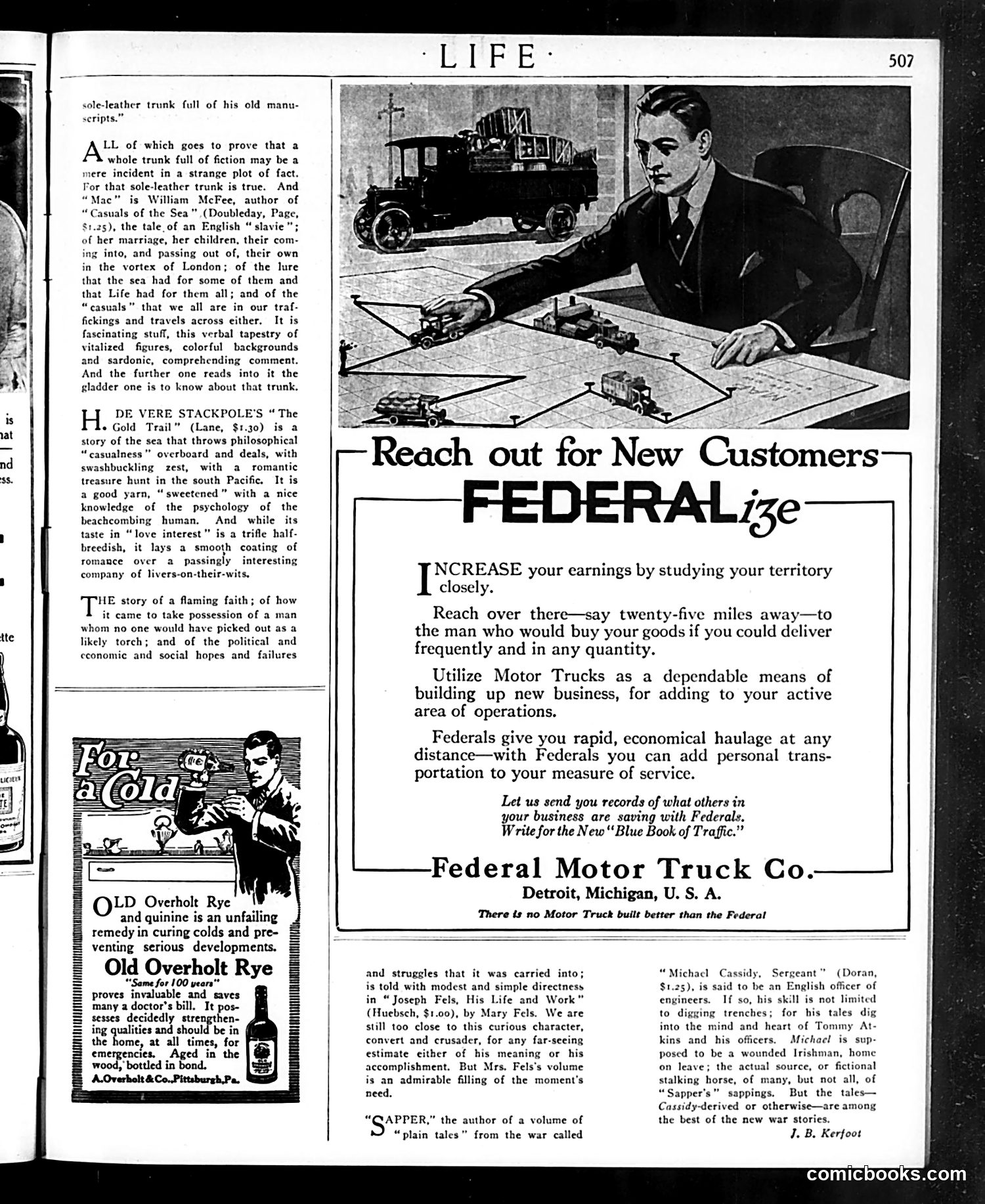
This page is primarily a **book review section** with an embedded advertisement—not a political cartoon. The reviews discuss three novels: William McFee's *Casuals of the Sea* (about English working-class life), De Vere Stackpole's *The Gold Trail* (a romantic sea adventure), and Mary Fels's biography of Joseph Fels (a labor reformer and "convert and crusader"). The main visual content is a **Federal Motor Truck Company advertisement** showing a businessman studying maps and toy trucks, promoting commercial vehicle sales by encouraging salesmen to expand their delivery territories. A smaller advertisement for **Old Overholt Rye whiskey** recommends the liquor as a home remedy for colds—reflecting pre-Prohibition era marketing. The page also reviews a war story collection attributed to "Sapper," purportedly told by a wounded Irish soldier named Michael Cassidy, though the author's identity appears somewhat obscured or fictionalized.
📄 Transcribed text from this page (OCR, searchable)
Machine-transcribed from the original scan — historical spelling and the odd misread are preserved.
sole-leather trunk full of his old manu- scripts.” LL of which goes to prove that a whole trunk full of fiction may be a mere incident in a strange plot of fact. For that sole-leather trunk is true. And “Mac” is William McFee, author of “Casuals of the Sea” (Doubleday, Page, $1.25), the tale of an English “ slavie"; of her marriage, her children, their com- ing into, and passing out of, their own in the vortex of London; of the lure that the sea had for some of them and that Life had for them all; and of the “casuals” that we all are in our traf- fickings and travels across either. It is fascinating stuff, this verbal tapestry of vitalized figures, colorful backgrounds and sardonic, comprehending comment. And the further one reads into it the gladder one is to know about that trunk. DE VERE STACKPOLE'S “ The Gold Trail” (Lane, $1.30) is a story of the sea that throws philosophical “casualness” overboard and deals, with swashbuckling zest, with a romantic treasure hunt in the south Pacific, It is a good yarn, “sweetened” with a nice knowledge of the psychology of the beachcombing human. And while its taste in “love interest” is a trifle half- breedish, it lays a smooth coating of romance over a passing! interesting company of livers-on-their-wits. HE story of a flaming faith; of how it came to take possession of a man whom no one would have picked out as a likely torch; and of the political and economic and social hopes and failures OLD Overholt Rye and quinine is an unfailing remedy in curing colds and pre- venting serious developments. Old Overholt ed “Same for 100 years" proves invaluable and saves many a doctor's bill. It pos- sesses decidedly strengthen- ing qualities and should be in the home, at all times, for emergencies. Aged in the wood, bottled in bond, A.Overholt &Co..Pittsburgh,Pa, Reach out oft New Customers FEDERAL ie NCREASE your earnings by studying your territory closely. Reach over there—say twenty-five miles away—to the man who would buy your goods if you could deliver frequently and in any quantity. Utilize Motor Trucks as a dependable means of building up new business, for adding to your active area of operations. Federals give you rapid, economical haulage at any distance—with Federals you can add personal trans- portation to your measure of service. Let us send you records of what others in your business are saving with Federals, Write for the New ‘Blue Book of Traffic.” Federal Motor Truck Co. Detroit, Michigan, U. S. A. There ts no Motor Truck built better than the Federal and struggles that it was carried into; is told with modest and simple directness in “Joseph Fels, His Life and Work” (Huebsch, $1.00), by Mary Fels. We are still too close to this curious character, convert and crusader, for any far-seeing estimate either of his meaning or his accomplishment, But Mrs. Fels’s volume is an admirable filling of the moment's need. APPER,” the author of a volume of “plain tales” from the war called “Michacl Cassidy, Sergeant” (Doran, is said to be an English officer of engineers. If so, his skill is not limited to digging trenches; for his tales dig into the mind and heart of Tommy At- kins and his officers. Michael is sup- posed to be a wounded Irishman, home on leave; the actual source, or fictional stalking horse, of many, but not all, of “Sapper's” sappings. But the tales— Cassidy-derived or otherwise—are among the best of the new war stories. 7. B. Kerfoot comicbooks.com