
Life, 1916-09-21 · page 20 of 44
Life — September 21, 1916 — page 20: what you’re looking at
What you’re looking at
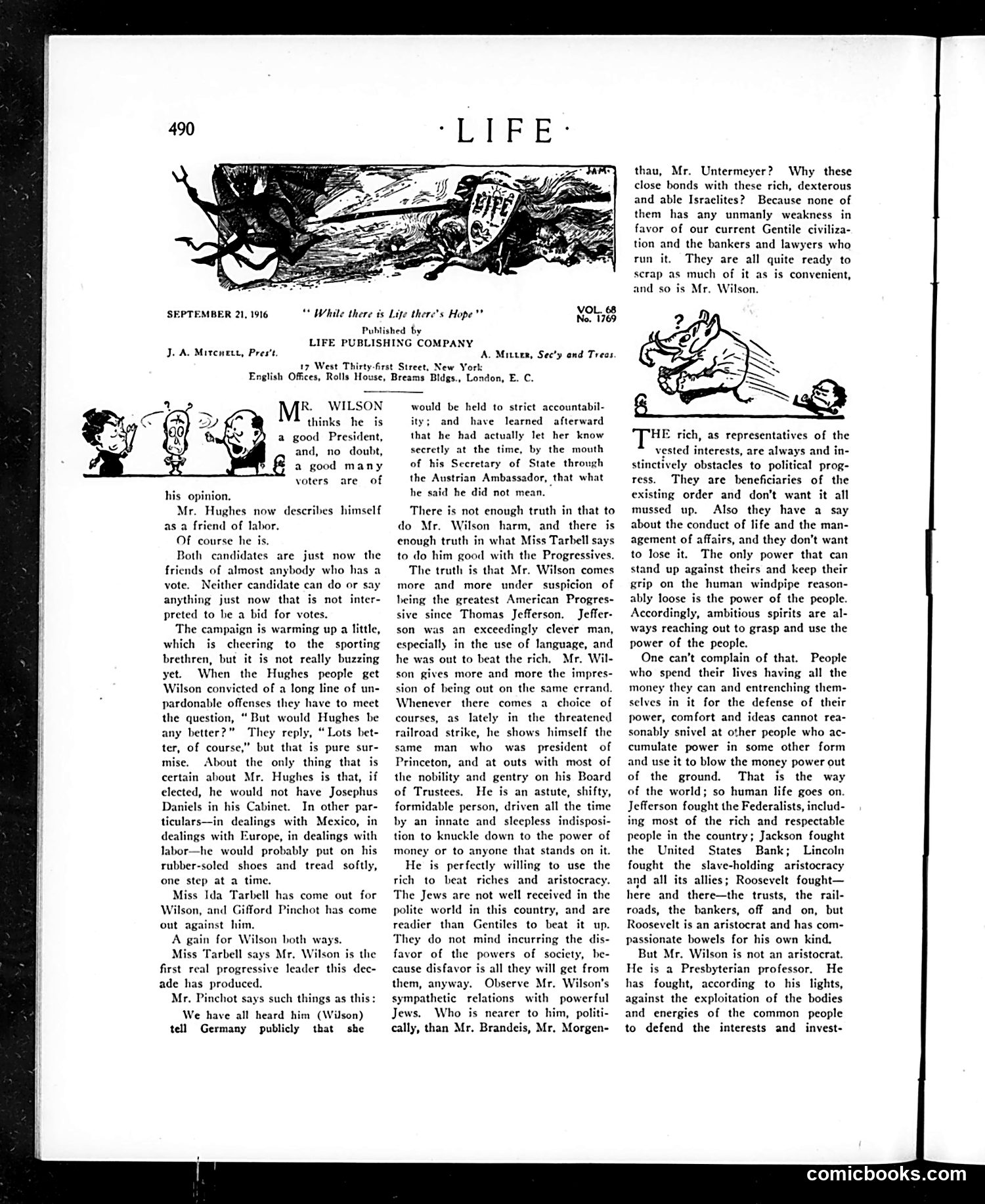
This article defends President Woodrow Wilson against Republican challenger Charles Evans Hughes during the 1916 election. The cartoons (small illustrations at left) show politicians courting voters. The text argues Wilson is genuinely progressive—more so than Hughes—comparing him favorably to Thomas Jefferson. It claims Wilson opposes entrenched wealth and power, evidenced by his willingness to challenge Princeton's board of trustees and his sympathetic relationships with prominent Jewish progressives like Louis Brandeis and others. The piece dismisses critic Gifford Pinchot's accusations that Wilson secretly contradicted public statements to Germany. It characterizes Wilson's progressive stance as driven by an internal opposition to "the power of money," distinguishing him from typical politicians merely bidding for votes. The article's tone is notably antisemitic, portraying Jewish supporters as useful allies precisely because they lack "unmanly weakness" favoring "current Gentile civilization"—a jarring reflection of 1916 prejudices.
📄 Transcribed text from this page (OCR, searchable)
Machine-transcribed from the original scan — historical spelling and the odd misread are preserved.
SEPTEMBER 21, 1916 “* While there ts Life there's Hope"* Published by LIFE PUBLISHING COMPANY J. A. Mitenent, Pres't. A. Mitten, Sec’y and Treas 17 West Thirty-first Street, New York English Offices, Rolls House, Breams Bldgs., London, E. C. R. WILSON thinks he is a good President, and, no doubt, a good many voters are of his opinion, Mr. Hughes now describes himself as a friend of labor. OF course he is. Both candidates are just now the friends of almost anybody who has a vote. Neither candidate can do or say anything just now that is not inter- preted to be a bid for votes. The campaign is warming up a little, which is cheering to the sporting brethren, but it is not really buzzing yet. When the Hughes people get Wilson convicted of a long line of un- pardonable offenses they have to meet the question, “But would Hughes be any better?” They reply, “ Lots bet- ter, of course,” but that is pure sur- mise. About the only thing that is certain about Mr. Hughes is that, if elected, he would not have Josephus Daniels in his Cabinet. In other par- ticulars—in dealings with Mexico, in dealings with Europe, in dealings with labor—he would probably put on his rubber-soled shoes and tread softly, one step at a time. Miss Ida Tarbell has come out for Wilson, and Gifford Pinchot has come out against him. A gain for Wilson both ways. Miss Tarbell says Mr. Wilson is the first real progressive leader this dec- ade has produced. Mr. Pinchot says such things as this: We have all heard him (Wilson) tell Germany publicly that she would be held to strict accountabil- ity; and have learned afterward that he had actually let her know secretly at the time, by the mouth of his Sceretary of State through the Austrian Ambassador, that what he said he did not mean.” There is not enough truth in that to do Mr. Wilson harm, and there is enough truth in what Miss Tarbell says to do him good with the Progressives. The truth is that Mr. Wilson comes more and more under suspicion of being the greatest American Progres- sive since Thomas Jefferson. Jeffer- son was an exceedingly clever man, especially in the use of language, and he was out to beat the rich, Mr. Wil- son gives more and more the impres- sion of being out on the same errand. Whenever there comes a choice of courses, as lately in the threatened railroad strike, he shows himself the same man who was president of Princeton, and at outs with most of the nobility and gentry on his Board of Trustees. He is an astute, shifty, formidable person, driven all the time by an innate and sleepless indisposi- tion to knuckle down to the power of money or to anyone that stands on it. He is perfectly willing to use the rich to beat riches and aristocracy. The Jews are not well received in the polite world in this country, and are readier than Gentiles to beat it up. They do not mind incurring the di favor of the powers of socicty, be- cause disfavor is all they will get from them, anyway, Observe Mr. Wilson's sympathetic relations with powerful Jews, Who is nearer to him, politi- cally, than Mr. Brandeis, Mr. Morgen- thau, Mr. Untermeyer? Why these close bonds with these rich, dexterous and able Israclites? Because none of them has any unmanly weakness in favor of our current Gentile civiliza- tion and the bankers and lawyers who run it. They are all quite ready to scrap as much of it as is convenient, and so is Mr. Wilson. W Ss E rich, as representatives of the ted interests, are always and in- ely obstacles to political prog- ress. They are beneficiaries of the existing order and don’t want it all mussed up. Also they have a say about the conduct of life and the man- agement of affairs, and they don’t want to lose it. The only power that can stand up against theirs and keep their grip on the human windpipe reason- ably loose is the power of the people. Accordingly, ambitious spirits are al- ways reaching out to grasp and use the power of the people. One can’t complain of that. People who spend their lives having all the money they can and entrenching them- selves in it for the defense of their power, comfort and ideas cannot rea- sonably snivel at other people who ac- cumulate power in some other form and use it to blow the money power out of the ground. That is the way of the world; so human life goes on. Jefferson fought the Federalists, includ- ing most of the rich and respectable people in the country; Jackson fought the United States Bank; Lincoln fought the slave-holding aristocracy and all its allies; Roosevelt fought— here and there—the trusts, the rail- roads, the bankers, off and on, but Roosevelt is an aristocrat and has com- passionate bowels for his own kind. But Mr. Wilson is not an aristocrat. He is a Presbyterian professor. He has fought, according to his lights, against the exploitation of the bodies and energies of the common people to defend the interests and invest- stinct! comicbooks.com