
Life, 1916-09-21 · page 25 of 44
Life — September 21, 1916 — page 25: what you’re looking at
What you’re looking at
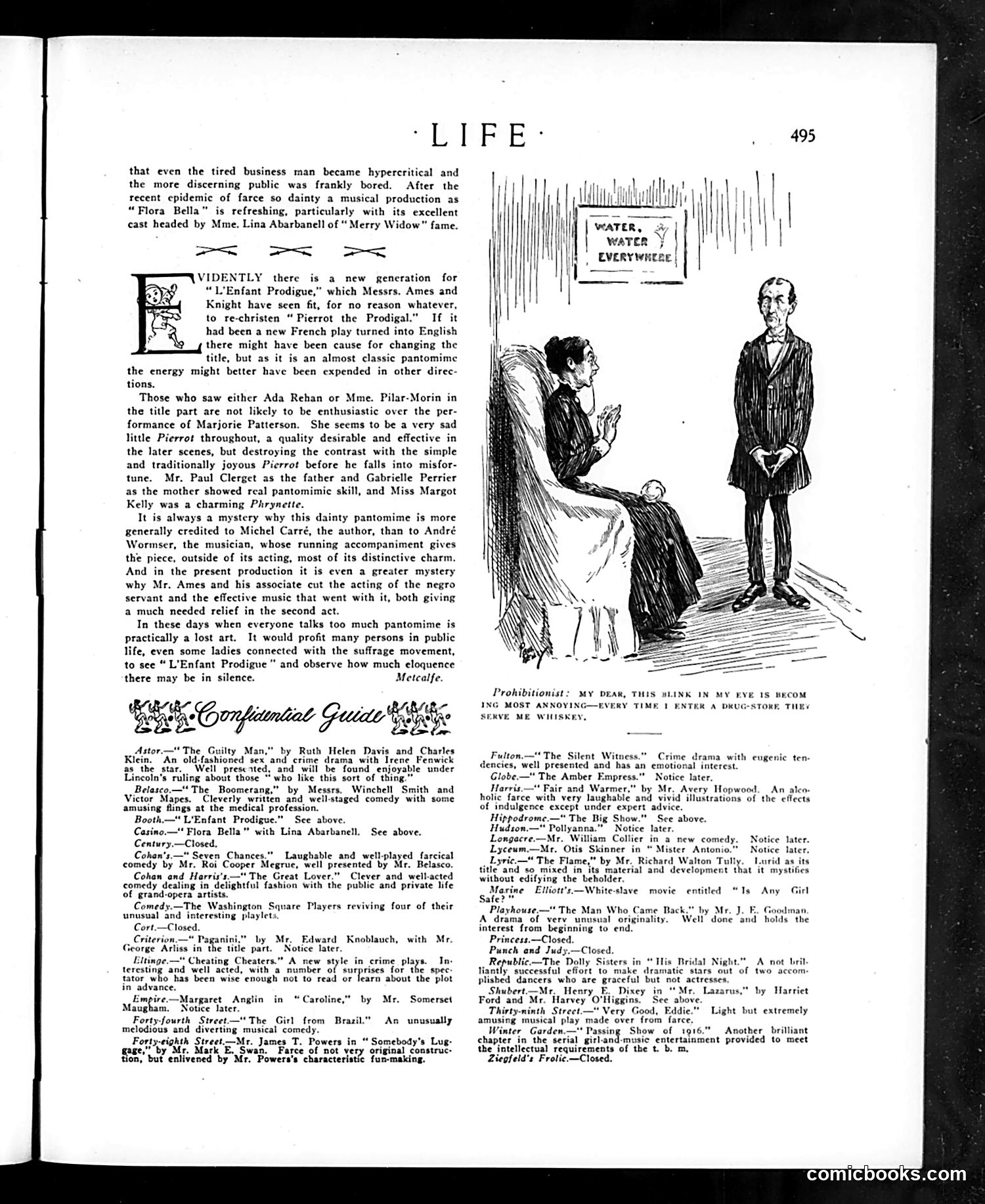
This page is a theater review section covering Broadway productions. The main illustration shows two figures in what appears to be a scene from "L'Enfant Prodigue" (retitled "Pierrot the Prodigal")—likely depicting the title character and another actor. The cartoon's implicit satire concerns the **renaming of a classic French pantomime**. The critic (Metcalfe) questions why producers Ames and Knight changed the traditional title, suggesting the energy wasted on this unnecessary alteration could have improved the actual production. The review also contains **subtle social commentary**: it suggests that pantomime's value—communicating through silence rather than words—would benefit "persons in public life, even some ladies connected with the suffrage movement," implying that suffragettes talk too much. This reflects the era's anti-suffrage sentiment among some cultural critics. The page primarily functions as theater criticism rather than political satire, evaluating various Broadway shows with mixed reviews.
📄 Transcribed text from this page (OCR, searchable)
Machine-transcribed from the original scan — historical spelling and the odd misread are preserved.
“ETRE - that even the tired business man became hypercritical and the more discerning public was frankly bored. After the recent cpidemic of farce so dainty a musical production as “Flora Bella” is refreshing, particularly with its excellent cast headed by Mme. Lina Abarbanell of “ Merry Widow” fame. os == VIDENTLY there is a new generation for “L’Enfant Prodigue,” which Messrs. Ames and Knight have scen fit, for no reason whatever, to re-christen “ Pierrot the Prodigal.” If it had been a new French play turned into English there might have been cause for changing the title, but as it is an almost classic pantomime the energy might better have been expended in other direc- tions. Those who saw either Ada Rehan or Mme. Pilar-Morin in the title part are not likely to be enthusiastic over the per- formance of Marjorie Patterson. She seems to be a very sad little Pierrot throughout, a quality desirable and effective in the later scenes, but destroying the contrast with the simple and traditionally joyous Pierrot before he falls into misfor- tune. Mr. Paul Clerget as the father and Gabrielle Perrier as the mother showed real pantomimic skill, and Miss Margot Kelly was a charming Phrynette. It is always a mystery why this dainty pantomime is more generally credited to Michel Carré, the author, than to André Wormser, the musician, whose running accompaniment gives the piece, outside of its acting, most of its distinctive charm. And in the present production it is even a greater mystery why Mr. Ames and his associate cut the acting of the negro servant and the effective music that went with it, both giving a much needed relief in the second act. In these days when everyone talks too much pantomime is practically a lost art. It would profit many persons in public life, even some ladies connected with the suffrage movement, to see “ L’Enfant Prodigue” and observe how much eloquence there may be in silence. Metcalfe. Astor.— The Guilty Man,” by Ruth Helen Davis and Charles Klein. An old-fashioned sex and crime drama with Irene Fenwick as the star. Well preseated, and will be found enjoyable under Lincoln's ruling about those “who like this sort of thing.” Belasco.—* The. Boomerang,” by Messrs, Winchell Smith and Victor Mapes. Cleverly written and well-staged comedy with some amusing flings at the medical profession. Booth.—" L'Enfant Prodigue.” See above. Casino.— Flora Bella with Lina Abarbanell, See above. Century.—Closed. Cohan’s.— Seven Chances.” Laughable and well-played farcical comedy by Mr. Roi Cooper Megrue, well presented by Mr. Belasco. Cohan and Harris's.—" The Great Lover.” Clever and well-acted comedy dealing in delightful fashion with the public and private life of grand-opera artists. Comedy.—The Washington Square Players reviving four of their unusual and interesting playlets Cort.—Closed. Criterion —" Paganini,” by Mr, Edward Knoblauch, with Mr. George Arliss in the title part. Notice later. Eltinge.—" Cheating Cheaters.” A new syle in crime plays. In- teresting and well acted, with a number of surprises for the spec: tator who has been wise enough not to read or learn about the plot in advance, Empire-—Margaret | Anglin in Maugham. Notice later. Forty-fourth Street—"The Girl from Brazil.” An unusually melodious and diverting musical comedy. Forty-eighth Street—Mr. James T. Powers in “ Somebody's Lug: gage," by Mr. Mark E. Swan. Farce of not very original construc- tion, but enlivened by Mr. Powers's characteristic fun-making. = “Caroline,” by Mr. Somerset i Prohibitionist: MY DEAR, THIS BLINK IN MY EVE IS MECOM NG MOST ANNOVING—EVERY TIME 1 ENTRK A DRUG-STORE THEY SERVE ME WIUISKEY, Fulton.— The Silent Witness.” Crime drama with euge: dencies, well presented and has an emotional interest. Globe.—" The Amber Empress.” Notice later. Harris —"' Fair and Warmer,” by Mr. Avery Hopwood. An aleo: holic farce with very laughable and vivid illustrations of the effects of indulgence except under expert advice. Hippodrome.—" The Big Show.” See above. Hudson.—" Pollyanna.” Notice later. Longacre.—Mr. William Collier in a new comedy. . Otis Skinner in “ Mister Antonio.” Lyric.—" The Flame,” by Mr. Richard Walton title and so mixed in its material and developme' without edifying the beholder. Marine Eltiott’s—White-slave movie entitled “Is Any Girl Safe?" Playhouse-—" The Man Who Came Back." by Mr. J. E. Goodman. A drama of very unusual originality. Well done and holds the interest from beginning to end. Princess.—Closed. Punch and Judy.—Closed. Republic.—The Dolly Sisters in “His Bridal Night." A not br Niantly. successful effort to make dramatic stars out of two ace plished dancers who are graceful but not actresses, Shubert-—Mr. Henry FE. Dixey in “Mr. Lazarus,” by Harriet Ford and Mr. Harvey O'lliggins. See above Thirty-ninth Street.—" Very Good, Eddie.” amusing musical play made over from farce, Winter Garden.—"* Passing Show of 1916." Another, brilliant chapter in the serial girl-and-music entertainment provided to meet the intellectual requirements of the t. b. m, Ziegfeld’s Frolic. —Closed. Notice later. Notice later. y. id as its that it mystifies Light but extremely comicbooks.com