
Life, 1916-09-21 · page 16 of 44
Life — September 21, 1916 — page 16: what you’re looking at
What you’re looking at
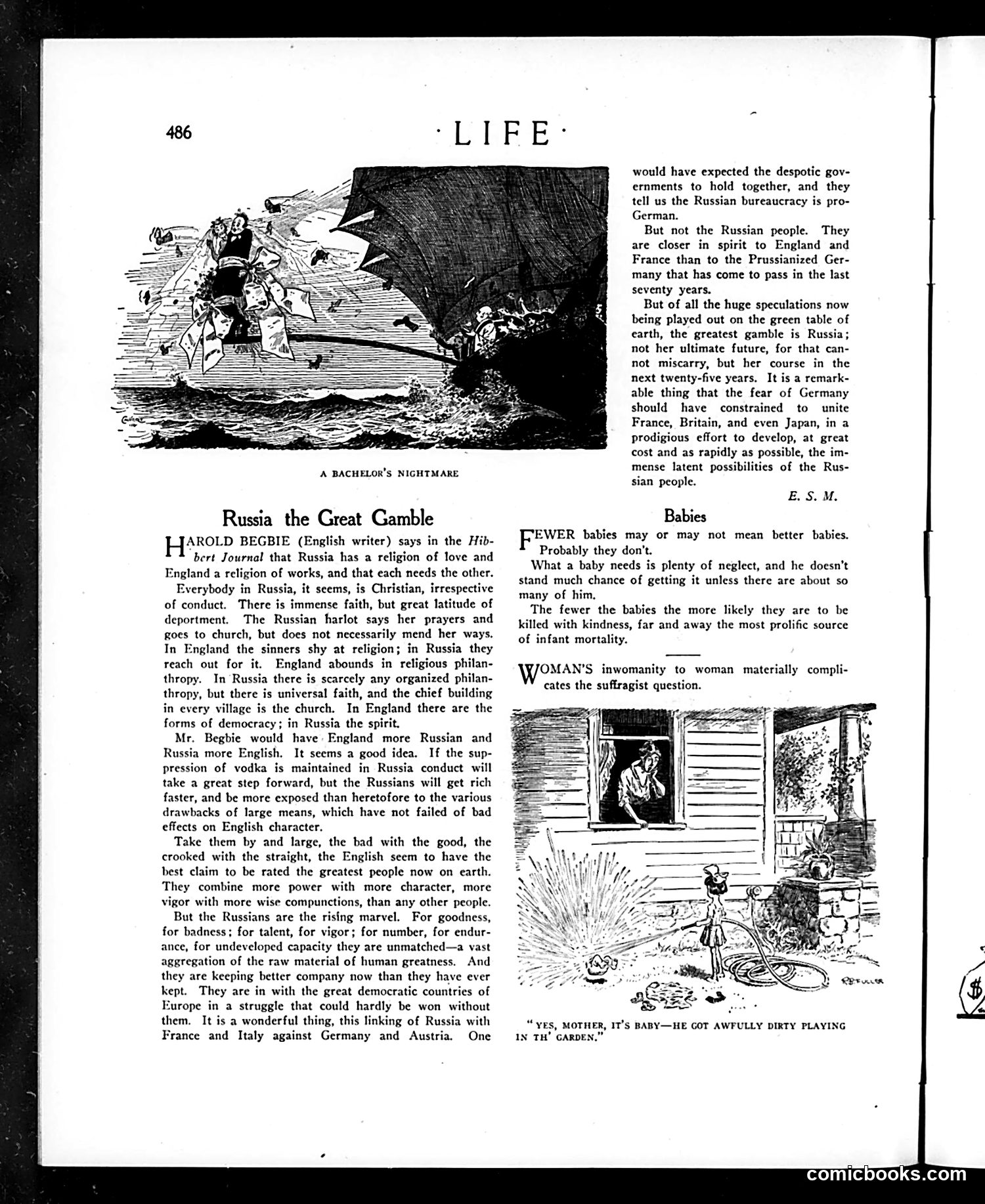
**Top Illustration ("A Bachelor's Nightmare"):** A dark, nightmarish engraving shows a man seemingly attacked or threatened by a large shadowy figure or creature—likely depicting anxieties about marriage or domestic life, a common satirical theme of the era. **"Russia the Great Gamble":** Harold Begbie's essay compares Russian and English character, written during WWI (referenced by Russia's alliance with France, Britain, and Japan against Germany). The satire praises Russia's spiritual faith while noting its moral inconsistency, and questions whether rapid modernization will benefit or corrupt Russian society. The "gamble" refers to uncertainty about Russia's future trajectory over the next 25 years—prescient given the Russian Revolution occurred in 1917. **"Babies" Section:** A satirical piece suggesting that fewer babies paradoxically leads to worse outcomes because parents over-indulge remaining children with excessive care, causing harm. The accompanying cartoon shows a mother's exasperation with her child playing outdoors—mocking contemporary anxieties about child-rearing.
📄 Transcribed text from this page (OCR, searchable)
Machine-transcribed from the original scan — historical spelling and the odd misread are preserved.
A BACHELOR'S NIGHTMARE Russia the Great Gamble Hol BEGBIE (English writer) says in the Hib- bert Journal that Russia has a religion of love and England a religion of works, and that each needs the other. Everybody in Russia, it seems, is Christian, irrespective of conduct. There is immense faith, but great latitude of deportment. The Russian harlot says her prayers and goes to church, but does not necessarily mend her ways. In England the sinners shy at religion; in Russia they reach out for it. England abounds in religious philan- thropy. In Russia there is scarcely any organized philan- thropy, but there is universal faith, and the chief building in every village is the church. In England there are the forms of democracy; in Russia the spirit. Mr. Begbie would have: England more Russian and Russia more English. It seems a good idea. If the sup- pression of vodka is maintained in Russia conduct will take a great step forward, but the Russians will get rich faster, and be more exposed than heretofore to the various drawbacks of large means, which have not failed of bad effects on English character. Take them by and large, the bad with the good, the crooked with the straight, the English seem to have the best claim to be rated the greatest people now on earth. They combine more power with more character, more vigor with more wise compunctions, than any other people. But the Russians are the rising marvel, For goodness, for badness; for talent, for vigor; for number, for endur- ance, for undeveloped capacity they are unmatched—a vast aggregation of the raw material of human greatness. And they are keeping better company now than they have ever kept. They are in with the great democratic countries of Europe in a struggle that could hardly be won without them. It is a wonderful thing, this linking of Russia with France and Italy against Germany and Austria. One would have expected the despotic gov- ernments to hold together, and they tell us the Russian bureaucracy is pro- German. But not the Russian people. They are closer in spirit to England and France than to the Prussianized Ger- many that has come to pass in the last seventy years. But of all the huge speculations now being played out on the green table of earth, the greatest gamble is Russia; not her ultimate future, for that can- not miscarry, but her course in the next twenty-five years. It is a remark- able thing that the fear of Germany should have constrained to unite France, Britain, and even Japan, in a prodigious effort to develop, at great cost and as rapidly as possible, the im- mense latent possibilities of the Rus- sian people. E.S. M. Babies FEWER babies may or may not mean better babies. Probably they don’t. What a baby needs is plenty of neglect, and he doesn’t stand much chance of getting it unless there are about so many of him, The fewer the babies the more likely they are to be killed with kindness, far and away the most prolific source of infant mortality. Woman's inwomanity to woman materially compli- cates the suffragist question. “YES, MOTHER, IT'S BABY—HE GOT AWFULLY DIRTY PLAYING IN TH’ GARDEN,” comicbooks.com