
Life, 1916-09-21 · page 24 of 44
Life — September 21, 1916 — page 24: what you’re looking at
What you’re looking at
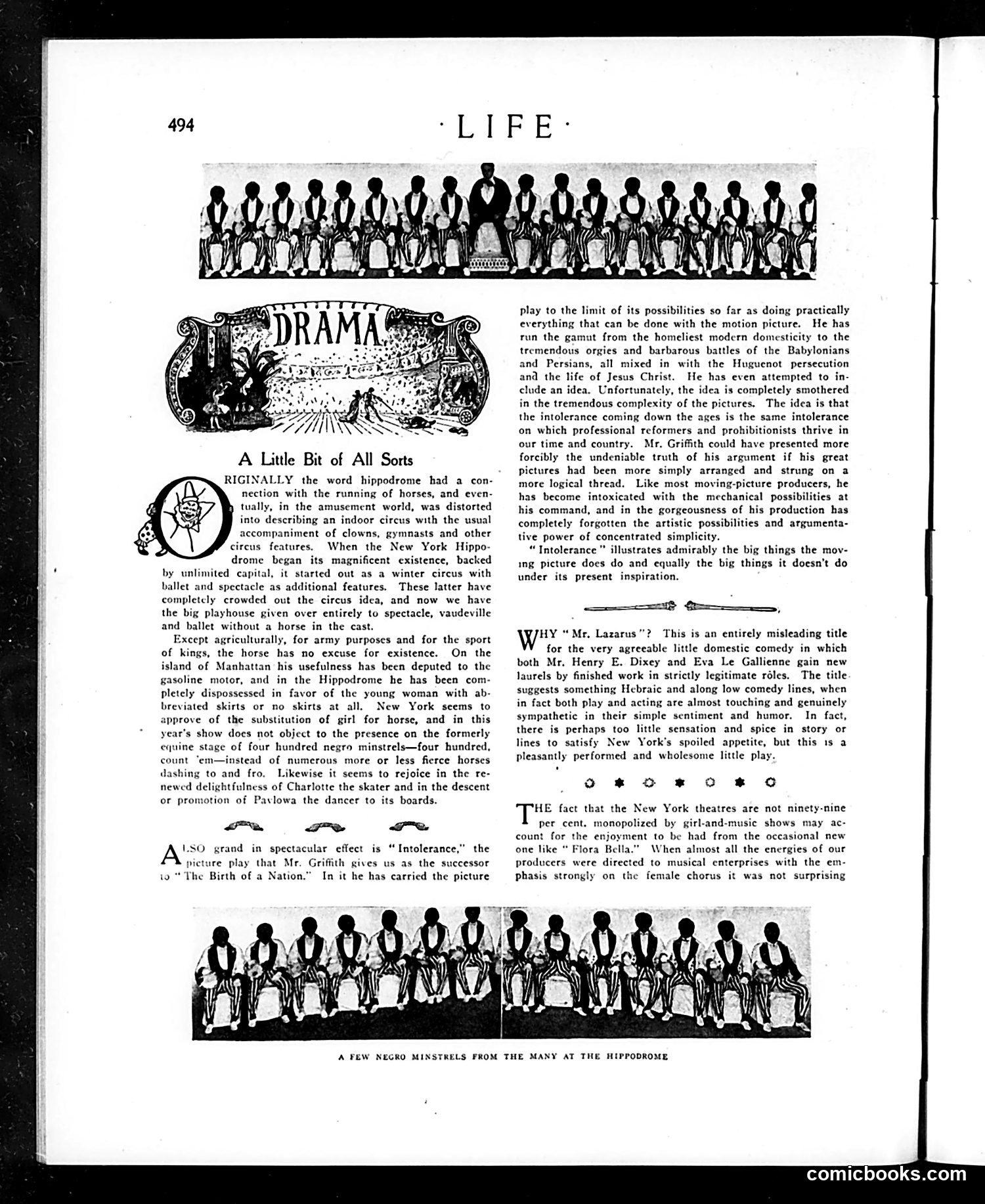
This page reviews New York theatrical productions with period-specific cultural commentary. The main subjects are: **"A Little Bit of All Sorts"** (Hippodrome): The critic praises the venue's shift from traditional circus to spectacle and ballet, notably celebrating the replacement of horses with "four hundred negro minstrels" and female dancers like Charlotte the skater and Pavlova. By modern standards, this casually racist language reveals how African Americans were viewed as novelty entertainment rather than serious performers. **"Intolerance"** (D.W. Griffith film): The review critiques Griffith's ambitious historical epic, noting it overwhelms its message about intolerance with visual spectacle—a prescient observation about form overshadowing substance. **"Why Mr. Lazarus?"**: A favorable review of a domestic comedy starring Henry E. Dixey and Eva Le Gallienne, praising its restraint against New York's preference for sensational entertainment. The page reflects early 20th-century entertainment tastes and attitudes toward race that modern readers would find deeply offensive.
📄 Transcribed text from this page (OCR, searchable)
Machine-transcribed from the original scan — historical spelling and the odd misread are preserved.
A Little Bit of All Sorts RIGINALLY the word hippodrome had a con- nection with the running of horses, and even- tually, in the amusement world, was distorted into describing an indoor circus with the usual accompaniment of clowns, gymnasts and other circus features. When the New York Hippo- drome began its magnificent existence, backed by unlimited capital, it started out as a winter circus with ballet and spectacle as additional features. These latter have completely crowded out the circus idea, and now we have the big playhouse given over entirely to spectacle, vaudeville and ballet without a horse in the cast. Except agriculturally, for army purposes and for the sport . the horse has no excuse for existence. On the island of Manhattan his usefulness has been deputed to the gasoline motor, and in the Hippodrome he has been com- pletely dispossessed in favor of the young woman with ab- breviated skirts or no skirts at all. New York seems to approve of the substitution of girl for horse, and in this year’s show docs not object to the presence on the formerly equine stage of four hundred negro minstrels—four hundred, count ‘em—instead of numerous more or less fierce horses dashing to and fro, Likewise it seems to rejoice in the re- newed delightfulness of Charlotte the skater and in the descent or promotion of Pavlowa the dancer to its boards. UN Feu KS A' SO grand in spectacular effect is “Intolerance,” the ure play that Mr. Griffith gives us as the successor o The Birth of a Nation.” In it he has carried the picture play to the limit of its possibilities so far as doing practically everything that can be done with the motion picture. He has run the gamut from the homeliest modern domesticity to the tremendous orgies and barbarous battles of the Babylonians and Persians, all mixed in with the Huguenot persecution and the life of Jesus Christ. He has even attempted to in- clude an idea. Unfortunately, the idea is completely smothered in the tremendous complexity of the pictures. The idea is that the intolerance coming down the ages is the same intolerance on which professional reformers and prohibitionists thrive in our time and country. Mr. Griffith could have presented more forcibly the undeniable truth of his argument if his great pictures had been more simply arranged and strung on a more logical thread. Like most moving-picture producers, he has become intoxicated with the mechanical possibilities at his command, and in the gorgeousness of his production has completely forgotten the artistic possibilities and argumenta- tive power of concentrated simplicity. “Intolerance ” illustrates admirably the big things the mov- ing picture does do and equally the big things it doesn’t do under its present inspiration. = fe, HY “Mr, Lazarus”? This is an entirely misleading title for the very agreeable little domestic comedy in which both Mr. Henry E. Dixey and Eva Le Gallienne gain new laurels by finished work in strictly legitimate réles. The title suggests something Hebraic and along low comedy lines, when in fact both play and acting are almost touching and genuinely sympathetic in their simple sentiment and humor. In fact, there is perhaps too little sensation and spice in story or lines to satisfy New York's spoiled appetite, but this 1s a pleasantly performed and wholesome little play. o *£ Oo *® GO *& CG HE fact that the New York theatres are not ninety-nine per cent. monopolized by girl-and-music shows may ac- count for the enjoyment to be had from the occasional new one like “ Flora Bella.” When almost all the energies of our producers were directed to musical enterprises with the em- phasis strongly on the female chorus it was not surprising Wal ‘a A FEW NEGRO MINSTRELS FROM THE MANY AT THE HIPPODROME comicbooks.com