
Life, 1916-09-21 · page 27 of 44
Life — September 21, 1916 — page 27: what you’re looking at
What you’re looking at
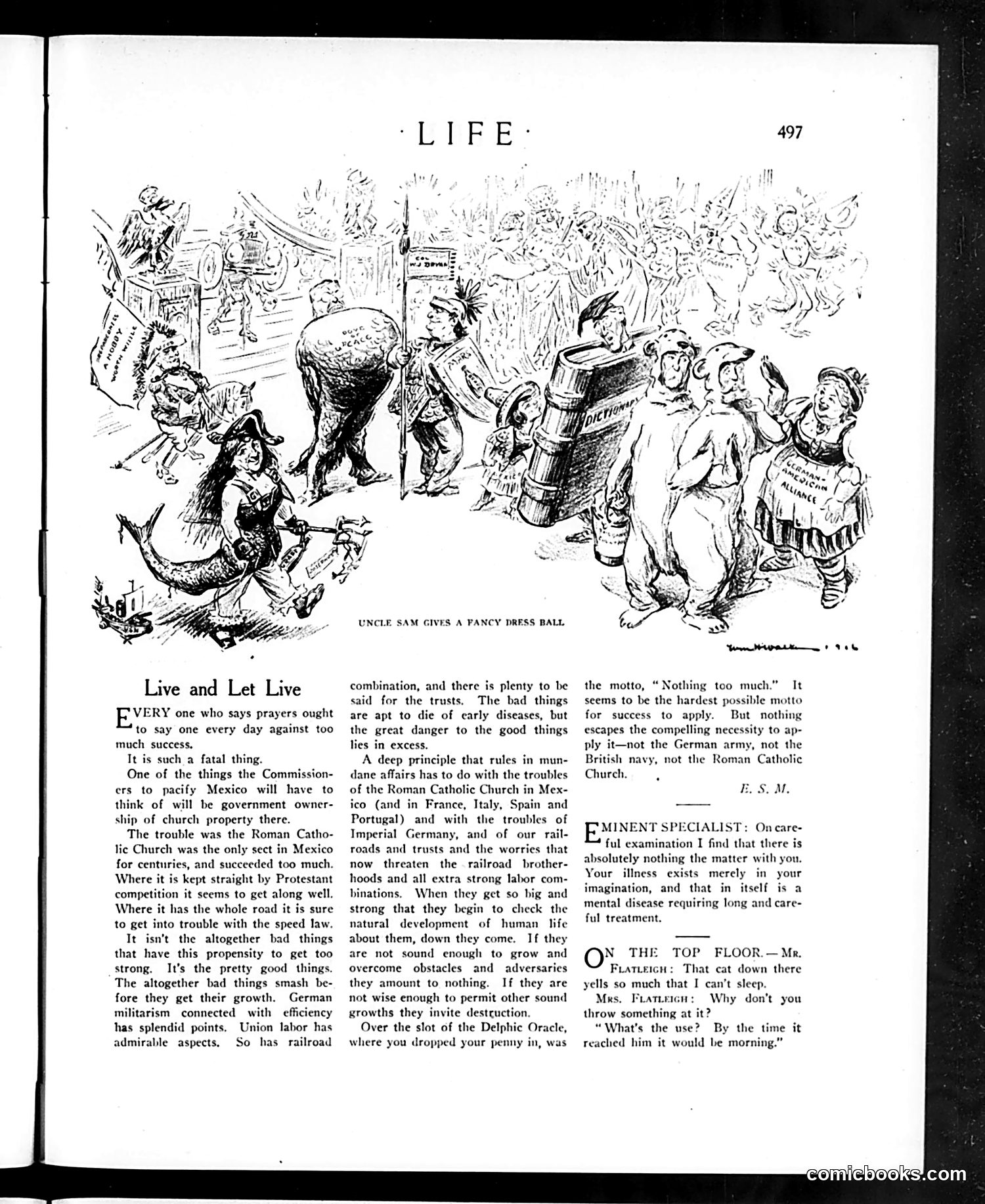
The cartoon depicts a chaotic ball or formal gathering where Uncle Sam (representing the U.S. government) hosts various figures in costumes or disguises. The satire appears to mock American diplomatic efforts, likely referencing the Mexican Commission mentioned in the essay—U.S. commissioners sent to "pacify Mexico." The accompanying essay argues that institutions become dangerous when they grow too powerful without restraint. Using the Roman Catholic Church's dominance in Mexico as the primary example, the author warns that "pretty good things" become destructive through excess. The text references trusts, German militarism, and labor unions as parallel cases where concentrated power invites collapse. The cartoon likely satirizes government interference abroad and the naiveté of American diplomatic missions, while the essay's central metaphor—the Delphic Oracle's motto "Nothing too much"—suggests that unchecked power, regardless of its initial virtue, inevitably fails. This reflects Progressive Era anxieties about monopolies and institutional overreach.
📄 Transcribed text from this page (OCR, searchable)
Machine-transcribed from the original scan — historical spelling and the odd misread are preserved.
Live and Let Live VERY one who says prayers ought to say one every day against too much success, It is such a fatal thing. One of the things the Commission- ers to pacify Mexico will have to think of will be government owner- ship of church property there. The trouble was the Roman Catho- lic Church was the only sect in Mexico for centuries, and succeeded too much. Where it is kept straight by Protestant competition it seems to get along well. Where it has the whole road it is sure to get into trouble with the speed law. It isn’t the altogether bad things that have this propensity to get too strong. It’s the pretty good things. The altogether bad things smash be- fore they get their growth. German militarism connected with efficiency has splendid points. Union labor has admirable aspects, So has railroad UNCLE SAM GIVES A PANCY DRESS BALL combination, and there is plenty to be said for the trusts. The bad things are apt to die of early diseases, but the great danger to the good things lies in excess. A deep principle that rules in mun- dane affairs has to do with the troubles of the Roman Catholic Church in Mex- ico (and in France, Italy, Spain and Portugal) and with the troubles of Imperial Germany, and of our rail- roads and trusts and the worries that now threaten the railroad brother- hoods and all extra strong labor com- hinations. When they get so big and strong that they begin to check the natural development of human life about them, down they come. If they are not sound enough to grow and overcome obstacles and adversaries they amount to nothing. If they are not wise enough to permit other sound growths they invite destruction. Over the slot of the Delphic Oracle, where you dropped your penny in, was ee the motto, “Nothing too much.” It seems to be the hardest possible motto for success to apply. But nothing escapes the compelling necessity to ap- ply it—not the German army, not the British navy, not the Roman Catholic Church, B.S: M, MINENT SPECIALIST: On care- ful examination I find that there is absolutely nothing the matter with you. Your illness exists merely in your imagination, and that in itself is a mental disease requiring long and care- ful treatment. N THE TOP FLOOR.— Mr. Fratteicn: That cat down there yells so much that I can’t sleep. Mrs. Frater: Why don't you throw something at it? “What's the use? By the time it reached him it would be morning.”