
A complete issue · 52 pages · 1916
Life — March 23, 1916
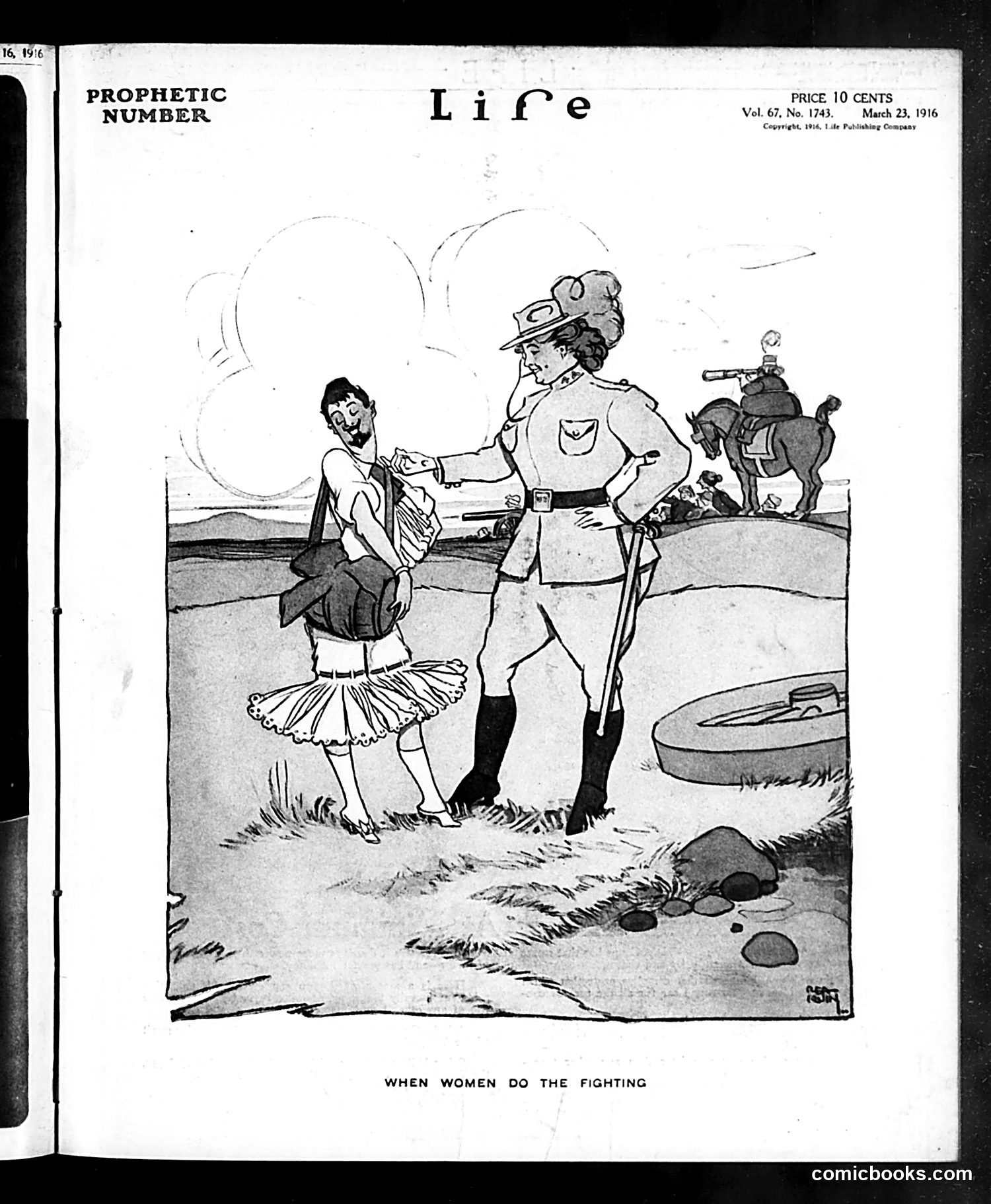
This 1916 *Life* magazine cartoon satirizes women's military participation during World War I. The image shows a woman soldier in uniform flirting with a male soldier while holding a rifle, with military encampments visible in the background. The satire mocks the notion of female combatants by depicting the woman as more interested in romance (she wears a tutu-like skirt and strikes a coquettish pose) than serious soldiering. The title suggests skepticism about women's combat effectiveness. This reflects early-20th-century attitudes dismissing female military service as inherently frivolous. Some nations did employ women in combat roles during WWI, but American popular culture often trivialized their contributions through gendered stereotypes about women's proper domestic roles versus military duty.
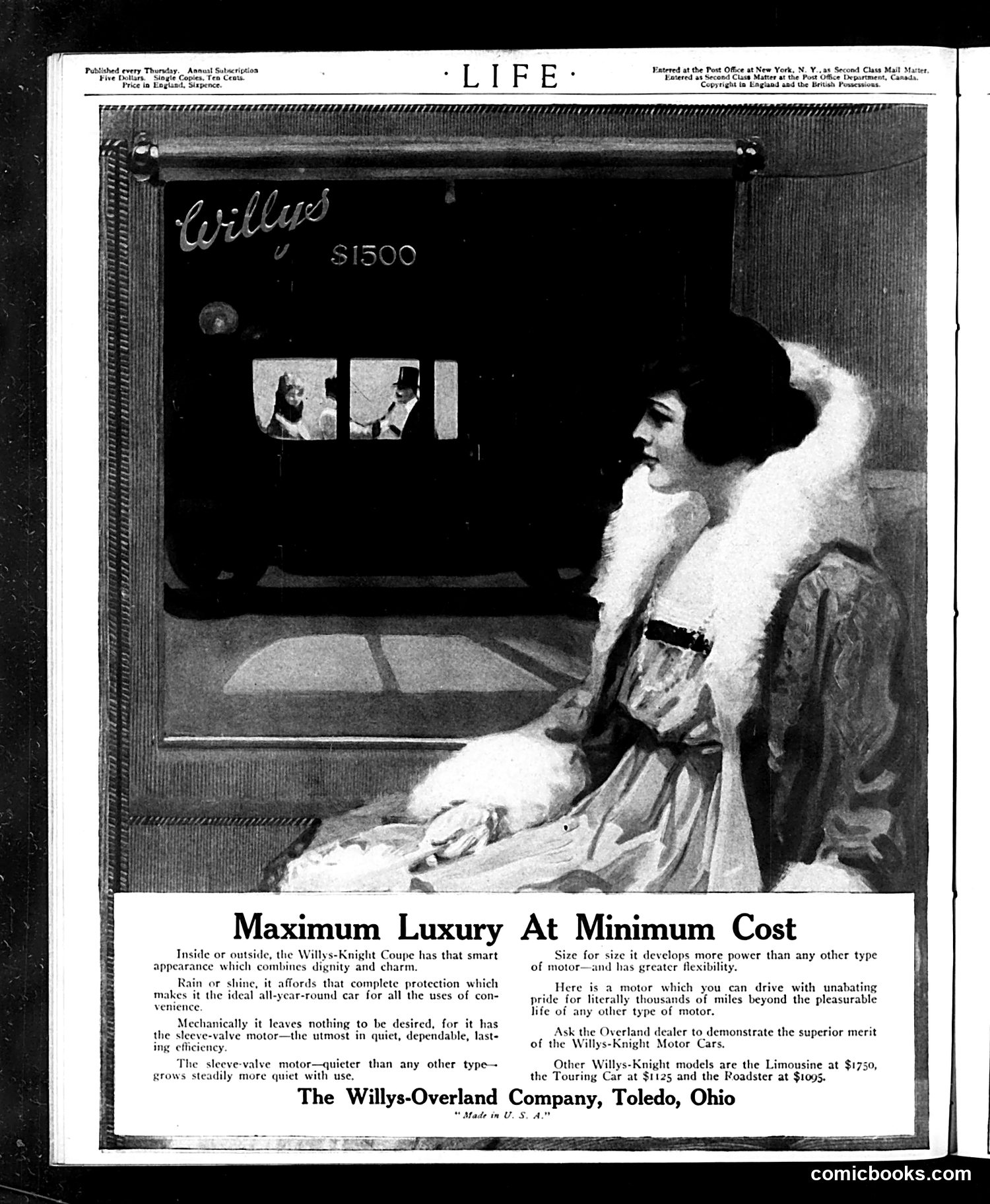
This page is primarily **advertising, not satire or political commentary**. It features a Willys-Knight automobile advertisement from The Willys-Overland Company of Toledo, Ohio. The image shows a well-dressed woman in fur examining a display of the Willys-Knight Coupe (priced at $1500). The ad's headline—"Maximum Luxury At Minimum Cost"—appeals to affluent buyers by emphasizing the car's quality and power relative to its price. The advertisement highlights the vehicle's sleeve-valve motor, positioning it as quiet and reliable. Other models mentioned include a Limousine ($1750) and Touring Car ($1125). This represents early 20th-century automobile marketing targeting middle-to-upper-class consumers, particularly women as household decision-makers.
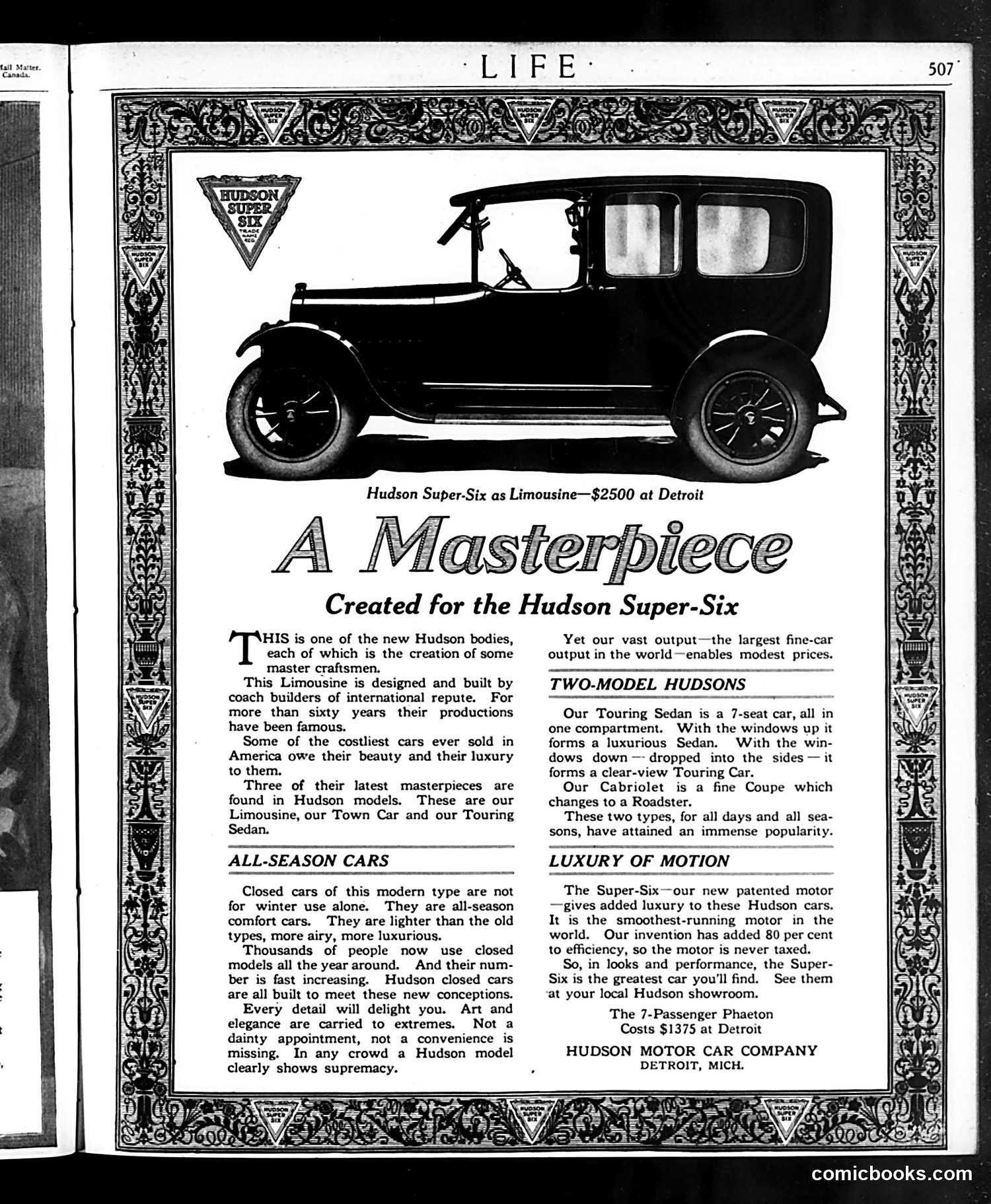
This is **not a cartoon or satire page**—it's a straightforward automobile advertisement for the Hudson Super-Six, a luxury car manufactured by Hudson Motor Car Company in Detroit, Michigan. The page features a silhouette illustration of a Hudson Super-Six Limousine priced at $2,500 and promotes the vehicle as "A Masterpiece." The ad emphasizes the car's qualities: all-season closed-body comfort, craftsmanship, a new patented motor with improved efficiency, and available models including a Touring Sedan and Cabriolet. This represents typical early 20th-century automotive advertising in *Life* magazine, which regularly featured luxury goods alongside its satirical editorial content. There is no political commentary or hidden meaning—it's simply a period advertisement.
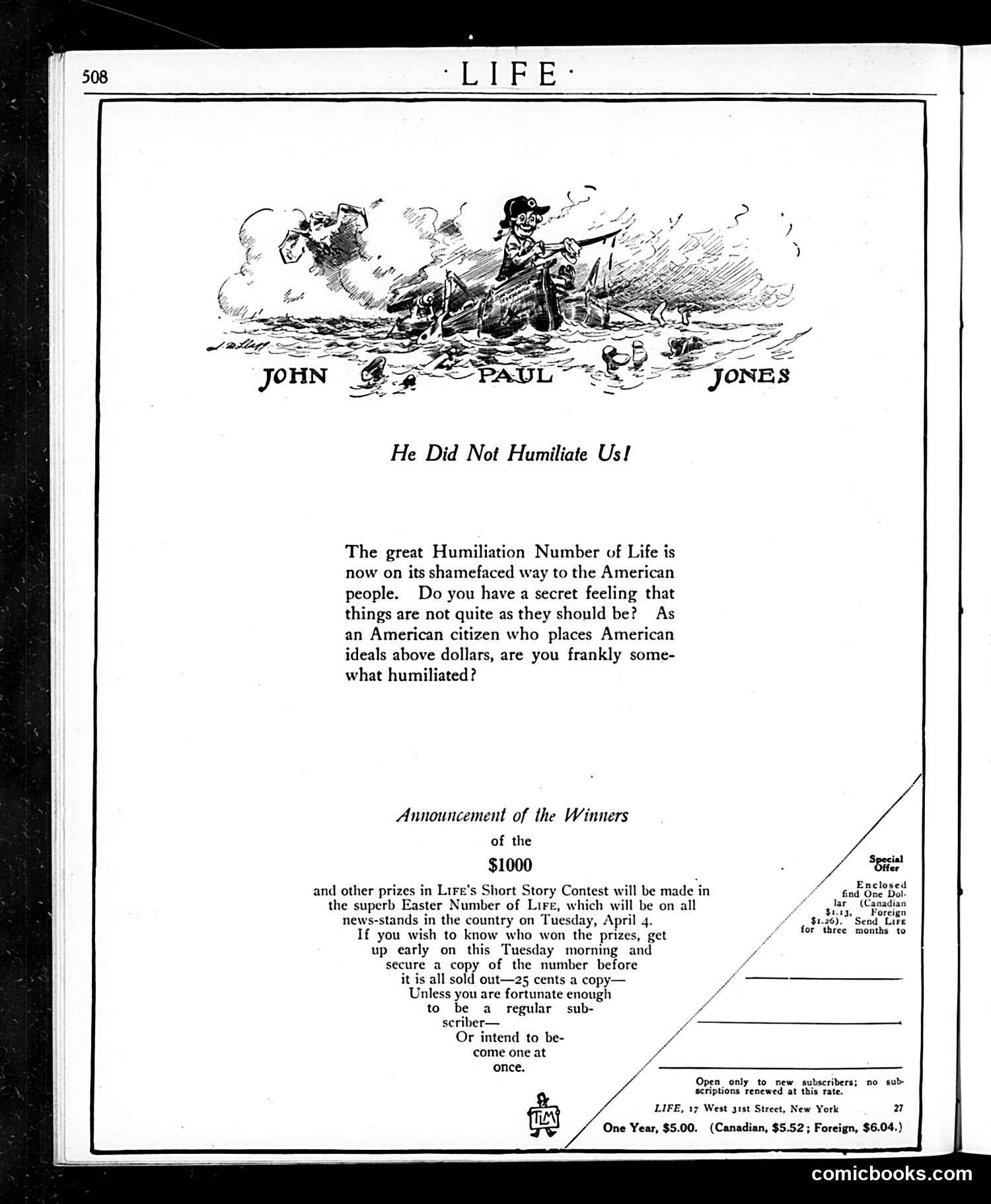
This cartoon depicts **John Paul Jones**, the Revolutionary War naval commander famous for the phrase "I have not yet begun to fight." The illustration shows him in a chaotic naval battle scene with explosions and cannon fire. The accompanying text frames this as commentary on American national pride and ideals. It suggests that Life magazine readers—positioned as patriotic Americans—should feel "humiliated" by current conditions, asking if they've experienced "a secret feeling that things are not quite as they should be." The reference to Jones appears designed to invoke historical American courage and defiance against humiliation, implying contemporary Americans should similarly resist whatever circumstances the magazine considers shameful to national values.
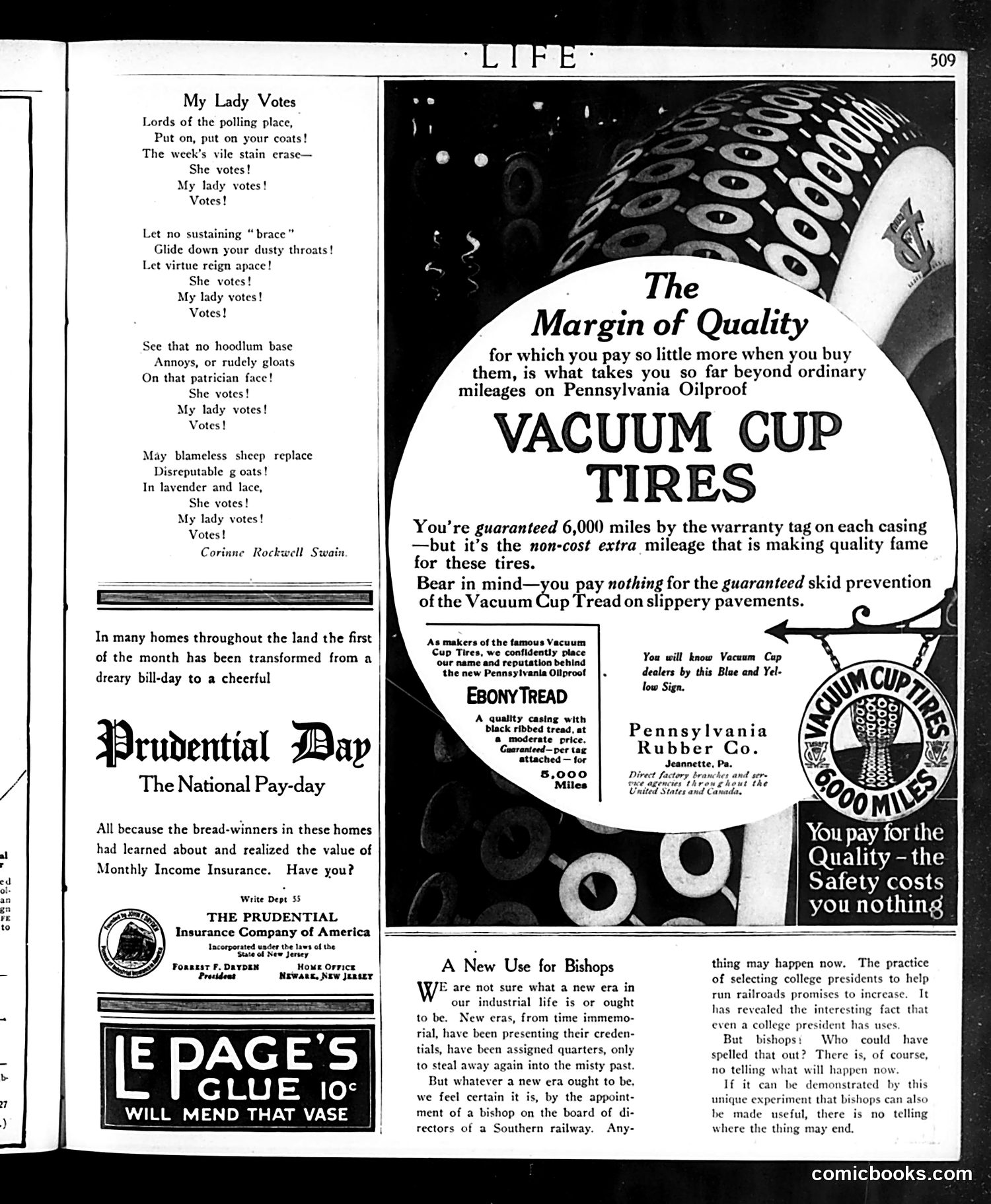
This page is primarily **advertising and light satirical content**, not political commentary. The left column features "My Lady Votes," a humorous poem by Corinne Rockwell Swain celebrating women's suffrage. It mocks pretentious attitudes while praising women exercising their voting rights—likely referencing the recent 19th Amendment (1920). The bulk of the page contains advertisements: Prudential Insurance's "Prudential Day" campaign, Vacuum Cup Tires (emphasizing durability), and Ledge's Glue. A brief article discusses "A New Use for Bishops," proposing bishops serve on railroad boards of directors. **The satire is mild**: the suffrage poem gently ridicules aristocratic pretension while celebrating democratic participation. The overall page reflects 1920s consumer culture and early feminist victories, not sharp political critique.
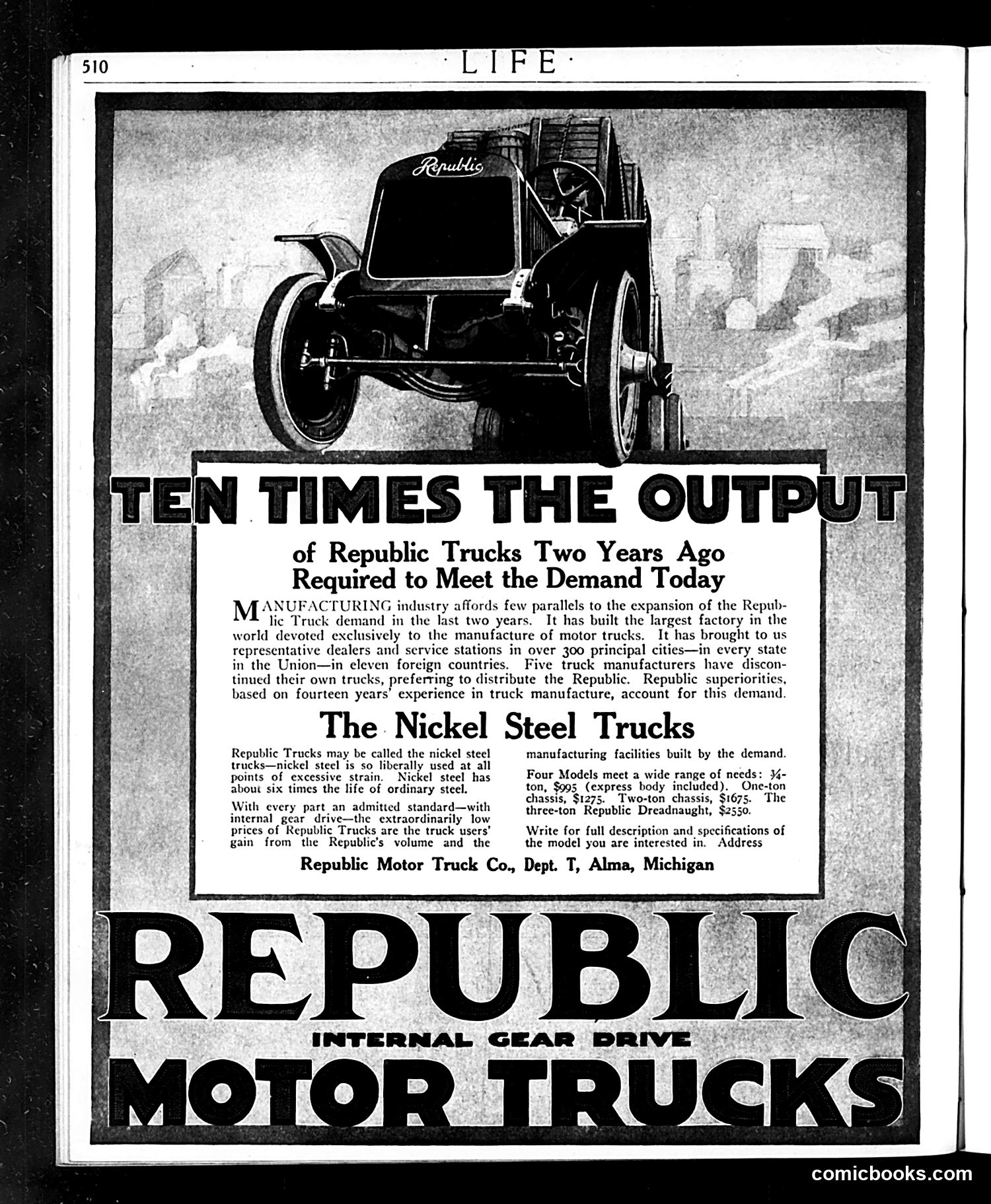
This page is primarily **advertising rather than satire or political commentary**. It contains a full-page advertisement for Republic Motor Trucks, manufactured in Alma, Michigan. The ad features an illustration of a Republic truck and emphasizes that current demand requires "ten times the output" compared to two years prior. The copy highlights the truck's durability, noting that nickel steel construction extends the vehicle's lifespan six times longer than ordinary steel. Four truck models are listed with prices ranging from $495 to $550, marketed as affordable, reliable commercial vehicles. The page demonstrates the post-WWI industrial expansion and growing commercial trucking market in early 1920s America. There is no political cartoon or satire present on this page.
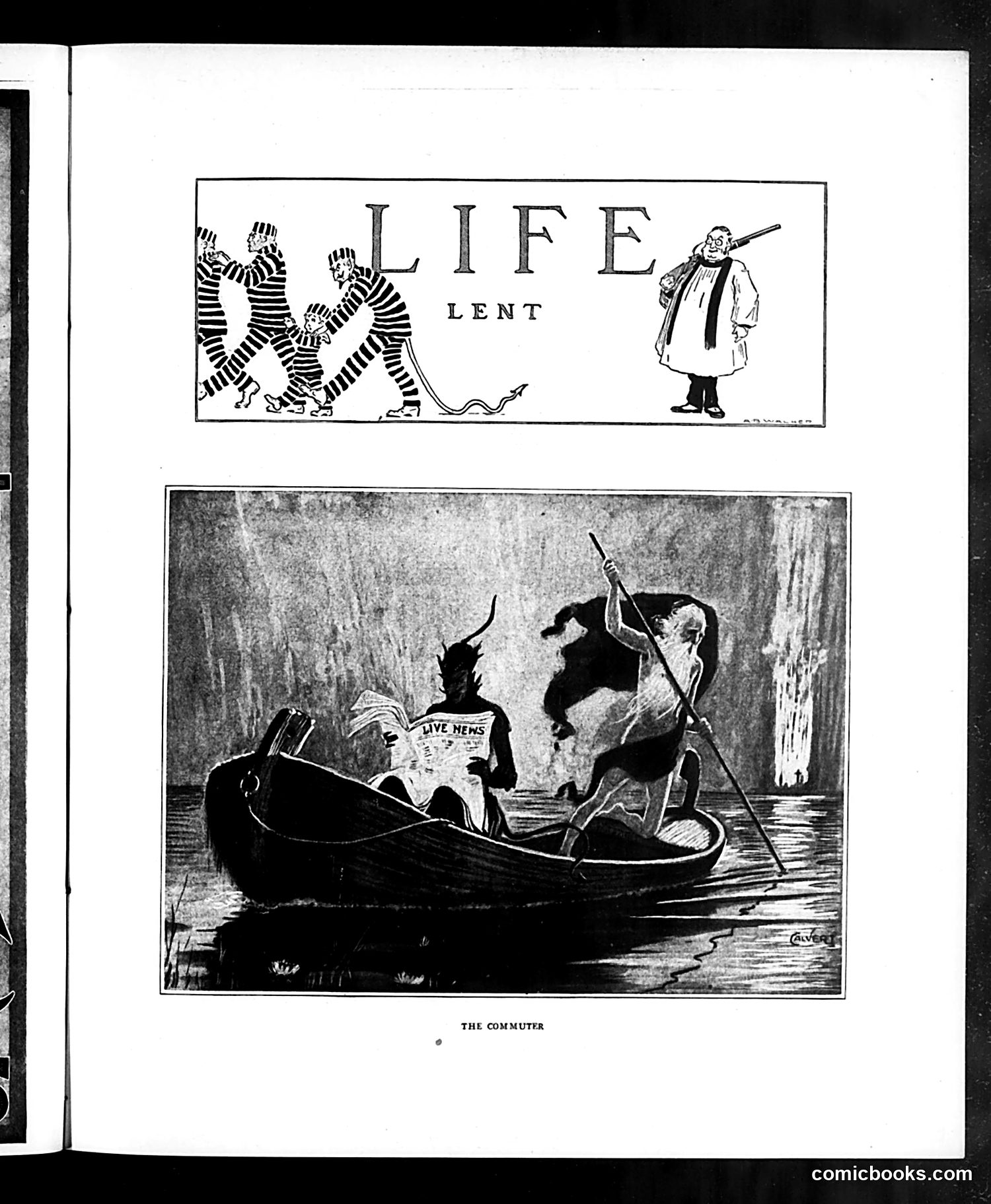
This satirical cartoon from *Life* magazine presents a Lenten commentary on modern commuting. The header shows striped figures (appearing to represent penitents or the faithful observing Lent) alongside the word "LIFE" and a figure with a rifle. The main cartoon below, titled "THE COMMUTER," depicts a man in a gondola reading a newspaper labeled "LIVE NEWS" while being ferried by two boatmen. The satire likely mocks the daily commuter's disconnection from reality—absorbed in newspapers while being passively transported, oblivious to his surroundings. During Lent, a religious period emphasizing spiritual awareness, the cartoon suggests the commuter remains spiritually and socially disconnected, mechanically repeating his routine without genuine engagement or reflection.
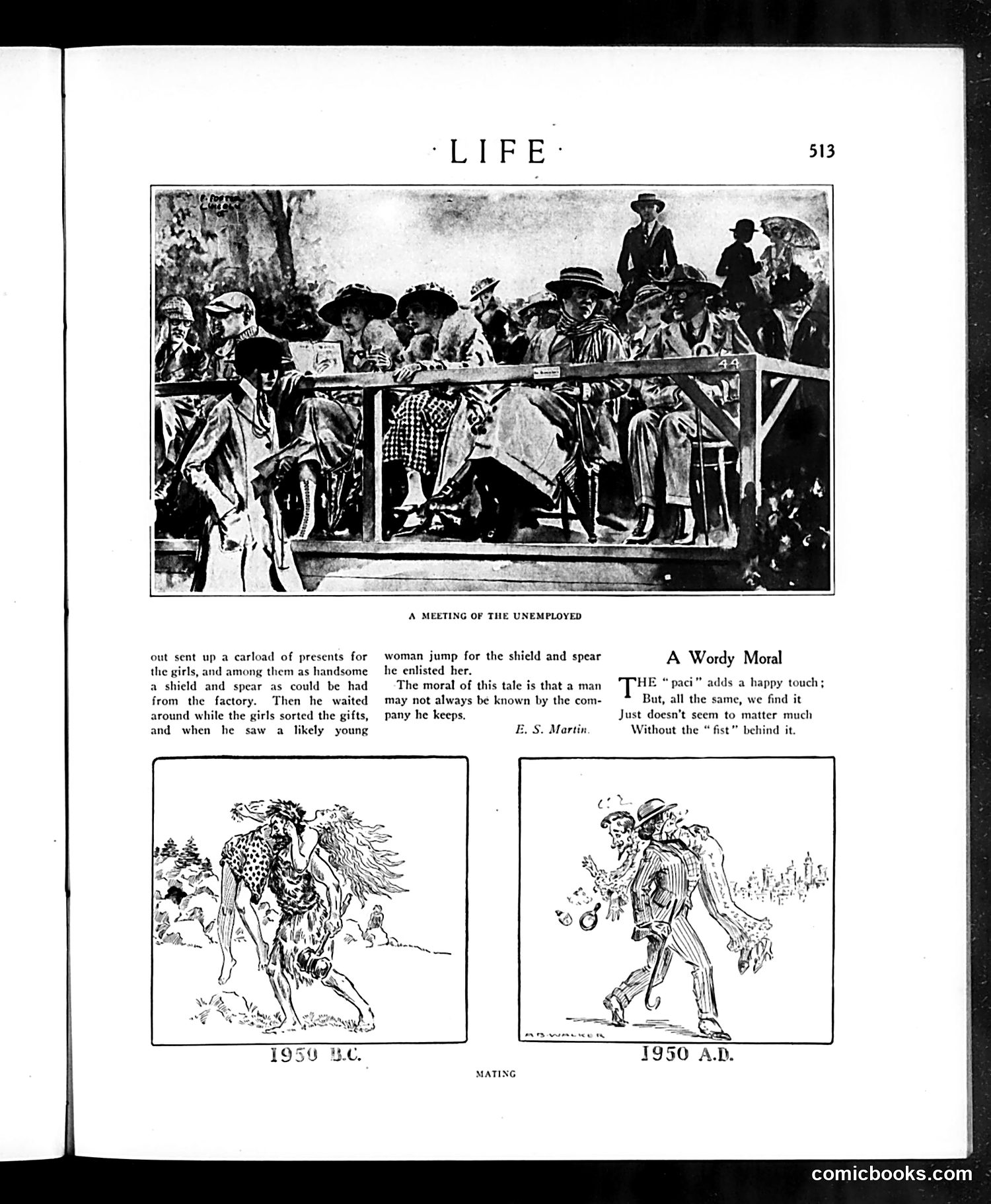
**Top Image:** "A Meeting of the Unemployed" shows a large crowd of working-class people gathered on a platform, depicting unemployment during what appears to be an economic downturn (likely the Great Depression era, given the clothing styles and composition). **Bottom Section:** Two allegorical drawings labeled "Mating" compare courtship across history—"1950 B.C." shows primitive figures, while "1950 A.D." depicts a modern man carrying material possessions and chaos. **"A Wordy Moral":** The accompanying verse jokes that a man may not be known by the company he keeps ("the pact"), but rather by the "fist" behind his actions—suggesting that true character emerges through force or conflict, not mere associations. The satire appears to contrast primitive versus modern mating rituals and social behavior.
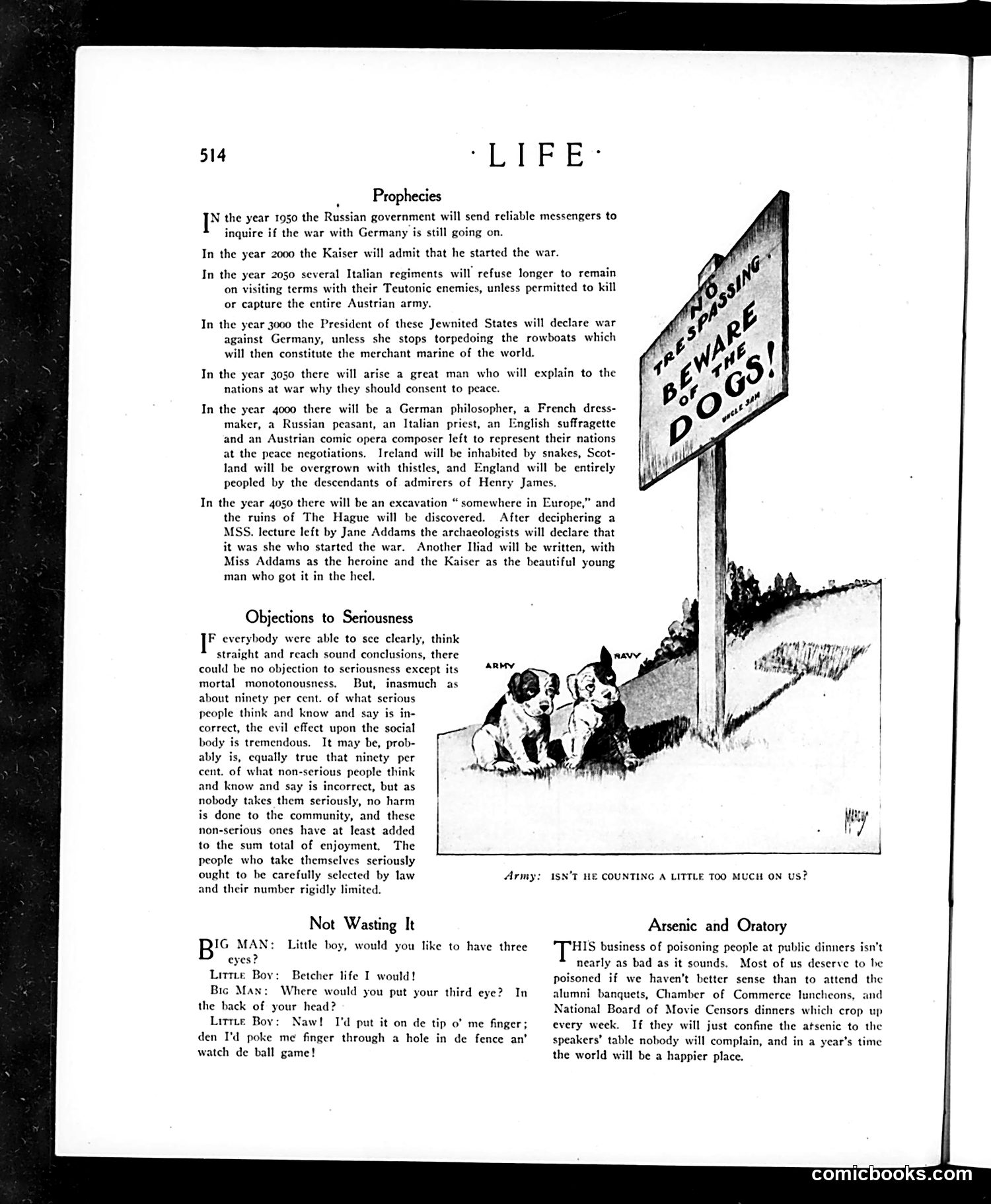
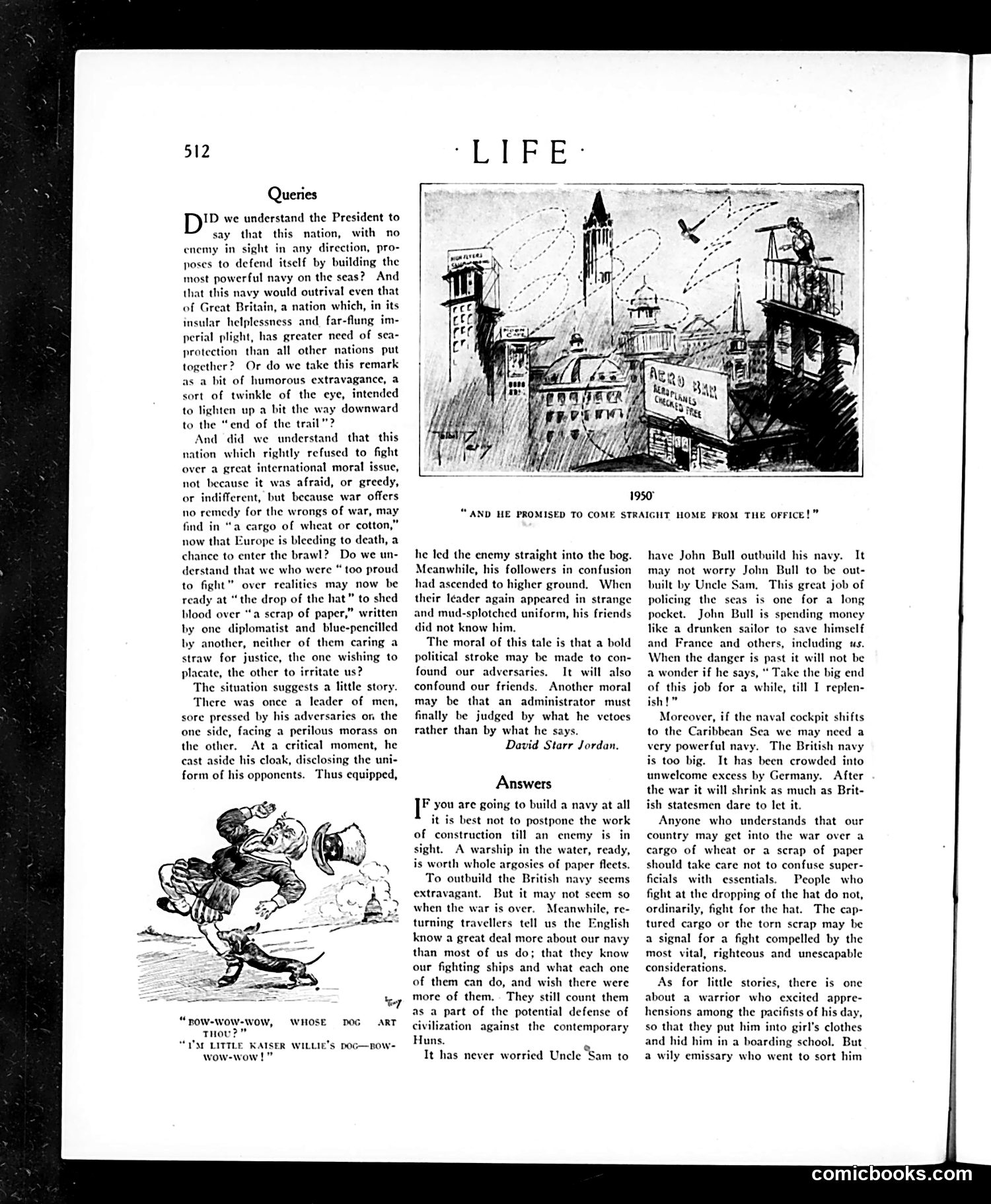
This page contains satirical "Prophecies" mocking serious predictions about future wars and political outcomes (dated 1950-2400). The text ridicules overwrought pessimism about inevitable conflict with Germany and predictions of catastrophic geopolitical shifts. The cartoon shows Army and Navy mascots (a bulldog and sailor) beneath a warning sign reading "TRESPASSING BEWARE OF DOGS!" The caption asks "ISN'T HE COUNTING A LITTLE TOO MUCH ON US?" This mocks military overconfidence or politicians relying too heavily on armed forces to solve complex problems. The lower sections titled "Objections to Seriousness" and "Arsenic and Oratory" argue that excessive seriousness about social problems can be counterproductive, and that poisoning public discourse through endless lectures (at banquets, censorship boards) undermines community well-being. The tone is lighthearted social criticism.
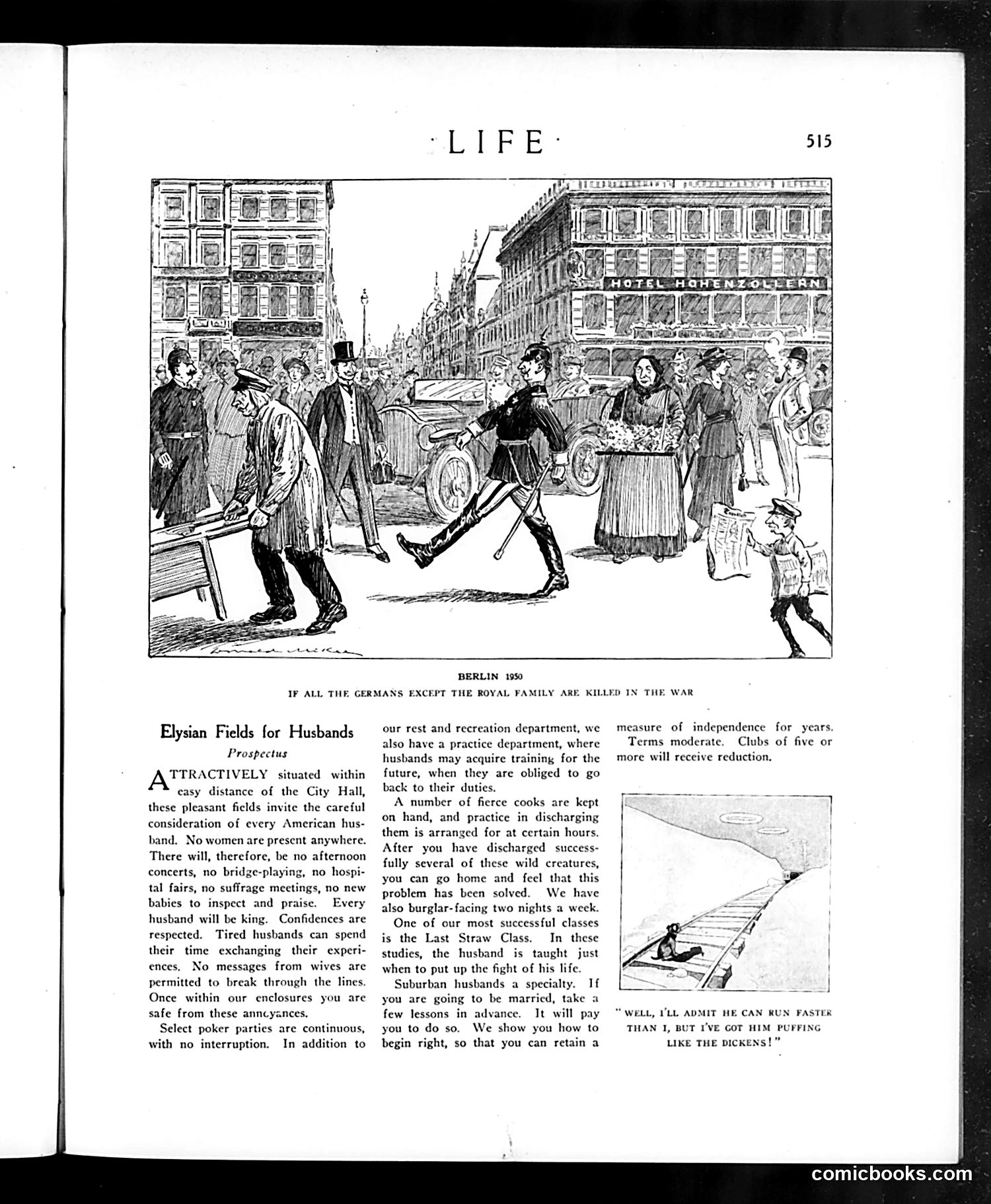
**The Top Illustration:** A satirical sketch titled "Berlin 1950" with the caption: "If all the Germans except the royal family are killed in the war." The drawing shows a post-WWI Berlin street scene with civilians engaged in everyday activities—playing hockey, walking, shopping. The satire mocks anxieties about Germany's future after World War I, suggesting that even with massive casualties, ordinary life would continue. **"Elysian Fields for Husbands" Article:** This is a humorous prospectus for a fictional facility offering leisure and training for husbands. It satirizes the domestic power dynamics of the era, joking about wives' control over husbands' time and proposing a space where men could escape household duties, practice "discharging" wild cooks, and learn marital skills—poking fun at both men's domestic incompetence and women's management of home life.
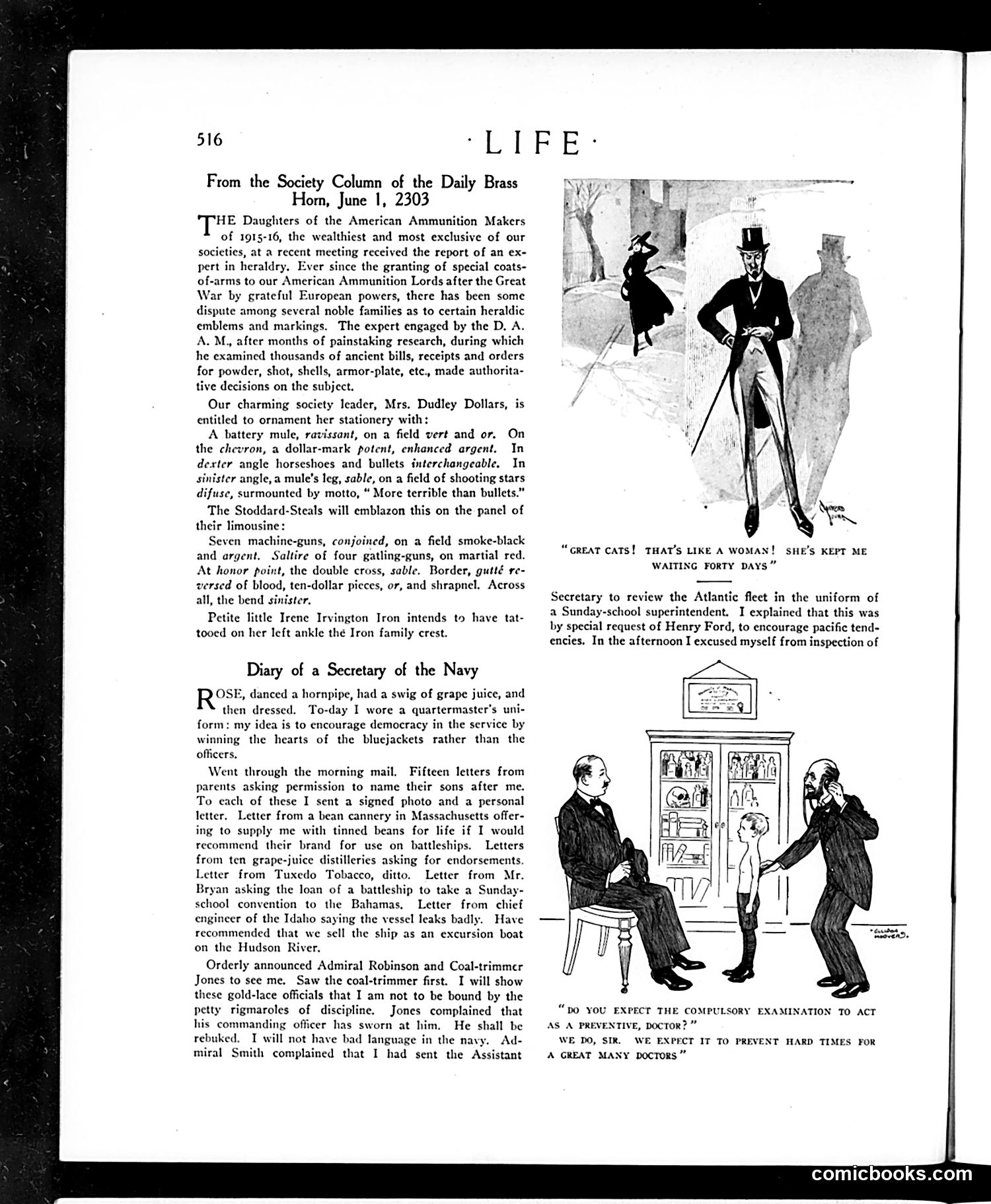
**Top Cartoon**: Shows a woman in fashionable dress keeping a man waiting. The caption "Great Cats! That's Like a Woman! She's Kept Me Waiting Forty Days" satirizes gender stereotypes about female punctuality and fashion preoccupation. The man's exasperation reflects early 20th-century social humor about dating and courtship frustrations. **Bottom Cartoon**: Depicts a doctor discussing a "compulsory examination" with a patient, captioned about preventing "hard times for a great many doctors." This appears to satirize mandatory medical examinations—likely military or public health screenings—suggesting such requirements would reduce doctors' business from preventable illnesses. Both cartoons use period-typical social commentary about gender relations and medical/bureaucratic practices.
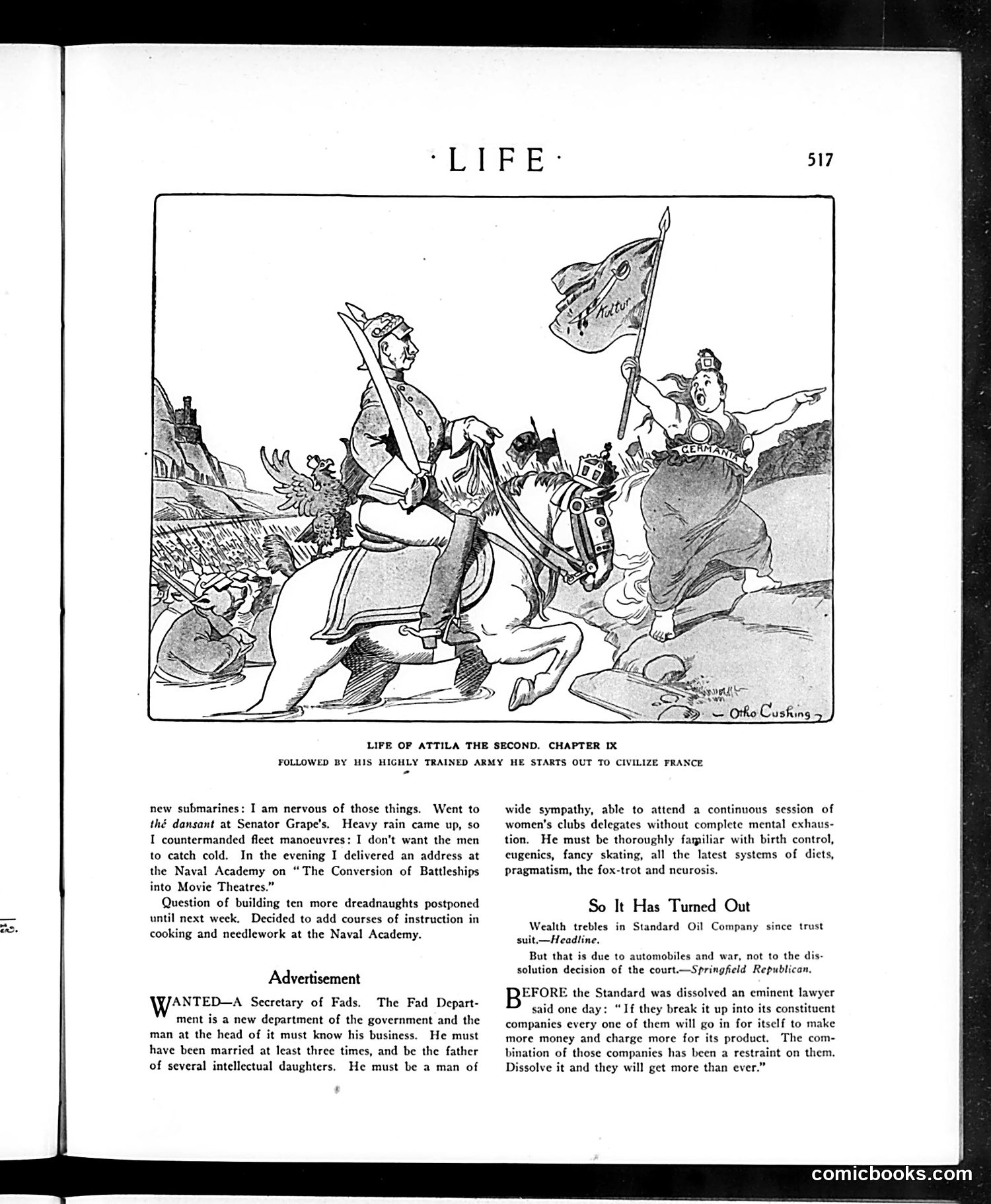
The cartoon illustrates "Life of Attila the Second, Chapter IX," depicting a military leader on horseback with an army, waving a flag labeled "GERMANY" as he prepares to invade France. The satire equates a contemporary political figure with Attila the Hun, history's destructive barbarian invader—a scathing comparison suggesting aggressive militarism. The accompanying text discusses automobile industry trusts and Standard Oil's dissolution, seemingly unrelated to the Attila cartoon. An advertisement seeks a "Secretary of Fads" for a new government department, satirizing bureaucratic expansion. The page appears to conflate military aggression with corporate monopolism as parallel threats to American society, typical of early 20th-century Life magazine's satirical approach to imperial ambitions and industrial consolidation.
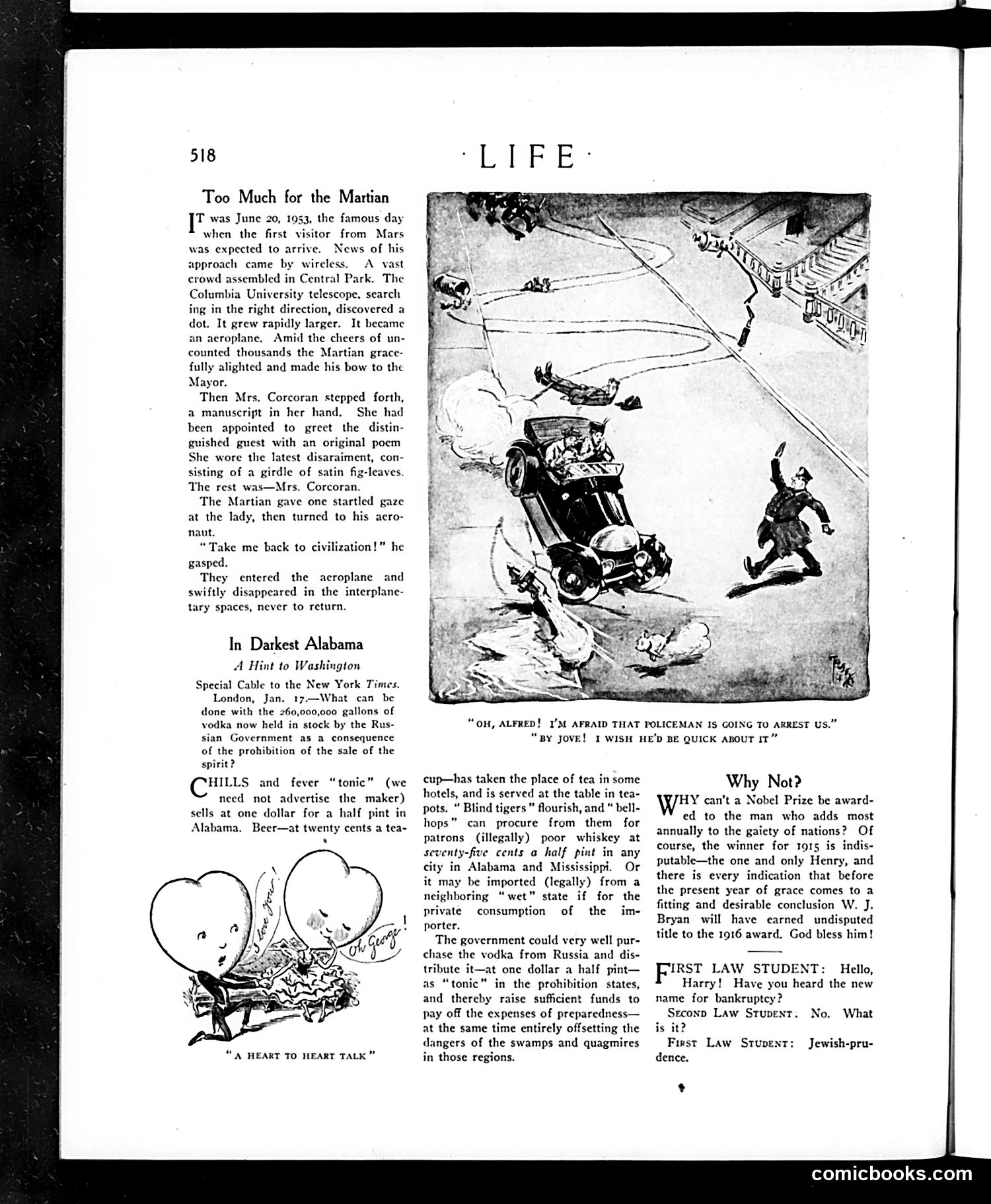
This page contains three separate satirical pieces: 1. **"Too Much for the Martian"**: A science fiction joke where a Martian visitor to Earth in 1953 is overwhelmed by civilization and requests to be taken "back to civilization"—implying Earth is uncivilized. The humor inverts expectations by suggesting Mars (or space) is more refined. 2. **"In Darkest Alabama"**: Social commentary on Prohibition-era bootlegging. It sarcastically suggests the U.S. government could solve regional poverty by purchasing cheap Russian vodka and redistribution it as "tonic," while addressing malaria and swamp diseases. This critiques both Prohibition's failures and economic inequality in the American South. 3. **"Why Not?" and law student jokes**: Brief humorous quips about prize awards and legal terminology ("Jewish-prudence" as bankruptcy wordplay).
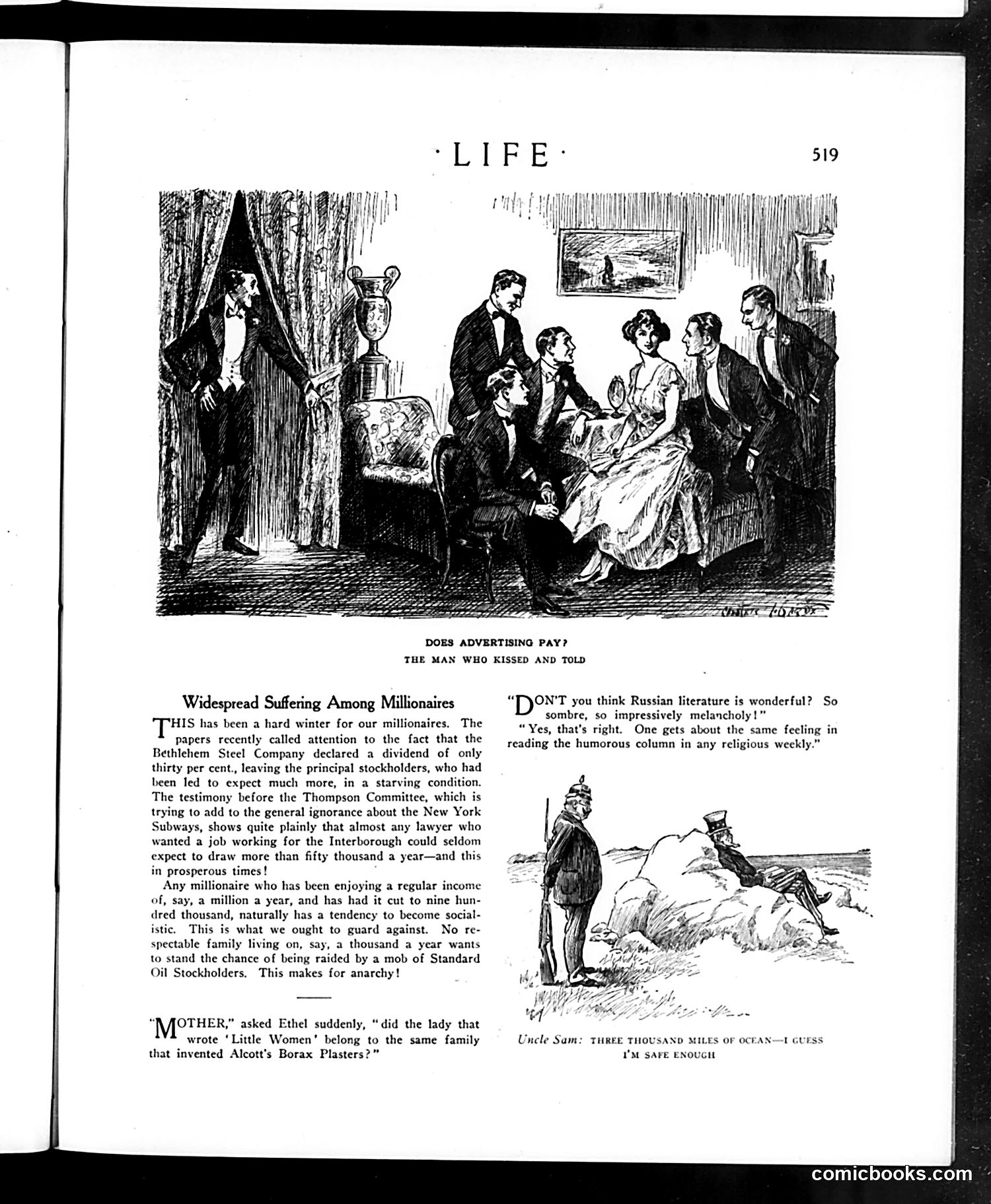
This page contains two distinct satirical pieces: **Top cartoon** ("Does Advertising Pay?"): Shows a social gathering where a man whispers to others about kissing a woman, illustrating the satirical point that gossip and word-of-mouth spread information effectively—hence "advertising" through personal anecdote rather than paid advertising. **Main article** ("Widespread Suffering Among Millionaires"): Satirizes wealthy industrialists complaining about reduced dividends. The text mocks millionaires who've seen income cut from one million to nine hundred thousand dollars annually, suggesting their "suffering" is absurd and unrelatable. It critiques their anxiety about potential financial loss despite remaining extraordinarily wealthy—a commentary on class disparity and unrealistic expectations among the ultra-rich. **Bottom cartoon**: A separate humorous piece about ocean safety unrelated to the main content.
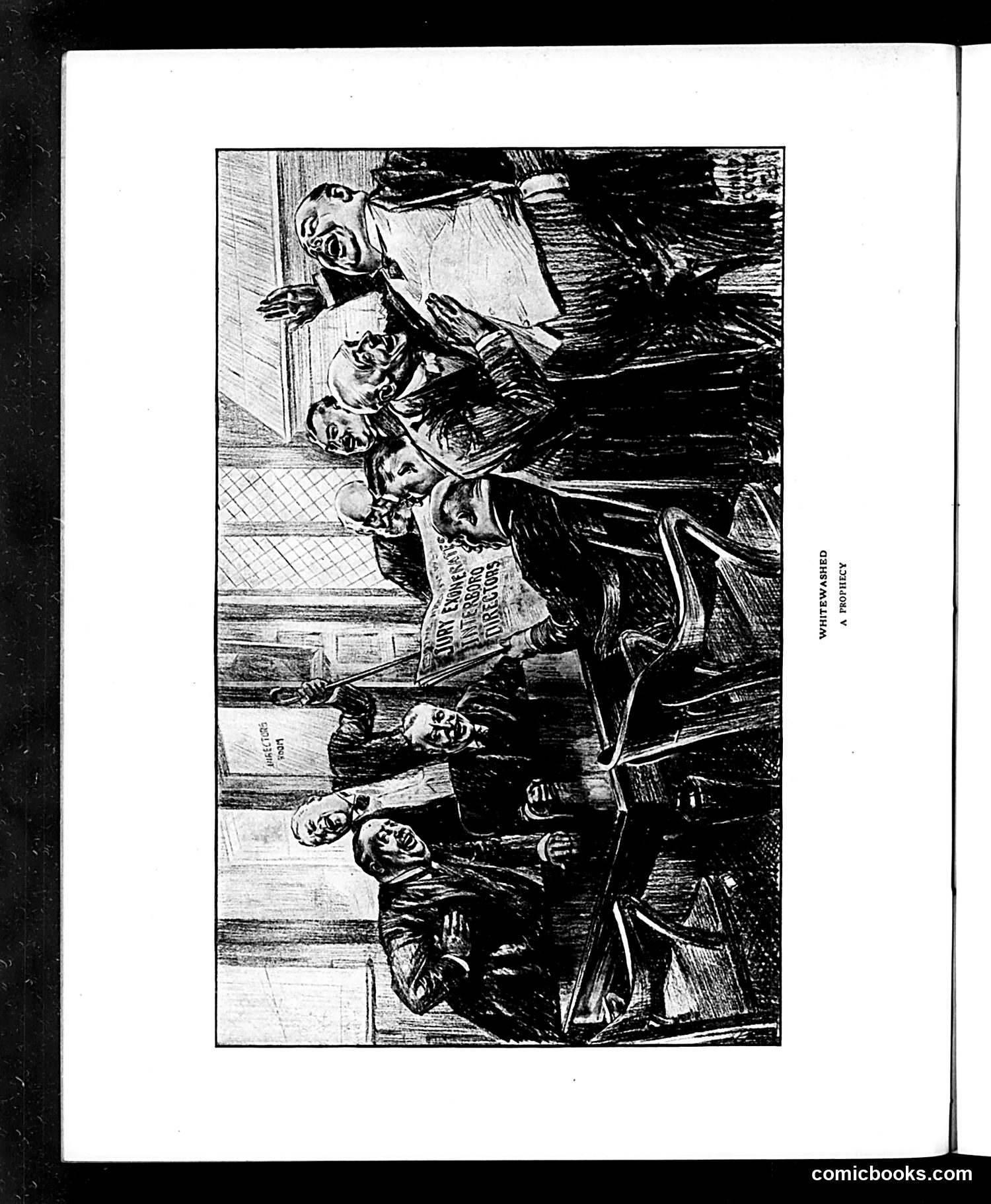
This is a political cartoon titled "Whitewashed: A Prophecy." The image appears to show figures in formal dress, with one central figure holding what looks like a document or proclamation. The composition suggests a scene of official proceedings or announcement. The OCR text is too corrupted to read reliably, preventing identification of specific historical figures or events referenced. However, the title "Whitewashed" suggests satire about concealing wrongdoing or presenting a false, sanitized version of events—a common target of *Life* magazine's political commentary. Without readable text identifying the figures or the specific historical moment, I cannot definitively state which political scandal, legal proceeding, or public controversy this addresses. The formal setting and the apparent emphasis on an official document suggest critique of institutional dishonesty or cover-up.
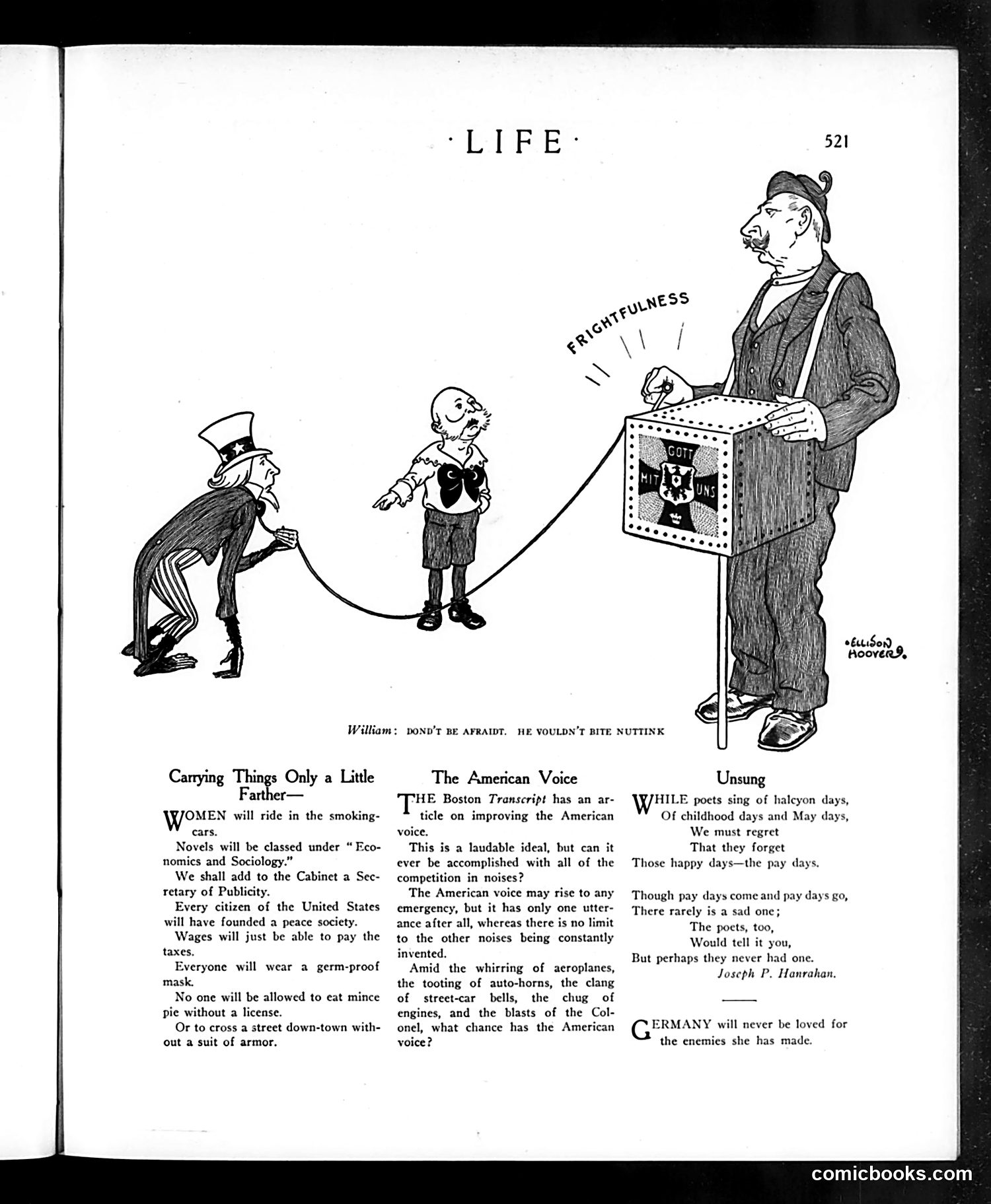
The main cartoon depicts a man operating a jack-in-the-box labeled "Scott" (likely referring to political or social commentary), with "Frightfulness" emanating from it. A small boy on a leash is being shown not to fear it ("William: don't be afraid. He wouldn't bite nuttin'k"). The accompanying text sarcastically lists absurd future predictions—women in smoking cars, germ-proof masks, armor for street-crossing, licenses for eating mince pie—mocking progressive or reformist proposals of the era as increasingly ridiculous overreach. **The American Voice** section critiques Boston media's call to improve American speech, arguing it's futile given modern urban noise (airplanes, horns, engines). The **Unsung** poem laments that poets romanticize childhood but forget paydays—the practical reality of working life. The final line about Germany reflects post-WWI bitterness toward German wartime actions, suggesting lasting international resentment. Overall, the page blends social satire with political commentary typical of interwar American humor.
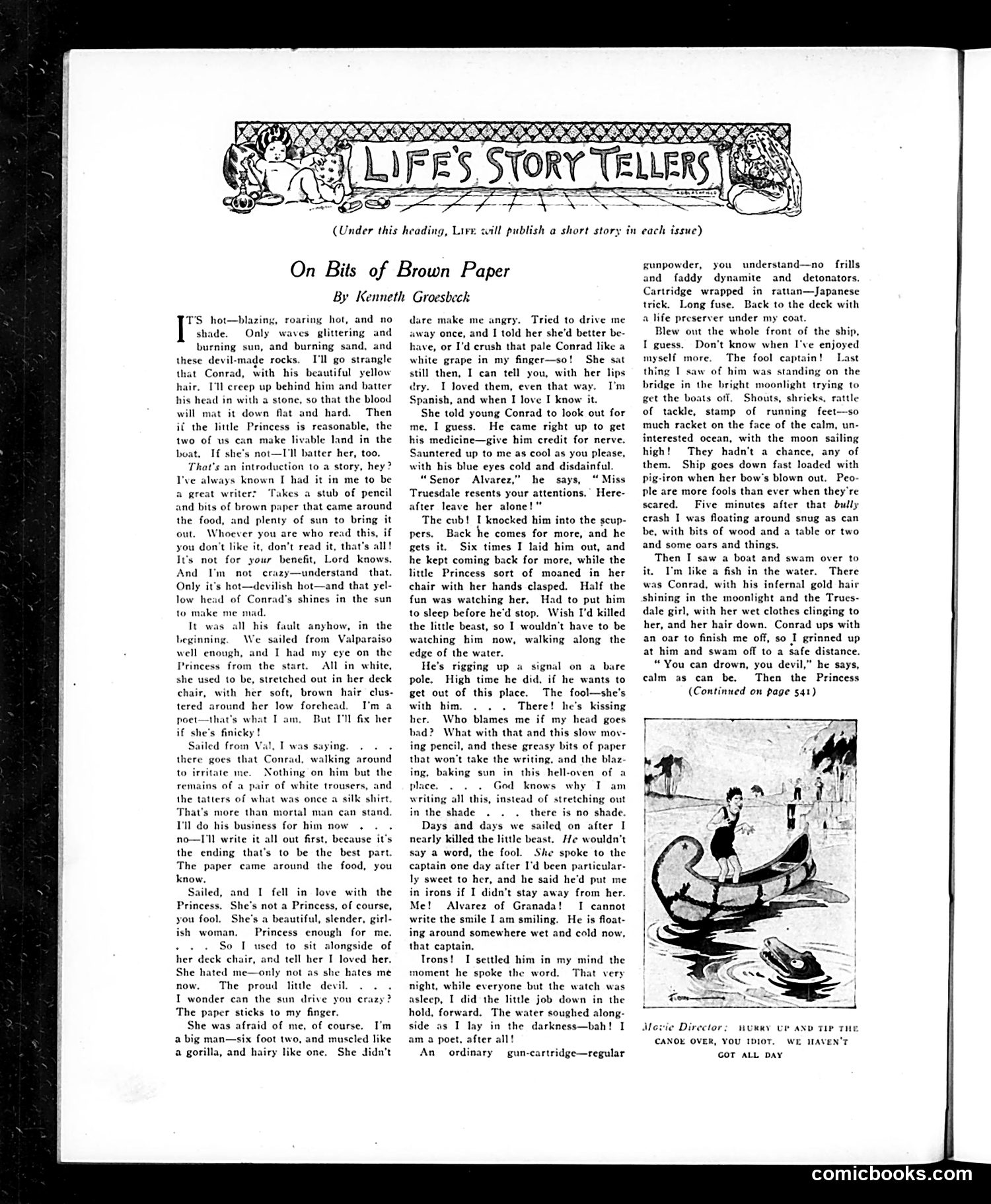
This is a short story (not political satire) published in Life's "Life's Story Tellers" section. The narrative is a first-person confession by "Senor Alvarez," a violent, unstable man aboard a ship in a tropical location. The story depicts Alvarez's obsession with an upper-class woman (called "the Princess") and his brutal rivalry with a refined man named Conrad over her affections. Alvarez repeatedly beats Conrad in fights, and the story hints at darker intentions—the opening monologue suggests fantasies of violence. The framing device is revealing: Alvarez claims he's writing this confession on brown paper scraps in extreme heat, questioning whether the sun is driving him mad. The final illustrated panel shows Conrad signaling for rescue while kissing the woman, triggering Alvarez's rage. This appears to be **early pulp fiction**—emphasizing passion, violence, and psychological instability rather than political commentary. The "Life's Story Tellers" heading suggests it's entertainment fiction for the magazine's readers.
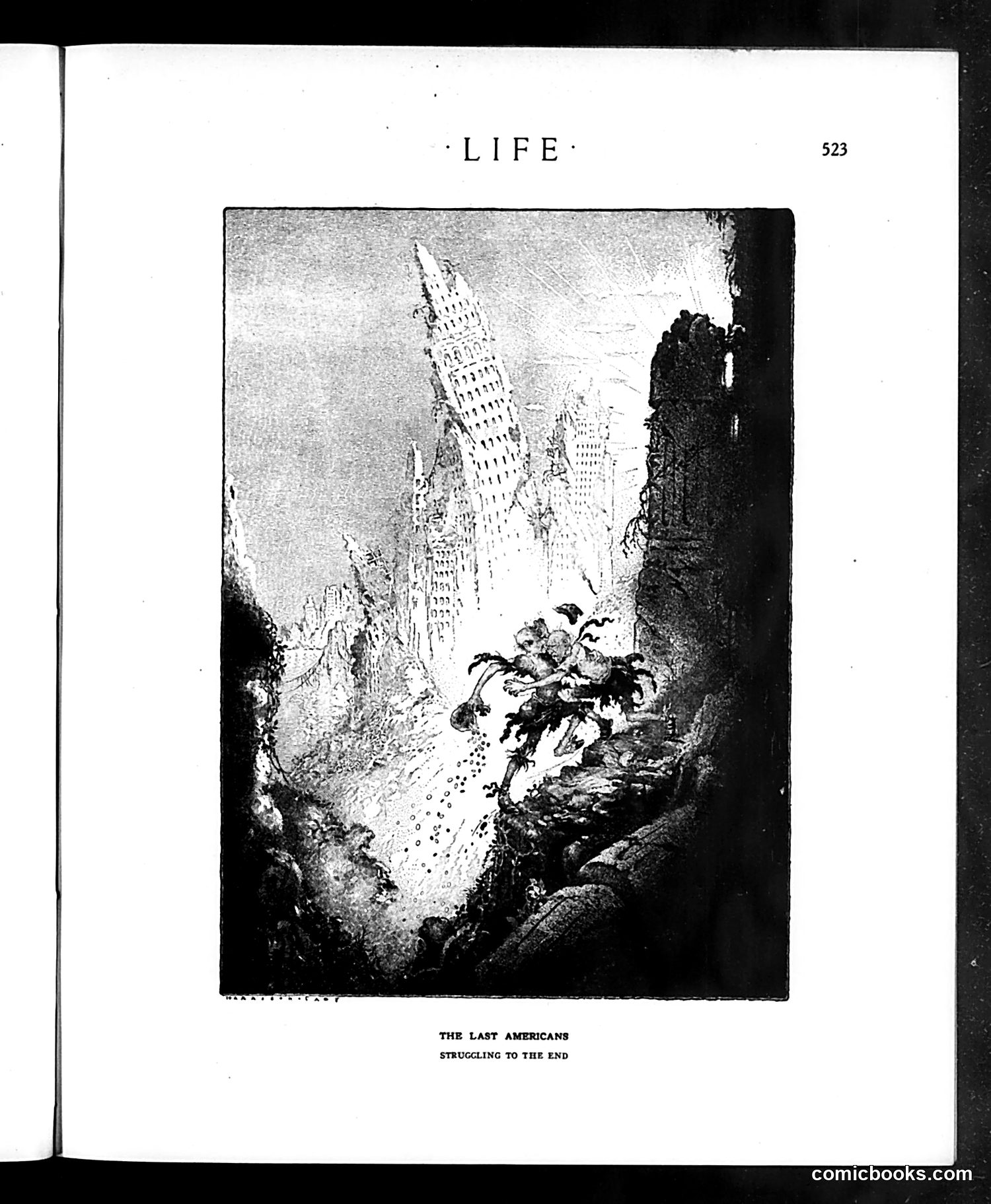
This illustration depicts a dystopian or apocalyptic scene titled "The Last Americans Struggling to the End." The image shows figures in what appears to be a ruined urban landscape—tall buildings are visible in the background amid smoke or haze, while rocky, debris-filled terrain dominates the foreground where exhausted figures struggle. The satirical point appears to critique American civilization or society, suggesting a catastrophic collapse. Given Life magazine's tradition of social commentary, this likely comments on contemporary concerns—possibly industrial excess, environmental degradation, or social decay—presenting a pessimistic vision of America's trajectory. The dramatic, dark artistic style emphasizes the bleakness of the imagined scenario. Without publication date visibility, the specific historical context remains unclear, though the style suggests early-to-mid 20th century.
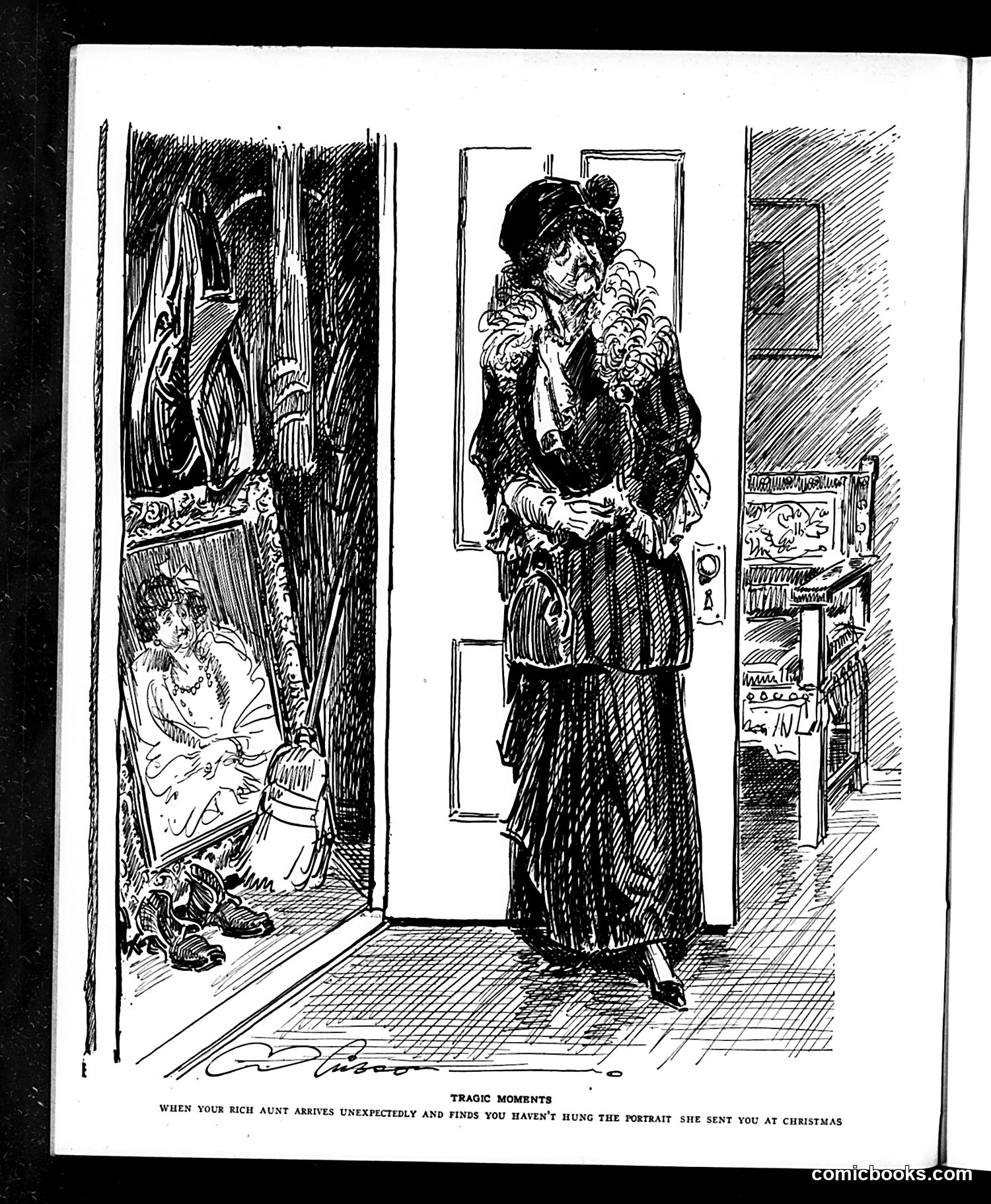
This is a humorous domestic scene from *Life* magazine satirizing the social awkwardness of family gift-giving etiquette. The cartoon depicts a wealthy aunt arriving unannounced at her niece's home, discovering that a portrait she gifted at Christmas remains unhung—instead stored away in a closet or corner. The joke relies on early 20th-century social conventions: receiving gifts from wealthy relatives carried implicit obligations to display them prominently, signaling gratitude and respect. The niece's failure to hang the portrait would be perceived as an insult. The cartoon captures the mortifying "tragic moment" of being caught in this social transgression, illustrating the anxiety surrounding Victorian-era family dynamics and the performative nature of domestic life among different social classes.
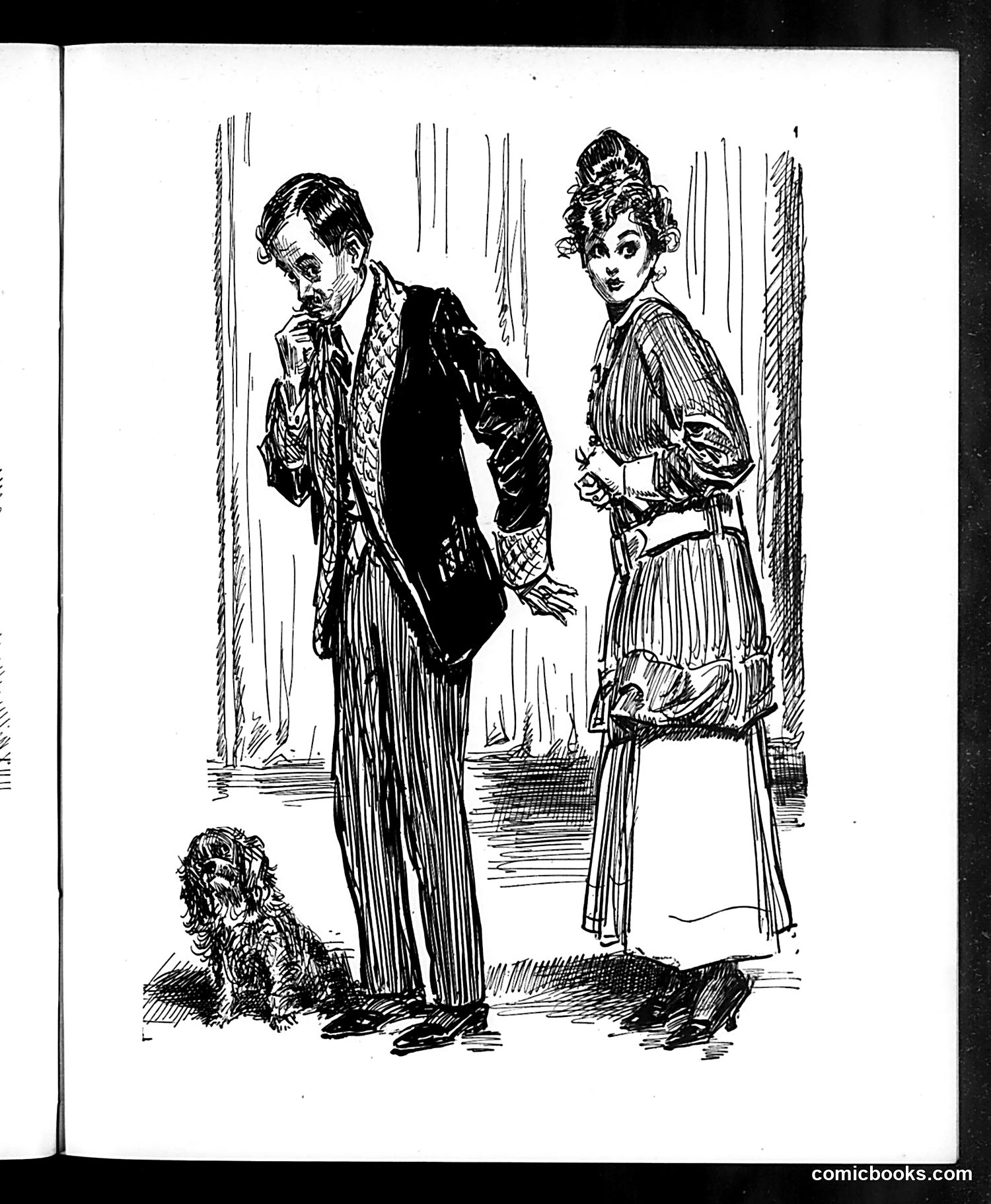
This appears to be a satirical illustration from *Life* magazine depicting a social interaction between a well-dressed man and woman, with a small dog present. The drawing style is characteristic of early 20th-century social satire. The scene likely comments on courtship or social etiquette conventions of the era. The man's formal attire (jacket, vest, tie) and the woman's fashionable dress with elaborate upswept hair suggest upper-class society. Their body language and positioning suggest a somewhat awkward or formal encounter. However, the OCR text is largely illegible, making it impossible to identify the specific figures, determine whether this references particular individuals or events, or understand the precise satirical point. Without readable caption or title text, I cannot reliably explain what social commentary this illustration intends to convey to modern readers.
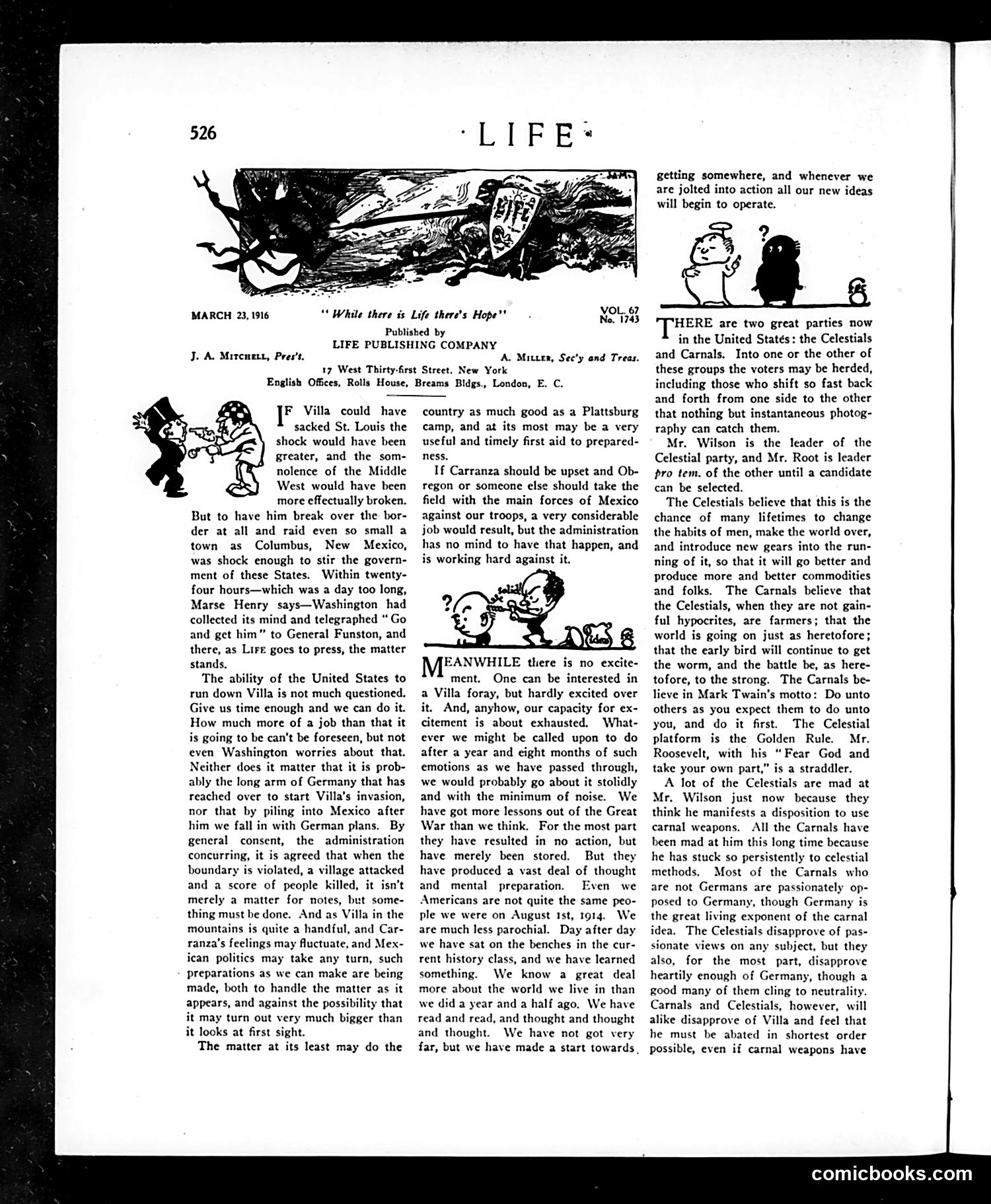
This page discusses Pancho Villa's raid on Columbus, New Mexico (March 1916), which prompted a U.S. military response. The editorial argues the incident, while shocking, demonstrates America's growing political maturity since World War I began in 1914—Americans are less "parochial" and more thoughtful about world affairs. The cartoon (top left) depicts small figures apparently reacting to news of Villa's border crossing. The text notes that while Villa's raid is noteworthy, Americans are emotionally exhausted from following European war developments and will respond with calm practicality rather than hysteria. The editorial concludes by introducing two competing political parties: "Celestials" (idealists supporting Wilson) and "Carnals" (pragmatists supporting Root as opposition candidate). The piece suggests voters oscillate between these camps so rapidly that only "instantaneous photography" could track their allegiances—satirizing the electorate's political inconsistency during this pivotal 1916 election year.
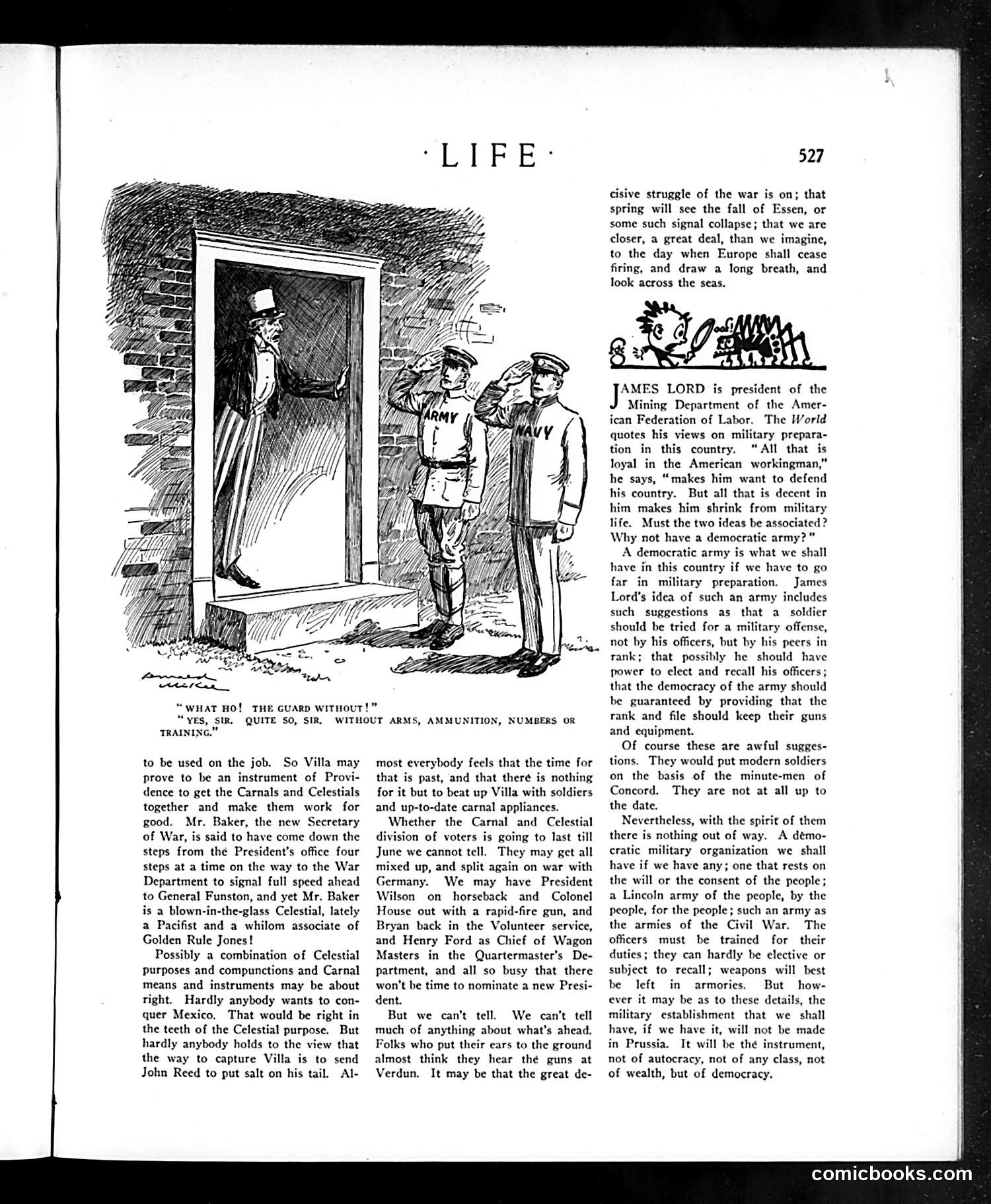
The cartoon depicts a military guard refusing entry to two soldiers labeled "ARMY" and "NAVY," illustrating the satirical tension discussed in the accompanying text about American military preparedness during World War I. The page critiques the political debate over U.S. military preparation circa 1916. It references Pancho Villa (Mexican revolutionary), contrasting "Celestial purposes" (idealistic/pacifist values) with "Carnal means" (military force). The featured article quotes James Lord, a labor leader, advocating for a "democratic army"—one where soldiers are tried by peers rather than officers, possibly elect their leadership, and retain control of weapons. Life satirizes these suggestions as dangerously impractical, yet ultimately endorses democratic military organization based on consent rather than autocracy, invoking Civil War precedent. The piece reflects anxieties about American intervention in WWI, balancing pacifist sentiment against military necessity.
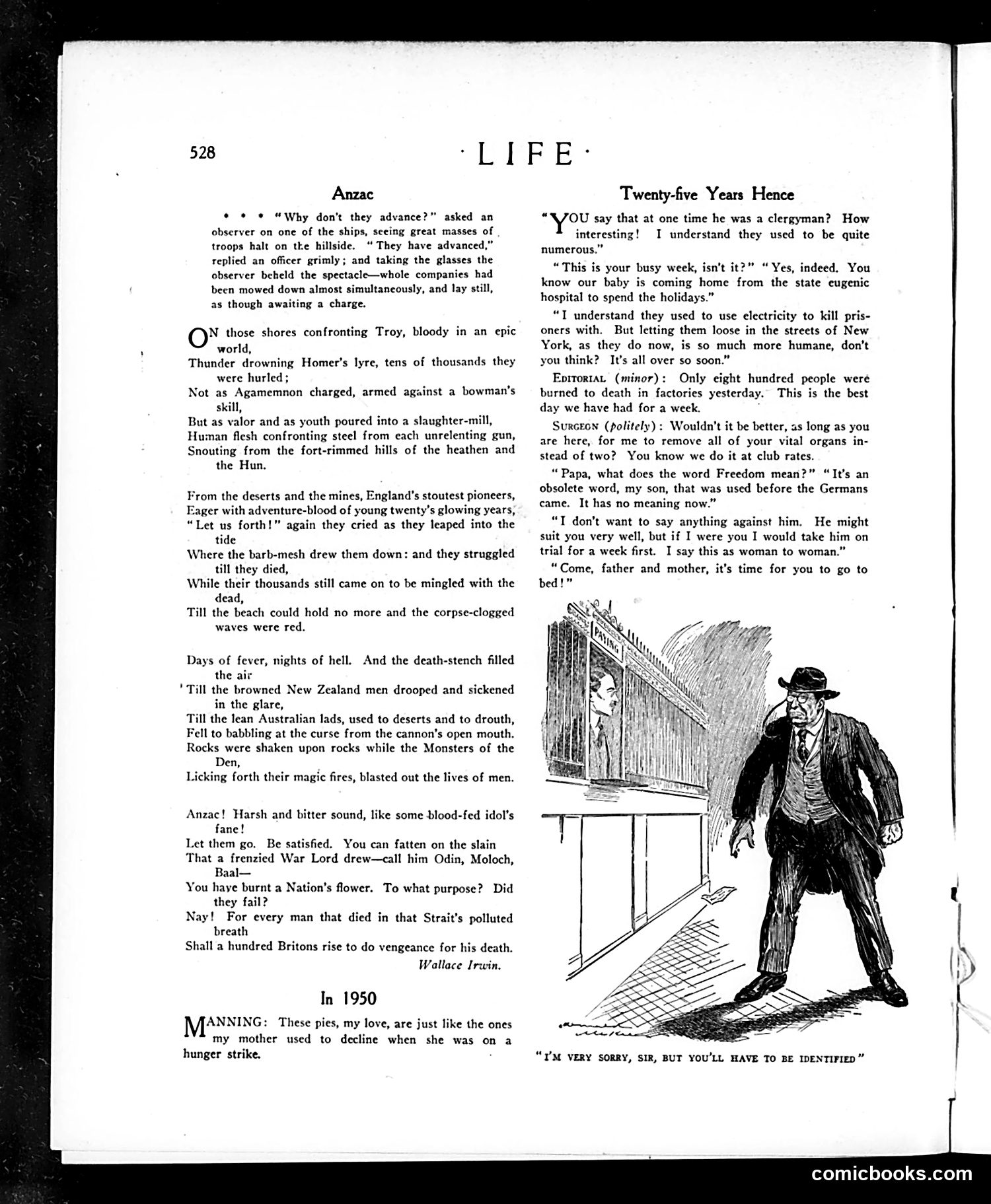
This Life magazine page combines WWI commemoration with dystopian satire. The **"Anzac"** section is a serious poem by Wallace Irwin mourning the 1915 Gallipoli Campaign, where Australian and New Zealand troops suffered catastrophic casualties against Ottoman forces. It references the slaughter directly ("corpse-clogged waves were red") and invokes vengeance, typical of WWI-era patriotic literature. The **"Twenty-five Years Hence"** section satirizes an imagined future society of 1950 (written around 1925). It mocks feared dystopian trends: eugenics ("state eugenic hospital"), state execution ("electricity to kill prisoners"), industrial negligence ("eight hundred people burned"), devaluation of human life, loss of freedom under unnamed oppressive rule ("before the Germans came"), and surveillance ("you'll have to be identified"). The cartoon depicts an unidentified man confronting someone at a doorway—likely illustrating the surveillance/identification theme. This satirizes contemporary anxieties about totalitarianism and social degeneration, presenting them as logical extensions of current trends.
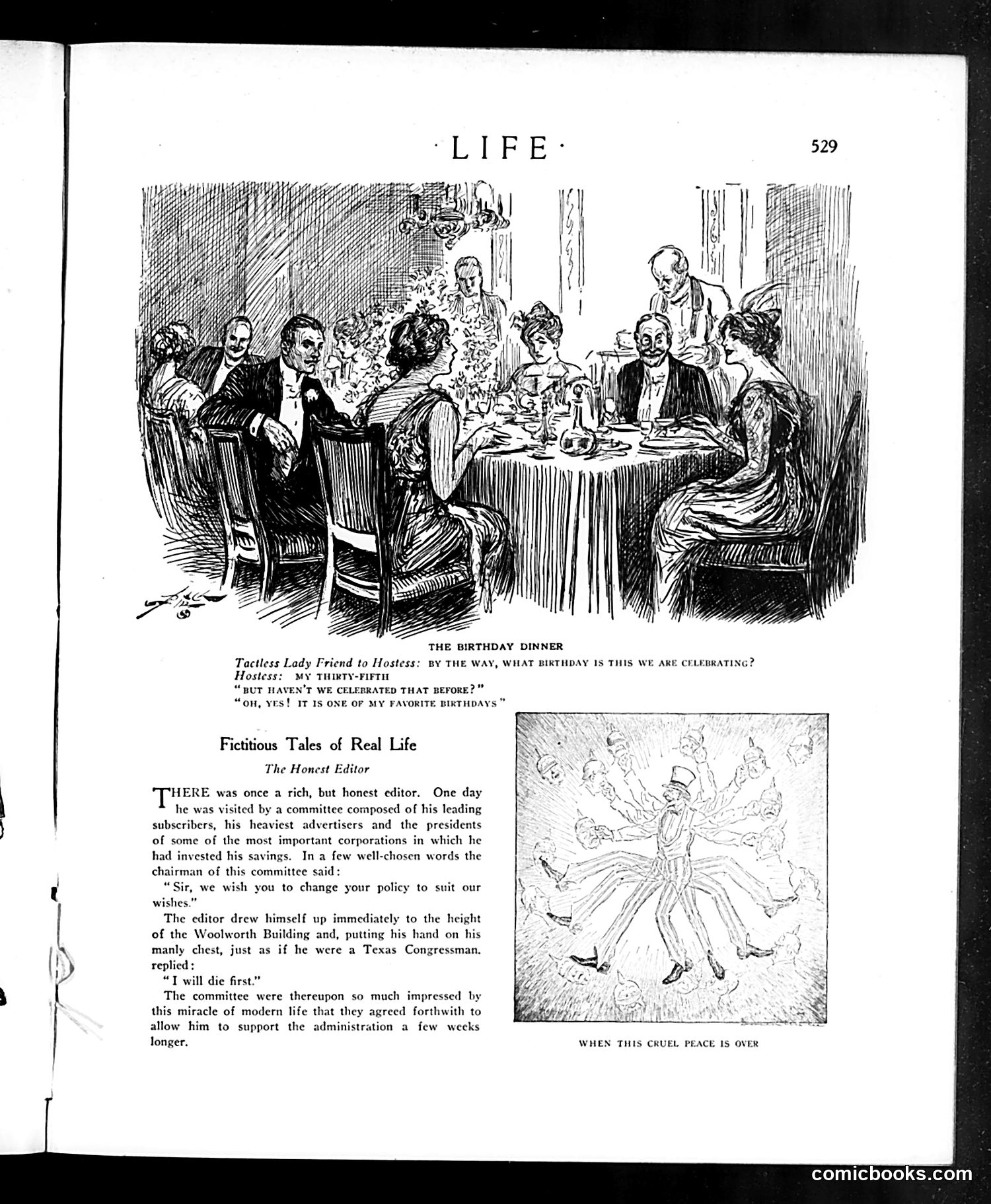
**Top Cartoon - "The Birthday Dinner":** A hostess claims she's celebrating her thirty-fifth birthday, but a tactless guest points out they've celebrated this same birthday before. The joke satirizes women who repeatedly claim the same age, pretending not to age. It's gentle social satire about vanity and dishonesty regarding age. **Bottom Story - "The Honest Editor":** This is darker political satire. A wealthy editor is visited by major advertisers and corporate investors demanding he change his editorial policy. He grandiosely refuses, comparing himself to a "Texas Congressman" (suggesting theatrical, performative patriotism). However, the punchline reveals the satire's bite: the committee then allows him to continue—but only to "support the administration." The story mocks the illusion of editorial independence; the editor's principled stance changes nothing, and he remains a puppet of corporate interests serving political power. It critiques both media integrity and corporate control of journalism.
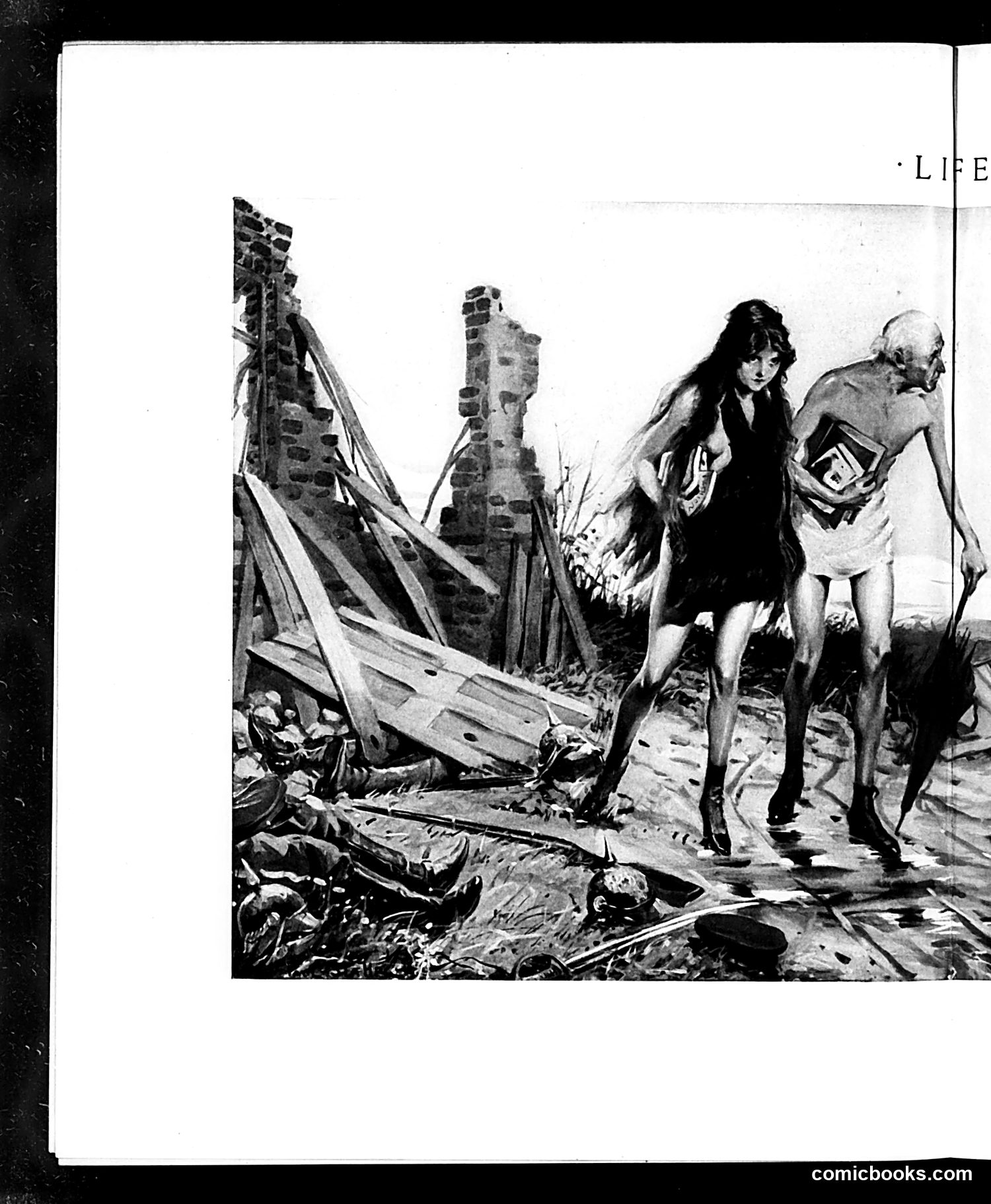
This appears to be a satirical illustration from *Life* magazine depicting survivors amid post-apocalyptic or catastrophic ruins. Two figures—a woman with long dark hair and a thin, elderly man—stand among wreckage, debris, and what appear to be bodies or casualties. Both carry framed images or documents. The satire likely comments on **civilization's collapse** or **cultural decay**. The figures' attempts to preserve cultural artifacts (the framed items) amid widespread destruction suggests commentary on humanity's misplaced priorities—clinging to symbols of refinement while society crumbles around them. Without additional context (date, caption text), the specific historical reference remains unclear, though this style suggests early-to-mid 20th century social criticism, possibly addressing war, economic collapse, or societal decline.
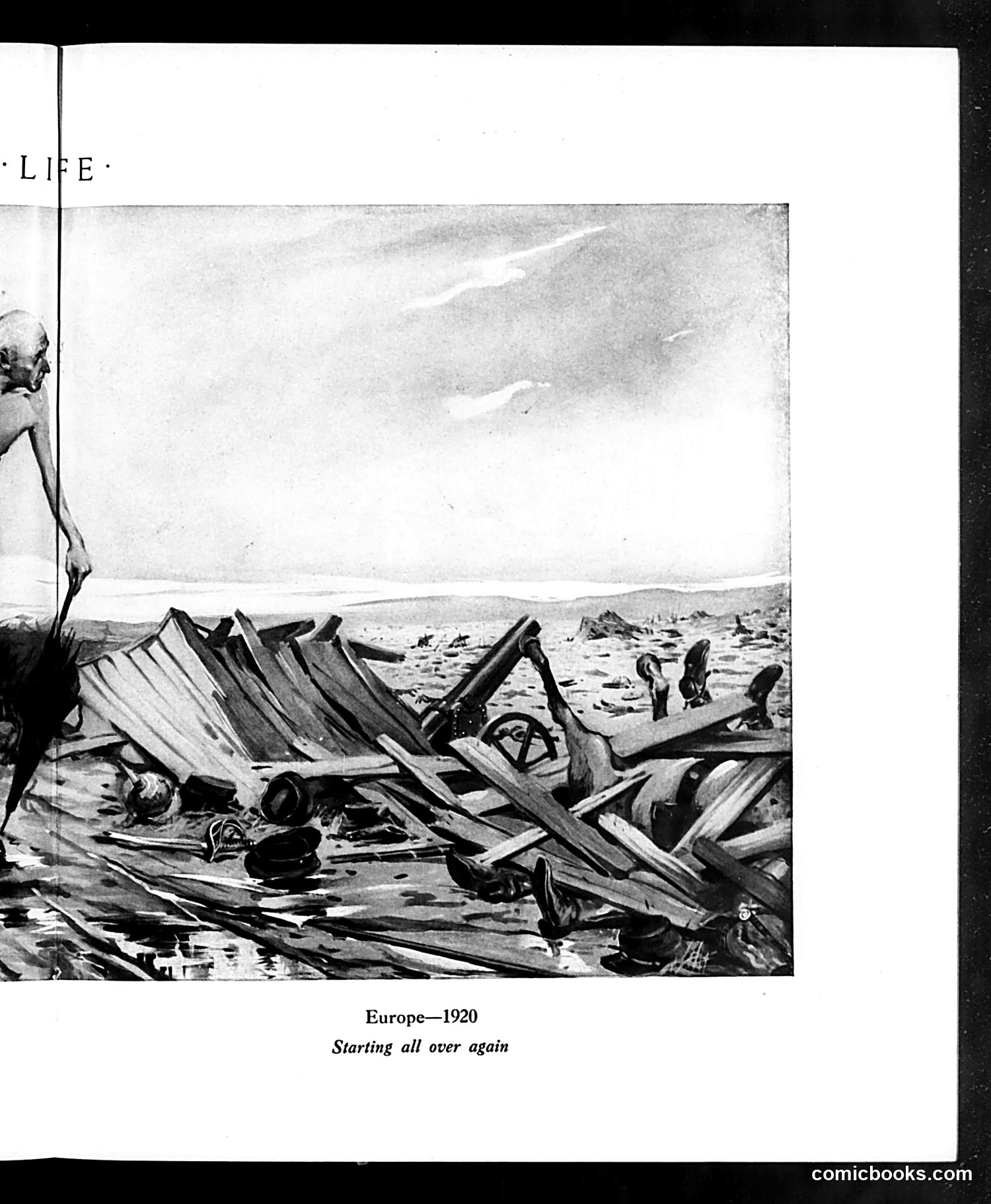
This page depicts post-World War I European devastation. The photograph shows a desolate battlefield landscape scattered with wreckage—broken wooden structures, debris, and what appear to be casualties or bodies. A solitary emaciated figure stands at left, observing the destruction. The caption "Starting all over again" carries bitter irony: Europe must rebuild from complete ruin following the war's massive casualties and infrastructure destruction. The starving figure represents the continent's exhausted, impoverished population facing an enormous reconstruction challenge. This reflects Life magazine's satirical commentary on the grim reality of post-war Europe in 1920—not celebrating victory, but highlighting the human and material catastrophe that "victory" had produced, and the monumental task of recovery ahead.
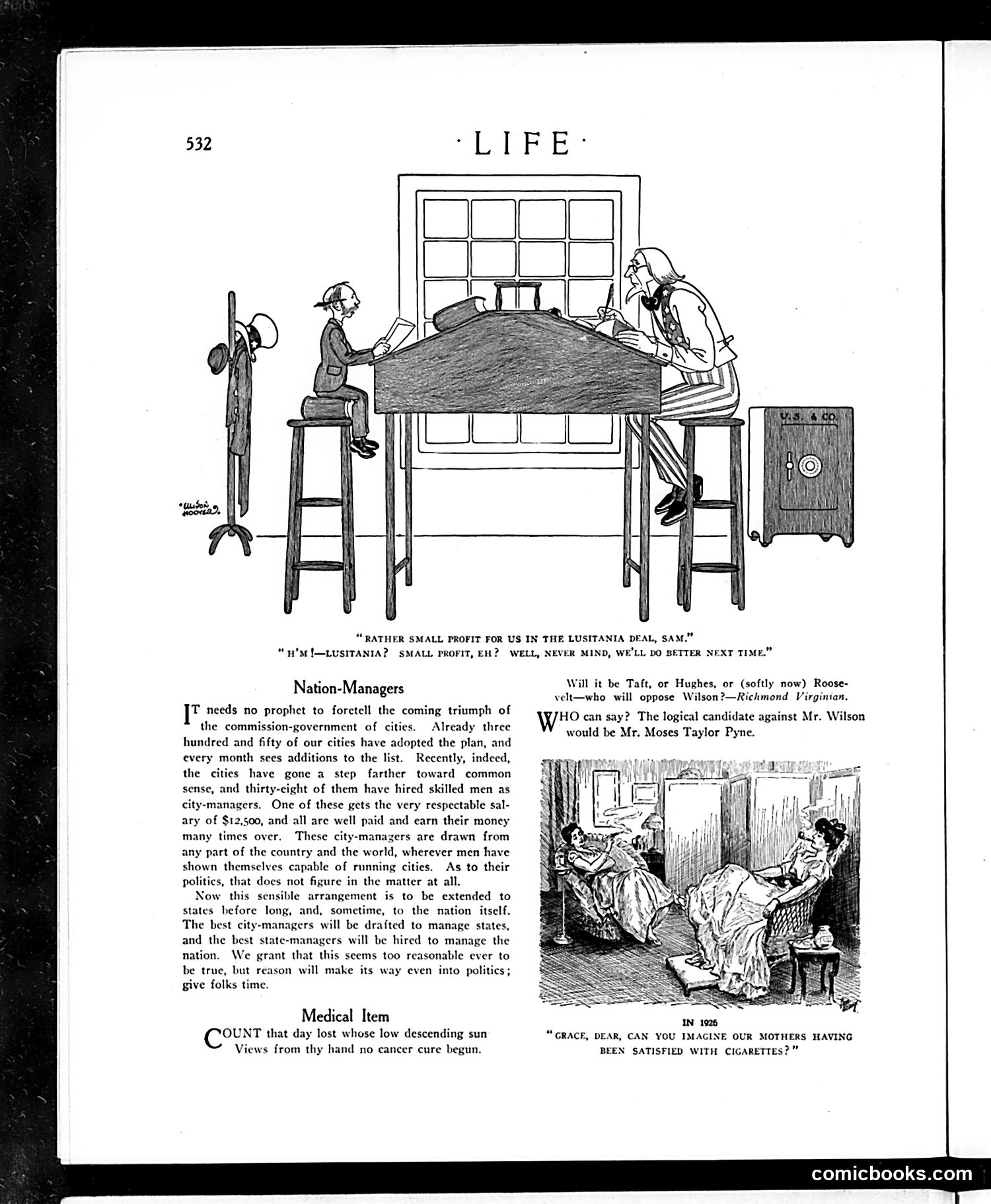
The top cartoon satirizes profiteering from the Lusitania tragedy. Two businessmen sit at a table laden with money, discussing how the ship's sinking provided "small profit." One says they'll "do better next time"—darkly joking about future disasters as profit opportunities. The **Lusitania** (a British ocean liner torpedoed by Germany in 1915, killing 128 Americans) was a real event that inflamed American public opinion. The satire targets war profiteers and munitions manufacturers who benefited from international conflict and tragedy. The "Nation-Managers" article proposes extending city-manager government to states and the nation itself—a Progressive Era reform idea treating government as a business needing professional management. The lower cartoon mocks 1920s women smokers, with a mother horrified her daughter enjoys cigarettes—commenting on changing social norms around women and smoking.
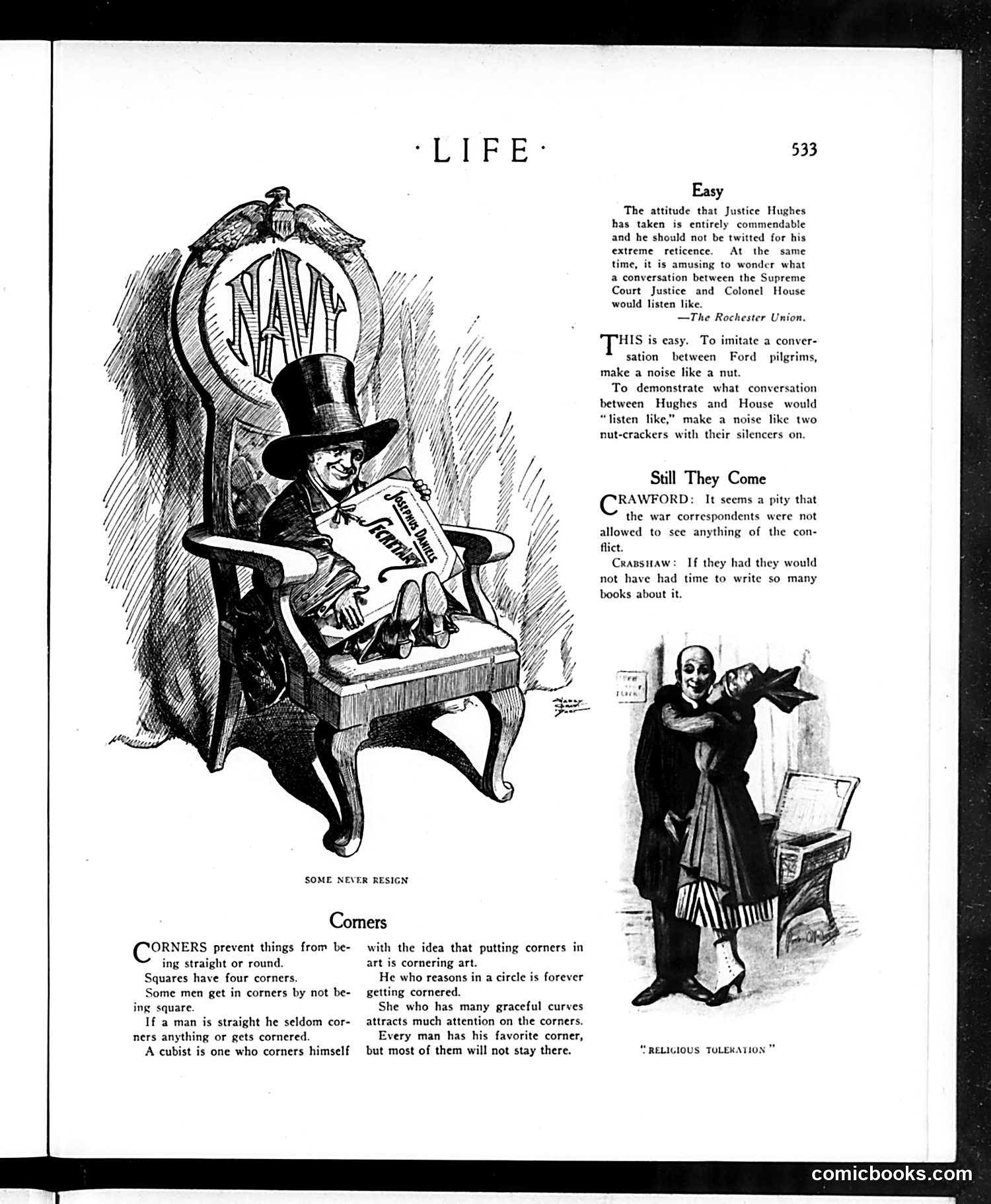
This page satirizes early 20th-century American political figures and social attitudes through multiple vignettes. The main cartoon "Some Never Resign" depicts a figure (likely Justice Charles Evans Hughes, referenced in the "Easy" section) enthroned with an eagle overhead—suggesting someone clinging to power despite expectations he would step down. The accompanying text mocks Hughes's silence on political matters and imagines a hypothetical conversation between Hughes and Colonel Edward House (President Wilson's advisor) as merely "nut-crackers" making noise. Below, "Religious Toleration" shows a figure throwing something out a window—likely commenting on hypocrisy regarding tolerance. The "Still They Come" section ridicules war correspondents who weren't permitted to witness WWI combat firsthand yet published numerous accounts anyway—suggesting their books were fabricated or second-hand. Throughout, Life employs wordplay and visual metaphor to critique political reticence, pretense, and journalistic dishonesty during the Wilson era.
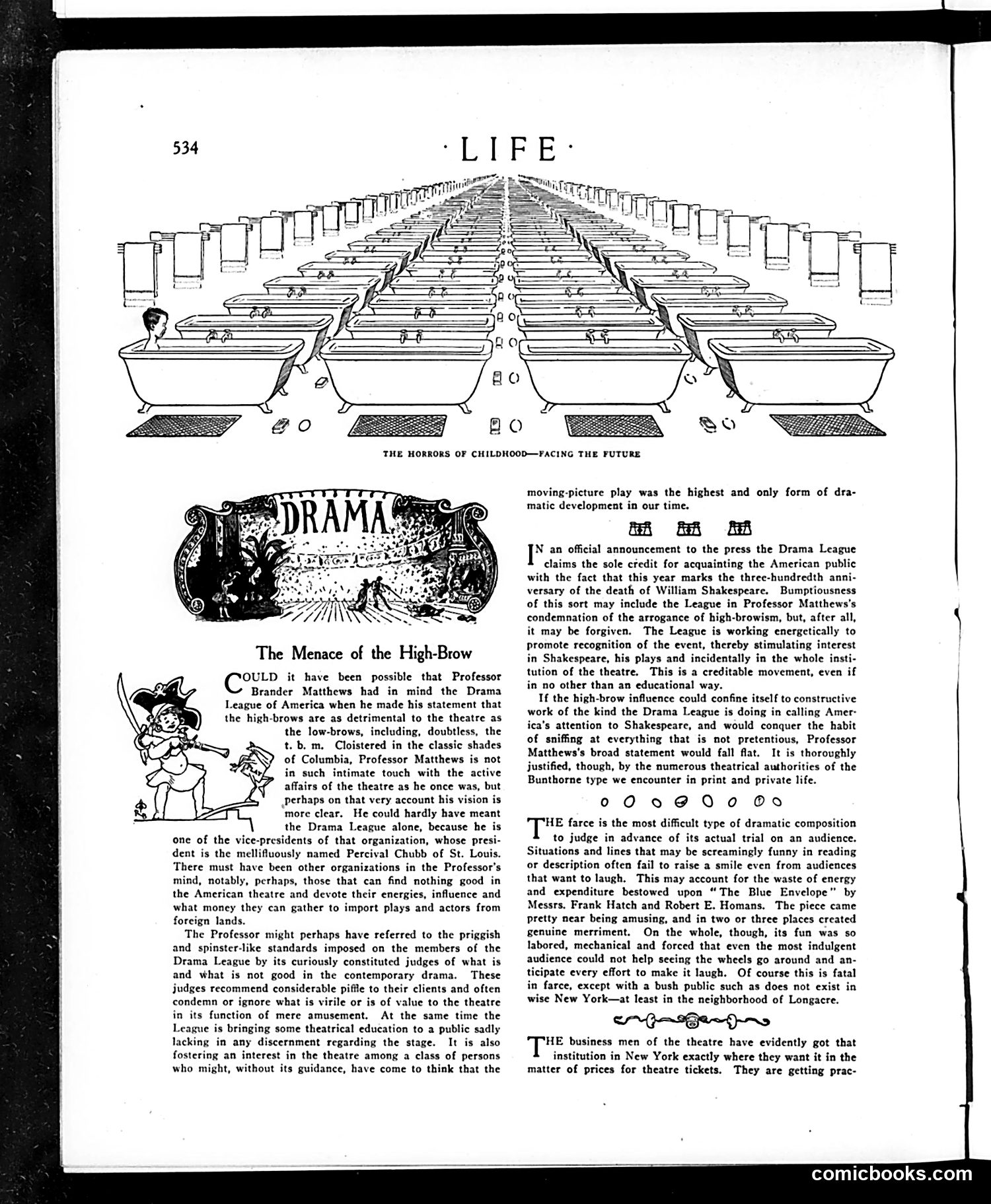
This satirical article critiques intellectual elitism in early 20th-century American theater. The cartoon at top—showing endless bathtubs with one figure bathing—illustrates "The Horrors of Childhood," satirizing how anxious parents obsess over child-rearing. The main piece targets the Drama League and similar organizations for imposing snobbish artistic standards on theater. While acknowledging their educational value (promoting Shakespeare), the author mocks their "priggish" gatekeeping—rejecting popular entertainment as vulgar while championing European imports. Professor Brander Matthews of Columbia University is cited as claiming both "high-brows" and "low-brows" damage theater equally. The piece defends theatrical amusement as legitimate, criticizing the League's dismissive attitude toward moving pictures and commercial farce. The reference to "Bunthorne type" alludes to Gilbert & Sullivan's pretentious character, reinforcing the critique of theatrical snobbishness. The satire attacks cultural gatekeepers who privilege intellectual prestige over genuine entertainment value.
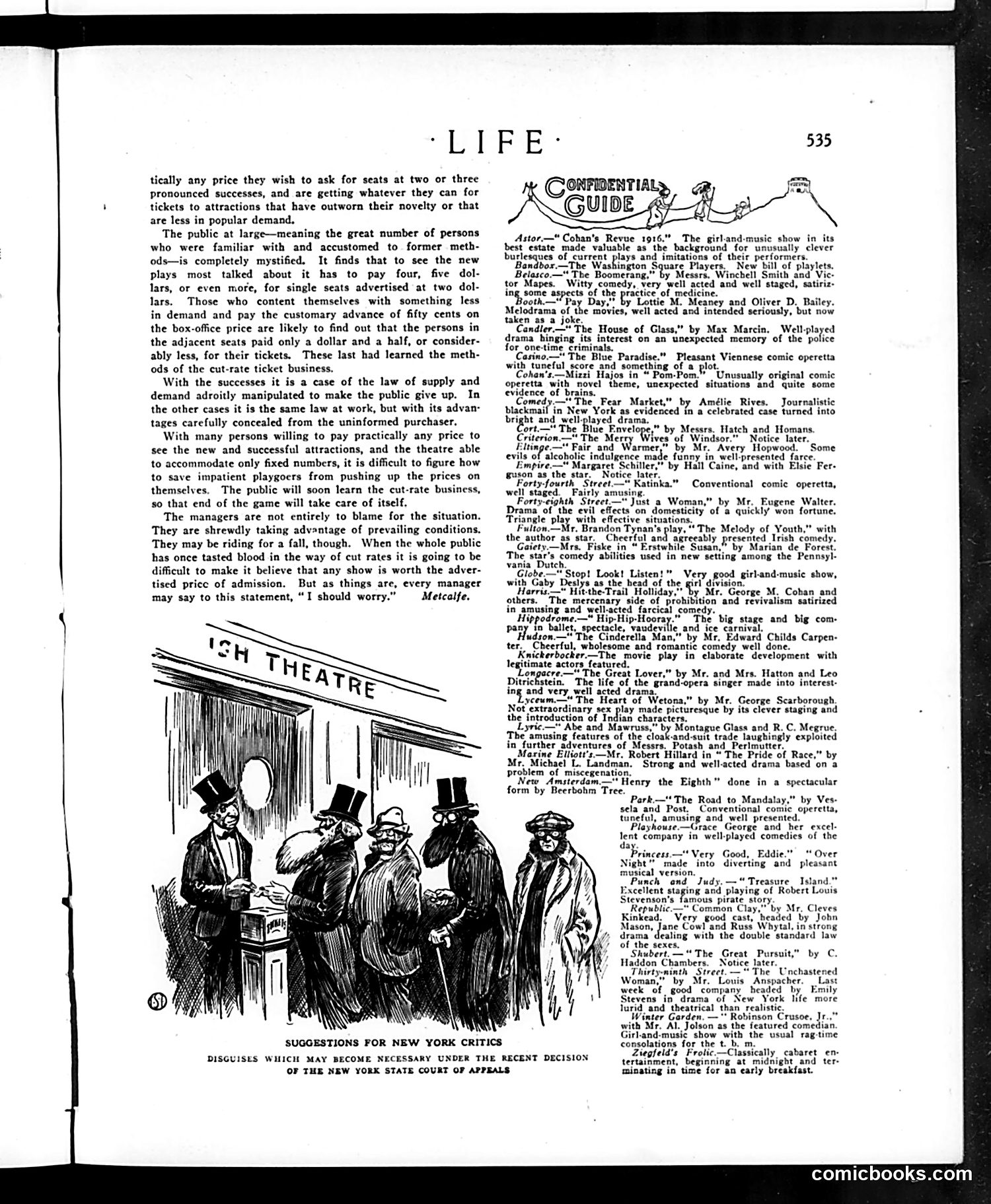
This satirical cartoon illustrates a recent New York State Court of Appeals decision affecting theater criticism. The illustration shows five men in formal attire outside a theater box office, depicted as figures in disguise—wearing various hats and coats to conceal their identities. The joke references a court ruling that apparently restricted critics' access to theaters or their ability to review shows openly. The caption suggests critics now need "disguises" to attend performances without detection, presumably to avoid being denied entry or ejected by theater management responding to the legal decision. The accompanying article discusses theater ticket pricing manipulation—how managers exploit high demand for successful shows while using hidden "cut-rate" methods for less popular productions, deceiving the general public about actual ticket costs. The cartoon satirizes both the court's decision's impracticality and theater owners' adversarial relationship with critics during this period.
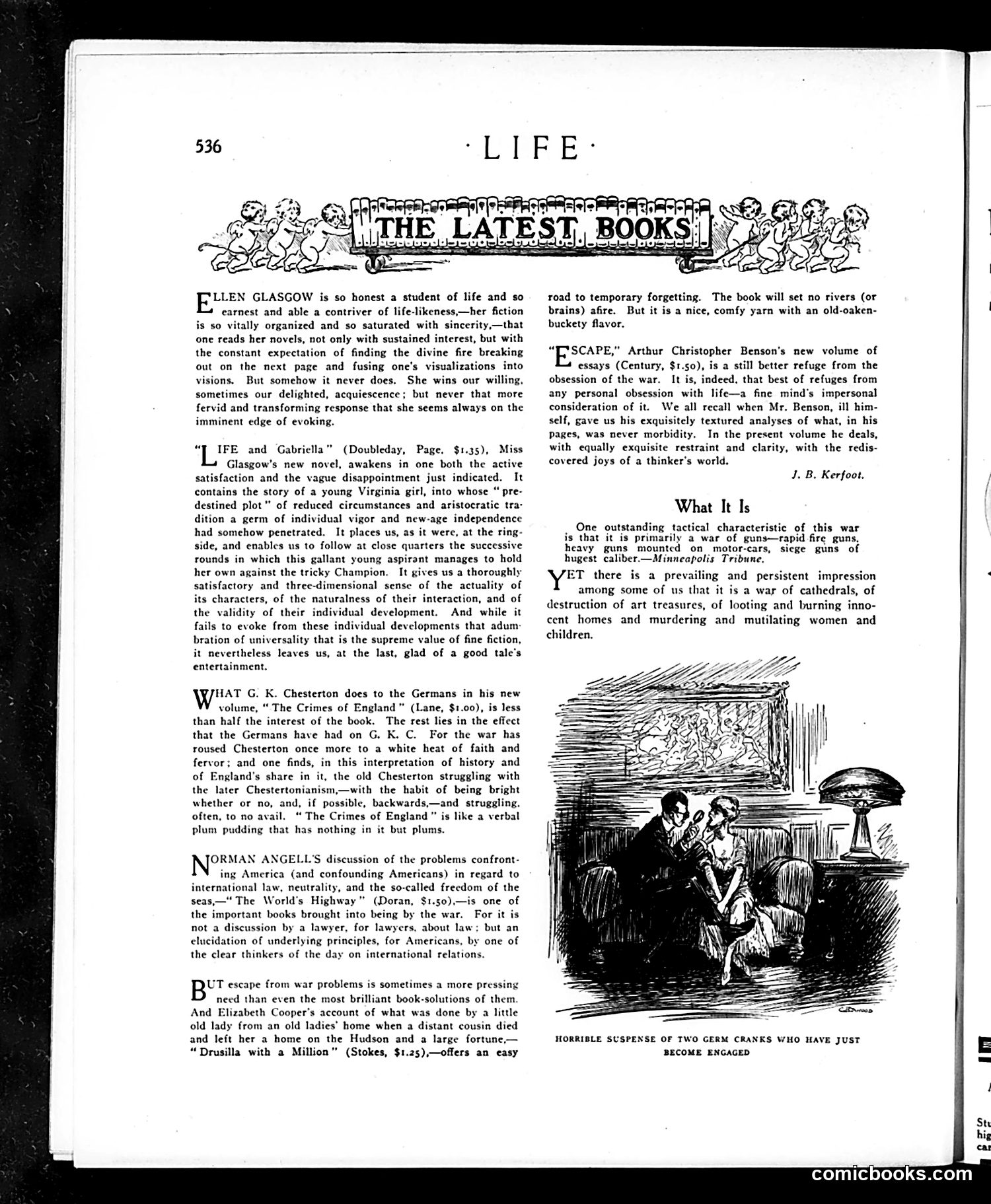
This is a book review section from Life magazine during World War I. The page critiques several contemporary works: **Ellen Glasgow's "Life and Gabriella"** — praised for honest characterization of a Virginia woman achieving independence despite aristocratic constraints, though criticized for lacking transcendent emotional power. **G.K. Chesterton's "The Crimes of England"** — reviewed as Chesterton's passionate war-era polemic against Germany, noting the tension between his rhetorical brilliance and forced wit. **Norman Angell's "The World's Highway"** — commended as serious analysis of American neutrality and international law during wartime. **Elizabeth Cooper's "Drusilla with a Million"** and **Arthur Benson's essays** — offered as escapist reading from war preoccupations. The **illustration** (captioned "Horrible Suspense of Two Germ Cranks Who Have Just Become Engaged") shows a satirical WWI-era joke: two German soldiers/spies anxiously awaiting news, mocking German paranoia or military concerns during the conflict.
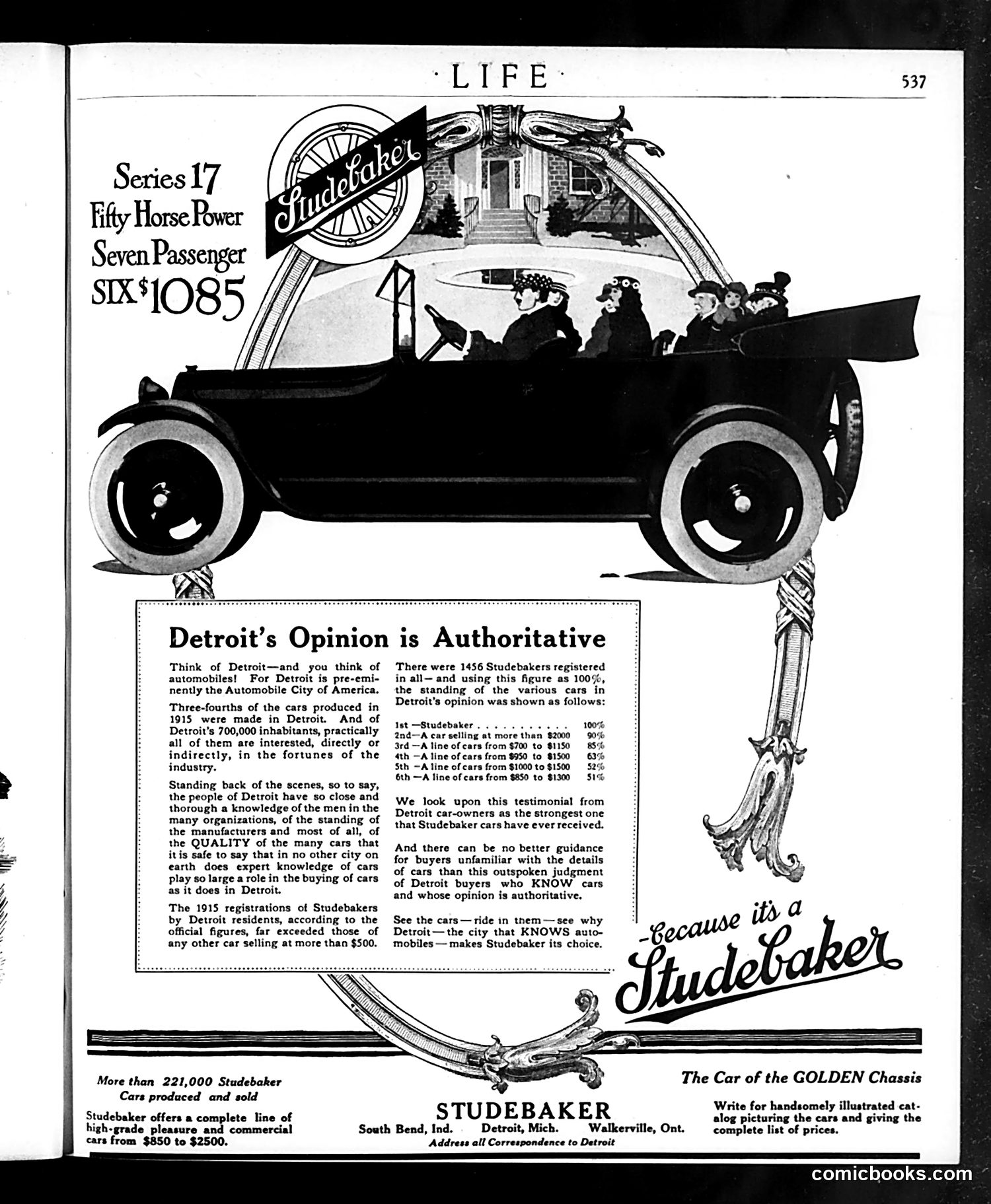
This is primarily a **automobile advertisement**, not a political cartoon. It's a 1915 Studebaker car ad appearing in *Life* magazine (page 537). The ad employs a marketing strategy leveraging **Detroit's reputation as "the Automobile City of America"** to sell cars. Since three-fourths of 1915 American cars were made in Detroit, the ad argues that Detroit residents possessed expert knowledge about automobiles and thus their purchasing preferences were "authoritative." The ad cites 1915 registration data showing Studebaker outsold other cars priced above $500 in Detroit—presented as proof of quality and value. The silhouette illustration shows well-dressed passengers in an open touring car, emphasizing the vehicle's appeal to prosperous buyers. The core pitch: **Detroit knows cars best, Detroit chose Studebaker, therefore you should too.** This reflects early 20th-century advertising's reliance on geographic prestige and expert consensus rather than specifications or performance claims.
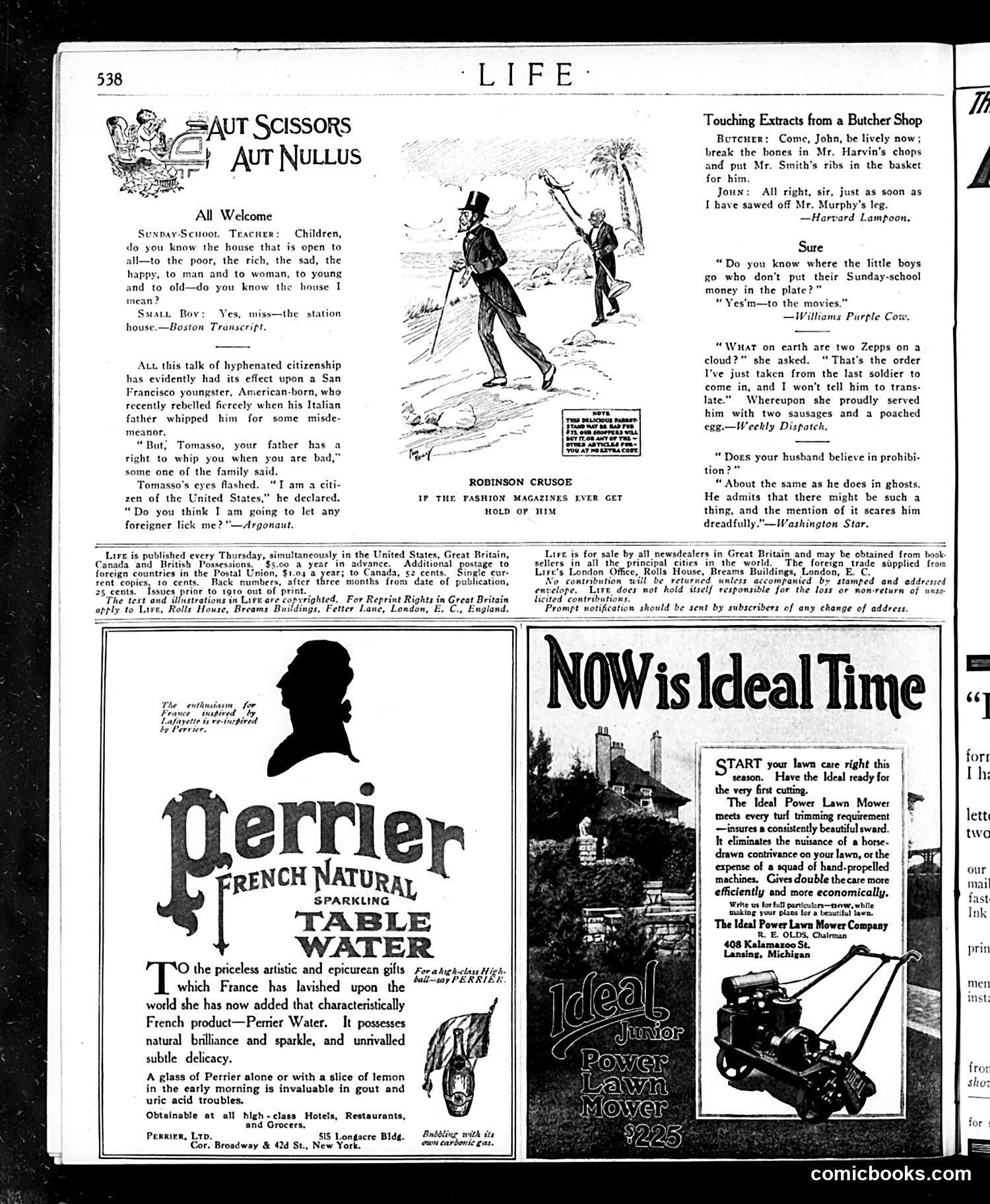
This page contains several short humorous anecdotes and advertisements typical of *Life* magazine's satirical format. **The Main Cartoons/Jokes:** 1. **"All Welcome"** satirizes "hyphenated citizenship"—a contemporary debate about immigrants' divided loyalties. A second-generation Italian-American boy refuses his father's punishment, asserting he's a U.S. citizen and won't accept discipline from a "foreigner." 2. **"Robinson Crusoe"** jokes that fashion magazines would absurdly over-style even a castaway. 3. Other brief quips mock butchers' casual language about body parts, children's priorities (movies over church), and WWI-era food rationing (references to "Zepps"—Germans/Zeppelins). **Context:** This reflects early 20th-century American anxieties about immigration assimilation and WWI tensions, alongside typical period humor about social classes and consumer products (lawn mowers, sparkling water). The page is primarily advertisements for Perrier water and lawn mowers with light satirical content interspersed.
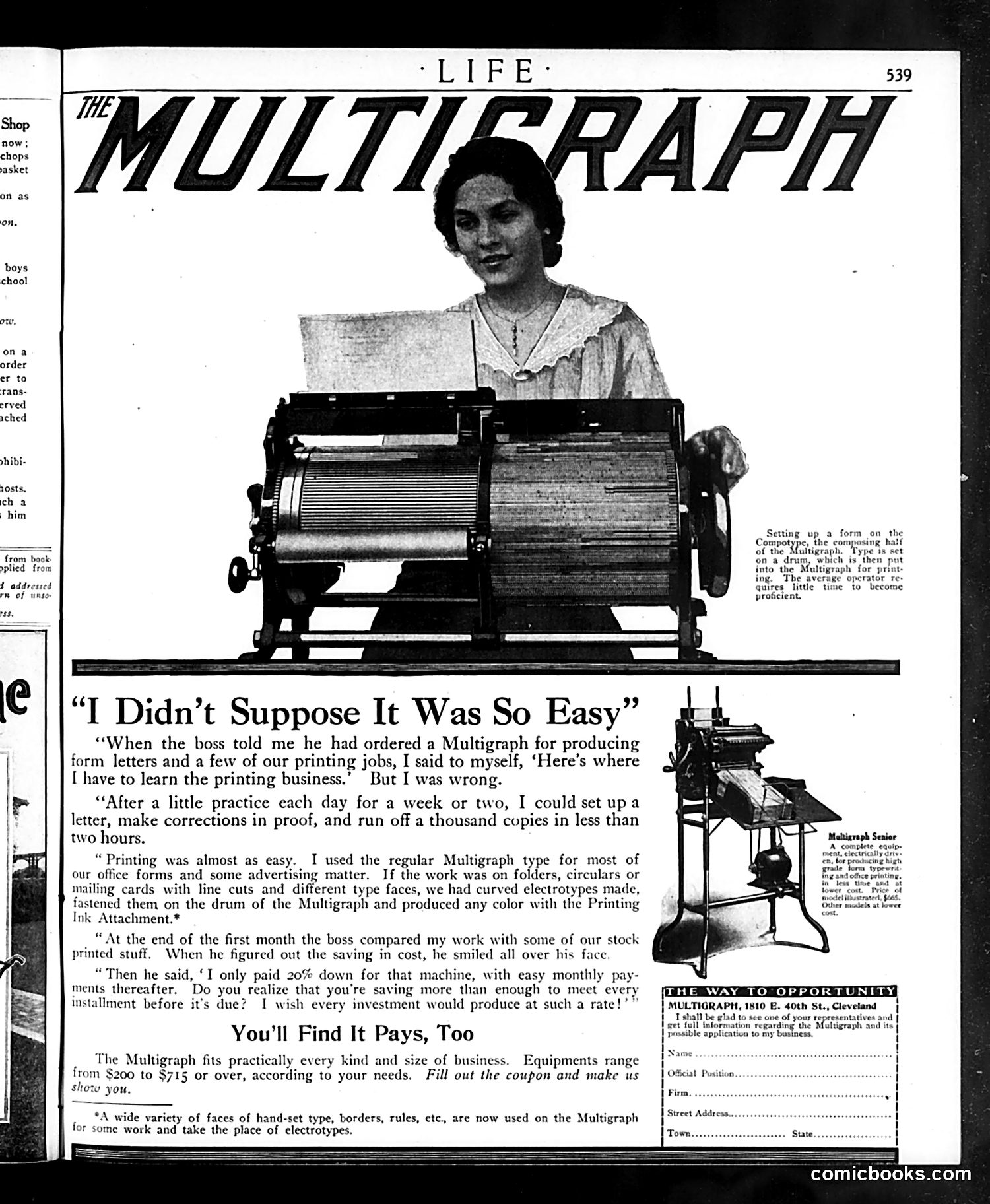
This is a **business advertisement**, not a political cartoon. It promotes the Multigraph, an early printing machine (circa 1920s). The "story" features an unnamed office worker whose skepticism about learning to use new technology is overturned by easy success. After a week's practice, she operates the machine efficiently, producing thousands of copies quickly. Her boss is delighted by the cost savings—the machine pays for itself through reduced printing expenses. The satire is gentle: the headline "I Didn't Suppose It Was So Easy" plays on common anxiety about adopting unfamiliar office machinery. The ad reassures potential business customers that despite appearing complex, the Multigraph is actually user-friendly and profitable. This reflects early-20th-century business culture's emphasis on efficiency and labor-saving devices, targeting small offices and print shops who couldn't afford traditional printing services. The gendered presentation (a woman operator) was typical of period advertising.
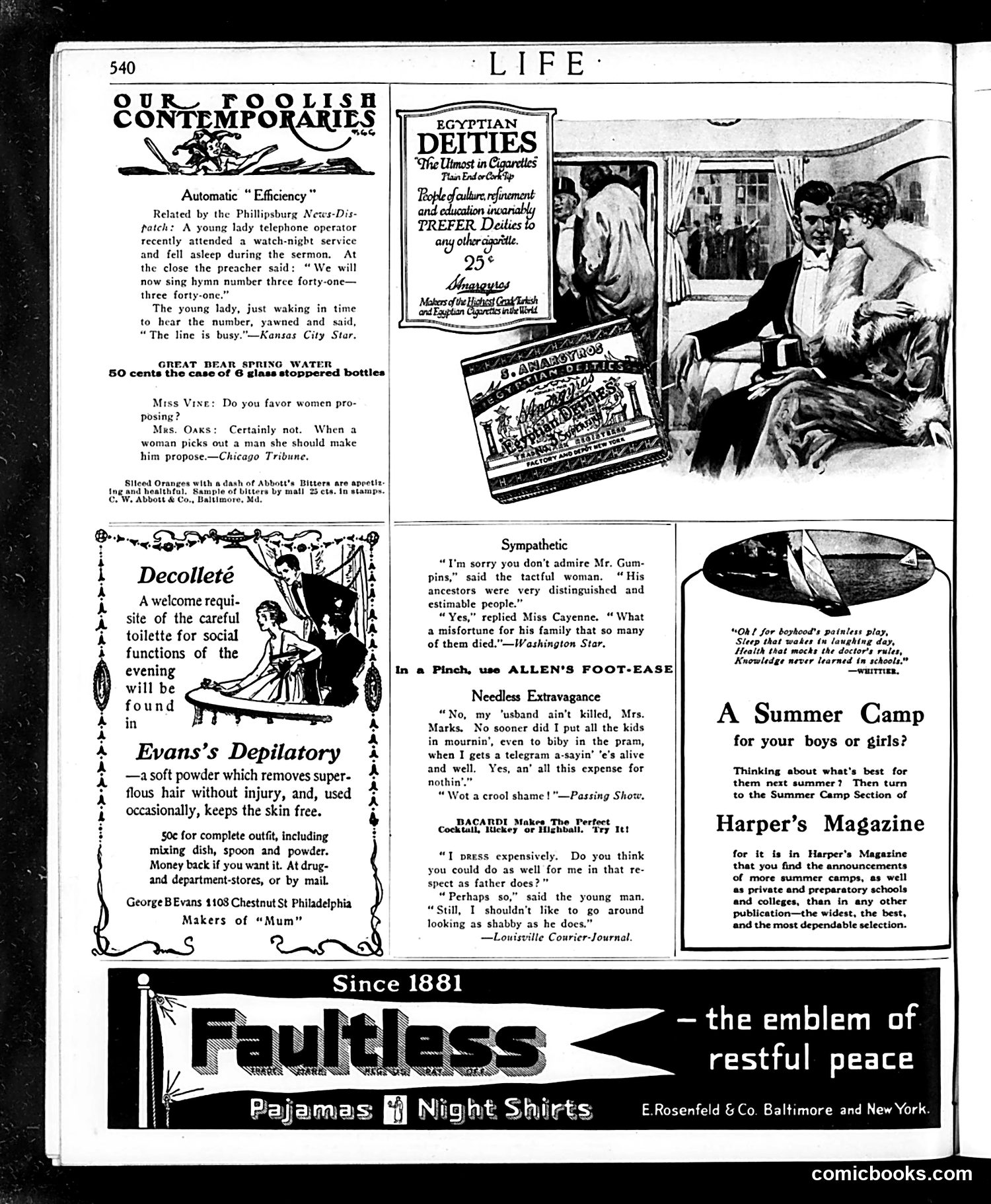
This page from *Life* magazine (a satirical publication, not the photo magazine) contains short humorous anecdotes and advertisements typical of early 20th-century American humor. The "Automatic Efficiency" joke satirizes how modern technology (telephone switchboard culture) infiltrates everyday life—a sleep-deprived telephone operator, trained to respond to numbers, automatically answers "The line is busy" when hearing a hymn number. Other brief jokes mock social conventions: women proposing to men, a woman's tactless consolation about an unadmirable suitor, and a couple's dispute about clothing expenses. The humor relies on mild social commentary about gender roles and class. The page is primarily **advertising**—products like Egyptian Deities cigarettes, Evans's Depilatory (hair removal), Great Bear Spring Water, and prominently, Faultless Pajamas dominate. The ads reflect period concerns: personal grooming, health tonics, and genteel evening wear. Harper's Magazine advertises summer camps for children, targeting middle-class readers. The satire is gentle and domestic, typical of *Life*'s early 20th-century tone.
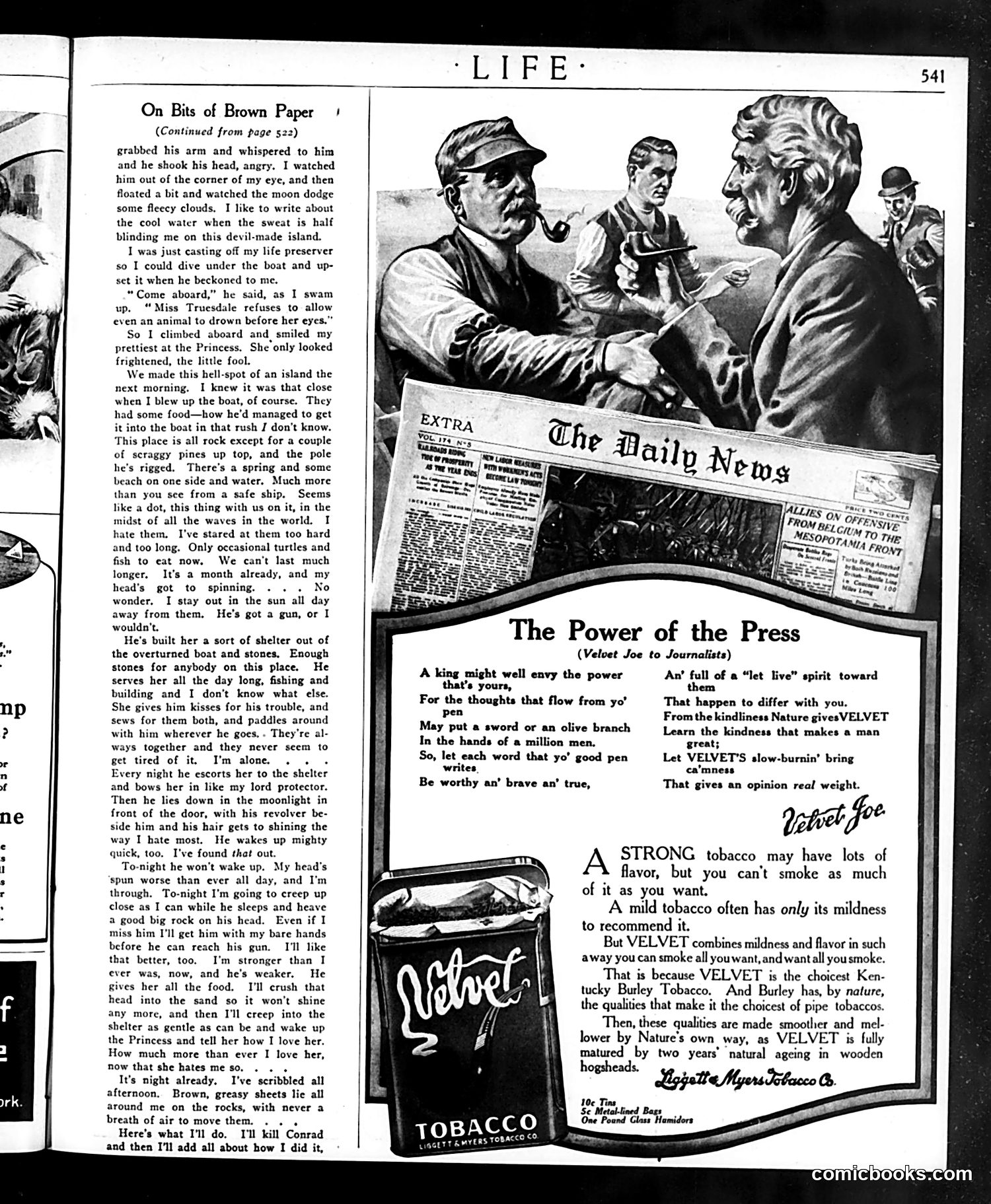
This page contains two distinct elements: **The Story**: "On Bits of Brown Paper" is a serialized fiction piece (continued from page 522) depicting a dramatic survival narrative on an island. A jealous rival narrator plots to murder "Conrad" to win over "the Princess" (Miss Truesdale). The passage is written as the narrator's confession, documenting their descent into madness and murderous intent while stranded. **The Advertisements**: The right side features two ads: "The Power of the Press" is a poetic tribute to journalists' influence, urging them to write with kindness and truth. Below it, a **Velvet Joe Tobacco** advertisement claims their product combines "mildness and flavor," emphasizing moderation in smoking. The juxtaposition is characteristic of *Life* magazine—serious serialized fiction alongside satirical commentary on press responsibility, punctuated by commercial appeals. The tobacco ad's emphasis on restraint is somewhat ironic given the violent passion described in the story.
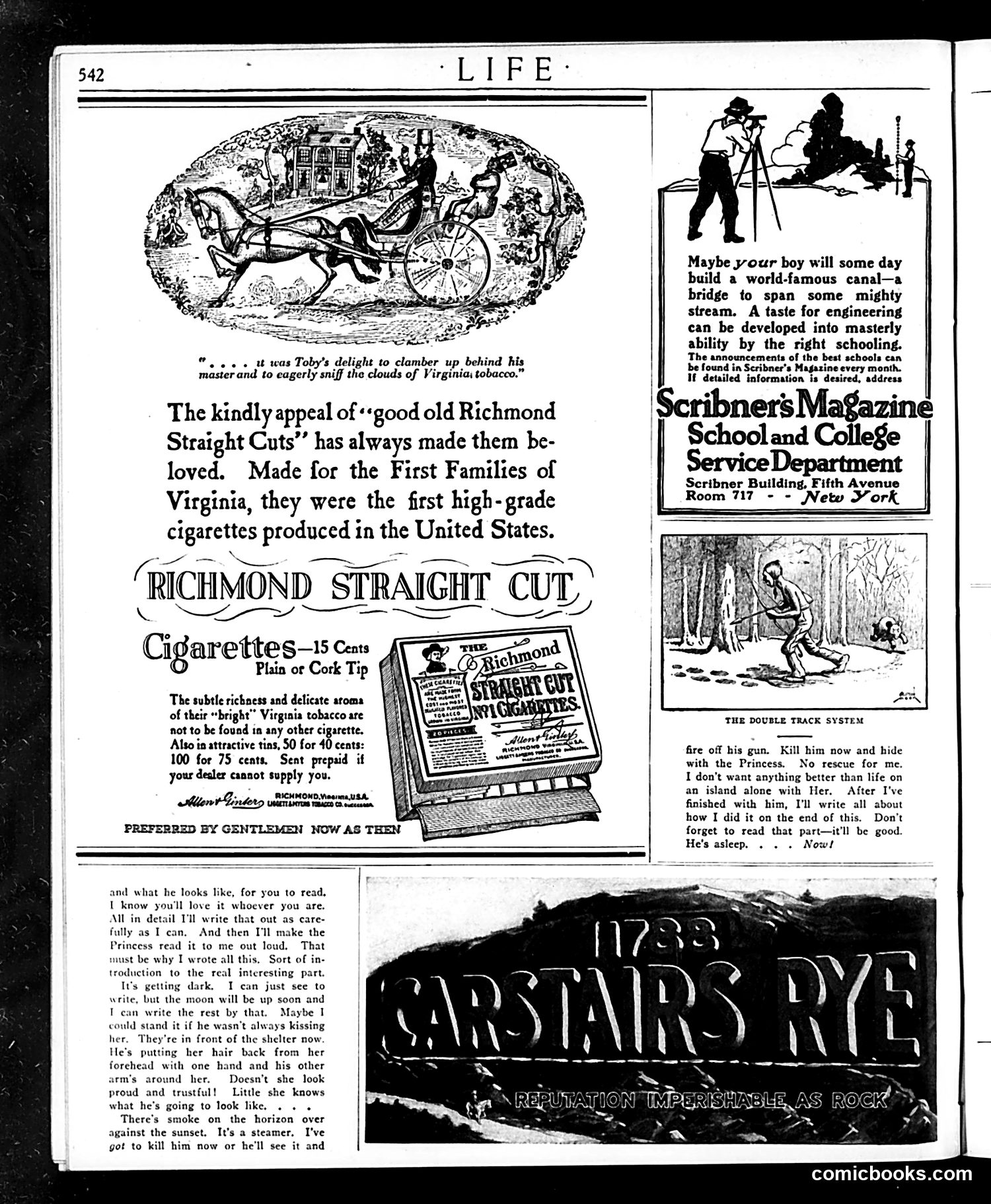
This page contains three distinct advertisements aimed at early 20th-century readers: **Richmond Straight Cut Cigarettes**: An ad promoting cigarettes as "the first high-grade cigarettes produced in the United States," preferred by gentlemen. The illustrated vignette shows a man on horseback enjoying the product. This reflects the era when cigarette advertising was unregulated and glamorized smoking without health warnings. **Scribner's Magazine School and College Service**: An educational recruitment ad suggesting parents develop their sons' talents—specifically engineering—through proper schooling. The accompanying illustrations depict outdoor activities and outdoor work. **"Cars That Rye" (bottom)**: A film advertisement with dramatic text suggesting a suspenseful plot involving jealousy, murder, and romance on an island. The tagline reads "Reputation Imperishable as Rock." The page reflects early 1900s advertising conventions: cigarettes marketed as gentlemanly products, education promoted to the middle class, and sensational film plots designed to attract audiences. No political satire is evident here—it's primarily a commercial page from *Life* magazine's advertising section.
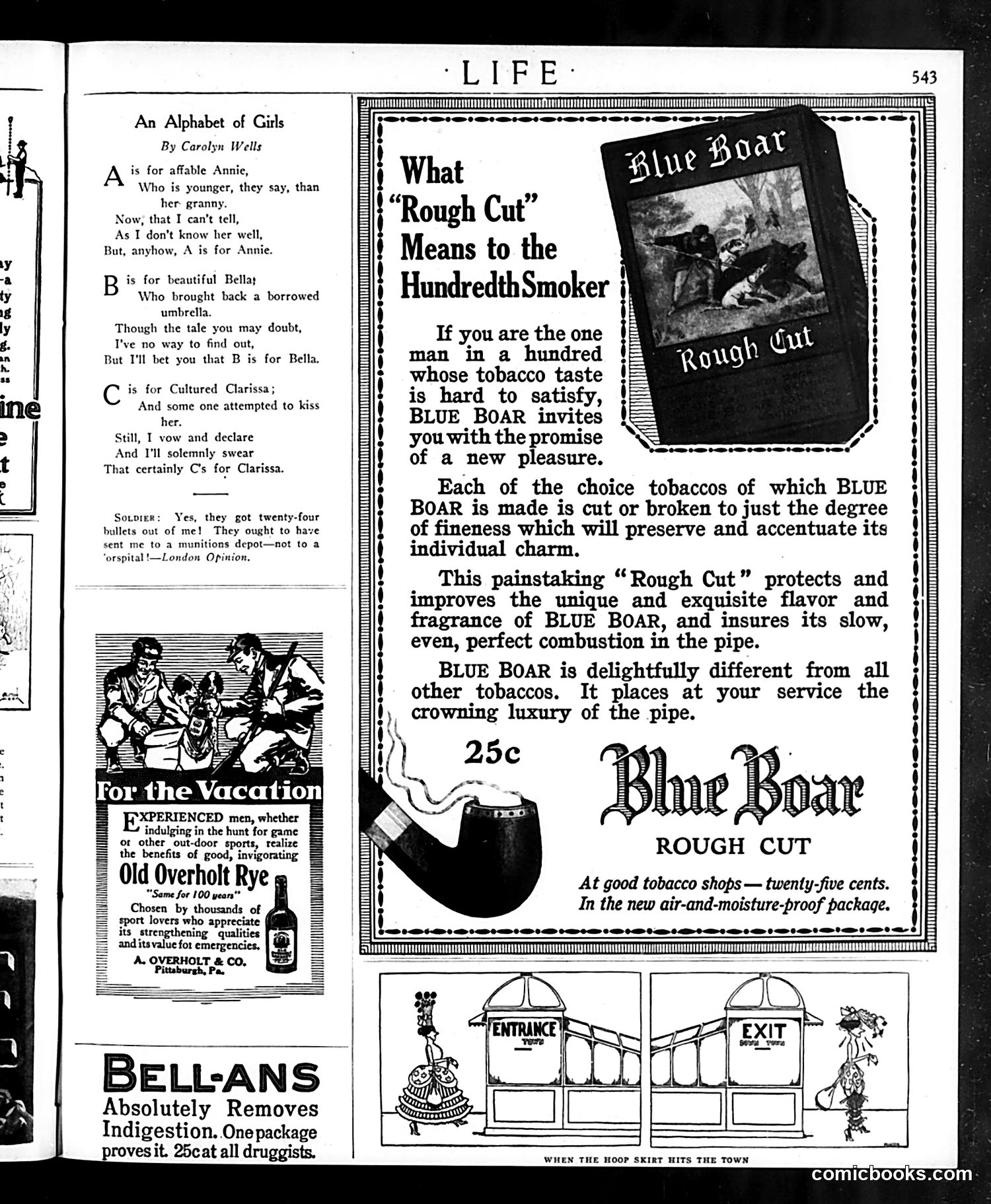
This page contains primarily **light entertainment and advertising** rather than political satire. The main content is "An Alphabet of Girls" by Carolyn Wells—a humorous poem following the A-B-C format, making gentle jokes about young women. Each verse presents a girl with an alliterative name (Annie, Bella, Clarissa) and a trivial anecdote, concluding with obvious rhymes. The humor is mild and domestic—for example, Bella returns a borrowed umbrella (noteworthy for honesty), and Clarissa was almost kissed. This reflects early 20th-century magazine humor: lighthearted, slightly risqué without being scandalous. A small cartoon shows a soldier claiming to have had "twenty-four bullets" removed, joking he should have been sent to a munitions factory instead of a hospital—likely a WWI-era quip about wartime injuries. The remaining space features **period advertisements**: Old Overholt Rye whiskey, Bell-Ans indigestion remedy, and Blue Boar tobacco ("Rough Cut" at 25 cents). These ads are typical of Life's commercial content. The page reflects 1920s entertainment and consumer culture rather than political commentary.
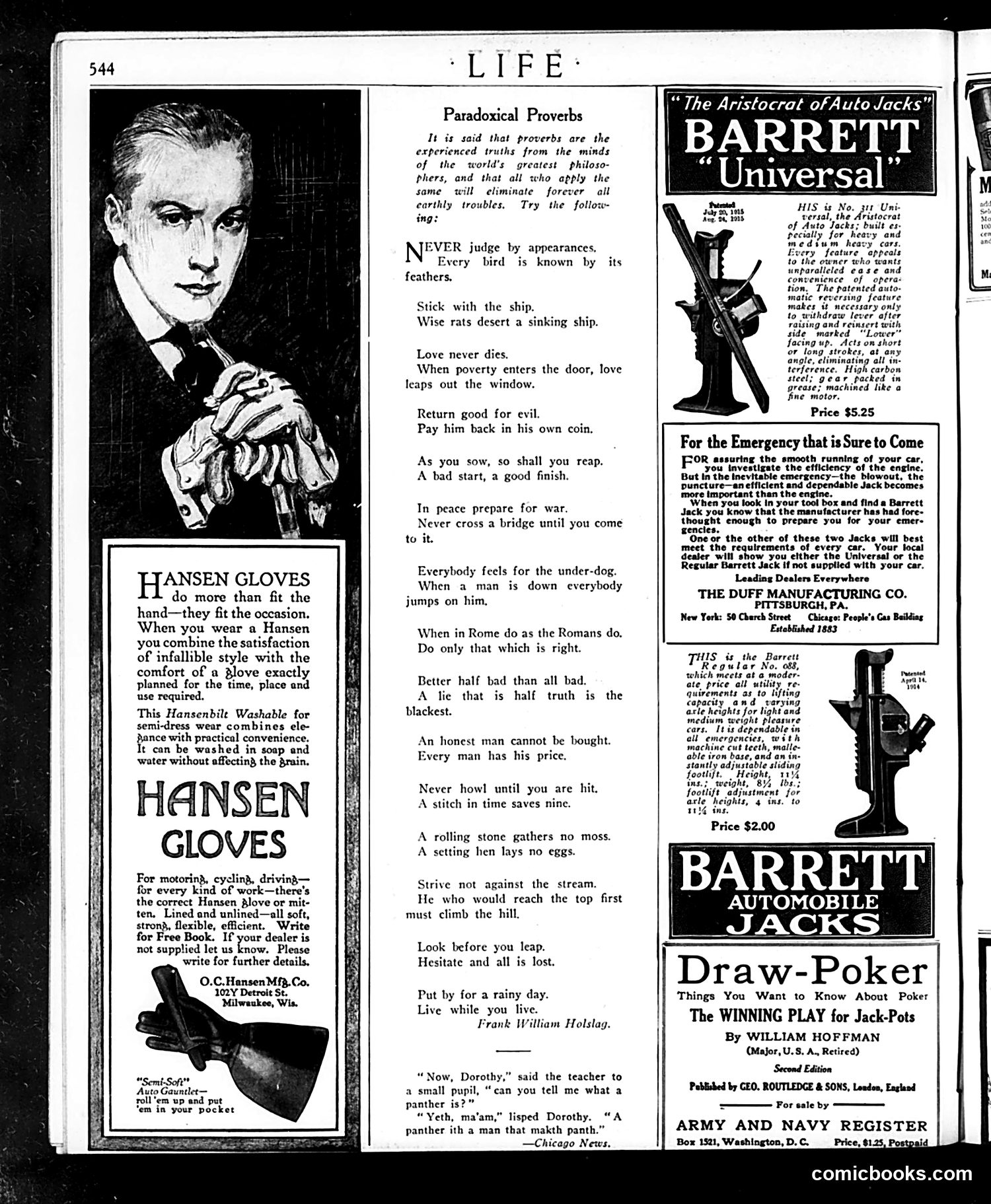
This page is primarily **advertising and miscellaneous content** rather than political satire or comics requiring historical context. **Main Content:** The centerpiece is "Paradoxical Proverbs" by Frank William Holslag—a collection of contradictory sayings meant to humorously expose life's inconsistencies. Examples include "Love never dies" paired with "When poverty enters the door, love leaps out the window" and "Never judge by appearances" versus "Every bird is known by its feathers." The satire is mild social observation about human hypocrisy and self-contradiction, not political commentary. **Advertisements:** The page features product ads for Hansen Gloves, Barrett Automobile Jacks, and a book on poker strategy. A small joke at bottom depicts a child's malapropism: "panther" meaning "a man that makths panth." **Historical Note:** This appears to be early 20th-century content with no specific political cartoon or caricature requiring identification. The page functions as a typical magazine layout mixing light humor with commerce.
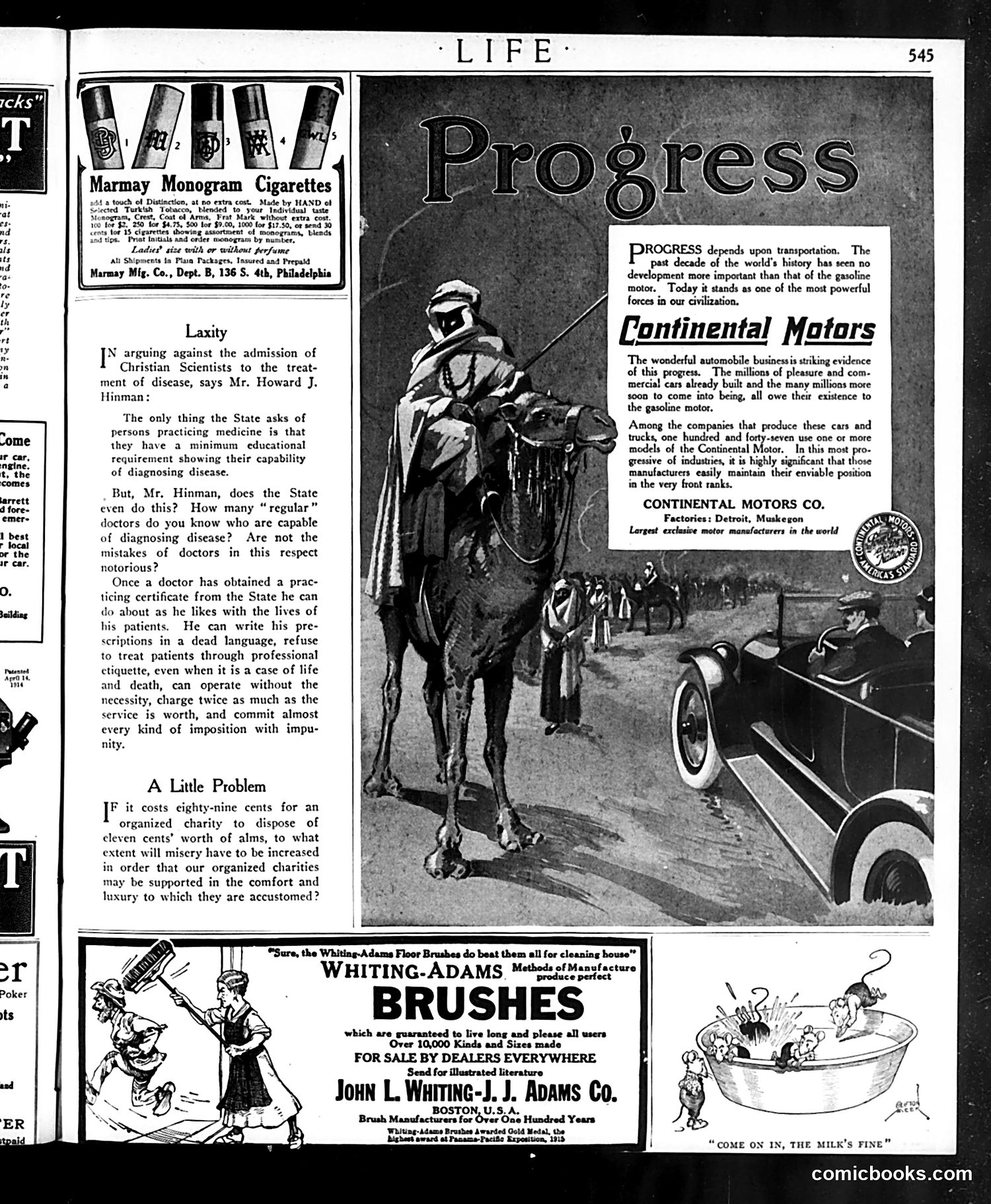
This page from *Life* magazine is primarily **advertisements and opinion pieces** rather than political cartoons. The main content includes: **Editorial commentary** on Christian Science and medical practice, where writer Howard J. Hinman critiques how the state regulates doctors—arguing that licensing requirements are minimal and doctors operate with near-total impunity, even committing malpractice and overcharging patients. **A satirical "Little Problem"** questioning the efficiency of charitable organizations, suggesting that overhead costs (89 cents to distribute 11 cents) are absurdly high. **Multiple product advertisements**: Marmay cigarettes, Continental Motors (automobiles), Whiting-Adams brushes, and an illustration captioned "Come On In, The Milk's Fine"—likely depicting children in unsafe conditions, darkly mocking the era's laissez-faire approach to child welfare. The page reflects early 20th-century concerns about professional regulation, corporate efficiency, and consumer protection—issues *Life* magazine regularly satirized through pointed social criticism.
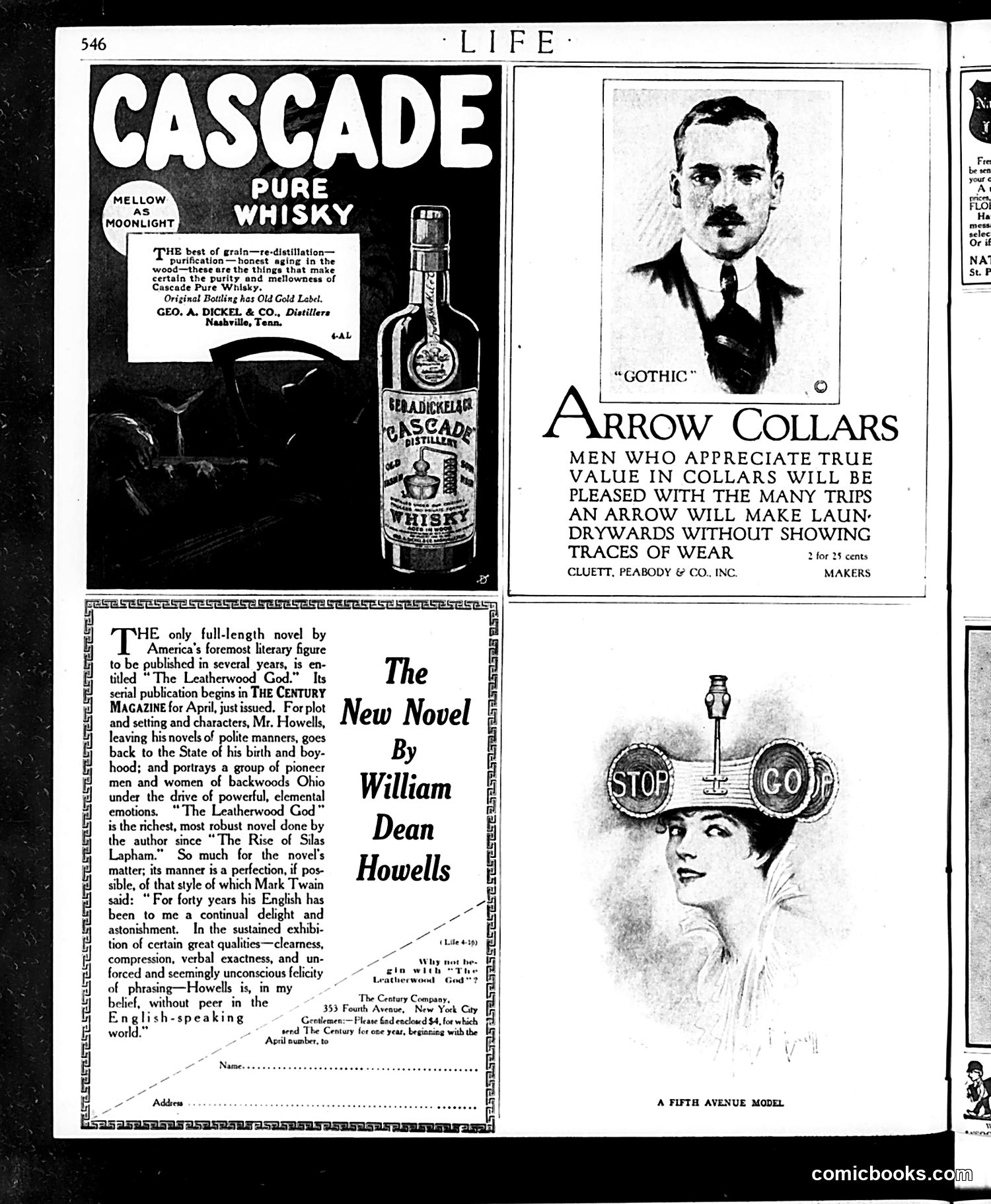
This is primarily an **advertising page** rather than satirical content. It features three advertisements: 1. **Cascade Pure Whisky** (top left): A straightforward liquor ad emphasizing purity and aging quality, distributed by a Nashville distillery. 2. **Arrow Collars** (top right): Features a man labeled "Gothic"—likely referring to a fashionable or serious style—advertising collars that withstand multiple launderings without visible wear. 3. **William Dean Howells' Novel** (bottom): Announces serialization of "The Leatherwood God" in *The Century Magazine*, praising Howells as "America's foremost literary figure." The ad includes a famous Mark Twain endorsement of Howells' prose style and provides a subscription coupon. The Howells announcement is noteworthy as it positions serious American literature alongside consumer goods—typical of *Life's* mixed editorial-advertising format. The "Fifth Avenue Model" caption references high-fashion standards of the era.
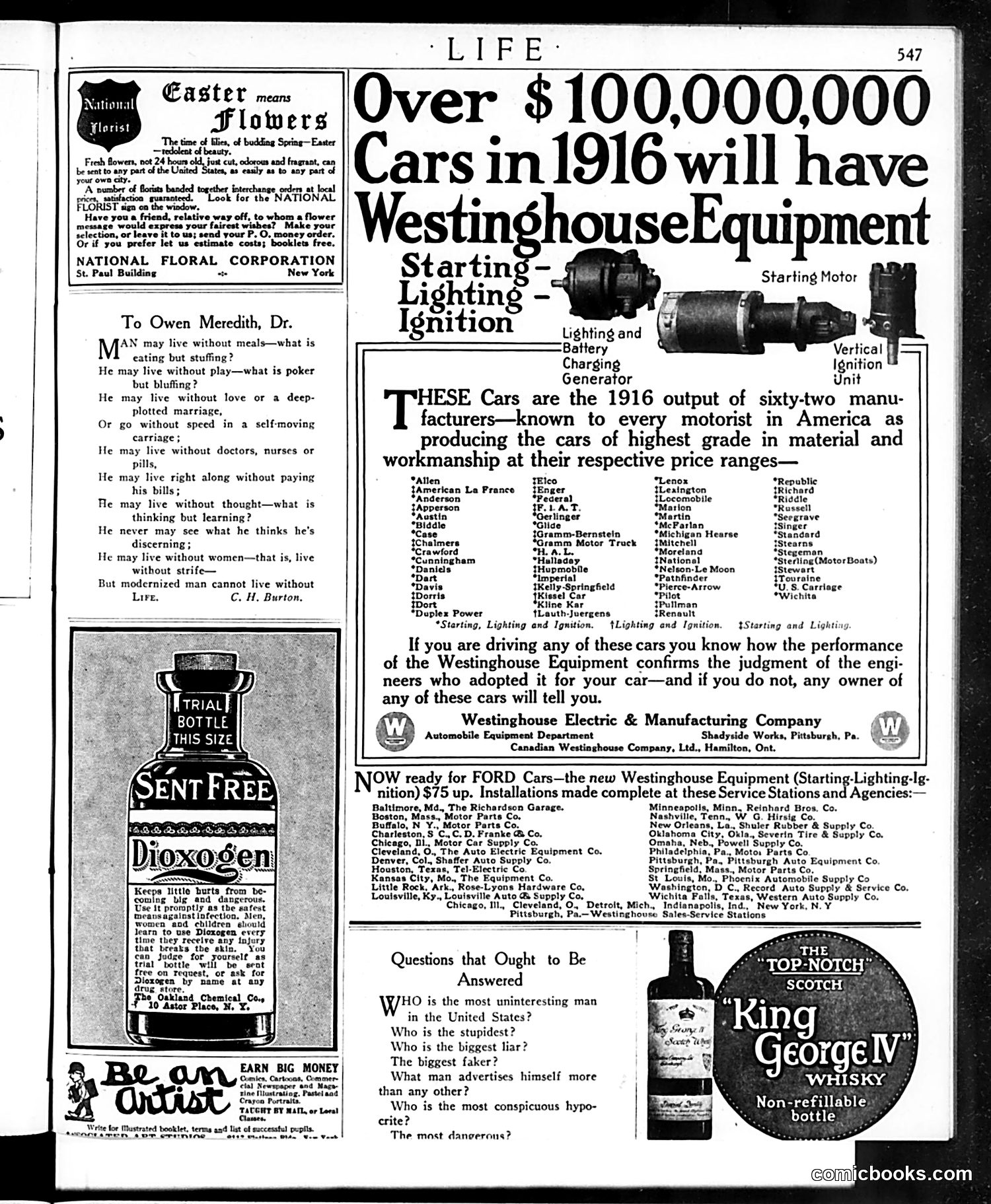
This page is primarily **advertising**, not satire. The dominant content is a large Westinghouse Electric advertisement claiming that over $100 million worth of 1916 automobiles will use their electrical equipment (starters, lighting, ignition systems). The ad lists 62 car manufacturers as clients, positioning Westinghouse as the industry standard. Supporting advertisements include: - **National Floral Corporation**: Easter flower delivery service - **Dioxogen**: An antiseptic/disinfectant product - **King George IV Whisky**: Scotch whisky in a "non-refillable bottle" - **Be an Artist**: A correspondence course for earning money The only non-advertising content is a sentimental poem "To Owen Meredith, Dr." by C.H. Burton about modern life necessities, and a column header "Questions that Ought to Be Answered" (contents cut off). This represents typical early 20th-century *Life* magazine content: editorial material mixed with commercial advertisements targeting middle and upper-class readers.
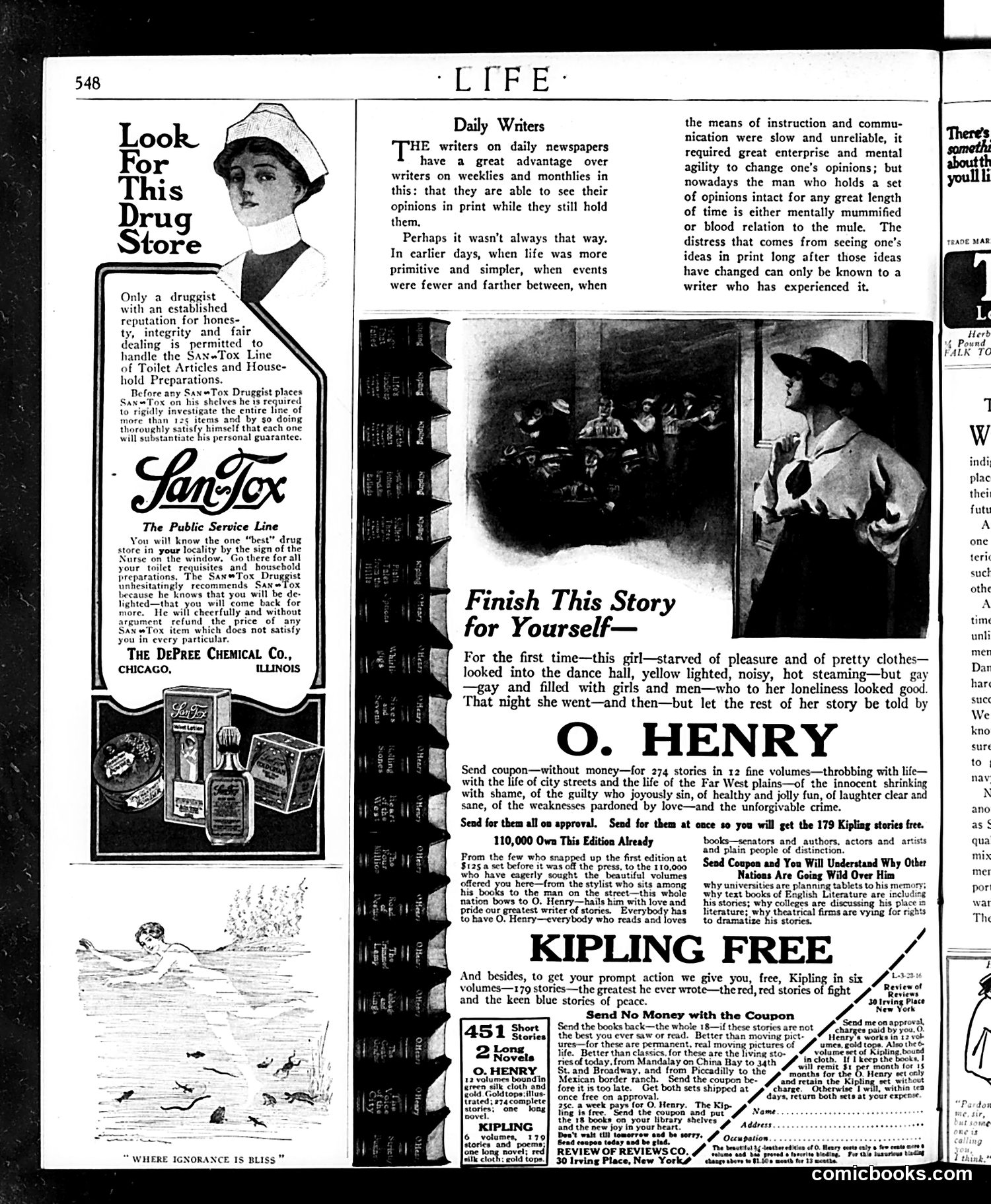
This page contains **advertisements and literary promotion** rather than political satire. The main content advertises O. Henry's collected stories (274 stories in 12 volumes) available on approval, emphasizing his popularity and cultural importance. The accompanying image shows a young woman at a dance hall—illustrating the story premise: a poor girl experiencing urban pleasures for the first time, hinting at moral compromise ("but let the rest of her story be told by O. Henry"). The page also promotes a **Sax-Tox drugstore chain** and discusses **newspaper columnists' challenges** with quickly-changing public opinions. The "Where Ignorance is Bliss" illustration at bottom appears unrelated to the main content—likely a separate humorous sketch typical of *Life* magazine's format. This is primarily **commercial content**, not political commentary.
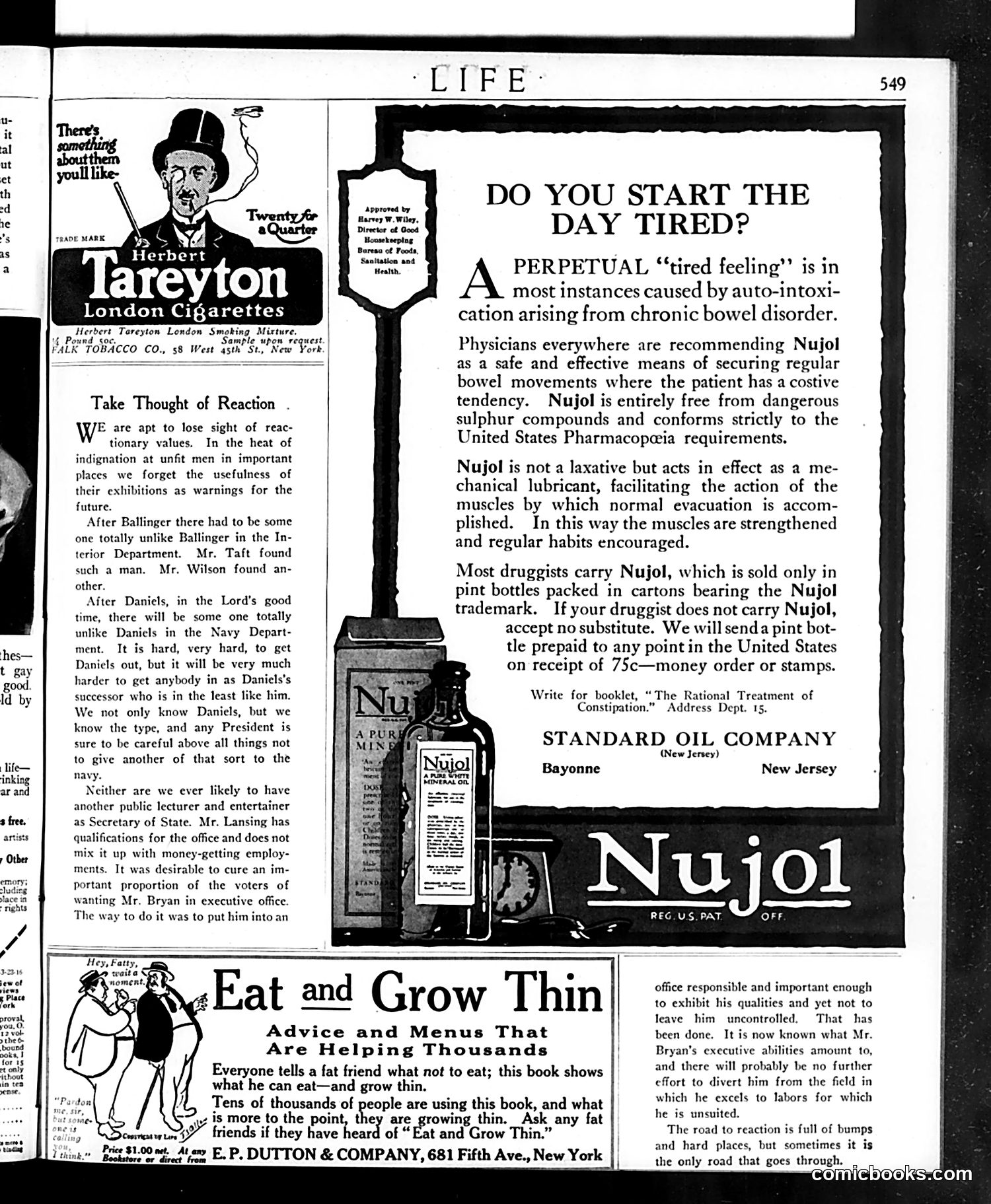
This page contains period advertisements mixed with political commentary titled "Take Thought of Reaction." The main article critiques recent Cabinet appointments under Presidents Taft and Wilson, referencing specific officials: **Ballinger** (Interior Secretary involved in a conservation scandal), **Daniels** (Navy Secretary), and **William Jennings Bryan** (Secretary of State under Wilson). The satirical point argues these appointees demonstrated why their predecessors were problematic—each successor was chosen as deliberately unlike their predecessor, serving as a cautionary lesson. The article's final jab at Bryan suggests Wilson gave him a prestigious but powerless position to demonstrate Bryan lacked executive ability, preventing future efforts to put him in real authority. The satire mocks the administration's method of discrediting a political figure. The advertisements—for **Tareyton cigarettes**, **Nujol** (a "mechanical lubricant" for bowel regularity), and weight-loss advice—are typical early 20th-century patent medicines and consumer goods marketed with exaggerated health claims.
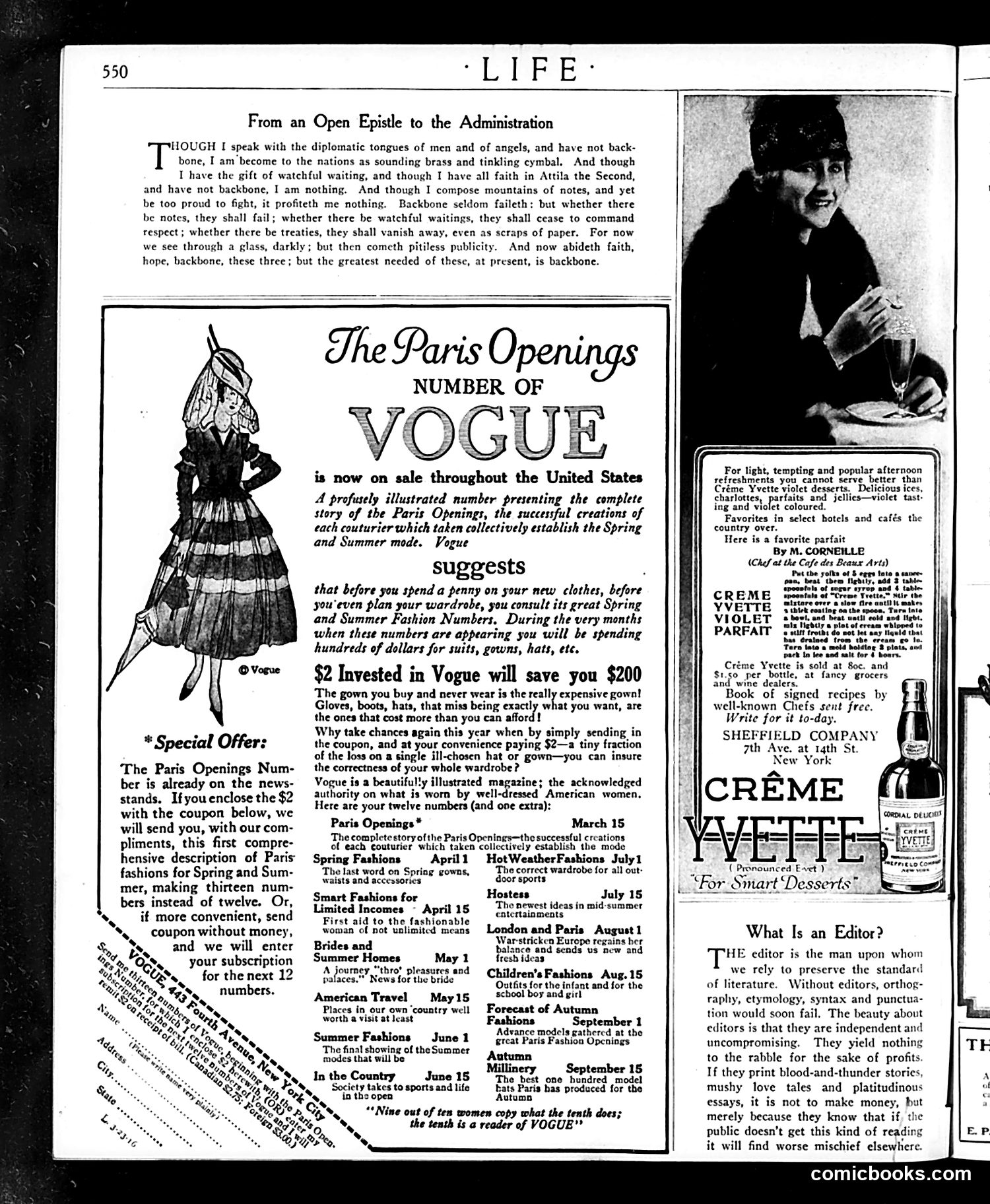
This page mixes political satire with advertising. The "Open Epistle to the Administration" uses biblical language (echoing 1 Corinthians 13) to mock U.S. government foreign policy, particularly regarding "backbone"—a coded reference to perceived weakness in diplomatic stance. The phrase "Attila the Second" appears to reference a contemporary political figure, likely President Wilson, though the satire's specific target remains unclear without fuller context. The repetition of "backbone" suggests criticism of indecisive leadership during a tense period (likely pre-WWI or WWI era). The remainder is straightforward **Vogue magazine advertising**, promoting their Paris Fashion issues at $2 for a year's subscription, claiming it will "save" readers $200 by preventing poor clothing purchases. This was standard early-20th-century marketing: fashion magazines positioned themselves as economical investments for middle-class women making wardrobe decisions.
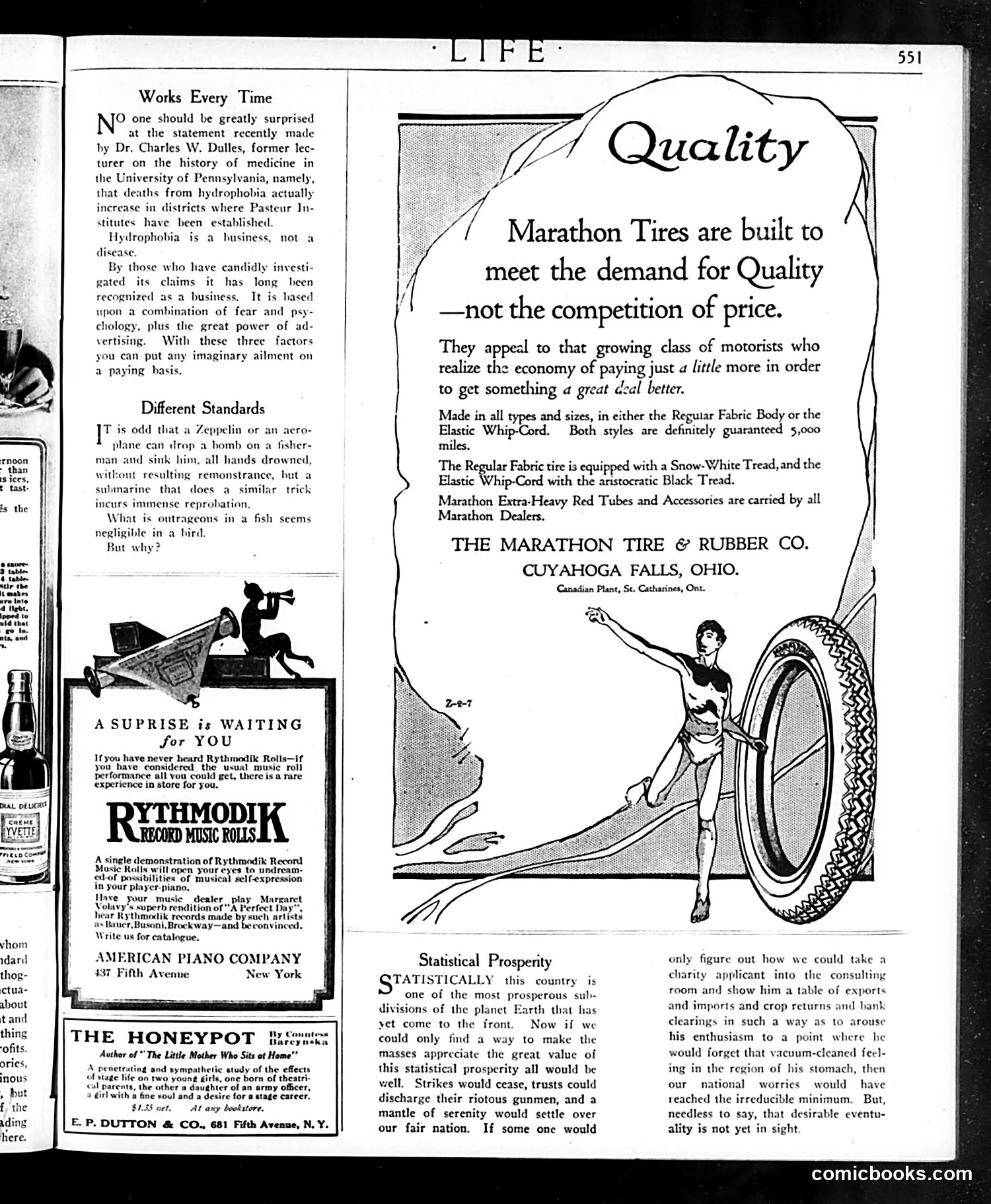
This page from *Life* magazine combines advertisements with satirical commentary on American society circa the 1910s-1920s. The **"Works Every Time"** column satirizes the Pasteur Institute's treatment of rabies (hydrophobia), cynically suggesting the disease persists because treating it is profitable—implying the medical establishment profits from fear and psychology rather than actual cures. **"Different Standards"** mocks wartime hypocrisy: bombing fishermen from aircraft provokes no outrage, but submarine attacks cause moral outrage. The joke exposes arbitrary ethical standards based on weapon type rather than actual harm. **"Statistical Prosperity"** critiques economic inequality and labor unrest. The satire argues that while America shows impressive statistics (exports, bank clearings), actual workers remain impoverished and angry. The piece suggests authorities could manipulate workers into contentment if they could make them appreciate abstract economic data rather than address real hardship. The advertisements (Marathon Tires, Rythmodik music rolls, American Piano Company) represent the consumer goods and leisure culture that existed alongside this social discontent.
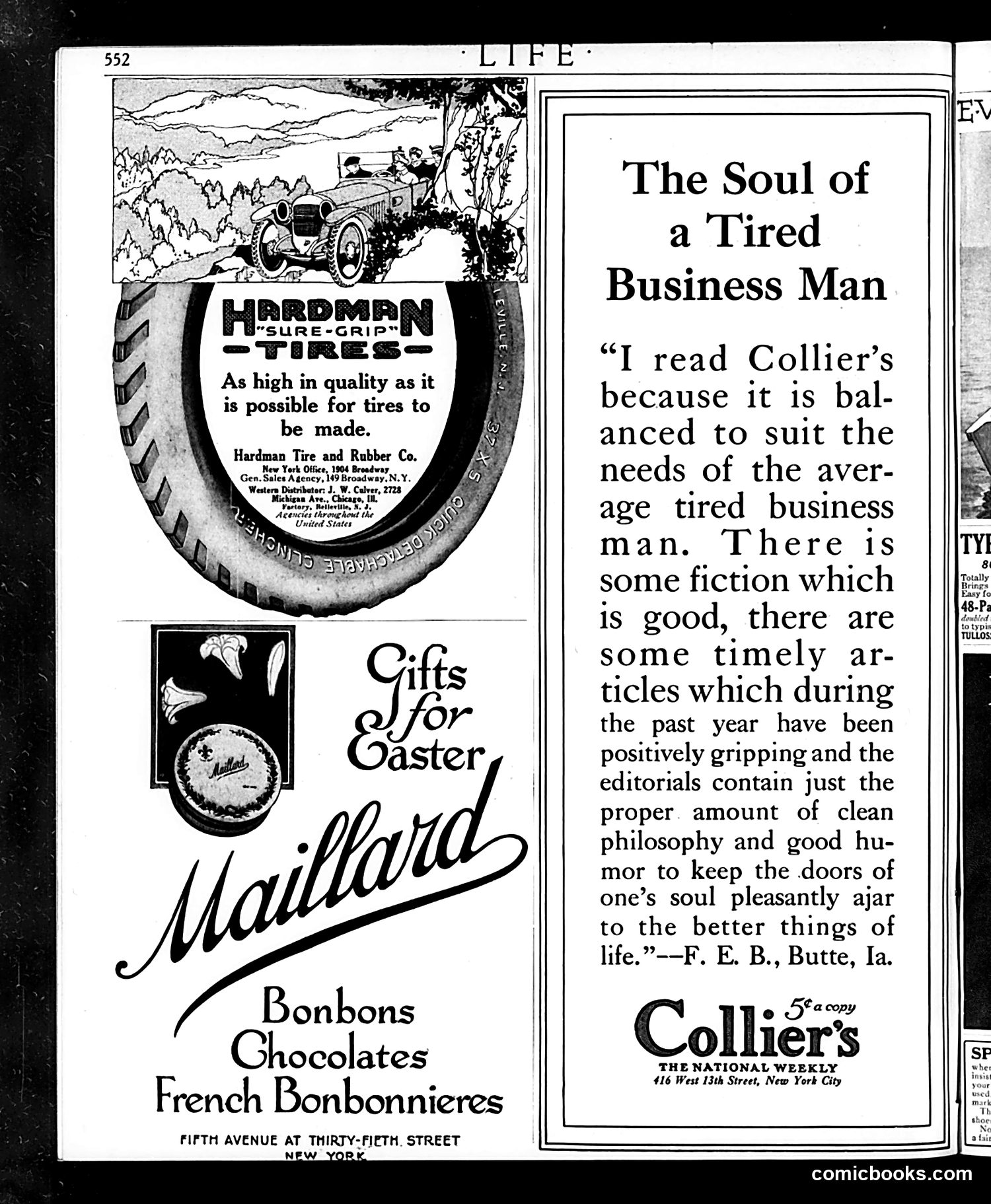
This page is primarily **advertising**, not satire or political commentary. It contains three product advertisements: 1. **Hardman Tires** (top): A car advertisement emphasizing quality, featuring an illustration of an early automobile on a country road. 2. **Maillard Chocolates** (bottom left): An Easter gift promotion for bonbons and French chocolates, with decorative imagery. 3. **Collier's Magazine** (right): A testimonial advertisement from a reader in Butte, Iowa, praising the magazine as ideal for "tired business men." The quote endorses Collier's blend of fiction, articles, and editorials as spiritually and intellectually restorative. The humor is gentle and commercial rather than satirical—playing on the idea that a busy businessman needs mental refreshment, which Collier's supposedly provides. The page number (552) indicates this appeared mid-issue in the magazine itself, using reader testimonials as advertising.
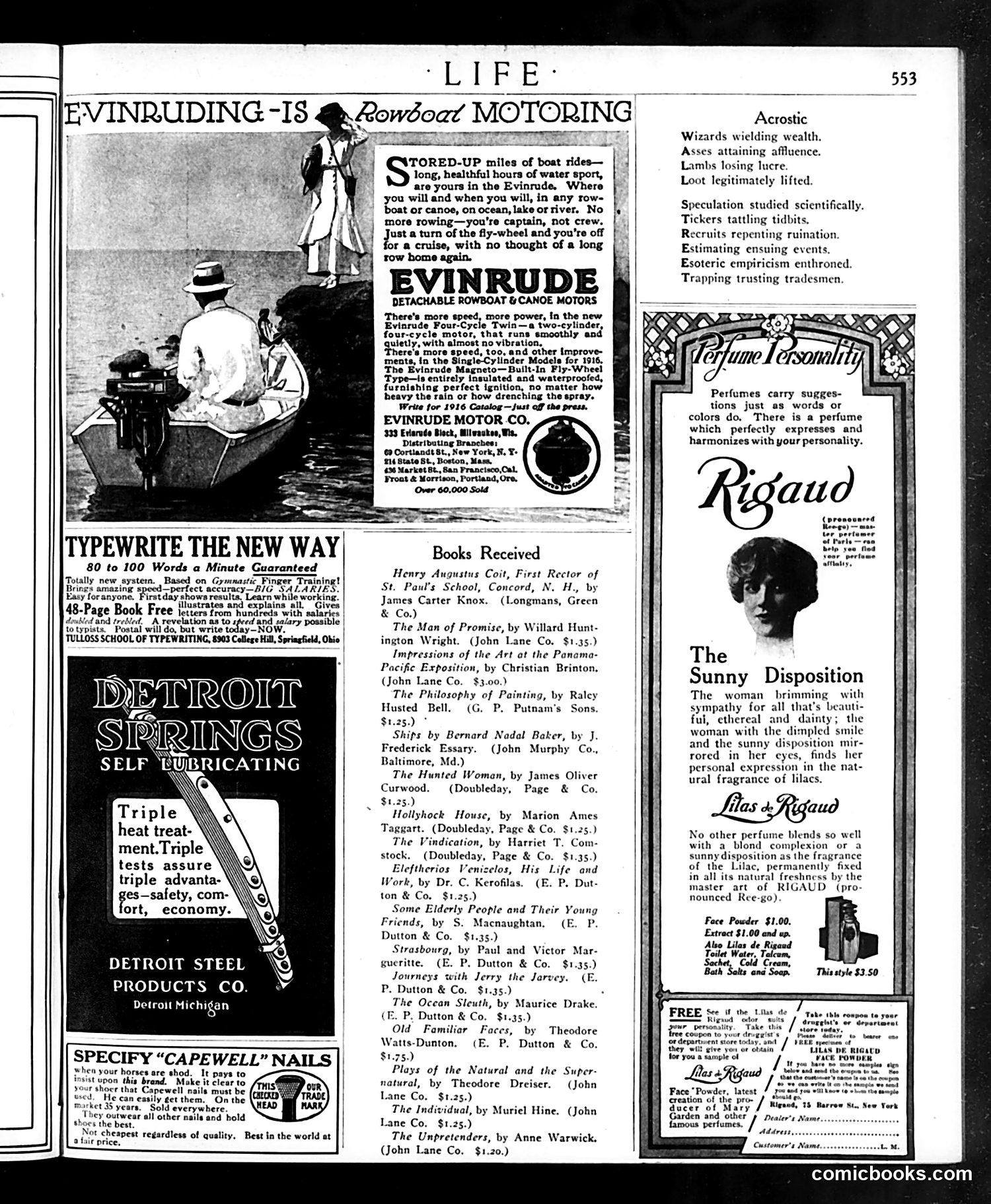
This page is primarily **advertising and book reviews**, not political satire or editorial cartooning. The main content features: 1. **Evinrude Motorboat Advertisement** (top): Promotes detachable rowboat motors, showing leisure-class couples enjoying water sports. The pitch emphasizes ease and escape from manual labor—"no more rowing." 2. **"Typewrite the New Way" Advertisement**: Promotes typing speed training (80-100 words/minute). 3. **Detroit Steel Springs and Capewell Nails Ads**: Industrial product marketing. 4. **"The Sunny Disposition" Perfume Ad**: Associates lilac fragrance with femininity and personality—typical early-20th-century marketing linking products to character traits. 5. **Books Received**: A straightforward listing of recently published books. 6. **Acrostic Poem** (right): A satirical verse using "WALLSTREET" as framework, mocking financial speculation and wealthy traders—this is the page's *only* satirical content, criticizing stock market manipulation and fraud. The page reflects 1910s consumer culture and early advertising psychology.

This is **not a cartoon or satire**—it's a straightforward advertisement for United States Tire Company's "Chain Tread Tires," published in *Life* magazine (page 554). The ad promotes the technical advantages of chain-tread tires, emphasizing two features: "dig-in" (the height of the chain treads gripping pavement) and "suction" (the cup-shaped links holding to the road). These were marketed as particularly effective on wet pavements for preventing skids and slipping. The page lists five tire varieties offered by the company: Chain, Nobby, Usco, Royal Cord, and Plain. The US Rubber Company logo appears at the bottom, identifying the manufacturer's parent corporation. The ad uses technical language and diagrams typical of early automotive marketing, positioning chain treads as the "most efficient moderate-priced anti-skids" available. No satire or political content is present—this is period commercial messaging about tire technology.
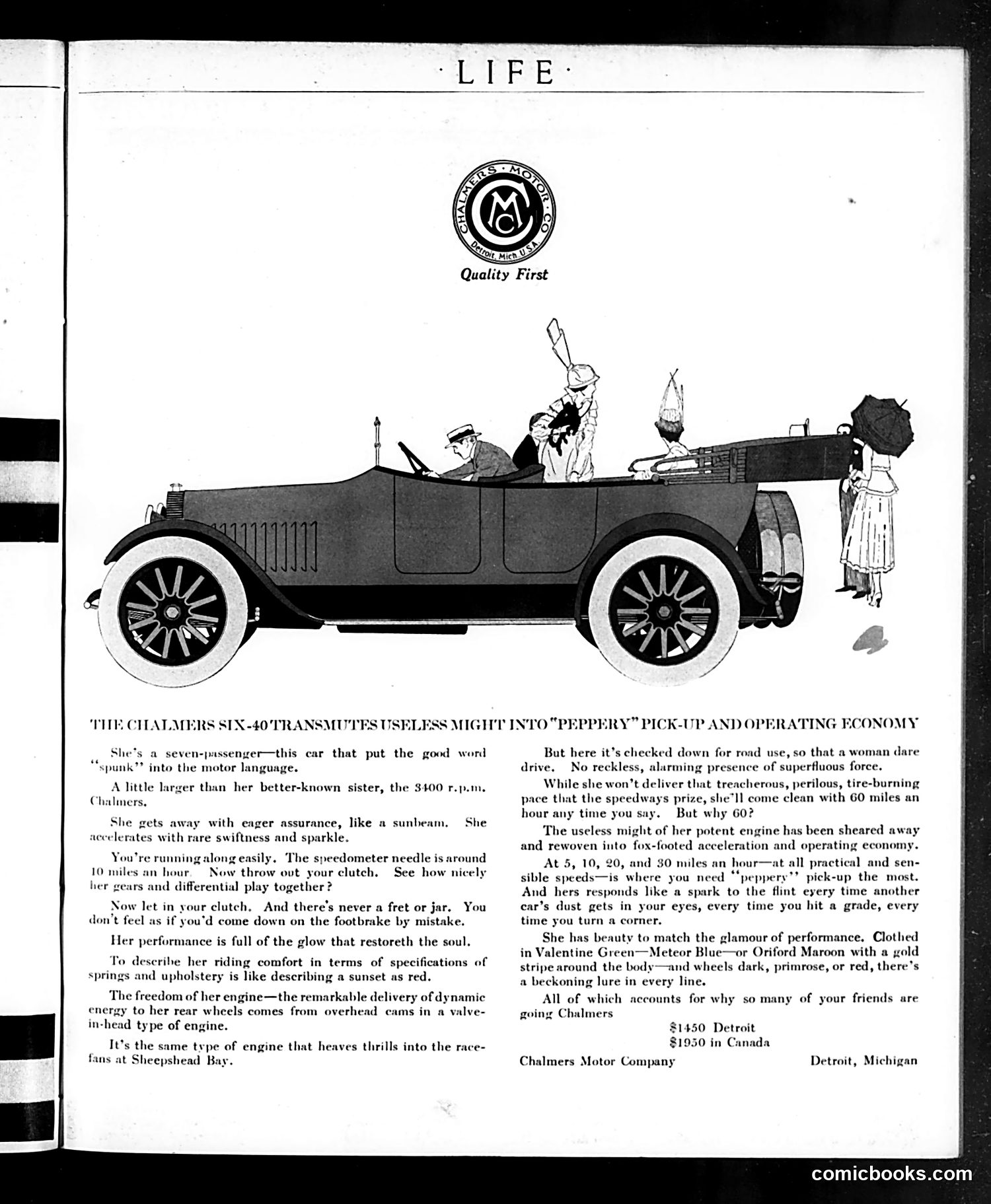
This is a **car advertisement**, not political satire. It promotes the Chalmers Six-40, a seven-passenger automobile priced at $1,450 (Detroit) or $1,950 (Canada). The illustration shows the car in use with well-dressed passengers and pedestrians, establishing aspirational appeal. The ad's rhetorical strategy addresses female drivers specifically—unusual for the era—emphasizing that the car's powerful engine is "checked down" to safe, manageable speeds suitable for women, while still delivering responsive "peppery" acceleration for practical driving situations. The text contrasts the car's racing-grade engine (overhead cams, valve-in-head design used at Sheepshead Bay racetrack) with its refined road application, suggesting engineering sophistication accessible to ordinary drivers. Aesthetic options (Valentine Green, Meteor Blue, Oxford Maroon) add luxury appeal. This represents early automotive marketing targeting middle-class consumers, particularly women entering the driving market.

This is a **Grape-Nuts cereal advertisement**, not political satire. Published in *Life* magazine (March 23, 1916), it uses a spiritual analogy to market breakfast food. The ad references the Biblical passage "Consider the lilies of the field" (Matthew 6:28), comparing the lily's brief life to human mortality ("three score years and ten"—70 years). The clever pitch claims that just as lilies need natural nourishment, humans require mineral phosphates for proper health—which Grape-Nuts allegedly provides. The illustrated lily in a vase represents natural vitality. The ad's tagline, "There's a Reason," was Grape-Nuts' actual advertising slogan during this era. **For modern readers**: This exemplifies early 20th-century health-food marketing that blended religious/philosophical language with pseudoscientific nutrition claims to sell processed cereals as "natural" and health-promoting—techniques still familiar today.