
Life, 1916-03-23 · page 14 of 52
Life — March 23, 1916 — page 14: what you’re looking at
What you’re looking at
This page contains three separate satirical pieces: 1. **"Too Much for the Martian"**: A science fiction joke where a Martian visitor to Earth in 1953 is overwhelmed by civilization and requests to be taken "back to civilization"—implying Earth is uncivilized. The humor inverts expectations by suggesting Mars (or space) is more refined. 2. **"In Darkest Alabama"**: Social commentary on Prohibition-era bootlegging. It sarcastically suggests the U.S. government could solve regional poverty by purchasing cheap Russian vodka and redistribution it as "tonic," while addressing malaria and swamp diseases. This critiques both Prohibition's failures and economic inequality in the American South. 3. **"Why Not?" and law student jokes**: Brief humorous quips about prize awards and legal terminology ("Jewish-prudence" as bankruptcy wordplay).
📄 Transcribed text from this page (OCR, searchable)
Machine-transcribed from the original scan — historical spelling and the odd misread are preserved.
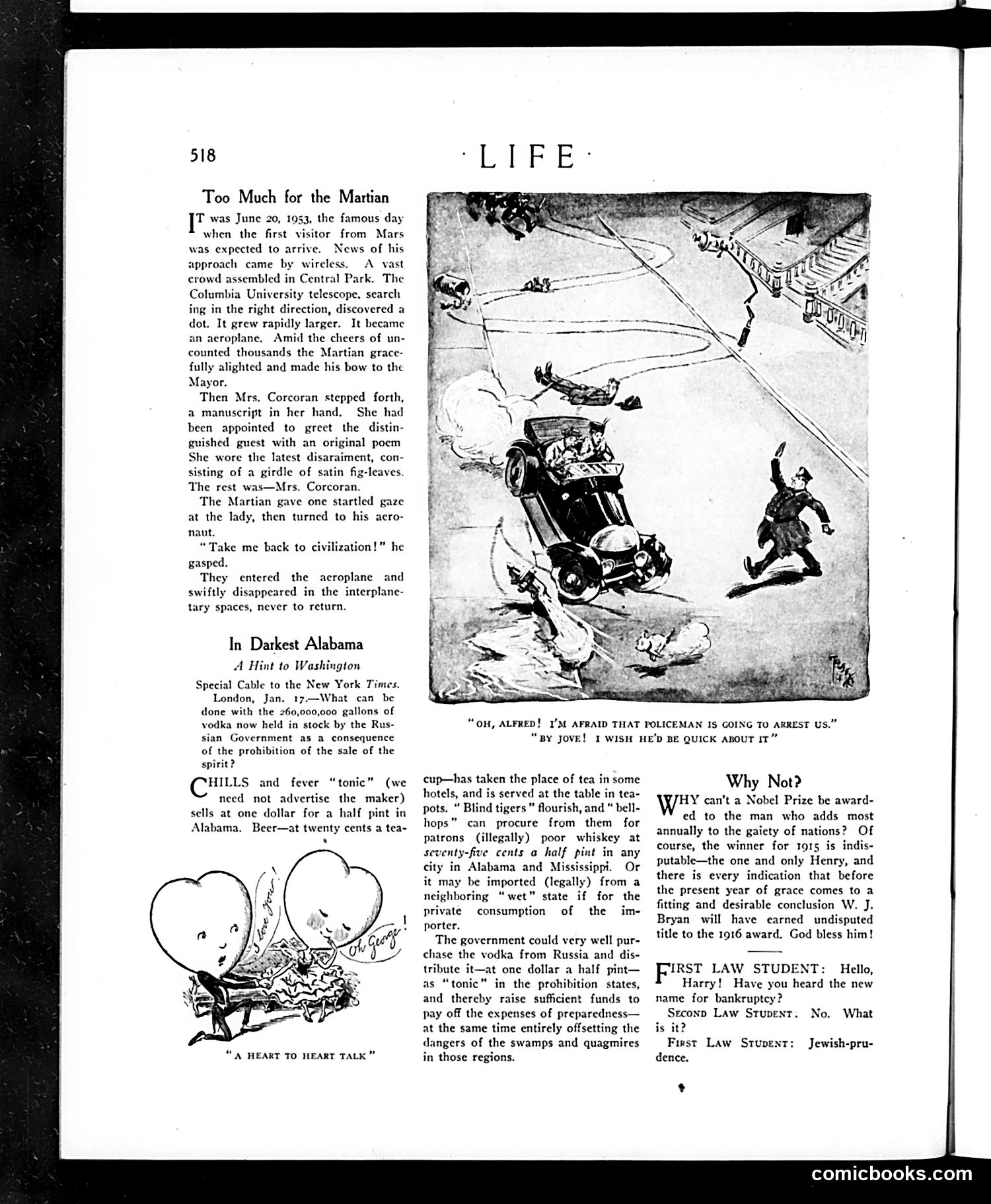
518 Too Much for the Martian T was June 20, 1953, the famous day when the first visitor from Mars was expected to arrive. News of his approach came by wireless. A vast crowd assembled in Central Park. The Columbia University telescope, search ing in the right direction, discovered a dot. It grew rapidly larger. It became an aeroplane. Amid the cheers of un- counted thousands the Martian grace- fully alighted and made his bow to the Mayor. Then Mrs. Corcoran stepped forth, a manuscript in her hand, She had been appointed to grect the distin- guished guest with an original pocm She wore the latest disaraiment, con- sisting of a girdle of satin fig-leaves The rest was—Mrs. Corcoran. The Martian gave one startled gaze at the lady, then turned to his aero- naut. ‘ake me back to civilization!” he gasped. They entered the acroplane and swiftly disappeared in the interplane- tary spaces, never to return. In Darkest Alabama A Hint to Washington Special Cable to the New York Times. London, Jan. 17.—What can be done with the 260,000,000 gallons of vodka now held in stock by the Rus- sian Government as a consequence of the prohibition of the sale of the spirit? HILLS and fever “tonic” (we need not advertise the maker) sells at one dollar for a half pint in Alabama. Beer—at twenty cents a tea- “\ HEART TO HEART TALK” “OH, ALFRED! I’M AFRAID THAT POLICEMAN IS GOING TO ARREST US.” “sy Jove! I WISH HE'D BE QUICK ABOUT IT” cup—has taken the place of tea in some hotels, and is served at the table in tea- pots. “ Blind tigers” flourish, and “ bell- hops” can procure from them for patrons (illegally) poor whiskey at seventy-five cents a half pint in any city in Alabama and Mississippi. Or it may be imported (legally) from a neighboring “wet” state if for the private consumption of the im- porter. The government could very well pur- chase the vodka from Russia and dis- tribute it—at one dollar a half pint— as “tonic” in the prohibition states, and thereby raise sufficient funds to pay off the expenses of preparedness— at the same time entirely offsetting the dangers of the swamps and quagmires in those regions. Why Not? HY can’t a Nobel Prize be award- ed to the man who adds most annually to the gaiety of nations? Of course, the winner for 1915 is indis- putable—the one and only Henry, and there is every indication that before the present year of grace comes to a fitting and desirable conclusion W. J. Bryan will have carned undisputed title to the 1916 award. God bless him! IRST LAW STUDENT: Hello, Harry! Have you heard the new name for bankruptcy? Seconp Law Stupent. is it? First Law Srupent: dence, No. What Jewish-pru- t comicbooks.com