
Life, 1916-03-23 · page 32 of 52
Life — March 23, 1916 — page 32: what you’re looking at
What you’re looking at
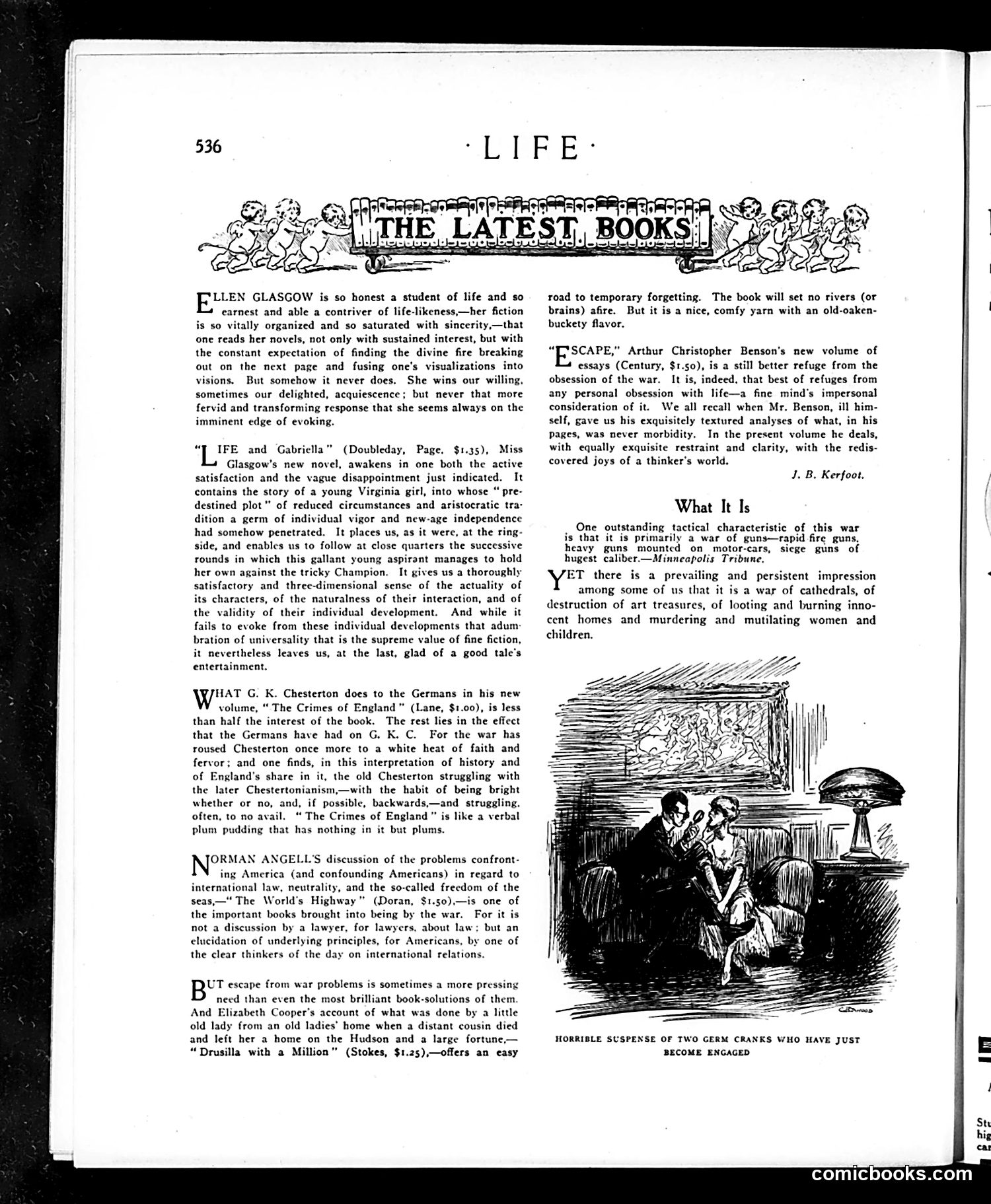
This is a book review section from Life magazine during World War I. The page critiques several contemporary works: **Ellen Glasgow's "Life and Gabriella"** — praised for honest characterization of a Virginia woman achieving independence despite aristocratic constraints, though criticized for lacking transcendent emotional power. **G.K. Chesterton's "The Crimes of England"** — reviewed as Chesterton's passionate war-era polemic against Germany, noting the tension between his rhetorical brilliance and forced wit. **Norman Angell's "The World's Highway"** — commended as serious analysis of American neutrality and international law during wartime. **Elizabeth Cooper's "Drusilla with a Million"** and **Arthur Benson's essays** — offered as escapist reading from war preoccupations. The **illustration** (captioned "Horrible Suspense of Two Germ Cranks Who Have Just Become Engaged") shows a satirical WWI-era joke: two German soldiers/spies anxiously awaiting news, mocking German paranoia or military concerns during the conflict.
📄 Transcribed text from this page (OCR, searchable)
Machine-transcribed from the original scan — historical spelling and the odd misread are preserved.
LLEN GLASGOW is so honest a student of life and so earnest and able a contriver of life-likeness,—her fiction is so vitally organized and so saturated with sincerity,—that one reads her novels, not only with sustained interest, but with the constant expectation of finding the divine fire breaking out on the next page and fusing one’s visualizations into visions. But somehow it never does. She wins our willing, sometimes our delighted, acquiescence; but never that more fervid and transforming response that she seems always on the imminent edge of evoking. IFE and Gabriella” (Doubleday, Page. $1.35), Miss Glasgow's new novel, awakens in one both the active satisfaction and the vague disappointment just indicated. It contains the story of a young Virginia girl, into whose “ pre- destined plot” of reduced circumstances and aristocratic tra- dition a germ of individual vigor and new-age independence had somehow penetrated. It places us, as it were, at the ring- side, and enables us to follow at close quarters the successive rounds in which this gallant young aspirant manages to hold her own against the tricky Champion. It gives us a thoroughly satisfactory and three-dimensional sense of the actuality of its characters, of the naturalness of their interaction, and of the validity of their individual development. And while it fails to evoke from these individual developments that adum: bration of universality that is the supreme value of fine fiction, it nevertheless leaves us, at the last, glad of a good tale’s entertainment. HAT G. K. Chesterton does to the Germans in his new volume, “ The Crimes of England” (Lane, $1.00), is less than half the interest of the book. The rest lies in the effect that the Germans have had on G. K. C. For the war has roused Chesterton once more to a white heat of faith and fervor; and one finds, in this interpretation of history and of England’s share in it, the old Chesterton struggling with the later Chestertonianism,—with the habit of being bright whether or no, and, if possible, backwards,—and struggling. often, to no avail. “The Crimes of England ” is like a verbal plum pudding that has nothing in it but plums. ORMAN ANGELL'S discussion of the problems confront- ing America (and confounding Americans) in regard to ional law, neutrality, and the so-called freedom of the The World's Highway” (Doran, $1.50),—is one of the important books brought into being by the war. For it is not a discussion by a lawyer, for lawyers, about law; but an elucidation of underlying principles, for Americans, by one of the clear thinkers of the day on international relations. UT escape from war problems is sometimes a more pressing need than even the most brilliant book-solutions of them. And Elizabeth Cooper's account of what was done by a little old lady from an old ladies’ home when a distant cousin died and left her a home on the Hudson and a large fortune, — “Drusilla with a Million” (Stokes, $1.25),—offers an easy road to temporary forgetting. The book will set no rivers (or brains) afire. But it is a nice, comfy yarn with an old-oaken- buckety flavor. SCAPE,” Arthur Christopher Benson's new volume of essays (Century, $1.50), is a still better refuge from the obsession of the war. It is, indeed, that best of refuges from any personal obsession with life—a fine mind's impersonal consideration of it. We all recall when Mr. Benson, ill him- self, gave us his exquisitely textured analyses of what, in his Pages, was never morbidity, In the present volume he deals, with equally exquisite restraint and clarity, with the redis- covered joys of a thinker’s world. J.B. Kerfoot. What It Is One outstanding tactical characteristic of this war is that it is primarily a war of guns—rapid fire guns, heavy guns mounted on motor-cars, siege guns of hugest caliber.—Minneapolis Tribune. T there is a prevailing and persistent impression among some of us that it is a war of cathedrals, of destruction of art treasures, of looting and burning inno- cent homes and murdering and mutilating women and children. HORRIBLE SUSPENSE OF TWO GERM CRANKS WHO HAVE JUST BECOME ENGAGED comicbooks.com Ste hig