
Life, 1916-03-23 · page 18 of 52
Life — March 23, 1916 — page 18: what you’re looking at
What you’re looking at
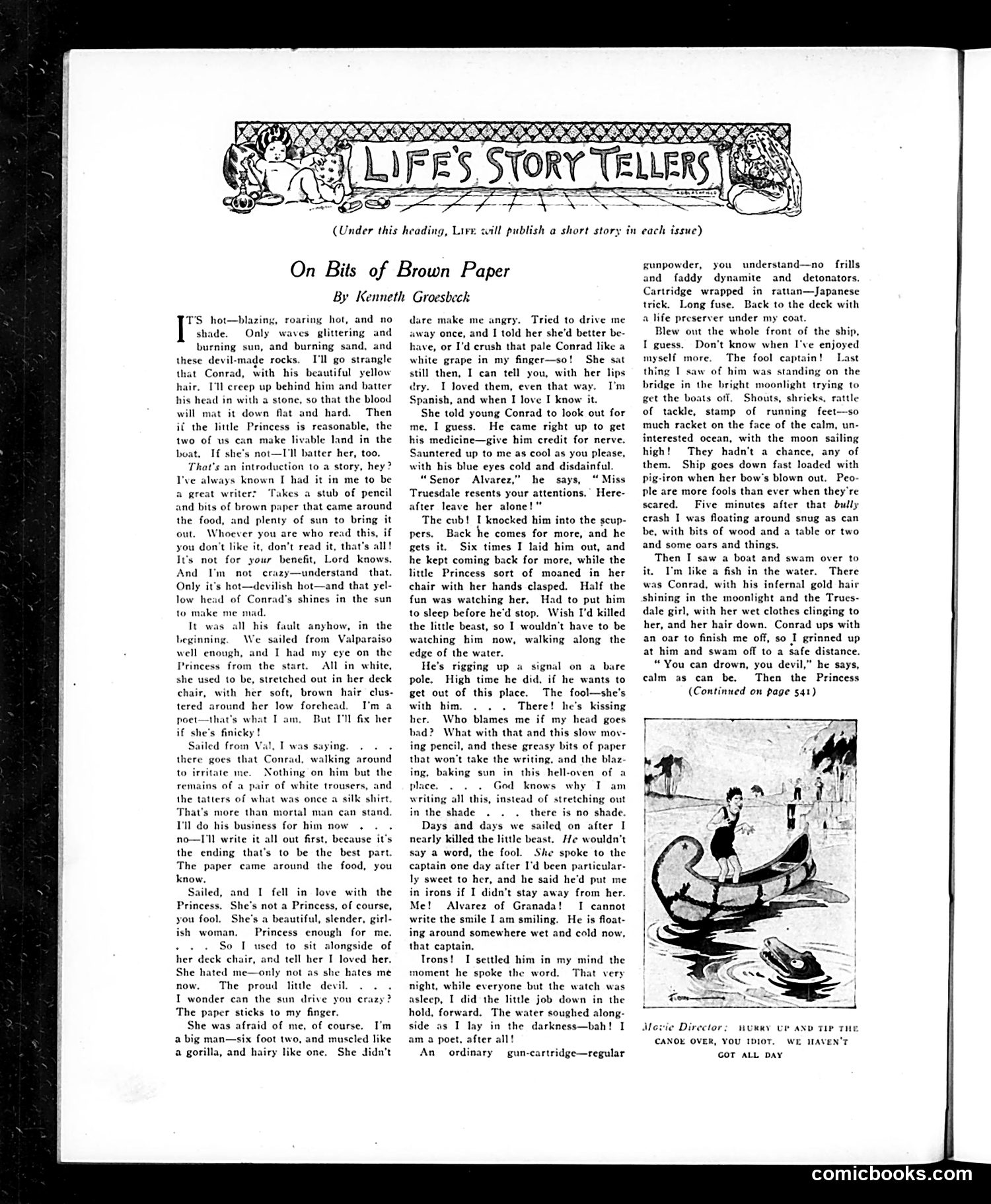
This is a short story (not political satire) published in Life's "Life's Story Tellers" section. The narrative is a first-person confession by "Senor Alvarez," a violent, unstable man aboard a ship in a tropical location. The story depicts Alvarez's obsession with an upper-class woman (called "the Princess") and his brutal rivalry with a refined man named Conrad over her affections. Alvarez repeatedly beats Conrad in fights, and the story hints at darker intentions—the opening monologue suggests fantasies of violence. The framing device is revealing: Alvarez claims he's writing this confession on brown paper scraps in extreme heat, questioning whether the sun is driving him mad. The final illustrated panel shows Conrad signaling for rescue while kissing the woman, triggering Alvarez's rage. This appears to be **early pulp fiction**—emphasizing passion, violence, and psychological instability rather than political commentary. The "Life's Story Tellers" heading suggests it's entertainment fiction for the magazine's readers.
📄 Transcribed text from this page (OCR, searchable)
Machine-transcribed from the original scan — historical spelling and the odd misread are preserved.
(Under this heading, Lire. sill publish a short story in each issue) On Bits of Brown Paper By Kenneth Groesbeck hot—blazing, roaring hot, and no if shade. Only waves glittering and burning sun, and burning sand, and these devil-made rocks. I'll go. strangle that Conrad, with his beautiful yellow air. I creep up behind him and batter his head in with a stone, so that the blood will mat it down flat and hard, Then if the little Princess is reasonable, the two of us can make livable land in the boat. If she’s not—I'll batter her, too. That's an introduction to a story, hey? I've always known I had it in me to be a great writer? Takes a stub of pencil and bits of brown paper that came around the food, and plenty of sun to bring it out. Whoever you are who read this, if you don’t like it, don’t read it, that's all! I's not for your benefit, Lord knows. And I'm not crazy—understand that. Only it’s hot—devilish hot—and that yel- 1 of Conrad’s shines in the sun to make me mad It was all his fault anyhow, in the Leginning. We sailed from Valparaiso well enough, and I had my eye on the Princess from the start. All in white, she used to be, stretched out in her deck chair, with her soft, brown hair clus- tered around her low forehead. I'm a poet—that’s what Tam, But I'll fix her if she's finicky! led from Val, Iwas saying. 2 6. there goes that Conrad, walking around Nothing on him but the of white trousers, and the tatters of what was once a silk shirt low he: to irritate remains of a That's more than mortal man can stand. I'll do his business for him now... no—I'll write it all out first, because it’s the ending that's to be the best part. The paper came around the food, you know. Sailed, and I fell in love with the Princess. She's not a Princess, of course, you fool. She's a beautiful, slender, girl- ish woman, Princess enough for me. * So I used to sit alongside of her deck chair, and tell her I loved her. She hated me—only not as she hates me The proud litte devil. I wonder can the sun drive you crazy? The paper sticks to my finger. She was afraid of me, of course. I'm a big man—six foot two, and muscled like a gorilla, and hairy like one, She didn’t now. dare make me angry. Tried to drive me uway once, and I told her she'd better be- have, or I'd crush that pale Conrad like a white grape in my finger—so! She sat still then, I can tell you, with her lips dry. I Joved them, even that I'm Spanish, and when I love I know it. She told young Conrad to look out for me, I guess. He came right up to get his medicine—give him credit for nerve. Sauntered up to me as cool as you please, with his blue eyes cold and disdainful. “Senor Alvarez,” he says, “ Miss Truesdale resents your attentions. Here- after leave her alone!” The cub! I knocked him into the scup- pers. Back he comes for more, and he gets it. Six times I laid him out, and he kept coming back for more, while the little Princess sort of moaned in her chair with her hands clasped. Half the fun was watching her, Had to put him to sleep before he'd stop. Wish I'd killed the little beast, so I wouldn't have to be watching him now, walking along the edge of the water. He's rigging up a signal on a bare pole. High time he did. if he wants to get out of this place. The fool—she's with him. . . . There! he’s kissing her. Who blames me if my head goes bad?) What with that and this slow mov- ing pencil, and these greasy bits of paper that won't take the writing, and the blaz ing, baking sun in this hell-oven of a place, God knows writing all this, instead of stretching out in the shade . there is no shade. Days and days we sailed on after I nearly killed the little beast. He wouldn't say a word, the fool. She spoke to the captain one day after I'd been particular- ly sweet to her, and he said he'd put me in irons if I didn’t stay away from her. Me! Alvarez of Granada! I cannot write the smile I am smiling. He is float- ing around somewhere wet and cold now, that captain. Irons! I settled him in my mind the moment he spoke the word. That very night, while everyone but the watch was asleep, I did the little job down in the hold, forward. The water soughed along- side as I lay in the darkness—bah! I am a poet, after all! An ordinary gun-cartridge—regular why T am gunpowder, you understand—no frills and faddy dynamite and detonators. Cartridge wrapped in rattan—Japanese trick. Long fuse. Back to the deck with a life preserver under my coat. Blew out the whole front of the ship, Don't know when I've enjoyed myself more, The fool captain! Last thing 1 saw of him was standing on the bridge in the bright moonlight trying to get the boats off, Shouts, shrieks, rattle of tackle, stamp of running feet—so much racket on the face of the calm, un- interested ocean, with the moon sailing high! They hadn't a chance, any of them. Ship goes down fast loaded with pig-iron when her bow’s blown out. Peo- ple are more fools than ever when they're scared. Five minutes after that bully crash I was floating around snug as can be, with bits of wood and a table or two and some oars and things. Then I saw a boat and swam over to it, I'm like a fish in the water. There was Conrad, with his infernal gold hair shining in the moonlight and the Trues- dale girl, with her wet clothes clinging to her, and her hair down. Conrad ups with an oar to finish me off, so I grinned up at him and swam off to a safe distance. “You can drown, you devil,” he says, calm as can be. Then the Princess (Continued on page 541) I guess. ny Mevie Director; wueey vr axv t CANOE OVER, YOU IDIOT. WE MAVE GOT ALL DAY comicbooks.com