
Life, 1916-03-23 · page 31 of 52
Life — March 23, 1916 — page 31: what you’re looking at
What you’re looking at
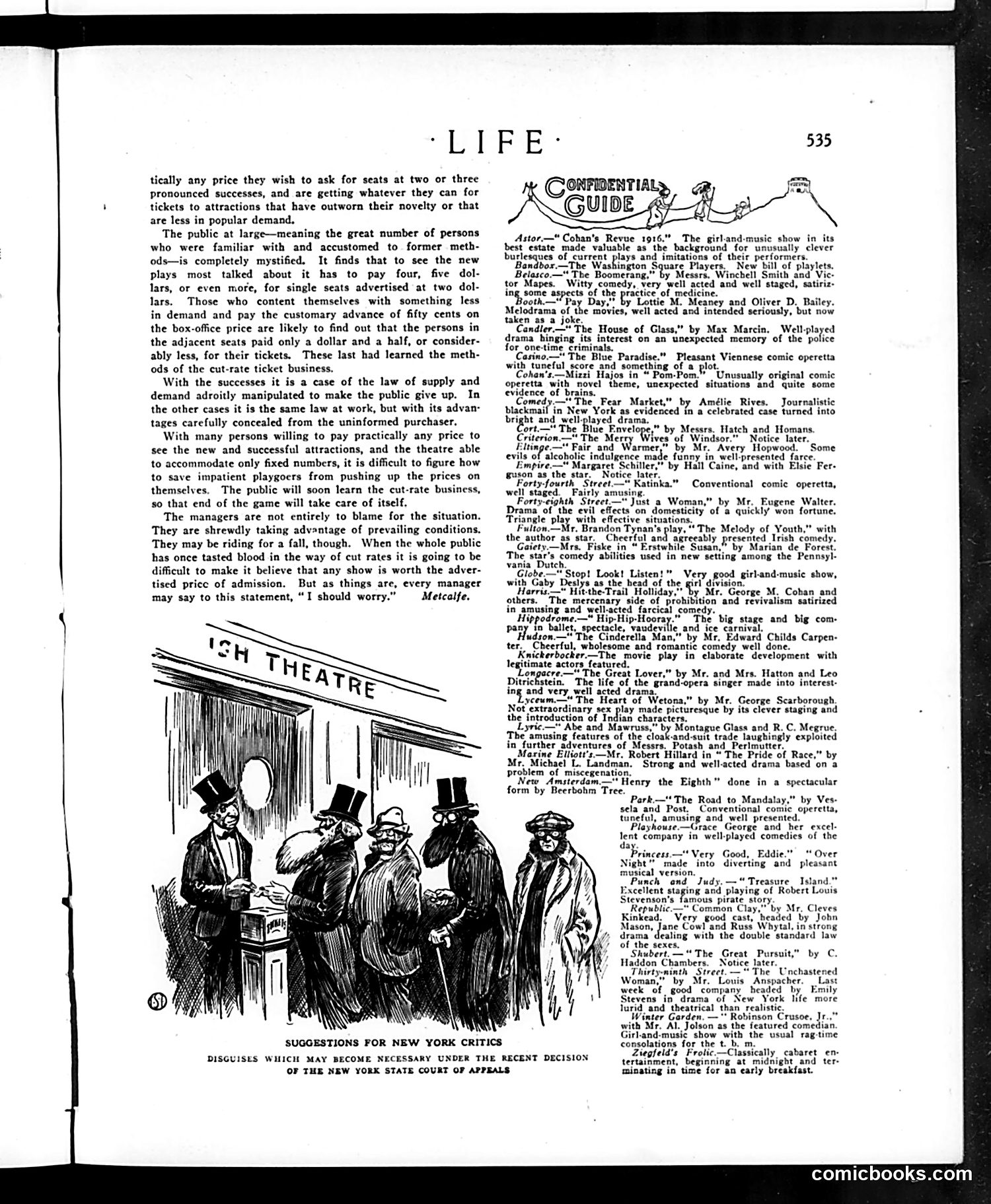
This satirical cartoon illustrates a recent New York State Court of Appeals decision affecting theater criticism. The illustration shows five men in formal attire outside a theater box office, depicted as figures in disguise—wearing various hats and coats to conceal their identities. The joke references a court ruling that apparently restricted critics' access to theaters or their ability to review shows openly. The caption suggests critics now need "disguises" to attend performances without detection, presumably to avoid being denied entry or ejected by theater management responding to the legal decision. The accompanying article discusses theater ticket pricing manipulation—how managers exploit high demand for successful shows while using hidden "cut-rate" methods for less popular productions, deceiving the general public about actual ticket costs. The cartoon satirizes both the court's decision's impracticality and theater owners' adversarial relationship with critics during this period.
📄 Transcribed text from this page (OCR, searchable)
Machine-transcribed from the original scan — historical spelling and the odd misread are preserved.
tically any price they wish to ask for seats at two or three pronounced successes, and are getting whatever they can for tickets to attractions that have outworn their novelty or that are less in popular demand, The public at large—meaning the great number of persons who were familiar with and accustomed to former meth- ods—is completely mystified. It finds that to see the new plays most talked about it has to pay four, five dol- lars, or even more, for single seats advertised at two dol- lars. Those who content themselves with something less in demand and pay the customary advance of fifty cents on the box-office price are likely to find out that the persons in the adjacent seats paid only a dollar and a half, or consider- ably less, for their tickets. These last had learned the meth- ods of the cut-rate ticket business. With the successes it is a case of the law of supply and demand adroitly manipulated to make the public give up. In the other cases it is the same law at work, but with its advan- tages carefully concealed from the uninformed purchaser, With many persons willing to pay practically any price to see the new and successful attractions, and the theatre able to accommodate only fixed numbers, it is difficult to figure how to save impatient playgoers from pushing up the prices on themselves, The public will soon learn the cut-rate business, so that end of the game will take care of itself. The managers are not entirely to blame for the situation. They are shrewdly taking advantage of prevailing conditions, They may be riding for a fall, though. When the whole public has once tasted blood in the way of cut rates it is going to be difficult to make it believe that any show is worth the adver- tised price of admission. But as things are, every manager Metcalfe. may say to this statement, “I should worry.” SUGGESTIONS FOR NEW YORK CRITICS DISGUISES WHICH MAY BECOME NECESSARY UNDER THE RECENT DECISION OF THE NEW YORK STATE COURT OF APPEALS “ETE * ONFIOENT I. ¢ ai . Astor.— Cohan's Revue 1916." |The girland-music show in its best estate made valuable as the background for unusually clever burlesques of current plays and imitations of their performers Bandbox.—The Washington Square Players, New bill of playlets, Belasco.—" The Boomerang,” by Messrs. Winchell Smith and Vie- tor Mapes. Witty comedy, very well acted and well staged, satiriz- ing, some aspects of the practice of medicine. jooth.—" Pay Day,” by Lottie M. Meaney and Oliver D. Bailey. Melodrama of the movies, well acted and intended seriously, but now taken as a joke. Candler.— The House of Glass,” by Max Marcin, | Well played drama hinging its interest on an unexpected memory of the police for one-time criminals, Casino.—" The Blue Paradise.” Pleasant Viennese comic operetta with tuneful score and something of a plot. Cohan’s.—Mizzi Hajos in “ Pom-Pom.” Unusually original comic operetta with novel theme, unexpected situations and quite some evidence of brains. Comedy —" The Fear Market," by Amélie Rives. Journalistic blackmail in New York as evidenced in a celebrated case turned into bright and well played. drama, The Blue Envelope,” by Messrs. Hatch and Homans. . ives of Windsor.” Notice later. by Mr. Avery Hopwood. funny in, well-presented farce. ‘mpire.—" Margaret by Hall Caine, and with Elsie Fer- guson as the star. Notice later. Forty-fourth Street—" Katinka.” well staged. Fairly amusing, Forty-eighth Street—" Just a Woman,” by Mr. Eugene Walter. Drama of the evil effects’ on domesticity’ of a quickly won fortune. Triangle play with effective situation: ir. Brandon Tynan’s play. The Melody of Youth,” with star. Cheerful and agreeably Presented Irish comedy, i irs. Fiske in “ Erstwhile Susan,” by Marian de Forest. The star's comedy abilities used in new setting among the Pennsyl- vania Dutch. ‘Globe—" Stop! Look! Listen!” with Gaby Deslys as the head of the girl division. Harris.—“ Hit-the-Trail Holliday,” by Mr. George M. Coban and others. The mercenary le of prohibition and revivalism satirized in amusing and well-acted farcical comedy. Hippodrome.—" Hip-Hip-Hooray.” The big stage and big com- pay, in ballet, spectacle, waudeville and ice carnival. fudson.—" The Cinderella Man,” by Mr, Edward Childs Carpen- ter. Cheerful, wholesome and romantic comedy well done. Knickerbocker—The movie play in elaborate development with legitimate actors featured. Longacre.—" The Great Lover,” by Mr. and Mrs. Hatton and Leo Ditrichstein. The life of the grand-opera singer made into interest evi Conventional comic operetta, Very good girland-musie show, ing and very, well acted drama, “The Heart of Wetona,” by Mr. George Scarborough. inary sex play made picturesque by its clever staging and the introduction of Indian characters, Lyric.—* Abe and Mawruss,” by Montague Glass and R. C. Megrue. The amusing features of the cloak-and-suit trade laughingly exploited in further adventures of Messrs. Potash and Perlmutter. Marine Elliott’s.—Mr. Robert Hillard in “ The Pride of Race,” by Mr. Michael L. Landman. Strong and well.acted drama based on a problem of miscegenation. New Amsterdam.— Henry the Eighth” done in a spectacular form by Beerbohm Tree. Park.—"' The Road to Mandalay,” by Ves- sela and Post. Conventional comic operetta, tuneful, amusing and well presented. Playhouse.—Grace George and her excel- lent company in well-played comedies of the day. Princess" Very Good, Eddie.” Over Night" made into diverting and pleasant musical version. Punch and Judy.—“ Treasure Island.” Excellent staging and playing of Robert L Stevenson's famous pirate story. Republic.—" Common Clay,” by Mr, Cleves Kinkead. Very good cast, headed by Jobn Mason, Jane Cow! and Russ Whytal, in strong. drama ‘dealing with the double standard law Great Pursuit, of the sexes, om Notice later. Shubert. —“ The Thirty-ninth Street. —“ The Unchastened is by Haddon Chambers. Woman,” by Mr. Louis Anspacher. | Last week of good company headed by Emily Stevens in drama of New York life more lurid and theatrical than realistic. Winter Garden. —** Robinson Crusoe, Jr..” with Mr. Al. Jolson as the featured comedi Girl-and-music show with the usual rag-time consolations for the t. b. m. Ziegfeld’s Frolic.—Classically cabaret en- tertainment, beginning at midnight and ter- minating in’ time for an early breakfast. comicbooks.com