
Life, 1916-03-23 · page 23 of 52
Life — March 23, 1916 — page 23: what you’re looking at
What you’re looking at
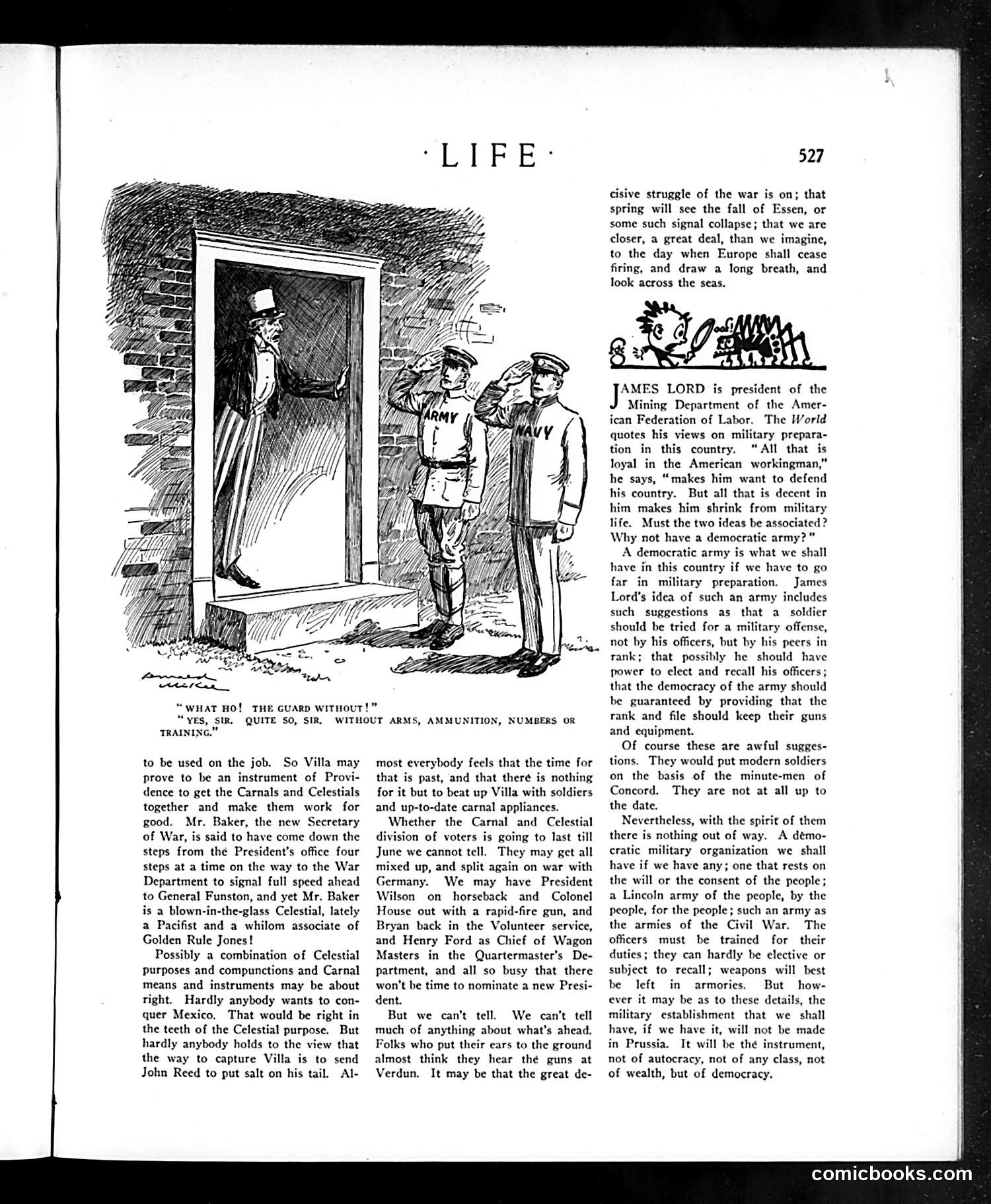
The cartoon depicts a military guard refusing entry to two soldiers labeled "ARMY" and "NAVY," illustrating the satirical tension discussed in the accompanying text about American military preparedness during World War I. The page critiques the political debate over U.S. military preparation circa 1916. It references Pancho Villa (Mexican revolutionary), contrasting "Celestial purposes" (idealistic/pacifist values) with "Carnal means" (military force). The featured article quotes James Lord, a labor leader, advocating for a "democratic army"—one where soldiers are tried by peers rather than officers, possibly elect their leadership, and retain control of weapons. Life satirizes these suggestions as dangerously impractical, yet ultimately endorses democratic military organization based on consent rather than autocracy, invoking Civil War precedent. The piece reflects anxieties about American intervention in WWI, balancing pacifist sentiment against military necessity.
📄 Transcribed text from this page (OCR, searchable)
Machine-transcribed from the original scan — historical spelling and the odd misread are preserved.
to be used on the job. So Villa may prove to be an instrument of Provi- dence to get the Carnals and Celestials together and make them work for good. Mr. Baker, the new Secretary of War, is said to have come down the steps from the President's office four steps at a time on the way to the War Department to signal full speed ahead to General Funston, and yet Mr. Baker is a blown-in-the-glass Celestial, lately a Pacifist and a whilom associate of Golden Rule Jones! Possibly a combination of Celestial Purposes and compunctions and Carnal means and instruments may be about right. Hardly anybody wants to con- quer Mexico, That would be right in the teeth of the Celestial purpose. But hardly anybody holds to the view that the way to capture Villa is to send John Reed to put salt on his tail. Al- most everybody feels that the time for that is past, and that theré is nothing for it but to beat up Villa with soldiers and up-to-date carnal appliances. Whether the Carnal and Celestial division of voters is going to last till June we cannot tell. They may get all mixed up, and split again on war with Germany. We may have President Wilson on horseback and Colonel House out with a rapid-fire gun, and Bryan back in the Volunteer service, and Henry Ford as Chief of Wagon Masters in the Quartermaster’s De- partment, and all so busy that there won't be time to nominate a new Presi- dent. But we can't tell. We can’t tell much of anything about what's ahead. Folks who put their ears to the ground almost think they hear thé guns at Verdun. It may be that the great de- 527 cisive struggle of the war is on; that spring will see the fall of Essen, or some such signal collapse; that we are closer, a great deal, than we imagine, to the day when Europe shall cease firing, and draw a long breath, and look across the seas. AMES LORD is president of the Mining Department of the Amer- ican Federation of Labor. The World quotes his views on military prepara- tion in this country. “All that is loyal in the American workingman,” he says, “makes him want to defend his country. But all that is decent in him makes him shrink from military life. Must the two ideas be associated ? Why not have a democratic army?” A democratic army is what we shall have in this country if we have to go far in military preparation. James Lord's idea of such an army includes such suggestions as that a_ soldier should be tried for a military offense, not by his officers, but by his peers in rank; that possibly he should have power to elect and recall his officers; that the democracy of the army should be guaranteed by providing that the rank and file should keep their guns and equipment. Of course these are awful sugges- tions. They would put modern soldiers on the basis of the minute-men of Concord. They are not at all up to the date. Nevertheless, with the spirit of them there is nothing out of way. A démo- cratic military organization we shall have if we have any; one that rests on the will or the consent of the people; a Lincoln army of the people, by the people, for the people; such an army as the armies of the Civil War. The officers must be trained for their duties; they can hardly be elective or subject to recall; weapons will best be left in armories. But how- ever it may be as to these details, the military establishment that we shall have, if we have it, will not be made in Prussia. It will be thé instrument, not of autocracy, not of any class, not of wealth, but of democracy. comicbooks.com