
Life, 1916-03-23 · page 30 of 52
Life — March 23, 1916 — page 30: what you’re looking at
What you’re looking at
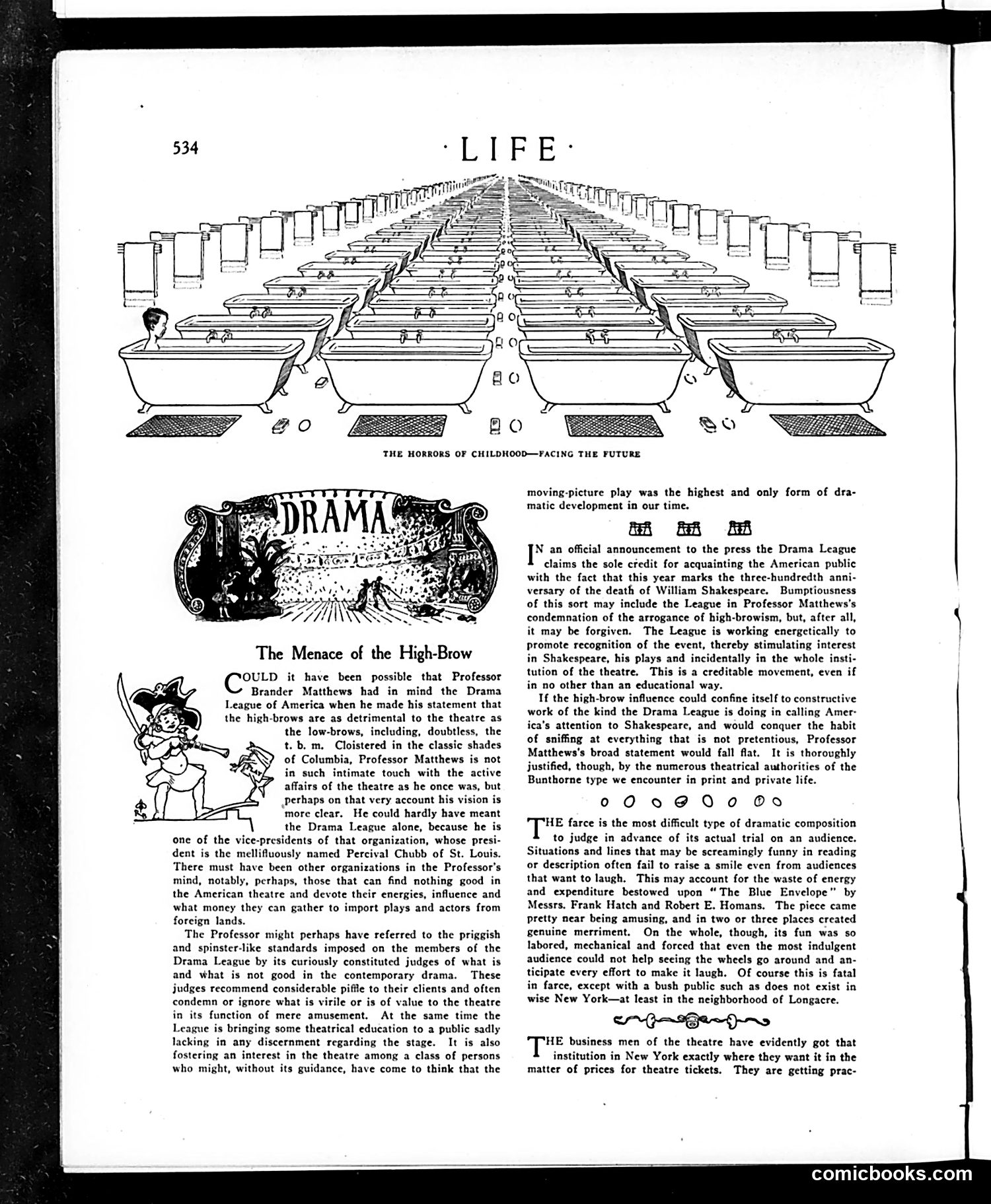
This satirical article critiques intellectual elitism in early 20th-century American theater. The cartoon at top—showing endless bathtubs with one figure bathing—illustrates "The Horrors of Childhood," satirizing how anxious parents obsess over child-rearing. The main piece targets the Drama League and similar organizations for imposing snobbish artistic standards on theater. While acknowledging their educational value (promoting Shakespeare), the author mocks their "priggish" gatekeeping—rejecting popular entertainment as vulgar while championing European imports. Professor Brander Matthews of Columbia University is cited as claiming both "high-brows" and "low-brows" damage theater equally. The piece defends theatrical amusement as legitimate, criticizing the League's dismissive attitude toward moving pictures and commercial farce. The reference to "Bunthorne type" alludes to Gilbert & Sullivan's pretentious character, reinforcing the critique of theatrical snobbishness. The satire attacks cultural gatekeepers who privilege intellectual prestige over genuine entertainment value.
📄 Transcribed text from this page (OCR, searchable)
Machine-transcribed from the original scan — historical spelling and the odd misread are preserved.
THE HORRORS OF CHILDHOOD—PACING THE FUTURE The Menace of the High-Brow OULD it have been possible that Professor Brander Matthews had in mind the Drama League of America when he made his statement that the high-brows are as detrimental to the theatre as the low-brows, including, doubtless, the t. b. m. Cloistered in the classic shades of Columbia, Professor Matthews is not in such intimate touch with the active affairs of the theatre as he once was, but perhaps on that very account his vision is ‘more clear. He could hardly have meant the Drama League alone, because he is one of the vice-presidents of that organization, whose presi. dent is the mellifluously named Percival Chubb of St. Louis. There must have been other organizations in the Professor's mind, notably, perhaps, those that can find nothing good in the American theatre and devote their energies, influence and what money they can gather to import plays and actors from foreign lands. The Professor might perhaps have referred to the priggish and spinster-like standards imposed on the members of the Drama League by its curiously constituted judges of what is and What is not good in the contemporary drama. These judges recommend considerable pifiie to their clients and often condemn or ignore what is virile or is of value to the theatre in its function of mere amusement. At the same time the League is bringing some theatrical education to a public sadly lacking in any discernment regarding the stage. It is also fostering an interest in the theatre among a class of persons who might, without its guidance, have come to think that the moving-picture play was the highest and only form of dra- matic development in our time. Si Hi AB Ik an official announcement to the press the Drama League claims the sole credit for acquainting the American public with the fact that this year marks the three-hundredth anni- versary of the death of William Shakespeare. Bumptiousness of this sort may include the League in Professor Matthews's condemnation of the arrogance of high-browism, but, after all, it may be forgiven. The League is working energetically to Promote recognition of the event, thereby stimulating interest in Shakespeare, his plays and incidentally in the whole insti- tution of the theatre. This is a creditable movement, even if in no other than an educational way. If the high-brow influence could confine itself to constructive work of the kind the Drama League is doing in calling Amer- ica’s attention to Shakespeare, and would conquer the habit of sniffing at everything that is not pretentious, Professor Matthews’s broad statement would fall flat. It is thoroughly justified, though, by the numerous theatrical authorities of the Bunthorne type we encounter in print and private life. 000800 00 'HE farce is the most difficult type of dramatic composition to judge in advance of its actual trial on an audience. Situations and lines that may be screamingly funny in reading or description often fail to raise a smile even from audiences that want to laugh. This may account for the waste of energy and expenditure bestowed upon “The Blue Envelope” by Messrs. Frank Hatch and Robert E. Homans. The piece came pretty near being amusing, and in two or three places created genuine merriment. On the whole, though, its fun was so labored, mechanical and forced that even the most indulgent audience could not help seeing the wheels go around and an- ticipate every effort to make it laugh. Of course this is fatal in farce, except with a bush public such as does not exist in wise New York—at least in the neighborhood of Longacre. GG 'HE business men of the theatre have evidently got that institution in New York exactly where they want it in the matter of prices for theatre tickets. They are getting prac- comicbooks.com