
A complete issue · 44 pages · 1916
Life — March 16, 1916
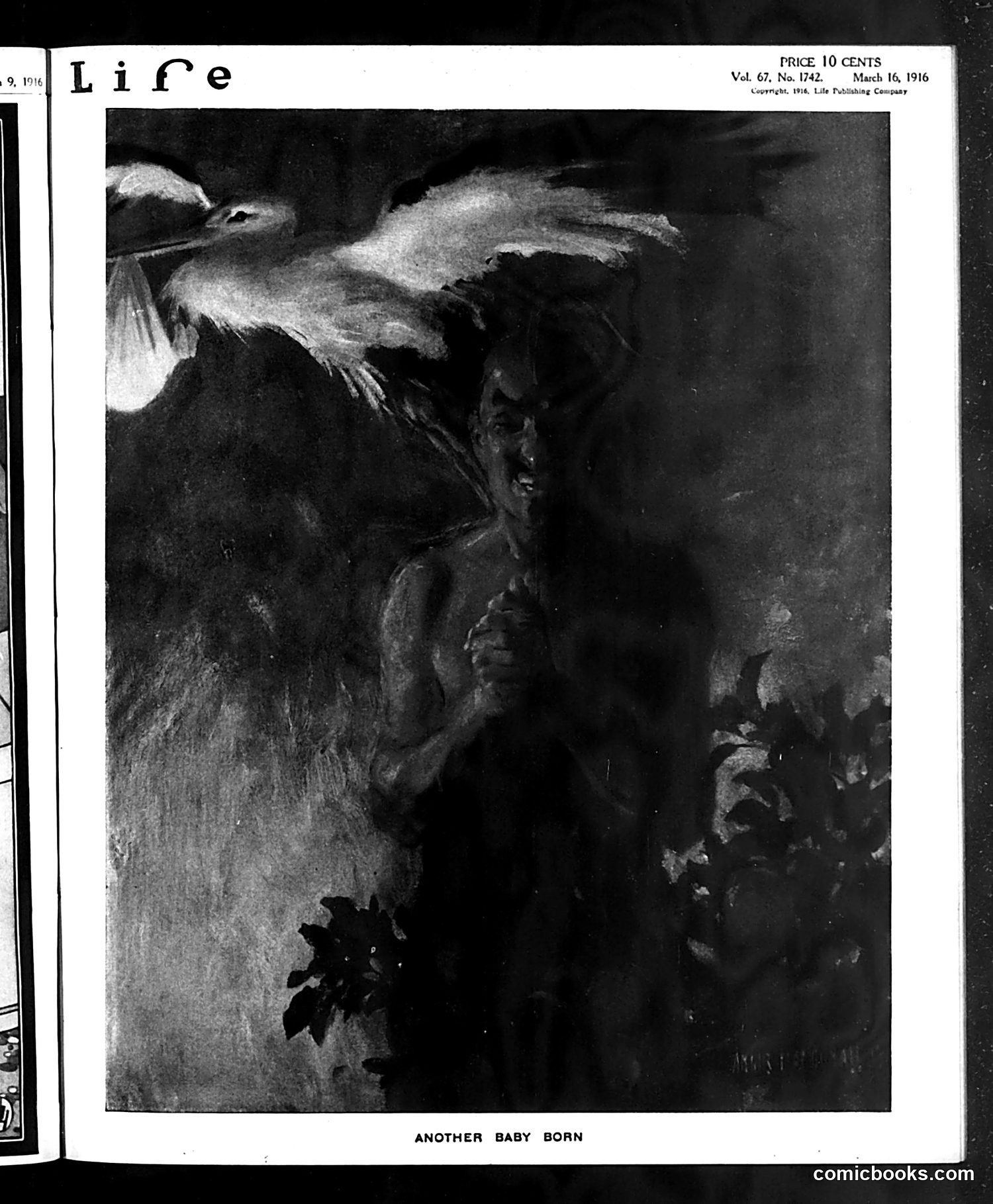
This March 1916 *Life* magazine illustration appears to depict a dramatic nativity or birth scene. The image shows figures gathered around a newborn, rendered in dark, expressionistic tones that contrast sharply with the bright illumination of the infant. Without additional caption text visible, the specific satirical target is unclear. However, given *Life*'s typical focus on social and political commentary, this could reference either: - A contemporary political figure or event portrayed allegorically as a "birth" - Social commentary on childbirth, family, or population issues - Possibly commentary on a significant institutional or national development The expressionistic style suggests gravity or momentousness, but the precise historical reference remains uncertain without more textual context from the original publication.
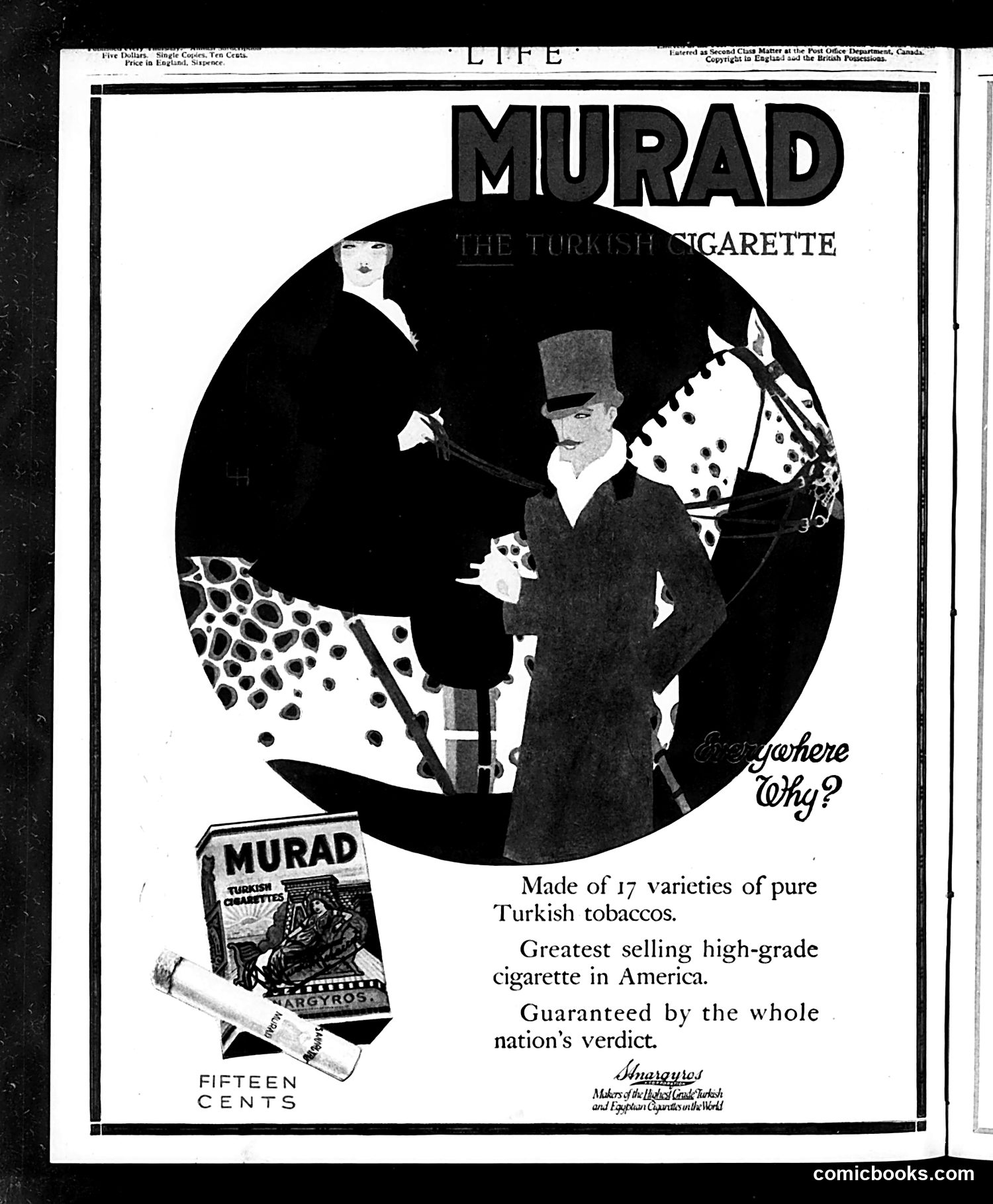
This is a cigarette advertisement, not satire. It depicts two elegantly dressed figures—a woman in a black coat and hat, and a man in formal attire with a top hat—posed with decorative spotted horses in a circular vignette. The tagline reads "Ever where Why?" The ad emphasizes that Murad is "Made of 17 varieties of pure Turkish tobaccos" and claims to be the "Greatest selling high-grade cigarette in America," "Guaranteed by the whole nation's verdict." Priced at fifteen cents, it positions the product as sophisticated and cosmopolitan. The Turkish imagery and refined aesthetic appealed to early 20th-century consumers who associated Turkish cigarettes with luxury and worldliness.
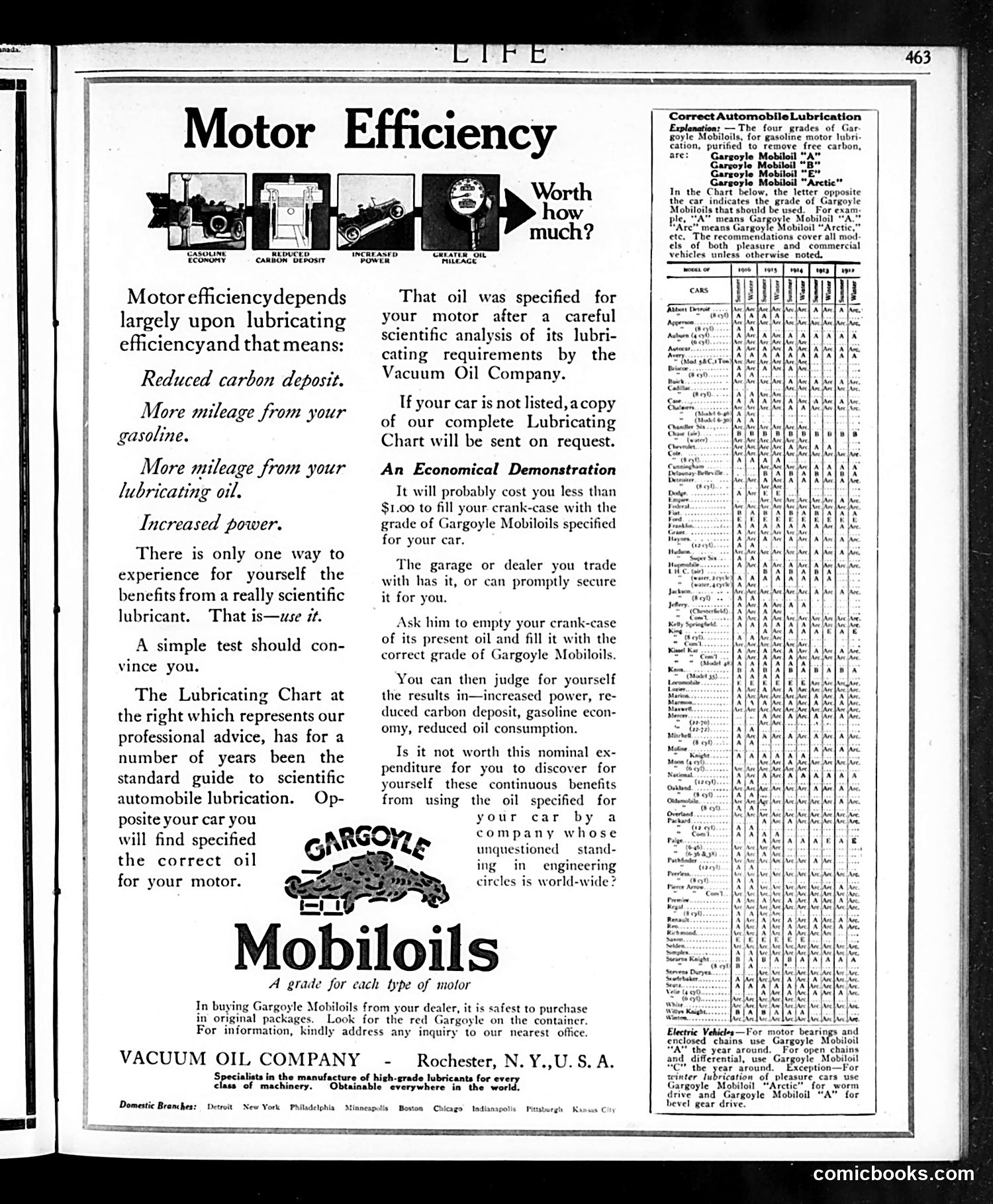
This page is **not satirical content but rather a straightforward advertisement** for Gargoyle Mobiloils lubricating oil, published in *Life* magazine (page 463). The ad promotes motor efficiency through proper lubrication, claiming benefits including reduced carbon deposits, improved mileage, and increased engine power. The "cartoon" elements—showing gasoline, crankcase, injected parts, and oil—are **product education diagrams, not satire**. A detailed lubrication chart lists recommended oil grades for various automobile models. The ad emphasizes that Gargoyle oils were scientifically formulated for specific engines, positioning the Vacuum Oil Company as an engineering authority. This represents early automotive advertising, when proper lubrication was a significant maintenance concern and manufacturers competed on technical specifications rather than brand image alone.
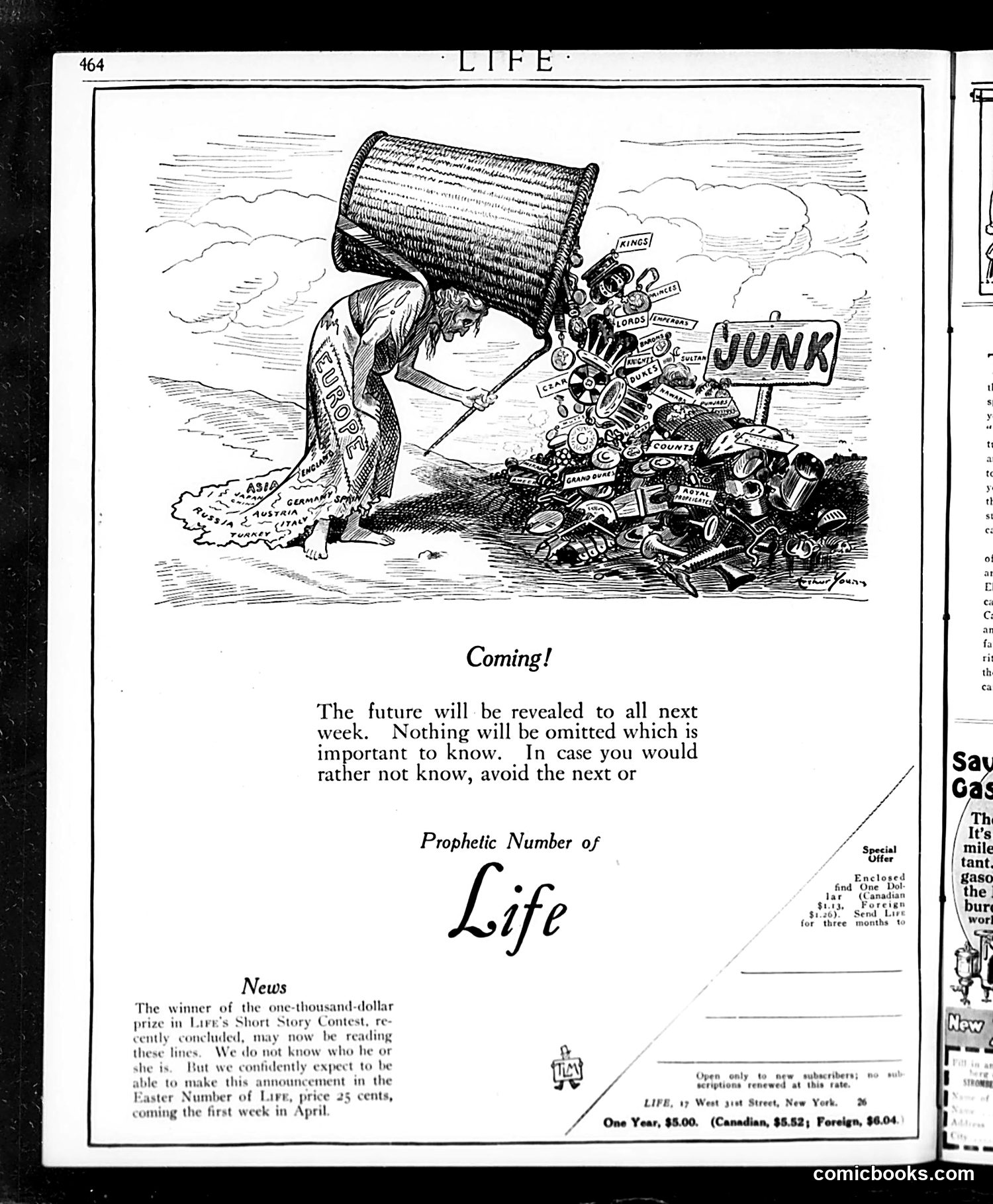
This page is primarily **promotional/advertising content** for *Life* magazine rather than editorial satire. The main cartoon depicts a figure dumping trash labeled "JUNK" from an oversized basket. The figure's garment appears to reference Austria-Hungary, suggesting this concerns **post-WWI European political cleanup or reorganization**. The heap contains various labeled debris representing what the cartoonist characterizes as obsolete institutions or systems—possibly monarchies, empires, or old political structures being discarded. The accompanying text teases an upcoming "Prophetic Number" issue promising revelations about "the future." This appears to be a marketing hook: intriguing readers with vague promises of important predictions while encouraging subscriptions. **Without clearer labeling or historical context**, the specific political figures and exact historical moment remain uncertain, though the post-war European context seems clear.
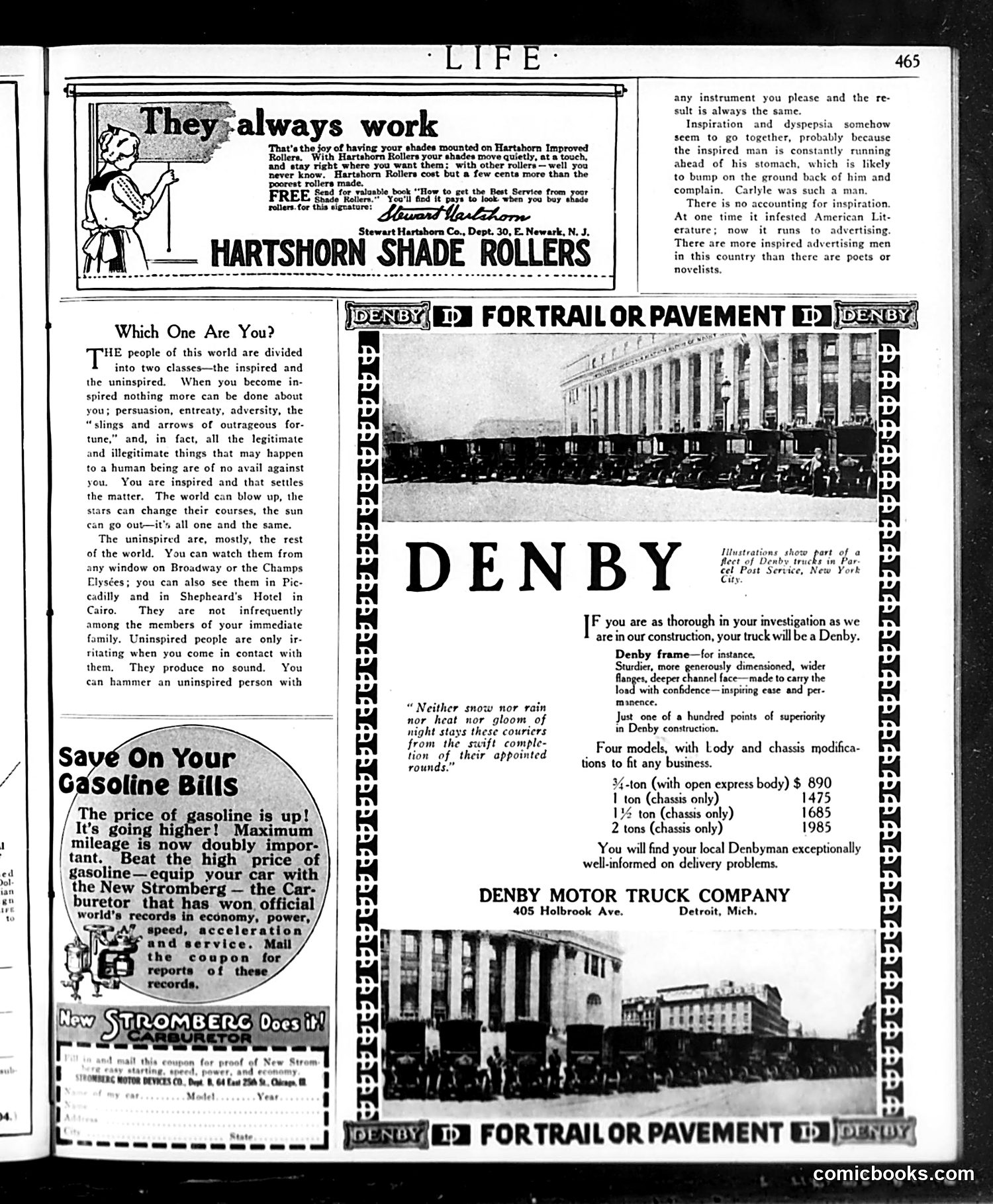
This page is **primarily advertising** (approximately 70% of content), not political satire or comics. The main advertisements are: 1. **Hartshorn Shade Rollers** – a household product pitch 2. **Denby Motor Trucks** – commercial vehicle marketing with two photographs showing trucks and their delivery capabilities 3. **Stromberg Carburetor** – automobile efficiency product The only substantive editorial content is a brief essay titled "Which One Are You?" that discusses two human types: the "inspired" versus "uninspired." This appears to be a generalized philosophical commentary rather than political satire, distinguishing between ambitious and passive personalities. The page reflects 1920s-era magazine format, mixing editorial content with consumer advertising targeted at businesspeople and vehicle owners.
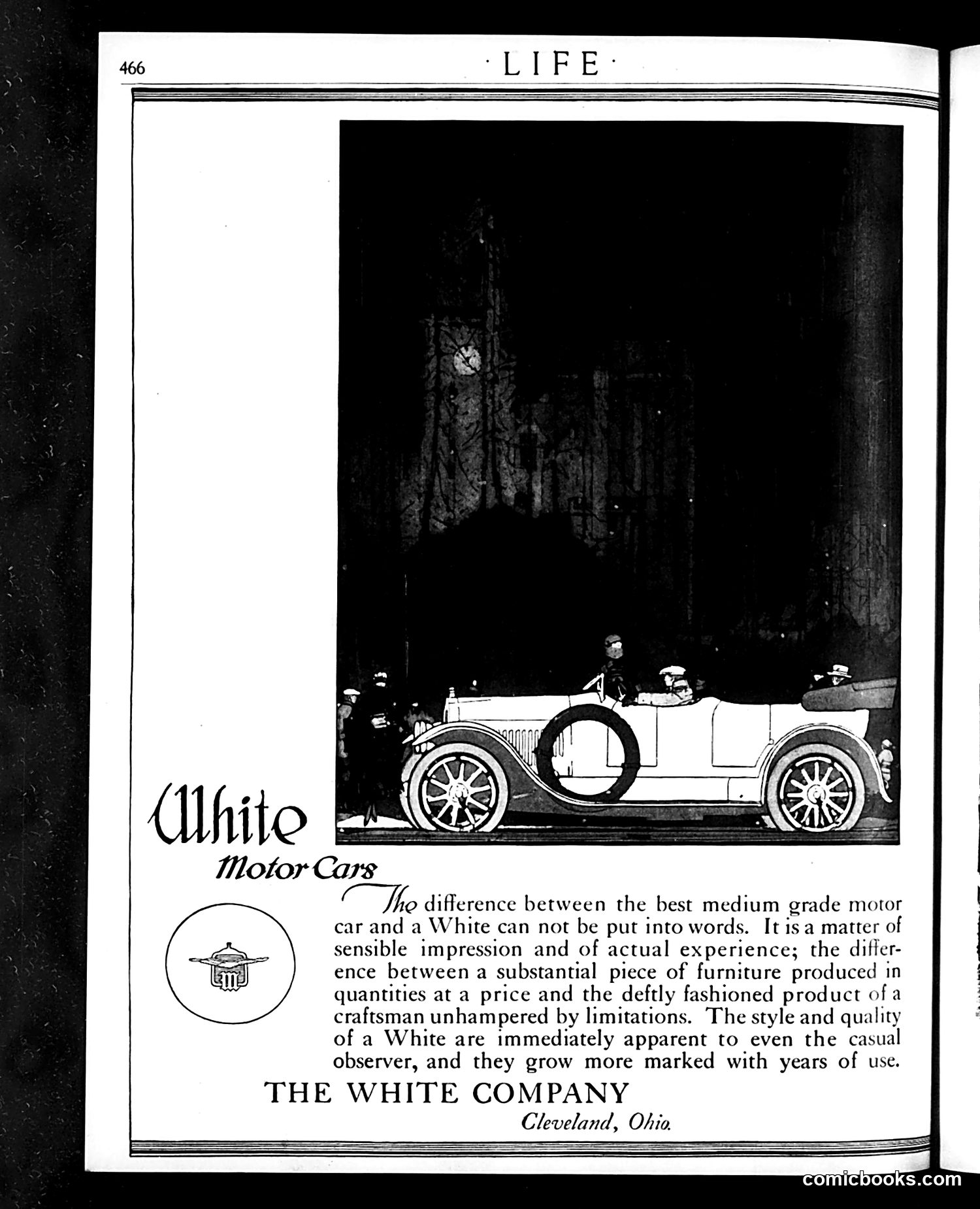
This page is **primarily an advertisement**, not satirical content. It promotes White Motor Cars, manufactured by The White Company in Cleveland, Ohio. The ad features a photograph of an early 1900s White automobile (open-air touring car) positioned dramatically against what appears to be a Gothic cathedral or church at night, lit by moonlight. Several passengers and onlookers are visible. The marketing copy emphasizes quality and craftsmanship, claiming White cars represent superior "medium grade motor cars" with distinctive style that becomes more apparent over years of use. The company distinguishes its product through implied exclusivity and careful engineering rather than mass production. The cathedral backdrop suggests elegance, permanence, and aspirational status—associating the automobile with cultural prestige and timeless quality.
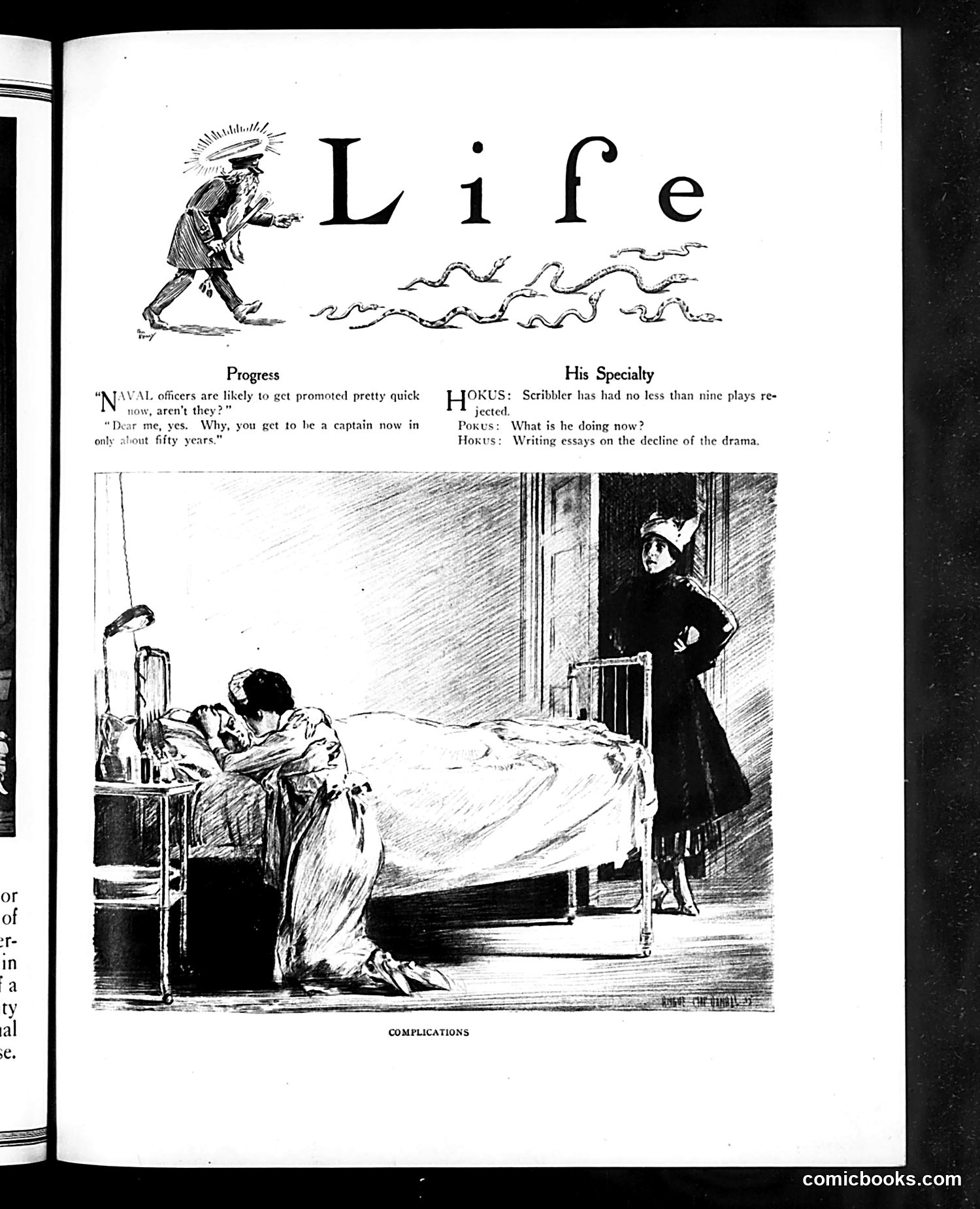
This page satirizes naval officer promotions and theatrical productivity. The top section presents two brief jokes: **"Progress"** mocks the slow advancement in the Navy—a captain humorously notes it takes fifty years to achieve that rank. **"His Specialty"** features a character named Scribbler who has had nine plays rejected; Pokus observes he's now writing essays on drama's decline—satirizing failed playwrights who pivot to criticism. The large illustration titled **"Complications"** depicts a domestic scene: a woman kneeling beside a bed while another woman stands nearby, suggesting a pregnancy or illness scenario. The specific narrative is unclear, but the image appears to illustrate romantic or marital complications typical of Life's humorous social commentary from this era.
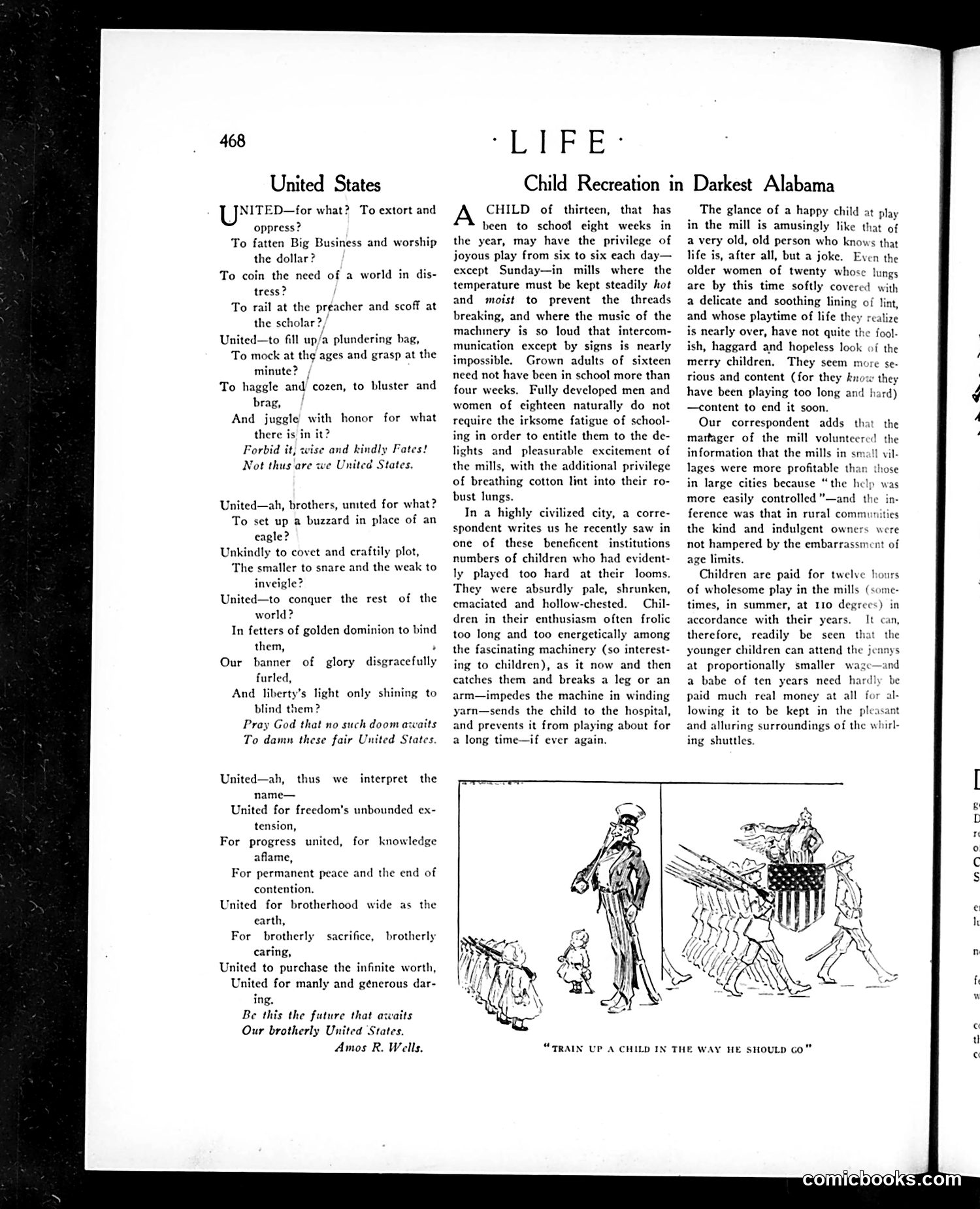
This page contrasts two visions of American childhood. The left column presents an idealistic poem by Amos R. Wells about the "United States" as a beacon of freedom and brotherhood. The right article, "Child Recreation in Darkest Alabama," describes the grim reality: thirteen-year-old children working twelve-hour shifts in cotton mills. The accompanying cartoon illustrates this contradiction—showing Uncle Sam pointing children toward a giant mill machine, with the caption "Train Up a Child in the Way He Should Go." The satire is bitter: the poem's noble rhetoric about American values clashes with the documented exploitation of child laborers in Southern factories. The cartoon's use of Uncle Sam as the figure directing children to dangerous machinery suggests the government's complicity or hypocrisy in allowing such conditions to exist.
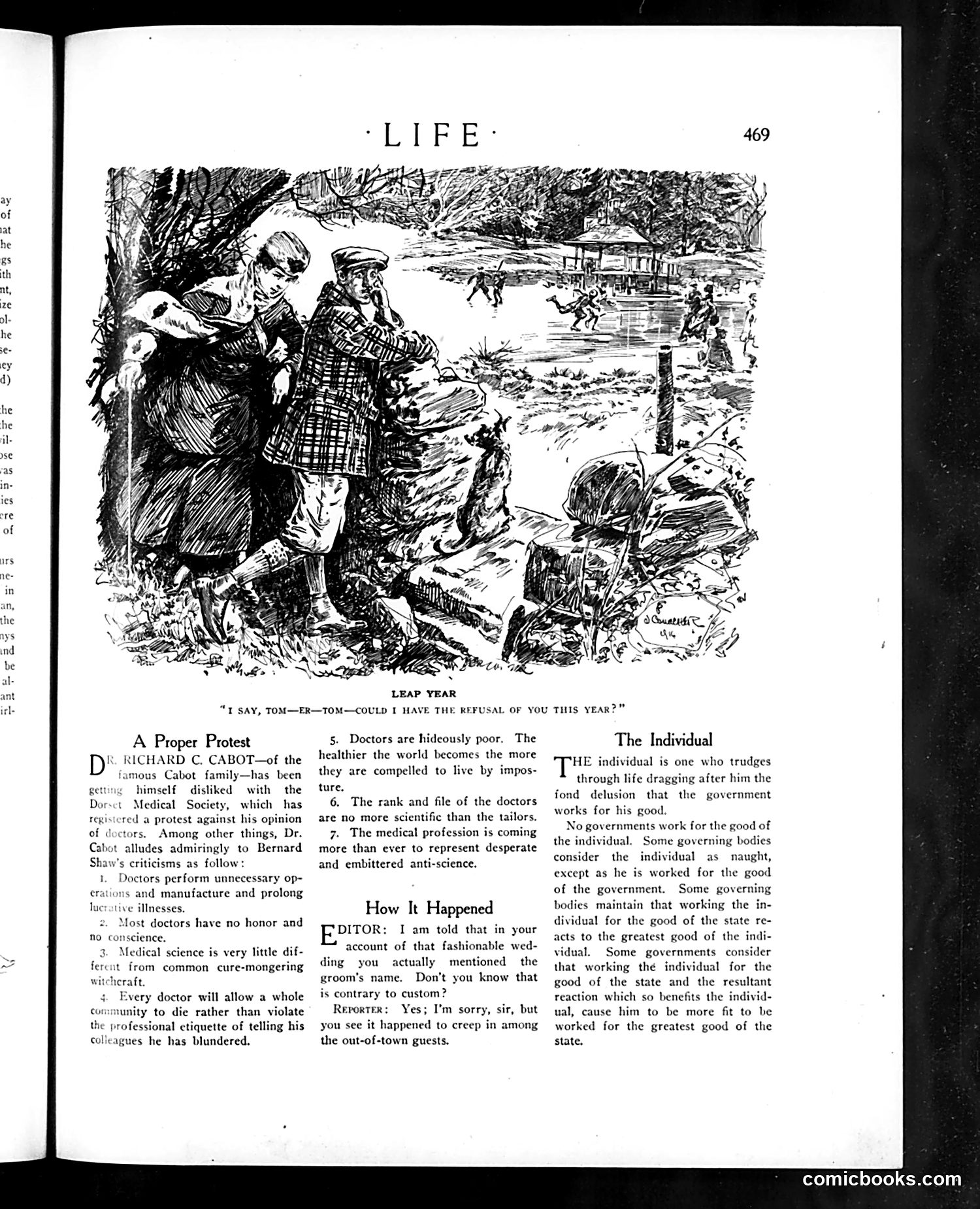
The main cartoon depicts a woman (in darker clothing, left) accosting a man (in plaid, right) by a riverside, with the caption: "I SAY, TOM—ER—TOM—COULD I HAVE THE REFUSAL OF YOU THIS YEAR?" This satirizes the tradition where women could propose to men during leap years—a reversal of normal courtship conventions. The woman's awkward, stammering approach ("TOM—ER—TOM") humorously captures the social discomfort of role-reversal. The man's body language suggests reluctance or surprise. The accompanying text articles ("A Proper Protest," "How It Happened," and "The Individual") appear unrelated to the cartoon, discussing medical ethics and government responsibility—typical Life magazine opinion content. The humor relies on early-20th-century gender expectations about courtship and marriage proposals.
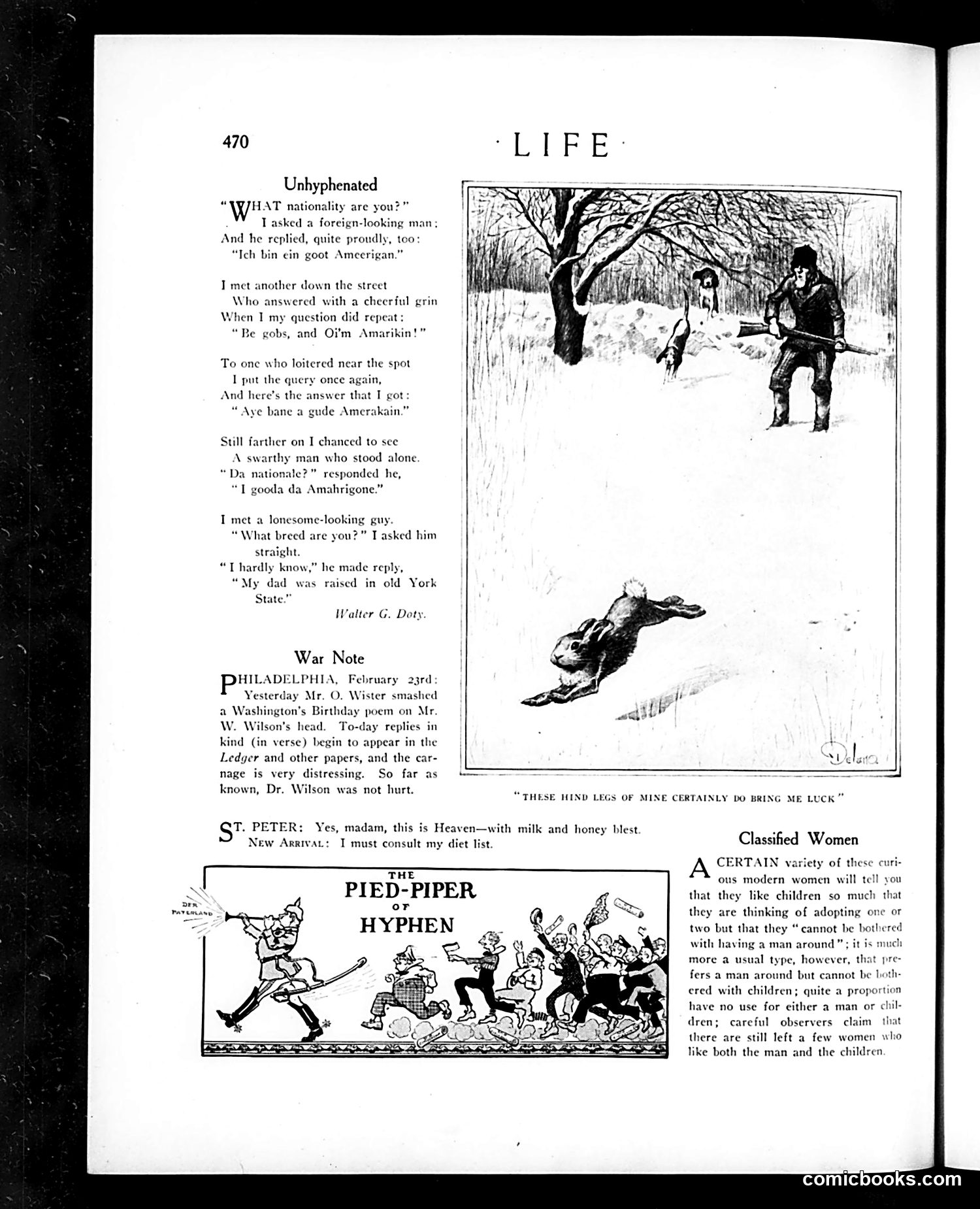
**"Unhyphenated" Poem** (by Walter G. Doty): This satirizes the common American question "What nationality are you?" to immigrants. The poem humorously catalogs diverse responses—"goot Ameerican," "Amarigone," "Amahrigone"—mocking both the question itself and immigrants' varied English pronunciations. The satire targets nativist anxiety about hyphenated Americans (German-American, Italian-American, etc.), which was contentious during WWI when foreign loyalties seemed suspect. **War Note**: Reports O. Wister's poem attacking President Wilson being smashed on his head—commentary on literary/political conflict during wartime. **"Piper of Hyphen" illustration**: A cartoon showing chaotic figures, likely satirizing how divisive "hyphenated American" identity was becoming, with the piper representing those stoking discord. **"Classified Women"**: Brief social commentary distinguishing women who want children from those who don't.
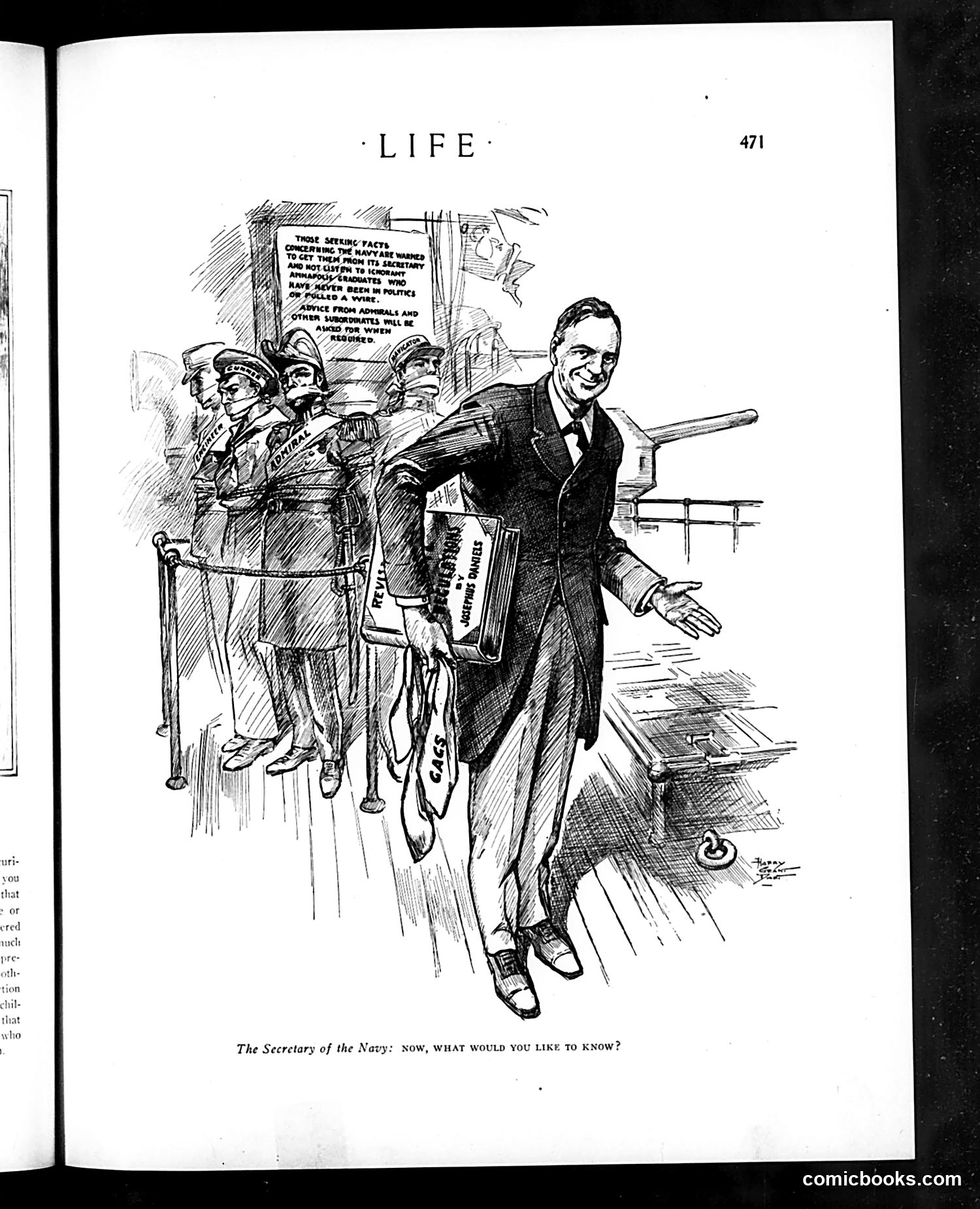
This political cartoon depicts the Secretary of the Navy as a smiling civilian figure leading military officers. The sign behind them contains text about "seeking facts" regarding admirals and subordinates, warning against listening to the secretary and noting that officers "have never been in politics or pulled a wire." The satire critiques the Secretary of the Navy for attempting to control or direct military affairs through political manipulation rather than proper naval procedure. The cartoon suggests the secretary is using underhanded tactics ("pulling wires," political maneuvering) to influence career military officers who traditionally operated outside politics. The officers appear skeptical or uncomfortable, emphasizing the tension between civilian political authority and military independence. The caption asks what the reader would "like to know," inviting public skepticism about the secretary's true motives.
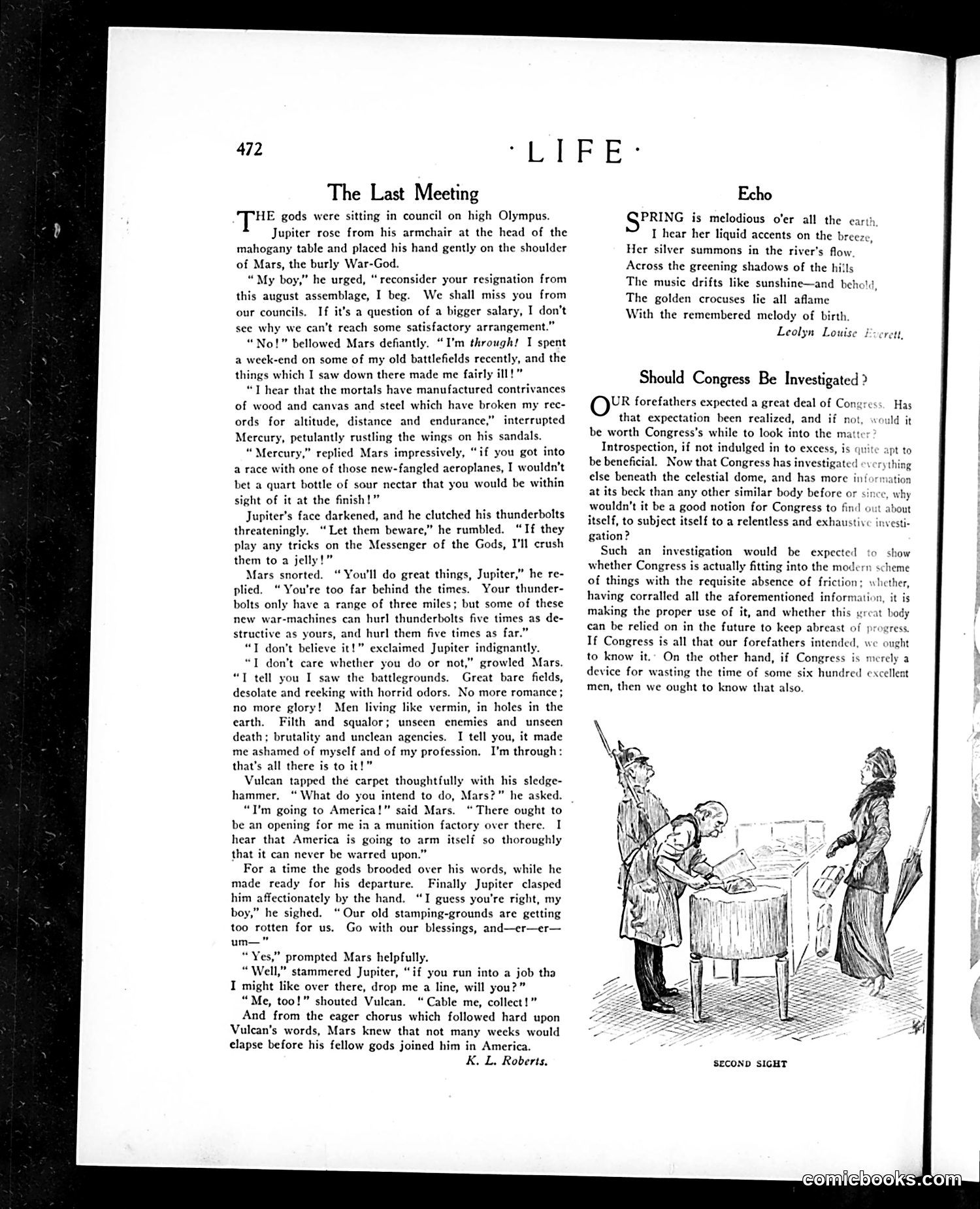
**"The Last Meeting"** (left column) is a satirical dialogue among Roman gods debating Mars's departure for America. Jupiter urges resignation, while Mars boasts about Earth's battlefields and complains about modern war machinery being "too soft" compared to ancient brutality. The satire mocks militarism and nostalgia for "glorious" warfare while suggesting America is preparing for armed conflict. **"Should Congress Be Investigated?"** (right column) advocates investigating whether Congress functions adequately in modern times, arguing self-examination would help them "keep ahead of progress." The illustration labeled **"Second Sight"** (bottom right) shows figures in what appears to be a séance or fortune-telling scene, likely satirizing spiritualism or political prophecy—though the specific reference remains unclear from the visible image.
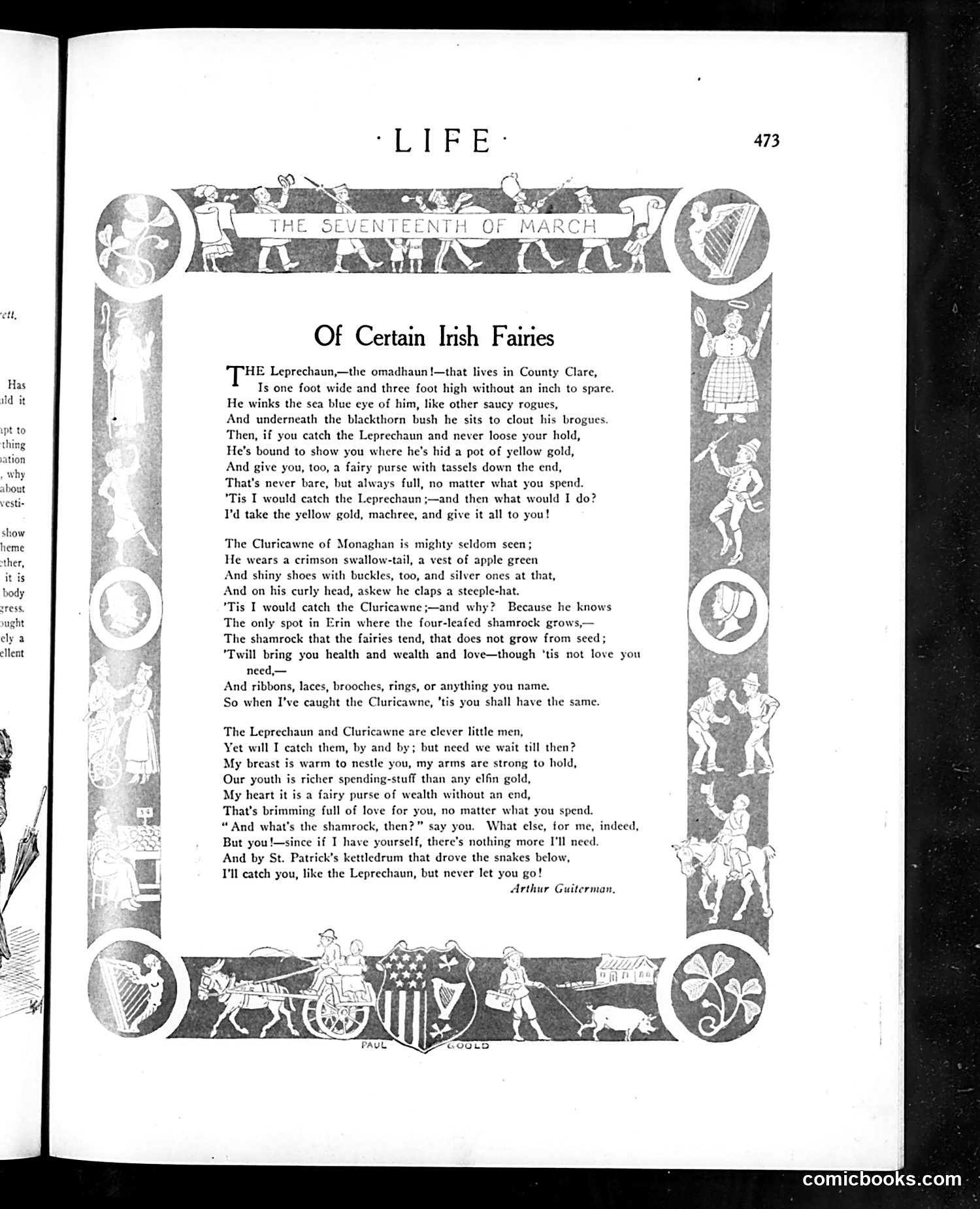
This is a poem by Arthur Guiterman about Irish folklore creatures, not a political cartoon. The text celebrates three mythological figures: the Leprechaun (a small man from County Clare who hides gold), the Clúricaune (a similar creature wearing fancy clothes who knows where four-leaf shamrocks grow), and references St. Patrick's kettledrum that "drove the snakes below." The poem frames these fairies as offering wealth and love to those who catch them, using folkloric promises as metaphor. The ornate decorative border features Celtic-inspired designs with figures and shamrocks, appropriate to the Irish fairy theme. This appears to be weekend entertainment content rather than satire—a whimsical celebration of Irish cultural mythology for American readers.
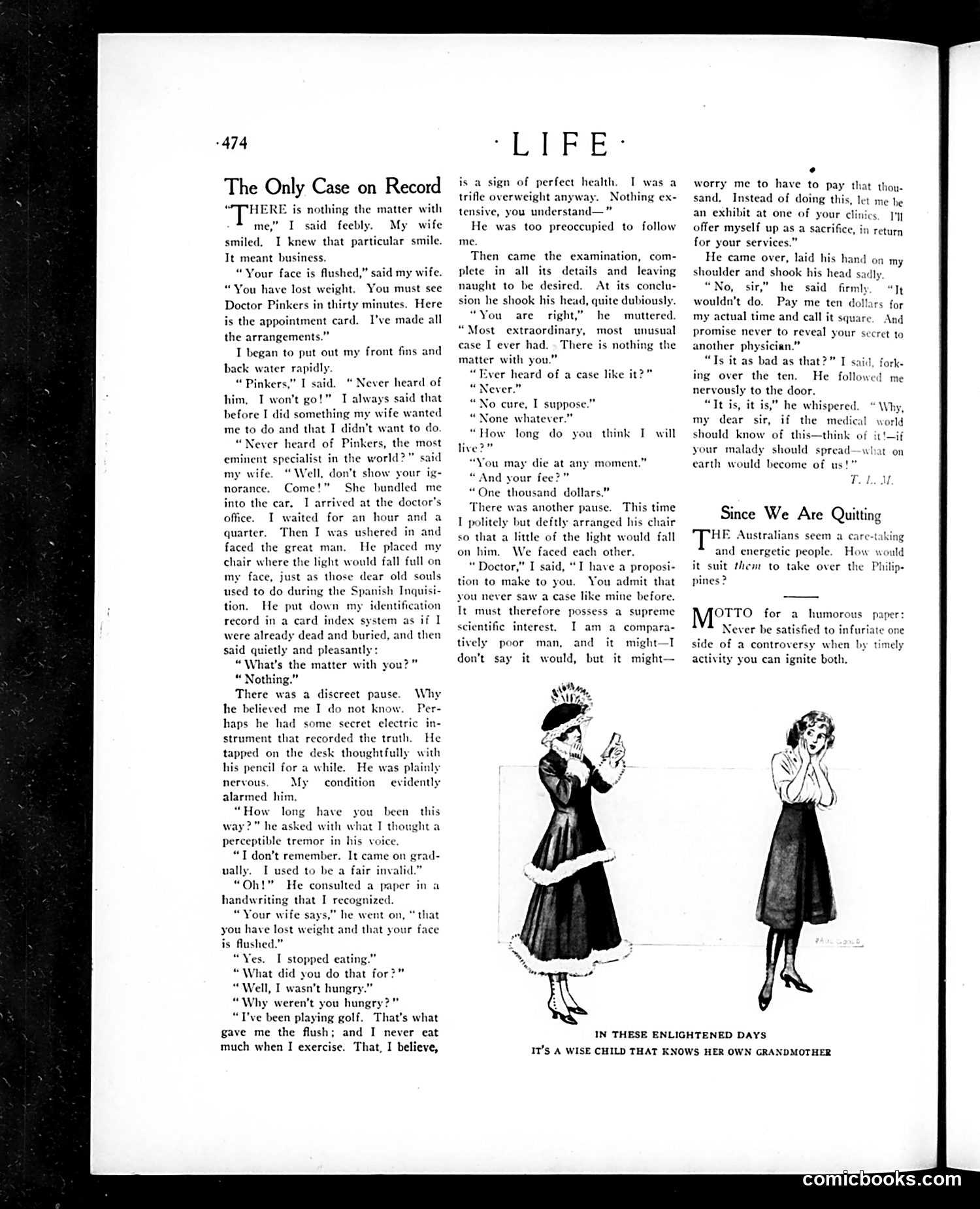
This page contains two distinct pieces: **"The Only Case on Record"** is a short story about a man consulting Doctor Pinkers, presented as "the most eminent specialist in the world." The patient has lost significant weight through golf and exercise rather than illness—a humorous inversion of typical medical cases. The doctor finds this so unusual he wants to study it scientifically, offering payment. The satire targets both hypochondria and the medical profession's fascination with pathology. **"Since We Are Quitting"** is a brief humorous motto mocking people who insert themselves into controversies unnecessarily. The accompanying illustrations show fashionably dressed women in 1920s-style clothing, likely accompanying the "enlightened days" caption about grandmothers.
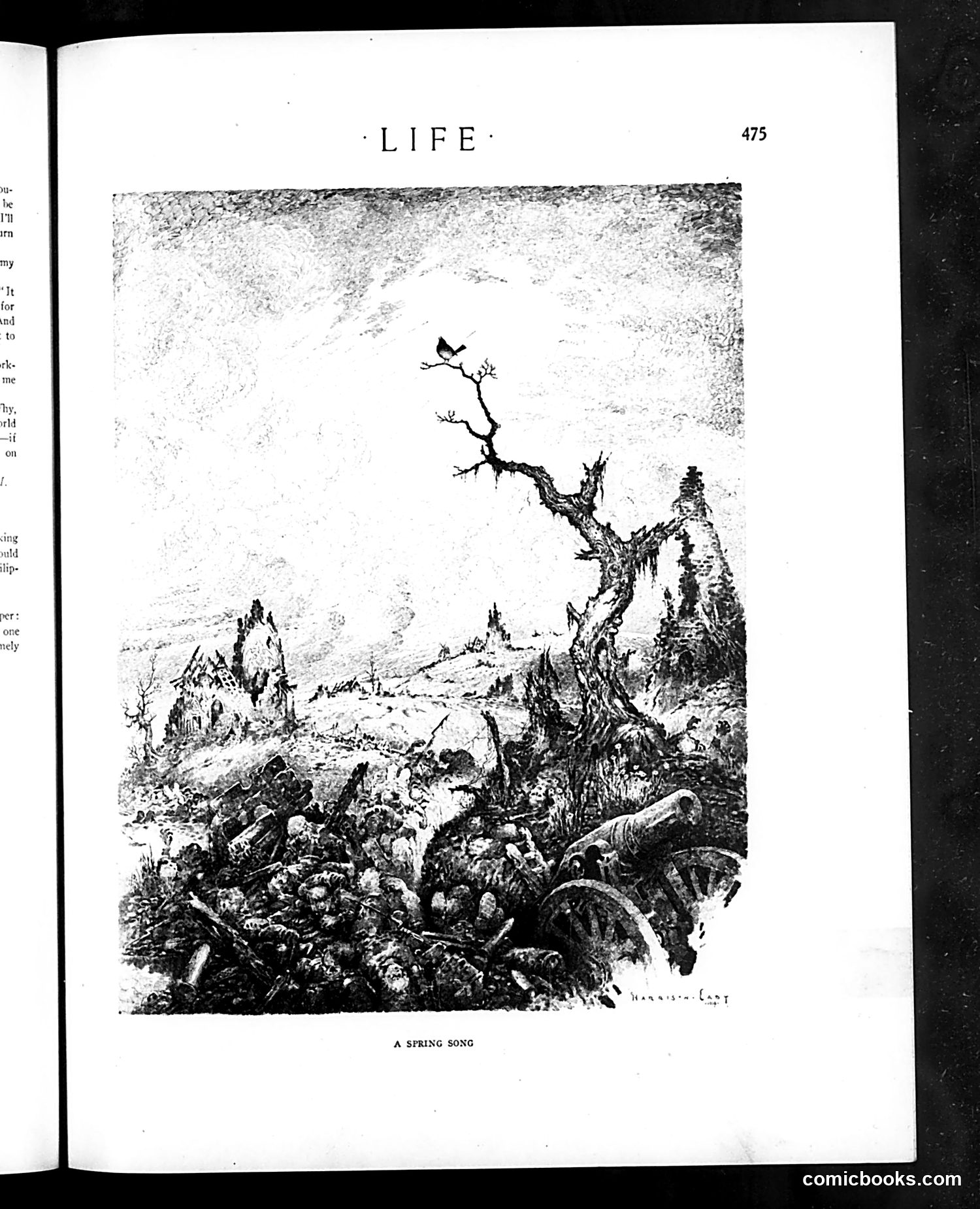
This page from *Life* magazine features a single detailed engraving titled "A Spring Song." The image depicts a war-ravaged landscape: in the foreground, cannonballs and military debris litter the ground; a dead or dying soldier lies prone; in the background, a gnarled, nearly leafless tree stretches skyward where a small bird perches—apparently singing despite the devastation surrounding it. The satire is bitter: the "spring song" is ironic commentary on nature's renewal contrasted against human carnage from warfare. The lone bird represents hope or beauty persisting amid destruction, though the overall composition emphasizes the grim toll of conflict. The work appears to critique war's wastefulness and the disconnect between nature's innocence and human violence. The specific conflict referenced remains unclear without additional context.
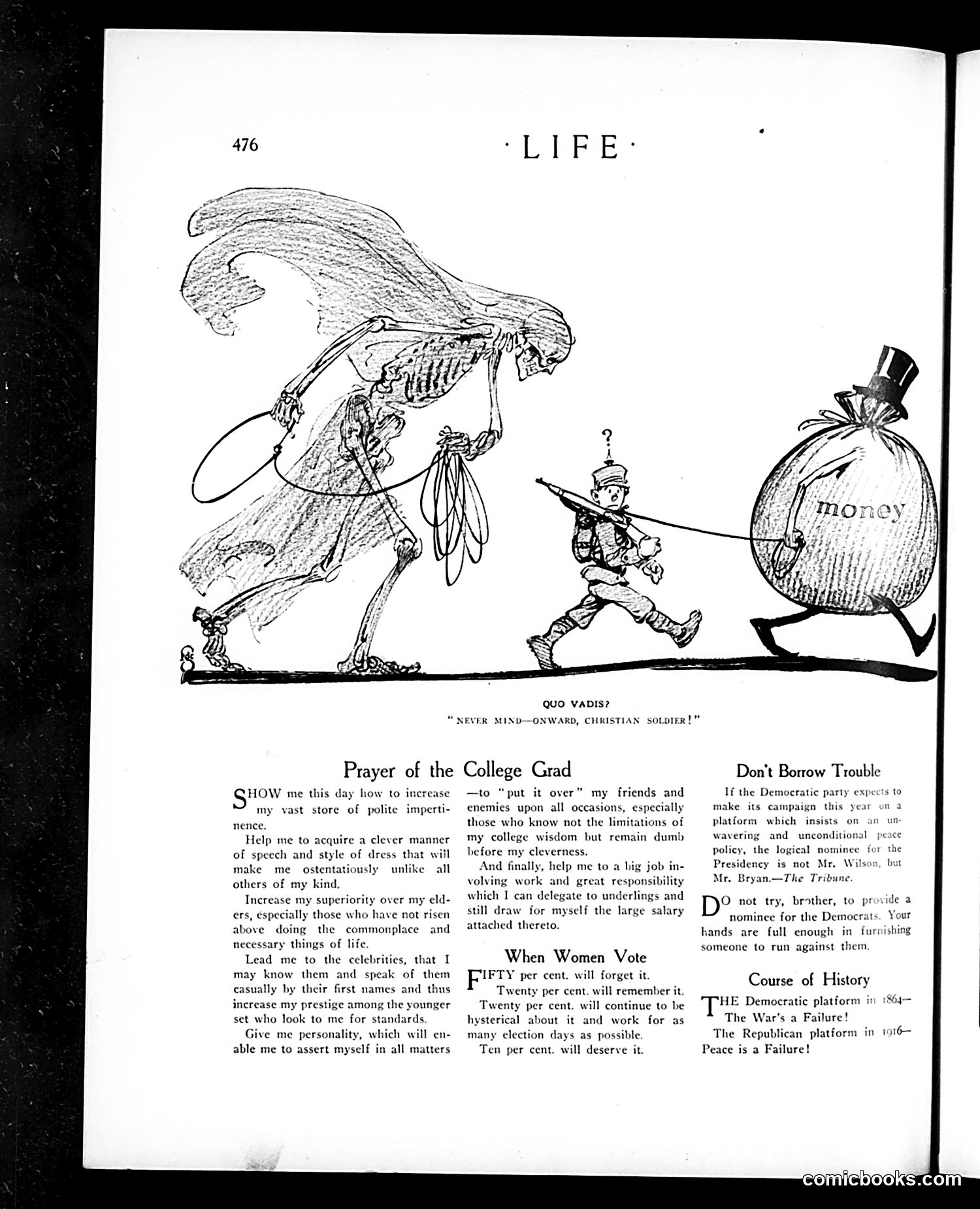
The main cartoon depicts a skeletal Death figure (labeled "Quo Vadis?"—"Where are you going?") carrying dead soldiers, while a small soldier with a money bag labeled "money" questions where this is leading. The Latin phrase and imagery suggest criticism of WWI as a senseless march toward death for financial gain. The "Prayer of the College Grad" mocks recent graduates' arrogance and superficiality—their desire for unearned status, celebrity connections, and high salaries without actual responsibility. "When Women Vote" expresses skepticism about female suffrage (newly granted or being debated), dismissing most women voters as forgetful, hysterical, or undeserving—a cynical view typical of anti-suffrage sentiment. The political commentary criticizes both Democratic and Republican platforms for contradictory peace/war positions, suggesting neither party offers coherent policy. Overall, the page satirizes American arrogance, generational pretension, doubts about democracy, and WWI's human cost.
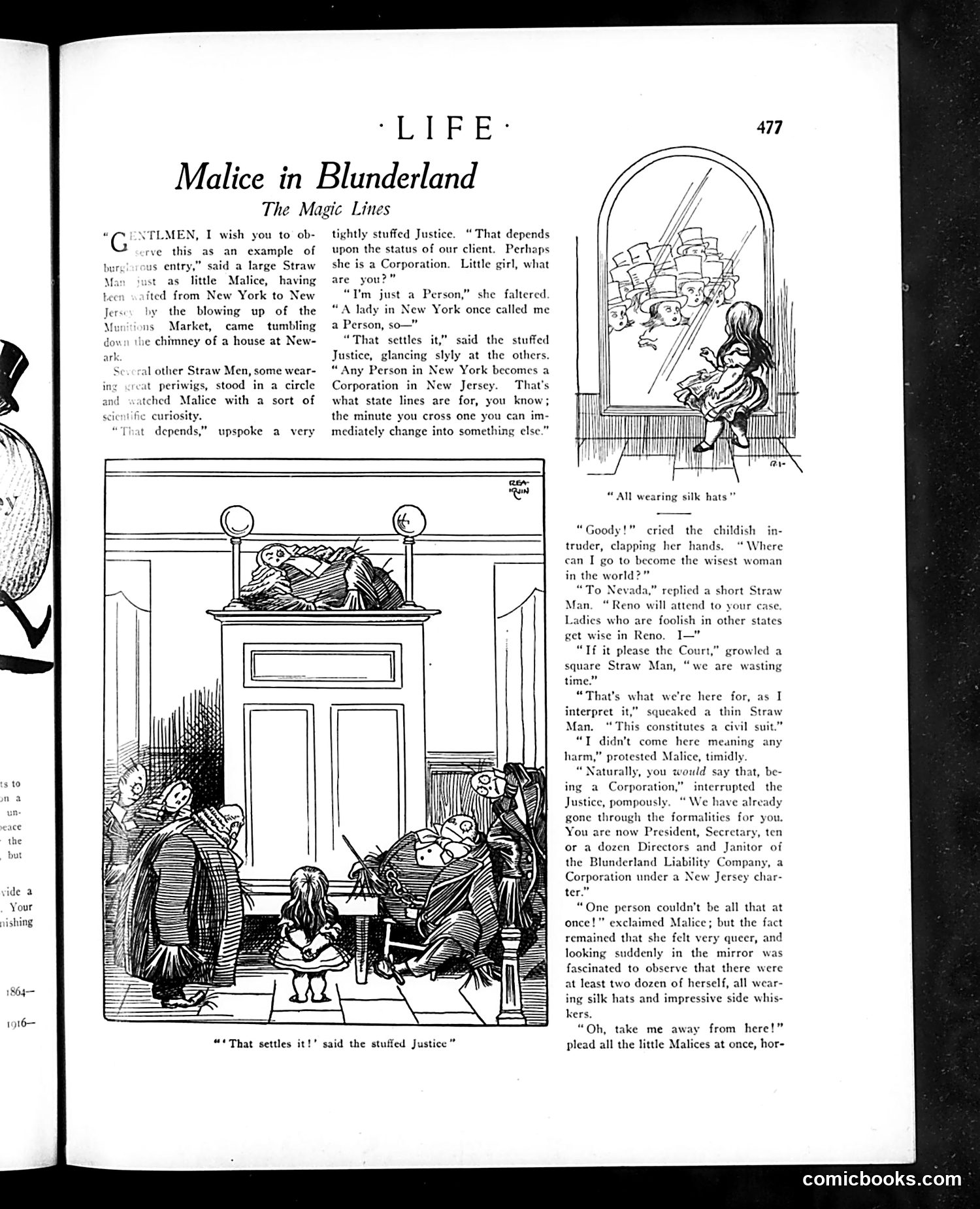
This satirical piece parodies corporate law and state jurisdiction loopholes. A young girl named Malice, arriving from New York, encounters stuffed-shirt "Straw Men" (likely representing lawyers and judges) in a courtroom setting. The satire targets how corporations exploit state boundary differences—particularly New Jersey and Nevada's permissive incorporation and divorce laws. The joke: merely crossing a state line magically transforms a "Person" into a "Corporation," complete with multiplying identities wearing silk hats (symbols of formal authority). The piece mocks: - Corporate legal formalism that contradicts common sense - State laws designed to attract business through lax regulations - How technicalities allow individuals to evade accountability by becoming entities - Nevada's notorious divorce industry ("Reno will attend to your case") The girl's multiplication into two dozen versions of herself—all suddenly formal corporate officers—visually emphasizes the absurd legal fiction that one person becomes a bureaucratic apparatus.
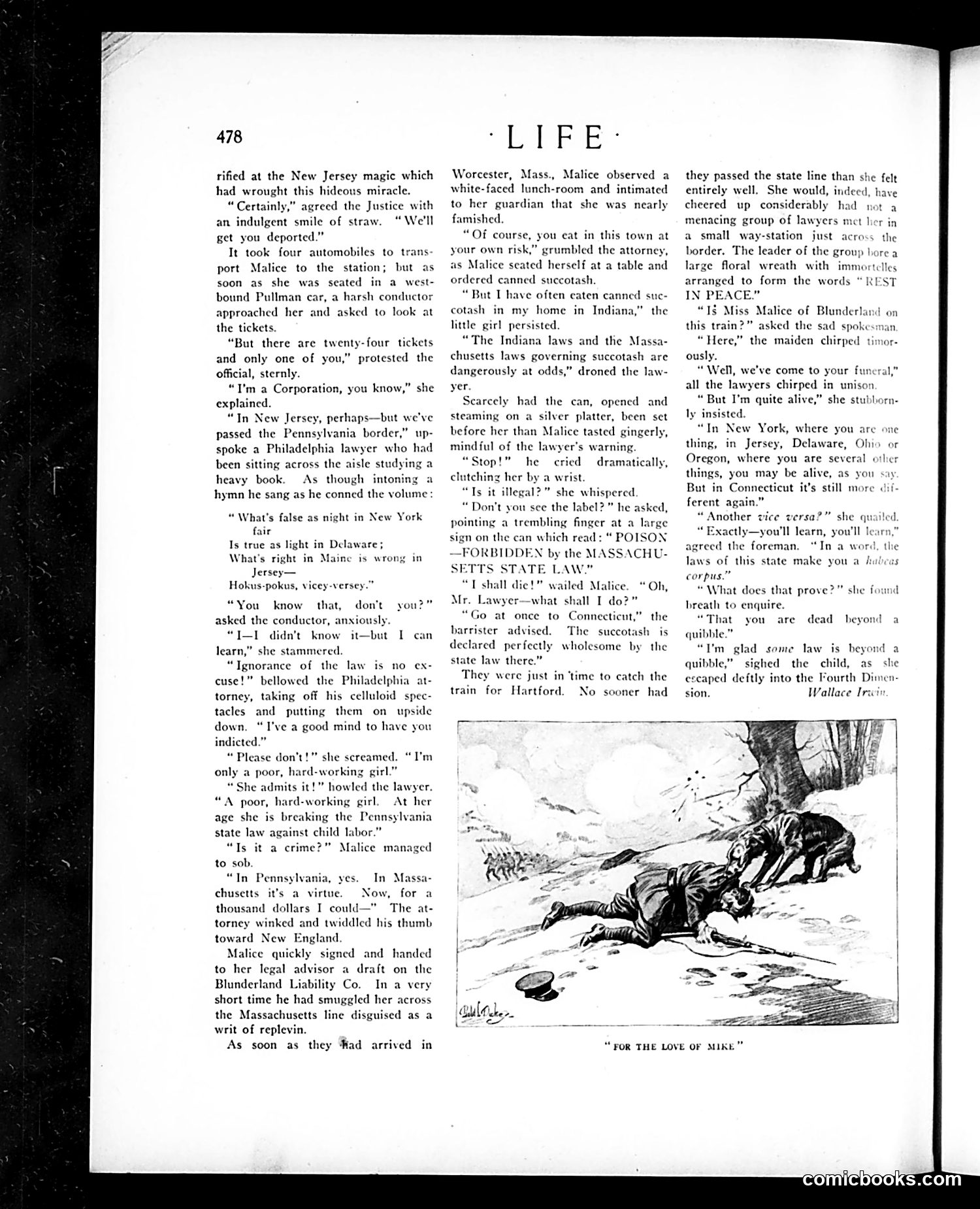
This page satirizes the chaotic patchwork of American state laws in the early 20th century. The story follows "Malice," a female character who becomes a "Corporation" (a legal entity) after crossing state lines, exploiting jurisdictional differences. The satire illustrates how contradictory state laws created absurd situations: conduct legal in one state becomes criminal in another. The Philadelphia lawyer's song—"What's false as night in New York / Is true as light in Delaware"—encapsulates the joke. Malice encounters ridiculous legal hazards: canned succotash that's "poison" in Massachusetts but "wholesome" in Connecticut; child labor laws that vary by state. The illustration shows lawyers greeting her with a funeral wreath at a train station, implying she's legally "dead" in that jurisdiction despite being physically alive. The satire mocks both the illogical nature of fragmented state regulation and lawyers' opportunistic exploitation of these gaps. It's commentary on the need for legal standardization and federal oversight.
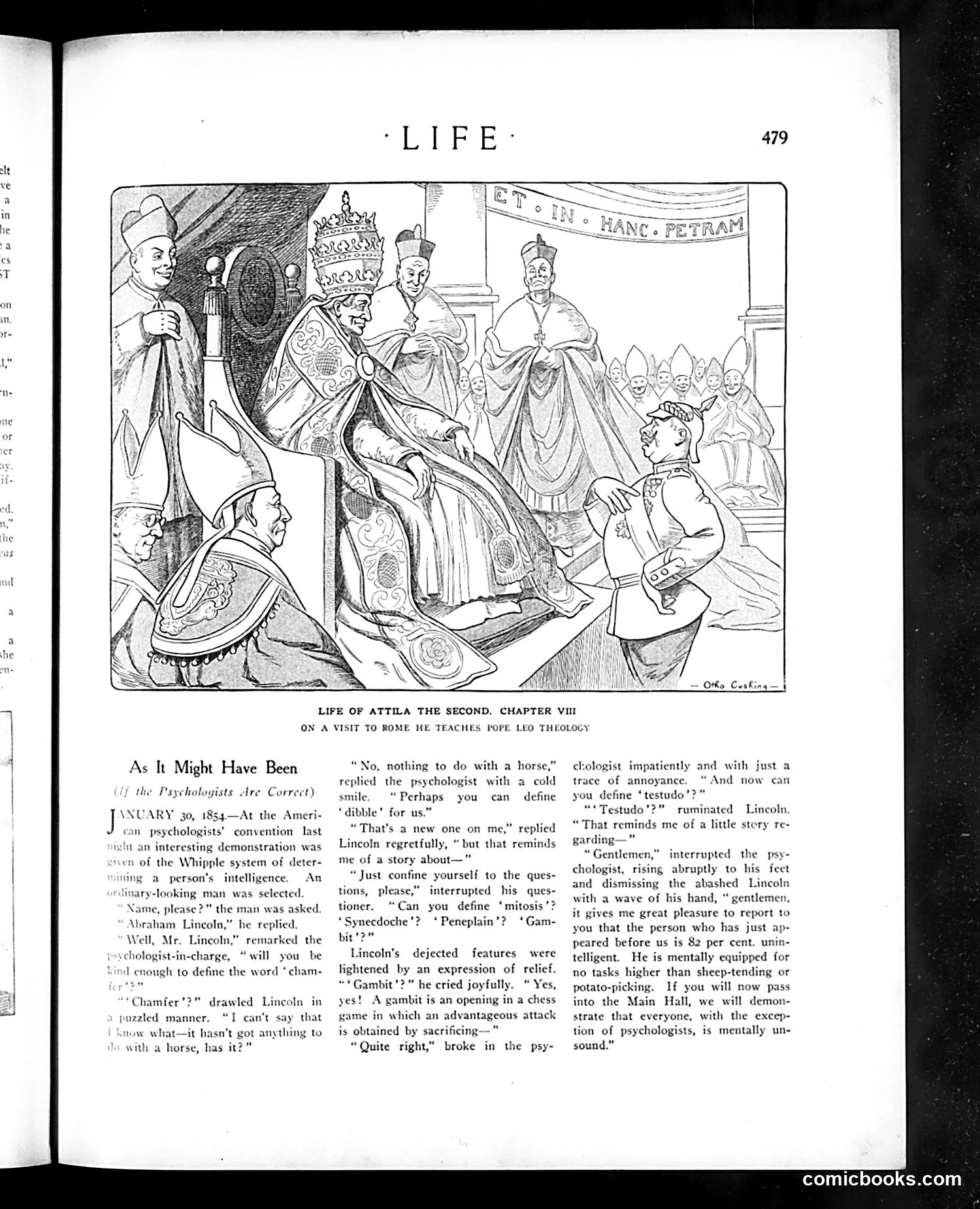
This 1854 *Life* magazine satire mocks pseudoscientific "psychology" conventions of the era. The cartoon depicts Abraham Lincoln being tested at an American psychologists' convention using the "Whipple system" to measure intelligence. The joke: Lincoln fails to define obscure technical terms ("chamfer," "mitosis," "synecdoche," "peneplain") but succeeds with "gambit"—a chess term. The psychologist concludes Lincoln is 82% unintelligent, fit only for sheep-tending or potato-picking. The satire targets the pretentiousness and absurdity of early psychology as a pseudo-science. By having Lincoln—who would become a revered president—declared mentally unfit by arrogant experts, the article ridicules how these psychologists use jargon to make baseless judgments about human capability. The final line, declaring everyone except psychologists "mentally unsound," hammers home the satire's point about expert pomposity and fraudulent science.
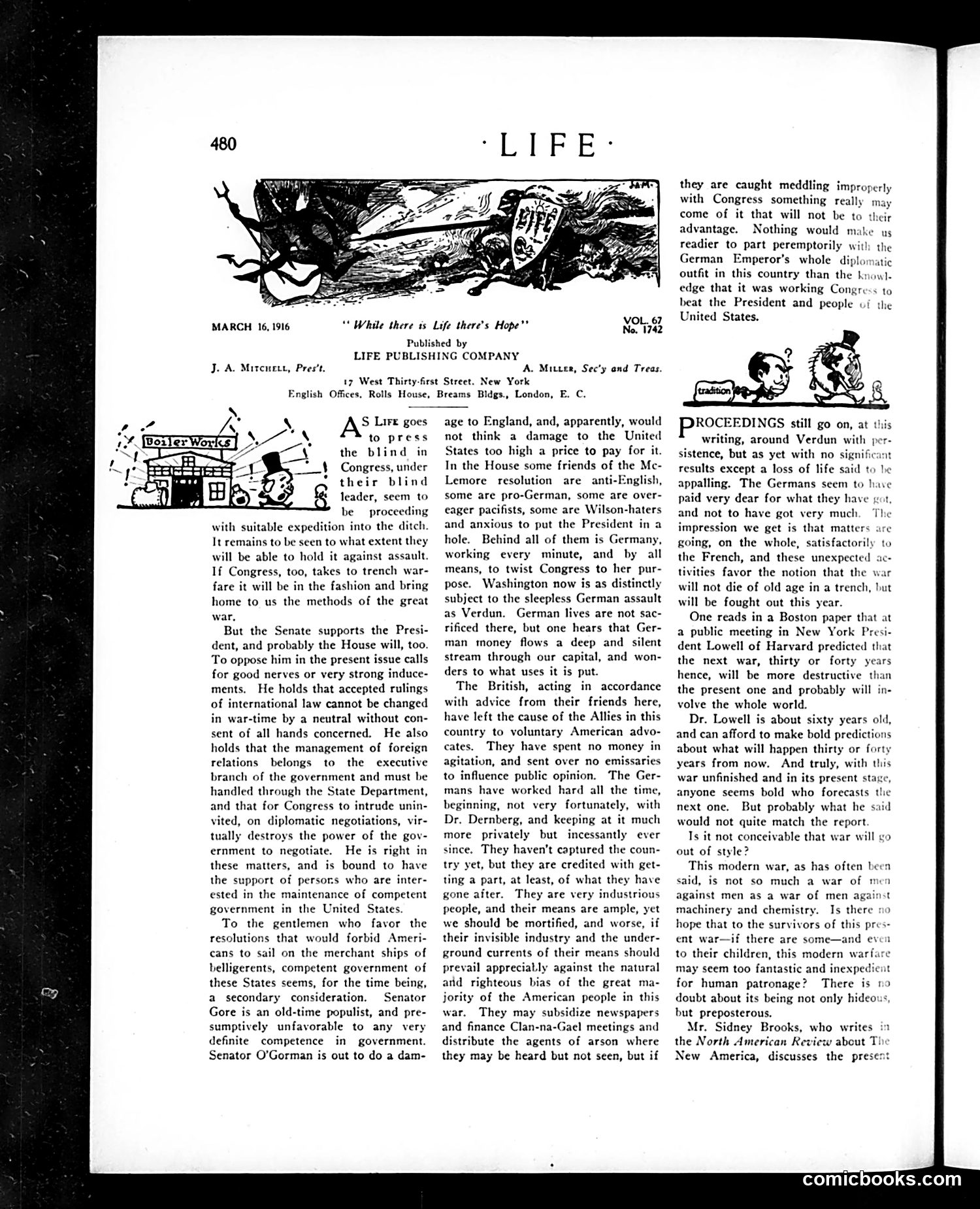
This *Life* magazine page (March 16, 1916) satirizes Congressional opposition to President Wilson's foreign policy during WWI. The cartoon depicts Congress as "blind" proceeding into a ditch—a metaphor for lawmakers marching toward disaster. The editorial attacks Senators Gore and O'Gorman and House members supporting the McLemore Resolution (which would restrict American travel on belligerent ships). Life accuses these politicians of various motives: anti-British sentiment, pro-German sympathy, pacifism, or anti-Wilson hostility. The piece alleges Germany is secretly manipulating Congress through money and agents ("Dr. Dernberg" likely refers to German propagandist Albert Dernberg). Life contrasts this with Britain's passive approach, arguing Germans are industriously undermining American neutrality through covert influence—a significant concern as America approached WWI entry (1917). The satire's point: Congressional isolationism serves German interests and threatens competent executive governance.
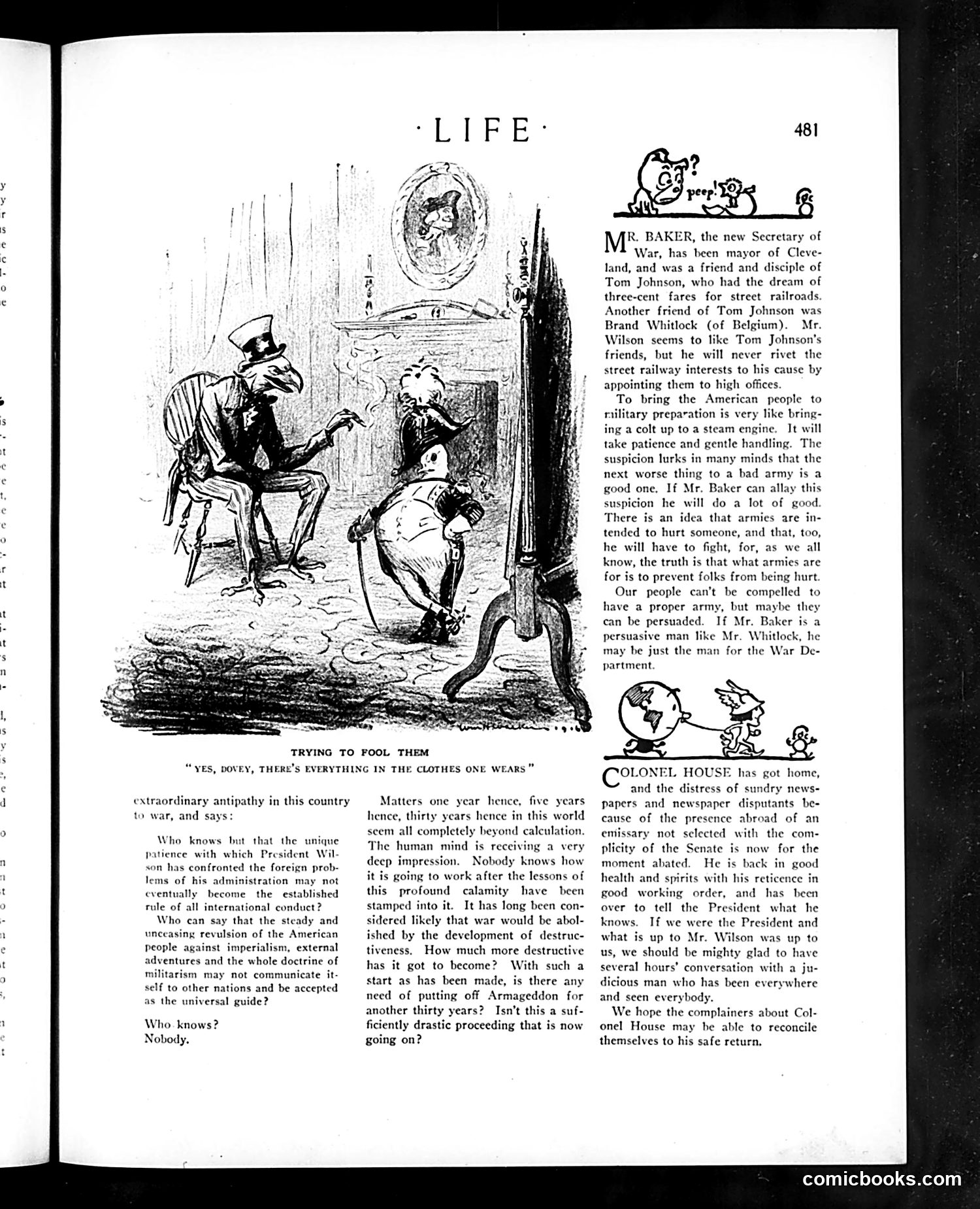
The main cartoon depicts two figures in military dress attempting deception—the caption suggests someone trying to pass off civilian clothes as military uniform ("there's everything in the clothes one wears"), satirizing superficial military preparedness. The accompanying text discusses Secretary of War **Newton D. Baker**, praising his appointment while mocking Americans' deep skepticism about militarism and armies. Life sarcastically notes the public suspects armies cause harm rather than prevent it—a fundamental obstacle Baker must overcome through persuasion rather than compulsion. The article also defends **Colonel Edward House**, President Wilson's unofficial diplomat, against Senate critics who resented his foreign missions. Life argues House's experience and discretion make him valuable counsel, dismissing complaints about his unsanctioned role. The satire targets American pacifist sentiment during WWI preparedness debates, the tension between civilian and military leadership, and partisan opposition to Wilson's diplomatic methods.
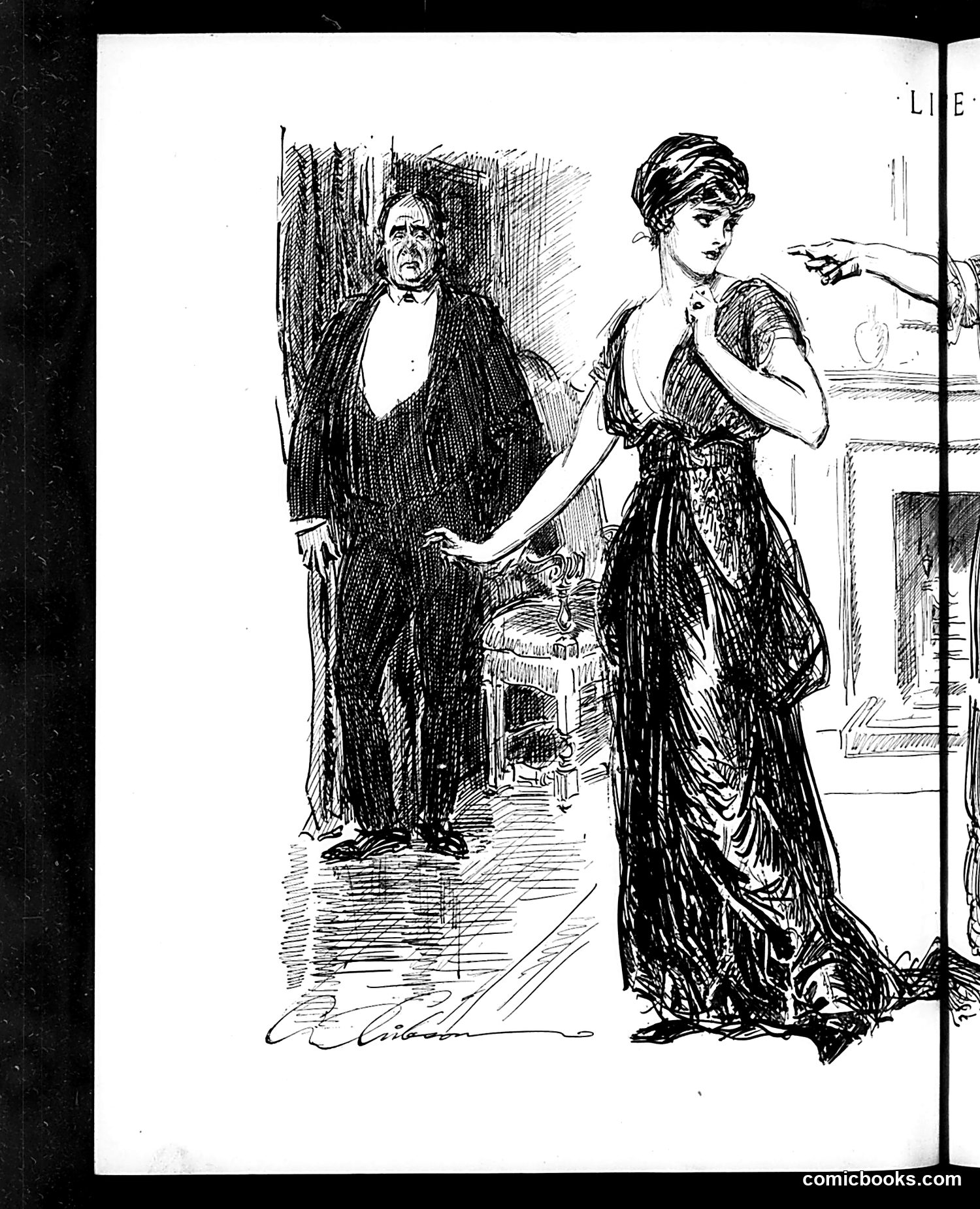
The OCR text is largely illegible, consisting of scattered letters and symbols that don't form coherent words or captions. Based solely on the **image**, this appears to be a satirical sketch depicting two figures in an interior setting: a formally dressed man in evening wear standing behind, and a woman in an elegant gown in the foreground. The woman appears to be gesturing dismissively while looking back at the man. The artistic style and composition suggest social commentary on gender dynamics or interpersonal relations, likely romantic or marital in nature—a common theme in *Life* magazine satire from the early-to-mid 20th century. Without legible text identifying the specific figures or providing context, I cannot definitively state what political or social issue this cartoon addresses.
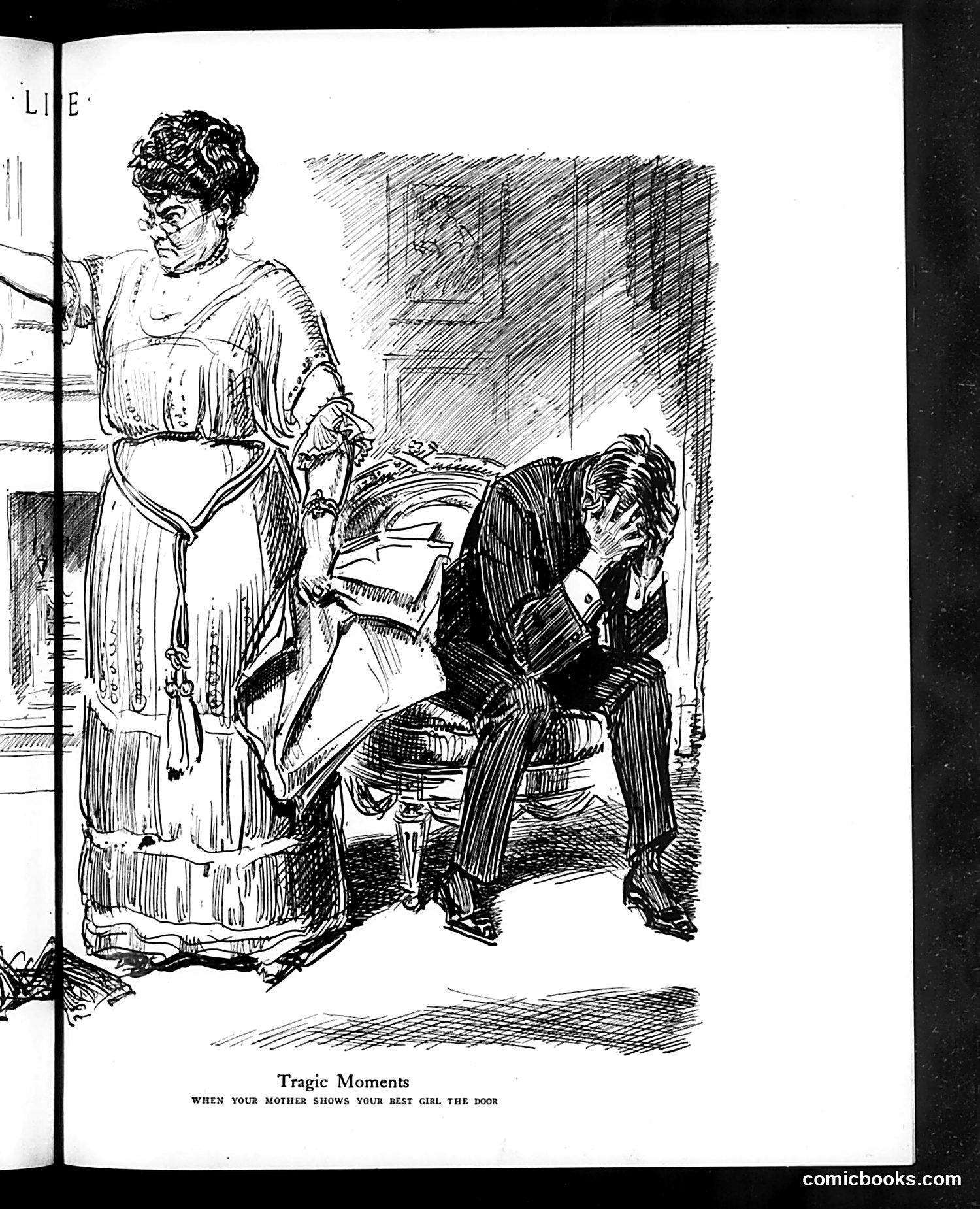
This is a humorous cartoon about social embarrassment. It depicts a young man being shown the door by a woman (presumably his mother), while his "best girl" (romantic interest) witnesses the rejection. The caption's irony is the key: being ejected from someone's home in front of your girlfriend represents a deeply awkward, "tragic" social moment. The joke relies on early 20th-century social conventions where a young man's reputation and romantic prospects depended heavily on maternal approval and proper courtship behavior. The cartoon satirizes this tension—the worst possible timing for parental disapproval is when you're trying to impress a potential partner. The exaggerated body language and expressions emphasize the mortification involved.
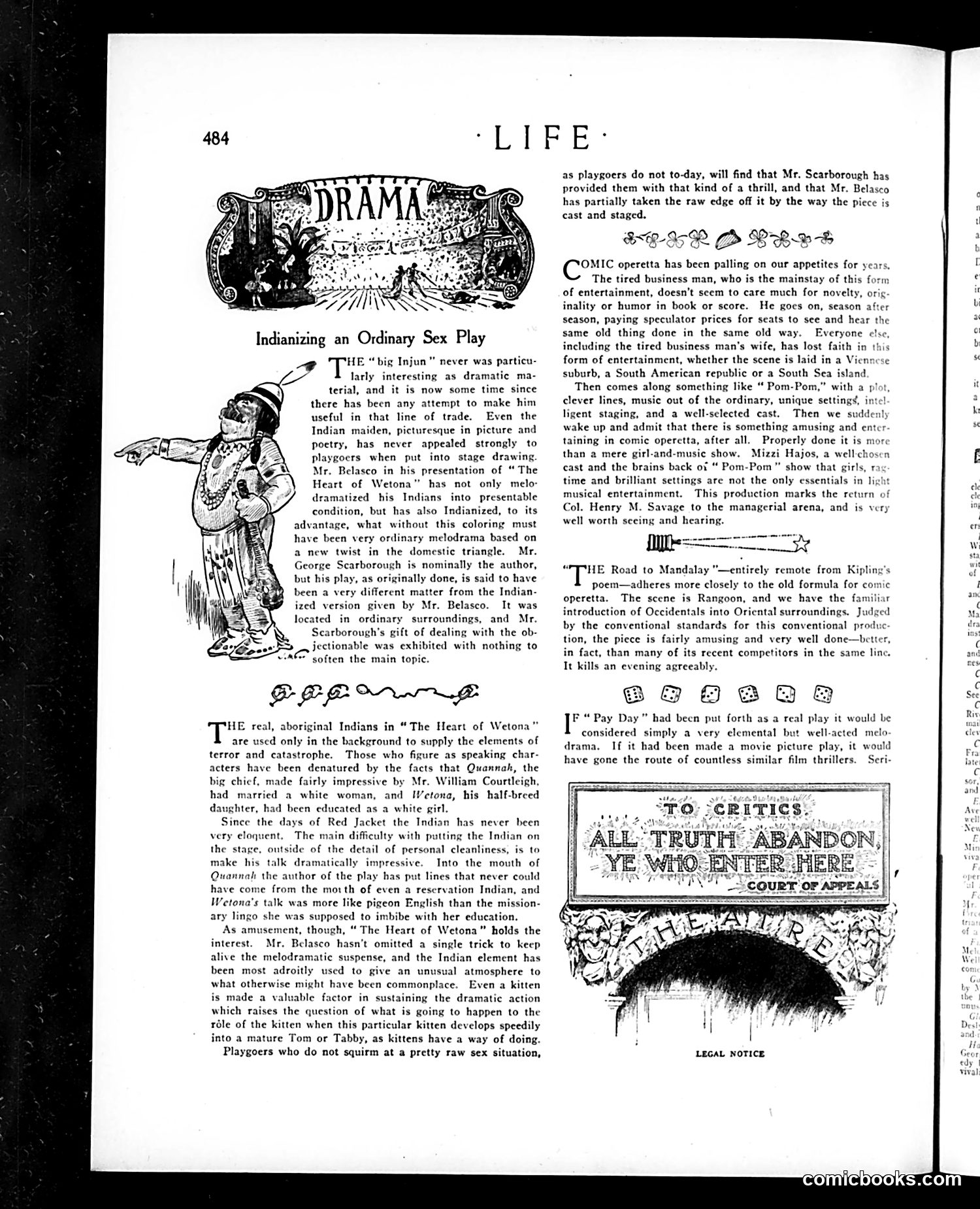
This article reviews David Belasco's theatrical production *"The Heart of Wetona,"* based on George Scarborough's play. The critic argues that Belasco's genius lay in adding Native American setting and characters to what was originally a conventional domestic melodrama—specifically, a story about marital infidelity ("the main topic"). The satire is subtle: the critic notes that standard "sex plays" about adultery had grown tired and crude for audiences. By "Indianizing" the story—adding Native American characters (a half-breed daughter, a chief who married white), scenic spectacle, and dramatic tension—Belasco made the sordid plot palatable and entertaining. The critic points out the irony that authentic Native American dialogue would be dramatically weak, so the playwright gave characters implausibly eloquent lines. Even a kitten factors into the melodrama. The overall point: theatrical dressing can make morally questionable material commercially successful and respectable.
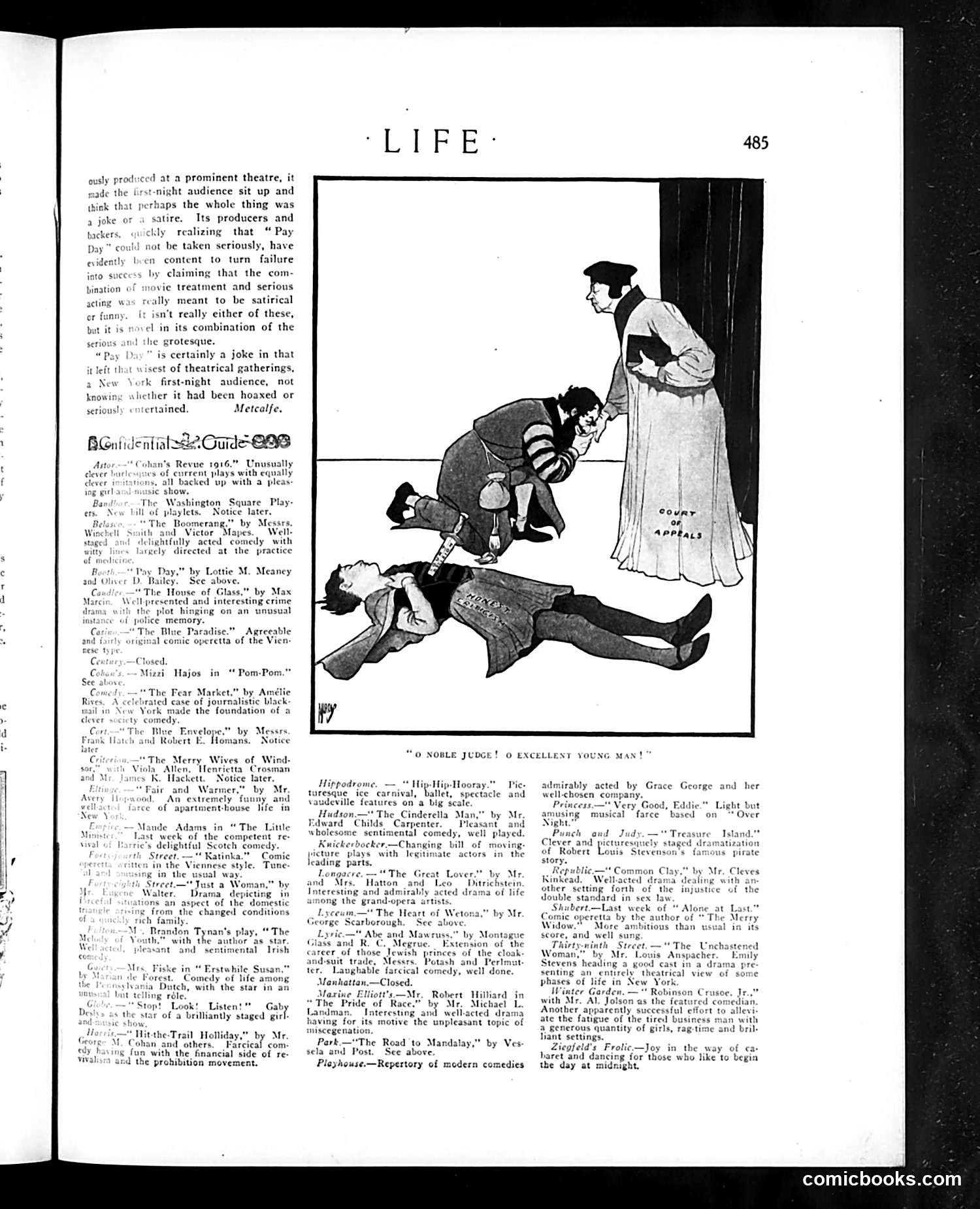
This page is primarily a **theater review section**, not a political cartoon. The dominant image shows a courtroom scene with the caption "O NOBLE JUDGE! O EXCELLENT YOUNG MAN!"—likely illustrating a scene from one of the reviewed plays. The page catalogs current Broadway productions with brief critical assessments. The text discusses "Pay Day," a film-turned-stage production that confused audiences about whether it intended satire or serious drama. Critic Metcalfe notes the producers claimed artistic intent after initial failure, calling the work neither genuinely satirical nor funny, but rather "a combination of the serious and the grotesque." Other reviewed shows include farces, comedies, and dramas typical of 1916 theater—sentimental pieces, musical comedies, and topical plays addressing contemporary social issues like miscegenation and the "double standard in sex law." The courtroom illustration likely represents a dramatic moment from one of these productions rather than serving as independent political commentary.
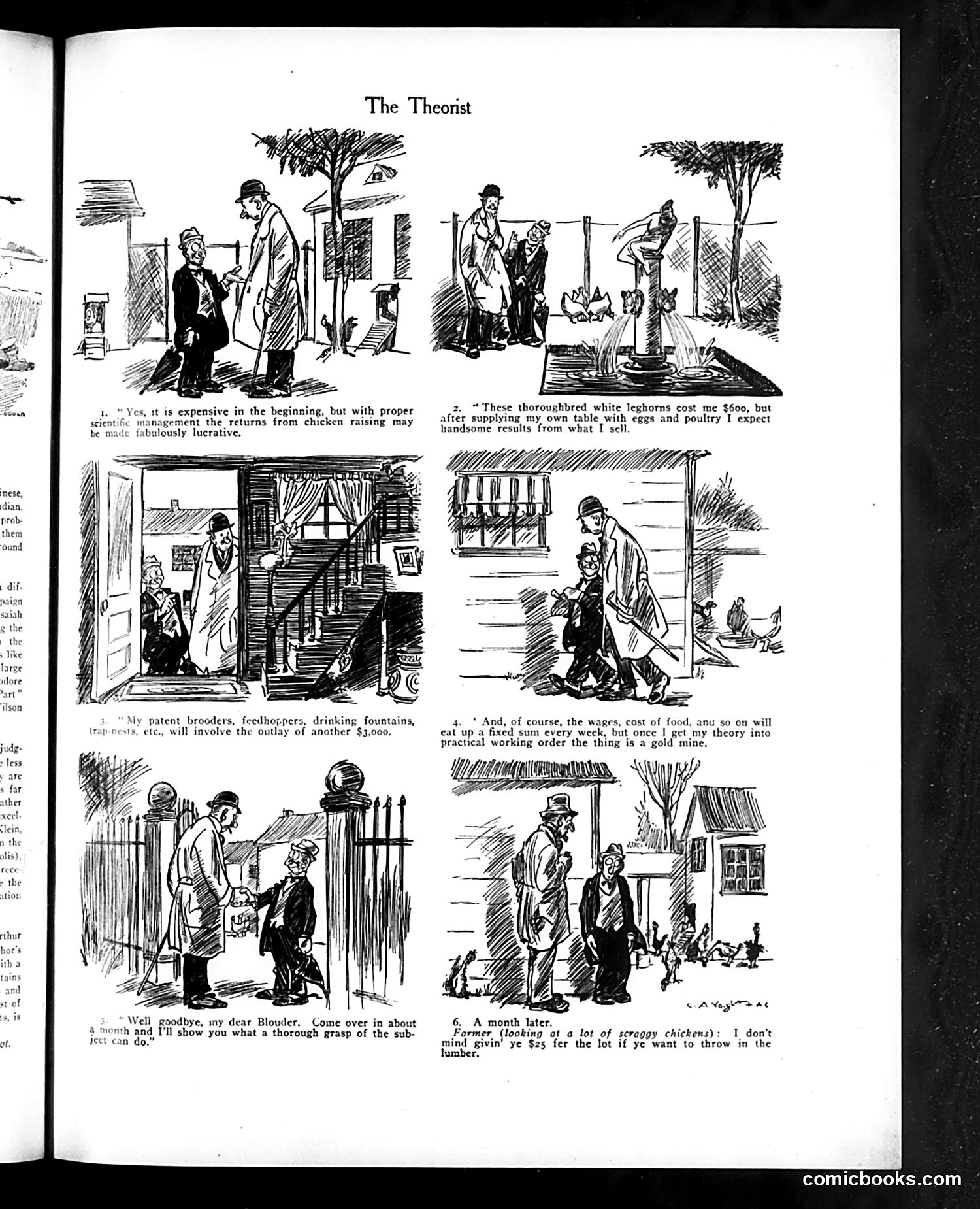
This satirical comic mocks impractical idealists who fancy themselves sophisticated experts without real-world experience. A well-dressed man confidently explains his chicken-farming scheme to a skeptical friend ("Blouder"), citing theoretical profits while casually mentioning massive startup costs ($600 for birds, $3,000 for equipment) and ongoing expenses. The joke: he's all theory, no practice. His grandiose calculations ignore reality—labor, feed, actual yields. One month later, the punchline arrives: his scraggy, worthless chickens fetch only $25, and the farmer suggests throwing in the lumber (the chicken coop itself) just to unload them. The satire targets turn-of-the-century Americans seduced by get-rich-quick schemes and pseudo-scientific management fads, who substitute elaborate planning for honest work and genuine knowledge. The "theorist" represents overconfident incompetence dressed in middle-class respectability.
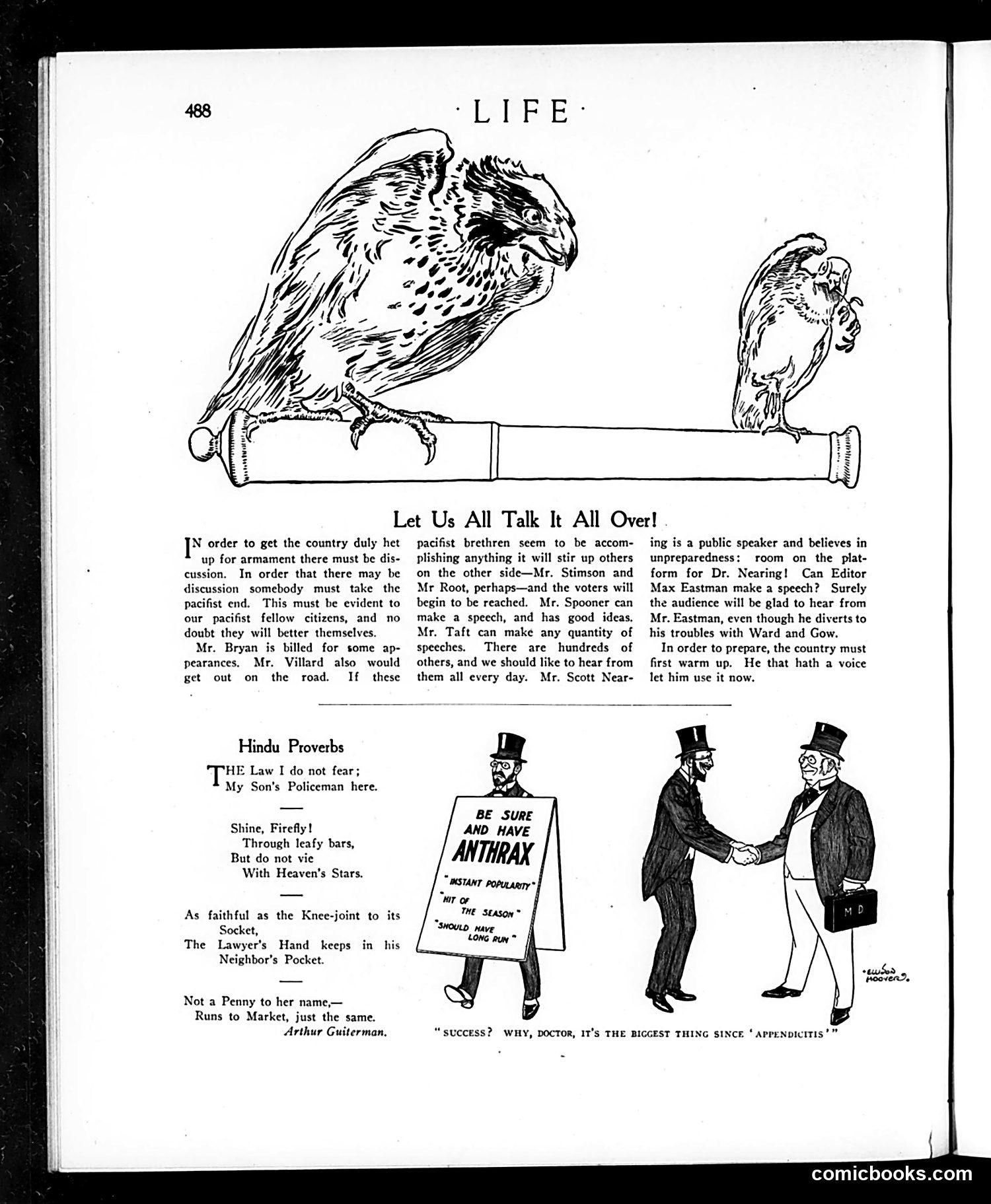
**Top Cartoon:** An illustration of two parrots on a perch satirizes calls for national "discussion" about military preparedness. The text argues that pacifists like William Jennings Bryan and Oswald Garrison Villard should publicly debate armament advocates (Stimson, Root, Taft, Spooner) to stir public engagement. The parrot imagery suggests this manufactured debate is mere repetitive squawking rather than substantive discourse. **Bottom Cartoon:** A doctor promotes "Anthrax" as a medical fad, claiming it's "the biggest thing since appendicitis." Two men in top hats (likely politicians or businessmen) celebrate its "success." This satirizes how serious issues—here, disease—become trendy talking points divorced from genuine concern, mirroring the top cartoon's critique of performative political debate. **Hindu Proverbs section:** Cynical aphorisms about power, corruption, and inequality serve as sardonic commentary on American society. The page's overall message: public discourse about armament is superficial theater, not serious policy deliberation.
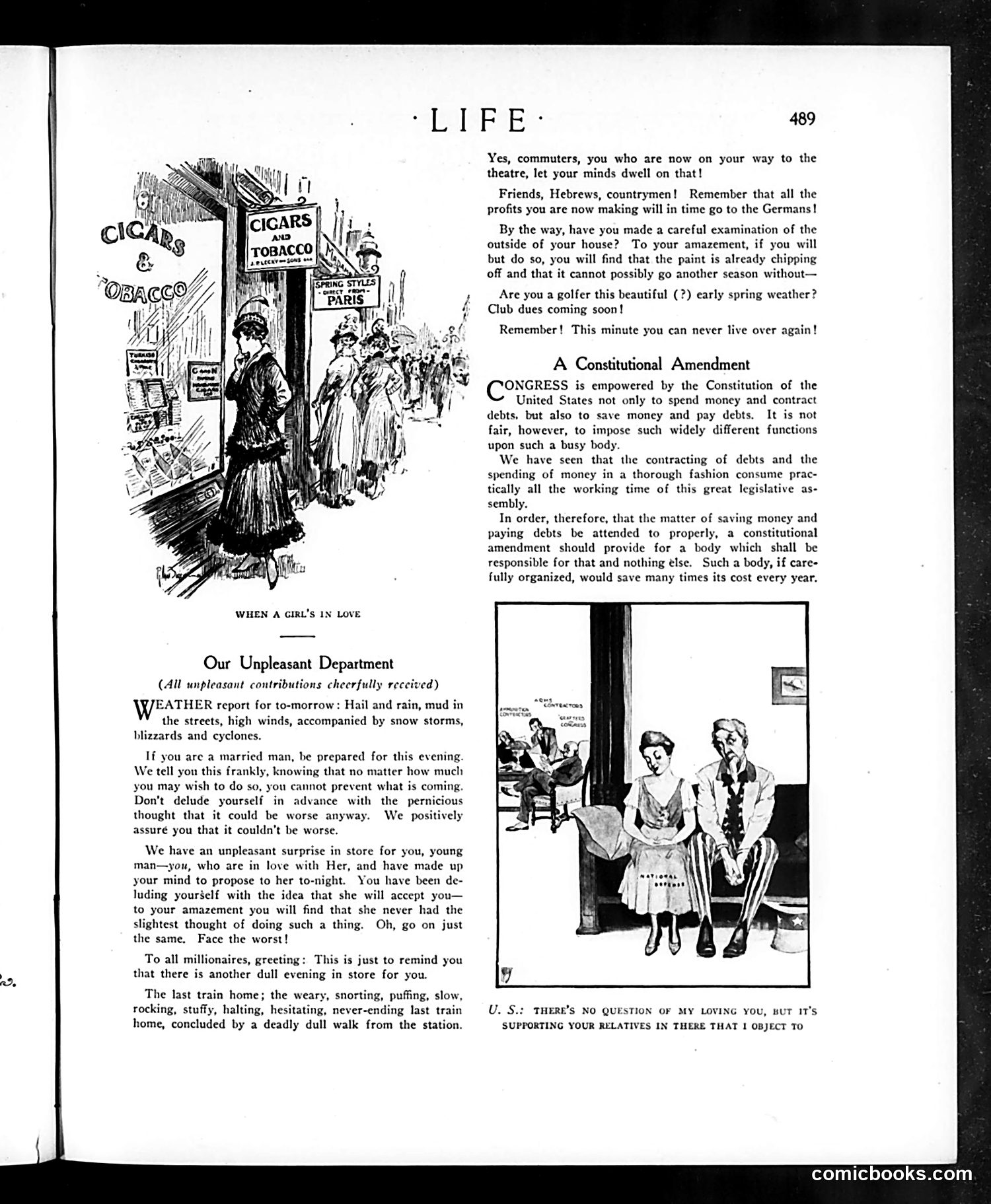
This page contains satirical humor targeting early 20th-century American anxieties. "Our Unpleasant Department" mocks various social groups with darkly comic predictions: married men face domestic troubles; young lovers will be rejected; commuters endure tedious train rides; millionaires face boredom; golfers face upcoming club dues. The tone is deliberately pessimistic, presenting life's minor frustrations as inevitable. The political cartoon below depicts a domestic dispute where a man objects to supporting his wife's relatives—a commentary on marriage financial burdens and family obligation tensions of the era. "A Constitutional Amendment" section satirizes Congress's poor fiscal management, proposing a separate governmental body dedicated solely to saving money and paying debts, implying Congress wastes resources on spending rather than financial responsibility. The cigar shop sketch ("When a Girl's in Love") likely illustrates romantic misadventure, though details are unclear from reproduction quality.
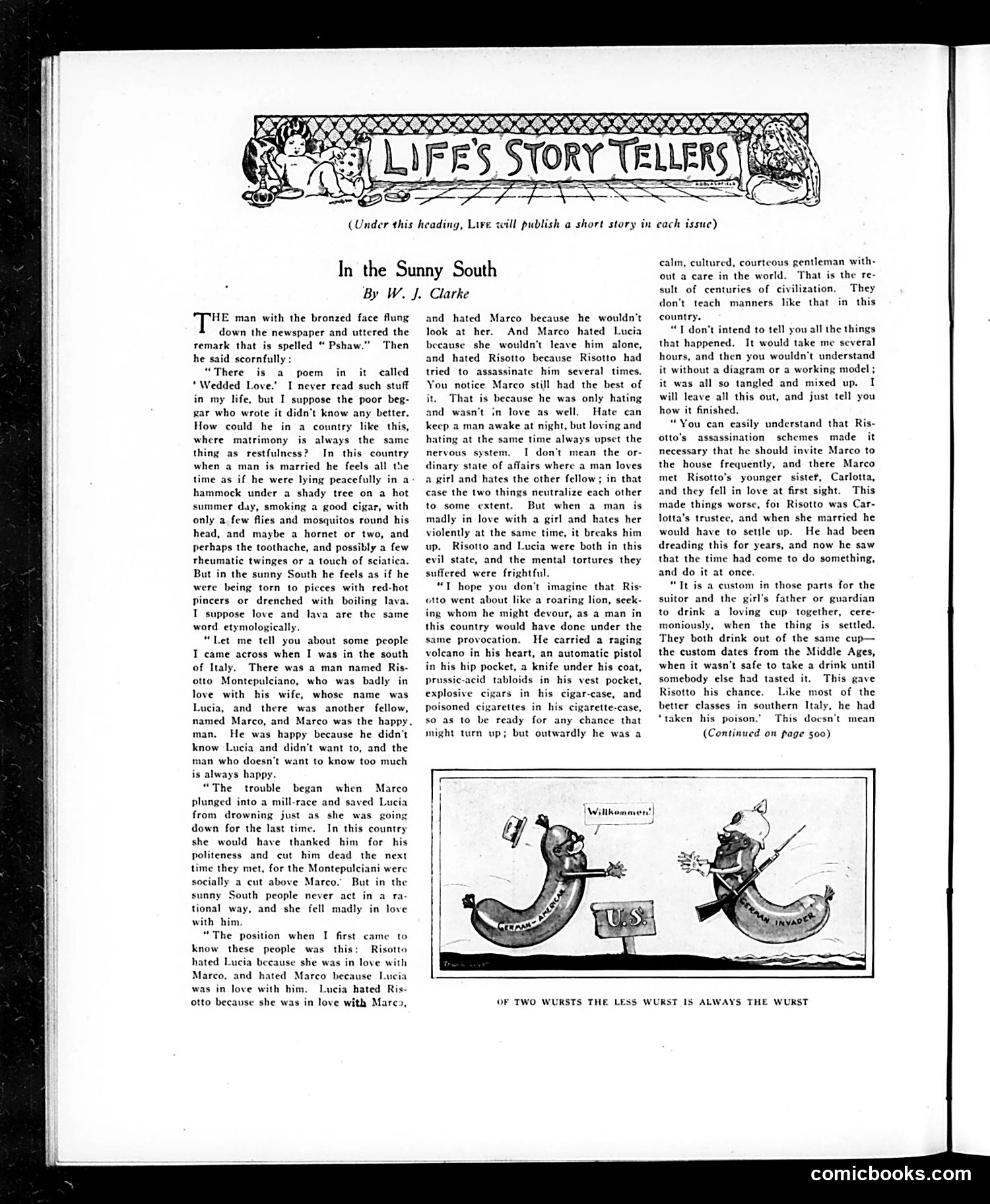
This page contains the opening of a satirical short story titled "In the Sunny South" by W. J. Clarke, published in *Life* magazine's "Life's Story Tellers" section. **The Satire:** The story mocks romantic passion and Southern European temperament through exaggerated contrast. An American narrator describes Italian characters (Risotto, Lucia, Marco) whose passionate love-hate entanglements involve carrying weapons—pistols, knives, poison tablets, and explosives—yet maintaining outward civility. The joke hinges on the absurd contradiction: these people harbor murderous intentions while presenting themselves as cultured gentlemen. **The Point:** The satire critiques both Southern European "irrationality" and American complacency. Americans, the narrator suggests, view marriage as peaceful domesticity (hammocks, cigars, minor annoyances like mosquitoes). Southerners, by contrast, experience marriage as violent chaos—yet civilization forces them to hide it. The cartoon below (showing two competing sausages) reinforces this: "Of two wursts the less wurst is always the wurst"—a pun suggesting that comparing bad options produces absurd results.
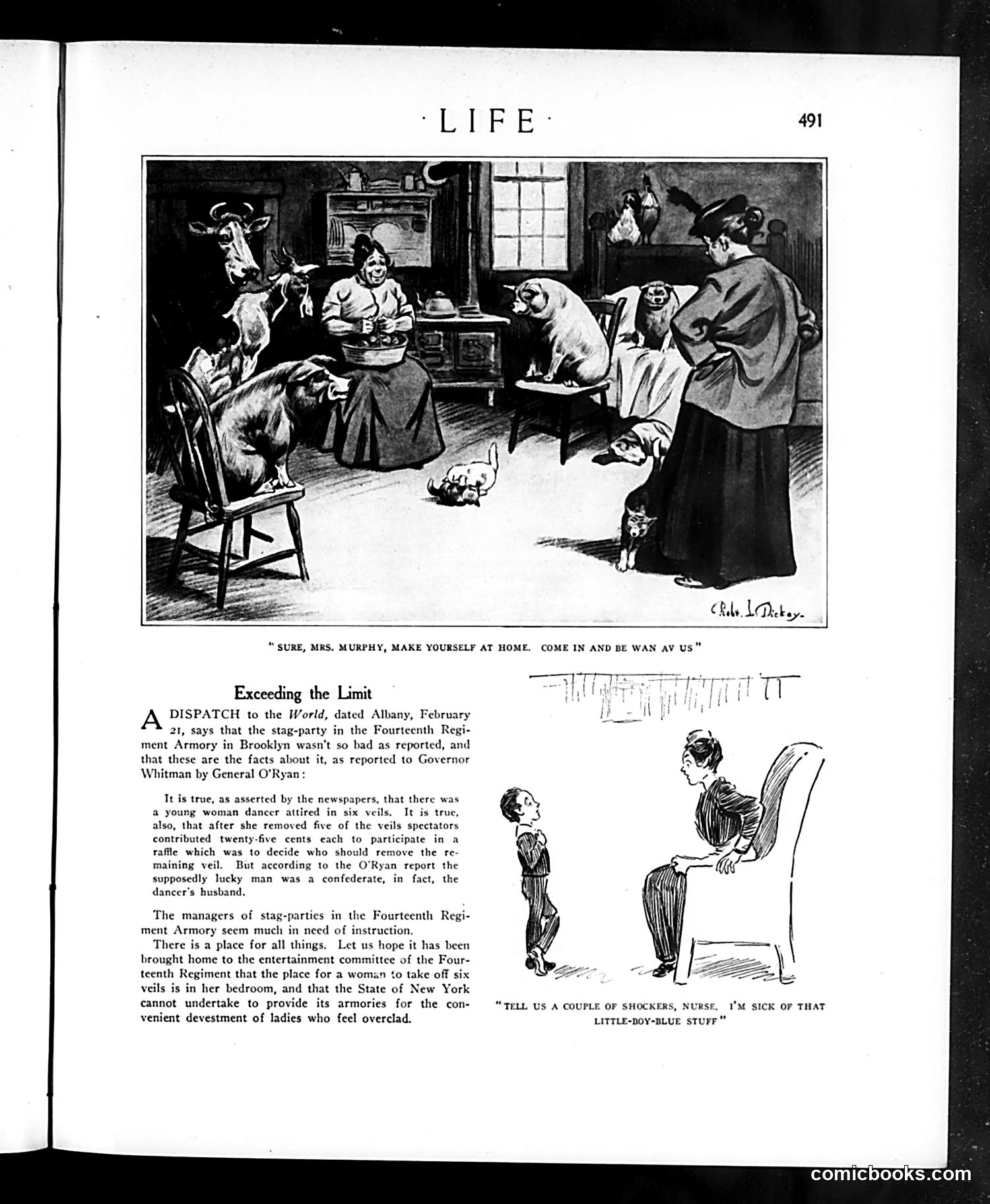
This satirical piece mocks a scandal at the Fourteenth Regiment Armory in Brooklyn involving a stag party (all-male entertainment event). A young female dancer performed a strip-tease act, removing five of six veils while spectators paid to raffle for who would remove the final veil. The "lucky winner" was revealed to be the dancer's own husband—a setup that Life ridicules as a confidence scheme. The satire targets both the event's impropriety and the official response. Governor Whitman and General O'Ryan apparently investigated and downplayed the incident's severity. Life sarcastically criticizes the military's use of public armories for such entertainment, arguing there are proper places (bedrooms, not government facilities) for women to undress. The second cartoon shows a nurse dismissing a patient's request for "little-boy-blue stuff"—likely referring to wholesome nursery rhymes, suggesting the page's broader theme: that propriety and decorum have limits being exceeded in public life.
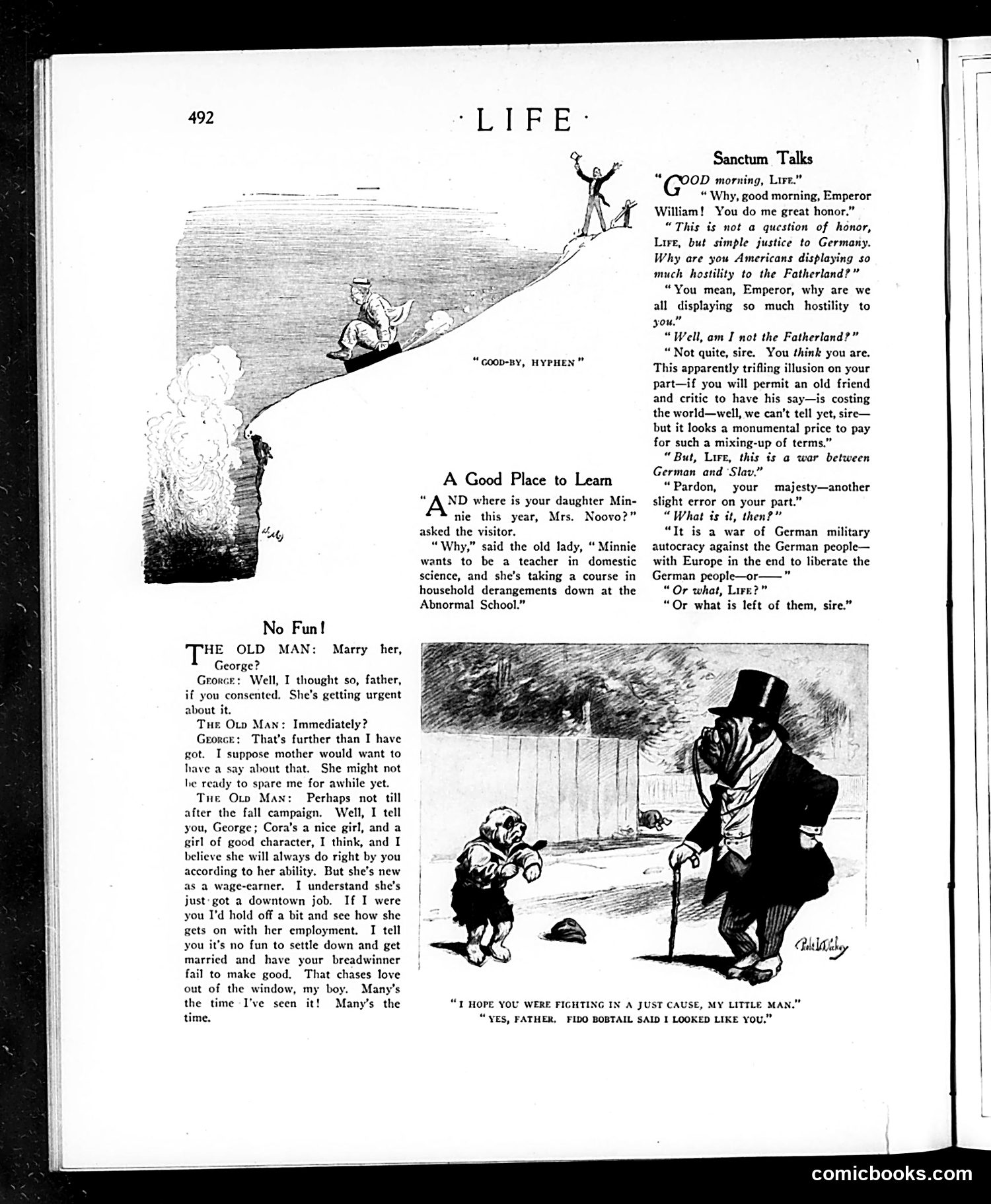
This page contains three satirical pieces from WWI-era Life magazine: **"No Fun!"** depicts an old man advising his son George against marrying Cora immediately. The father warns that marrying before a woman establishes financial stability is foolish—he's seen love destroyed when breadwinners fail. This reflects anxieties about women entering the workforce and economic uncertainty during wartime. **"A Good Place to Learn"** is a brief joke mocking progressive education: a mother reports her daughter attends a course in "household derangements" at the "Abnormal School"—satirizing newfangled domestic science education as chaotic and abnormal. **"Sanctum Talks"** features a conversation between "Life" (the magazine personified) and "Emperor William" (Germany's Kaiser Wilhelm II). Life accuses him of causing WWI while claiming to represent Germany itself. Life argues this is actually a war of "German military autocracy against the German people," with Europe fighting to liberate Germans. This directly critiques German militarism and autocracy as the war's true cause—not national conflict but authoritarian oppression.
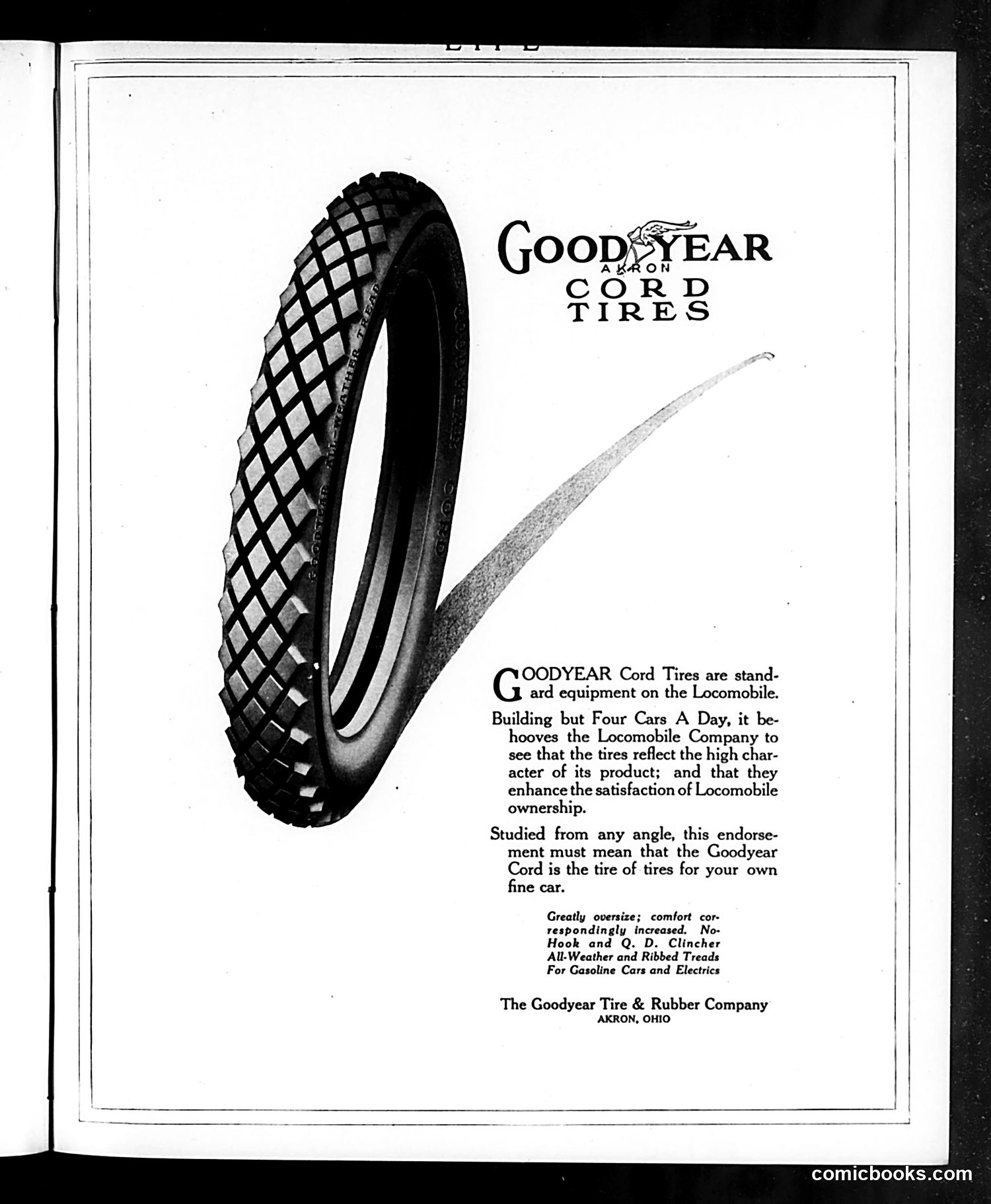
This is a **Goodyear tire advertisement**, not a political cartoon. The page promotes Goodyear Cord Tires by emphasizing their use as standard equipment on the Locomobile, a luxury automobile manufacturer. The advertisement's strategy is to leverage the Locomobile's prestige—notably that it builds "but Four Cars A Day," suggesting exclusivity and quality—to endorse Goodyear tires. The text argues that because Locomobile is selective about components, Goodyear's choice reflects the tire's superiority. The large tire image displays the diagonal cord construction and tread pattern. Features listed include "All-Weather and Ribbed Treads / For Gasoline Cars and Electrics," indicating this is from the early automobile era when electric vehicles were still competitive. This appears from a circa 1910s-1920s Life magazine issue and represents straightforward commercial promotion rather than satirical content.
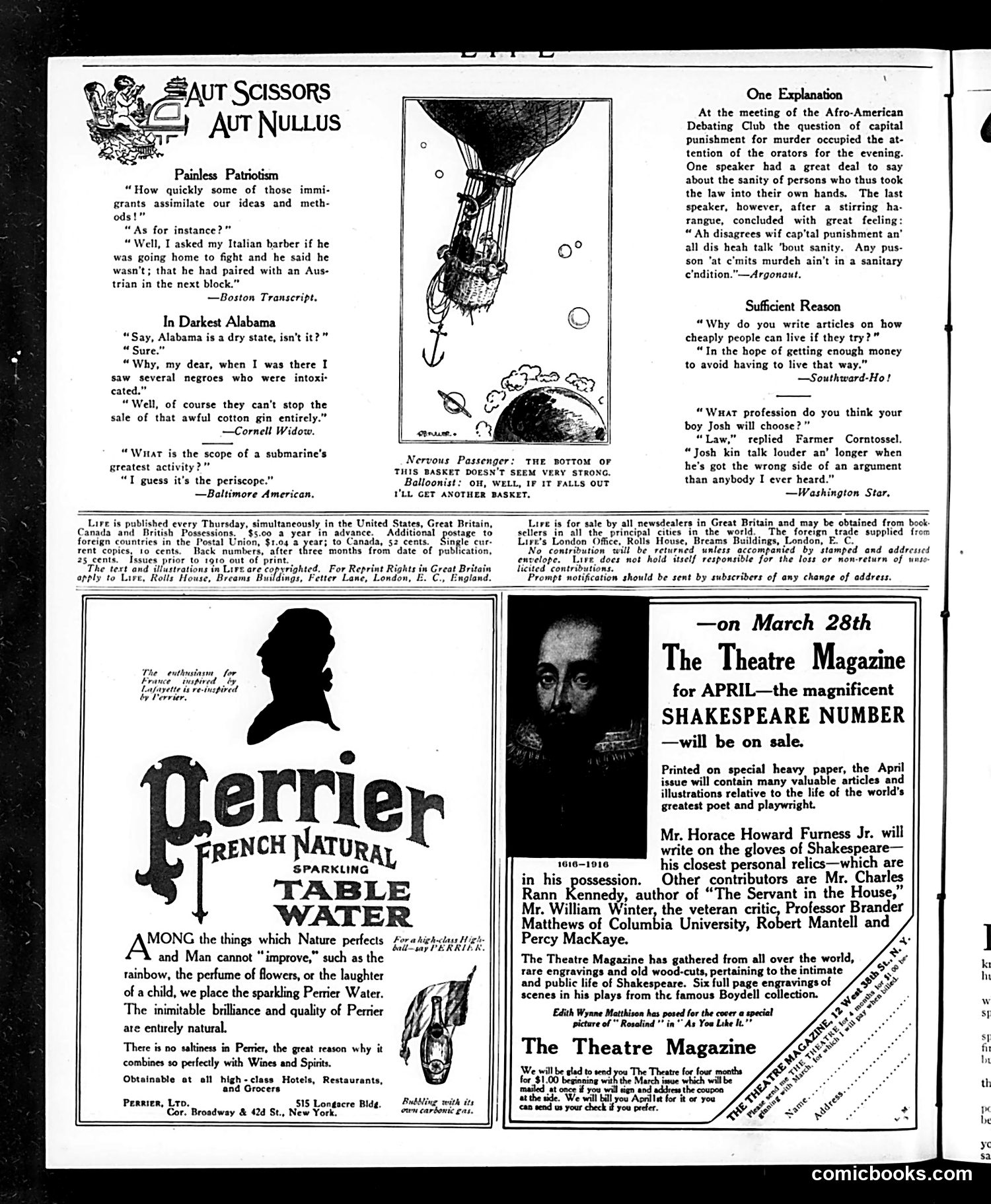
This page from *Life* magazine (a satirical weekly) contains brief humorous anecdotes and advertisements, typical of early 20th-century American humor publications. ## The Humor Pieces The jokes address contemporary social anxieties: - **"Painless Patriotism"**: A joke about Italian immigrants assimilating American values—specifically, adopting American business practices (like partnerships) rather than returning to fight in WWI. - **"In Darkest Alabama"**: Racial humor exploiting dialect stereotypes. It jokes about illegal alcohol sales in a "dry state" (Prohibition-era reference), using crude caricature of Black speech. - **Capital Punishment debate**: A satirical piece mocking dialect speech in an African-American debating club, presenting malapropism as humor. The remaining items are brief jokes about submarines, cost-of-living articles, and a balloon accident—standard magazine filler. ## Advertising Half the page contains upscale product ads (Perrier water, Theatre Magazine's Shakespeare issue), targeting affluent readers. **Overall**: This reflects early-20th-century American magazine humor relying heavily on ethnic and racial stereotypes now recognized as offensive.
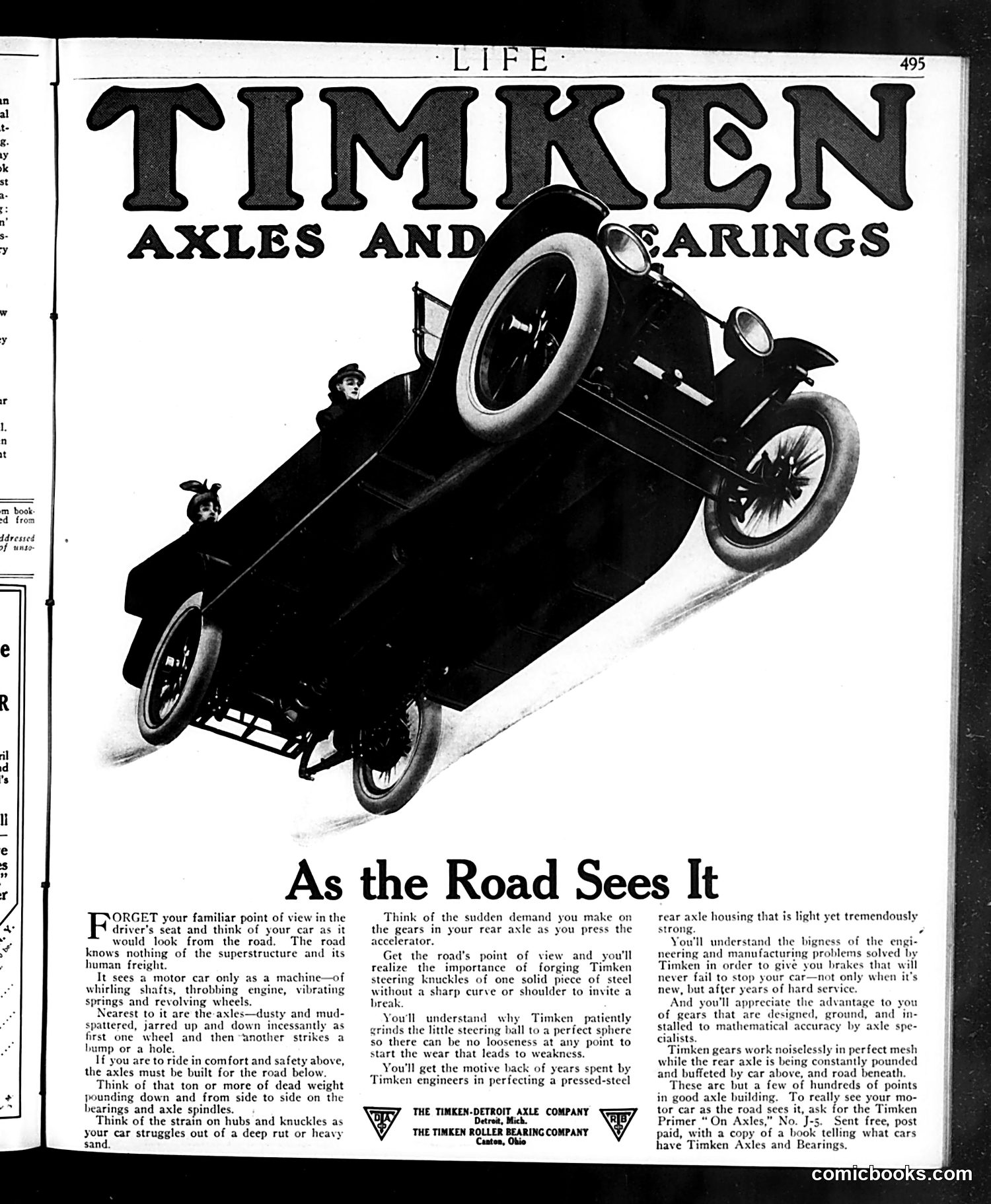
This is **not a cartoon or satire**—it's a full-page **automobile parts advertisement** from Life magazine (page 495). The image shows a car tilted dramatically on an incline, with two figures clinging to it, illustrating the stress placed on axles during driving. The headline "As the Road Sees It" frames the ad's central pitch: perspective matters. The advertisement uses engineering-focused rhetoric to convince readers that **Timken axles and bearings** are superior. It asks drivers to imagine their car "as the road knows it"—not as a passenger vehicle but as a machine subjected to constant mechanical strain: pounding, jarring, turning, and braking. The copy emphasizes Timken's technical advantages: one-piece forged steel knuckles, precision-ground spheres, and mathematically accurate gears. It concludes with a call-to-action offering a free technical primer. This represents early 20th-century automotive marketing that appeals to (male) readers' desire to understand mechanical sophistication.
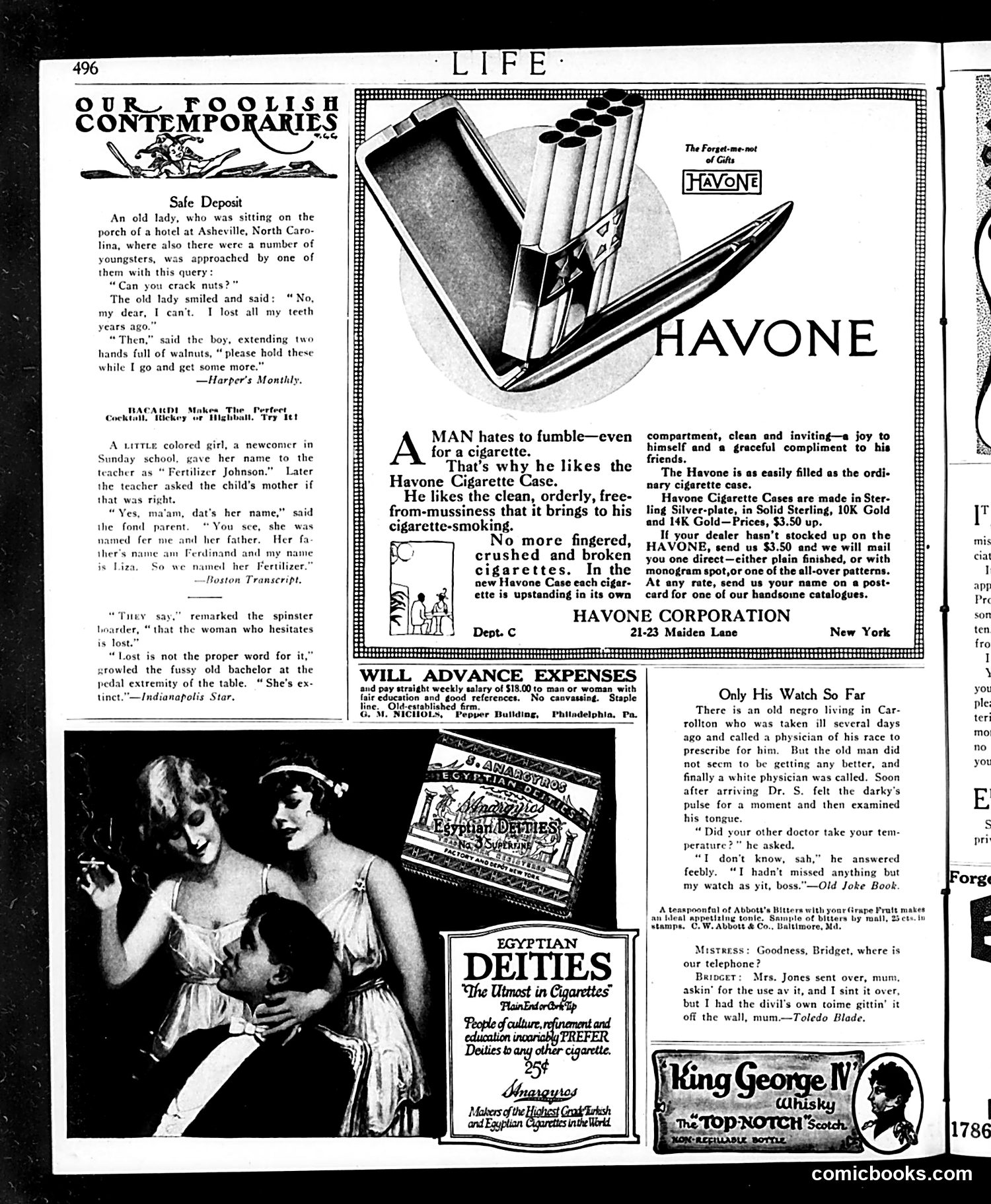
This page contains **several short humorous anecdotes** rather than political cartoons. The jokes satirize early 20th-century social stereotypes: 1. **"Safe Deposit"**: An elderly woman's absent teeth are mocked when a boy tricks her into holding walnuts while he fetches more—implying she's gullible and physically diminished. 2. **"Fertilizer Johnson"**: A Black child is named after her mother Liza and father Ferdinand, creating the unfortunate surname "Fertilizer"—humor based on racial caricature and malapropism. 3. **"Only His Watch So Far"**: A Black man visits two doctors but only notices his watch missing, implying theft or carelessness. The dialect humor reinforces period stereotypes. The page is primarily **advertising** (Havone cigarette cases, Egyptian Deities cigarettes, King George whiskey), with these brief jokes interspersed. The humor relies on physical disability, racial stereotypes, and dialect comedy—conventions considered acceptable in 1920s American magazines but reflecting deeply prejudiced attitudes.
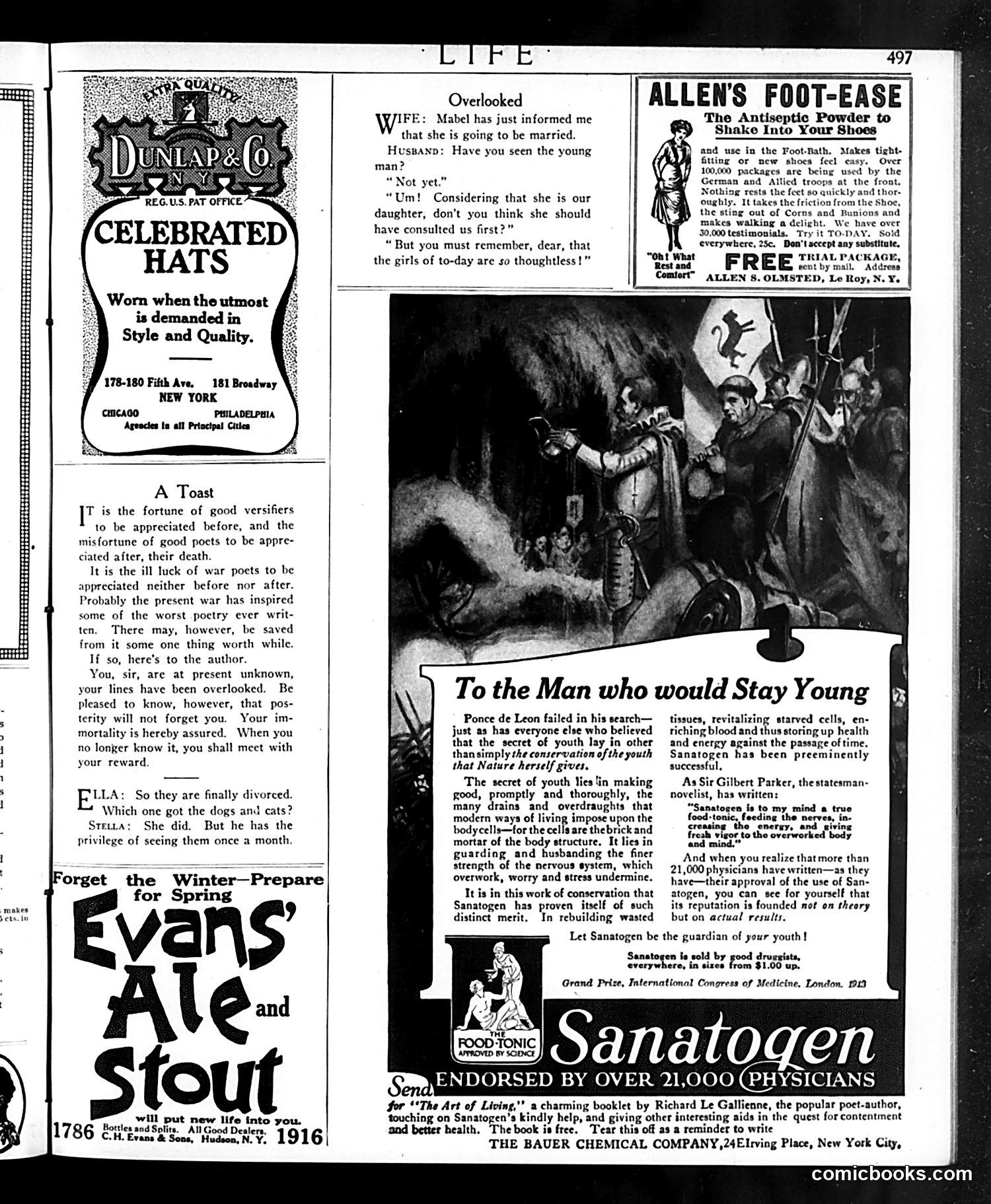
This page combines short comedic sketches with period advertisements. **"Overlooked"** is a brief domestic comedy: a husband expresses surprise that his daughter is marrying without consulting her parents first. The wife's response—that modern girls are "thoughtless"—is the joke's punchline, suggesting generational anxiety about young women's independence and changing social norms around courtship and parental authority. **"A Toast"** is a short verse tribute to unknown war poets, lamenting that poets of WWI (which was ongoing when this was published) receive neither contemporary nor posthumous recognition, unlike "good versifiers." The **"Ella"/"Stella" dialogue** jokes about divorce custody: in a settlement, the wife kept the pets but the husband retains visitation rights—a wry observation on modern marital dissolution. The page is primarily filled with period **advertisements**: Dunlap hats, Allen's Foot-Ease powder (marketed to soldiers), Evans Ale, and Sanatogen (a patent tonic claiming to restore youth, endorsed by 21,000 physicians). These ads reflect early 20th-century consumer culture and WWI-era marketing.
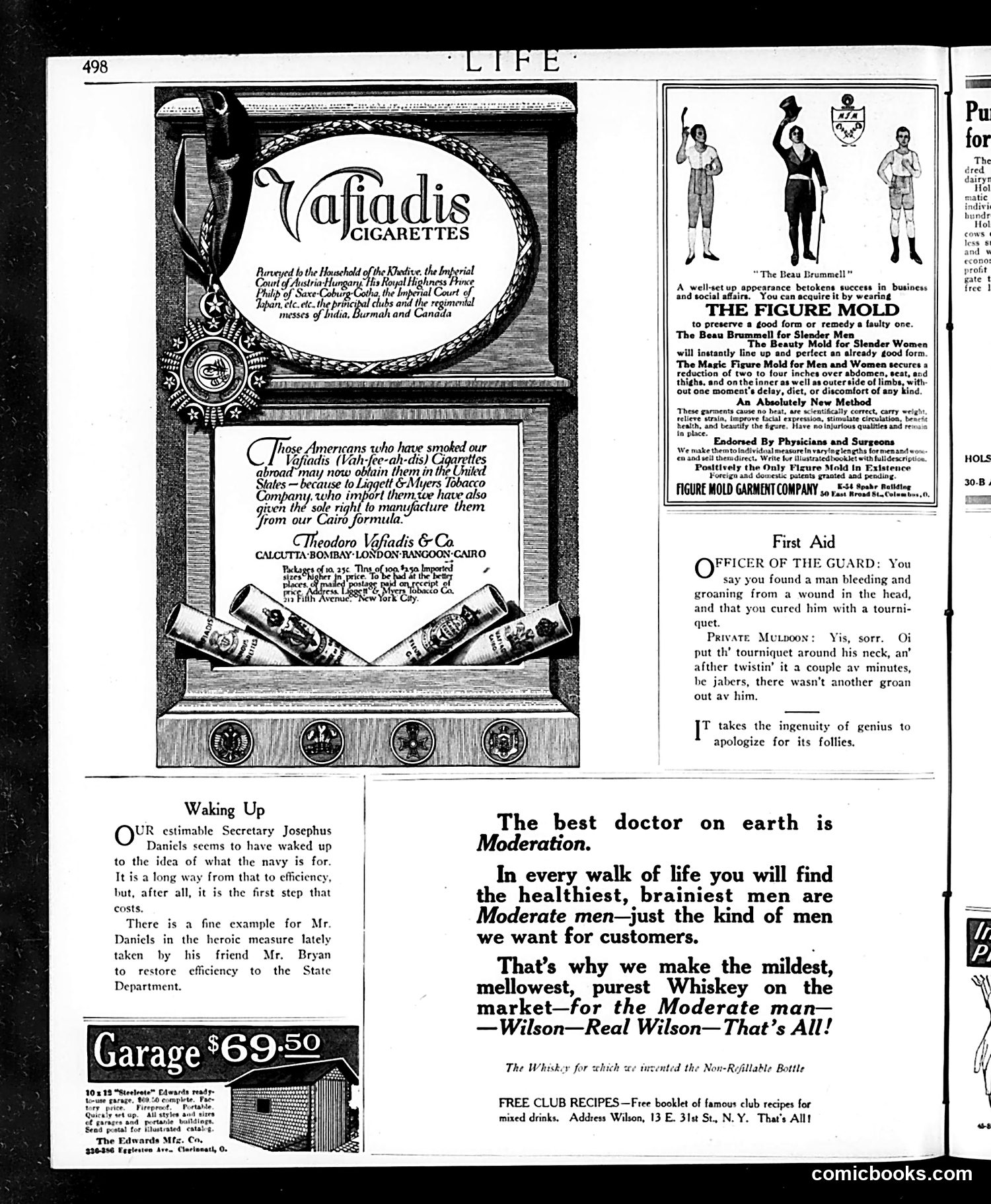
This page is primarily **advertising**, mixing commercial promotions with satirical editorial content typical of Life magazine's format. The main satire appears in the **"First Aid" dialogue**, which mocks military incompetence. A Private Mulroon describes "curing" a wounded soldier by applying a tourniquet around his *neck*—effectively strangling him into silence rather than treating his head wound. The joke criticizes the brutality and absurdity of military medicine and discipline. The editorial piece **"Waking Up"** references Secretary Josephus Daniels and his friend Mr. Bryan, suggesting Daniels was slow to recognize the Navy's purpose and needed prompting toward efficiency reforms. The remaining content consists of period advertisements: Vafiadis cigarettes (imported from Cairo), a "Figure Mold" garment company (corset-like devices), a garage, and Wilson whiskey marketed toward "Moderate men." The whiskey ad ironically emphasizes moderation while promoting alcohol consumption—typical early 20th-century marketing paradox.
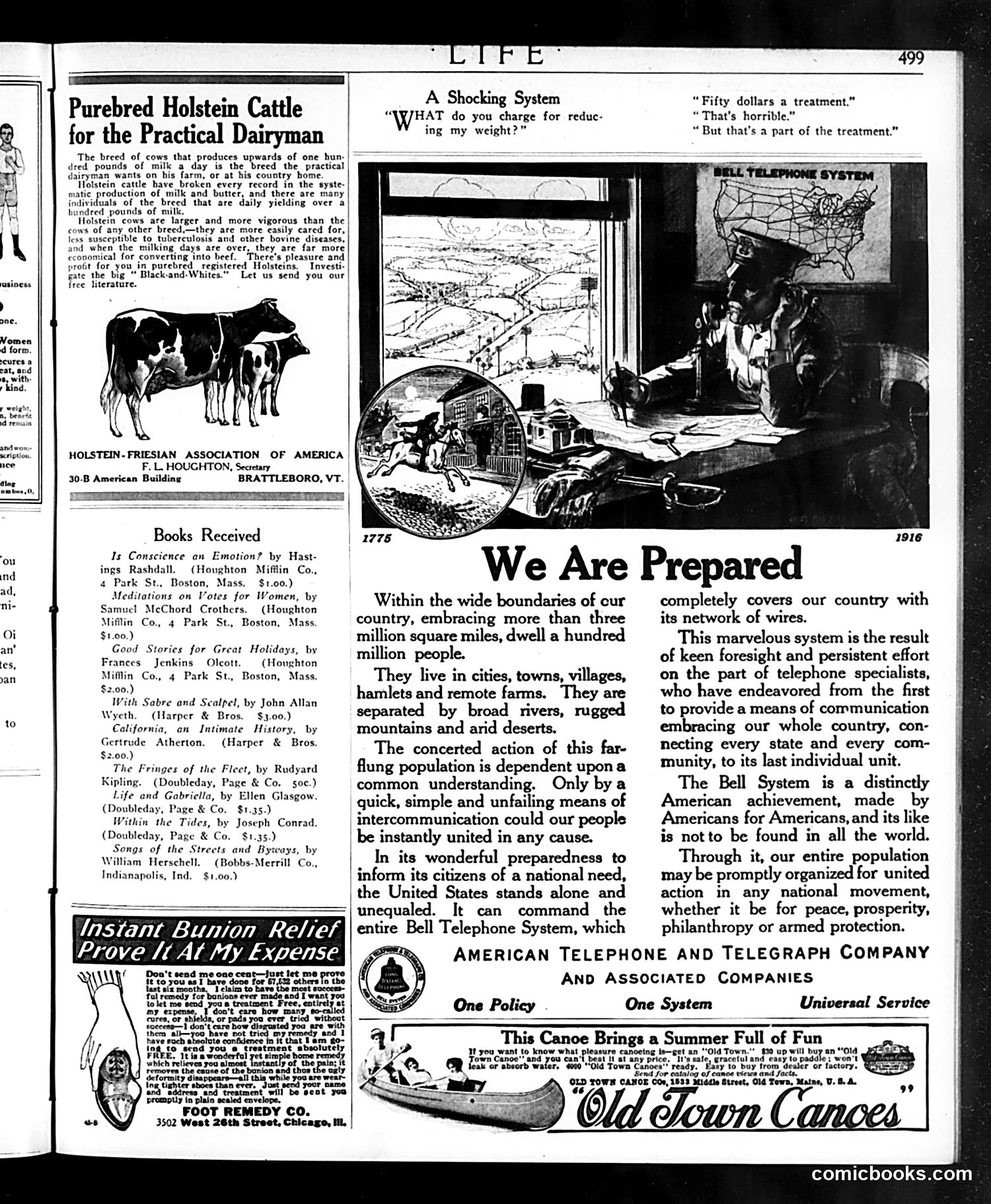
This page is primarily **advertising content** with minimal editorial material. The main cartoon—"A Shocking System"—presents a brief joke about a weight-reduction treatment costing fifty dollars per session. The humor is simple: when the client protests the price as "horrible," the doctor claims it's "part of the treatment," implying the shock or distress of the bill itself aids weight loss. The page's dominant feature is a lengthy **Bell Telephone System advertisement** emphasizing national preparedness and unified communication across America's vast geography. The ad uses patriotic language to frame telephony as distinctly American infrastructure capable of organizing the entire population for national causes. Supporting content includes book advertisements (Holstein cattle breeding, bunion relief) and a list of recently published books—typical Life magazine filler from this era (circa 1916, based on visual dating). The page reflects early 20th-century advertising culture where corporate messaging dominated popular magazines.
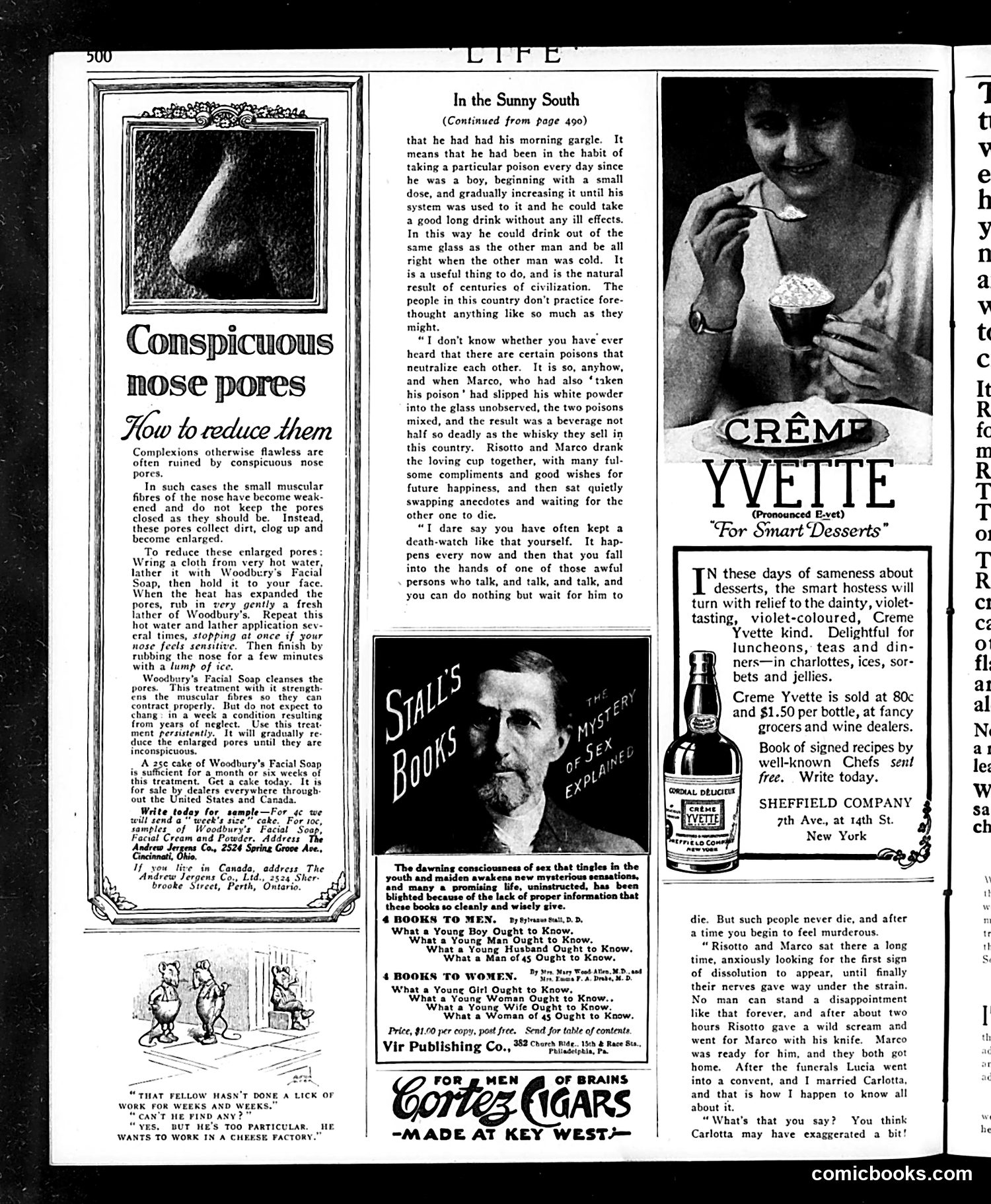
This page is primarily **advertising and serialized fiction** rather than political satire. The dominant feature is a **Woodbury's Facial Soap advertisement** about reducing enlarged nose pores—a "conspicuous" beauty flaw. The text ironically invokes pseudo-scientific medical treatment involving hot water and repetitive lathering to strengthen "muscular fibres." Below that is a **Vir Publishing book advertisement** hawking instructional titles for various life stages ("What a Young Boy Ought to Know," etc.)—likely early sex-education or self-improvement guides sold through mail order. The page also continues serialized fiction called "In the Sunny South," describing a plot involving poisoners trading drinks. There are **no political cartoons** on this page. The small cartoon at bottom ("That fellow hasn't done a lick of work...") appears to be generic workplace humor, unrelated to current events. **Notable for modern readers:** Early 1900s advertising casually marketed questionable remedies and potentially exploitative "self-help" books to vulnerable audiences.
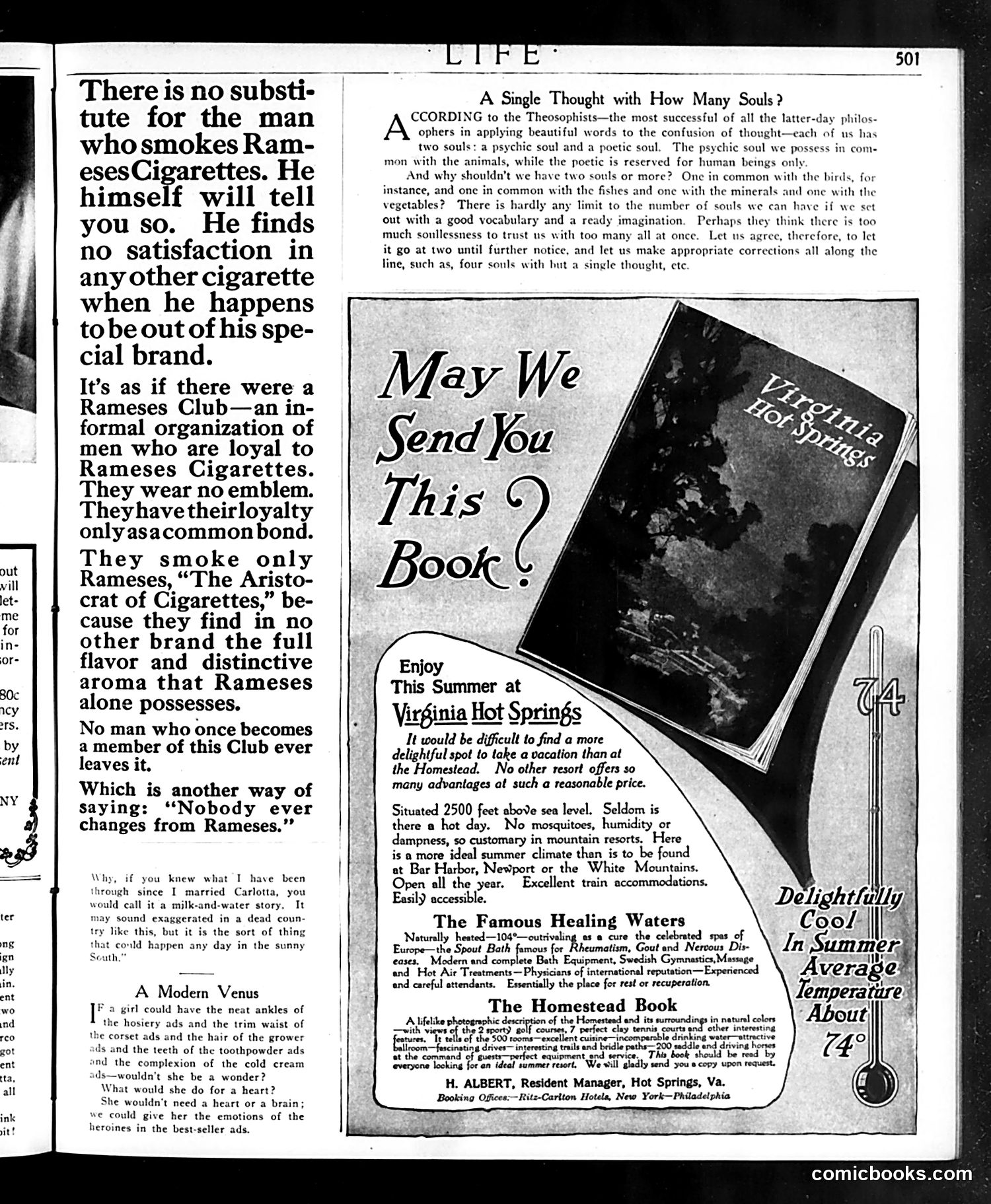
This page contains **advertisements and satirical commentary**, not political cartoons. The **left column** satirizes cigarette brand loyalty through the concept of a "Rameses Club"—an informal organization of men so devoted to one cigarette brand they never switch. The satire mocks both blind consumerism and masculine group conformity based on commercial product preference rather than genuine shared values. Below that, "A Modern Venus" satirizes advertising culture itself, imagining a woman assembled entirely from different beauty product advertisements—perfect ankles, waist, hair, teeth, and complexion. The joke's punchline critiques how advertisers reduce women to body parts while ignoring their intellect or character. The **right side** contains philosophical satire on Theosophy (a popular spiritual movement) and its claim that humans have multiple souls. The piece mocks the vagueness of such metaphysical claims by suggesting if two souls are plausible, why not many more? The **bottom half** is a **genuine advertisement** for Virginia Hot Springs resort, featuring travel information and promotional text.
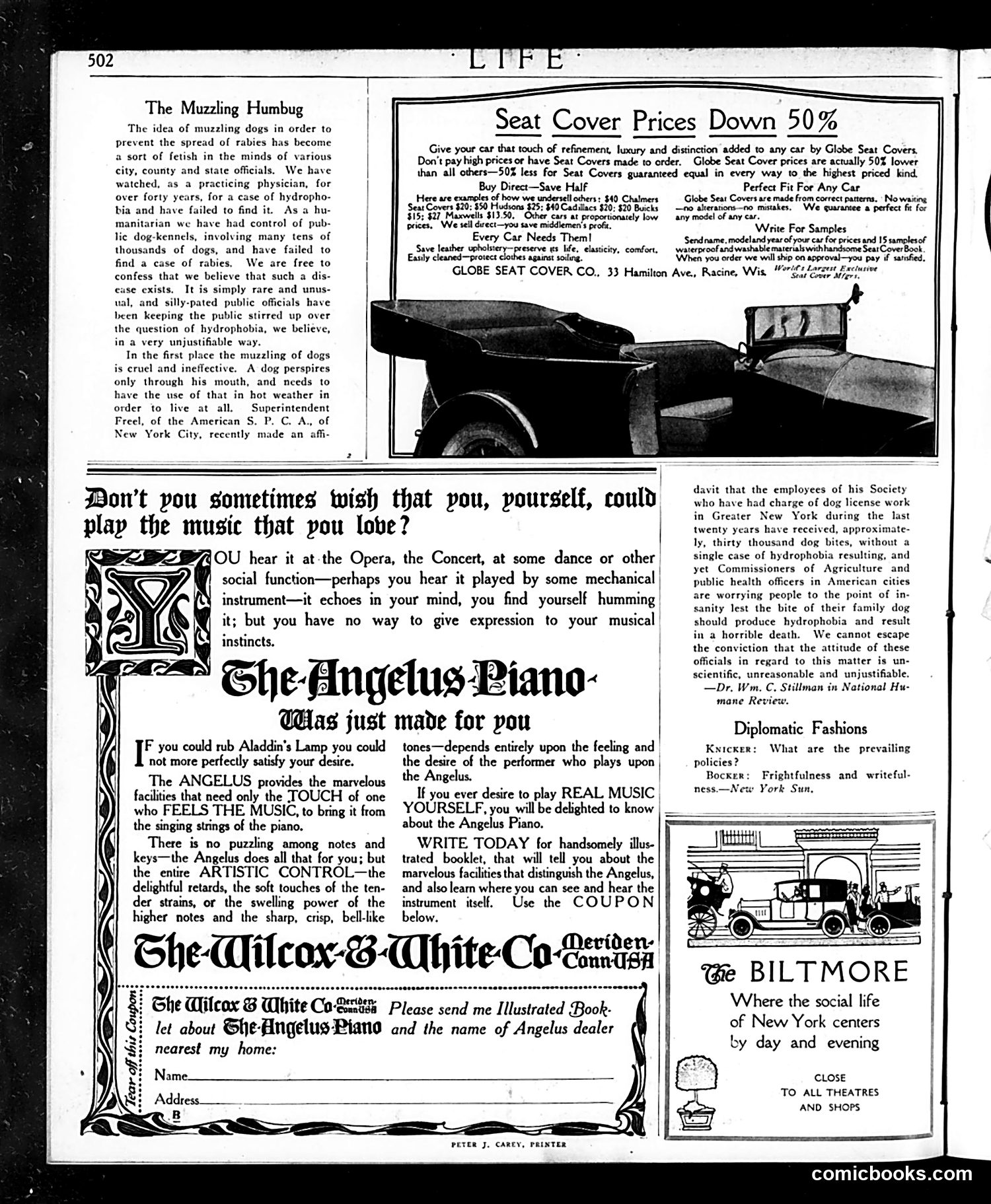
**"The Muzzling Humbug"** is an opinion piece criticizing mandatory dog muzzling laws. A physician argues that rabies is extremely rare (he claims not to have encountered it in 40 years of practice), making muzzling policies an overreaction driven by public hysteria rather than scientific fact. He contends muzzling is cruel—dogs need mouth access to cool themselves in heat—and cites the American SPCA superintendent's affidavit: 30,000 dog bites in New York with zero resulting rabies cases, suggesting officials are needlessly alarming the public about a non-existent threat. The piece reflects early-20th-century skepticism toward public health regulations, presenting this as "silly-pated officials" manufacturing fear. Modern readers should note: rabies is actually fatal once symptomatic, making prevention (including muzzling) medically justified—the author's statistics, while intriguing, don't negate the disease's danger. The rest of the page contains advertisements for car seat covers and player pianos.
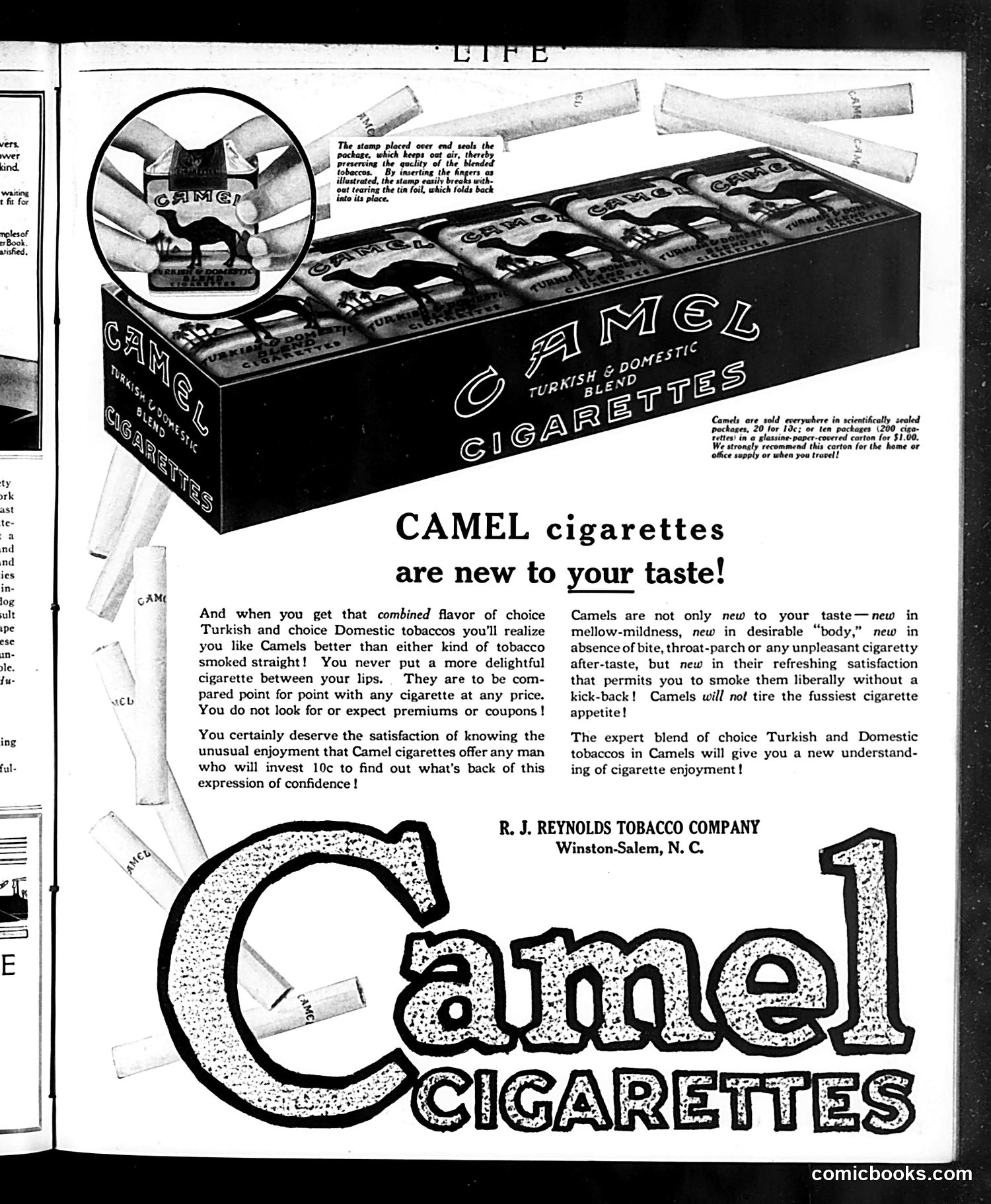
This is primarily a **Camel cigarettes advertisement**, not a political cartoon. The page showcases a product display box with an inset diagram explaining the cigarette packaging mechanism—specifically how a stamp helps open the tin foil wrapper without tearing it. The advertisement emphasizes that Camel cigarettes are "new to your taste," combining Turkish and domestic tobaccos. The copy appeals to masculinity and sophistication, claiming the product won't cause throat irritation or "tire the fussiest cigarette appetite." Notably, there are **no political cartoons or satirical content** on this page. The "Life" magazine context suggests this may have been a satirical publication, but this particular page is straightforward commercial advertising—typical of early 20th-century cigarette marketing that made health claims now recognized as false. Modern readers would find the casual health assertions ("mellow-mildness," absence of "throat-parch") striking, given what we now know about smoking dangers.
This is a cigarette advertisement from Life magazine (March 16, 1916). The image shows a gloved hand holding two cigarette packages marked "CORK" within a circular frame against a dark background. The advertisement's text reads: "At good places you don't need to mention the name. Just ask for the best cigarette." This is a prestige marketing strategy—the implication being that the product is so well-known and respected that customers need only request "the best cigarette" rather than specify the brand name. The cork-tipped cigarettes are presented as a luxury item associated with refined venues and clientele. The advertisement relies on brand recognition and social status rather than explicit product identification.