
Life, 1916-03-16 · page 26 of 44
Life — March 16, 1916 — page 26: what you’re looking at
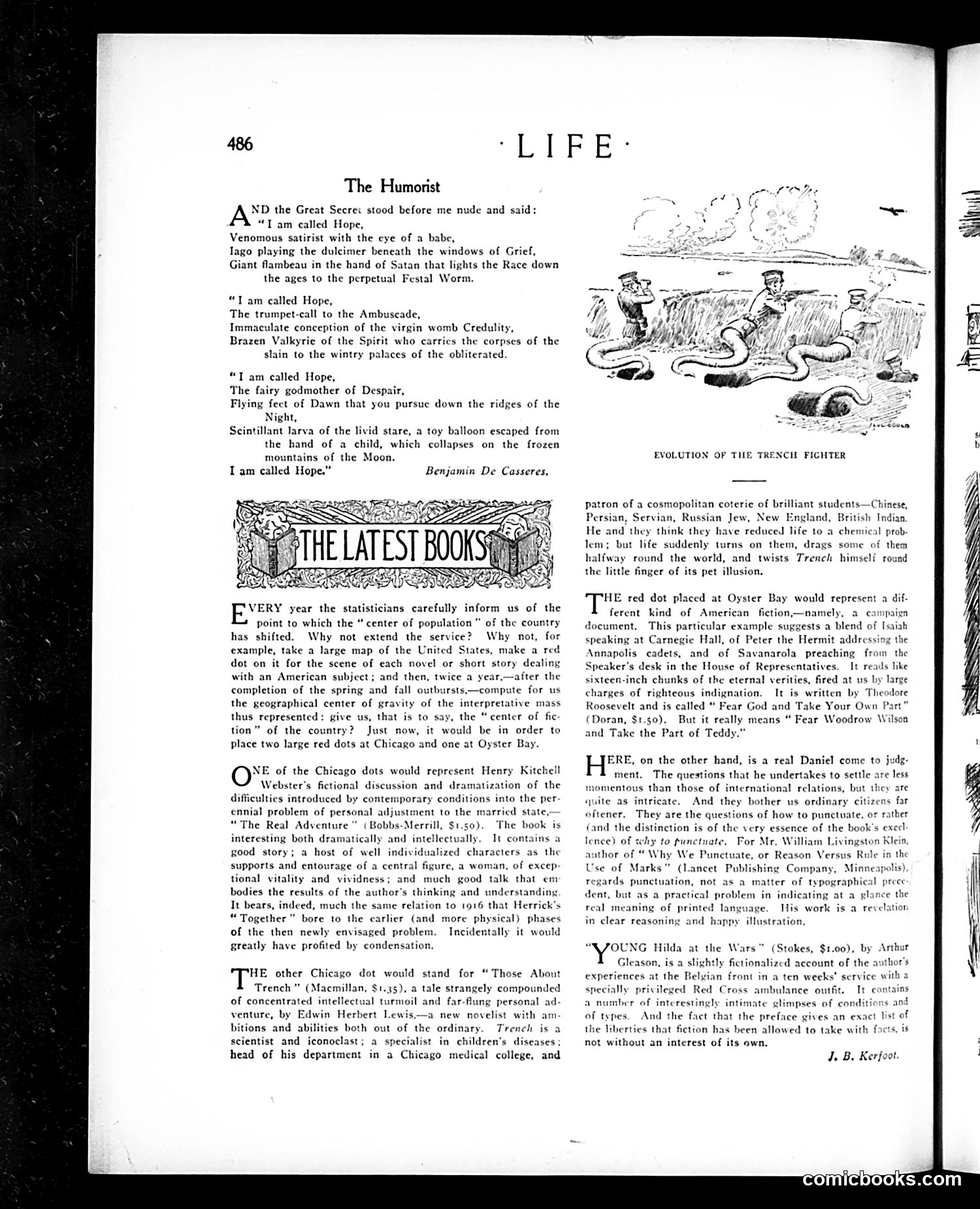
A restored page from Life, 1916-03-16. Page through the whole issue in the reader above.
📄 Transcribed text from this page (OCR, searchable)
Machine-transcribed from the original scan — historical spelling and the odd misread are preserved.
486 The Humorist ND the Great Secrei stood before me nude and said: “Tam called Hope, Venomous satirist with the eye of a babe, Iago playing the dulcimer beneath the windows of Grief, Giant flambeau in the hand of Satan that lights the Race down the ages to the perpetual Festal Worm. “Tam called Hope, The trumpet-call to the Ambuscade, Immaculate conception of the virgin womb Credulity, Brazen Valkyrie of the Spirit who carries the corpses of the slain to the wintry palaces of the obliterated. “Tam called Hope, The fairy godmother of Despair, Flying fect of Dawn that you pursue down the ridges of the Night, Scintillant larva of the livid stare, a toy balloon escaped from the hand of a child, which collapses on the frozen mountains of the Moon. Tam called Hope.” Benjamin De Casseres. VERY year the statisticians carefully inform us of the point to which the “center of population” of the country has shifted. Why not extend the service? Why not, for example, take a large map of the United States, make a red dot on it for the scene of each novel or short story dealing with an American subject; and then, twice a year,—after the completion of the spring and fall outbursts—compute for us the geographical center of gravity of the interpretative mass thus represented: give us, that is to say, the “center of fic tion” of the country? Just now, it would be in order to place two large red dots at Chicago and one at Oyster Bay. XE of the Chicago dots would represent Henry Kitchell Webster's fictional discussion and dramatization of the difficulties introduced by contemporary conditions into the per ennial problem of personal adjustment to the married state, The Real Adventure” (Bobbs-Merrill, $1.50). The book is interesting both dramatically and intellectually. It contains a good story; a host of well individualized characters as the supports and entourage of a central figure, a woman, of excep. tional vitality and vividness; and much good talk that em bodies the results of the author's thinking and understanding It bears, indeed, much the same relation to 1916 that Herrick’s “Together” bore to the earlier (and more physical) phases of the then newly envisaged problem. Incidentally it would greatly have profited by condensation. HE other Chicago dot would stand for “ Those About Trench” (Macmillan, $1 of concentrated intellectual t venture, by Edwin Herbert Lewis,—a new novelist with bitions and abilities both out of the ordinary. Trench is scientist and iconoclast; a specialist in children’s diseases; head of his department in a Chicago medical college, and 5), a tale strangely compounded moil and far-flung personal ad- “LIPE- EVOLUTION OF THE TRENCH FIGHTER patron of a cosmopolitan coterie of brilliant students—Chinese, Persian, Servian, Russian Jew, New England, British Indian He and they think they have reduced life to a chemical prob lem; but life suddenly turns on them, drags some of them halfway round the world, and twists Trench himself round the little finger of its pet illusion. HE red dot placed at Oyster Bay would represent a dif- ferent kind of Ame document. This particular example suggests a blend of Isaiah speaking at Carnegie Hall, of Peter the Hermit addressing the Annapolis cadets, and of Savanarola preaching from the Speaker's desk in the House of Representatives. It reads like sixteen-inch chunks of the eternal verities, fired at us by large charges of righteous indignation. It is written by Theodore Roosevelt and is called “ Fear God and Take Your Own Part” (Doran, $1.50). But it really means “ Fear Woodrow Wilson and Take the Part of Teddy.” fiction,—namely, a campaign H on the other hand, is a real Daniel come to judg- ment. The questions that he undertakes to settle are less montentous than those of international relations, but they are And they bother us ordinary citizens far tener. They are the questions of how to punctuate, or rather (and the distinction is of the ve lence) of thy to punctuate. For Mr. William Livingston Kl author of “ Why We Punctuate, or Reason Versus Rule in the Use of Marks” (Lancet Publishing Company, Minneapolis) ards punctuation, not as a matter of typographical preee dent, but as a practical problem in indicating at a glance the real meaning of printed lang His work is a revelation in clear reasoning and happy illustration. quite as intricate. essence of the book's excel “N/JOUNG Hilda at the Wars” Gleason, is a slightly fictionalized account of the a experiences at the B an front in a ten weeks’ service with 3 specially privileged Red Cross ambulance outfit. (Stokes, $1.00), by a number of interestingly intimate glimpses of condi And the fact that the preface gives an exact the liberties that fiction has been allowed to take with fac not without an interest of its own. of types J. B, Kerfoot Comicbooks.com