
Life, 1916-03-16 · page 30 of 44
Life — March 16, 1916 — page 30: what you’re looking at
What you’re looking at
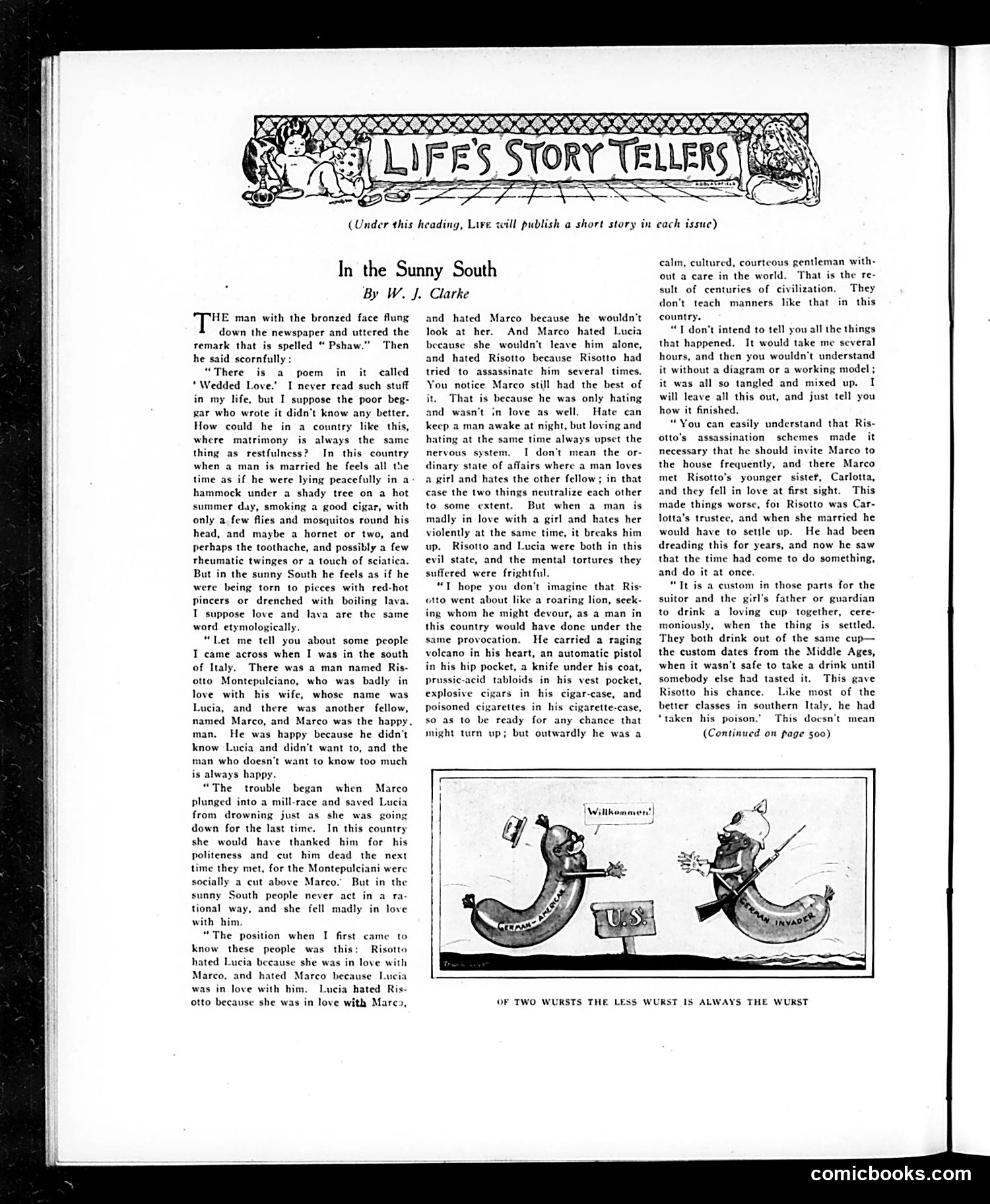
This page contains the opening of a satirical short story titled "In the Sunny South" by W. J. Clarke, published in *Life* magazine's "Life's Story Tellers" section. **The Satire:** The story mocks romantic passion and Southern European temperament through exaggerated contrast. An American narrator describes Italian characters (Risotto, Lucia, Marco) whose passionate love-hate entanglements involve carrying weapons—pistols, knives, poison tablets, and explosives—yet maintaining outward civility. The joke hinges on the absurd contradiction: these people harbor murderous intentions while presenting themselves as cultured gentlemen. **The Point:** The satire critiques both Southern European "irrationality" and American complacency. Americans, the narrator suggests, view marriage as peaceful domesticity (hammocks, cigars, minor annoyances like mosquitoes). Southerners, by contrast, experience marriage as violent chaos—yet civilization forces them to hide it. The cartoon below (showing two competing sausages) reinforces this: "Of two wursts the less wurst is always the wurst"—a pun suggesting that comparing bad options produces absurd results.
📄 Transcribed text from this page (OCR, searchable)
Machine-transcribed from the original scan — historical spelling and the odd misread are preserved.
(Under this heading, Live will publish a short story in each issue) In the Sunny South By W. J. Clarke HE man with the bronzed face flung down the newspaper and uttered the remark that is spelled “ Pshaw.” Then he said scornfully : “There is a poem in it called ‘Wedded Love.’ I never read such stuff in my life, but I suppose the poor beg- gar who wrote it didn’t know any better. How could he in a country like this, where matrimony is always the same thing as restfulness? In this country when a man is married he feels all the time as if he were lying peacefully in a hammock under a shady tree on a hot summer day, smoking a good cigar, with only a few flies and mosquitos round his head, and maybe a hornet or two, and perhaps the toothache, and possibly a few rheumatic twinges or a touch of sciatica. But in the sunny South he feels as if he were being torn to picces with red-hot pincers or drenched with boiling lava. I suppose love and lava are the same word etymologically. “Let me tell you about some people I came across when I was in the south of Italy. There was a man named Ris- otto Montepulciano, who was badly in love with his wife, whose Lucia, and there was another fellow, named Marco, and Marco was the happy man. He was happy because he didn't know Lucia and didn’t want to, and the man who doesn’t want to know too much is always happy. “The trouble began when Marco plunged into a mill-race and saved Lucia from drowning just as she was going down for the last time. In this country she would have thanked him for his politeness and cut him dead the next time they met, for the Montepulciani were socially a cut above Marco. But in the sunny South people never act in a ra- tional way, and she fell madly in love with him. “The position when I first came te know this: Risotte hated Lucia because she was in love with Marco, and hated Marco because Lucia was in love with him, Lucia hated Ris- otto because she was in love with Marco, name was these people was and hated Marco because he wouldn't look at her. And Marco hated Lucia because she wouldn't leave him alone, and hated Risotto because Risotto had tried to assassinate him several times. You notice Marco still had the best of it. That is because he was only hating and wasn’t in love as well. Hate can keep a man awake at night, but loving and hating at the same time always upset the nervous system. I don't mean the or- dinary state of affairs where a man loves a girl and hates the other fellow; in that case the two things neutralize each other to some extent, But when a man is madly in love with a girl and hates her violently at the same time, it breaks him up. Risotto and Lucia were both in this evil state, and the mental tortures they suffered were frightful. “T hope you don’t imagine that Ris- otto went about like a roaring lion, seek- ing whom he might devour, as a man in this country would have done under the same provocation. He carried a raging volcano in his heart, an automatic pistol in his hip pocket, a knife under his coat, prussic-acid tabloids in his vest pocket, explo: ars in his cigar-case, and poisoned cigarettes in his cigarette-case, so as to be ready for any chance that might turn up; but outwardly he was a ve cil calm, cultured, courteous gentleman with- out a care in the world. That is the re- sult of centuries of civilization. They don't manners like that in this country. “T don't intend to tell you all the things that happened. It would take me several hours, and then you wouldn't understand it without a diagram or a working model; it was all so tangled and mixed up. I will leave all this out, and just tell you how it finished. “You can easily understand that Ris- otto’s assassination schemes made it necessary that he should invite Marco to the house frequently, and there Marco met Risotto’s younger sistef, Carlotta, and they fell in love at first sight. This made things worse, for Risotto was Car- lotta’s trustee, and when she married he would have to settle up. He had been dreading this for years, and now he saw that the time had come to do something, and do it at once. “Tt is a custom in those parts for the suitor and the girl’s father or guardian to drink a loving cup together, cere- moniously, when the thing is settled. They both drink out of the same cup— the custom dates from the Middle Ages, when it wasn’t safe to take a drink until somebody else had tasted it. This gave Risotto his chance. Like most of the better classes in southern Italy, he had ‘taken his poison.’ This doesn't mean (Continued on page 500) teach OF TWO WURSTS THE LESS WURST IS ALWAYS THE WURST comicbooks.com