
Life, 1916-03-16 · page 9 of 44
Life — March 16, 1916 — page 9: what you’re looking at
What you’re looking at
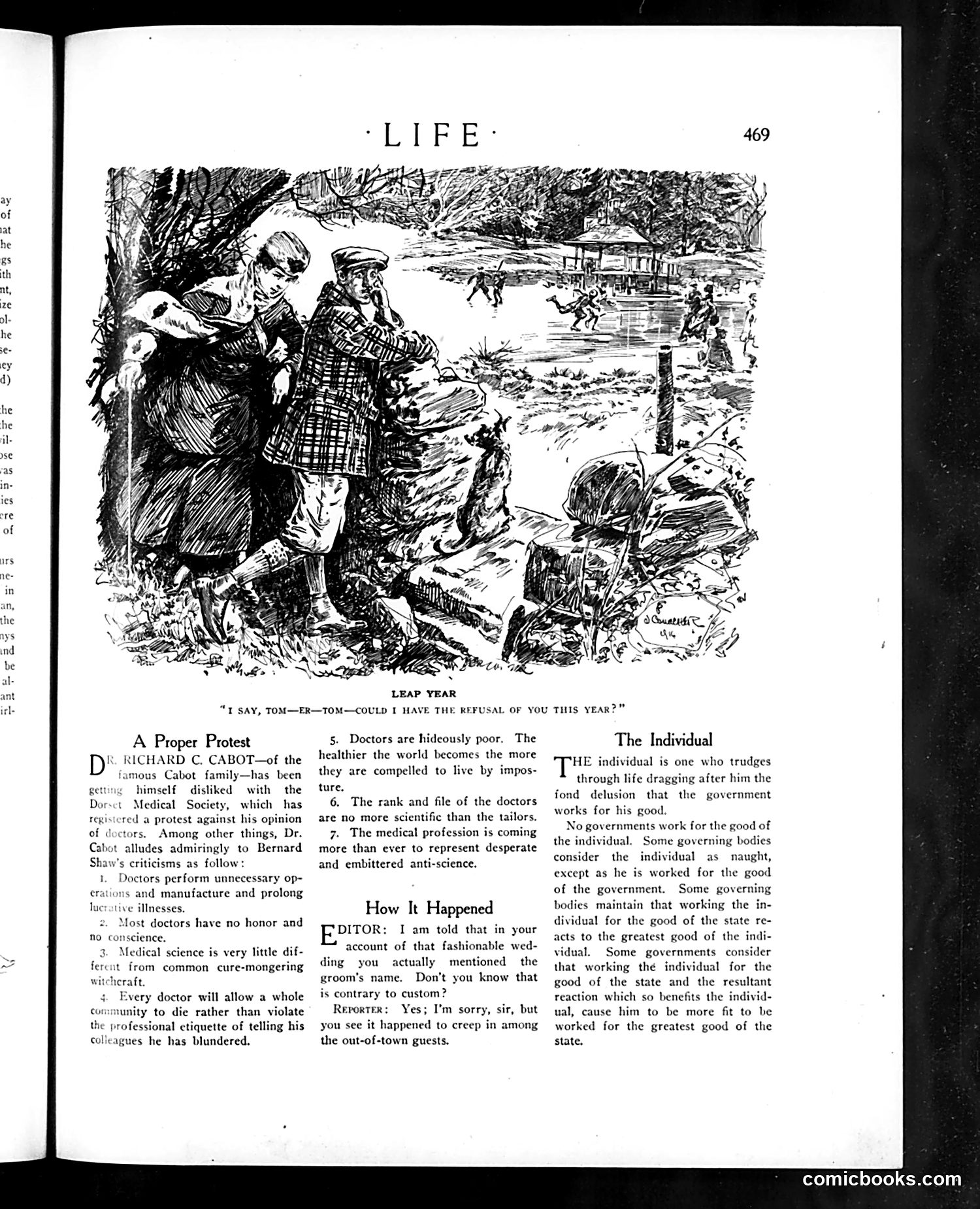
The main cartoon depicts a woman (in darker clothing, left) accosting a man (in plaid, right) by a riverside, with the caption: "I SAY, TOM—ER—TOM—COULD I HAVE THE REFUSAL OF YOU THIS YEAR?" This satirizes the tradition where women could propose to men during leap years—a reversal of normal courtship conventions. The woman's awkward, stammering approach ("TOM—ER—TOM") humorously captures the social discomfort of role-reversal. The man's body language suggests reluctance or surprise. The accompanying text articles ("A Proper Protest," "How It Happened," and "The Individual") appear unrelated to the cartoon, discussing medical ethics and government responsibility—typical Life magazine opinion content. The humor relies on early-20th-century gender expectations about courtship and marriage proposals.
📄 Transcribed text from this page (OCR, searchable)
Machine-transcribed from the original scan — historical spelling and the odd misread are preserved.
“1 SAY, TOM—ER—TOM—COULD I HAVE THE REFUSAL OF YOU THIS YEAR?” A Proper Protest D' RICHARD C, CABOT—of the famous Cabot family—has been gett himself disliked with the Dorset’ Medical Soci which has registered a protest against his opinion of doctors. Among other things, Dr. Cabot alludes admiringly to Bernard Shaw's criticisms as follow: 1. Doctors perform unnecessary op- erations and manufacture and prolong lucrotive illnesses. 2. Most doctors have no honor and No conscience, 3. Medical science is very little dif- fercat from common cure-mongering witchcraft. 4 Every doctor will allow a whole community to die rather than violate the professional etiquette of telling his colleagues he has blundered. 5. Doctors are hideously poor. The healthier the world becomes the more they are compelled to live by impos- ture, 6. The rank and file of the doctors are no more scientific than the tailors. 7. The medical profession is coming more than ever to represent desperate and embittered anti-science. How It Happened DITOR: I am told that in your account of that fashionable wed- ding you actually mentioned the groom's name. Don’t you know that is contrary to custom? Reporter: Yes; I'm sorry, sir, but you see it happened to creep in among the out-of-town guests. The Individual HE individual is one who trudges through life dragging after him the fond delusion that the government works for his good. No governments work for the good of the individual. Some governing bodies consider the individual as naught, except as he is worked for the good of the government. Some governing bodies maintain that working the in- dividual for the good of the state re- acts to the greatest good of the indi- vidual. Some governments consider that working thé individual for the good of the state and the resultant reaction which so benefits the individ- ual, cause him to be more fit to be worked for the greatest good of the state. comicbooks.com