
Life, 1916-03-16 · page 20 of 44
Life — March 16, 1916 — page 20: what you’re looking at
What you’re looking at
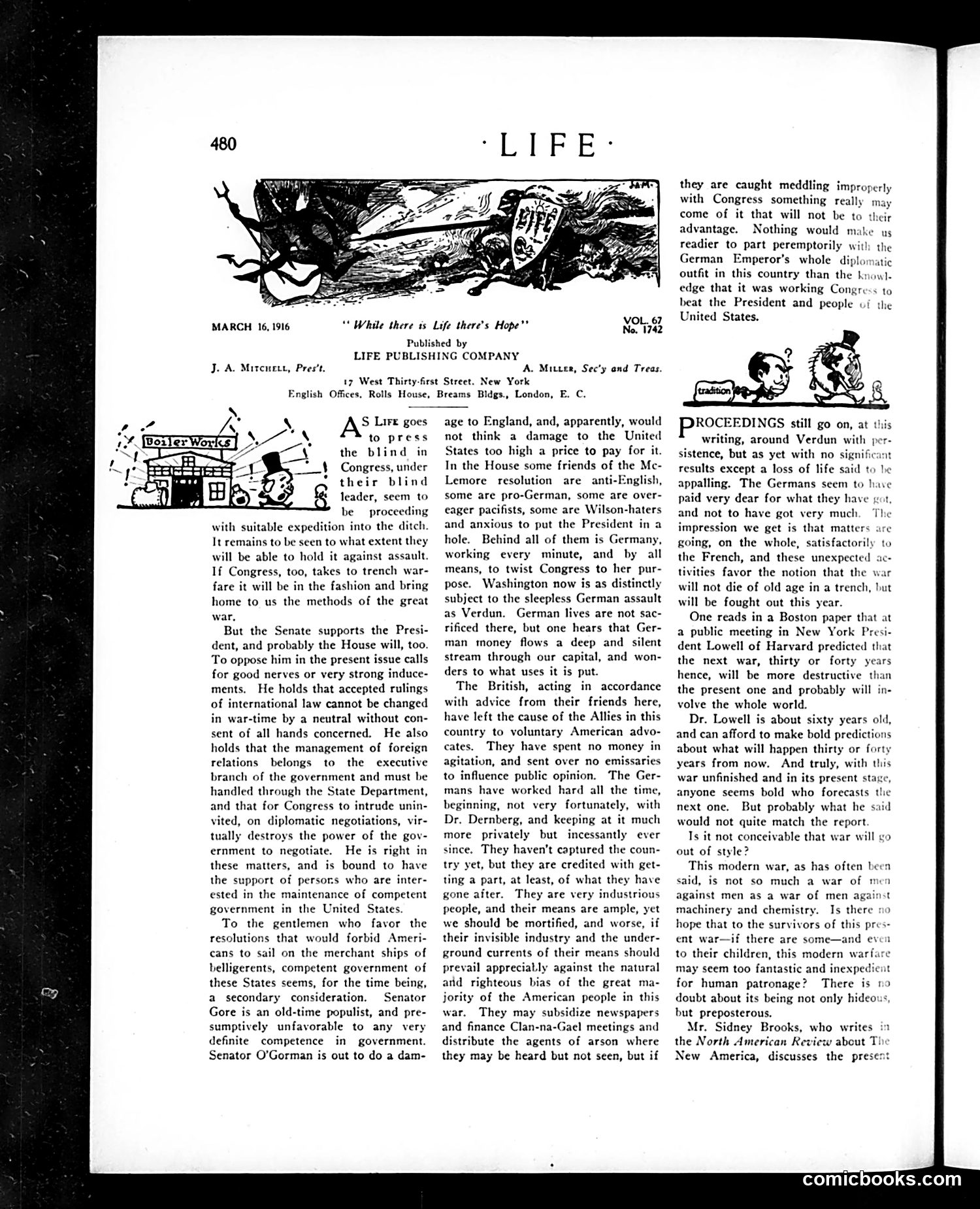
This *Life* magazine page (March 16, 1916) satirizes Congressional opposition to President Wilson's foreign policy during WWI. The cartoon depicts Congress as "blind" proceeding into a ditch—a metaphor for lawmakers marching toward disaster. The editorial attacks Senators Gore and O'Gorman and House members supporting the McLemore Resolution (which would restrict American travel on belligerent ships). Life accuses these politicians of various motives: anti-British sentiment, pro-German sympathy, pacifism, or anti-Wilson hostility. The piece alleges Germany is secretly manipulating Congress through money and agents ("Dr. Dernberg" likely refers to German propagandist Albert Dernberg). Life contrasts this with Britain's passive approach, arguing Germans are industriously undermining American neutrality through covert influence—a significant concern as America approached WWI entry (1917). The satire's point: Congressional isolationism serves German interests and threatens competent executive governance.
📄 Transcribed text from this page (OCR, searchable)
Machine-transcribed from the original scan — historical spelling and the odd misread are preserved.
eysey SEP VOL. 67 No, 1742 LIFE PUBLISHING COMPANY J. A. Mircurte, Pres't. A. Miter, Sec’y and Treas. 17 West Thirty-first Street. New York English Offices, Rolls House, S Lire goes to press the blind in Congress, under their blind leader, seem to be proceeding with suitable expedition into the ditch. It remains to be seen to what extent they will be able to hold it against assault. If Congress, too, takes to trench war- fare it will be in the fashion and bring home to us the methods of the great war, But the Senate supports the Presi- dent, and probably the House will, too. To oppose him in the present issue calls for good nerves or very strong induce- ments. He holds that accepted rulings of international law cannot be changed in war-time by a neutral without con- sent of all hands concerned. He also holds that the management of foreign relations belongs to the executive branch of the government and must be handled through the State Department, and that for Congress to intrude unin- vited, on diplomatic negotiations, vir- tually destroys the power of the gov- ernment to negotiate. He is right in these matters, and is bound to have the support of persons who are inter- ested in the maintenance of competent government in the United States. To the gentlemen who favor the resolutions that would forbid Ameri- cans to sail on the merchant ships of belligerents, competent government of these States seems, for the time being, a secondary consideration. Senator Gore is an old-time populist, and pre- sumptively unfavorable to any very definite competence in government. Senator O'Gorman is out to do a dam- Breams Bldgs. London, E. C. age to England, and, apparently, would not think a damage to the United States too high a price to pay for it. In the House some friends of the Mc- Lemore resolution are anti-English, some are pro-German, some are over- eager pacifists, some are Wilson-haters and anxious to put the President in a hole. Behind all of them is Germany, working every minute, and by all means, to twist Congress to her pur- pose. Washington now is as distinctly subject to the sleepless German assault as Verdun. German lives are not sac- rificed there, but one hears that Ger- man money flows a deep and silent stream through our capital, and won- ders to what uses it is put. The British, acting in accordance with advice from their friends here, have left the cause of the Allies in this country to voluntary American advo- cates. They have spent no money in agitation, and sent over no emissaries to influence public opinion. The Ger- mans have worked hard all the time, beginning, not very fortunately, with Dr. Dernberg, and keeping at it much more privately but incessantly ever since, They haven't captured the coun- try yet, but they are credited with get- ting a part, at least, of what they have gone after. They are very industrious people, and their means are ample, yi we should be mortified, and worse, their invisible industry and the under- ground currents of their means should prevail appreciably against the natural ard righteous bias of the great m; jority of the American people in this war. They may subsidize newspapers and finance Clan-na-Gael meetings and distribute the agents of arson where they may be heard but not seen, but if they are caught meddling improperly with Congress something really may come of it that will not be to their advantage. Nothing would make us readier to part peremptorily witl the German Emperor’s whole diplomatic outfit in this country than the knowl edge that it was working Congres to beat the President and people vj United States. ROCEEDINGS still go on, at this writing, around Verdun with per- sistence, but as yet with no significant results except a loss of life said to he appalling. The Germans seem to have paid very dear for what they have got, and not to have got very much. The impression we get is that matters are going, on the whole, satisfactorily to the French, and these unexpected ac- tivities favor the notion that the war will not die of old age in a trench, but will be fought out this year. One reads in a Boston paper that at a public meeting in New York Presi- dent Lowell of Harvard predicted that the next war, thirty or forty years hence, will be more destructive than the present one and probably will in- volve the whole world. Dr. Lowell is about sixty years old, and can afford to make bold predictions about what will happen thirty or forty years from now. And truly, with this war unfinished and in its present stage, anyone seems bold who forecasts the next one. But probably what he said would not quite match the report Is it not conceivable that war will go out of style? This modern war, as has often been said, is not so much a war of men against men as a war of men against machinery and chemistry. Is there no hope that to the survivors of this pres- ent war—if there are some—and even to their children, this modern warfare may seem too fantastic and inexpedient for human patronage? There is no doubt about its being not only hideous but preposterous. Mr. Sidney Brooks, who writes in the North American Review about T New America, discusses the pre comicbooks.com