
Life, 1916-03-16 · page 24 of 44
Life — March 16, 1916 — page 24: what you’re looking at
What you’re looking at
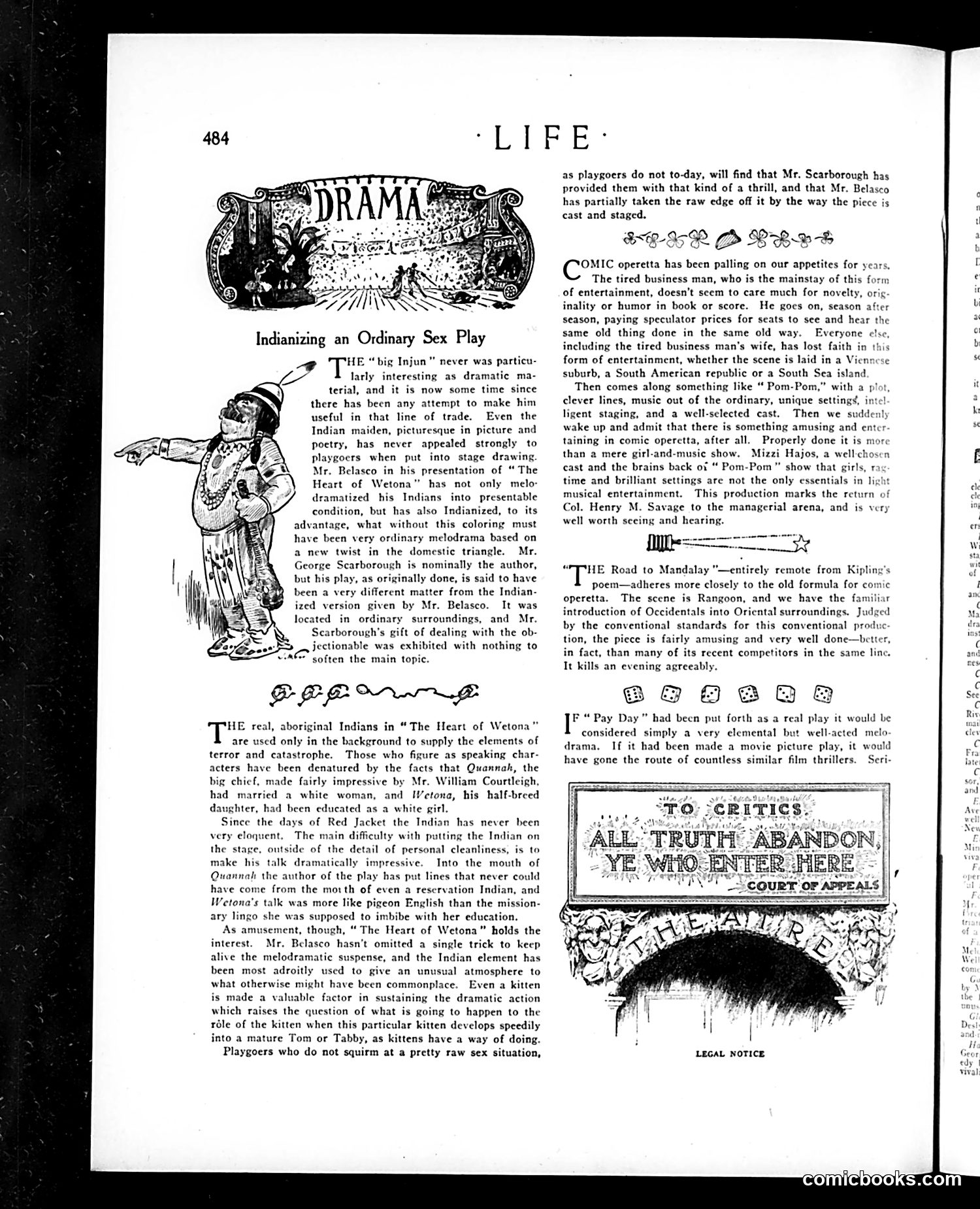
This article reviews David Belasco's theatrical production *"The Heart of Wetona,"* based on George Scarborough's play. The critic argues that Belasco's genius lay in adding Native American setting and characters to what was originally a conventional domestic melodrama—specifically, a story about marital infidelity ("the main topic"). The satire is subtle: the critic notes that standard "sex plays" about adultery had grown tired and crude for audiences. By "Indianizing" the story—adding Native American characters (a half-breed daughter, a chief who married white), scenic spectacle, and dramatic tension—Belasco made the sordid plot palatable and entertaining. The critic points out the irony that authentic Native American dialogue would be dramatically weak, so the playwright gave characters implausibly eloquent lines. Even a kitten factors into the melodrama. The overall point: theatrical dressing can make morally questionable material commercially successful and respectable.
📄 Transcribed text from this page (OCR, searchable)
Machine-transcribed from the original scan — historical spelling and the odd misread are preserved.
“LIFE: Indianizing an Ordinary Sex Play ® ‘THE “big Injun” never was partieu- larly interesting as dramatic ma- terial, and it is now some time since there has been any attempt to make him useful in that line of trade. Even the Indian maiden, picturesque in picture and poetry, has never appealed strongly to playgoers when put into stage drawing. Mr. Belasco in his presentation of “ The Heart of Wetona” has not only melo: dramatized his Indians into presentable condition, but has also Indianized, to its advantage, what without this coloring must have been very ordinary melodrama based on a new twist in the domestic triangle. Mr. George Scarborough is nominally the author, but his play, as originally done, is said to have been a very different matter from the Indian- ized version given by Mr. Belasco. It was located in ordinary surroundings, and Mr. Scarborough’s gift of dealing with the ob- xe jectionable was exhibited with nothing to AC soften the main topic. HE real, aboriginal Indians in “The Heart of Wetona” are used only in the background to supply the elements of terror and catastrophe. Those who figure as speaking char- acters have been denatured by the facts that Quannah, the big chief, made fairly impressive by Mr. William Courtleigh, had married a white woman, and I!ctona, his half-breed daughter, had been educated as a white girl. Since the days of Red Jacket the Indian has never been very eloquent, The main difficulty with putting the Indian on the stage, ontside of the detail of personal cleanliness, is to make his talk dramatically impressive. Into the mouth of Quannak the author of the play has put lines that never could have come from the mot th of even a reservation Indian, and Wetona's talk was more like pigeon English than the mission- ary lingo she was supposed to imbibe with her education. As amusement, though, “ The Heart of Wetona” holds the interest. Mr. Belasco hasn't omitted a single trick to keep alive the melodramatic suspense, and the Indian element has been most adroitly used to give an unusual atmosphere to what otherwise might have been commonplace. Even a kitten is made a valuable factor in sustaining the dramatic action which raises the question of what is going to happen to the rile of the kitten when this particular kitten develops speedily into a mature Tom or Tabby, as kittens have a way of doing. Playgoers who do not squirm at a pretty raw sex situation, as playgoers do not to-day, will find that Mr. Scarborough has provided them with that kind of a thrill, and that Mr. Belasco has partially taken the raw edge off it by the way the piece is cast and staged. &eE. 45-98 SRO LRES comic operetta has been palling on our appetites for years, The tired business man, who is the mainstay of this f of entertainment, doesn’t seem to care much for novelty, orig inality or humor in book or score. He goes on, season after season, paying speculator prices for seats to see and hear the same old thing done in the same old way. Everyone e! including the tired business man's wife, has lost faith in form of entertainment, whether the scene is laid in a Viennese suburb, a South American republic or a South Sea island. Then comes along something like “ Pom-Pom,” with a plot, clever lines, music out of the ordinary, unique settings, inte! ligent staging, and a well-sclected cast. Then we sudden! wake up and admit that there is something amusing and enter taining in comic operctta, after all. Properly done it is n than a mere girl-and-music show. Mizzi Hajos, a well-ch cast and the brains back oi “ Pom-Pom” show that girls, r. time and brilliant settings are not the only essentials in light musical entertainment. This production marks the return c Col. Henry M. Savage to the managerial arena, and is very well worth seeing and hearing. “THE Road to Mandalay "—entirely remote from Kiplin, poem—adheres more closely to the old formula for comic operetta. The scene is Rangoon, and we have the familiar introduction of Occidentals into Oriental surroundings. Judged by the conventional standards for this conventional produc tion, the piece is fairly amusing and very well done—better, in fact, than many of its recent competitors in the same linc. It kills an evening agreeably. BS&EEeo 8 I F “ Pay Day” had been put forth as a real play it would be considered simply a very elemental but well-acted melo: drama. If it had been made a movie picture play, it wo! have gone the route of countless similar film thrillers. LEGAL NOTICE