
Life, 1916-03-16 · page 8 of 44
Life — March 16, 1916 — page 8: what you’re looking at
What you’re looking at
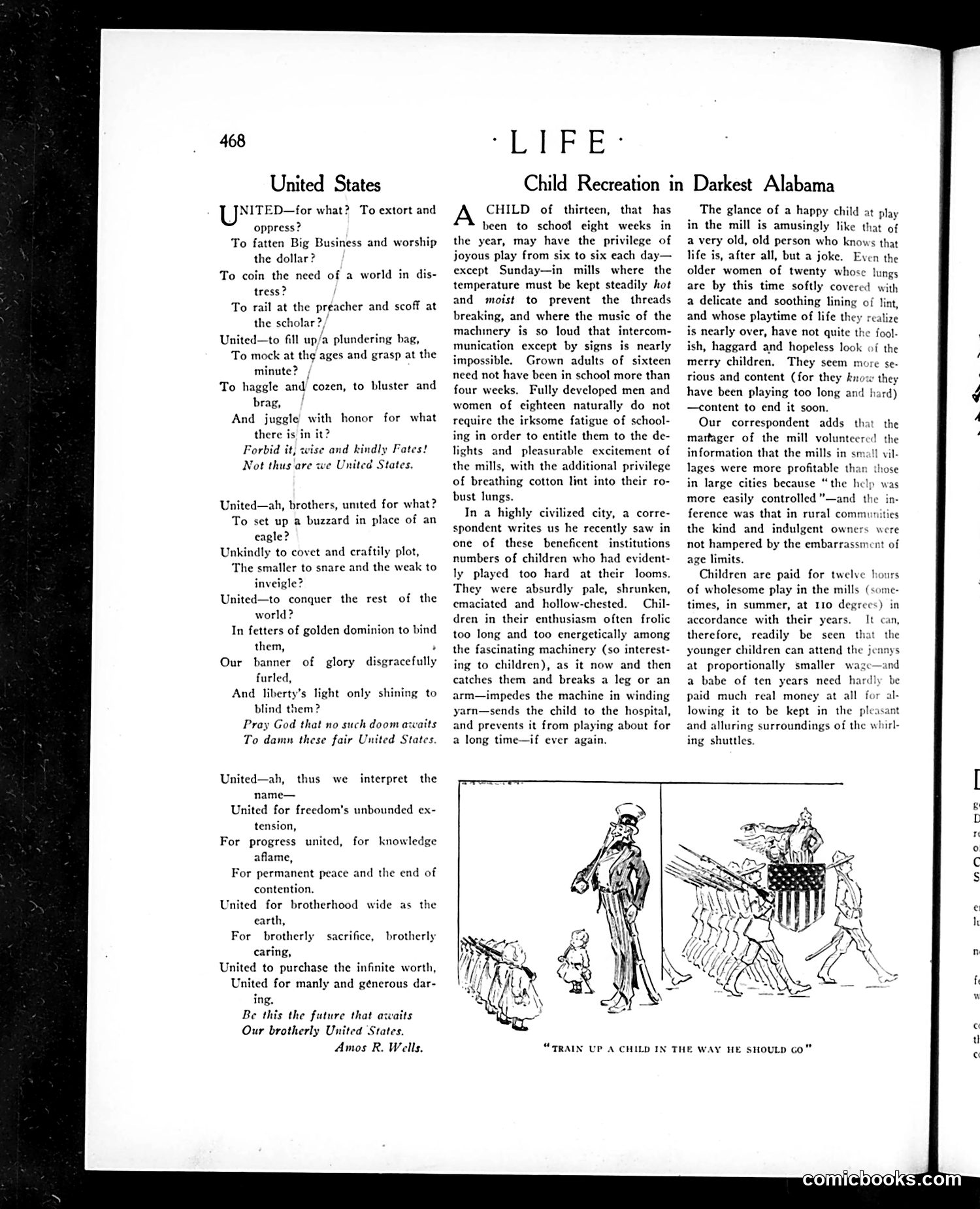
This page contrasts two visions of American childhood. The left column presents an idealistic poem by Amos R. Wells about the "United States" as a beacon of freedom and brotherhood. The right article, "Child Recreation in Darkest Alabama," describes the grim reality: thirteen-year-old children working twelve-hour shifts in cotton mills. The accompanying cartoon illustrates this contradiction—showing Uncle Sam pointing children toward a giant mill machine, with the caption "Train Up a Child in the Way He Should Go." The satire is bitter: the poem's noble rhetoric about American values clashes with the documented exploitation of child laborers in Southern factories. The cartoon's use of Uncle Sam as the figure directing children to dangerous machinery suggests the government's complicity or hypocrisy in allowing such conditions to exist.
📄 Transcribed text from this page (OCR, searchable)
Machine-transcribed from the original scan — historical spelling and the odd misread are preserved.
United States NITED—for what? To extort and oppress? To fatten Big Business and worship the dollar? To coin the need of a world in dis- tress? To rail at the preacher and scoff at the scholar ?, United—to fill up/a plundering bag, To mock at thg ages and grasp at the minute? To haggle and cozen, to bluster and brag, And juggle with honor for what there is in it? Forbid it, wise and kindly Fates! Not thus are we United States. United—ah, brothers, united for what? To set up a buzzard in place of an eagle? Unkindly to covet and craftily plot, The smaller to snare and the weak to inveigle? United—to conquer the rest of the world? In fetters of golden dominion to bind them, ’ Our banner of glory disgracefully furled, And liberty’s light only shining to blind them? Pray God that no such doom awaits To damn these fair United States. United—ah, thus we interpret the name— United for freedom's unbounded ex- tension, For progress united, for knowledge aflame, For permanent peace and the end of contention. United for brotherhood wide as the earth, For brotherly sacrifice, brotherly caring, United to purchase the infinite worth, United for manly and generous dar- ing. Be this the future that awaits Our brotherly United States. Amos R. Wells. “LIFE- Child Recreation in Darkest Alabama CHILD of thirteen, that has been to school eight weeks in the year, may have the privilege of joyous play from six to six each day— except Sunday—in mills where the temperature must be kept steadily hot and moist to prevent the threads breaking, and where the music of the machinery is so loud that intercom- munication except by signs is nearly impossible. Grown adults of sixteen need not have been in school more than four weeks. Fully developed men and women of cighteen naturally do not require the irksome fatigue of school- ing in order to entitle them to the de- lights and pleasurable excitement of the mills, with the additional privilege of breathing cotton lint into their ro- bust lungs. In a highly civilized city, a corre- spondent writes us he recently saw in one of these beneficent institutions numbers of children who had evident- ly played too hard at their loo They were absurdly pale, shrunken, emaciated and hollow-chested. Chil- dren in their enthusiasm often frolic too long and too energetically among the fascinating machinery (so interest- ing to children), as it now and then catches them and breaks a leg or an arm—impedes the machine in winding yarn—sends the child to the hospital, and prevents it from playing about for a long time—if ever again. The glance of a happy child at play in the mill is amusingly like that of a very old, old person who knows that life is, after all, but a joke. Even the older women of twenty whose lungs are by this time softly covered with a delicate and soothing lining of lint, and whose playtime of life they realize is nearly over, have not quite fool- ish, haggard and hopeless look of the merry children, They seem more se- rious and content (for they know they have been playing too long and hard) —content to end it soon. Our correspondent adds that the marfager of the mill volunteered the information that the mills in sm. lages were more profitable than those in large cities because “the help was more easily controlled "—and the in- ference was that in rural com ties the kind and indulgent owners were not hampered by the embarrassment of age limits. Children are paid for twelve hours of wholesome play in the mills (so times, in summer, at 110 degrees) in accordance with their years. It can, therefore, readily be seen that the younger children can attend the jennys at proportionally smaller wa, nd a babe of ten years need hardly be paid much real money at all for al- lowing it to be kept in the ple and alluring surroundings of the whirl- ing shuttles. “TRAIN UP A CHILD IN THE WAY HE SHOULD co” — ~ nanorre