
A complete issue · 48 pages · 1916
Life — February 24, 1916
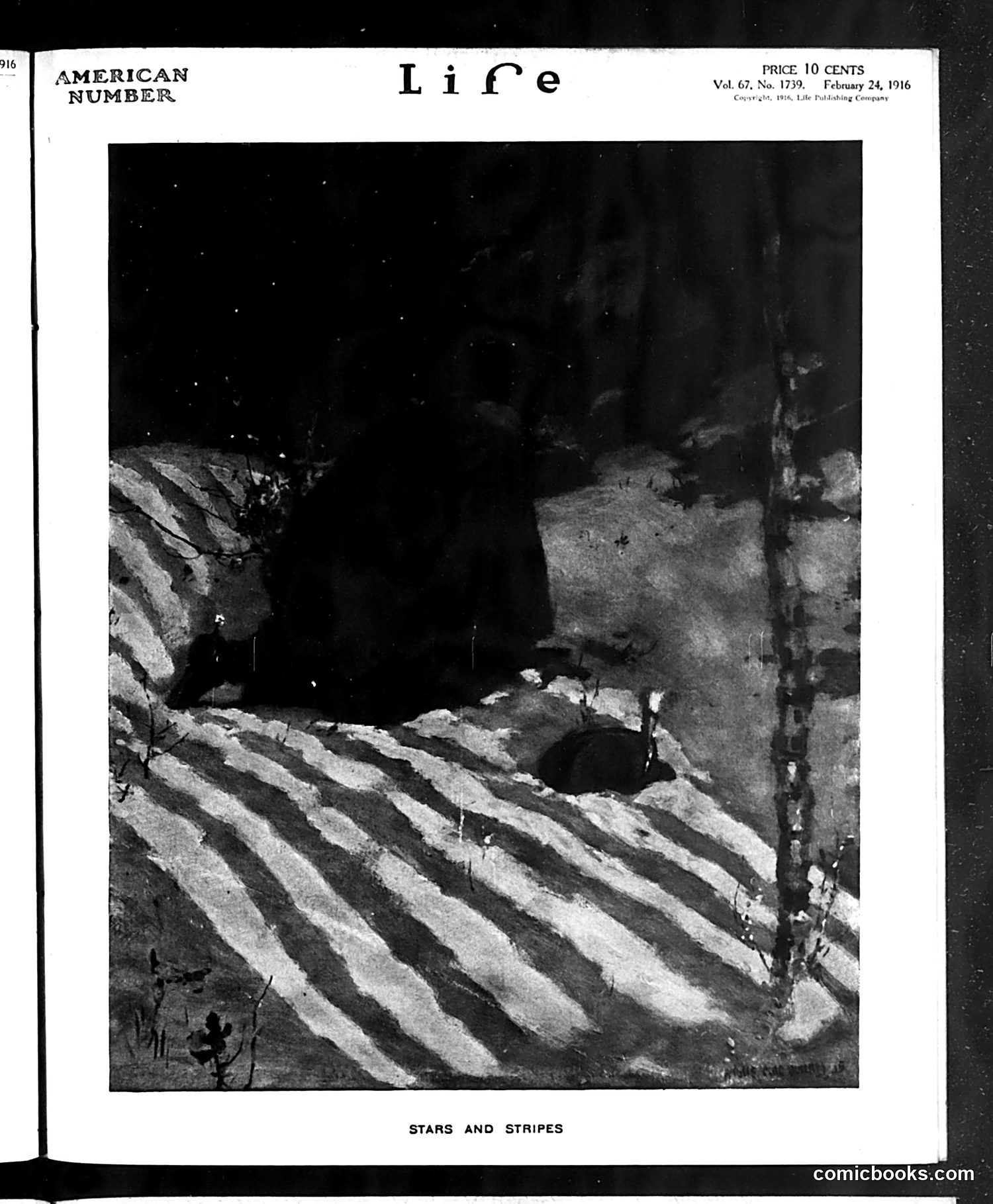
This appears to be a World War I-era photograph rather than a political cartoon. The image shows a trench scene with diagonal wooden reinforcements (likely duckboards or trench supports) illuminated against darker surroundings. A figure in silhouette stands in the trench, with what appears to be military structures visible. The caption "Stars and Stripes" likely references American military involvement in WWI (the U.S. entered in April 1917, though this issue is from February 1916). The photograph may be documenting trench warfare conditions or possibly illustrating an article about American preparedness or military service. Without accompanying article text, the specific satirical intent is unclear, though Life frequently used such imagery to comment on military readiness during this period.
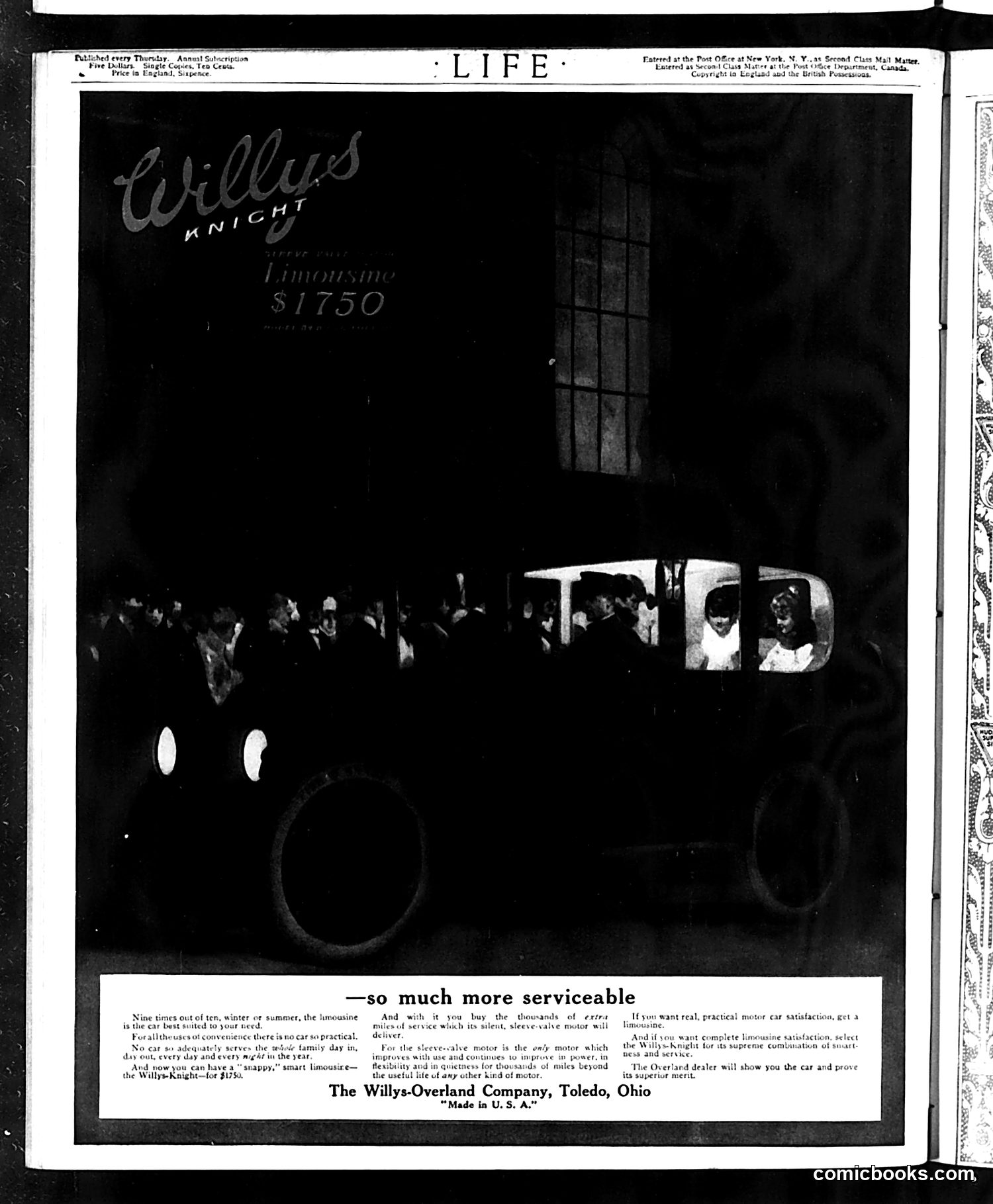
This page is primarily **an advertisement for the Willys-Knight automobile**, not political satire. The image shows a Willys-Knight limousine priced at $1750, depicted at night with passengers visible through windows and a crowd gathered around it. The ad's headline—"so much more serviceable"—emphasizes the vehicle's practical advantages. The accompanying text promotes the Willys-Knight's reliability and performance, claiming it's "the only motor which improves with use" and praising its durability for thousands of miles. The nighttime scene appears designed to showcase the vehicle's elegant presence and utility. This is straightforward commercial advertising from the early automotive era, not satirical commentary. The Life magazine page functioned as both editorial content and advertising space.
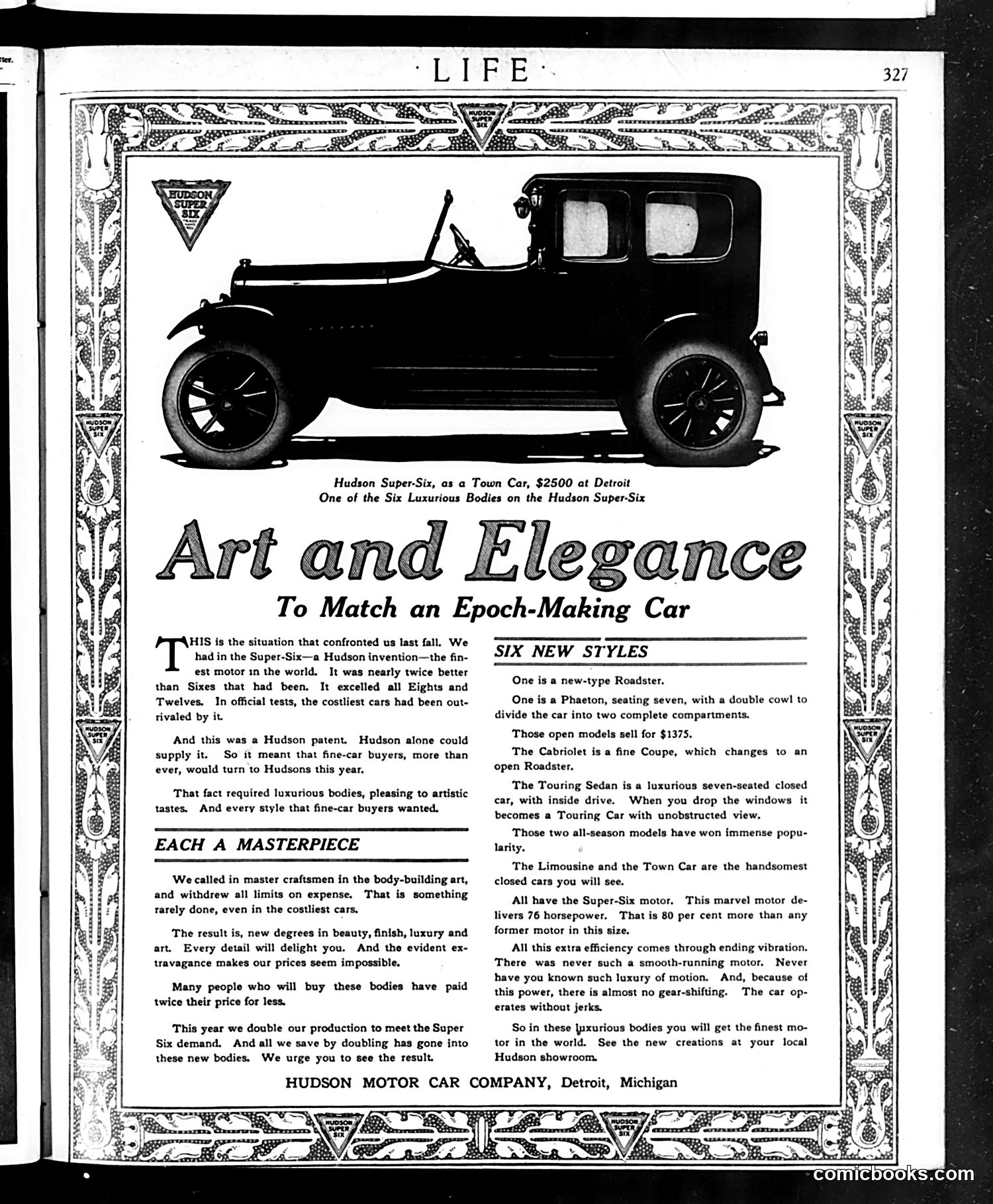
This is **not a political cartoon or satire**—it's a straightforward automobile advertisement, not satirical content. The page advertises the Hudson Super-Six, a luxury car priced at $2,500 in Detroit. The ad emphasizes the vehicle's engineering superiority and newly available body styles (Roadster, Phaeton, Touring Sedan, Cabriolet, Limousine, Town Car). The pitch targets affluent buyers by highlighting that Hudson held a patent on the Super-Six motor, positioning it as exclusive. The ad claims the motor delivers 76 horsepower with smooth operation and efficiency—advantages over competitors. The decorative border and formal layout reflect typical 1920s advertising design in *Life* magazine. This represents early automotive marketing emphasizing luxury, exclusivity, and technical innovation to wealthy consumers.
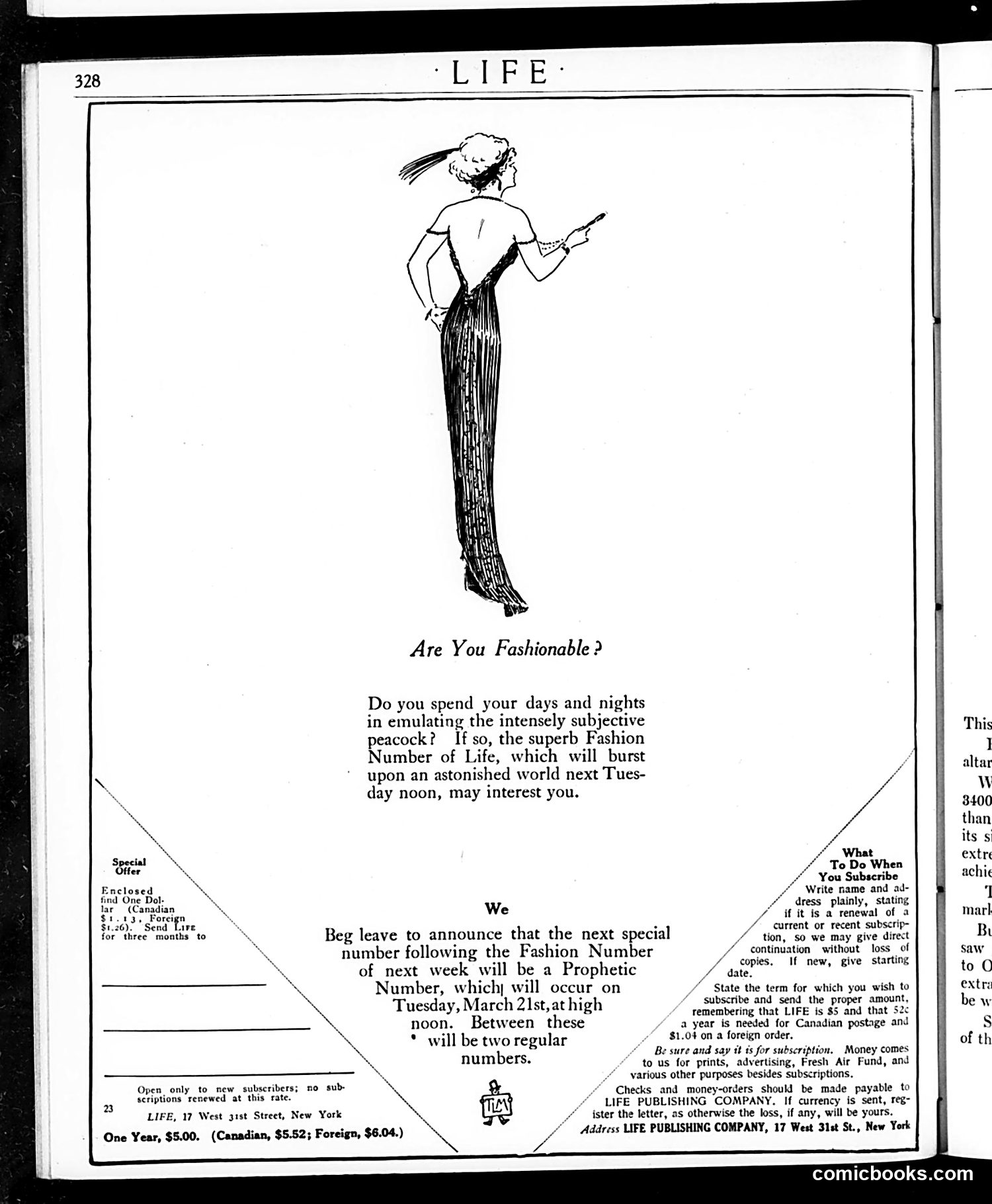
This page is primarily **advertising and promotional content** rather than political satire. The main illustration depicts an elegant woman in an evening gown, captioned "Are You Fashionable?" The text promotes an upcoming "Fashion Number" special issue coming Tuesday, March 21st at noon. It humorously asks if readers spend their time "emulating the intensely subjective peacock"—a satirical jab at fashion-obsession itself. The bottom half contains subscription offers and publishing information for Life magazine. The satire here is gentle: the magazine mocks fashion vanity while simultaneously *selling* a fashion-focused special issue—a self-aware irony typical of Life's comedic approach. The page targets affluent, style-conscious readers of the era.
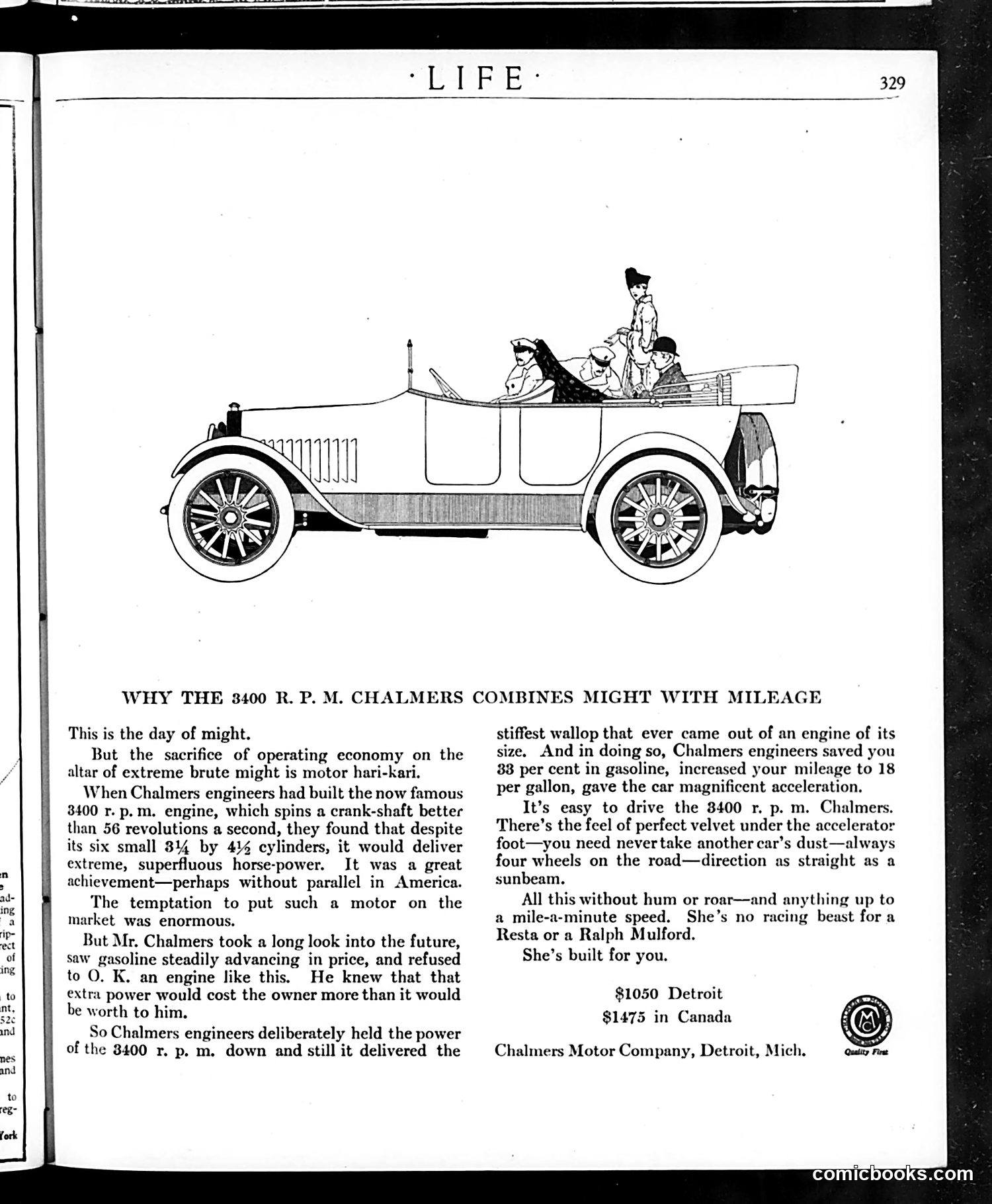
This is **advertising copy, not satire or political cartoon**. The page promotes the Chalmers automobile's 3400 r.p.m. engine. The single illustration shows a side-view drawing of an open-air touring car with five passengers in period dress (early 1910s style), depicting the vehicle as a luxury family automobile. The text explains that Chalmers engineers deliberately restricted their engine's power output to prioritize **fuel economy over raw horsepower**—a pragmatic business decision as gasoline prices rose. The advertisement emphasizes the car's smooth acceleration, reliability, and cost-efficiency (18 miles per gallon), positioning it as practical for owners seeking value rather than extreme performance. Pricing is listed as $1050 in Detroit, $1475 in Canada. This represents a straightforward early automotive advertisement in *Life* magazine's commercial pages.
This page is **not a satirical cartoon** but rather a **luxury automobile advertisement** for the Locomobile Company of America, presented as editorial content in Life magazine. The elaborate decorative border frames the company's manufacturing philosophy: they commit to producing limited numbers of high-quality, expensive cars rather than mass-producing cheaper vehicles. Key policy points emphasize fine materials, skilled workmanship, six-cylinder engines with four-speed transmissions, and restrictive production ("not more than 'Four Cars a Day'"). The advertisement positions Locomobiles as exclusive, aristocratic vehicles for wealthy buyers. The ornate Victorian design and formal typography reinforce this premium brand identity, appealing to Life magazine's affluent readership during the early automobile era.
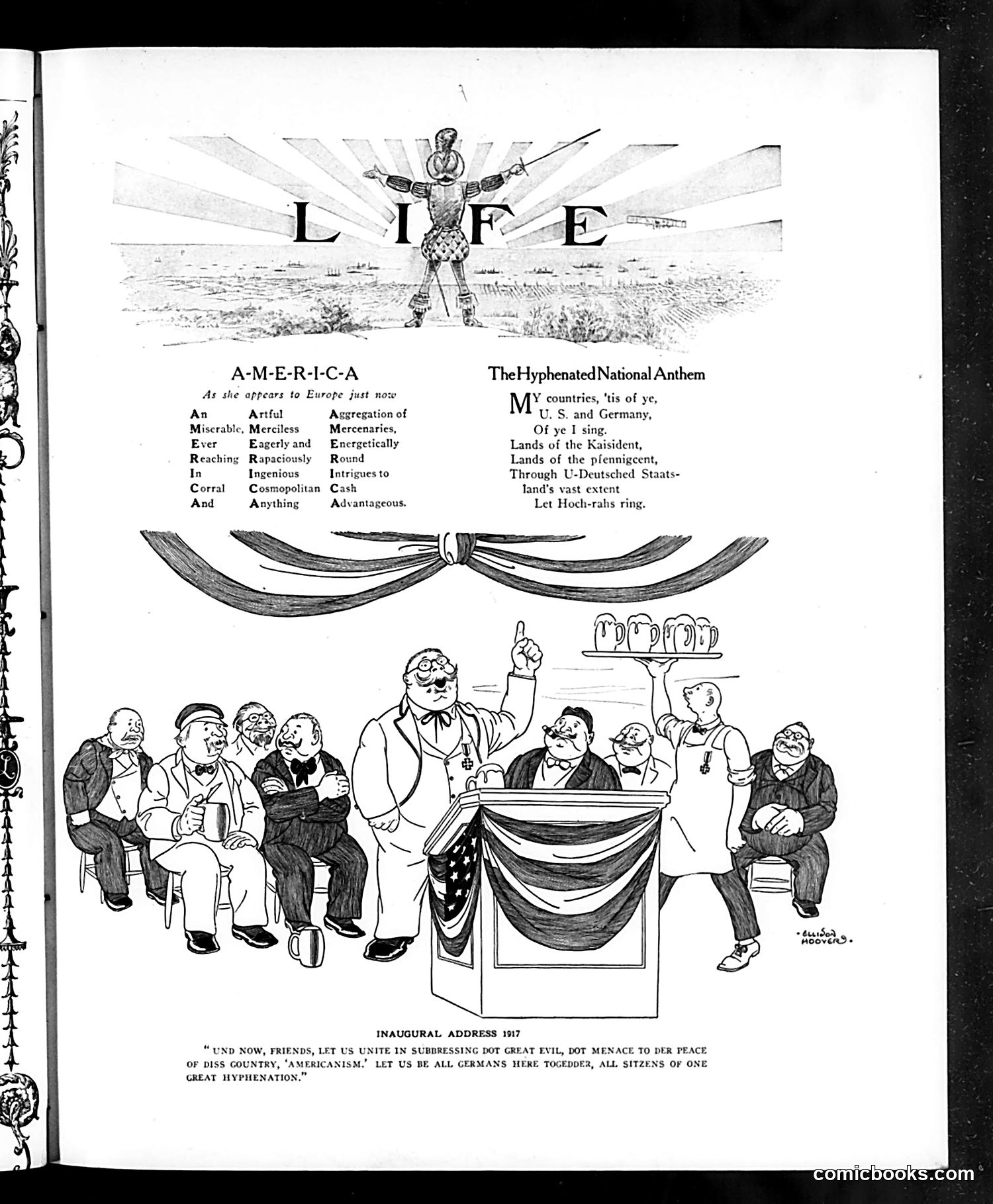
This page satirizes American attitudes toward Germany during World War I, specifically around President Wilson's 1917 inaugural address. The top section mocks "AMERICA" as hypocritical—claiming noble values ("Artful," "Merciful," "Energetic") while actually being mercenary and advantageous. The lower cartoon depicts German leaders at a podium, with the caption mocking their call for "hyphenation"—unity among German-Americans and other ethnic groups. The seated figures appear to represent German officials or sympathizers. The satire targets both German propaganda efforts to unite hyphenated Americans and American politicians who preached idealism while pursuing self-interest. This reflects wartime suspicion of German-American loyalties and anti-hyphenation sentiment that peaked during WWI.
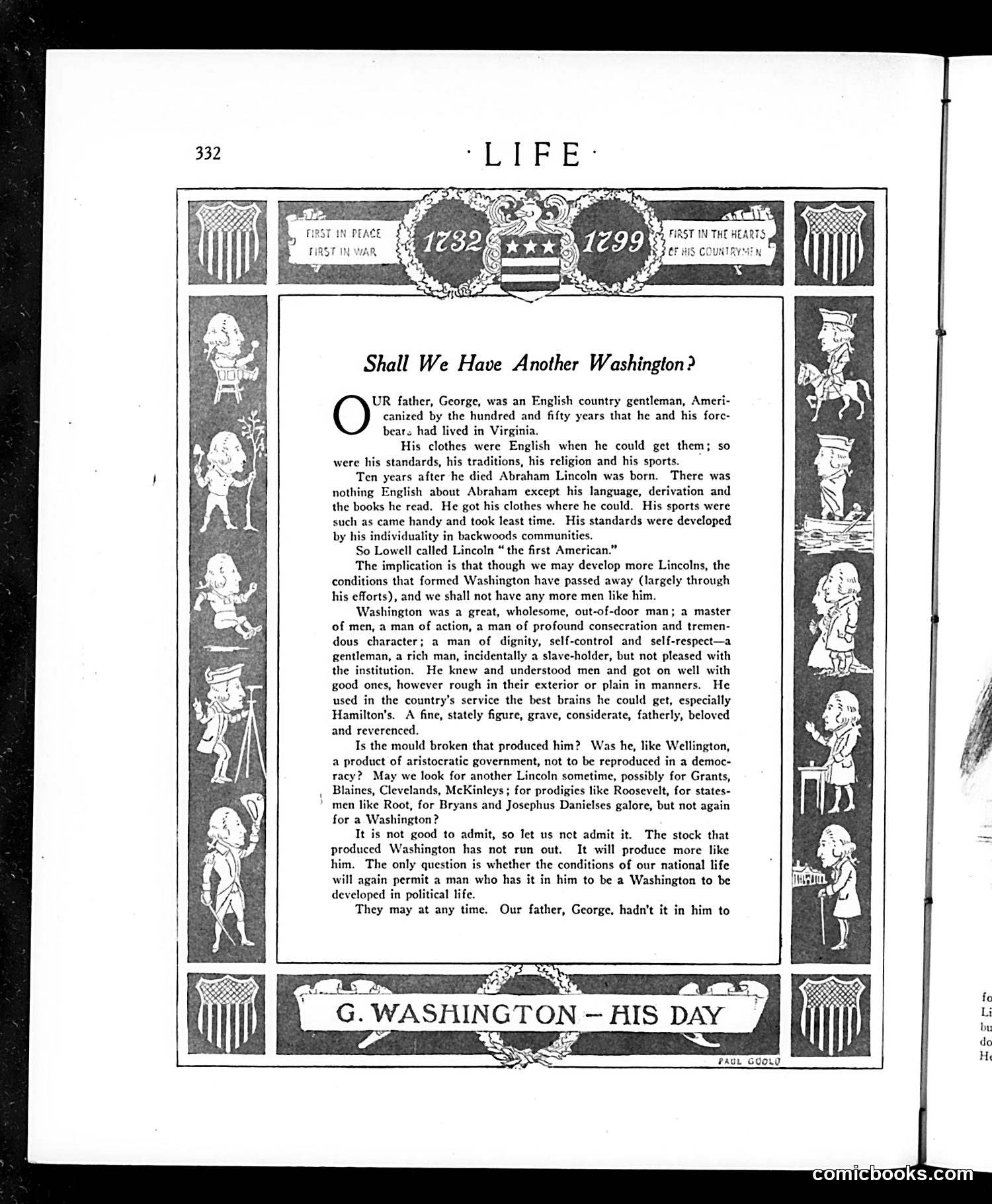
This article questions whether America can produce another George Washington. The author contrasts Washington—described as a self-made man from backwoods Virginia with English heritage—with Abraham Lincoln, called "the first American" despite his rough frontier upbringing. The piece argues that while Washington emerged from aristocratic conditions unlikely to recur in democracy, the *stock* that produced him remains viable. However, it expresses doubt that democratic institutions will again permit such a figure's political development. The sidebar illustrations show various American leaders (appearing to be Grant, Cleveland, McKinley, Roosevelt, and others mentioned) as potential successors, though the text suggests none truly replicate Washington's unique combination of character, dignity, and leadership.
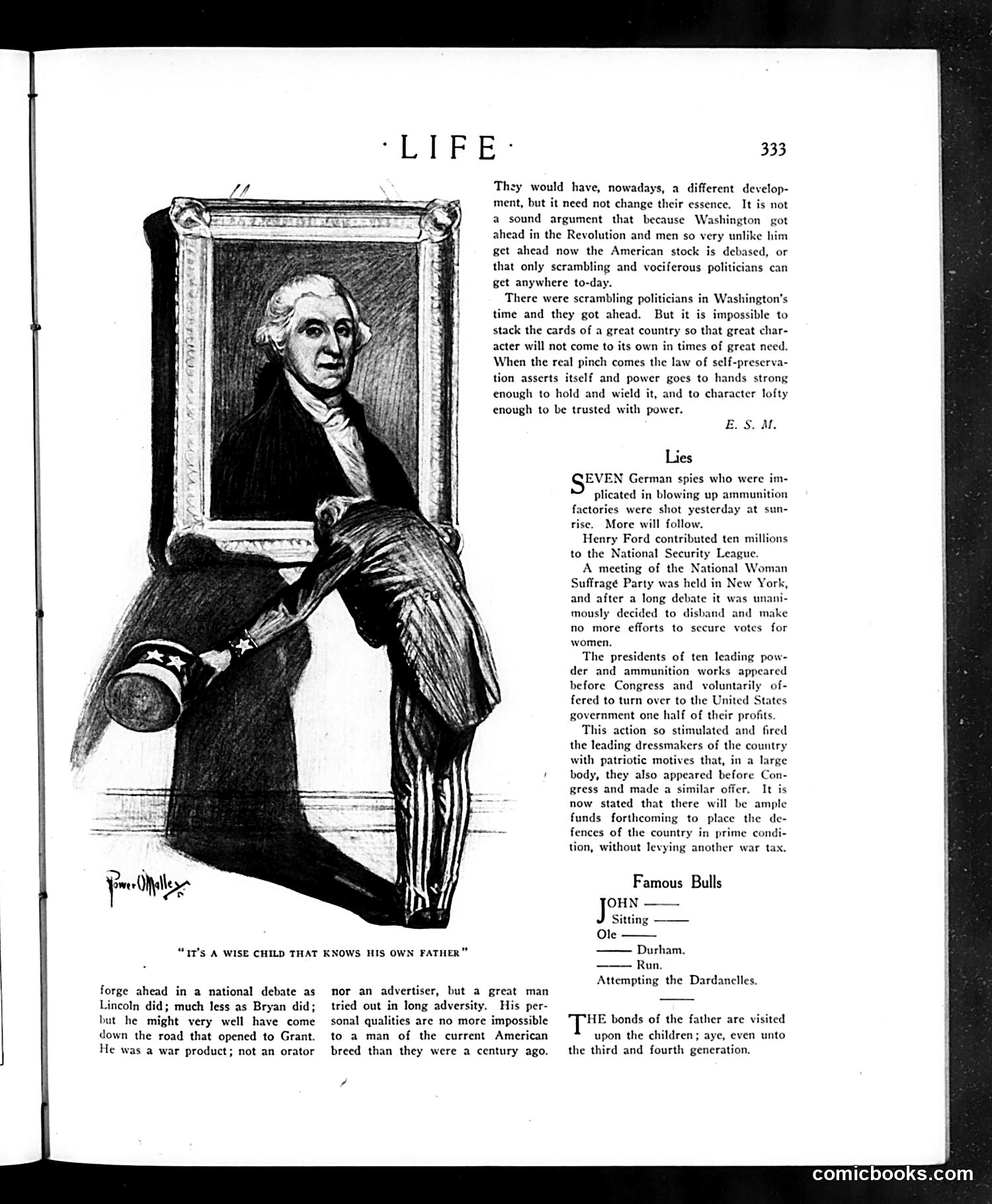
The main cartoon depicts a figure holding a portrait labeled "It's a Wise Child That Knows His Own Father." The accompanying text criticizes American political leadership, comparing current politicians unfavorably to figures like Lincoln and Grant. The author argues that mediocre politicians now "get ahead" through "scrambling and vociferous" tactics, whereas great leaders once emerged naturally during crises. The satire suggests that American character and leadership have declined—the nation can no longer reliably produce capable statesmen when needed. The "wise child" metaphor implies uncertainty about whether current leaders are truly worthy successors to past giants, questioning the legitimacy of contemporary American political authority and competence.
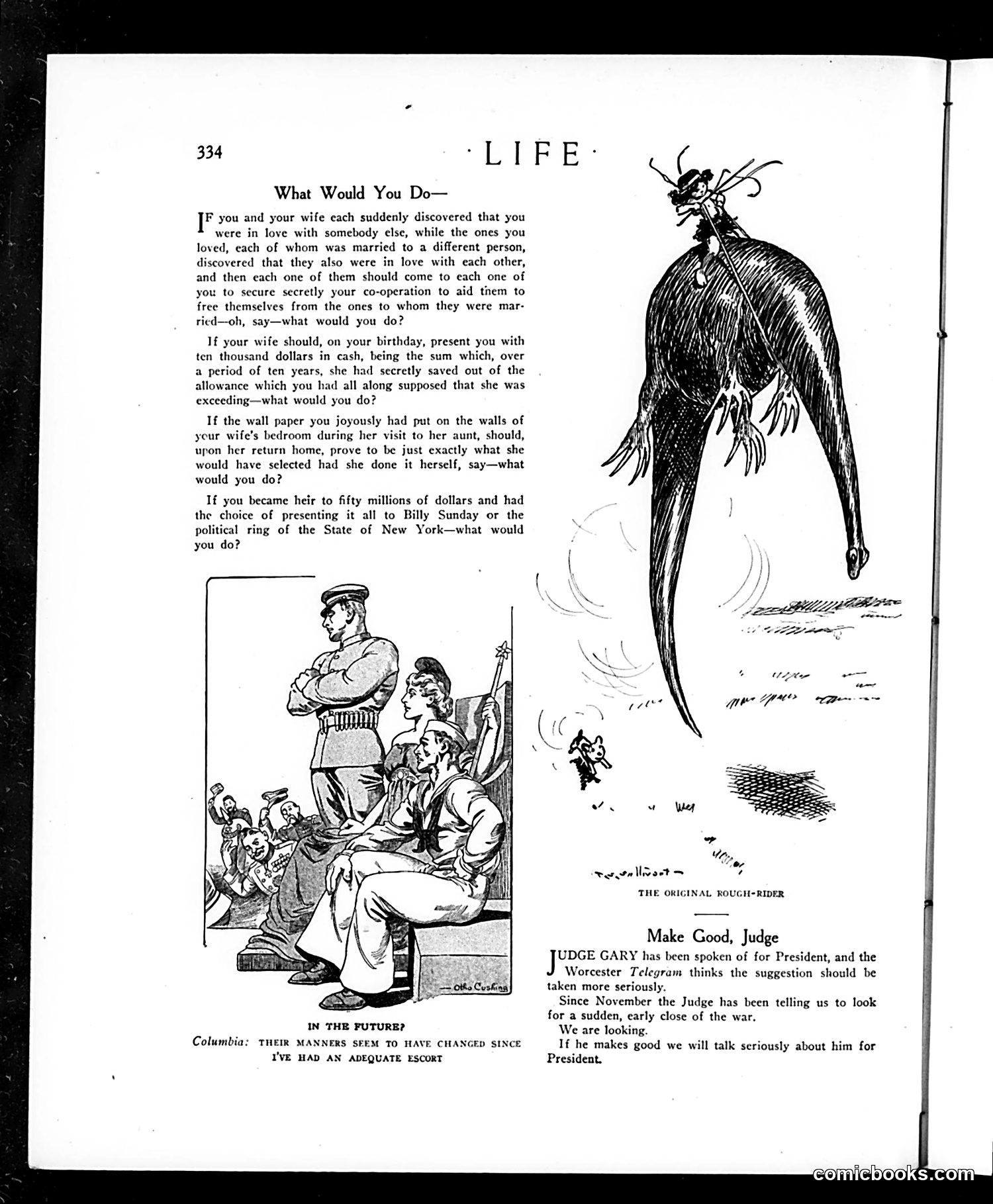
This page contains two distinct satirical pieces: **"What Would You Do?"** presents hypothetical moral dilemmas testing the reader's ethics and judgment—a common Life magazine format for social commentary. **"The Original Rough-Rider"** and **"Make Good, Judge"** reference Judge Gary, who has been mentioned as a potential presidential candidate. The text suggests the *Worcester Telegram* supports this idea seriously. The cartoon depicts Columbia (America personified) with military/government figures, likely satirizing Gary's qualifications or the absurdity of his candidacy. The "rough-rider" reference alludes to Theodore Roosevelt's famous persona. The joke appears to be that if Judge Gary can deliver "a sudden, early close of the war" (unclear which war), then he'd be worth considering for President—suggesting skepticism about both his capabilities and his political viability.
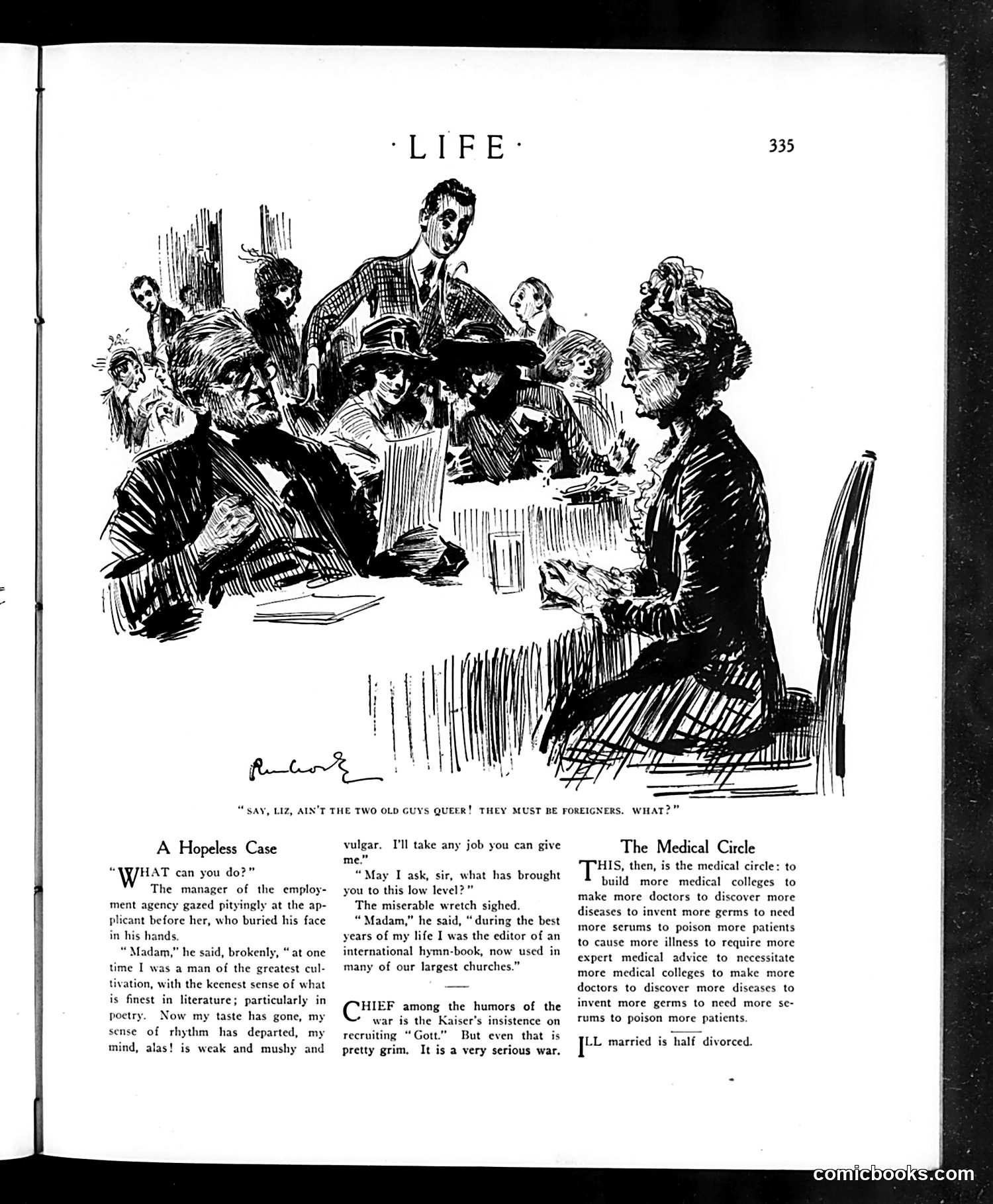
The main cartoon depicts a social gathering where a woman seated on the right observes a group of men at a table. The caption reads: "Say, Liz, ain't the two old guys queer? They must be foreigners. What?" This satirizes casual xenophobia and class prejudice among American socialites. The "two old guys" appear to be poorly dressed or foreign-looking, prompting disparaging comments from the observer. The joke targets both the narrow-mindedness of upper-class Americans and their reflexive assumption that anything unusual must be "foreign." Below are text pieces titled "A Hopeless Case" (about an employment agency) and "The Medical Circle" (satirizing how doctors create demand for their own services). These are typical Life magazine social commentary.
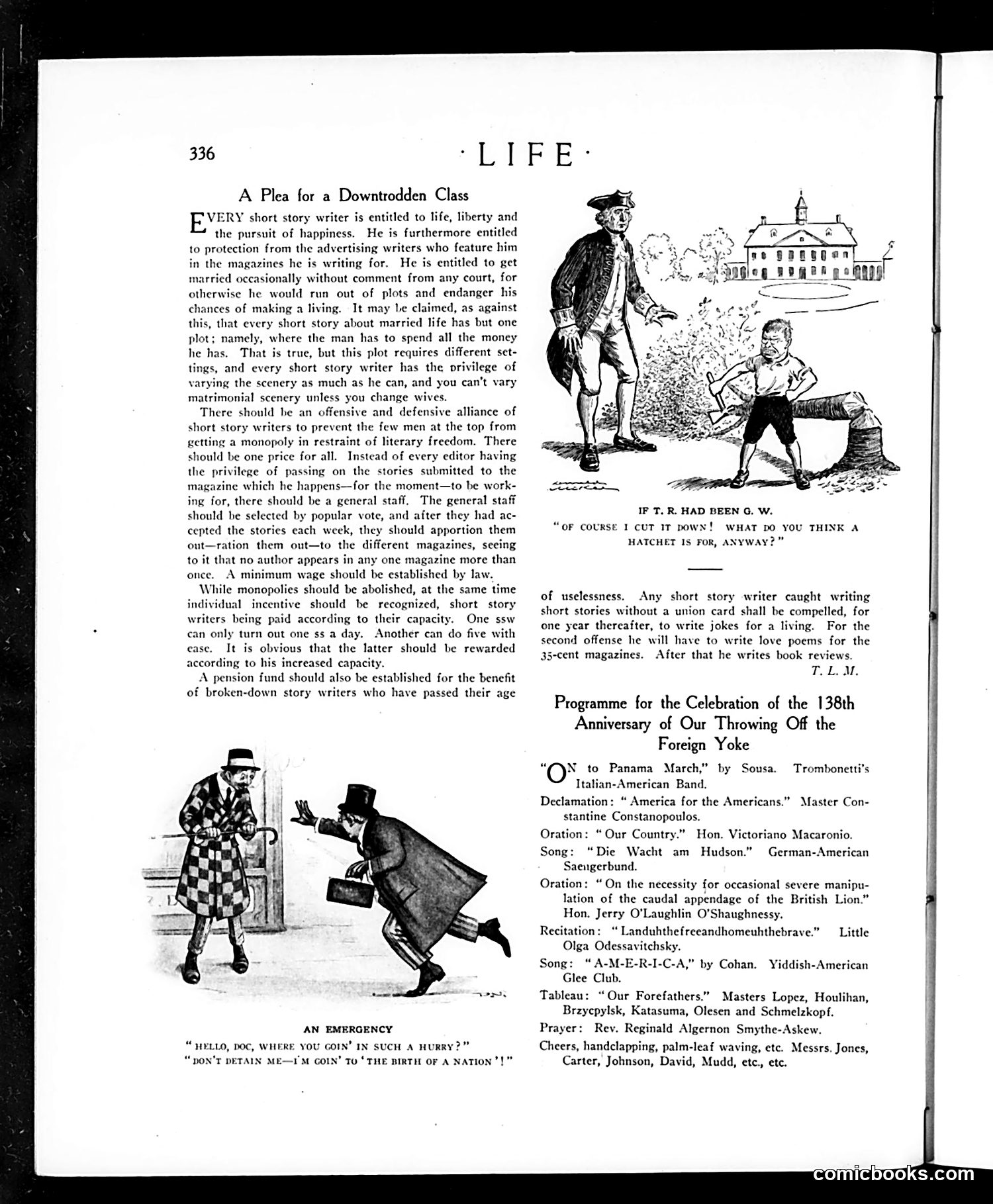
This page contains two main editorial cartoons satirizing early 20th-century American social issues: **"If T.R. Had Been G.W."** depicts a man and boy discussing a hatchet, referencing the famous George Washington cherry-tree legend. The joke appears to satirize Theodore Roosevelt's rough demeanor by contrasting it with Washington's supposed honesty. **"An Emergency"** shows two figures in frantic motion—one appears to be a panicked official or bureaucrat. The caption's reference to "going to 'the birth of a nation'" likely alludes to D.W. Griffith's controversial 1915 film, suggesting satirical commentary on contemporary cultural or political urgency. The page's upper section contains editorial commentary advocating for short-story writers' rights and professional standards in publishing—a labor/economic issue of that era.
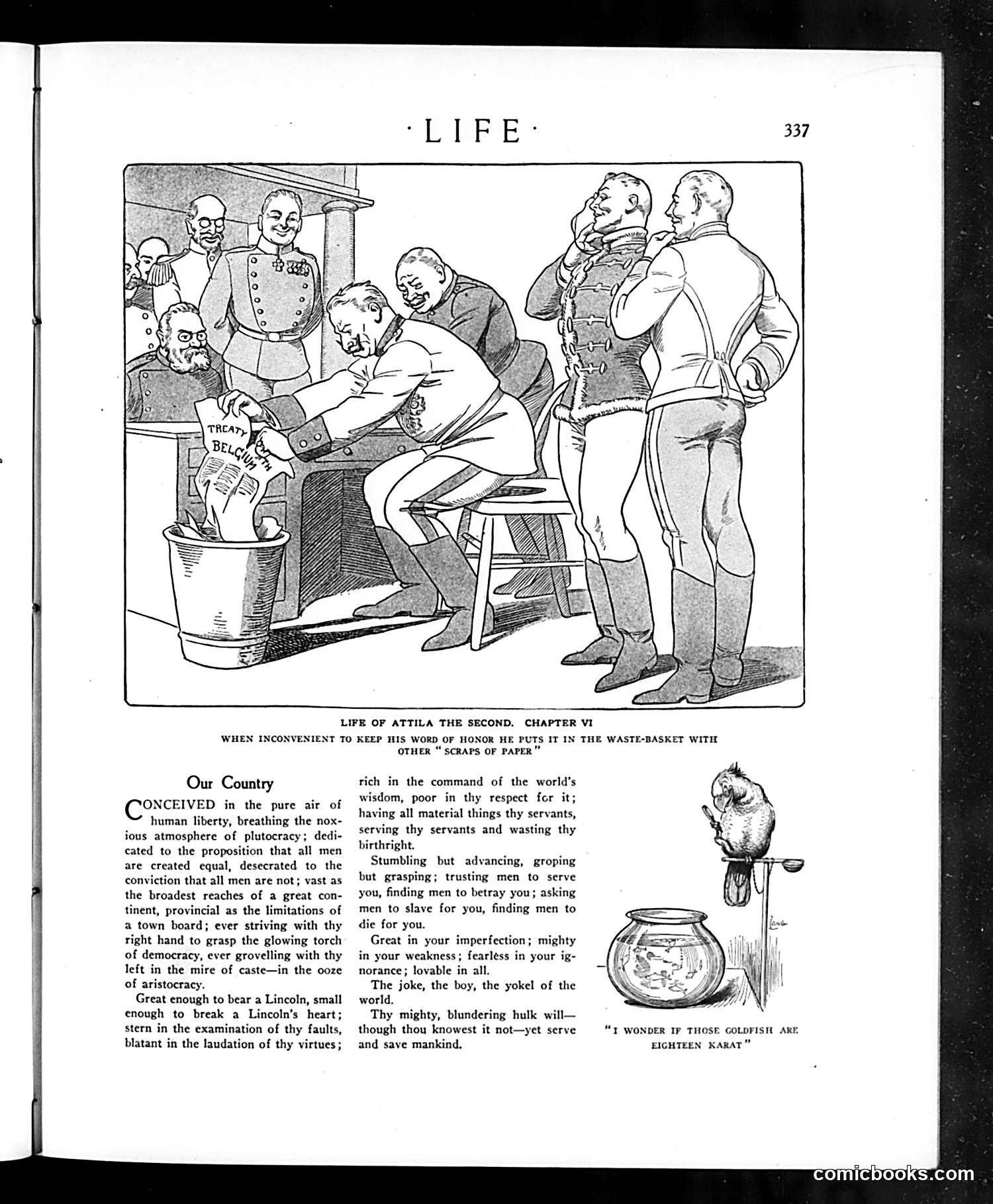
This Life magazine page satirizes military and political leadership, specifically what appears to be commentary on Austro-Hungarian authority during WWI era. The main cartoon depicts a high-ranking military officer (identifiable by elaborate uniform and medals) signing a document while seated, surrounded by subordinate officers. The caption indicates he's placing his "word of honor" in a waste basket rather than honoring it—a scathing critique of broken promises or dishonorable conduct by leadership. The accompanying essay "Our Country" attacks leaders who espouse democratic ideals while acting autocratically—"great enough to bear a Lincoln" yet betraying foundational principles. The satire suggests military brass prioritized expedience over integrity, reducing their pledges to mere "scraps of paper."
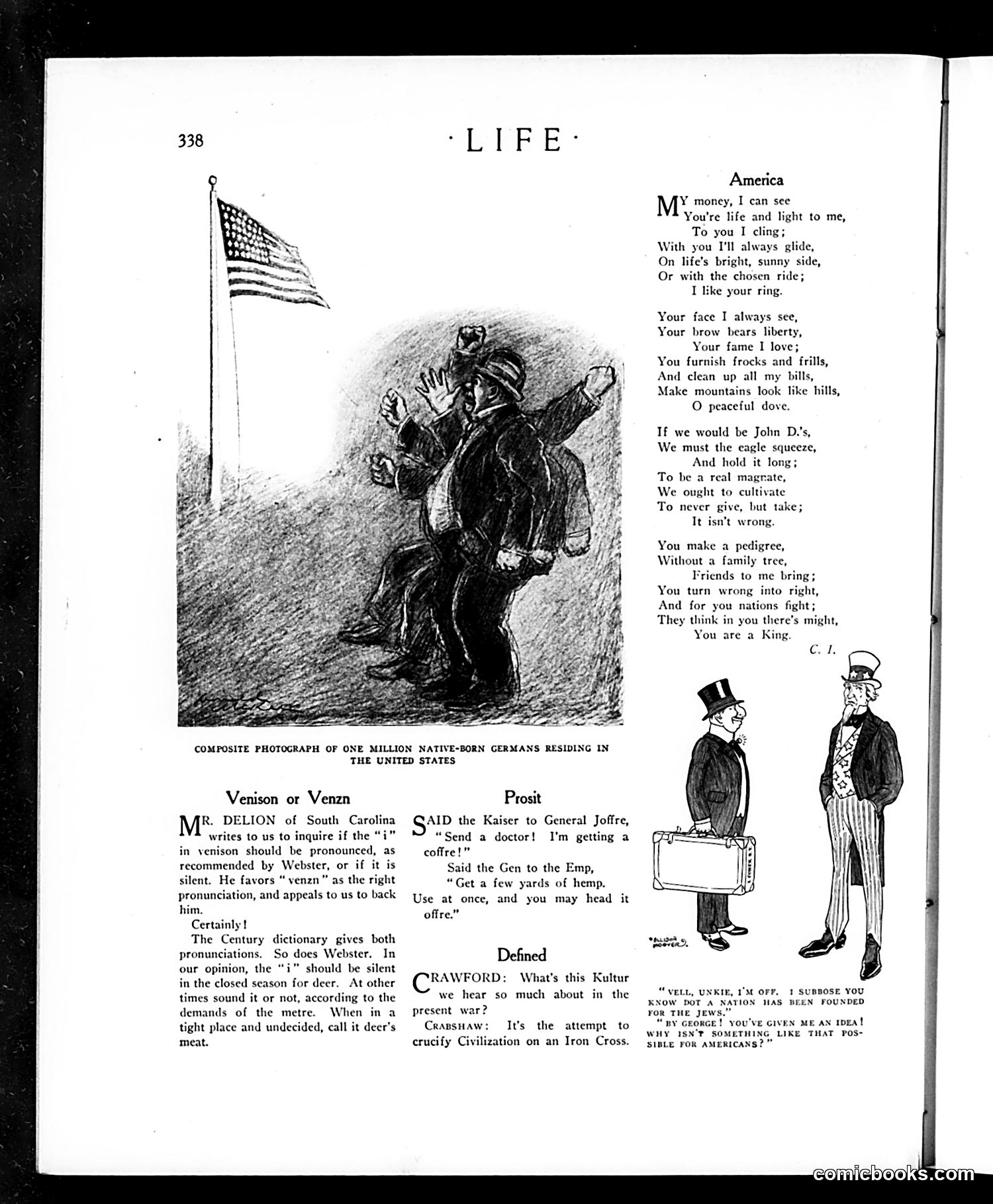
This page from *Life* magazine contains WWI-era American satire. The large central cartoon depicts Uncle Sam (identifiable by the flag and characteristic figure) embracing German immigrants, with the caption noting it's a "composite photograph of one million native-born Germans residing in the United States." The accompanying poem "America" addresses concerns about German-American loyalty during the war, asking them to support American interests. The bottom section includes satirical exchanges mocking Kaiser Wilhelm II and German military leadership, with jokes about coffee shortages and the concept of "Kultur" (German civilization). The cartoon pairs of suited gentlemen likely represent American and foreign diplomats or politicians. The overall message reflects American anxiety about German-American populations' allegiances during World War I.
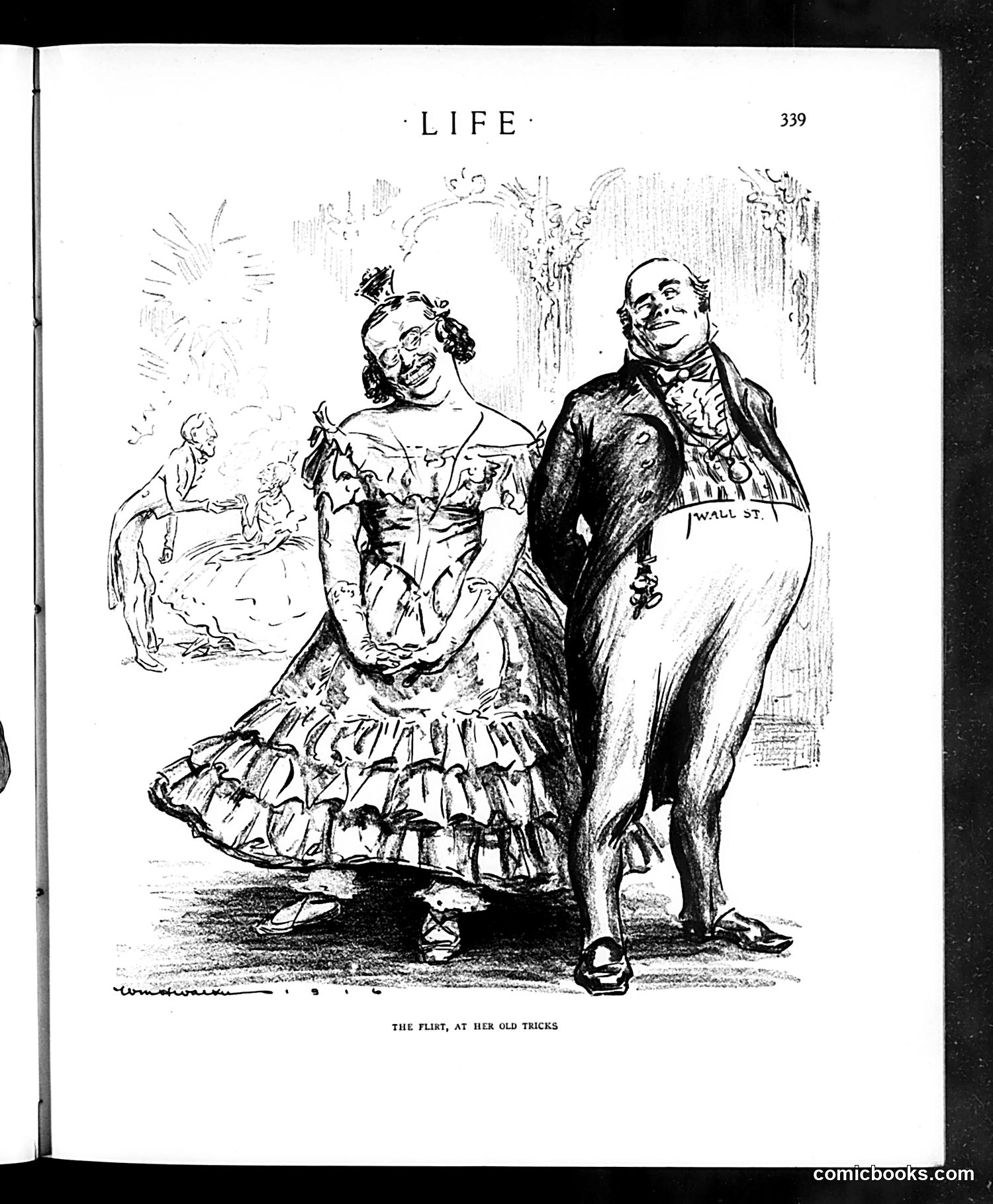
This satirical cartoon depicts a woman in an elaborate ball gown flirting with a portly man labeled "WALL ST." (representing Wall Street/financial interests). In the background, smaller figures appear to be engaged in financial activity or speculation. The satire criticizes how a woman—likely representing America, a specific social class, or perhaps a political figure—uses charm and manipulation ("old tricks") to win favor from wealthy financial interests. The exaggerated caricature style and the woman's coquettish expression suggest mockery of superficial flirtation as a means of gaining financial advantage or influence. The cartoon likely comments on corruption, influence-peddling, or the compromising relationships between political/social figures and Wall Street during the period when *Life* magazine published such satirical content.
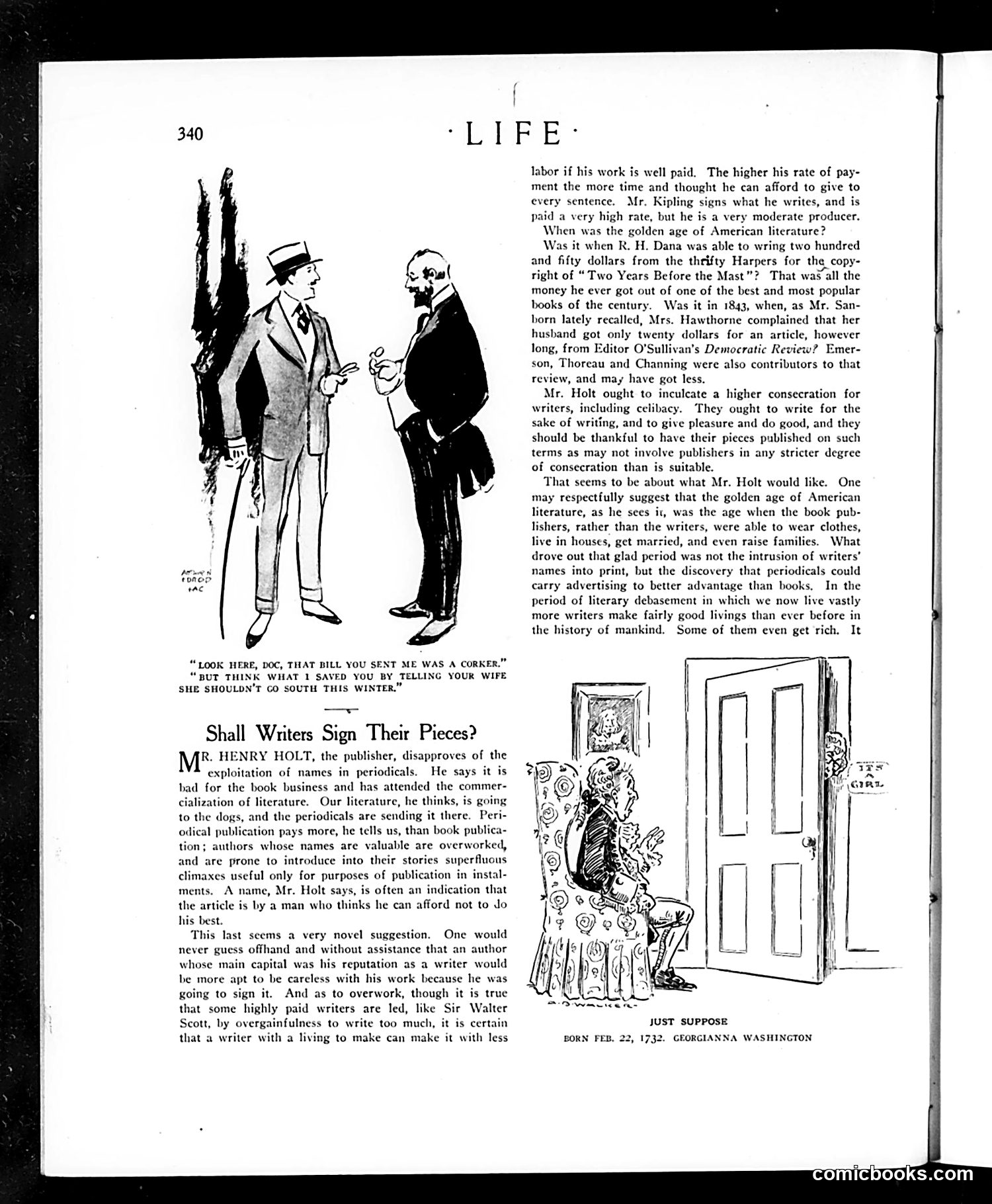
This page satirizes publisher **Henry Holt's** argument against writers signing their work in periodicals. Holt claimed bylines harm literature by encouraging overwork and carelessness, and that anonymous publication maintains quality. Life's rebuttal uses historical evidence: early American authors like R.H. Dana and Nathaniel Hawthorne were *grossly underpaid* for unsigned work—Dana received only $250 for "Two Years Before the Mast." The article argues the "golden age" Holt nostalgically recalls was actually when *publishers* profited while writers starved. Modern improvements in writer compensation came precisely *because* signed work proved valuable to periodicals carrying advertisements. The top cartoon jokes darkly about a doctor billing a patient for "saving" money by advising against a trip—rewarding poor service through deception. The bottom illustration references Georgianna Washington (born 1732), likely a humorous aside about early American history, though its connection to the main article is unclear.
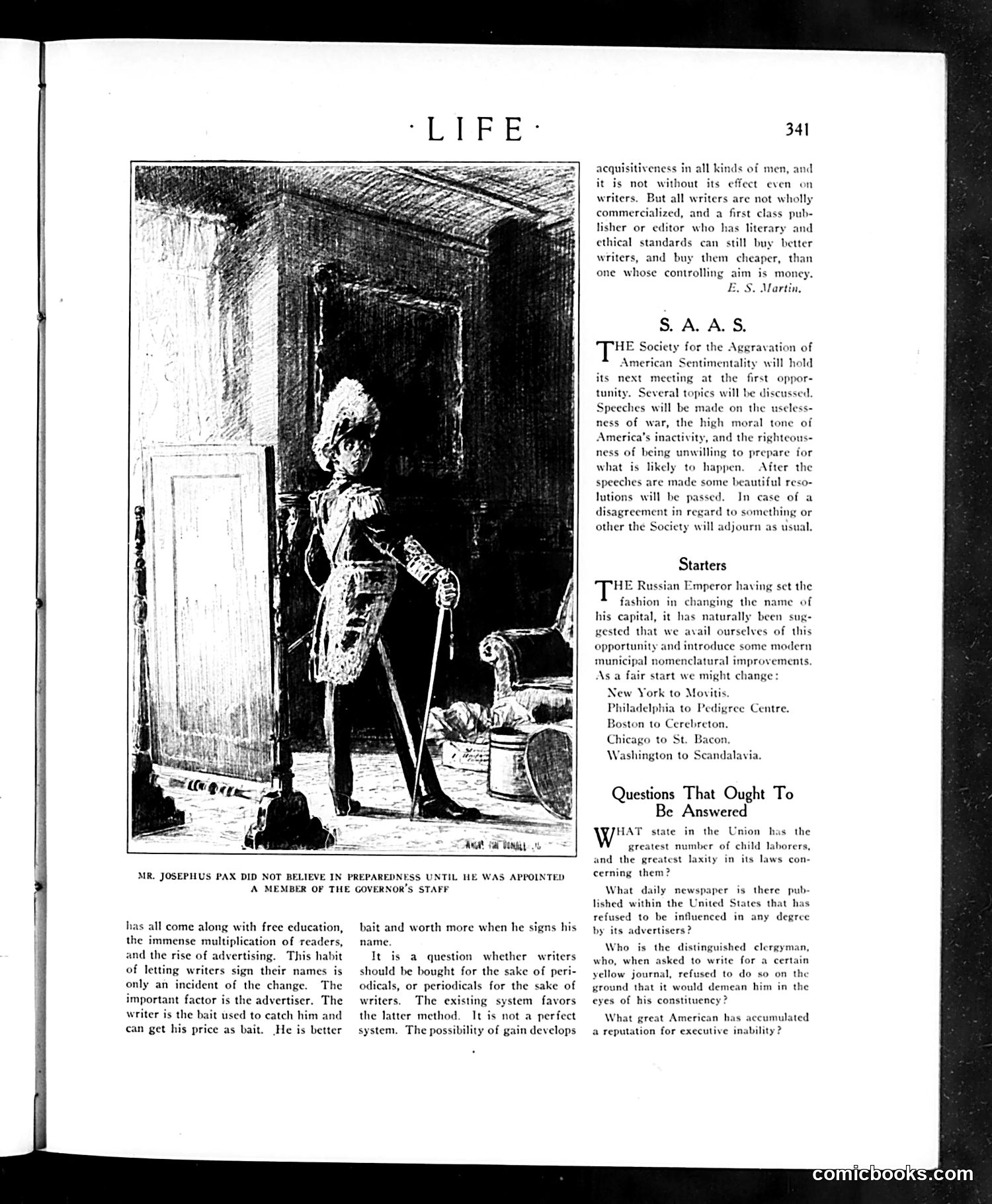
The main cartoon satirizes opportunism during wartime preparedness debates. "Mr. Josephus Pax" (his name ironically means "Joseph Peace") is depicted as a pacifist who suddenly becomes a military advocate after receiving a prestigious appointment to the governor's staff—suggesting he adopted hawkish views purely for social advancement and prestige rather than principle. The accompanying text mocks the "Society for the Aggravation of American Sentimentality," criticizing Americans who opposed military preparedness on moral grounds while praising their own "righteousness" and inactivity. This references pre-WWI isolationist sentiment, sardonically suggesting such pacifism was hypocritical moralizing. The "Starters" section jokes about renaming cities with commercial/materialist names (Chicago to "St. Bacon"), mocking American commercialism. The final section poses rhetorical questions about American hypocrisy: child labor, newspaper corruption by advertisers, and clergy compromised by yellow journalism—all suggesting American institutions lacked moral integrity.
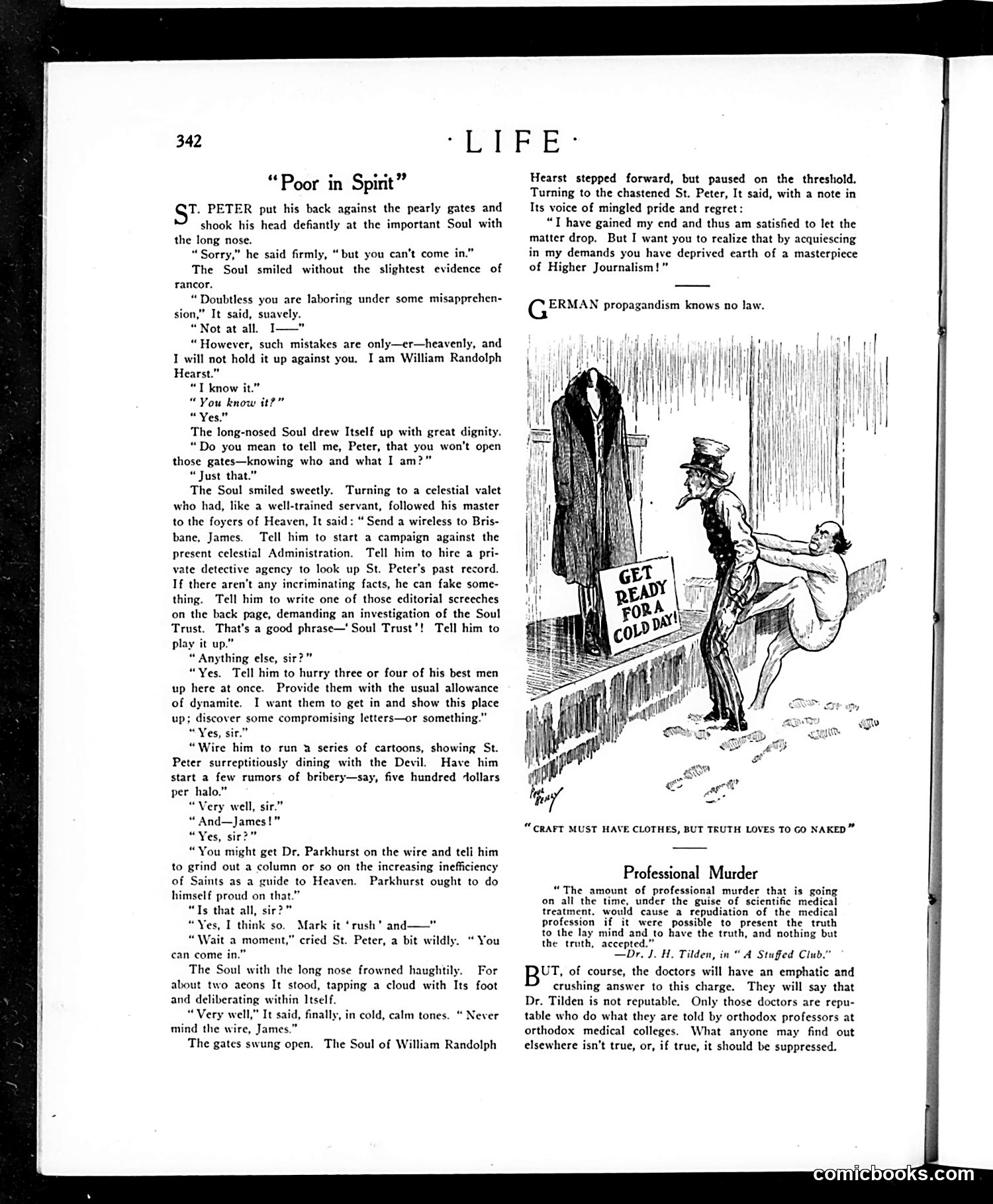
**The Main Cartoon: "Poor in Spirit"** This satirical piece depicts William Randolph Hearst (the newspaper magnate) being denied entry to Heaven by St. Peter. The cartoon mocks Hearst's ruthless tactics: when refused admission, his Soul instructs an aide to orchestrate a smear campaign against St. Peter—hiring detectives, fabricating scandals, running cartoons, spreading bribery rumors, and enlisting reformers like Dr. Parkhurst to attack Heaven's administration. The joke's pointed barb: St. Peter capitulates immediately, unable to withstand Hearst's propaganda machinery. Hearst then smugly declines entry anyway, claiming he's satisfied having "deprived earth of a masterpiece of Higher Journalism." **The Satire:** Life attacks Hearst's notorious yellow journalism tactics—his willingness to fabricate stories, manufacture outrage, and destroy reputations to achieve his goals. The cartoon suggests these methods are so powerful that even divine authority cannot resist them. **Secondary Article: "Professional Murder"** A brief critique of medical malpractice covered up by professional gatekeeping in medical colleges.
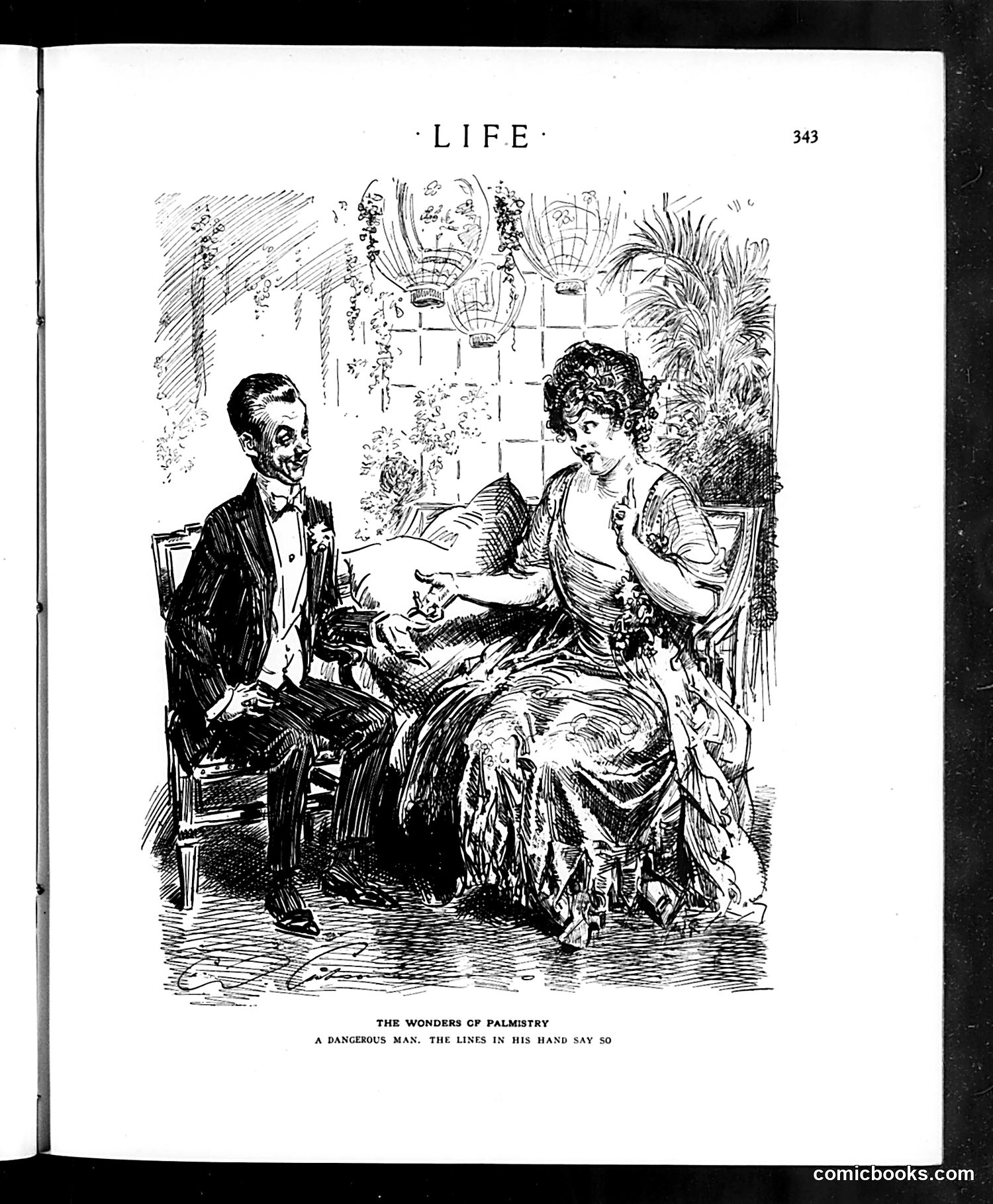
This illustration satirizes palmistry—the pseudoscientific practice of reading character and fortune from hand lines. The caption's irony is the joke: a well-dressed gentleman sits with two women examining his palm, presumably to have his fortune told. The caption declares him "dangerous" based on his hand lines, yet nothing in his appearance suggests danger; he looks respectable and genteel. The satire mocks both palmistry itself (as fraudulent) and the gullibility of people—particularly women—who believed in it. By labeling an ordinary-looking man as "dangerous" based on superstitious hand-reading, the cartoonist ridicules the entire practice as unreliable and absurd. This reflects late 19th/early 20th-century skepticism toward occult practices and fortune-telling that were popular among the public.
This satirical editorial addresses American military preparedness during World War I. The text critiques Congress's sluggish response to President Wilson's defense initiatives, particularly regarding formation of a "Continental army." **Key figures referenced:** - **President Wilson**: criticized for taking "a year and a half" to recognize military necessity - **Lindley M. Garrison**: Secretary of War who resigned in frustration over Congressional opposition to his Continental Army proposal - **Congress**: portrayed as slow, imaginative, and reluctant to spend on unfamiliar military structures **The satire's point:** Life mocks Congressional inertia—they move cautiously on unprecedented spending despite European war raging nearby. The opening cartoon joke suggests America invite Britain and Germany to fight on U.S. soil as a "lesson." **Political context:** This reflects pre-WWI American isolationism and Congressional resistance to military expansion, complicated by whether to support state militias (favored by Democrats) versus a federal Continental Army (favored by Wilson's administration). The editorial reveals America's defensive anxiety in 1916, when entry into WWI seemed increasingly possible.
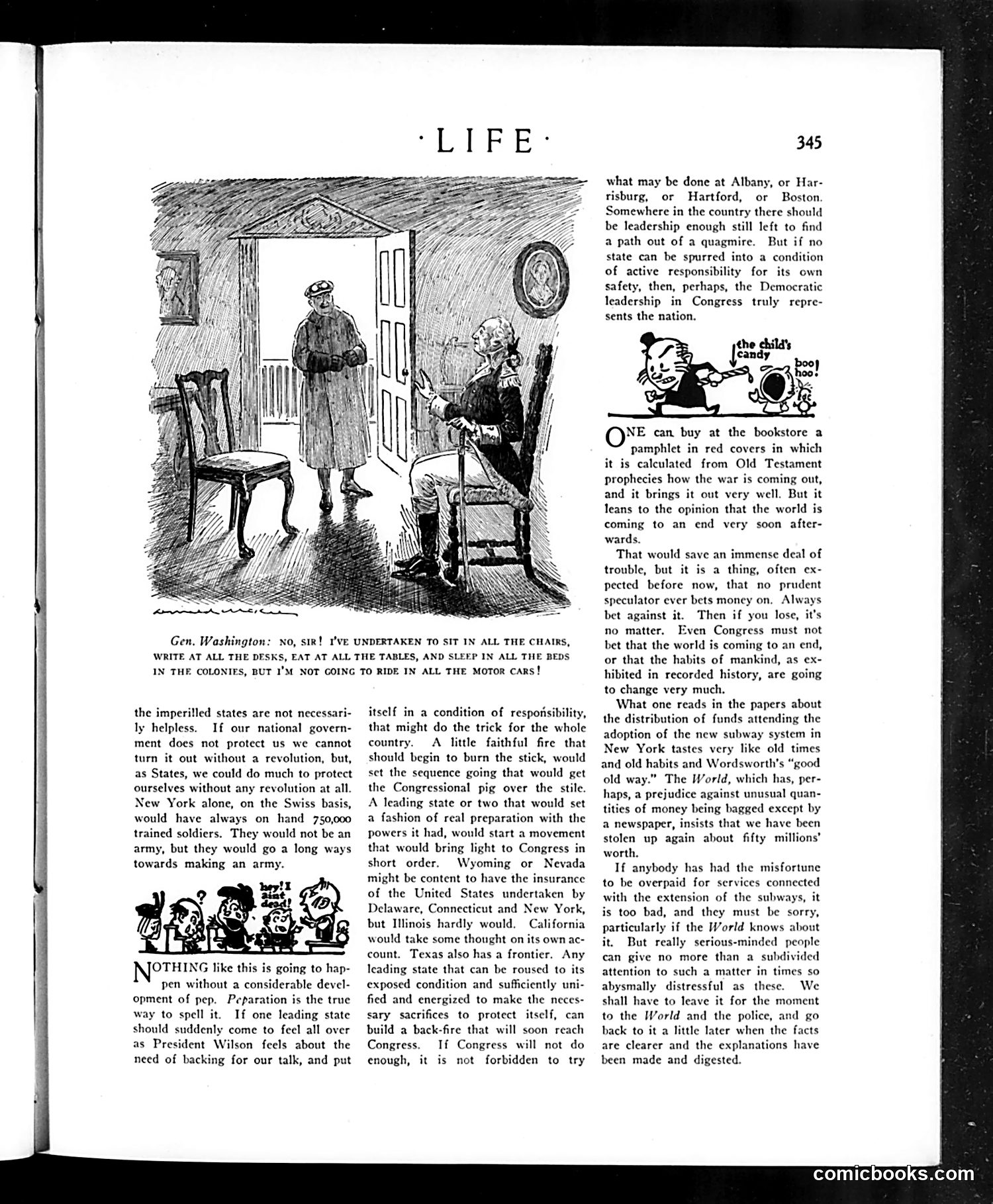
The main cartoon depicts **General George Washington** refusing to ride in motor cars, despite agreeing to sit in all colonial chairs, write at all desks, eat at all tables, and sleep in all beds. This is satirical commentary on **preparedness for World War I**. The joke contrasts Washington's willingness to sacrifice everything for the nation with his refusal of modern technology—suggesting Americans should embrace new methods (motor cars/military modernization) necessary for contemporary warfare, not cling to outdated approaches. The accompanying text argues that **individual states** should take military preparation seriously rather than relying on Congress, which the author suggests is failing in its duty. The satire mocks Congressional inaction on war readiness while praising Washington's willingness to sacrifice, implying modern leaders should show similar commitment to defensive preparation using modern means.
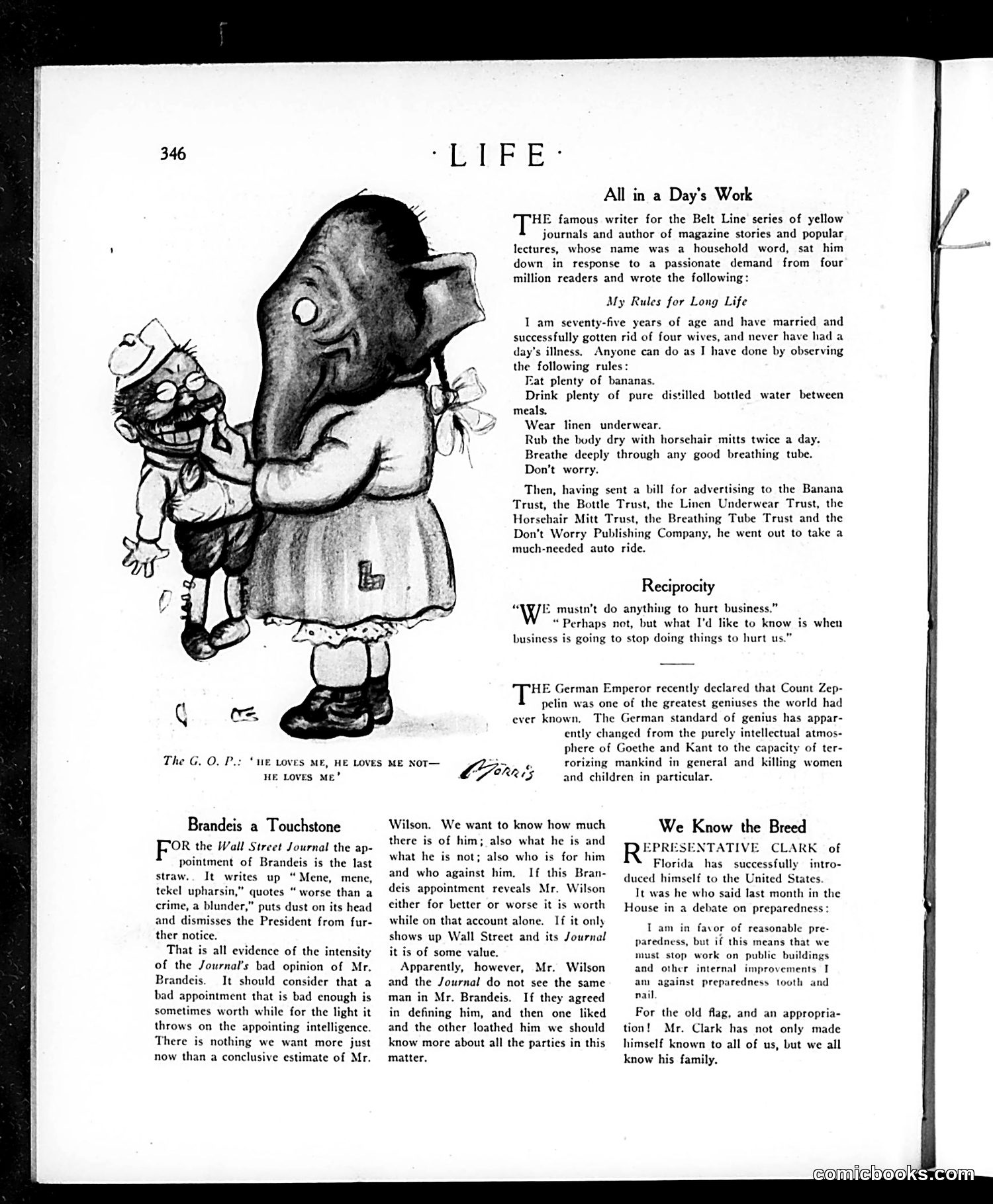
This page satirizes a famous popular writer (identity unclear from text alone, but described as prolific in "yellow journals") who has become a self-help authority. The cartoon mocks his absurd "Rules for Long Life"—eating bananas, wearing horsehair mitts, using breathing tubes—which are transparently designed to advertise various corporate trusts (Banana Trust, Bottle Trust, etc.). The satire suggests this writer profits by disguising advertisements as health advice while claiming to serve "four million readers." The secondary pieces target other targets: German militarism (Count Zeppelin), President Wilson's Brandeis appointment (seen as either revealing Wilson's character or exposing Wall Street's hypocrisy), and Representative Clark of Florida, mocked for prioritizing patriotic spending on monuments over practical "preparedness" measures during what appears to be a pre-WWI debate. The overall theme: expose contradiction between public virtue and private interest.
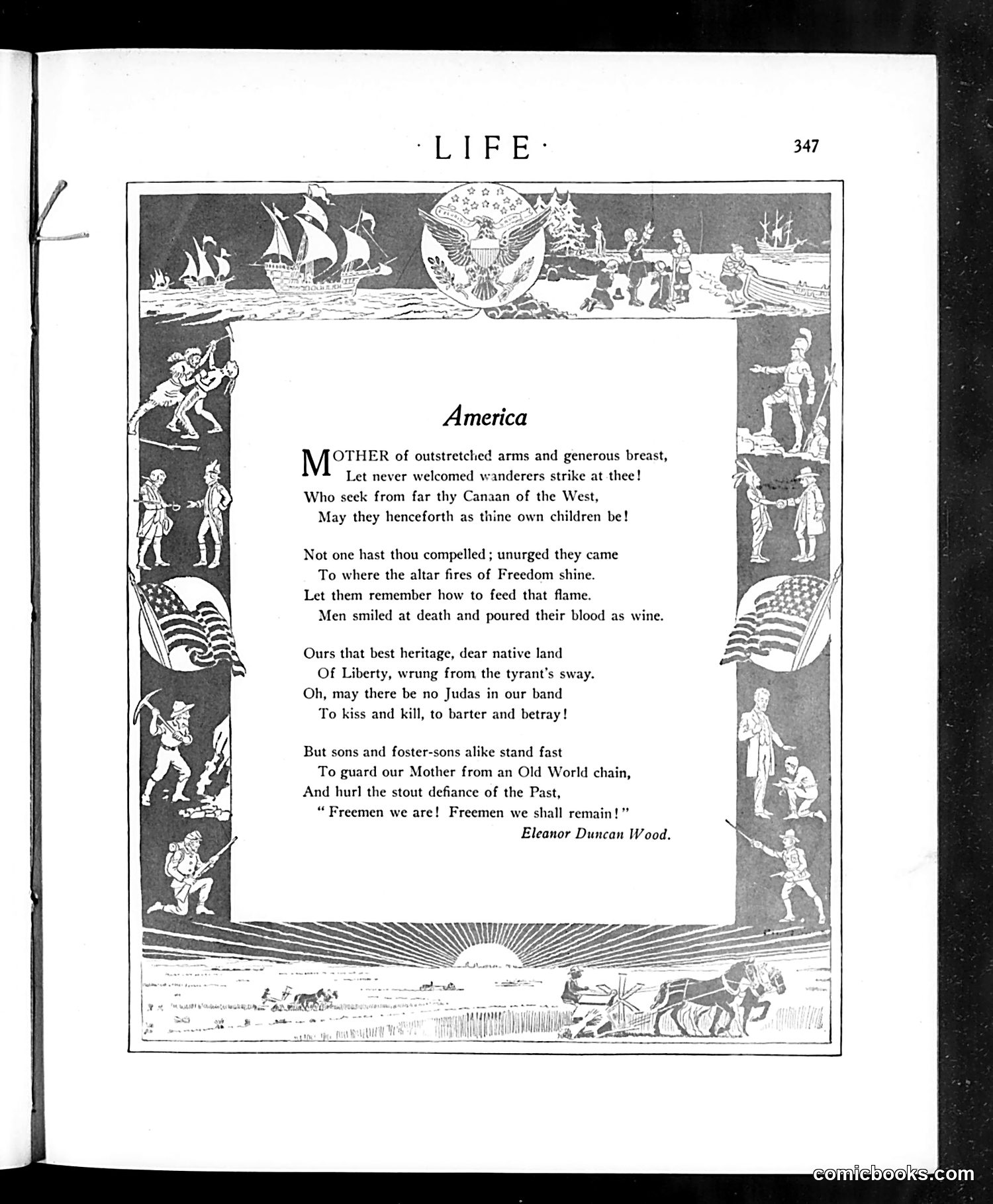
This is a patriotic poem by Eleanor Duncan Wood, not a political cartoon. It appears in *Life* magazine as celebratory verse about American identity and immigration. The poem personifies America as a "Mother" welcoming immigrants ("wanderers") as children. It emphasizes that immigrants came voluntarily—"not one hast thou compelled"—to embrace American freedom, contrasting this with "Old World" tyranny. The decorative border features colonial imagery (ships, soldiers, Native Americans, the Great Seal) and American flags, reinforcing patriotic themes. The poem warns against internal betrayal ("no Judas in our band") and calls on "sons and foster-sons alike" to defend American liberty together. It reflects early 20th-century immigrant-friendly American nationalism, portraying immigration as compatible with American freedom rather than as a threat.
This appears to be a dramatic illustration from Life magazine showing a figure lying down in deep shadow, rendered in stark black and white. The artistic style—with heavy shadows and emotional intensity—suggests this depicts a moment of crisis, death, or moral reckoning. Without visible text identifying the specific subject or political context, I cannot definitively say who is depicted or what historical event this references. The signature appears to read "Poul Henningsen" or similar. The "LIFE" header indicates this is from the satirical publication, and the theatrical, shadowy treatment suggests social or political commentary typical of Life's editorial illustrations from the early-to-mid 20th century, but the specific target of the satire remains unclear from the image alone.
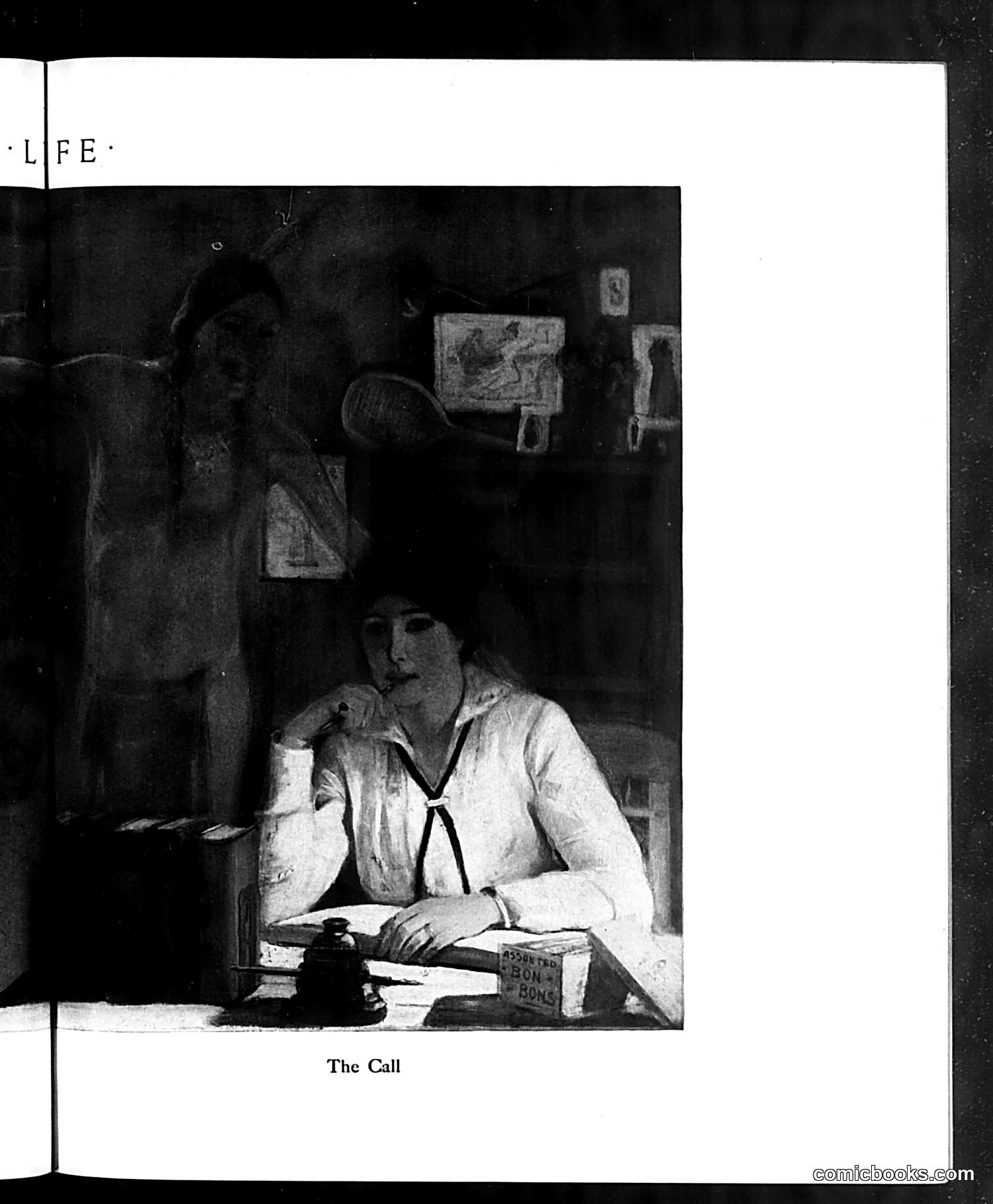
This appears to be a satirical illustration showing a woman at a desk in what looks like an office or institutional setting. She's seated at a typewriter with papers and a box labeled "ASSORTED BON BONS" visible. Behind her are posted notices on the wall, and there's a silhouette of another figure. The caption "The Call" suggests this depicts a woman responding to some kind of summons or professional duty. Given Life magazine's satirical nature, this likely comments on women entering the workforce or taking on professional roles, possibly during a period when such work was still considered unconventional. The "bon bons" detail might ironically suggest assumptions about women's interests conflicting with their professional duties, though without additional context, the specific historical reference remains unclear.
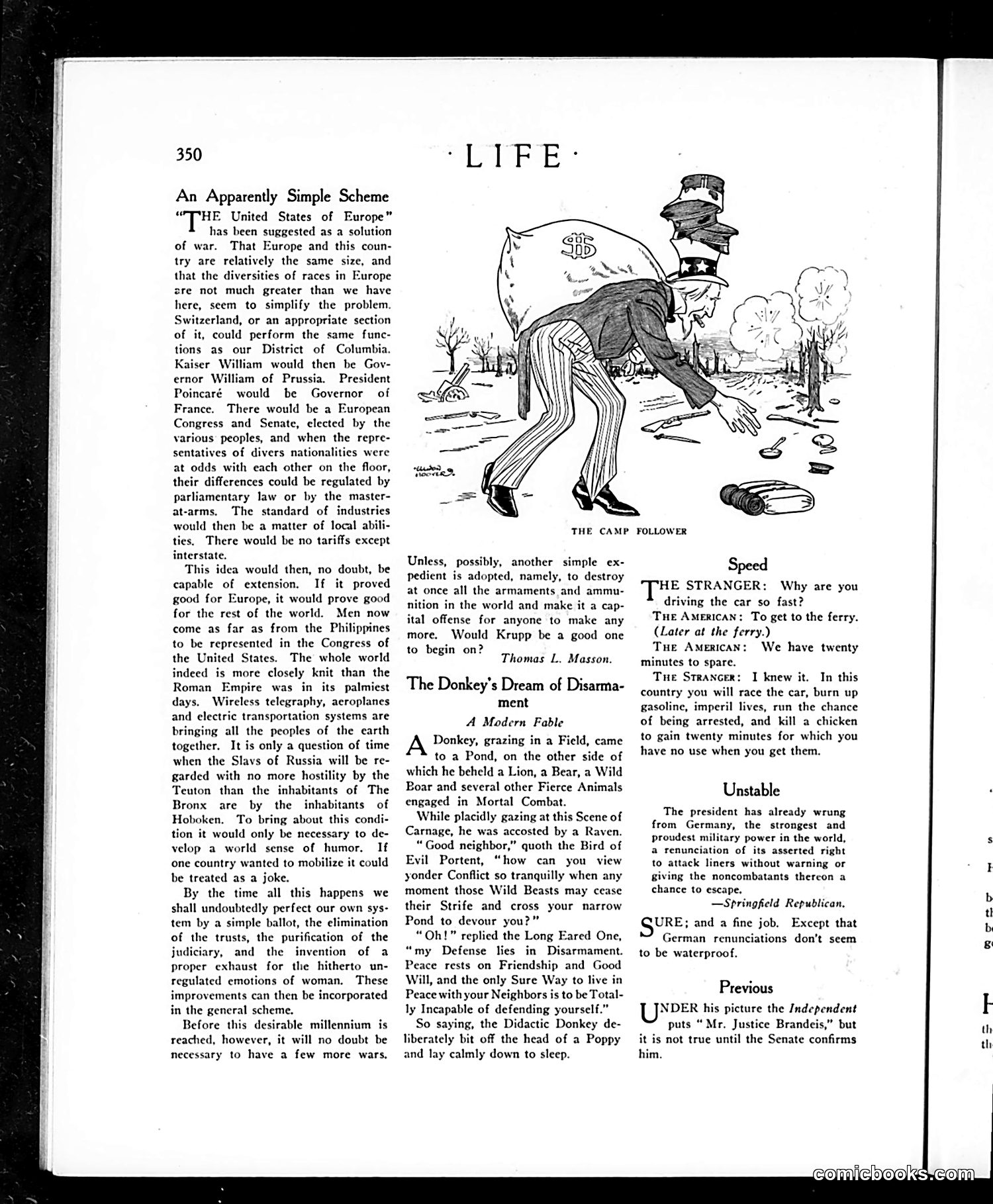
This page satirizes World War I-era idealism and American naïveté. The main article proposes a "United States of Europe"—treating European nations like American states with Kaiser Wilhelm as "Governor of Prussia" and Poincaré as "Governor of France." The satire mocks this oversimplification: Europe's ethnic conflicts are presented as no worse than tensions between the Bronx and Hoboken, yet the author acknowledges "a few more wars" will likely be necessary first. The accompanying fable reinforces the point: a naive Donkey preaches total disarmament to dangerous predators (Lion, Bear, Wild Boar)—representing warring European powers—then passively awaits destruction. The moral: pacifism without military capability is foolish. The "Speed" dialogue jokes about American impatience and recklessness. Together, these pieces mock both naive pacifist internationalism and American cultural assumptions about solving European conflicts.
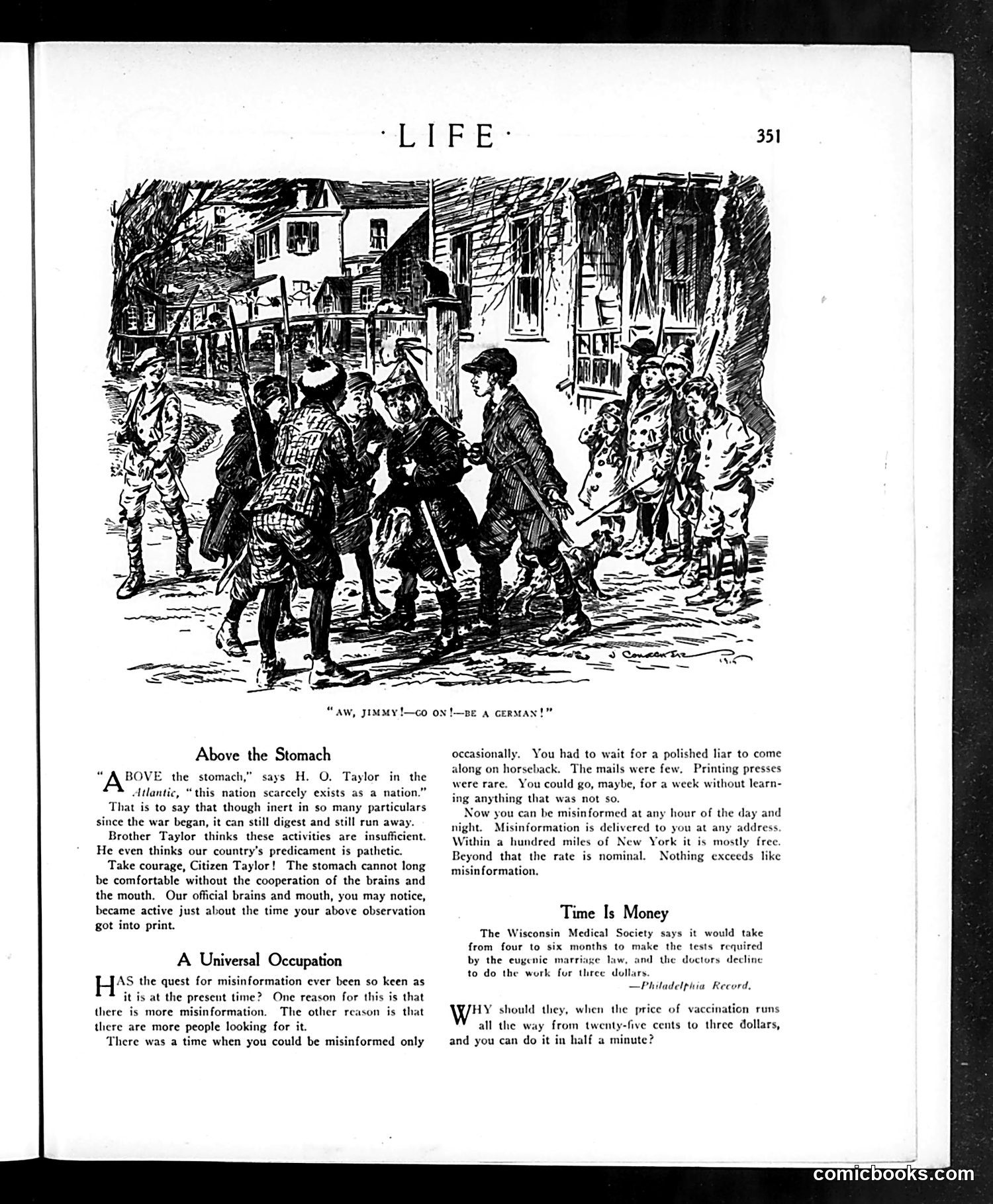
**The Cartoon ("Aw, Jimmy!—Go On!—Be a German!")** A street scene depicts children pressuring a boy named Jimmy to "be a German," likely referencing anti-German sentiment during World War I. The satire mocks how Americans were coercing others into patriotic conformity or hostile attitudes toward Germans, portraying such peer pressure as childish mob behavior. **"Above the Stomach"** A critique of American passivity citing H.O. Taylor's *Atlantic* article. The piece argues the nation has been inactive since war began, functioning only at a basic survival level ("stomach") without engaging higher faculties (brain, mouth—thought and speech). The author notes this criticism became relevant precisely when government action finally occurred. **"A Universal Occupation"** A humorous complaint about the modern proliferation of misinformation. Unlike earlier eras when false information spread slowly via occasional liars and rare mail, modern technology (implicitly newspapers, telephony) enables constant misinformation delivery "at any address." **"Time Is Money"** A brief note mocking Wisconsin doctors' resistance to eugenic marriage law testing for only three dollars, while vaccination services charge more for less work—questioning inconsistent professional compensation standards.
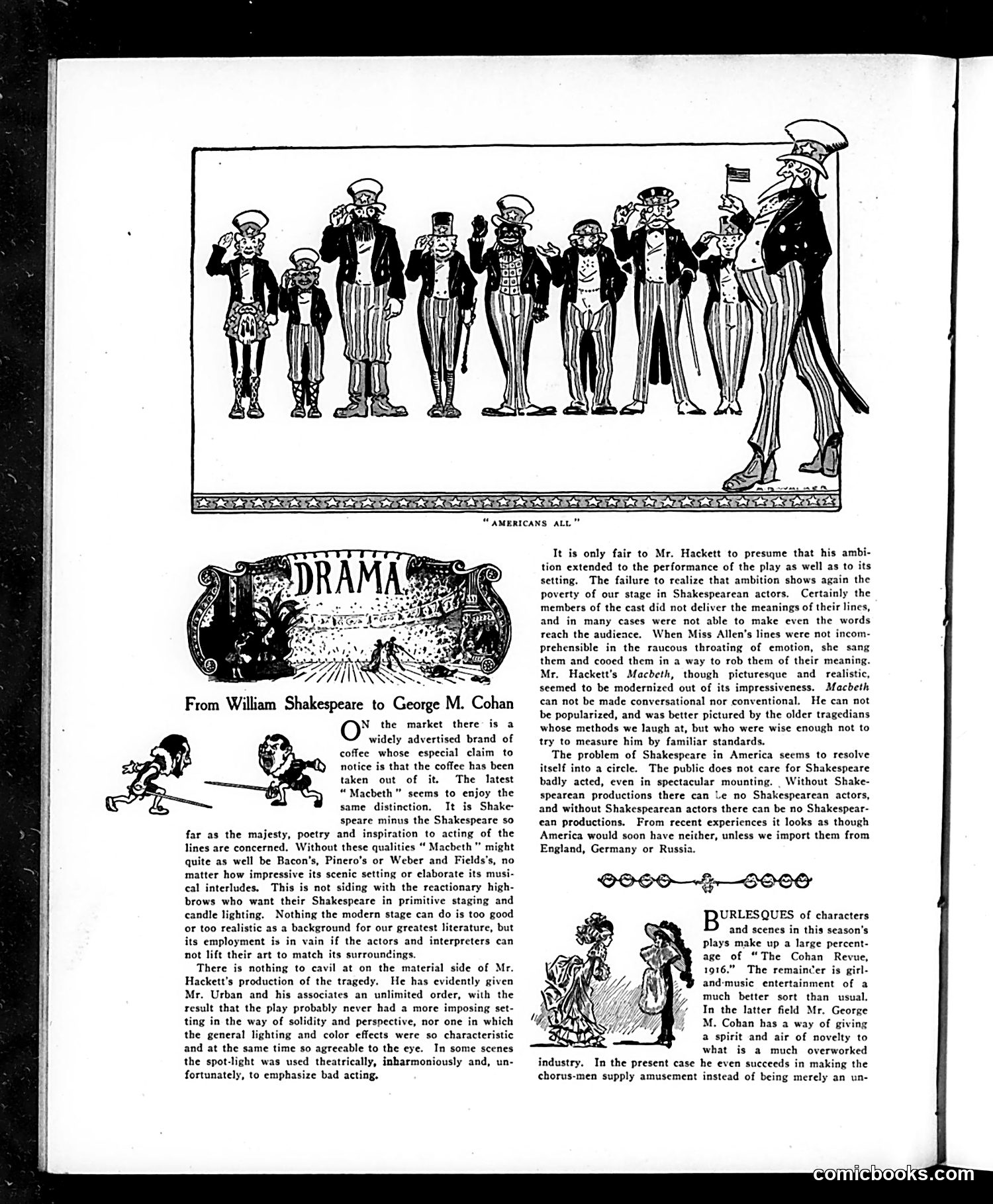
This page critiques actor James K. Hackett's production of *Macbeth*, likely from around 1916 (based on the Cohan Revue reference). The headline illustration "Americans All" shows figures representing different ethnicities or social types. The review's central argument: Hackett invested heavily in spectacular scenery and staging (designed by Joseph Urban) but failed in the crucial element—the *acting*. The critic compares this to decaffeinated coffee: all presentation, no substance. Specific complaints include Miss Allen's incomprehensible, overly theatrical delivery, and Hackett's modernized interpretation that made Shakespeare conversational rather than grand. The critic argues Shakespeare cannot be "popularized" and requires skilled interpreters—a resource America lacks. The piece identifies a vicious circle: without good Shakespearean actors, productions fail; without productions, actors cannot develop. The solution, the reviewer suggests, is importing talent from England, Germany, or Russia.
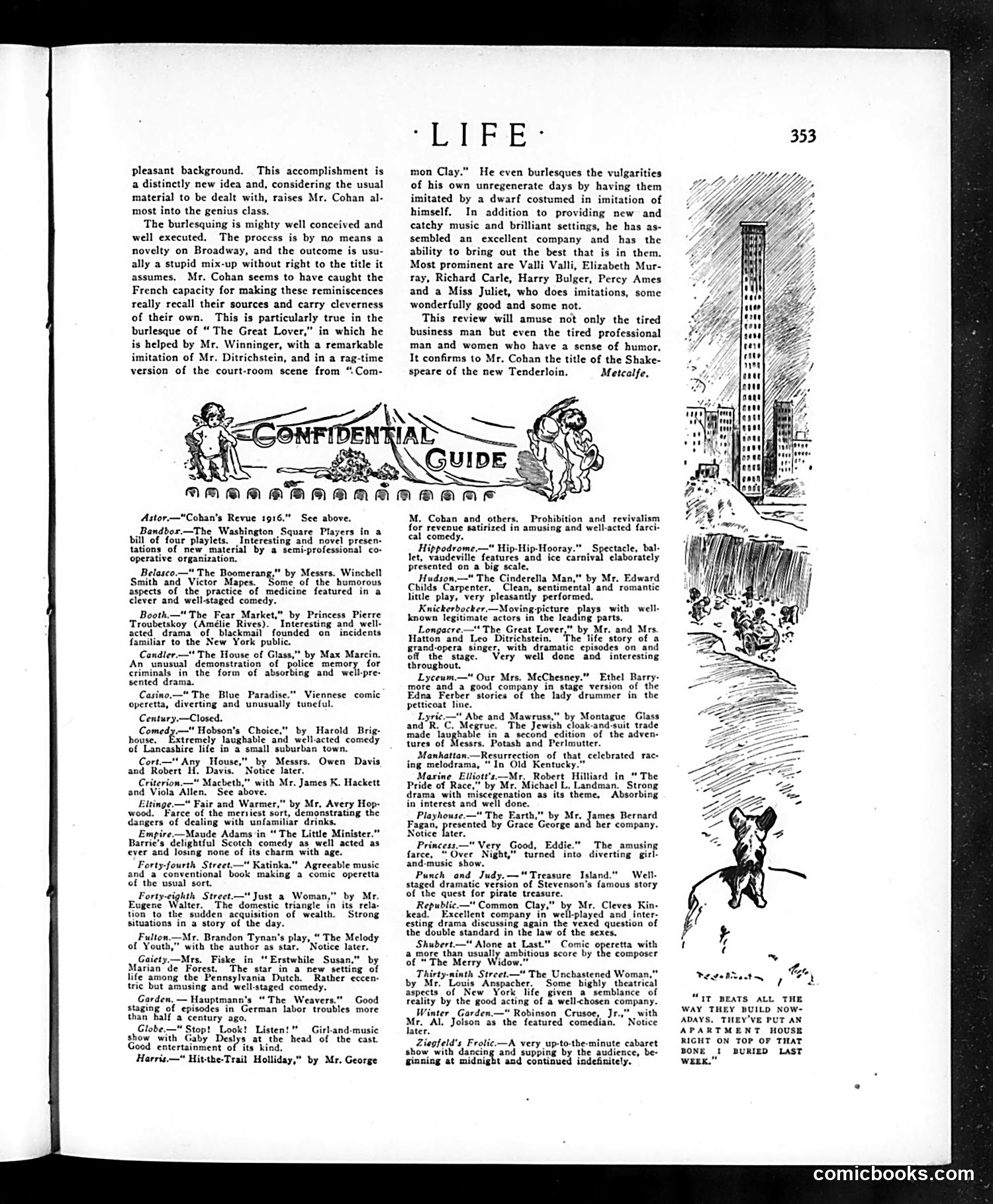
This page contains theater reviews from Life magazine's "Confidential Guide" section, a satirical column reviewing Broadway productions. The main text discusses George M. Cohan's "Revue 1916," praising his burlesque work and company of actors (Valli Valli, Elizabeth Murray, Richard Carle, Harry Bulger, Percy Ames, and "Miss Juliet"). The decorative header illustration shows two figures in theatrical poses flanking the title—typical of Life's satirical style. The cartoon's humor lay in mocking both tired businessmen attending shows and the pretensions of professional theater-goers. The column reviews numerous Broadway productions with brief, witty critiques—a common Life feature offering readers sarcastic commentary on current entertainment. References to specific theaters (Astor, Belasco, Casino, etc.) and playwrights anchored readers in NYC's theater scene circa 1916.
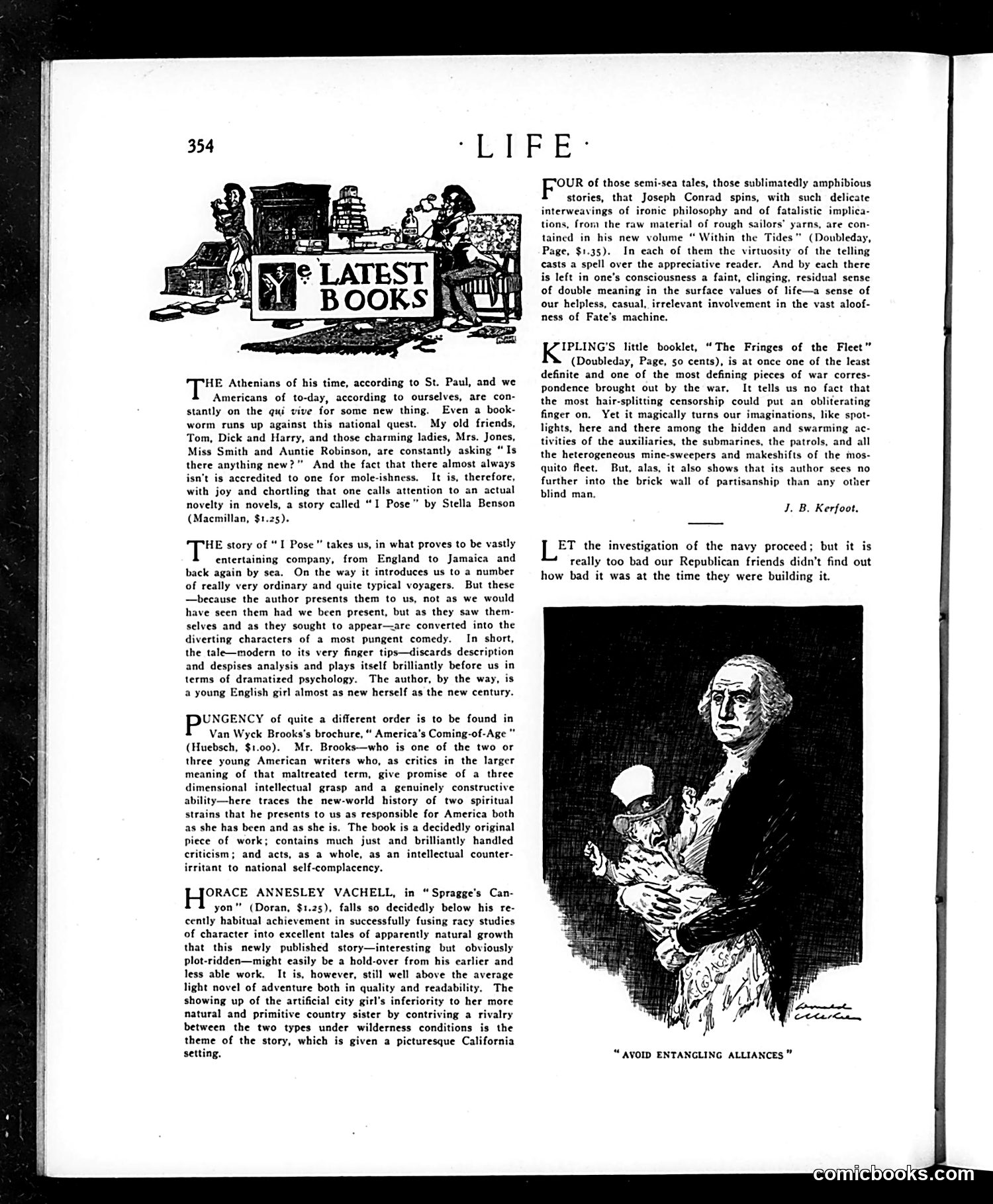
This is a **book review section** from Life magazine, not a political cartoon page. The content discusses four contemporary literary works: 1. **"I Pose"** by Stella Benson—praised as a novel using modern "dramatized psychology" rather than traditional description 2. **"America's Coming-of-Age"** by Van Wyck Brooks—intellectual criticism of American spiritual history 3. **"Spragge's Canyon"** by Horace Annesley Vachell—adventure tale comparing city versus country women 4. **"Within the Tides"** by Joseph Conrad—sea stories with philosophical depth The single illustration captioned **"Avoid Entangling Alliances"** appears to be a political reference, likely satirizing American foreign policy isolationism (a recurring early 20th-century debate). The figure's caricatured appearance and gesture suggest disapproval of international involvement, though the specific target remains unclear without additional context. The page reflects Life's dual role as both satirical magazine and serious literary arbiter.
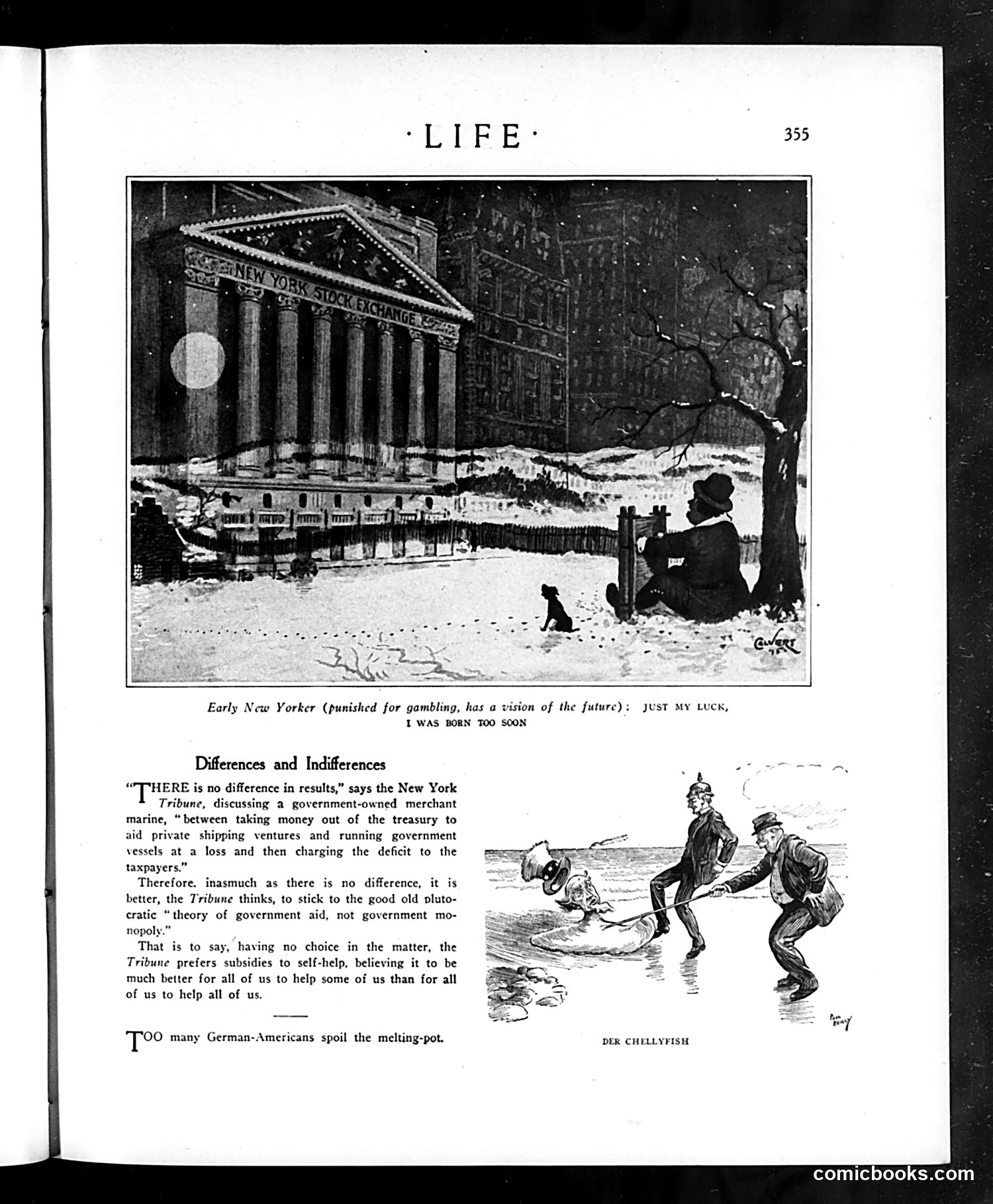
**Top Cartoon:** A gambler punished for his vice has a vision of the New York Stock Exchange transformed into a desert wasteland—satirizing the precarious nature of financial speculation and gambling culture on Wall Street. **"Differences and Indifferences" Article:** Life mocks the *New York Tribune's* contradictory editorial logic regarding government shipping. The Tribune claims there's "no difference" between private subsidies and government monopolies both costing taxpayers money, yet still advocates for private subsidies. Life ridicules this as plutocratic hypocrisy—arguing that if results are identical, self-help (government operation benefiting all) is preferable to subsidizing private interests (helping "some of us"). **"Der Chellyfish" Cartoon:** Three figures appear to be rescuing or helping someone from water, likely a political cartoon addressing tensions around German-American integration ("spoiling the melting-pot"), though the specific reference remains unclear from the image alone.
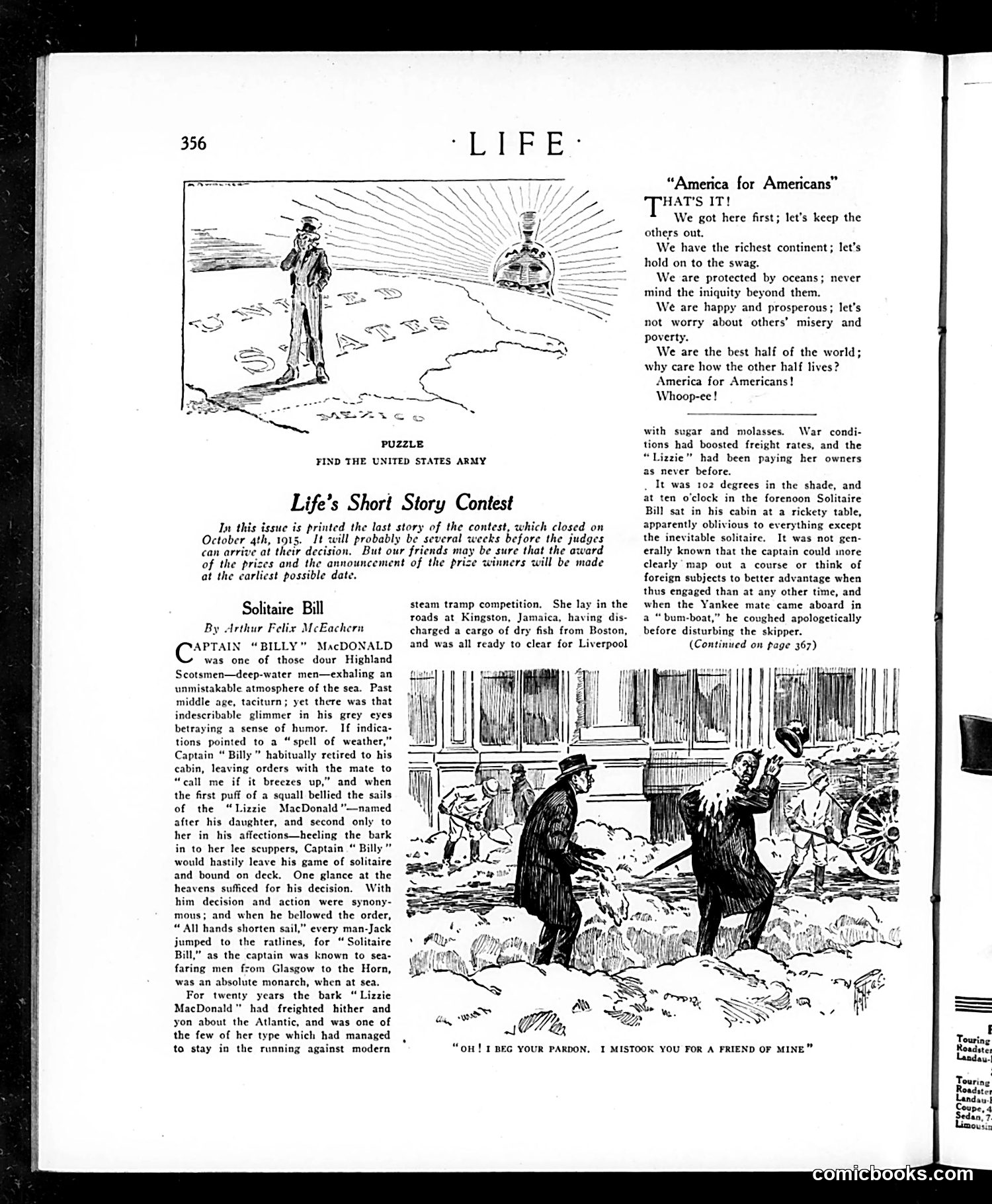
**"America for Americans" Section (Right):** This satirical poem mocks isolationist sentiment popular during World War I (the page is dated 1915). It ridicules the attitude that America should ignore global suffering and foreign conflicts, prioritize wealth accumulation ("hold on to the swag"), and seal itself off from the world. The tone is deliberately crude ("Whoop-ee!") to expose the selfishness underlying such nationalism. The phrase "why care how the other half lives?" invokes contemporary social inequality debates. **"Find the United States Army" Puzzle (Top Left):** This is a "hidden object" puzzle game where readers must locate the U.S. Army within the illustration of a standing figure gazing at sunrise/landscape. These were popular magazine features. **"Solitaire Bill" Story:** A short story about a Scottish sea captain managing his ship during wartime (when freight rates had risen due to WWI conditions). The bottom illustration shows a humorous shipboard encounter.
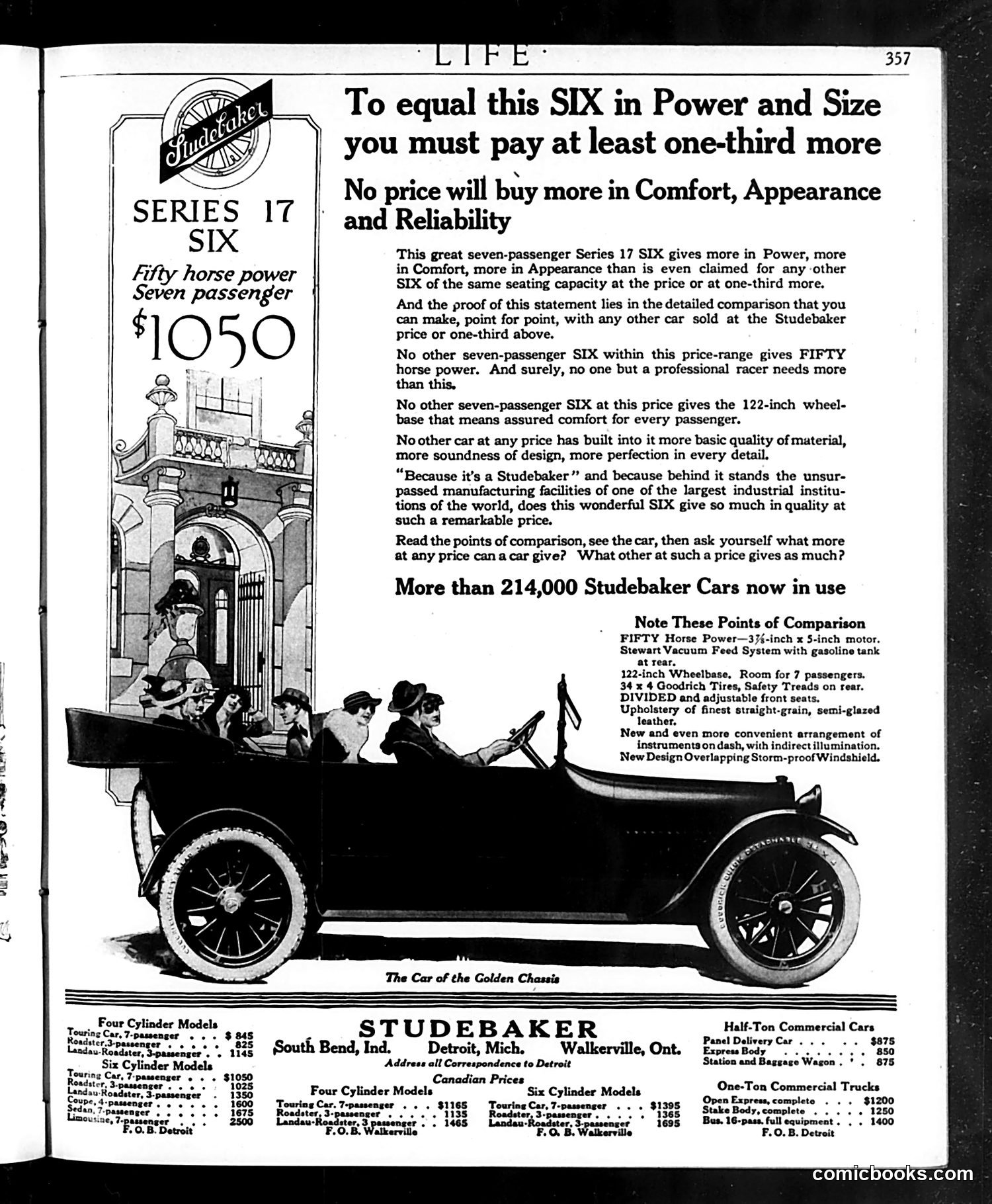
This is a **automobile advertisement**, not political satire. It promotes the Studebaker Series 17 SIX, a seven-passenger car priced at $1,050. The ad's central claim is comparative marketing: the Series 17 SIX offers more power (50 horsepower), comfort, and quality than competitors charging one-third more. The text repeatedly challenges readers to compare "point for point" with any other car at the Studebaker price or higher. The illustration shows the car with fashionably dressed passengers in an elegant urban setting, emphasizing luxury and status. Key selling points include a 122-inch wheelbase, Stewart Vacuum Feed System, and fine leather upholstery. The phrase "Because it's a Studebaker" appeals to brand reputation and manufacturing quality. The note that "more than 214,000 Studebaker Cars now in use" serves as social proof of reliability. This represents early 20th-century automotive marketing emphasizing value proposition and brand prestige.
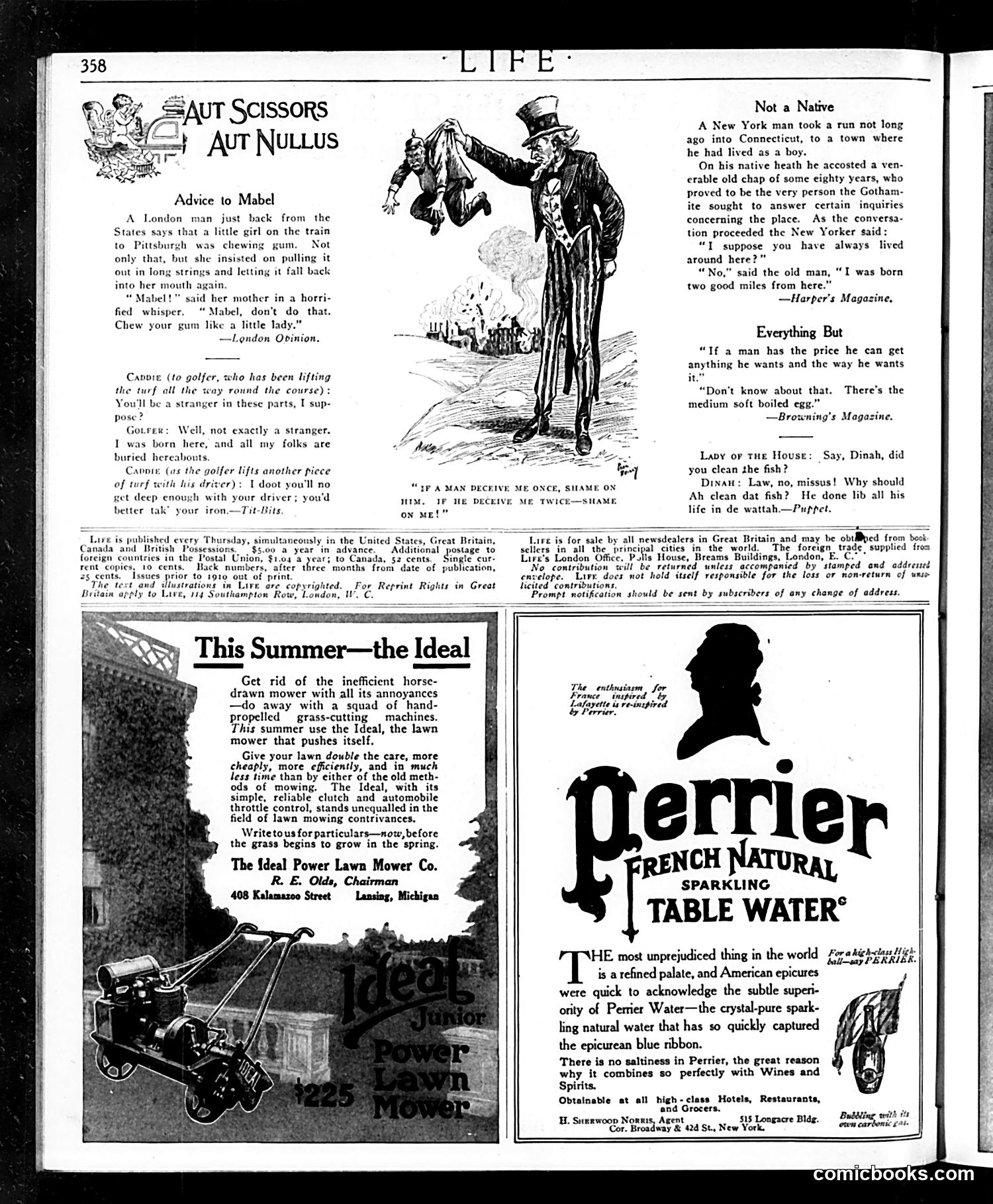
This page contains several humor pieces and advertisements typical of early 20th-century Life magazine. **The cartoons/jokes** are brief satirical vignettes: - "Advice to Mabel" mocks American gum-chewing habits as crude (a British observer's perspective) - A golf anecdote plays on regional accents and the golfer's destructive course behavior - "Not a Native" jokes about Connecticut identity—a man thought to be a lifelong resident was actually born "two good miles" away - "Everything But" and other short quips satirize materialism and domestic absurdities The main visual cartoon (center) depicts two well-dressed men examining something, with text reading "IF A MAN DECEIVE ME ONCE, SHAME ON HIM. IF HE DECEIVE ME TWICE—SHAME ON ME!"—illustrating the proverb about repeated deception. **Advertisements** for the Ideal Power Lawn Mower and Perrier sparkling water occupy significant space, reflecting turn-of-the-century consumer culture. The humor is genteel, observational rather than biting—typical of Life's sophisticated audience.
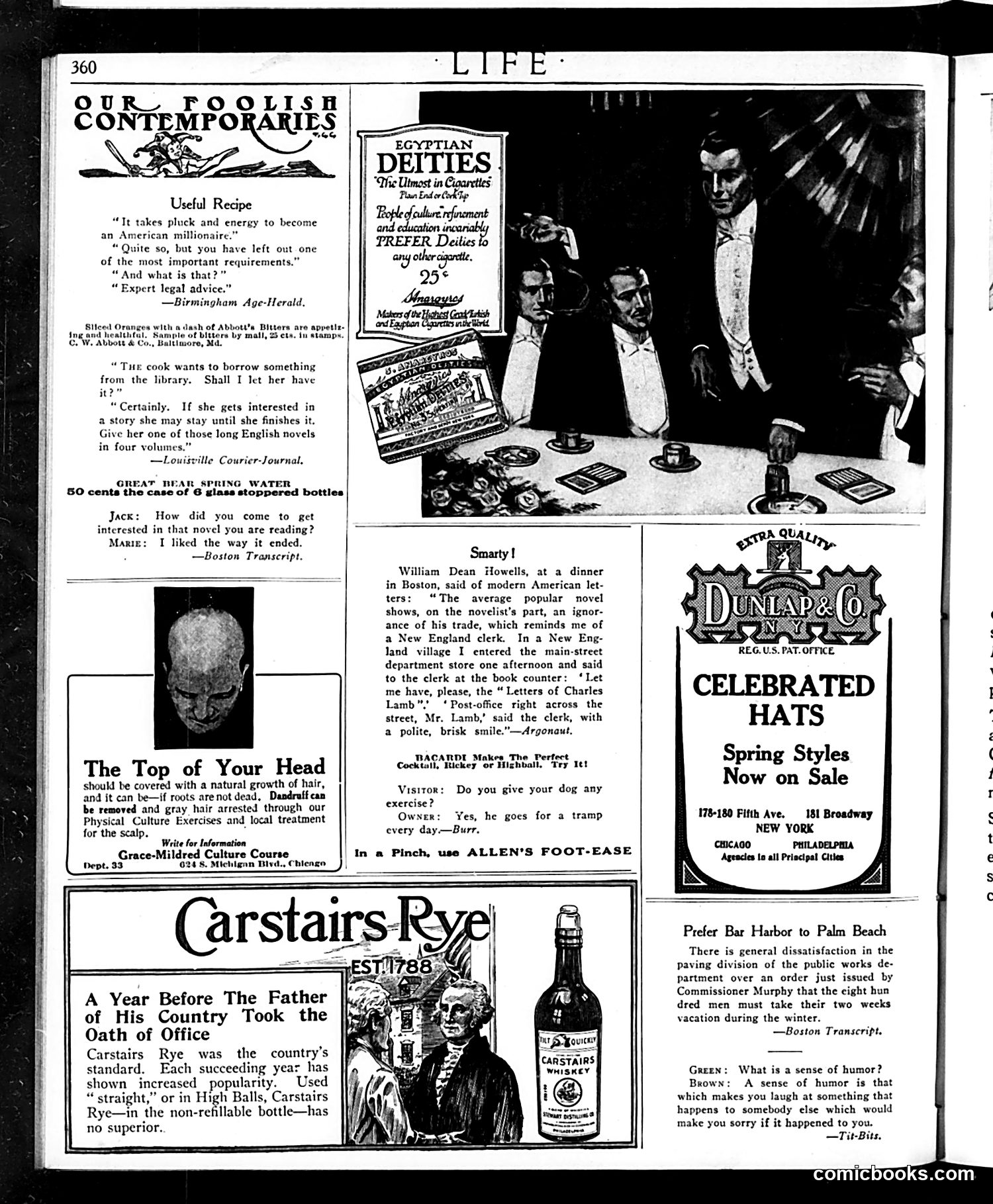
This is primarily an **advertising and humor page** from Life magazine (early 20th century). The content mixes satirical jokes with product advertisements. The satirical humor reflects common themes of the era: - **"Expert Legal Advice"** joke mocks wealthy industrialists, suggesting that becoming a millionaire requires not just hard work but dubious legal maneuvering—a jab at gilded-age business practices. - **The cook and library books** joke satirizes class dynamics, suggesting servants should be kept occupied with lengthy novels to prevent them from leaving employment. - **William Dean Howells anecdote** criticizes popular novelists' ignorance of their craft, contrasting a New England clerk's confusion about "Letters of Charles Lamb" with modern writers' superficiality. The **Egyptian Deities cigarette advertisement** and other product placements (Carstairs Rye whiskey, Dunlap hats, etc.) dominate the page, typical of Life's business model. The humor pieces serve as editorial filler between ads rather than serious political commentary.
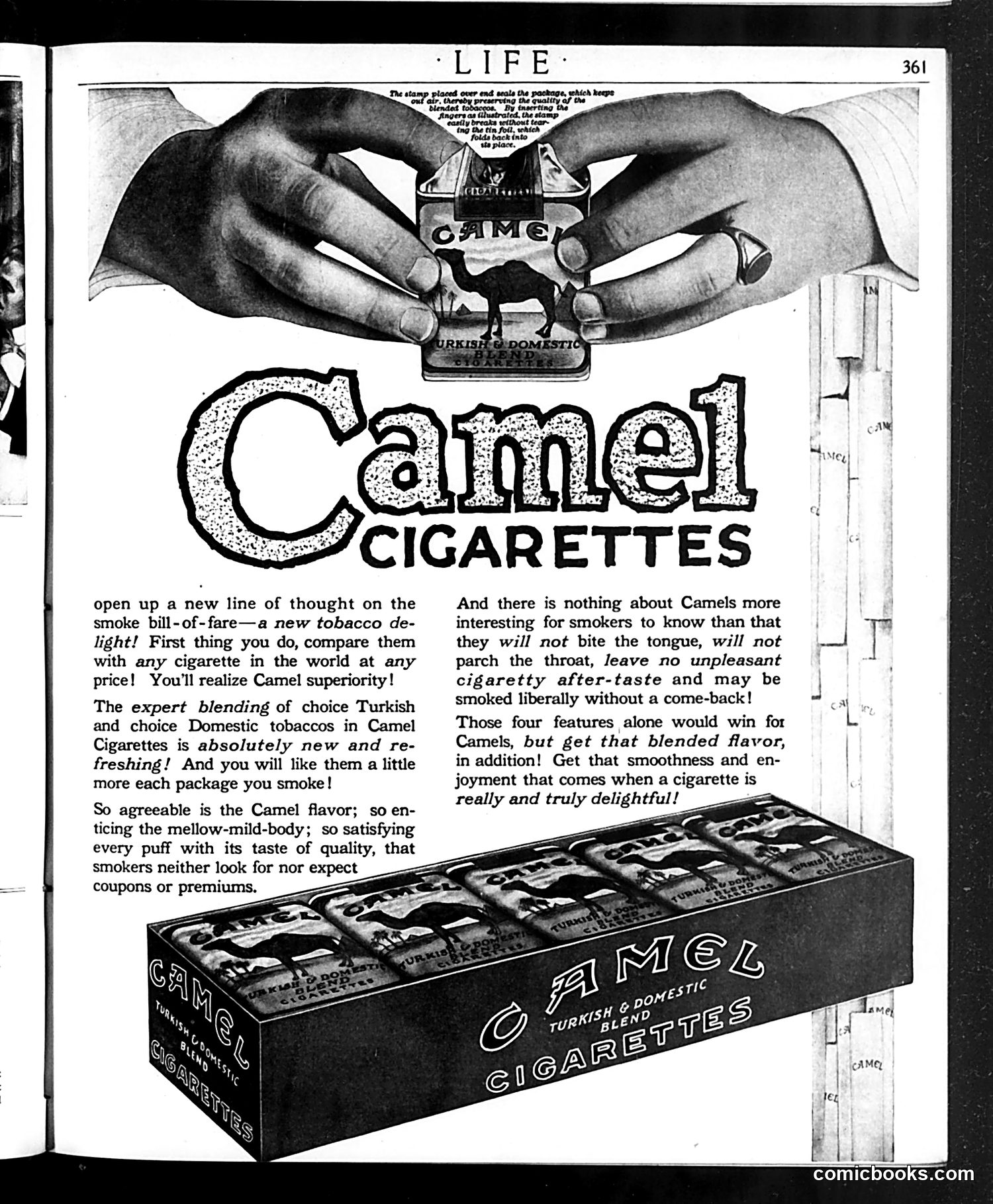
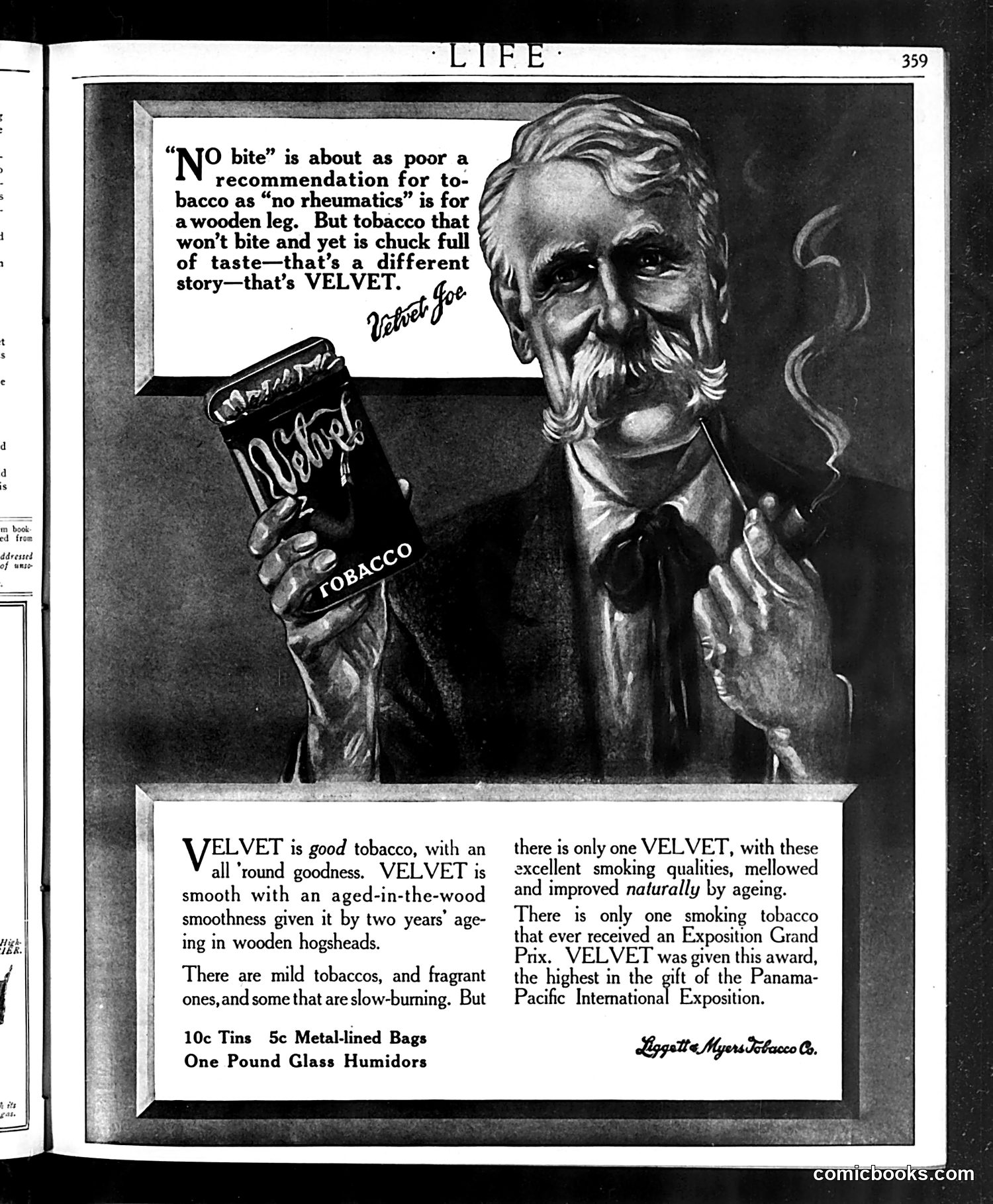
This is a **Camel cigarette advertisement**, not political satire. The page shows a vintage tobacco ad from an era when such marketing was standard in mainstream publications like Life magazine. The imagery depicts hands holding a Camel cigarette package, emphasizing the product. The text makes marketing claims typical of early 20th-century cigarette advertising: superior blending, smooth flavor, and notably, assertions that Camels won't irritate the throat or leave unpleasant aftertaste. **For modern readers**: This represents a historical artifact of unregulated tobacco marketing. The health claims ("will not bite the tongue, will not parch the throat") would be illegal today. The ad's confidence and the magazine's willingness to publish it reflect an era before cigarette health risks were publicly acknowledged or regulated—a stark contrast to modern tobacco warnings and advertising restrictions.
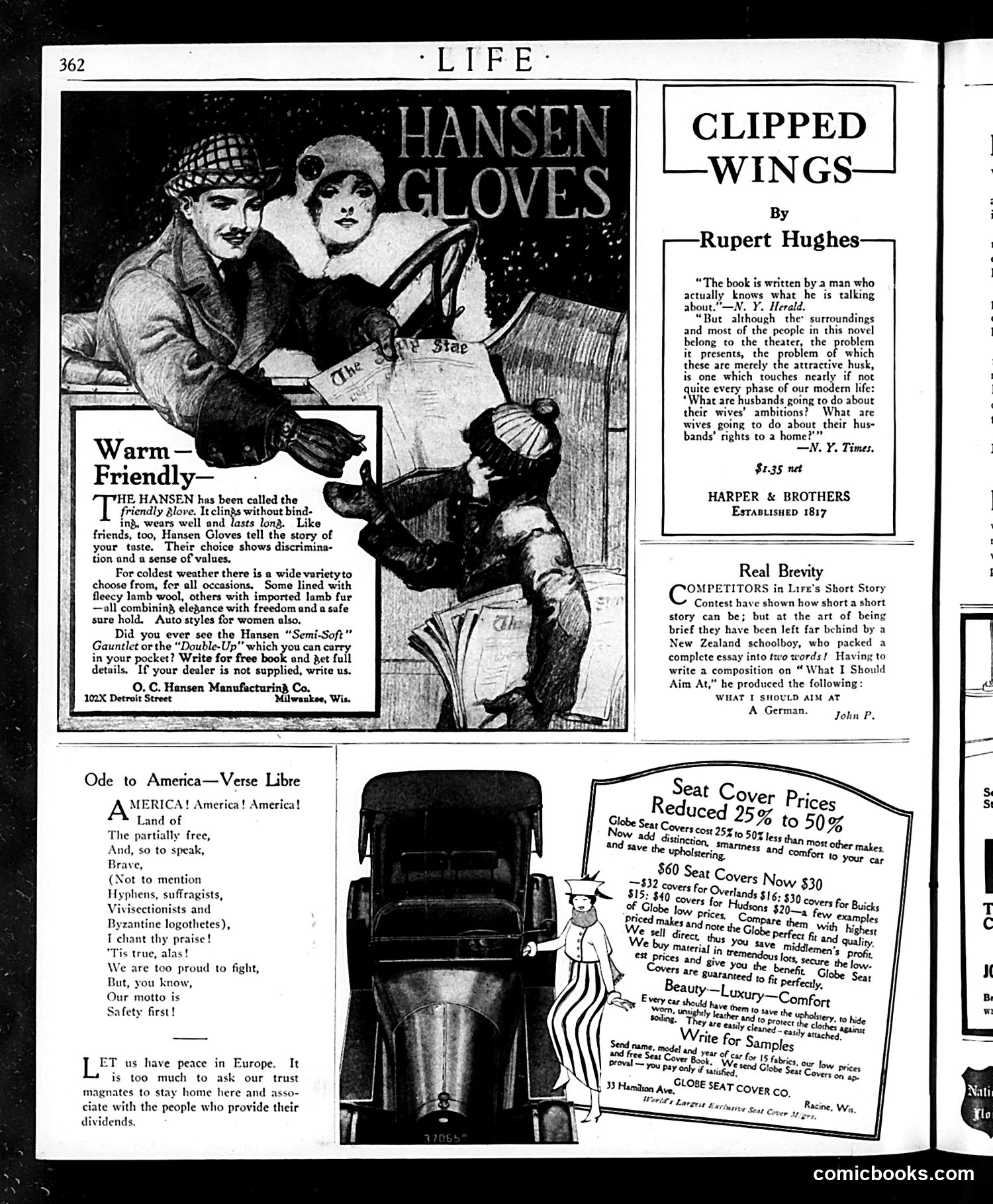
This page contains three distinct sections: **Hansen Gloves Advertisement** (top left): A straightforward commercial ad emphasizing the product's quality and durability, using the metaphor that gloves, like friends, reflect one's taste and discrimination. **"Clipped Wings" Book Review** (top right): A review of Rupert Hughes' novel about marital conflict—specifically, the tension between wives' professional ambitions and husbands' expectations of domestic life. The quoted criticism highlights a contemporary social anxiety: what happens when women pursue careers? **"Ode to America" and "Real Brevity"** (bottom): Satirical content mocking American hypocrisy and pretense. The verse attacks America's claimed ideals (freedom, bravery) while acknowledging uncomfortable realities—suffragists, pacifism ("too proud to fight"), and prioritizing safety over principle. The "Real Brevity" anecdote jokes darkly that a German student's answer to "What should I aim at?" is simply "A German"—likely a cynical reference to wartime militarism. The page reflects 1920s concerns: women's changing roles, American isolationism, and post-WWI skepticism about European affairs.
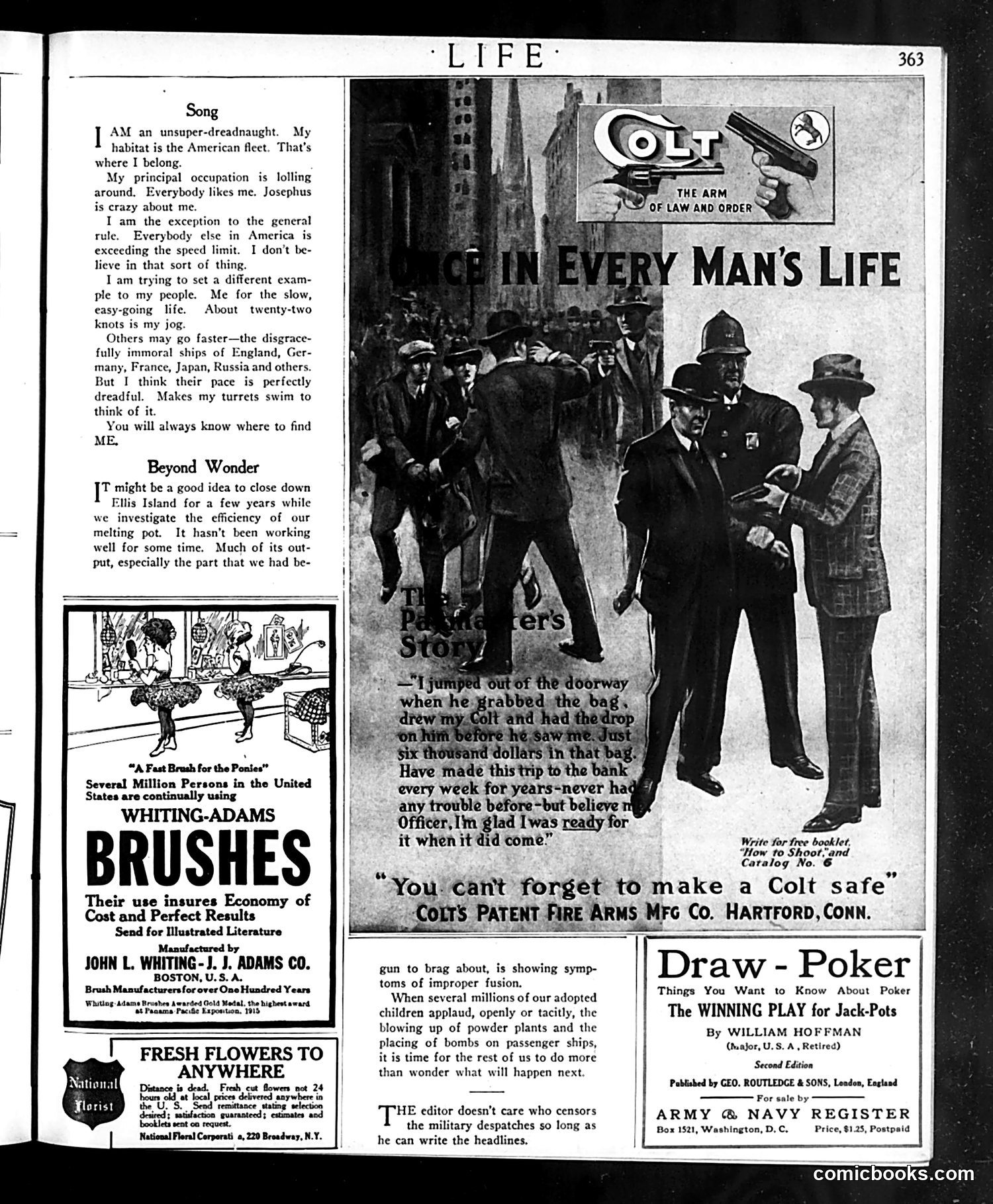
This page is primarily **advertising** interspersed with brief satirical commentary. The main content includes: **"Song"** — A humorous monologue from an American naval vessel (dreadnaught) bragging about maintaining slow speeds (22 knots) while criticizing faster foreign warships from England, Germany, France, Japan, and Russia as "disgracefully immoral." This appears to satirize American naval policy or Secretary of the Navy Josephus Daniels' approach to fleet management during the pre-WWI era. **"Beyond Wonder"** — A brief editorial complaint about Ellis Island's "melting pot" failing to assimilate immigrants properly, noting concern when "adopted children" support bombing powder plants and passenger ships—likely referencing radical immigrant anarchists or saboteurs active during this period. **Advertisements** dominate: Whiting-Adams Brushes, National Floral Corporation, and a **Colt Firearms ad** featuring a bank messenger describing a robbery, emphasizing gun safety. The page reflects early 20th-century anxieties about naval competition, immigration assimilation, and domestic violence/radical activity.
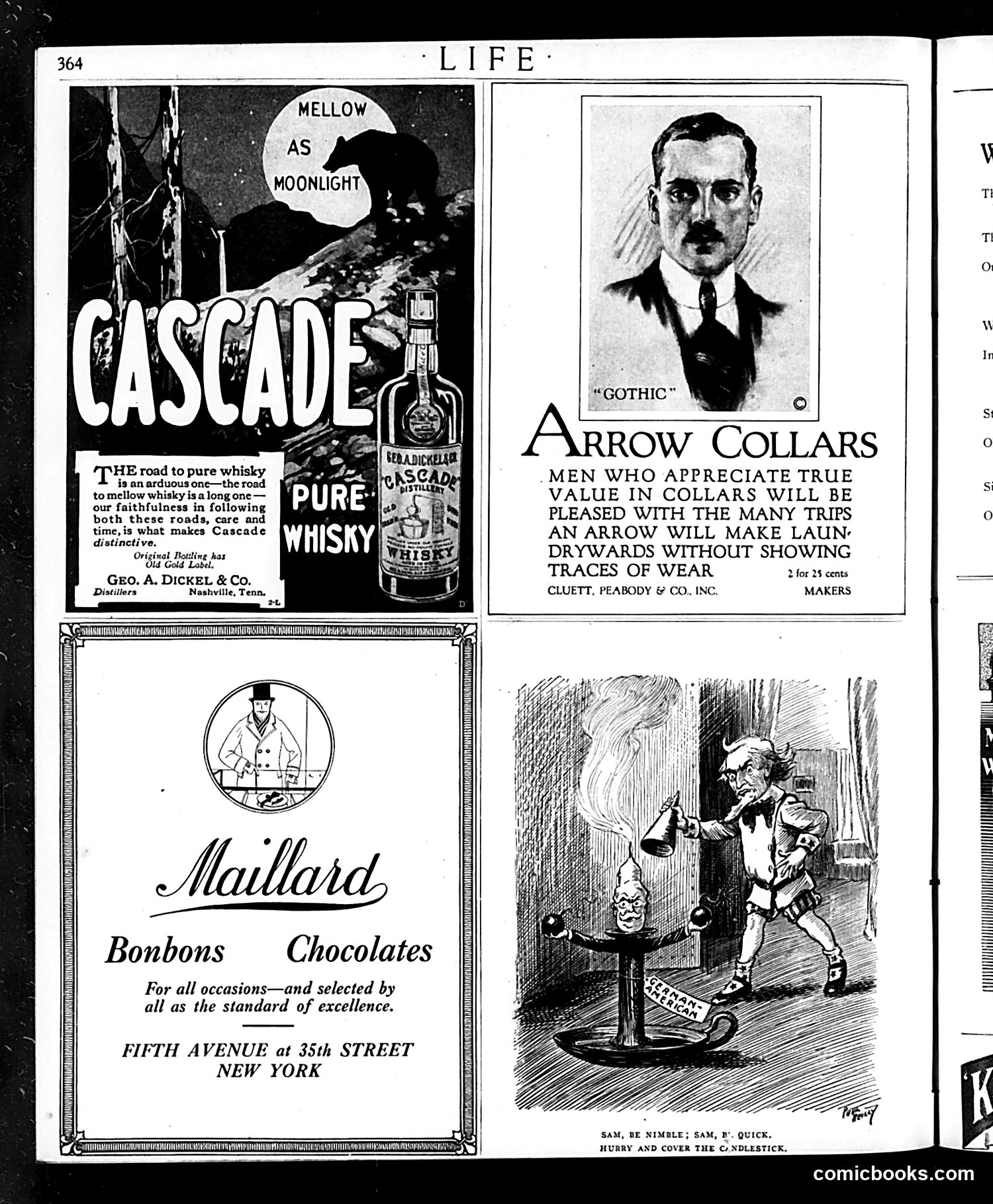
This page consists primarily of **period advertisements** (Cascade Whisky, Arrow Collars, Maillard Chocolates) typical of early 20th-century magazine marketing. The only cartoon is a **small illustrated joke** at bottom right, captioned "SAM, BE NIMBLE; SAM, BE QUICK. HURRY AND COVER THE CANDLESTICK." It depicts a figure (likely a servant or enslaved person, based on the caricatured style) frantically trying to extinguish or cover a candlestick, apparently from the nursery rhyme "Jack Be Nimble." The humor appears to derive from slapstick chaos and the character's panicked efforts. The "Gothic" portrait of a stern man advertising Arrow Collars uses aspirational masculinity marketing common to the era. Overall, this is a **commercial page** with minimal editorial content—primarily showcasing luxury goods targeting affluent readers.
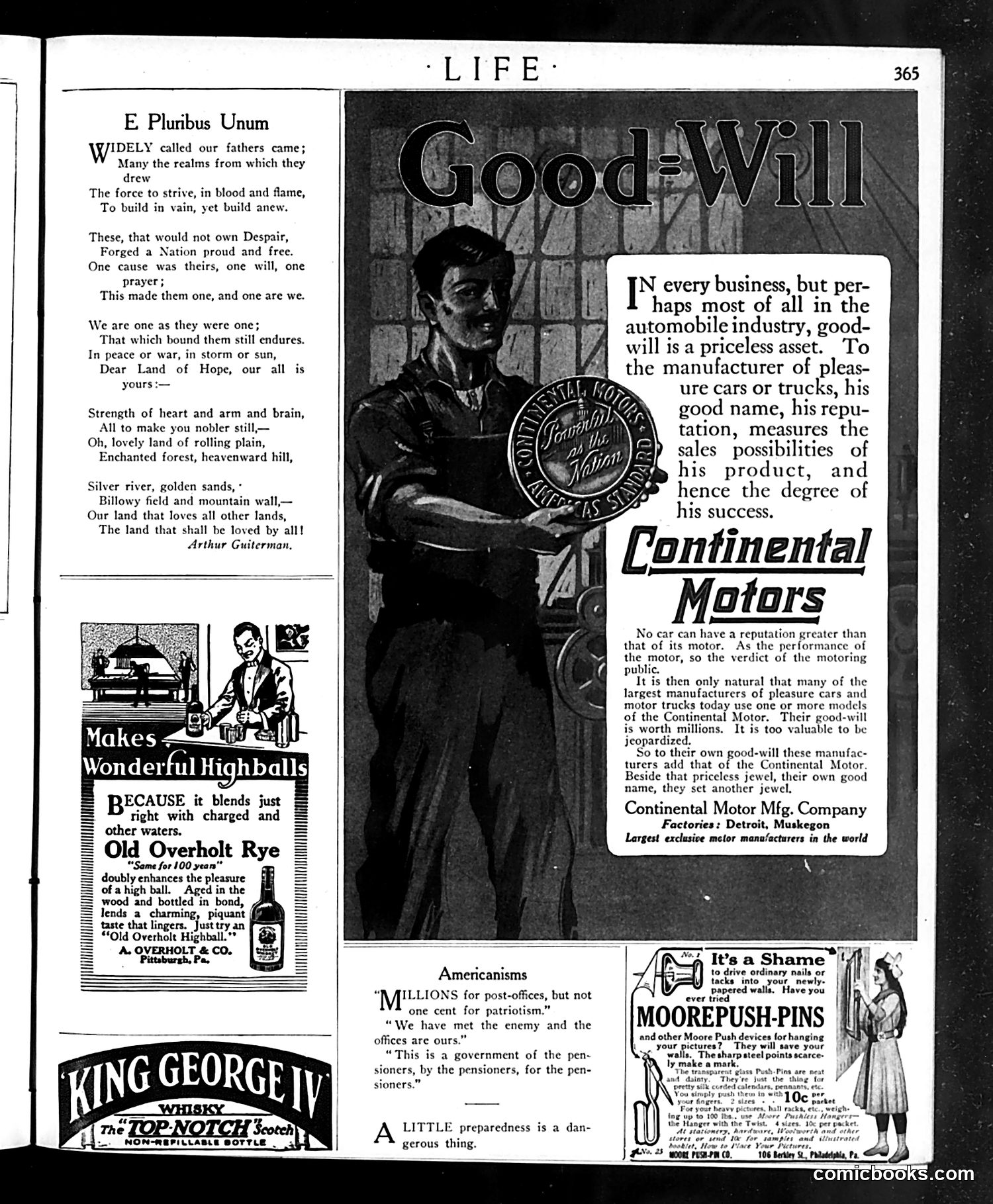
This page combines patriotic poetry with period advertising and light political satire. **Main Content:** Arthur Guiterman's poem "E Pluribus Unum" celebrates American unity and national pride, invoking founding ideals of shared purpose across diverse origins—relevant given the page's publication date appears pre-WWI era based on patriotic tone. **Political Satire ("Americanisms"):** Three brief satirical quotes mock political corruption: - "Millions for post-offices, but not one cent for patriotism" attacks patronage systems - "We have met the enemy and the offices are ours" parodies patriotic rhetoric while criticizing spoils politics - References to "government of the pensioners" critique veteran pension abuse These appear to satirize turn-of-century political machine corruption and self-serving patriotism. **Advertisements:** The page features period products (Old Overholt Rye whiskey, Continental Motors, Moorepush-Pins) typical of Life's commercial content. The juxtaposition of genuine patriotic sentiment with cynical political commentary reflects Life's satirical mission.
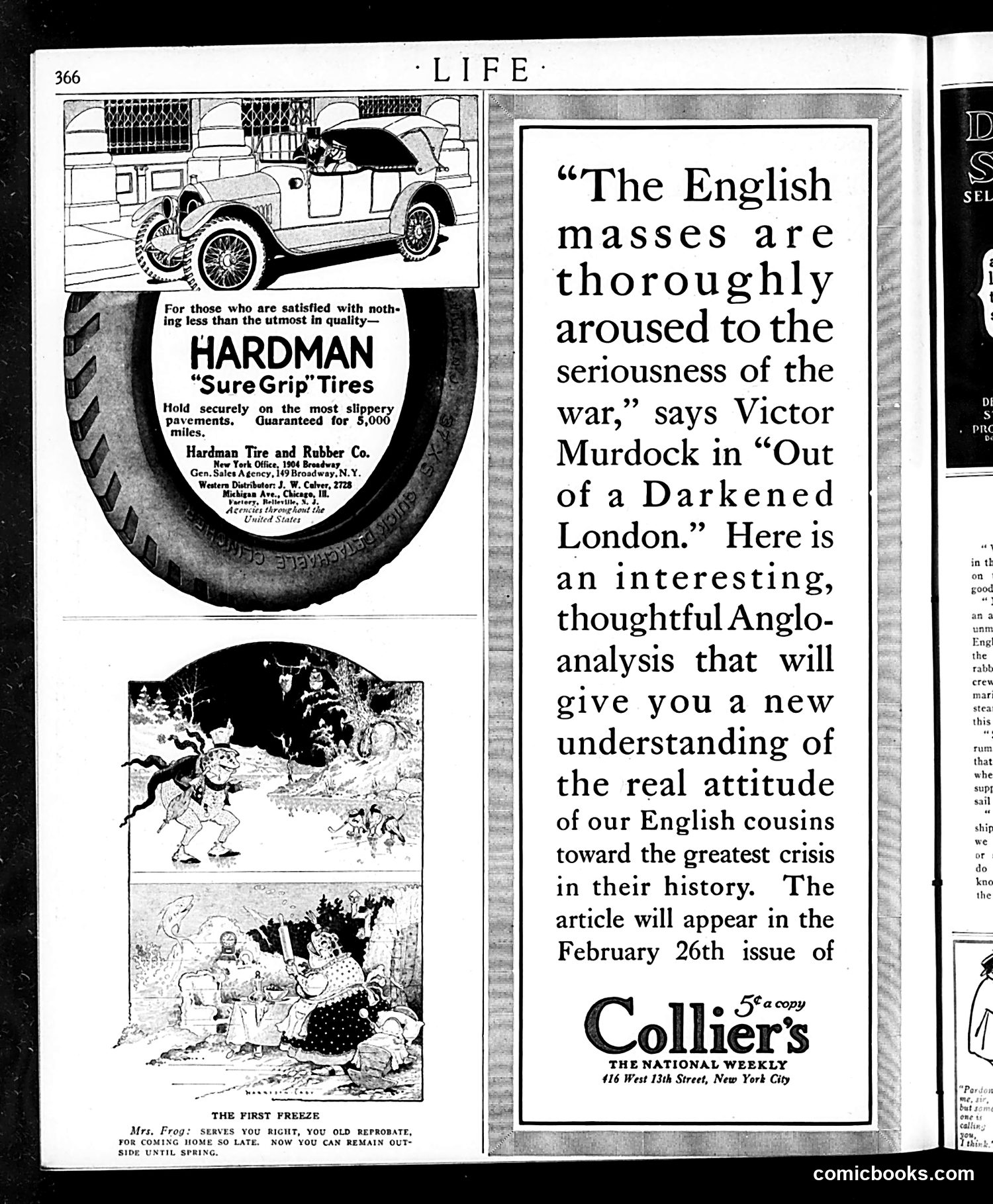
This page combines advertising with satire. The **Hardman tire ad** features a straightforward product pitch about reliable tires. The cartoon **"The First Freeze"** is a domestic joke: a wife (Mrs. Frog) punishes her husband for coming home late by locking him outside until spring—a playful reference to how frogs freeze during winter hibernation. The humor relies on anthropomorphizing frogs and the wife's exaggerated marital punishment. The **Collier's advertisement** references Victor Murdock's article about English public opinion regarding World War I (the context suggests early WWI era, likely 1914-1915). The ad promises readers insight into British attitudes toward "the greatest crisis in their history"—positioning the magazine as providing serious, sophisticated analysis of international affairs to American audiences interested in understanding European perspectives on the war.
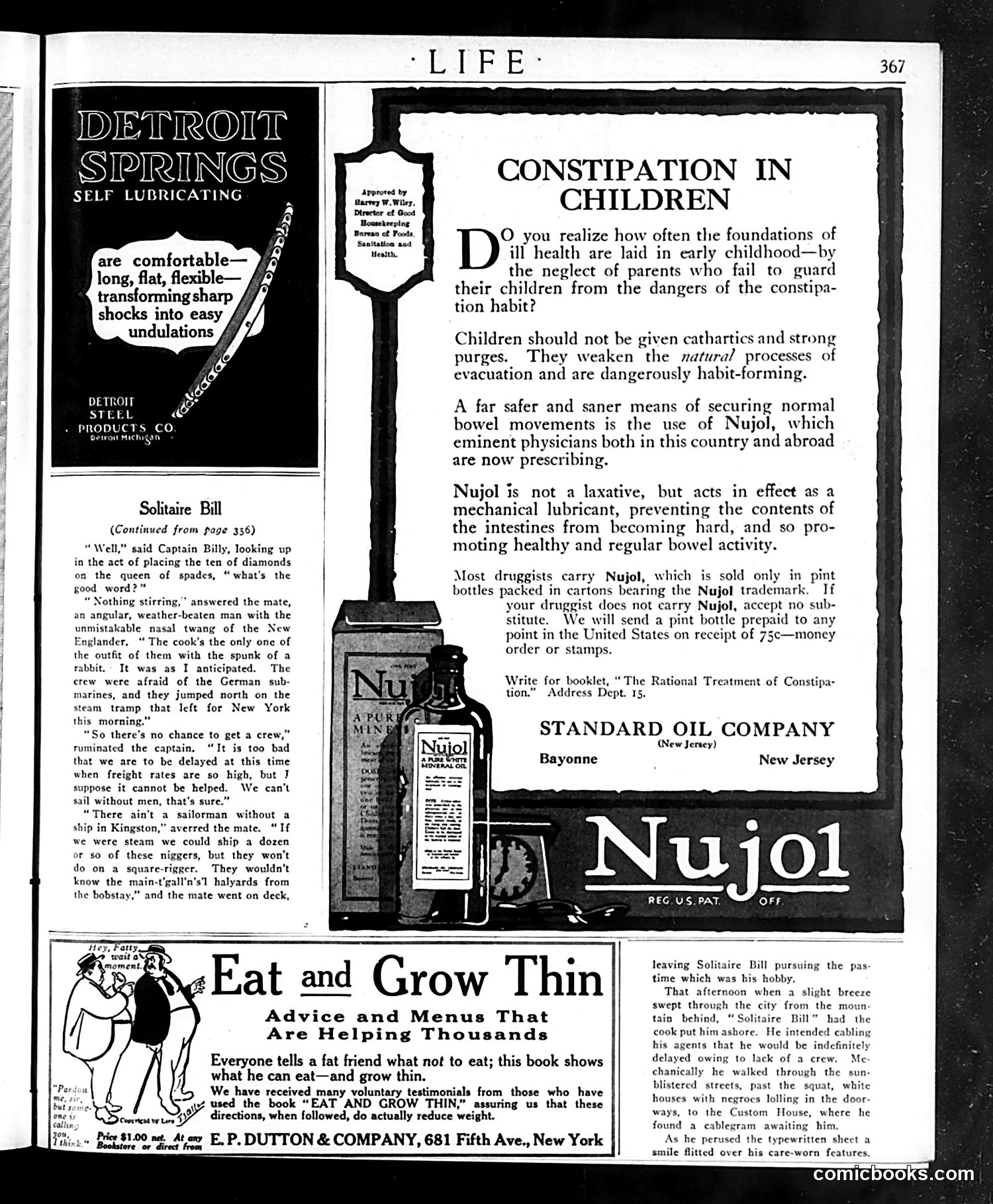
This page contains three distinct advertisements and a serialized story excerpt, rather than political cartoons. **Detroit Springs ad** (top left): Promotes self-lubricating car springs, emphasizing comfort and shock absorption—a standard automotive product advertisement. **Nujol ad** (center): Markets a mineral oil product for childhood constipation, positioning it as safer than harsh laxatives. It includes a doctor's endorsement and offers mail-order purchase. This reflects early 20th-century patent medicine marketing and emerging medical guidance about digestive health. **"Solitaire Bill" story** (left column): Continues a serialized tale about a ship captain unable to find a crew during wartime (World War I era, based on submarine references). The dialogue reveals period attitudes—the mate dismisses Black workers as unsuitable for sailing ships, reflecting the racism embedded in such publications. **"Eat and Grow Thin"** (bottom): An advertisement for a weight-loss diet book, reflecting contemporary diet culture. The page is primarily commercial, showing how Life mixed editorial content with advertising revenue.
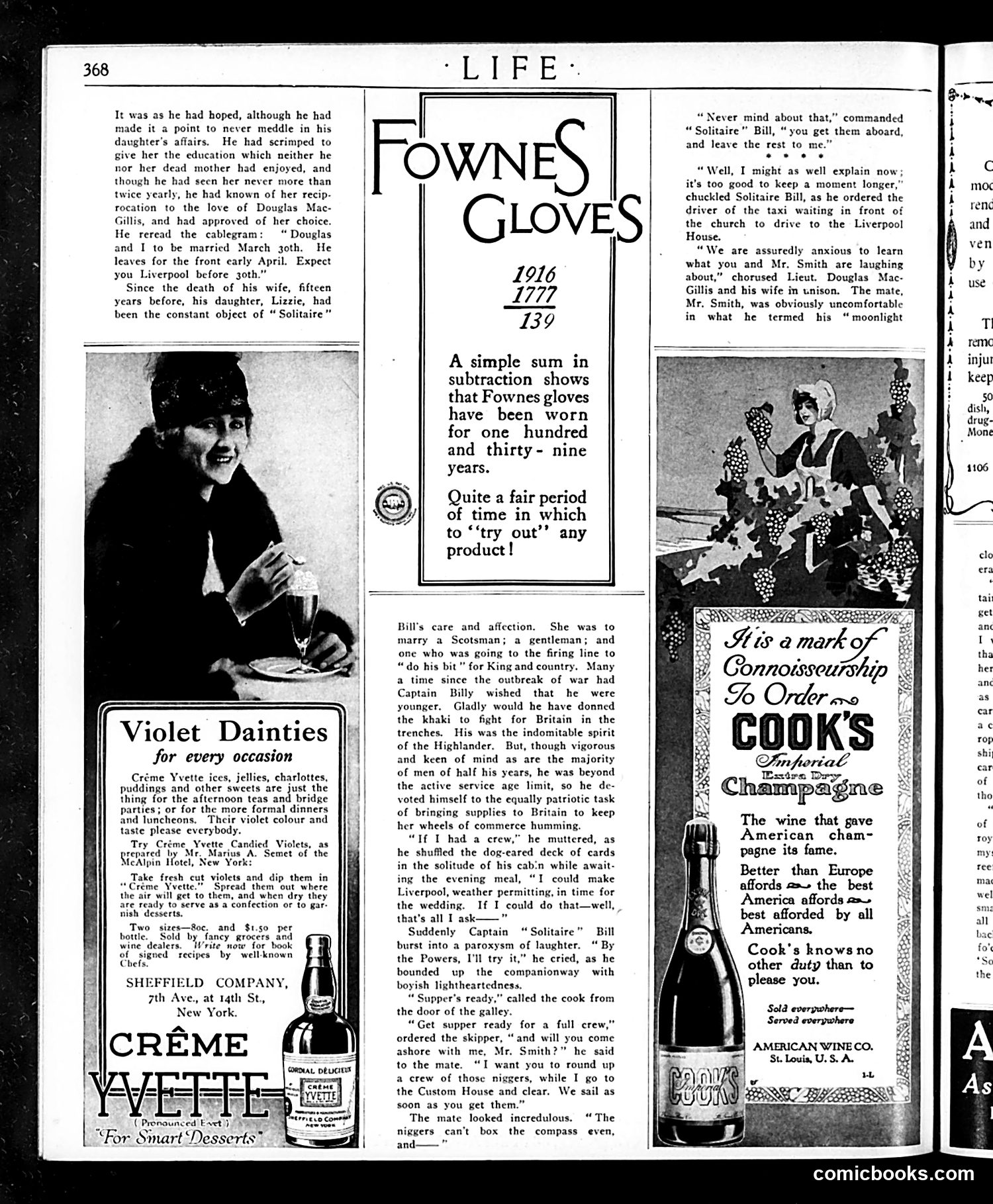
This page contains a serialized story about "Captain 'Solitaire' Bill," an aging sea captain planning to reach his daughter's wedding in Liverpool before she marries a Scottish officer departing for WWI service. The narrative emphasizes his patriotic character—he's too old for active service, so he contributes by transporting supplies to Britain. The story includes period-typical racist language ("niggers") referring to crew members the mate is instructed to recruit, reflecting deeply offensive historical attitudes embedded in early 20th-century literature without satirical intent. The page is primarily **advertising-driven**: Fownes Gloves (emphasizing 139-year durability), Crème Yvette (a violet-flavored liqueur marketed for elegant desserts and entertaining), and Cook's Champagne dominate the layout. The actual narrative content—a sentimental wartime romance—serves as filler around paid advertisements, which was standard Life magazine practice during this era.
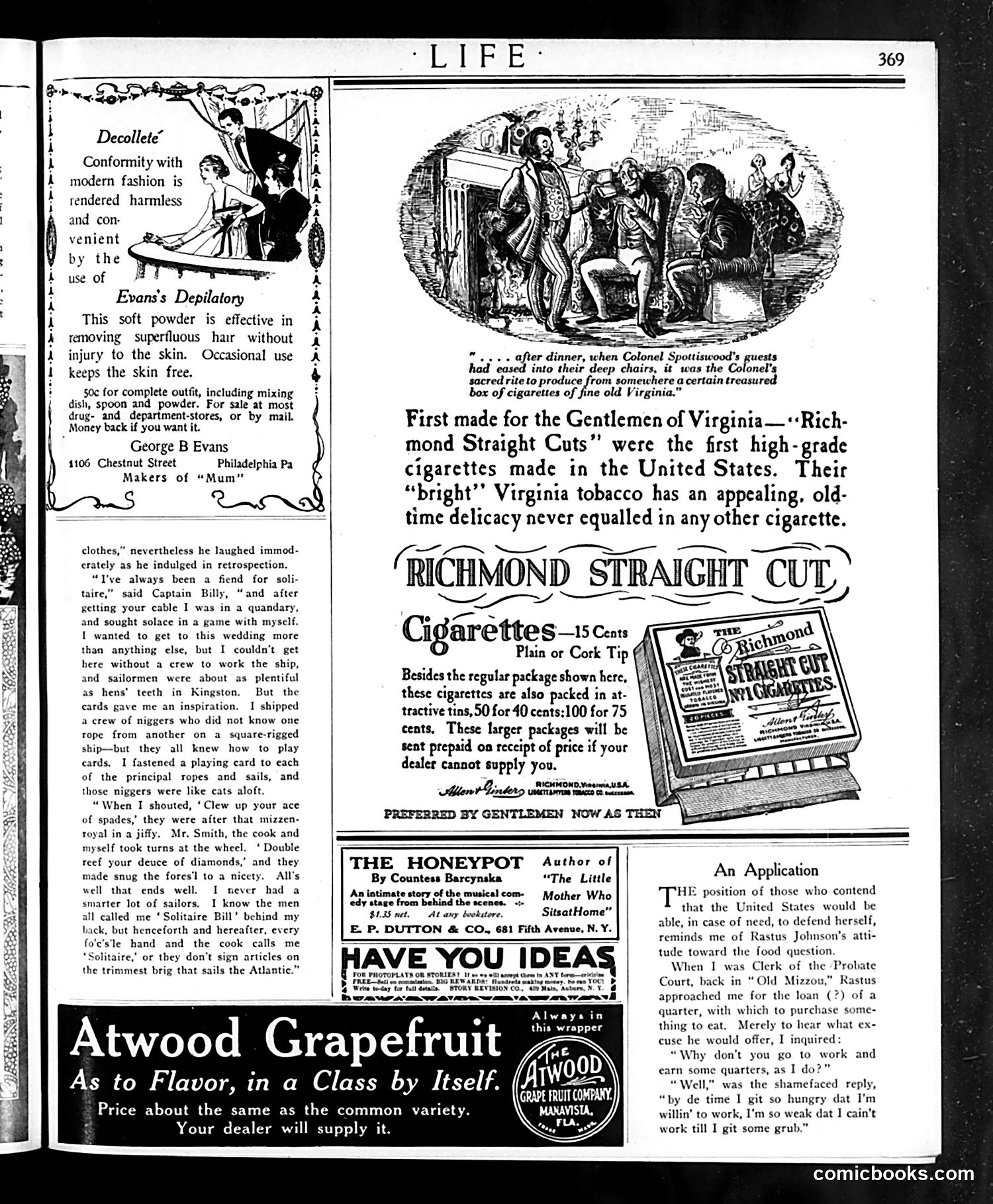
This page mixes advertisements with a short humorous anecdote. The main narrative tells of "Captain Billy" recruiting an inexperienced crew in Kingston by assigning playing cards to ship's ropes and sails—then commanding the illiterate sailors using card names ("Clew up your ace of spades"). The joke relies on the men's familiarity with cards enabling them to perform complex nautical tasks despite knowing nothing about sailing. The surrounding advertisements include Evans's Depilatory (hair removal), Richmond Straight Cut cigarettes, and Atwood Grapefruit. A brief text piece titled "An Application" uses a racial dialect anecdote about "Rastus Johnson" as a metaphor for America's defense preparedness—suggesting the country relies on potential future necessity rather than present readiness. The racial language and caricatures throughout reflect the casual bigotry of the era, typical of early 20th-century American satire magazines.
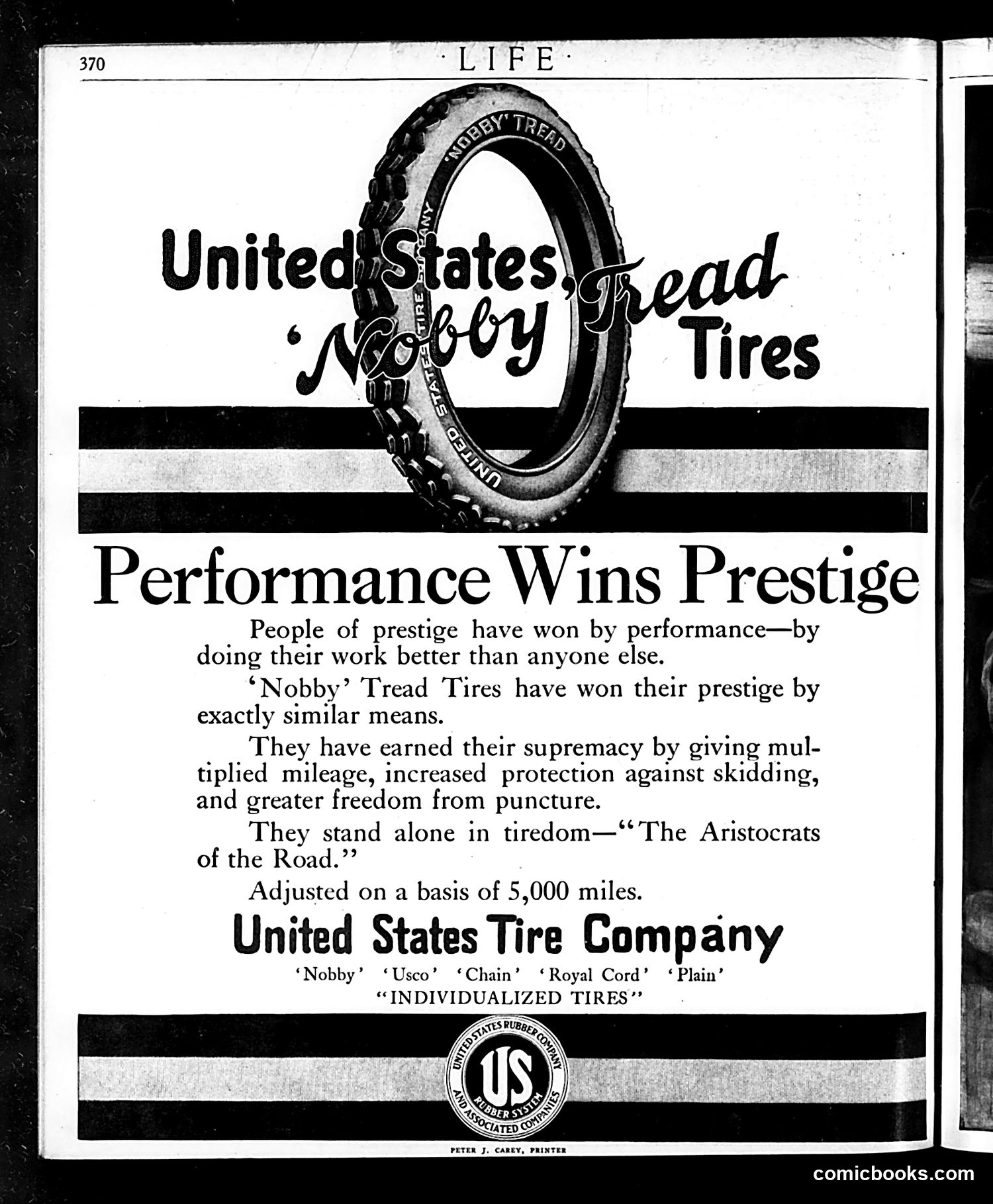
This is a **full-page advertisement**, not a cartoon or satire. It promotes United States Tire Company's "Nobby Tread" automobile tires. The ad uses an aspirational marketing approach common to the era, comparing tire quality to social prestige. It claims that just as prestigious people succeed through superior performance, Nobby tires have earned their reputation through better mileage, skid resistance, and puncture protection. The phrase "Aristocrats of the Road" appeals to consumers' desires for status and quality. The tire shown is illustrated prominently as a product shot. The ad lists the company's tire brands: Nobby, Usco, Chain, Royal Cord, and Plain—described as "individualized tires," suggesting options for different consumer needs and budgets. This reflects early 20th-century automobile culture when tire quality significantly affected driving safety and cost.
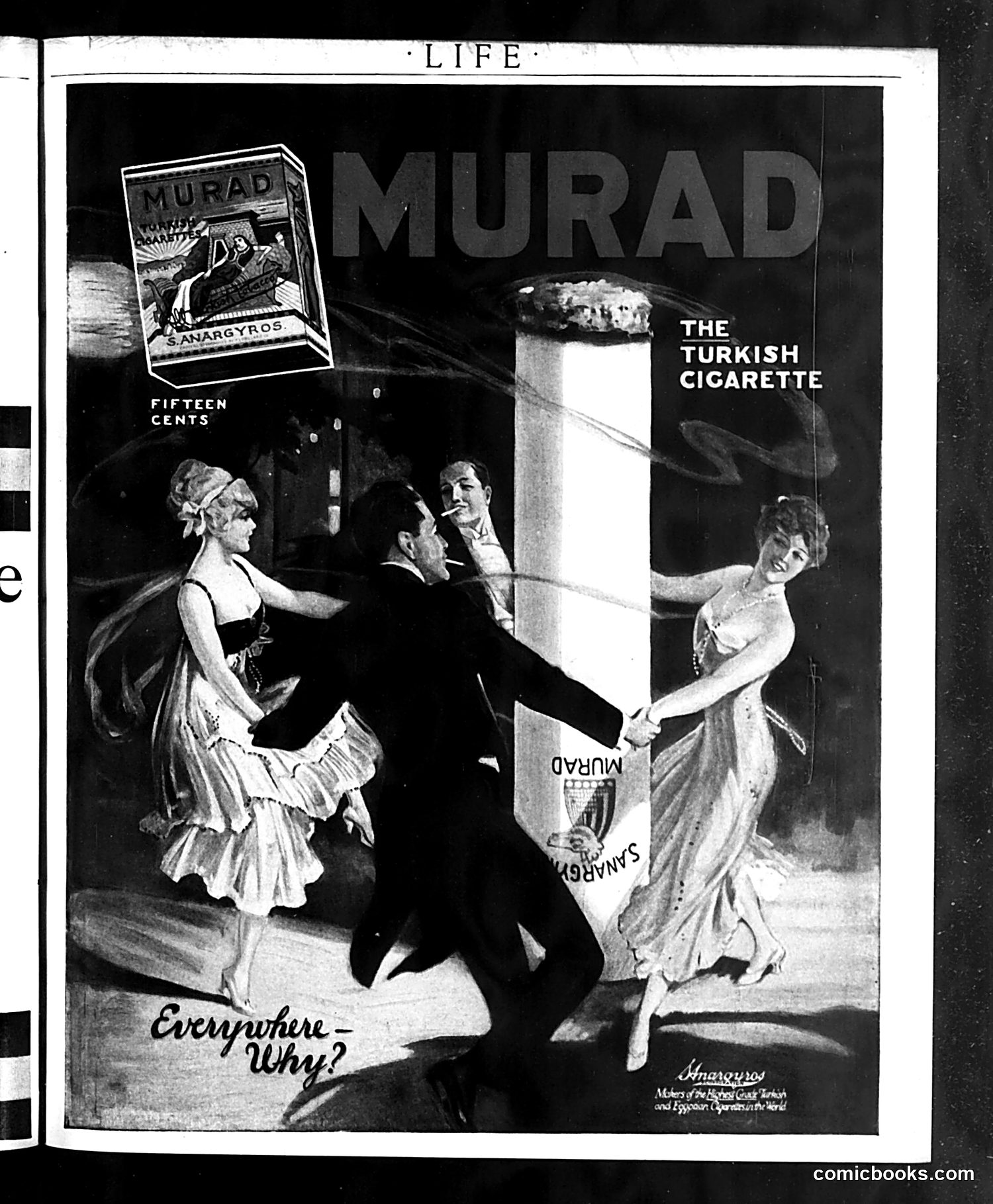
This is a commercial advertisement for Murad Turkish cigarettes, priced at fifteen cents. The image shows a man in formal attire (tuxedo and top hat) being pulled in opposite directions by two women in theatrical costumes, suggesting romantic or comedic tension. The tagline "Everywhere—Why?" appears at the bottom left. The ad employs humor and mild innuendo typical of early 20th-century advertising. The "Turkish cigarette" branding evokes exoticism and sophistication that was marketable to American consumers of that era. The central figure's bemused expression suggests the cigarette's appeal lies in its desirability among women. This reflects period advertising conventions that associated certain consumer products with romantic success and cosmopolitan lifestyle.
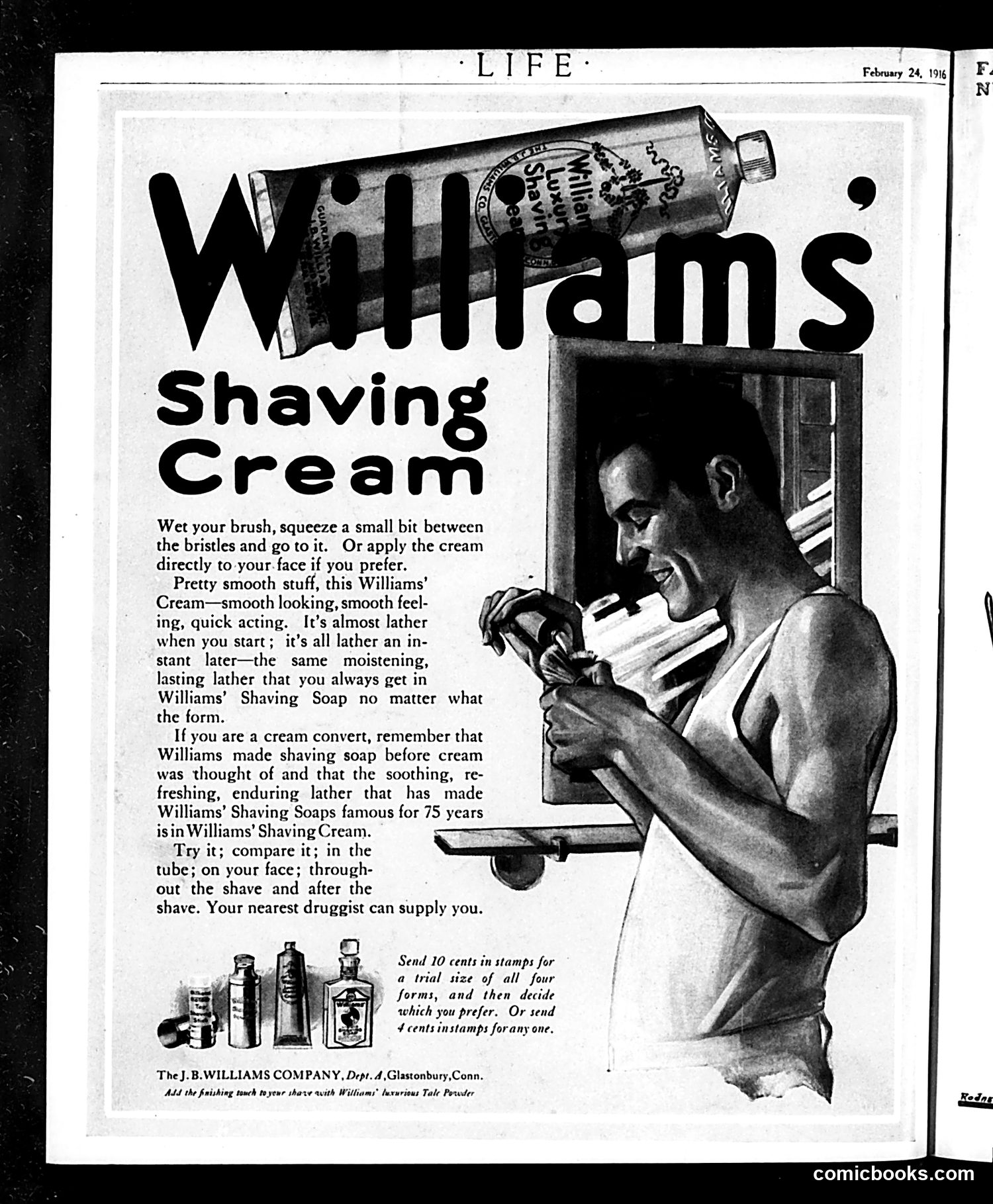
This is a straightforward **product advertisement**, not political satire. It promotes J.B. Williams Company's shaving cream to male readers. The image shows a man in a bathroom mirror, applying shaving cream with a brush. The text emphasizes the product's qualities: smooth application, quick lathering, and moisturizing properties. It notes Williams previously made shaving soap for 75 years, positioning the cream as a trusted extension of an established brand. The advertisement encourages direct comparison with competitors and offers trial sizes for 10 cents in stamps. It concludes by mentioning Williams' talc powder as a complementary product. There is no cartoon, satire, or political commentary—this is simply period advertising using a relatable domestic scene to sell grooming products to early 20th-century male consumers.