
Life, 1916-02-24 · page 28 of 48
Life — February 24, 1916 — page 28: what you’re looking at
What you’re looking at
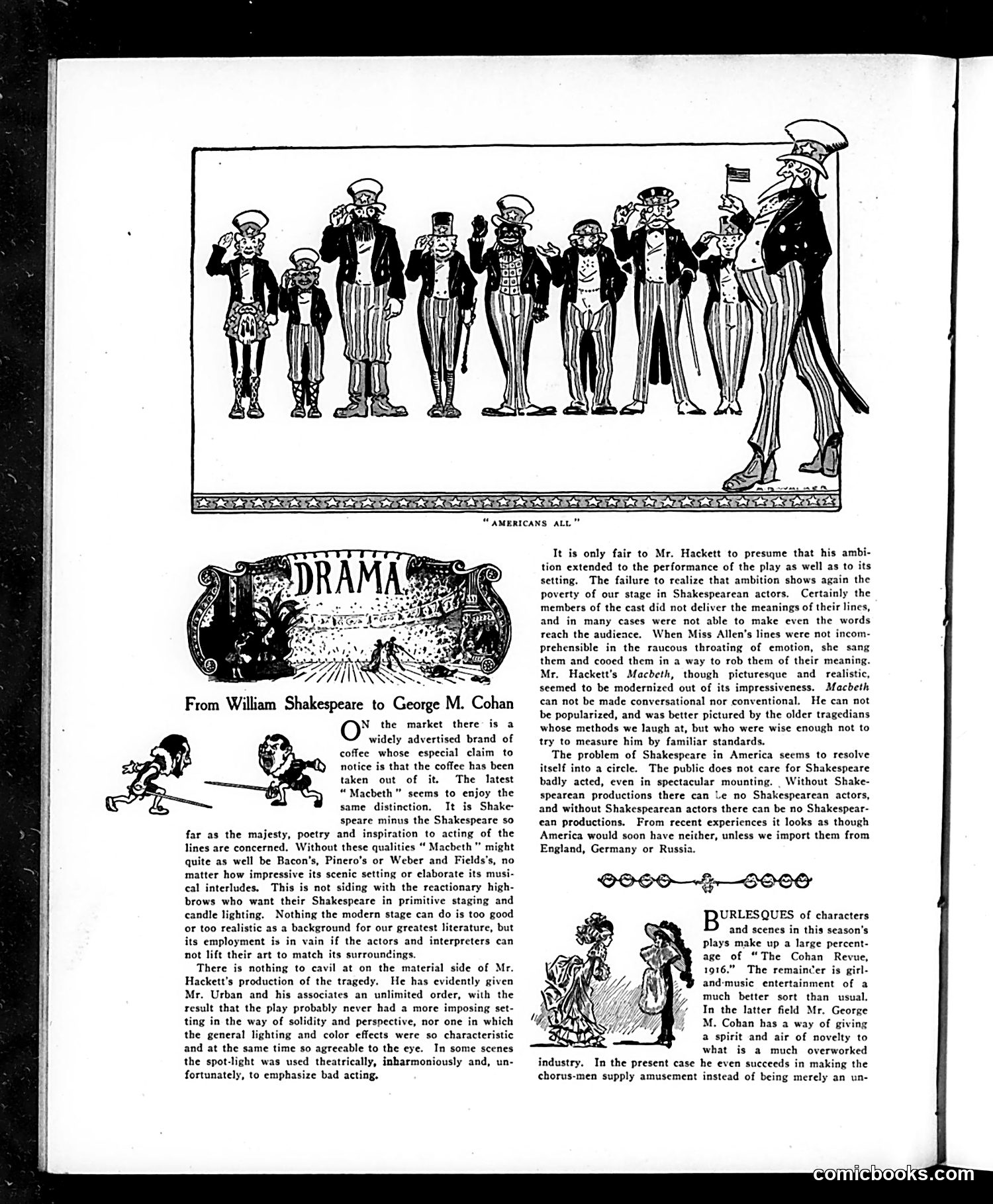
This page critiques actor James K. Hackett's production of *Macbeth*, likely from around 1916 (based on the Cohan Revue reference). The headline illustration "Americans All" shows figures representing different ethnicities or social types. The review's central argument: Hackett invested heavily in spectacular scenery and staging (designed by Joseph Urban) but failed in the crucial element—the *acting*. The critic compares this to decaffeinated coffee: all presentation, no substance. Specific complaints include Miss Allen's incomprehensible, overly theatrical delivery, and Hackett's modernized interpretation that made Shakespeare conversational rather than grand. The critic argues Shakespeare cannot be "popularized" and requires skilled interpreters—a resource America lacks. The piece identifies a vicious circle: without good Shakespearean actors, productions fail; without productions, actors cannot develop. The solution, the reviewer suggests, is importing talent from England, Germany, or Russia.
📄 Transcribed text from this page (OCR, searchable)
Machine-transcribed from the original scan — historical spelling and the odd misread are preserved.
po O_________ 2 se FATRERERTRERE REAR I WTAE Na WOREAEAEA SA ERTA TREND AEA A NAAENEND AR AD AEN EER GATHERS “AMERICANS ALL” N the market there is a widely advertised brand of coffee whose especial claim to notice is that the coffee has been taken out of it. The latest “Macbeth” seems to enjoy the same distinction. It is Shake- speare minus the Shakespeare so far as the majesty, poetry and inspiration to acting of the lines are concerned, Without these qualities “ Macbeth ” might quite as well be Bacon's, Pinero’s or Weber and Fields’s, no matter how impressive its scenic setting or elaborate its musi- cal interludes. This is not siding with the reactionary high- brows who want their Shakespeare in primitive staging and candle lighting. Nothing the modern stage can do is too good or too realistic as a background for our greatest literature, but its employment is in vain if the actors and interpreters can not lift their art to match its surroundings. There is nothing to cavil at on the material side of Mr. Hackett’s production of the tragedy, He has evidently given Mr. Urban and his associates an unlimited order, with the result that the play probably never had a more imposing set- ting in the way of solidity and perspective, nor one in which the general lighting and color effects were so characteristic and at the same time so agreeable to the eye. In some scenes the spot-light was used theatrically, inharmoniously and, un- fortunately, to emphasize bad acting. It is only fair to Mr. Hackett to presume that his ambi- tion extended to the performance of the play as well as to its setting. The failure to realize that ambition shows again the poverty of our stage in Shakespearean actors. Certainly the members of the cast did not deliver the meanings of their lines, and in many cases were not able to make even the words reach the audience. When Miss Allen's lines were not incom- prehensible in the raucous throating of emotion, she sang them and cooed them in a way to rob them of their meaning. Mr. Hackett's Macbeth, though picturesque and realistic, seemed to be modernized out of its impressiveness. Macbeth can not be made conversational nor conventional, He can not be popularized, and was better pictured by the older tragedians whose methods we laugh at, but who were wise enough not to try to measure him by familiar standards. The problem of Shakespeare in America seems to resolve itself into a circle. The public does not care for Shakespeare badly acted, even in spectacular mounting. | Without Shake- spearean productions there can Le no Shakespearean actors, and without Shakespearean actors there can be no Shakespear- can productions. From recent experiences it looks as though America would soon have neither, unless we import them from England, Germany or Russia. URLESQUES of characters and scenes in this season's plays make up a large percent- age of “The Cohan Revue, 1916.” The remaincer is girl- and-music entertainment of a much better sort than usual, In the latter field Mr. George M. Cohan has a way of giving a spirit and air of novelty to what is a much overworked industry. In the present case he even succeeds in making the chorus-men supply amusement instead of being merely an un-