
Life, 1916-02-24 · page 29 of 48
Life — February 24, 1916 — page 29: what you’re looking at
What you’re looking at
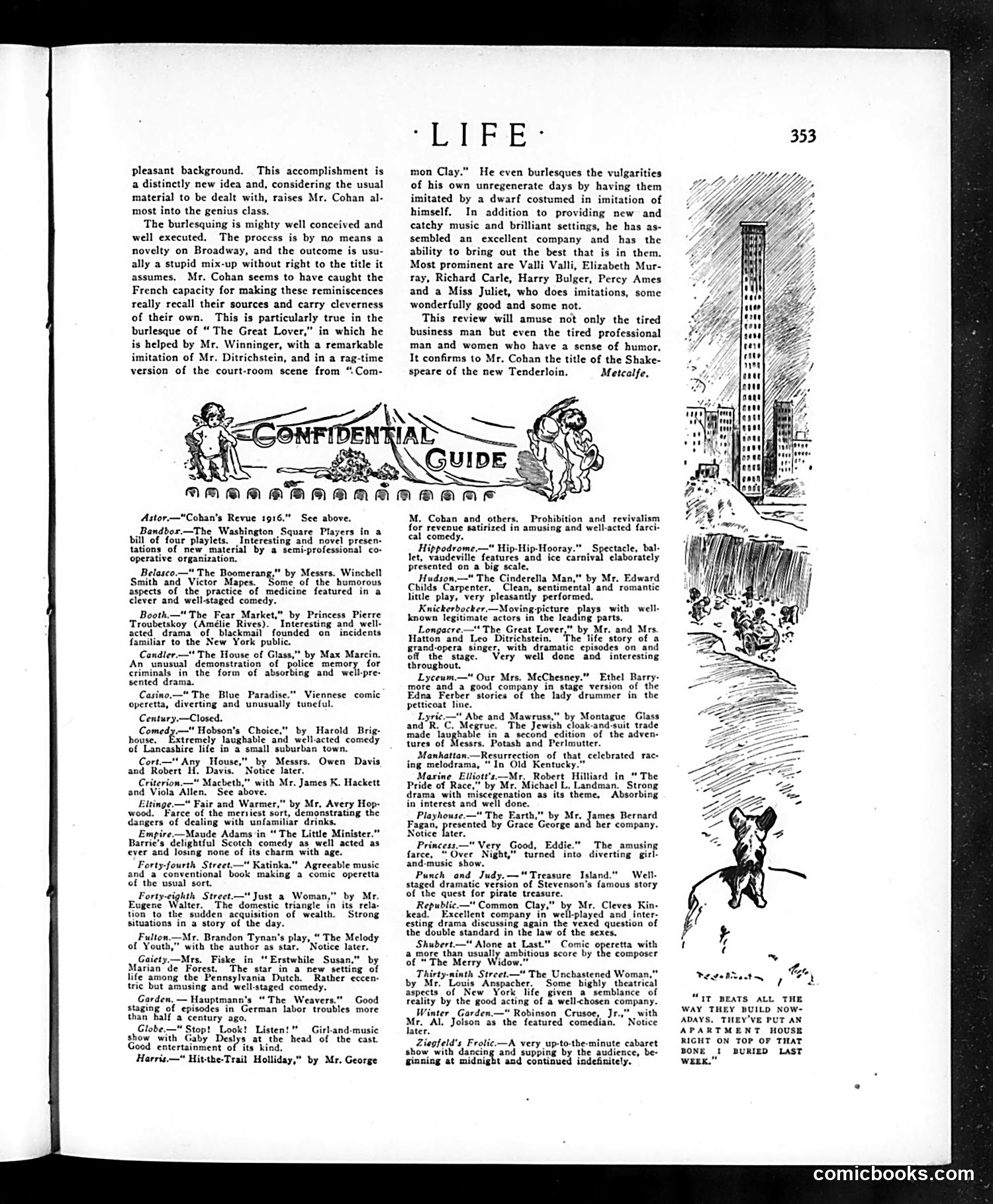
This page contains theater reviews from Life magazine's "Confidential Guide" section, a satirical column reviewing Broadway productions. The main text discusses George M. Cohan's "Revue 1916," praising his burlesque work and company of actors (Valli Valli, Elizabeth Murray, Richard Carle, Harry Bulger, Percy Ames, and "Miss Juliet"). The decorative header illustration shows two figures in theatrical poses flanking the title—typical of Life's satirical style. The cartoon's humor lay in mocking both tired businessmen attending shows and the pretensions of professional theater-goers. The column reviews numerous Broadway productions with brief, witty critiques—a common Life feature offering readers sarcastic commentary on current entertainment. References to specific theaters (Astor, Belasco, Casino, etc.) and playwrights anchored readers in NYC's theater scene circa 1916.
📄 Transcribed text from this page (OCR, searchable)
Machine-transcribed from the original scan — historical spelling and the odd misread are preserved.
pleasant background. This accomplishment is a distinctly new idea and, considering the usual material to be dealt with, raises Mr. Cohan al- most into the genius class. The burlesquing is mighty well conceived and well executed. The process is by no means a novelty on Broadway, and the outcome is usu- ally a stupid mix-up without right to the title it assumes. Mr. Cohan seems to have caught the French capacity for making these reminiscences really recall their sources and carry cleverness of their own. This is particularly true in the burlesque of “ The Great Lover,” in which he is helped by Mr. Winninger, with a remarkable imitation of Mr. Ditrichstein, and in a rag-time version of the court-room scene from “:Com- TEESE mon Clay.” He even burlesques the vulgarities of his own unregenerate days by having them imitated by a dwarf costumed in imitation of himself. In addition to providing new and catchy music and brilliant settings, he has as- sembled an excellent company and has the ability to bring out the best that is in them. Most prominent are Valli Valli, Elizabeth Mur- ray, Richard Carle, Harry Bulger, Percy Ames and a Miss Juliet, who does imitations, some wonderfully good and some not. This review will amuse not only the tired business man but even the tired professional man and women who have a sense of humor. It confirms to Mr. Cohan the title of the Shake- speare of the new Tenderloin. Metcalfe, ADAADAANAMAMAAE Astor.—“Cohan’s Revue 1916." See above. Bandbor.—The Washington Square Players in a bill of four playlets. Interesting and novel presen: tations of new material by a semi-professional co- operative organization. Belasco" The Boomerang,” by Messrs. Winchell Smith and Victor Mapes. Some of the humorous aspects of the practice of medicine featured in a clever and well-staged comedy. Booth.—" The Fear Market,” by Princess Pierre Troubetskoy (Amélie Rives). "Interesting and_well- acted drama of blackmail founded on incidents familiar to the New York public. Candler.— The House of Glass,” by Max Marcin. An unusual demonstration of police memory for criminals in the form of absorbing and well-pre- sented drama. Casino.— The Blue Paradise.” Viennese comic operetta, diverting and unusually tuneful. Century.—Closed. Comedy—" Hobson's Choice.” by house. fi Harold Brig. remely laughable and well-acted comedy of Lancashire life in a small suburban town. Cort—" Any House," by Messrs. Owen Davis and Robert H. Davis. ' Notice later. Criterion." Macbeth,” with Mr. James K. Hackett and Viola Allen. See above. EItinge.—" Fair and Warmer,” by Mr. Avery Hop- wood. Farce of the meriiest sort, demonstrating the dangers of dealing with unfamiliar drinks. ire-—Maude Adams in “ The Little Minister.” Barrie's delightful Scotch comedy as well acted as ever and losing none o! harm with age. Forty-fourth Street.—“ Katinka.” Agreeable music and a conventional book making a comic operetta of the usual sort. Forty-eighth Strect.—"* Just_a Woman,” by Mr. Eugene Walter. The domestic triangle in its rela- tion to the sudden acquisition of wealth. Strong situations in a story of the day. Fulton.—Mr. Brandon Tynan’s play, “ The Melody of Youth,” with the author as star. ‘Notice later. Gaiety.—Mrs. Fiske in ‘“Erstwhile Susan.” by Marian de Forest. The star_in a new setting of life among the Pennsylvania Dutch. Rather eccen- tric but amusing and well-staged comedy. Garden. — Hauptmann's “The Weavers.” Good staging of episodes in German labor troubles more than half a century ago. Globe—" Stop! Look! Listen!” Girl-and-music show with Gaby Deslys at the head of the cast. Good entertainment of its kind. Harris—" Hit-the-Trail Holliday,” by Mr. George M. Cohan and. others, Prohibition and revivalism for revenue satirized in amusing and well-acted farci- cal comedy. Hippodrom: let, vaudeville features and ice carniv. presented on a big scale. Hudson.—" The Cinderella Man,” by Mr. Edward Childs Carpenter. Clean, sentimental and romantic little play, very pleasantly performed. Knickerbocker—Moving-picture plays with well- known legitimate actors in the leading parts. Longacre.—" The Great Lover,” by Mr. and Mrs Hatton and Leo Ditrichstein. ‘The life story of a grand-opera singer, with dramatic episodes on and off the stage. Very well done and. interesting throughout, Lyceum.—" Our Mrs. McChesney.” Ethel Barry- more and a good company in stage version of the Edna Ferber stories of the lady drummer in the petticoat line. Lyric.—"" Abe and Mawruss,” by Montague Glass and R. C. Megruc, The Jewish cloak-and-suit trade made laughable in a second edition of the adven- tures of Messrs. Potash and Perlmutter. Manhattan.—Resurrection of that, celebrated rac- ing melodrama, “In Old Kentucky. farine Elliott’s.—Mr. Robert Hilliard in The Pride of Race,” by Mr. Michael L, Landman. Strong drama with miscegenation as its theme, Absorbing in interest and well done. Playhouse.—“ The Earth," by Mr. Fagan, presented by Grace George an Notice later. Princess.—" Very Good, Eddie." The amusing farce, “Over Night,” turned into diverting girl and-music show. Punch and Judy.—“ Treasure Island.” Well- staged dramatic version of Stevenson's famous story of the quest for pirate treasure. Republic.— Common Clay,” by Mr. Cleves Kin- kead. Excellent company in’ well-played and inter- esting drama discussing again the vexed question of the double standard in the law of the sexes. Shubert—" Alone at Last." Comic operetta with a more than usually ambitious score by the composer of “The Merry Wi “ Hip-Hip-Hooray.” Spectacle, bal- es an Carnival elaborately james Bernard her company. idow. Thirty-ninth Street— The Unchastened Woman,” by Mr. Louis Anspacher. Some highly theatrical aspects. of New York life given a semblance of reality by the good acting of a well-chosen company. Winter Garden.—" Robinson Crusoe, Jr.,"_ with . Al. Jolson as the featured comedian.” Notice Ziegfeld's Frotic.—A very up-to-the-minute cabaret show with dancing and supping by the audience, be- ginning at midnight and continued indefinitely. “IT BEATS ALL THE WAY THEY BUILD NOW- ADAYS, THEY'VE PUT AN APARTMENT HOUSE RIGHT ON TOP OF THAT BONE 1 BURIED LAST comicbooks.com