
Life, 1916-02-24 · page 30 of 48
Life — February 24, 1916 — page 30: what you’re looking at
What you’re looking at
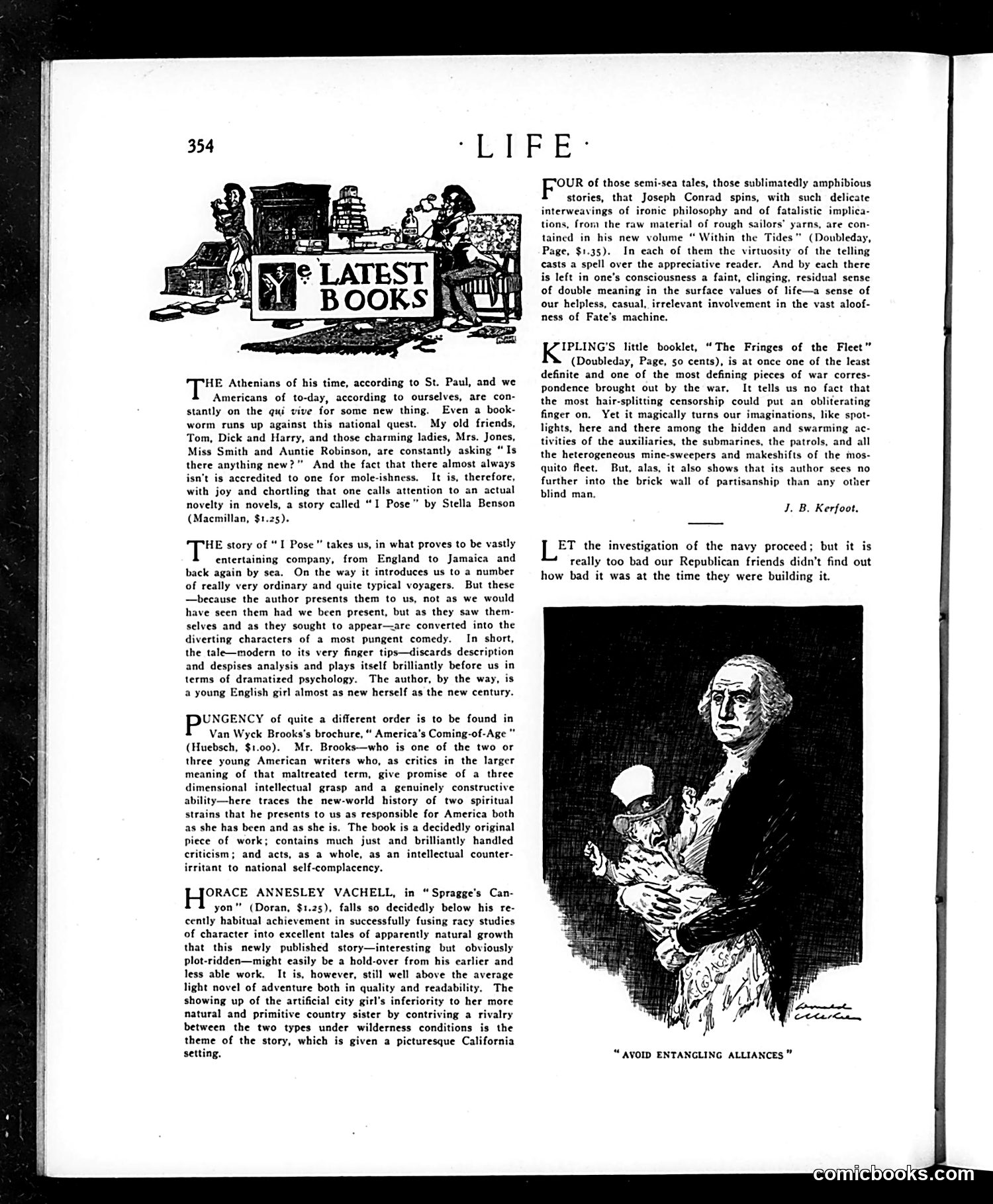
This is a **book review section** from Life magazine, not a political cartoon page. The content discusses four contemporary literary works: 1. **"I Pose"** by Stella Benson—praised as a novel using modern "dramatized psychology" rather than traditional description 2. **"America's Coming-of-Age"** by Van Wyck Brooks—intellectual criticism of American spiritual history 3. **"Spragge's Canyon"** by Horace Annesley Vachell—adventure tale comparing city versus country women 4. **"Within the Tides"** by Joseph Conrad—sea stories with philosophical depth The single illustration captioned **"Avoid Entangling Alliances"** appears to be a political reference, likely satirizing American foreign policy isolationism (a recurring early 20th-century debate). The figure's caricatured appearance and gesture suggest disapproval of international involvement, though the specific target remains unclear without additional context. The page reflects Life's dual role as both satirical magazine and serious literary arbiter.
📄 Transcribed text from this page (OCR, searchable)
Machine-transcribed from the original scan — historical spelling and the odd misread are preserved.
“LEIP E * HE Athenians of his time, according to St. Paul, and we Americans of to-day, according to ourselves, are con- stantly on the qui vive for some new thing. Even a book- worm runs up against this national quest. My old friends, Tom, Dick and Harry, and those charming ladies, Mrs. Jones, Miss Smith and Auntie Robinson, are constantly asking “Is there anything new?” And the fact that there almost always isn't is accredited to one for mole-ishness. It is, therefore, with joy and chortling that one calls attention to an actual novelty in novels, a story called “I Pose” by Stella Benson (Macmillan, $1.25). HE story of “I Pose” takes us, in what proves to be vastly entertaining company, from England to Jamaica and back again by sea. On the way it introduces us to a number of really very ordinary and quite typical voyagers. But these —because the author presents them to us, not as we would have seen them had we been present, but as they saw them- selves and as they sought to appear—are converted into the diverting characters of a most pungent comedy. In short, the tale—modern to its very finger tips—discards description and despises analysis and plays itself brilliantly before us in terms of dramatized psychology. The author, by the way, is a young English girl almost as new herself as the new century. pers CY of quite a different order is to be found in Van Wyck Brooks's brochure, “ America’s Coming-of-Age " (Huebsch, $1.00). Mr. Brooks—who is one of the two or three young American writers who, as critics in the larger meaning of that maltreated term, give promise of a three dimensional intellectual grasp and a genuinely constructive ability—here traces the new-world history of two spiritual strains that he presents to us as responsible for America both as she has been and as she is. The book is a decidedly original piece of work; contains much just and brilliantly handled criticism; and acts, as a whole, as an intellectual counter- irritant to national self-complacency. ORACE ANNESLEY VACHELL, in “ Spragge’s Can- yon" (Doran, $1.25), falls so decidedly below his re- cently habitual achievement in successfully fusing racy studies of character into excellent tales of apparently natural growth that this newly published story—interesting but obviously plot-ridden—might easily be a hold-over from his earlier and less able work. It is, however, still well above the average light novel of adventure both in quality and readability. The showing up of the artificial city girl's inferiority to her more natural and primitive country sister by contriving a rivalry between the two types under wilderness conditions is the theme of the story, which is given a picturesque California setting. ‘OUR of those semi-sea tales, those sublimatedly amphibious stories, that Joseph Conrad spins, with such delicate interweavings of ironic philosophy and of fatalistic implica- tions, from the raw material of rough sailors’ yarns, are con- tained in his new volume “ Within the Tides” (Doubleday, Page, $1.35). In each of them the virtuosity of the telling casts a spell over the appreciative reader. And by each there is left in one’s consciousness a faint, clinging, residual sense of double meaning in the surface values of life—a sense of our helpless, casual, irrelevant involvement in the vast aloof- ness of Fate's machine. IPLING'S little booklet, “The Fringes of the Fleet” (Doubleday, Page, so cents), is at once one of the least definite and one of the most defining pieces of war corres- pondence brought out by the war, It tells us no fact that the most hair-splitting censorship could put an obliterating finger on. Yet it magically turns our imaginations, like spot- lights, here and there among the hidden and swarming ac- tivities of the auxiliaries, the submarines, the patrols, and all the heterogencous mine-sweepers and makeshifts of the mos- quito feet. But, alas, it also shows that its author sees no further into the brick wall of partisanship than any other blind man. J. B. Kerfoot, L the investigation of the navy proceed; but it is really too bad our Republican friends didn’t find out how bad it was at the time they were building it. “AVOID ENTANGLING ALLIANCES”