
Life, 1916-02-24 · page 16 of 48
Life — February 24, 1916 — page 16: what you’re looking at
What you’re looking at
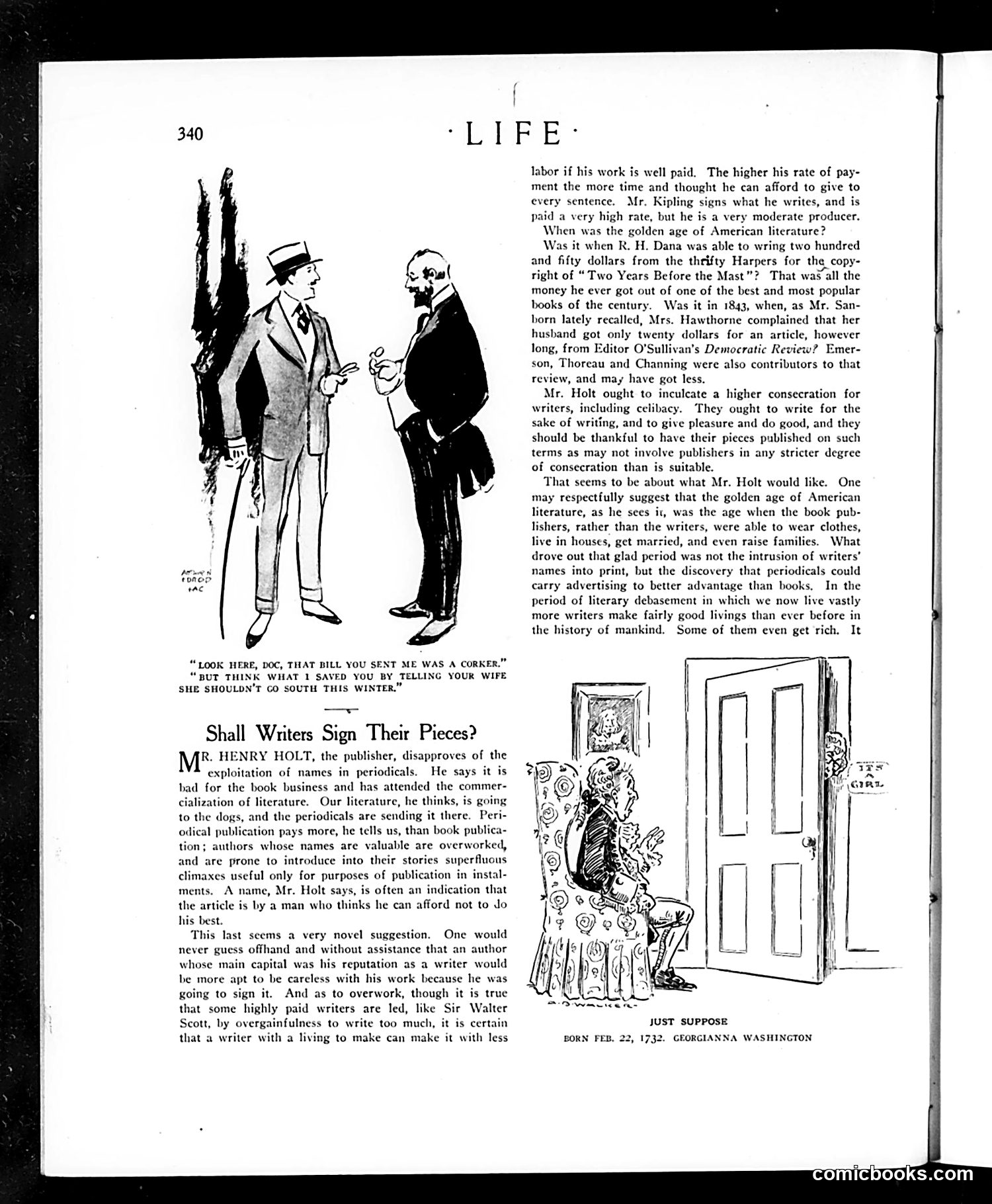
This page satirizes publisher **Henry Holt's** argument against writers signing their work in periodicals. Holt claimed bylines harm literature by encouraging overwork and carelessness, and that anonymous publication maintains quality. Life's rebuttal uses historical evidence: early American authors like R.H. Dana and Nathaniel Hawthorne were *grossly underpaid* for unsigned work—Dana received only $250 for "Two Years Before the Mast." The article argues the "golden age" Holt nostalgically recalls was actually when *publishers* profited while writers starved. Modern improvements in writer compensation came precisely *because* signed work proved valuable to periodicals carrying advertisements. The top cartoon jokes darkly about a doctor billing a patient for "saving" money by advising against a trip—rewarding poor service through deception. The bottom illustration references Georgianna Washington (born 1732), likely a humorous aside about early American history, though its connection to the main article is unclear.
📄 Transcribed text from this page (OCR, searchable)
Machine-transcribed from the original scan — historical spelling and the odd misread are preserved.
“LTE E~ labor if his work is well paid. The higher his rate of pay- ment the more time and thought he can afford to give to every sentence. Mr. Kipling signs what he writes, and is paid a very high rate, but he is a very moderate producer. When was the golden age of American literature? Was it when R. H. Dana was able to wring two hundred and fifty dollars from the thrifty Harpers for the_copy- right of “Two Years Before the Mast"? That was all the money he ever got out of one of the best and most popular books of the century. Was it in 1843, when, as Mr. San- born lately recalled, Mrs. Hawthorne complained that her husband got only twenty dollars for an article, however long, from Editor O’Sullivan’s Democratic Review? Emer- son, Thoreau and Channing were also contributors to that review, and may have got less. Mr. Holt ought to inculcate a higher consecration for writers, including celibacy. They ought to write for the sake of writing, and to give pleasure and do good, and they should be thankful to have their pieces published on such terms as may not involve publishers in any stricter degree of consecration than is suitable. That seems to be about what Mr. Holt would like. One may respectfully suggest that the golden age of American literature, as he sees it, was the age when the book pub- lishers, rather than the writers, were able to wear clothes, live in houses, get married, and even raise families. What drove out that glad period was not the intrusion of writers’ names into print, but the discovery that periodicals could carry advertising to better advantage than books, In the period of literary debasement in which we now live vastly more writers make fairly good livings than ever before in the history of mankind. Some of them even get rich. It “LOOK HERE, DOC, THAT BILL YOU SENT ME WAS A CORKER.” “BUT THINK WHAT 1 SAVED YOU BY TELLING YOUR WIFE SHE SHOULDN'T GO SOUTH THIS WINTER,” i Shall Writers Sign Their Pieces? R. HENRY HOLT, the publisher, disapproves of the exploitation of names in periodicals. He says it is bad for the book business and has attended the commer- cialization of literature. Our literature, he thinks, is going to the dogs, and the periodicals are sending it there. Peri- odical publication pays more, he tells us, than book publica- tion; authors whose names are valuable are overworked, and are prone to introduce into their stories superfluous climaxes useful only for purposes of publication in instal- ments. A name, Mr. Holt says, is often an indication that the article is by a man who thinks he can afford not to do his best. This last seems a very novel suggestion. One would never guess offhand and without assistance that an author whose main capital was his reputation as a writer would be more apt to be careless with his work because he was going to sign it. And to overwork, though it is true that some highly paid writers are led, like Sir Walter Scott, by overgainfulness to write too much, it is certain JUST SUPPOSE that a writer with a living to make can make it with less BORN FEB, 22, 1732. GEORGIANNA WASHINGTON comicbooks.com