
Life, 1916-02-24 · page 21 of 48
Life — February 24, 1916 — page 21: what you’re looking at
What you’re looking at
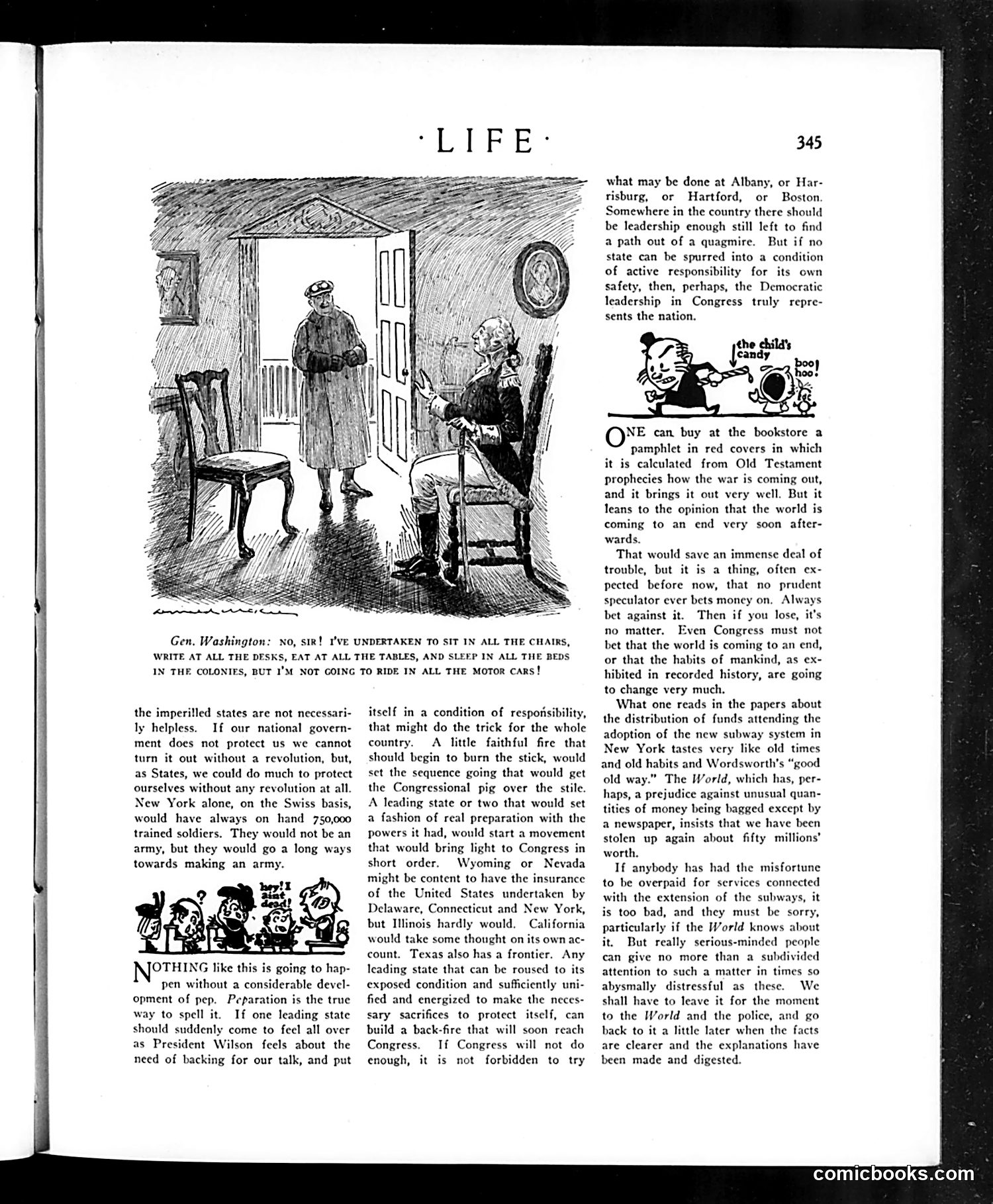
The main cartoon depicts **General George Washington** refusing to ride in motor cars, despite agreeing to sit in all colonial chairs, write at all desks, eat at all tables, and sleep in all beds. This is satirical commentary on **preparedness for World War I**. The joke contrasts Washington's willingness to sacrifice everything for the nation with his refusal of modern technology—suggesting Americans should embrace new methods (motor cars/military modernization) necessary for contemporary warfare, not cling to outdated approaches. The accompanying text argues that **individual states** should take military preparation seriously rather than relying on Congress, which the author suggests is failing in its duty. The satire mocks Congressional inaction on war readiness while praising Washington's willingness to sacrifice, implying modern leaders should show similar commitment to defensive preparation using modern means.
📄 Transcribed text from this page (OCR, searchable)
Machine-transcribed from the original scan — historical spelling and the odd misread are preserved.
Gen. Washington: No, six! I'VE UNDERTAKEN TO SIT IN ALL THE CHAIRS, WRITE AT ALL THE DESKS, EAT AT ALL THE TABLES, AND SLEEP IN ALL THE BEDS IN THE COLONIES, BUT I’M NOT GOING TO RIDE IN ALL THE MOTOR Cars! the imperilled states are not necessari- ly helpless. If our national govern- ment does not protect us we cannot turn it out without a revolution, but, as States, we could do much to protect ourselves without any revolution at all. New York alone, on the Swiss basis, would have always on hand 750,000 trained soldiers. They would not be an army, but they would go a long ways towards making an army. OTHING like this is going to hap- pen without a considerable devel- opment of pep. Peparation is the true way to spell it. If one leading state should suddenly come to feel all over as President Wilson feels about the need of backing for our talk, and put itself in a condition of responsibil that might do the trick for the whole country. A little faithful fire that should begin to burn the stick, would set the sequence going that would get the Congressional pig over the stile. A leading state or two that would set a fashion of real preparation with the powers it had, would start a movement that would bring light to Congress in short order. Wyoming or Nevada might be content to have the insurance of the United States undertaken by Delaware, Connecticut and New York, but Illinois hardly would. California would take some thought on its own ac- count. Texas also has a frontier. Any leading state that can be roused to its exposed condition and sufficiently uni- fied and energized to make the neces- sary sacrifices to protect itself, can build a back-fire that will soon reach Congress. If Congress will not do enough, it is not forbidden to try 345 what may be done at Albany, or Har- risburg, or Hartford, or Boston. Somewhere in the country there should be leadership enough still left to find a path out of a quagmire. But if no state can be spurred into a condition of active responsibility for its own safety, then, perhaps, the Democratic leadership in Congress truly repre- sents the nation. NE can buy at the bookstore a pamphlet in red covers in which it is calculated from Old Testament prophecies how the war is coming out, and it brings it out very well. But it leans to the opinion that the world is coming to an end very soon after- wards. That would save an immense deal of trouble, but it is a thing, often ex- pected before now, that no prudent speculator ever bets money on. Alway: bet against it. Then if you lose, no matter. Even Congress must not bet that the world is coming to an end, or that the habits of mankind, as ex- hibited in recorded history, are going to change very much. What one reads in the papers about the distribution of funds attending the adoption of the new subway system in New York tastes very like old times and old habits and Wordsworth's “good old way.” The World, which has, per- haps, a prejudice against unusual quan- tities of money being bagged except by a newspaper, insists that we have been stolen up again about fifty millions’ worth. If anybody has had the misfortune to be overpaid for services connected with the extension of the subways, it is too bad, and they must be sorry, particularly if the World knows about it. But really serious-minded people can give no more than a subdivided attention to such a matter in times so abysmally distressful as these. We shall have to leave it for the moment to the World and the police, and go back to it a little later when the facts are clearer and the explanations have been made and digested. comicbooks.com