
Life, 1916-02-24 · page 32 of 48
Life — February 24, 1916 — page 32: what you’re looking at
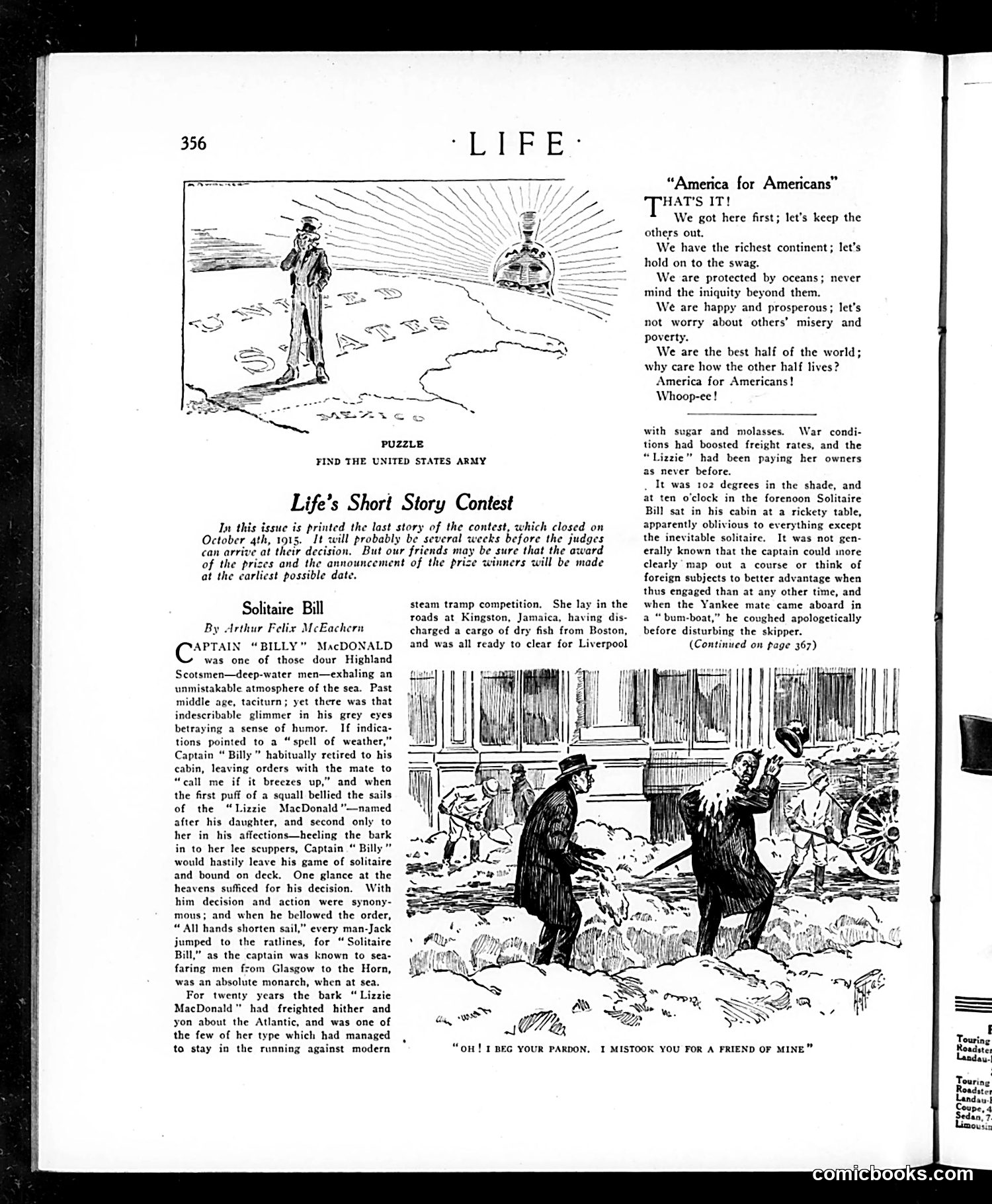
What you’re looking at
**"America for Americans" Section (Right):** This satirical poem mocks isolationist sentiment popular during World War I (the page is dated 1915). It ridicules the attitude that America should ignore global suffering and foreign conflicts, prioritize wealth accumulation ("hold on to the swag"), and seal itself off from the world. The tone is deliberately crude ("Whoop-ee!") to expose the selfishness underlying such nationalism. The phrase "why care how the other half lives?" invokes contemporary social inequality debates. **"Find the United States Army" Puzzle (Top Left):** This is a "hidden object" puzzle game where readers must locate the U.S. Army within the illustration of a standing figure gazing at sunrise/landscape. These were popular magazine features. **"Solitaire Bill" Story:** A short story about a Scottish sea captain managing his ship during wartime (when freight rates had risen due to WWI conditions). The bottom illustration shows a humorous shipboard encounter.
📄 Transcribed text from this page (OCR, searchable)
Machine-transcribed from the original scan — historical spelling and the odd misread are preserved.
FIND THE UNITED STATES ARMY Life’s Short Story Contest In this issue is printed the last story of the contest, which closed on October 4th, 1915. It ill probably be several weeks before the judges can arrive at their decision, But our friends may be sure that the award of the pi at the earliest possible date, Solitaire Bill By Arthur Felix McEachern APTAIN “BILLY” MacDONALD was one of those dour Highland Scotsmen—deep-water men—exhaling an unmistakable atmosphere of the sea. Past middle age, taciturn; yet there was that indescribable glimmer in his grey eyes betraying a sense of humor. If indica- tions pointed to a “spell of weather,” Captain “ Billy” habitually retired to his cabin, leaving orders with the mate to “call me if it breezes up,” and when the first puff of a squall bellied the sails of the “Lizzie MacDonald "—named after his daughter, and second only to her in his affections—hecling the bark in to her lee scuppers, Captain “ Billy” would hastily leave his game of solitaire and bound on deck. One glance at the heavens sufficed for his decision. With him decision and action were synony- mous; and when he bellowed the order, “ All hands shorten sail,” every man-Jack jumped to the ratlines, for “Solitaire Bill,” as the captain was known to sea- faring men from Glasgow to the Horn, was an absolute monarch, when at sea. For twenty years the bark “Lizzie MacDonald” had freighted hither and yon about the Atlantic, and was one of the few of her type which had managed to stay in the running against modern sand the announcement of the pri winners will be made steam tramp competition. She lay in the roads at Kingston, Jamaica, having dis- charged a cargo of dry fish from Boston, and was all ready to clear for Liverpool “on! 1 BEG YOUR PARDON, “America for Americans” HAT’S IT! We got here first; let’s keep the others out, We have the richest continent; let’s hold on to the swag. We are protected by oceans; mind the iniquity beyond them. We are happy and prosperous; let's not worry about others’ misery and poverty. We are the best half of the world; why care how the other half lives? America for Americans! Whoop-ee! never with sugar and molasses. War condi- tions had boosted freight rates, and the “Lizzie” had been paying her owners as never before. It was 102 degrees in the shade, and at ten o'clock in the forenoon Solitaire Bill sat in his cabin at a rickety table, apparently oblivious to everything except the inevitable solitaire. It was not gen- erally known that the captain could nore clearly’ map out a course or think of foreign subjects to better advantage when thus engaged than at any other time, and when the Yankee mate came aboard in a “bum-boat,” he coughed apologetically before disturbing the skipper. (Continued on page 367) I MISTOOK YOU FOR A FRIEND OF MINE”