
Life, 1916-02-24 · page 20 of 48
Life — February 24, 1916 — page 20: what you’re looking at
What you’re looking at
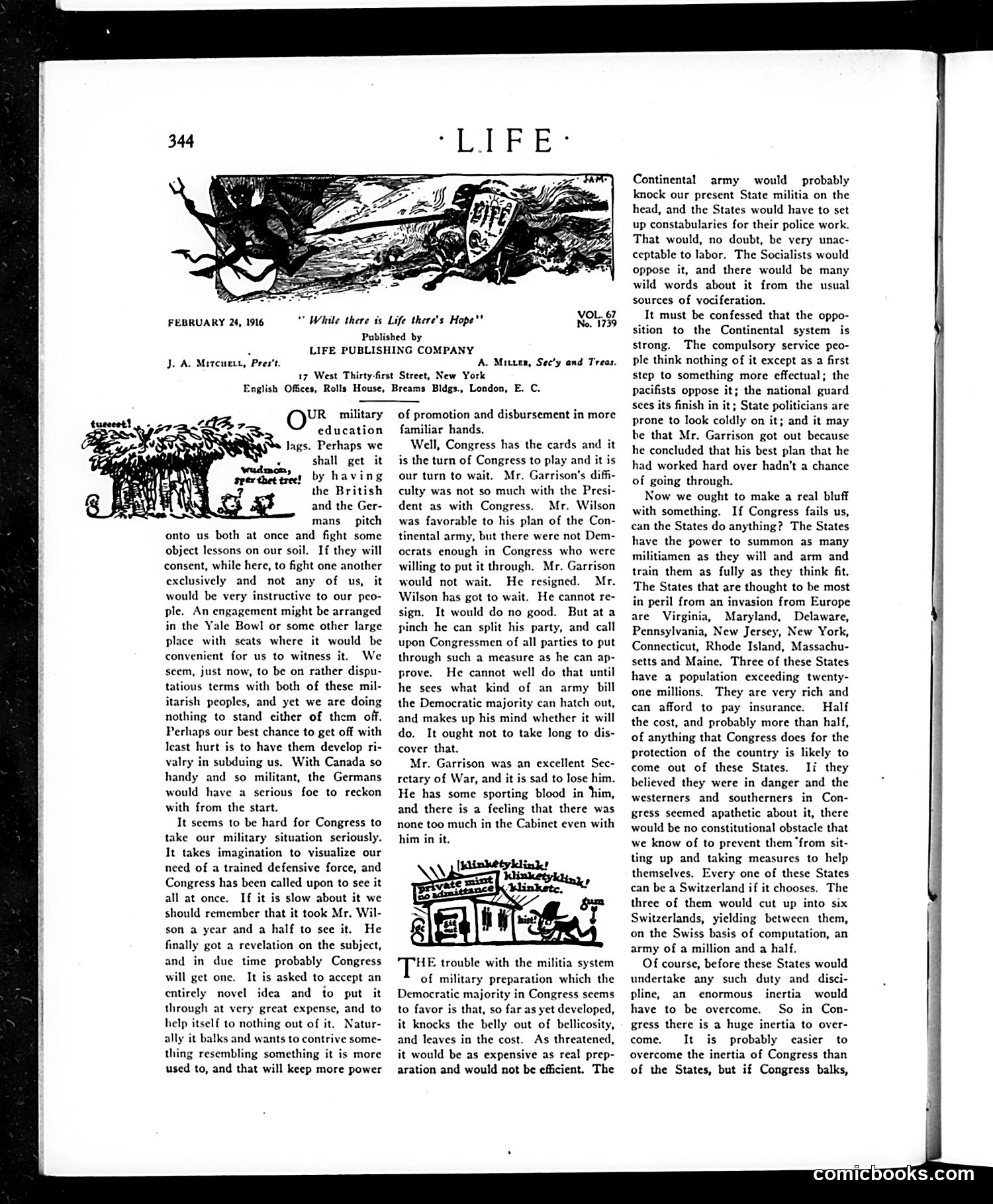
This satirical editorial addresses American military preparedness during World War I. The text critiques Congress's sluggish response to President Wilson's defense initiatives, particularly regarding formation of a "Continental army." **Key figures referenced:** - **President Wilson**: criticized for taking "a year and a half" to recognize military necessity - **Lindley M. Garrison**: Secretary of War who resigned in frustration over Congressional opposition to his Continental Army proposal - **Congress**: portrayed as slow, imaginative, and reluctant to spend on unfamiliar military structures **The satire's point:** Life mocks Congressional inertia—they move cautiously on unprecedented spending despite European war raging nearby. The opening cartoon joke suggests America invite Britain and Germany to fight on U.S. soil as a "lesson." **Political context:** This reflects pre-WWI American isolationism and Congressional resistance to military expansion, complicated by whether to support state militias (favored by Democrats) versus a federal Continental Army (favored by Wilson's administration). The editorial reveals America's defensive anxiety in 1916, when entry into WWI seemed increasingly possible.
📄 Transcribed text from this page (OCR, searchable)
Machine-transcribed from the original scan — historical spelling and the odd misread are preserved.
FEBRUARY 2¢, 1916 “ While there is Life there's Hope'* Published by LIFE PUBLISHING COMPANY J. A. Mitcurnt, Pres’t. UR military education Jags. Perhaps we shall get it by having the British and the Ger- mans pitch onto us both at once and fight some object lessons on our soil. If they will consent, while here, to fight one another exclusively and not any of us, it would be very instructive to our peo- ple. An engagement might be arranged in the Yale Bowl or some other large place with seats where it would be convenient for us to witness it. We seem, just now, to be on rather dispu- tatious terms with both of these mil- itarish peoples, and yet we are doing nothing to stand cither of them off. Perhaps our best chance to get off with Ieast hurt is to have them develop ri- valry in subduing us. With Canada so handy and so militant, the Germans would have a serious foe to reckon with from the start. It seems to be hard for Congress to take our military situation seriously. It takes imagination to visualize our need of a trained defensive force, and Congress has been called upon to see it all at once. If it is slow about it we should remember that it took Mr. Wil- son a year and a half to see it. He finally got a revelation on the subject, and in due time probably Congress will get one. It is asked to accept an entirely novel idea and to put it through at very great expense, and to help itself to nothing out of it. Natur- ally it balks and wants to contrive some- thing resembling something it is more used to, and that will keep more power A. Mitten, Sec’y and Treas. 17 West Thirty-first Street, New York English Offices, Rolls House, Breams Bldgs., London, E. C. of promotion and disbursement in more familiar hands. Well, Congress has the cards and it is the turn of Congress to play and it is our turn to wait. Mr. Garrison's diffi- culty was not so much with the Presi- dent as with Congress. Mr. Wilson was favorable to his plan of the Con- tinental army, but there were not Dem- ocrats enough in Congress who were willing to put it through. Mr. Garrison would not wait. He resigned. Mr. Wilson has got to wait. He cannot re- sign. It would do no good. But at a pinch he can split his party, and call upon Congressmen of all parties to put through such a measure as he can ap- prove. He cannot well do that until he sees what kind of an army bill the Democratic majority can hatch out, and makes up his mind whether it will do. It ought not to take long to dis- cover that. Mr. Garrison was an excellent Sec- retary of War, and it is sad to lose him. He has some sporting blood in ‘him, and there is a feeling that there was none too much in the Cabinet even with him in it. HE trouble with the militia system of military preparation which the Democratic majority in Congress seems to favor is that, so far as yet developed, it knocks the belly out of bellicosity, and leaves in the cost. As threatened, it would be as expensive as real prep- aration and would not be efficient. The Continental army would probably knock our present State militia on the head, and the States would have to set up constabularies for their police work. That would, no doubt, be very unac- ceptable to labor. The Socialists would oppose it, and there would be many wild words about it from the usual sources of vociferation. It must be confessed that the oppo- sition to the Continental system is strong. The compulsory service peo- ple think nothing of it except as a first step to something more effectual; the Pacifists oppose it; the national guard sees its finish in i tate politicians are prone to look coldly on it; and it may be that Mr. Garrison got out because he concluded that his best plan that he had worked hard over hadn't a chance of going through. Now we ought to make a real bluff with something. If Congress fails us, can the States do anything? The States have the power to summon as many militiamen as they will and arm and train them as fully as they think fit. The States that are thought to be most in peril from an invasion from Europe are Virginia, Maryland, Delaware, Pennsylvania, New Jersey, New York, Connecticut, Rhode Island, Massachu- setts and Maine. Three of these States have a population exceeding twenty- one millions. They are very rich and can afford to pay insurance. Half the cost, and probably more than half, of anything that Congress does for the protection of the country is likely to come out of these States. Ii they believed they were in danger and the westerners and southerners in Con- gress seemed apathetic about it, there would be no constitutional obstacle that we know of to prevent them ‘from sit- ting up and taking measures to help themselves. Every one of these States can be a Switzerland if it chooses. The three of them would cut up into six Switzerlands, yielding between them, on the Swiss basis of computation, an army of a million and a half. Of course, before these States would undertake any such duty and disci- pline, an enormous inertia would have to be overcome. So in Con- gress there is a huge inertia to over- come. It is probably casier to overcome the inertia of Congress than of the States, but if Congress balks, Ccomicbooks.com