
Life, 1916-02-24 · page 8 of 48
Life — February 24, 1916 — page 8: what you’re looking at
What you’re looking at
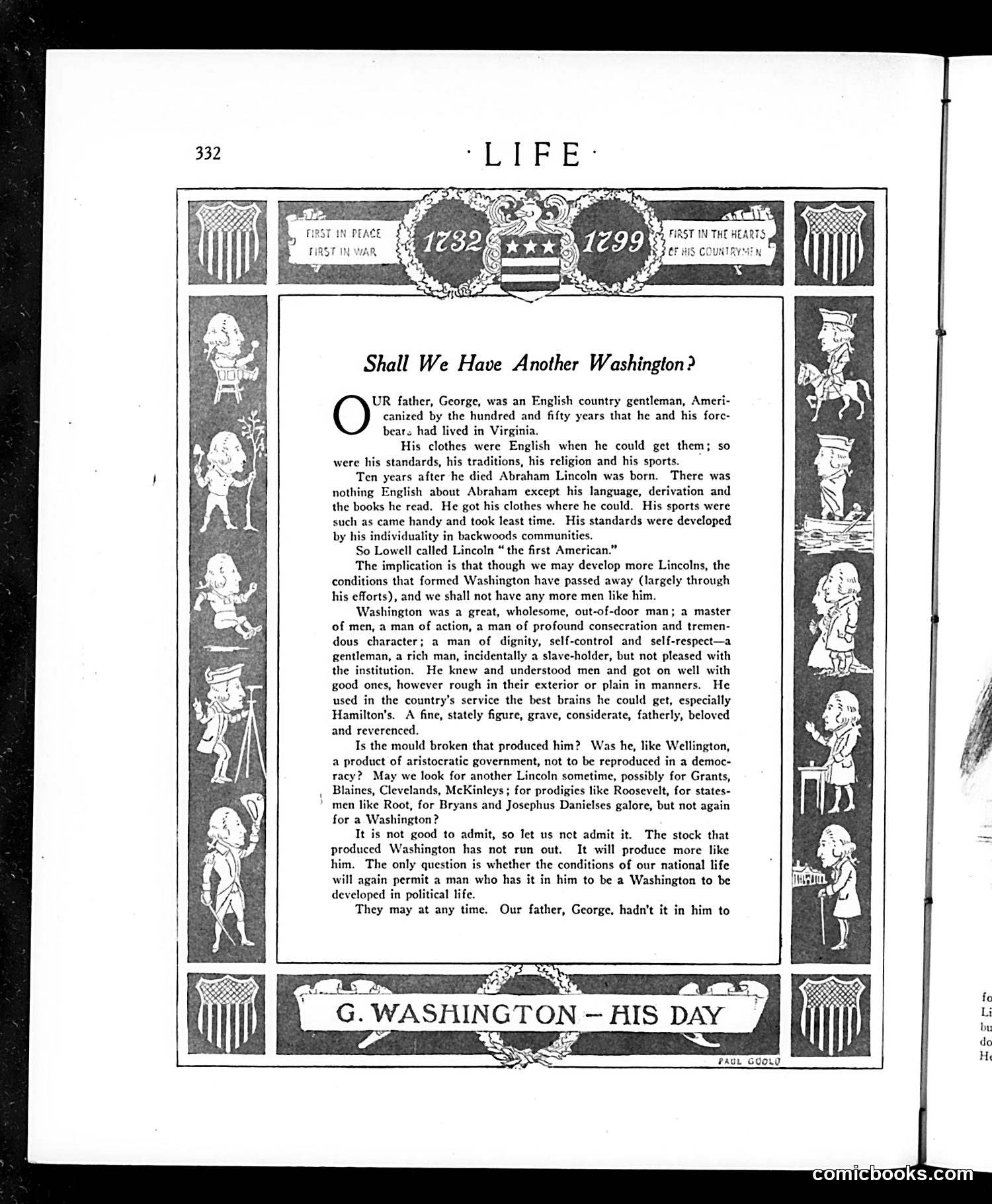
This article questions whether America can produce another George Washington. The author contrasts Washington—described as a self-made man from backwoods Virginia with English heritage—with Abraham Lincoln, called "the first American" despite his rough frontier upbringing. The piece argues that while Washington emerged from aristocratic conditions unlikely to recur in democracy, the *stock* that produced him remains viable. However, it expresses doubt that democratic institutions will again permit such a figure's political development. The sidebar illustrations show various American leaders (appearing to be Grant, Cleveland, McKinley, Roosevelt, and others mentioned) as potential successors, though the text suggests none truly replicate Washington's unique combination of character, dignity, and leadership.
📄 Transcribed text from this page (OCR, searchable)
Machine-transcribed from the original scan — historical spelling and the odd misread are preserved.
PEACE 1 WAR Shall We Have Another Washington? UR father, George, was an English country gentleman, Ameri- O canized by the hundred and fifty years that he and his fore- bears had lived in Virginia. His clothes were English when he could get them; so were his standards, his traditions, his religion and his sports. Ten years after he died Abraham Lincoln was born. There was nothing English about Abraham except his language, derivation and the books he read, He got his clothes where he could. His sports were such as came handy and took least time. His standards were developed by his individuality in backwoods communities. So Lowell called Lincoln “ the first American.” The implication is that though we may develop more Lincolns, the conditions that formed Washington have passed away (largely through his efforts), and we shall not have any more men like him. Washington was a great, wholesome, out-of-door man; a master of men, a man of action, a man of profound consecration and tremen- dous character; a man of dignity, self-control and self-respect—a gentleman, a rich man, incidentally a slave-holder, but not pleased with the institution. He knew and understood men and got on well with good ones, however rough in their exterior or plain in manners. He used in the country’s service the best brains he could get, especially Hamilton's. A fine, stately figure, grave, considerate, fatherly, beloved and reverenced. Is the mould broken that produced him? Was he, like Wellington, a product of aristocratic government, not to be reproduced in a democ- racy? May we look for another Lincoln sometime, possibly for Grants, Blaines, Clevelands, McKinleys ; for prodigies like Roosevelt, for states- men like Root, for Bryans and Josephus Danielses galore, but not again for a Washington? It is not good to admit, so Iet us net admit it. The stock that produced Washington has not run out. It will produce more like him. The only question is whether the conditions of our national life will again permit a man who has it in him to be a Washington to be developed in political life. They may at any time. Our father, George. hadn’t it in him to a: =P PAUL GOOL