
A complete issue · 44 pages · 1916
Life — February 10, 1916
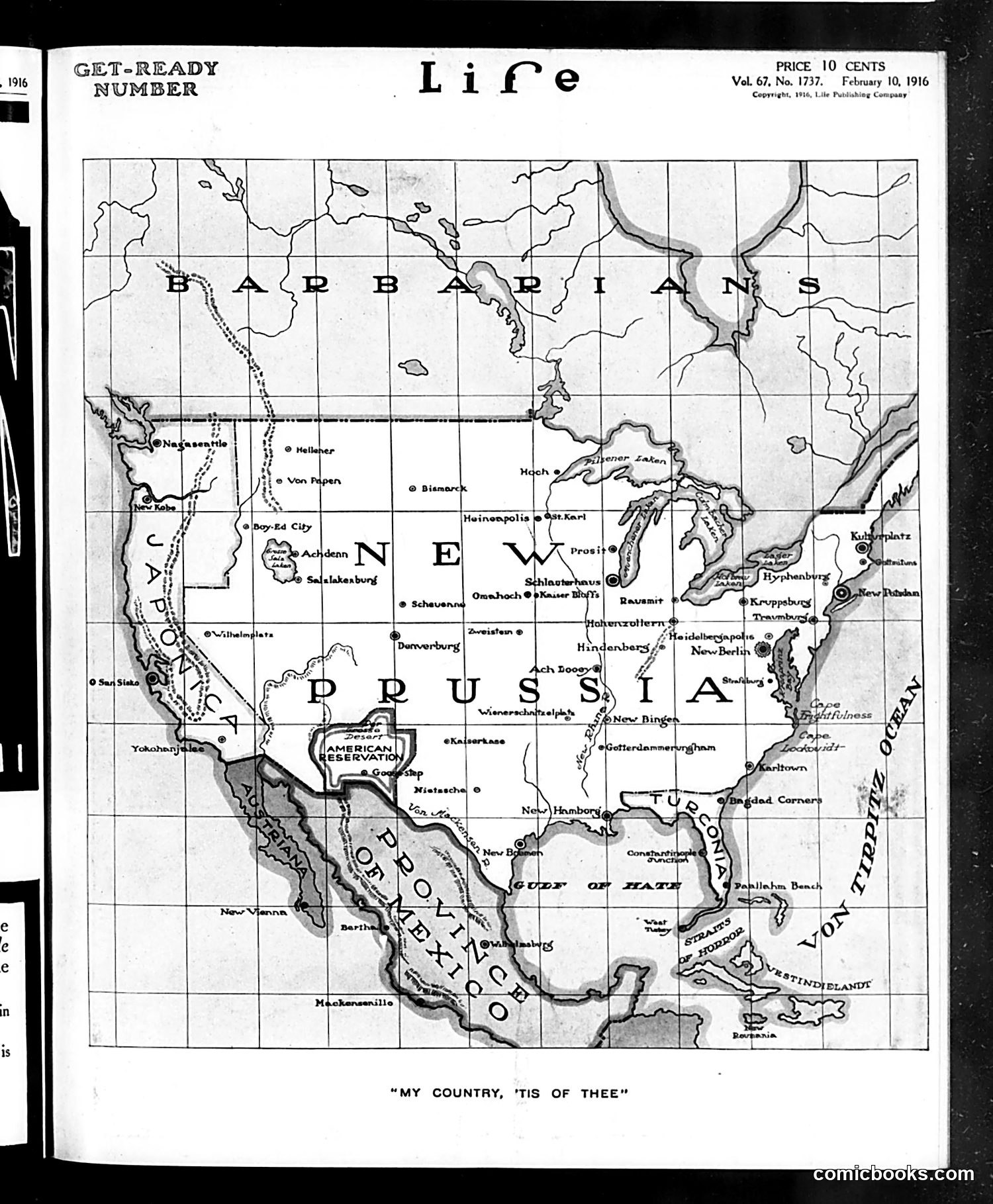
This is a satirical map from *Life* magazine (February 10, 1916) titled "MY COUNTRY, 'TIS OF THEE." The cartoon overlays a map of Germany with American geography and city names—Berlin becomes "New Berlin," German regions are relabeled as American states, and "American Reservation" appears in the center. **The Satire:** This is anti-German propaganda created during World War I (before U.S. entry in April 1917). The cartoonist ridicules German territorial ambitions by suggesting Germany sought to conquer and "Americanize" vast lands. By replacing German place names with American ones, the joke implies Germans harbored imperial designs comparable to American expansion or that German militarism threatened American interests. The caption's patriotic reference to the American hymn adds ironic weight to the warning.
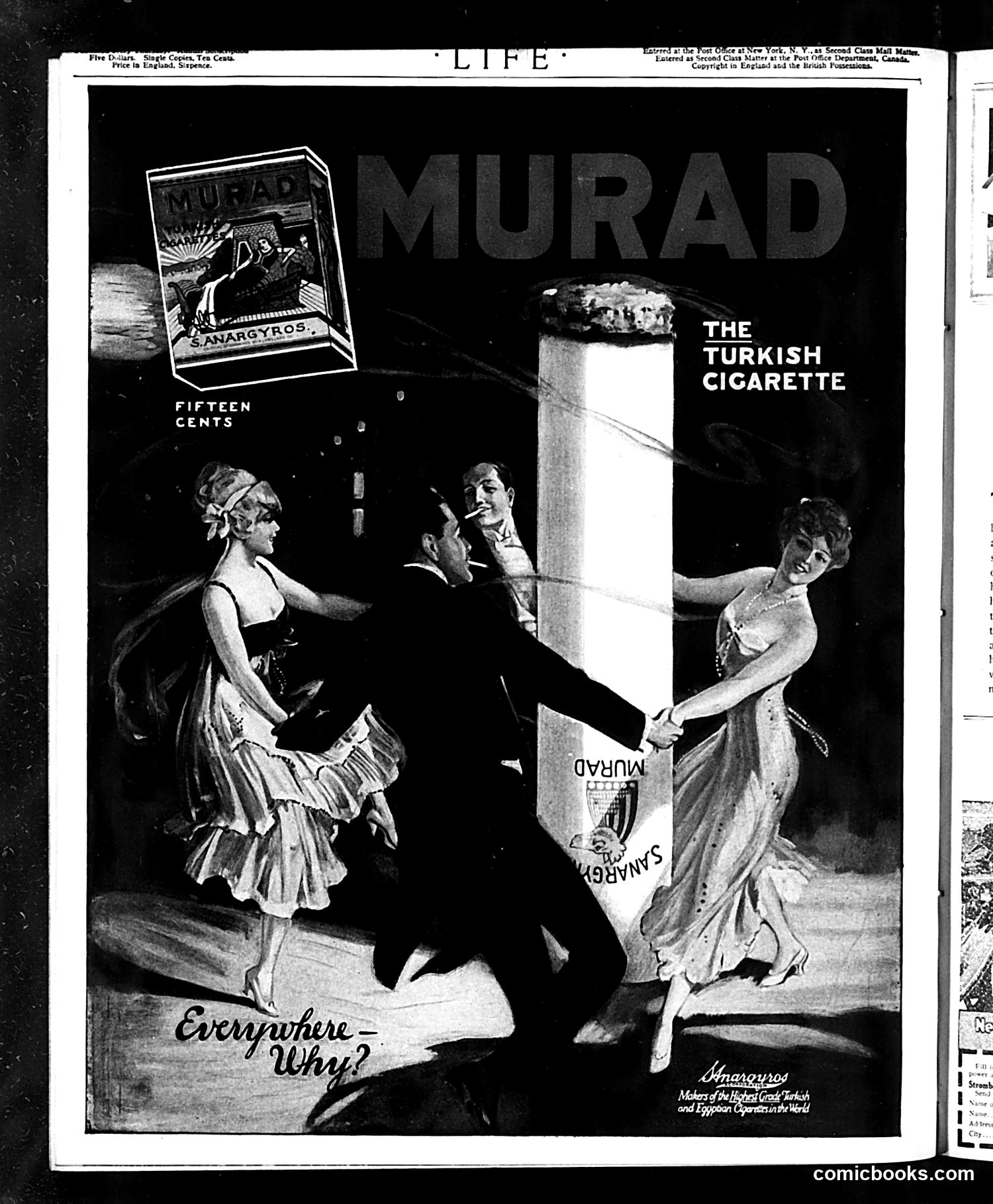
This is a **cigarette advertisement**, not political satire. It promotes Murad brand Turkish cigarettes at fifteen cents, positioned as an upscale product. The ad's humor targets social attitudes of its era. Two fashionably-dressed women flank a man in formal wear holding a large cigarette package. The caption "Everywhere—Why?" suggests the product's popularity. The imagery implies that Murad cigarettes attract sophisticated, attractive people—a common advertising strategy of the early 20th century. The "Turkish cigarette" designation was a genuine product category; Turkish tobacco was considered premium. The allure suggested here—elegance, social success, glamour—reflects period advertising conventions linking cigarettes to status and desirability. Modern viewers would likely find the openly sexualized marketing and health implications striking.
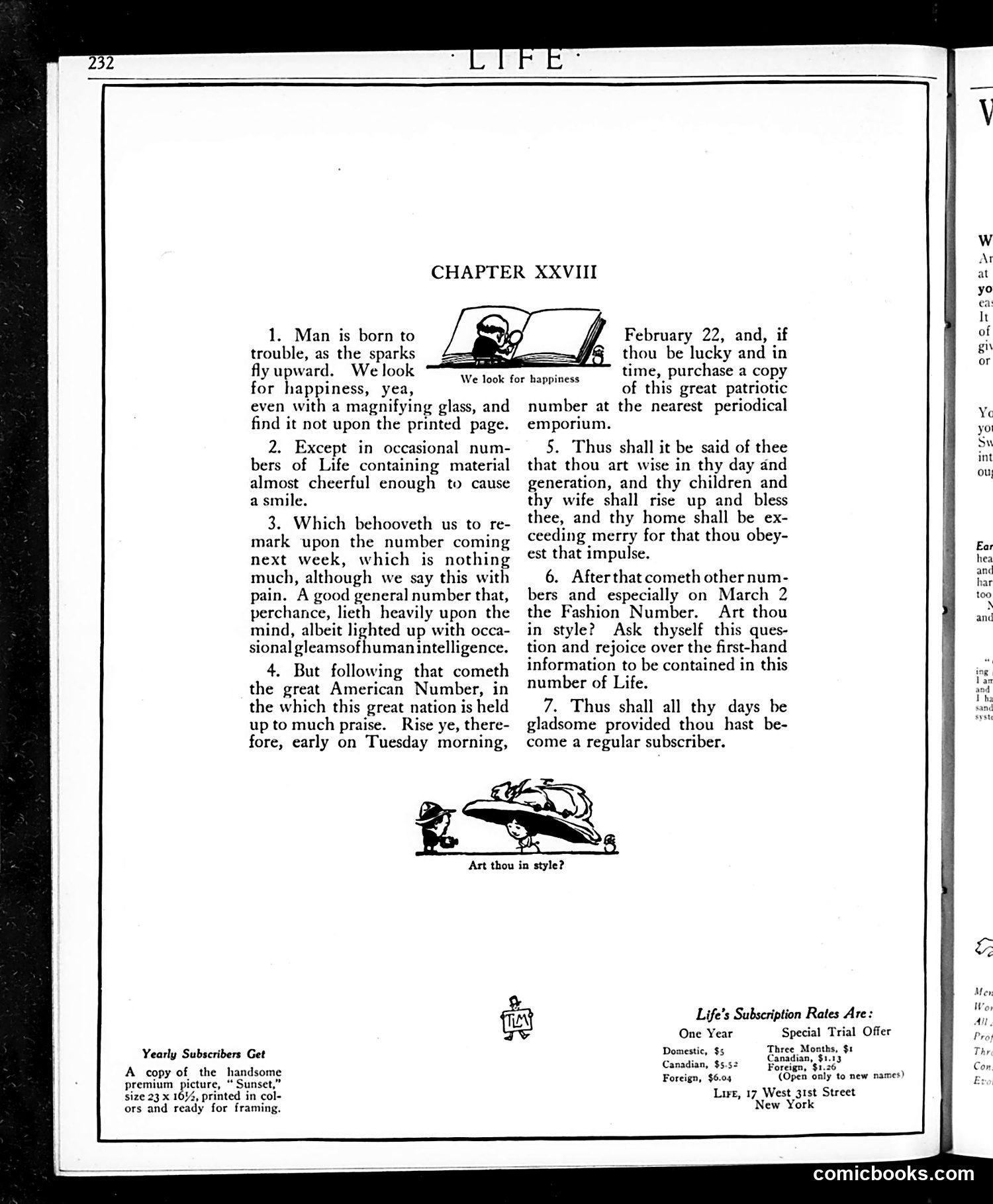
This page is primarily **promotional/satirical advertisement** for Life magazine subscriptions, written in mock-biblical language. **The satire:** The text humorously elevates Life magazine to sacred status, using archaic religious phrasing ("Rise ye, therefore, early on Tuesday morning") to encourage subscription. It presents acquiring Life as a moral obligation that will bring happiness and family blessings. **The cartoons:** Two small illustrations appear—one showing a figure reading (labeled "We look for happiness") and another of a fashionably-dressed woman (labeled "Art thou in style?"). These reinforce Life's appeal as a source for both entertainment and fashion guidance. **The joke:** By treating a commercial product with religious reverence, Life mocks both consumer culture and Americans' earnest pursuit of happiness through magazine consumption. The subscription rates are listed at bottom.
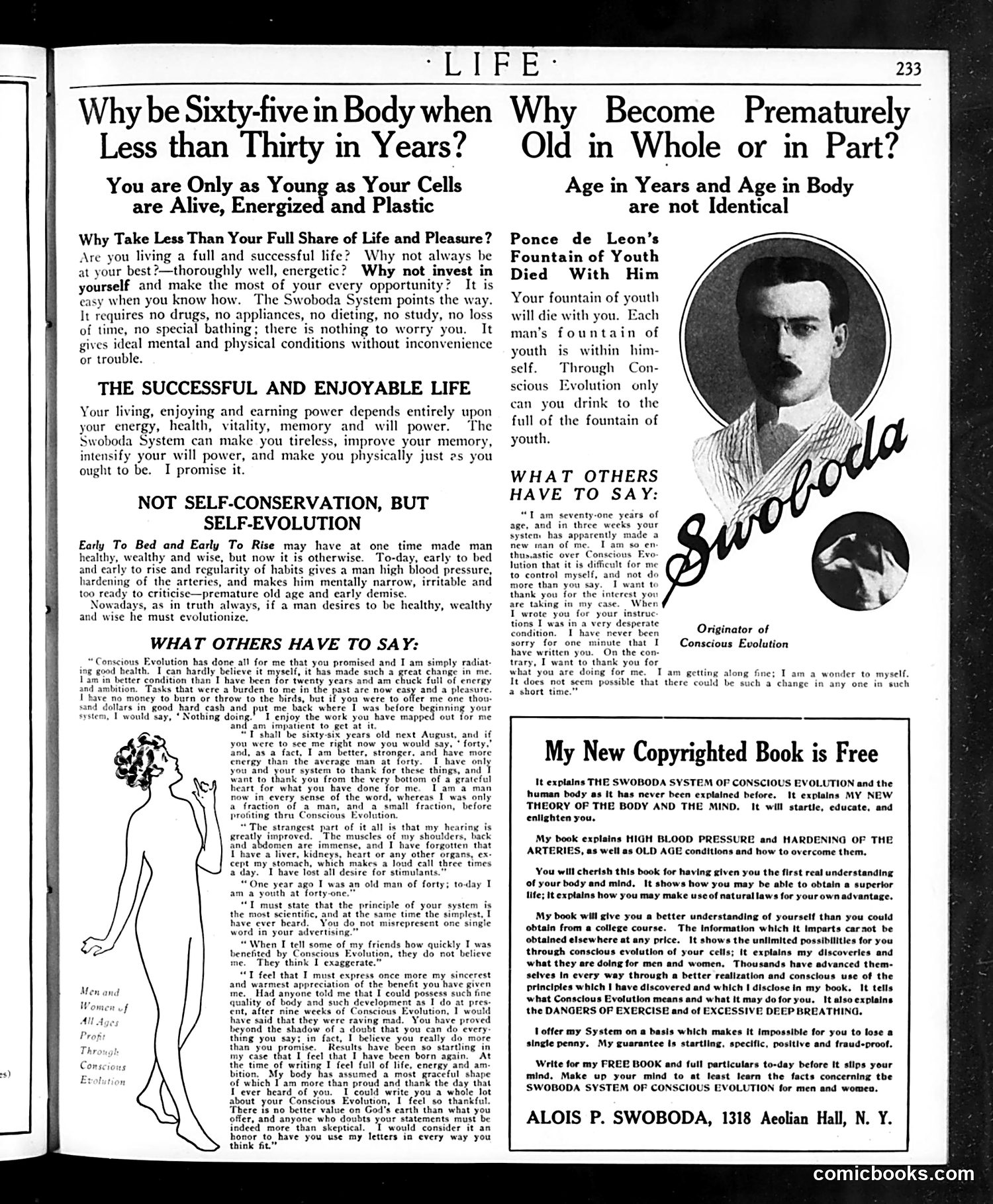
This page mixes editorial content with advertisement. The left side contains testimonials praising the "Swoboda System"—apparently a health/vitality method claiming to restore youth and energy without drugs or dieting. The cartoon on the left shows a simplified male figure labeled "Men and Women of All Ages Profit Through Conscious Evolution." The right side advertises Alois P. Swoboda's book and system, featuring his portrait. Swoboda claims his method explains "high blood pressure," "hardening of the arteries," and other conditions, promising readers will understand their body as "never before explained." This appears to be early 20th-century health pseudoscience marketing—a common Life magazine feature mixing genuine satire of quackery with paid advertisements for dubious "self-improvement" systems. The earnest testimonials likely parody such appeals.
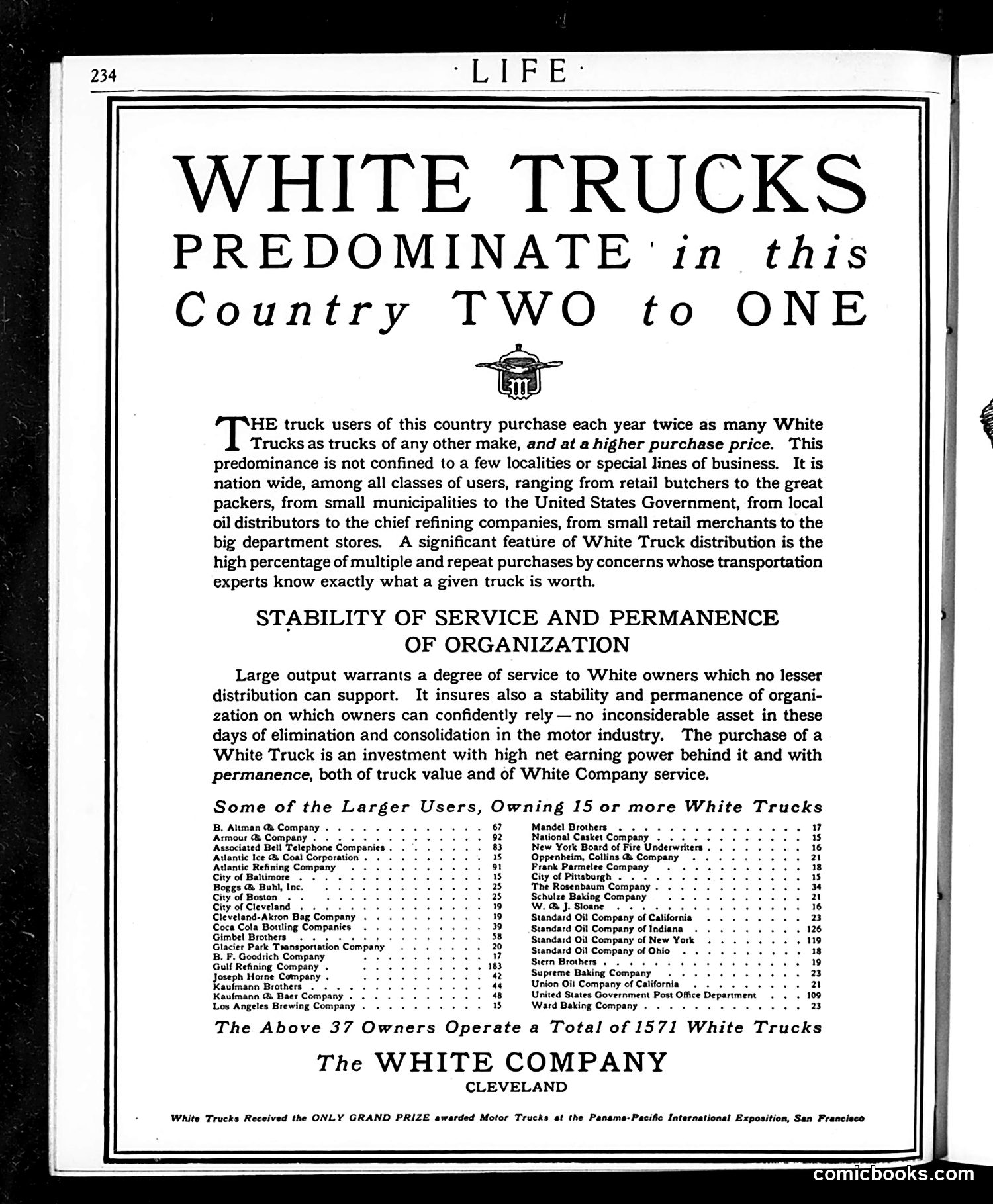
This page is a **commercial advertisement**, not satirical content. It promotes White Trucks, a commercial vehicle manufacturer based in Cleveland. The ad claims White Trucks dominate the market with a "two to one" sales advantage over competitors. The copy emphasizes White's reliability and stability—important selling points during an era of "elimination and consolidation in the motor industry." It lists 37 major corporate and government users owning 1,571 White trucks combined, including utilities, oil companies, bakeries, and government agencies. The advertisement appeals to business logic: White Trucks represent a sound investment with "high net earning power" and reliable service. This is straightforward corporate marketing, not satire or political commentary.
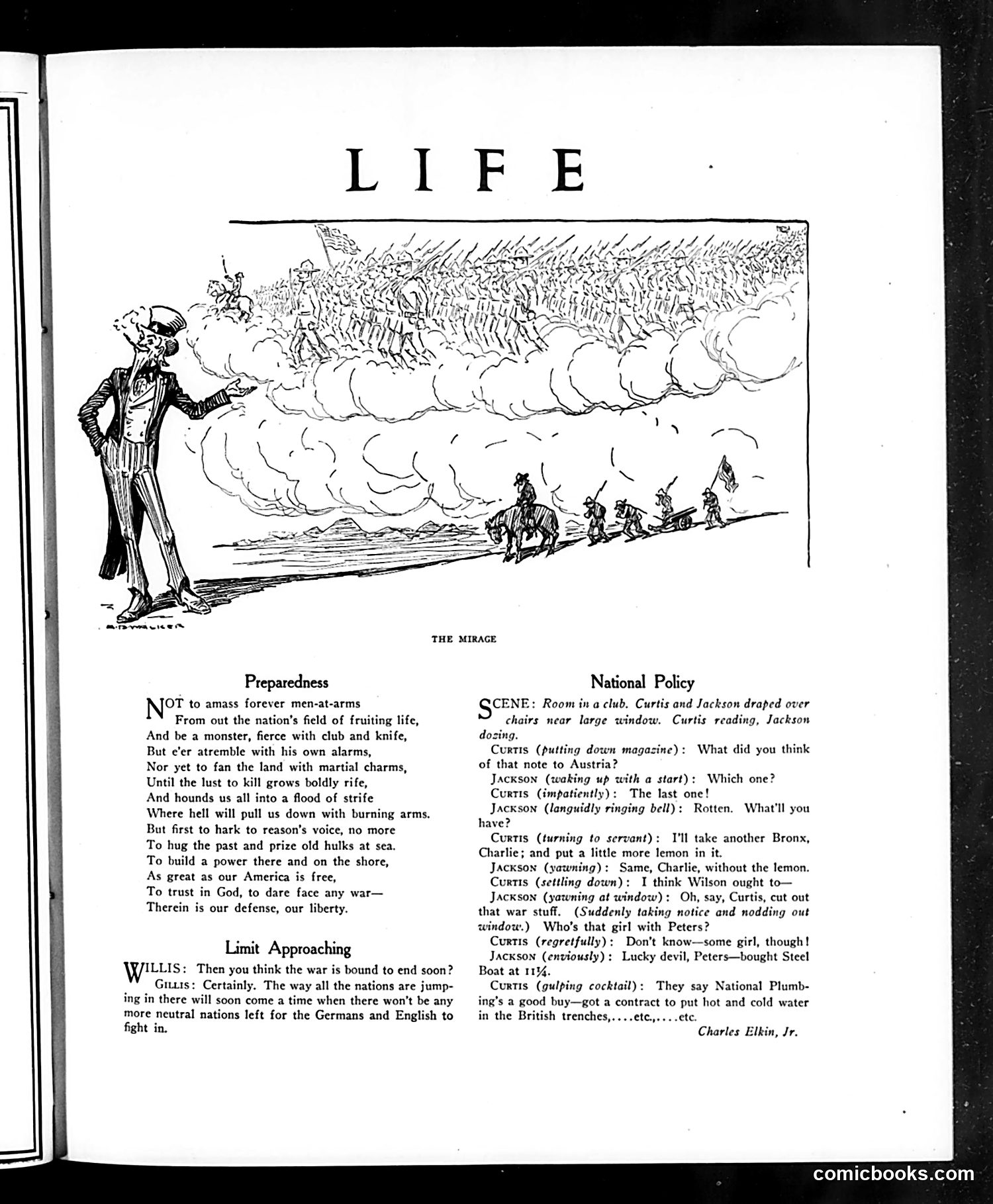
This page presents wartime commentary during World War I. **"The Mirage"** illustration depicts Uncle Sam (the tall figure on left) observing a vision of marching soldiers and crowds above clouds—representing idealistic American war aims versus harsh reality. **"Preparedness"** poem advocates military buildup before entering combat, rejecting pacifism and emphasizing American strength. **"National Policy"** dialogue features characters Curtis and Jackson discussing Austria and military supplies in a club setting, appearing to mock civilian political debate about war strategy. References to "Steel Boat" and "National Plumbing" suggest satirizing mundane commercial concerns amid serious wartime decisions. The overall page critiques American unpreparedness and questions national priorities during the conflict, typical of Life's contemporary editorial stance.
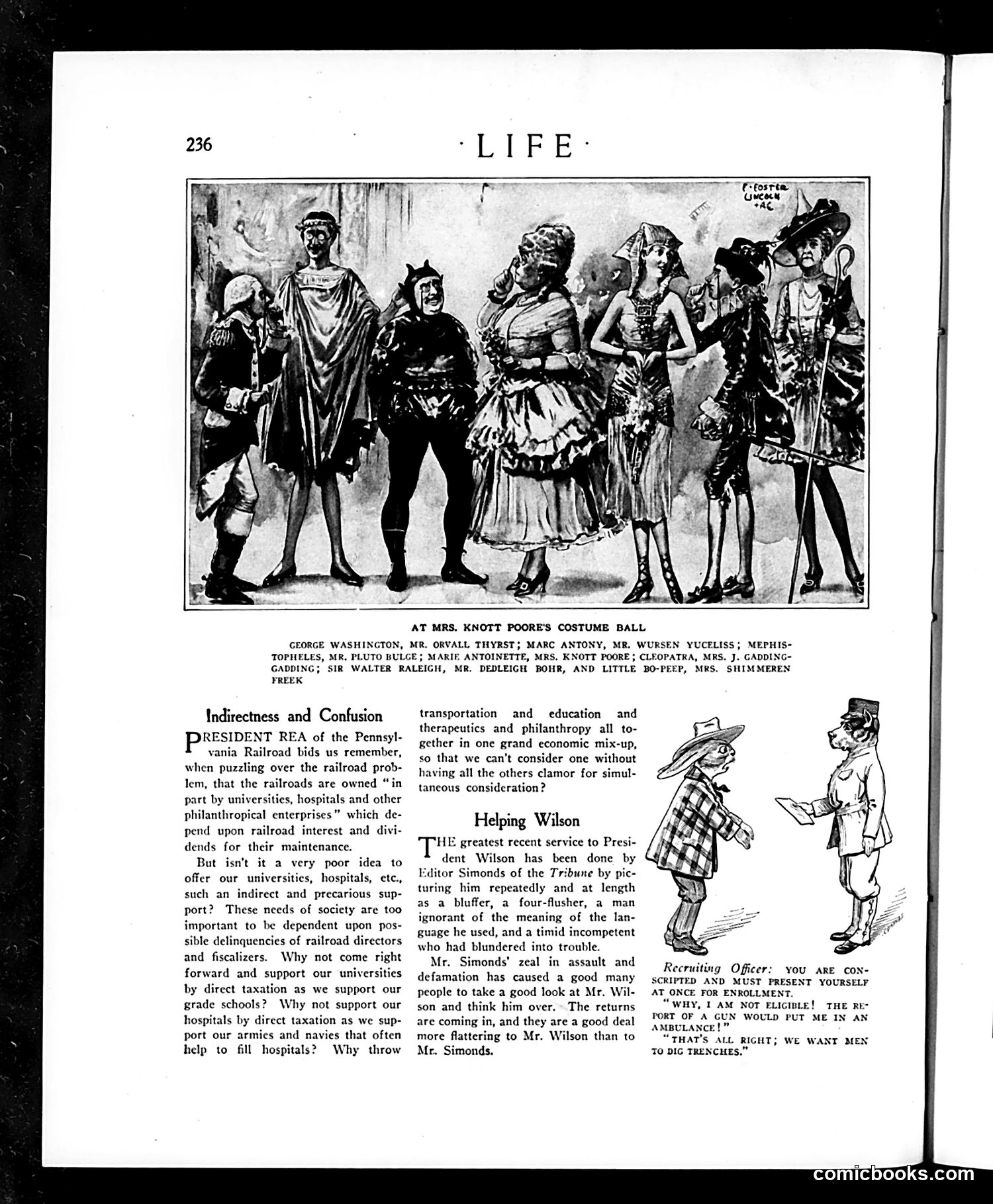
The top illustration depicts "Mrs. Knott Poore's Costume Ball," a high-society event featuring figures in historical and theatrical dress, labeled with names including George Washington and various other characters. Below, two article sections critique contemporary issues: **"Indirectness and Confusion"** satirizes President Rea of the Pennsylvania Railroad for suggesting universities and hospitals are partially responsible for maintaining railroads—the author argues this indirect economic logic is absurd and that railroads should be directly taxed instead. **"Helping Wilson"** mocks Editor Simonds of the *Tribune* for repeatedly calling President Wilson unflattering names (bluffer, four-flusher, incompetent), then praising the "good" responses these criticisms supposedly generated. The satire suggests Simonds wants credit for Wilson's success despite his attacks.
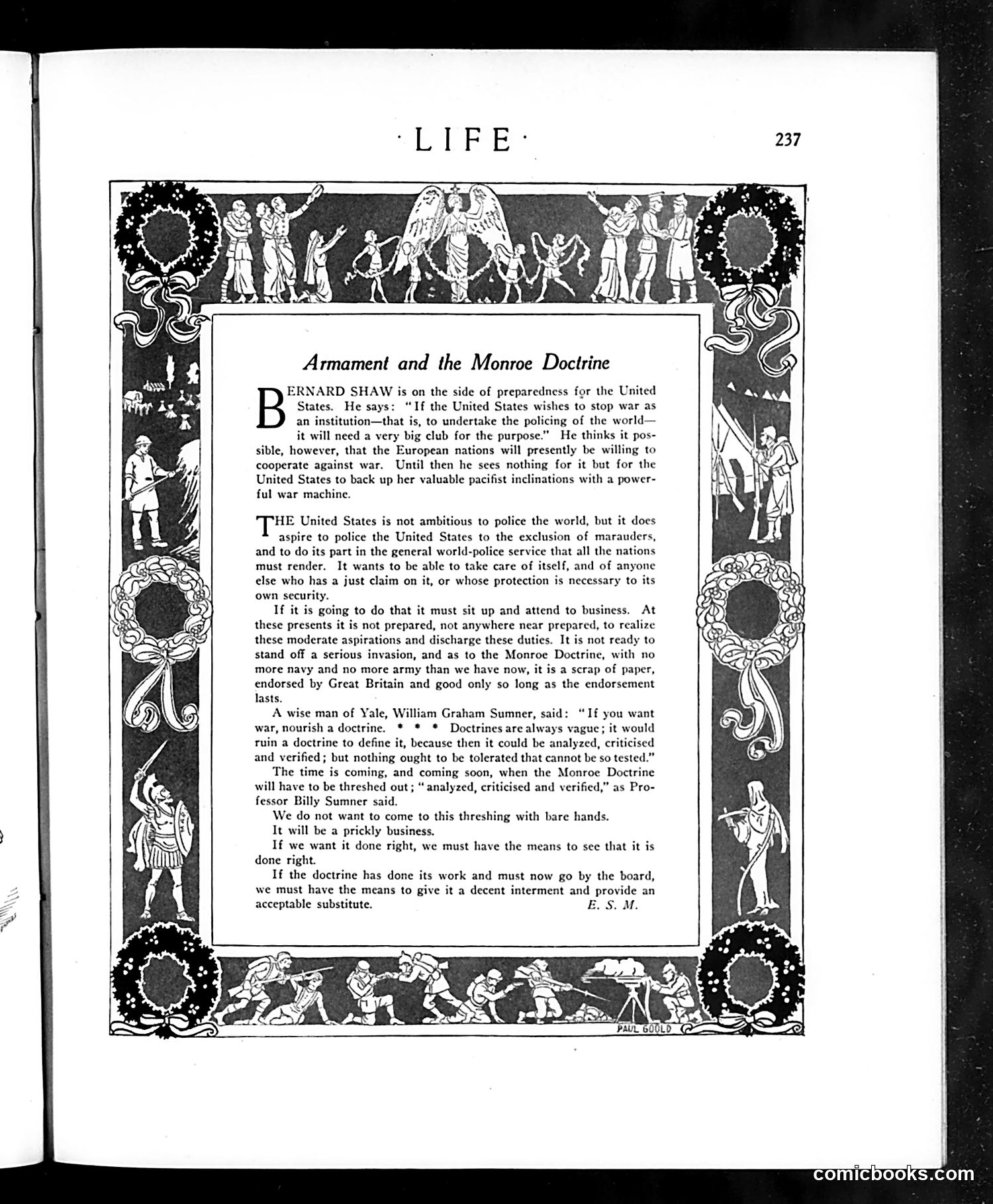
This editorial piece discusses U.S. military preparedness and foreign policy, specifically addressing Bernard Shaw's arguments about world policing. The text argues that while the U.S. doesn't seek to police the world, it must maintain armed forces to protect itself and the Monroe Doctrine (preventing foreign intervention in the Americas). The piece quotes Yale professor William Graham Sumner's caution that doctrines require rigorous testing and analysis before implementation. The author (E.S.M.) warns that enforcing the Monroe Doctrine without adequate military strength is meaningless—it would be merely "a scrap of paper" without backing from Great Britain. The ornamental border contains classical and allegorical figures, typical of *Life* magazine's design aesthetic of this era (appears early 20th century).
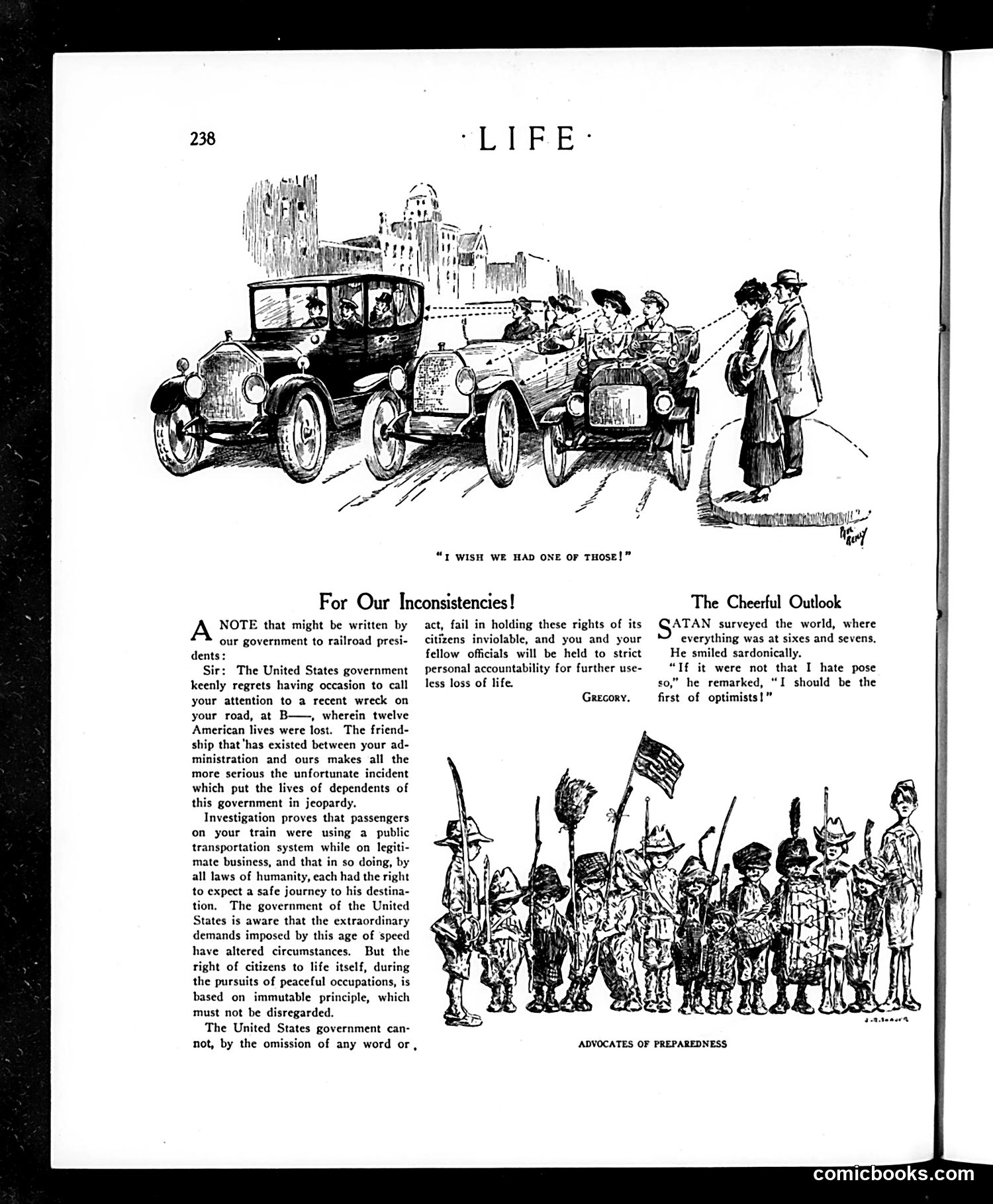
**Top Cartoon**: Shows three early automobiles with passengers observing two pedestrians, one saying "I wish we had one of those!" The joke satirizes the rapid shift from walking/carriages to automobiles as status symbols of modern life. **"For Our Inconsistencies"**: A serious editorial letter criticizing the U.S. government for railroad safety failures. It references a recent train wreck killing twelve Americans and argues the government demands safe conditions from citizens but fails to ensure safety on public transportation—highlighting hypocrisy in governmental responsibility. **"The Cheerful Outlook"**: A cartoon showing Satan surveying Earth, declaring himself "first of optimists" because conditions everywhere are terrible. This darkly satirizes pessimism about world conditions, likely referencing post-WWI concerns. **Bottom illustration**: Labeled "Advocates of Preparedness," showing various militaristic figures, appears to satirize military expansion advocacy.
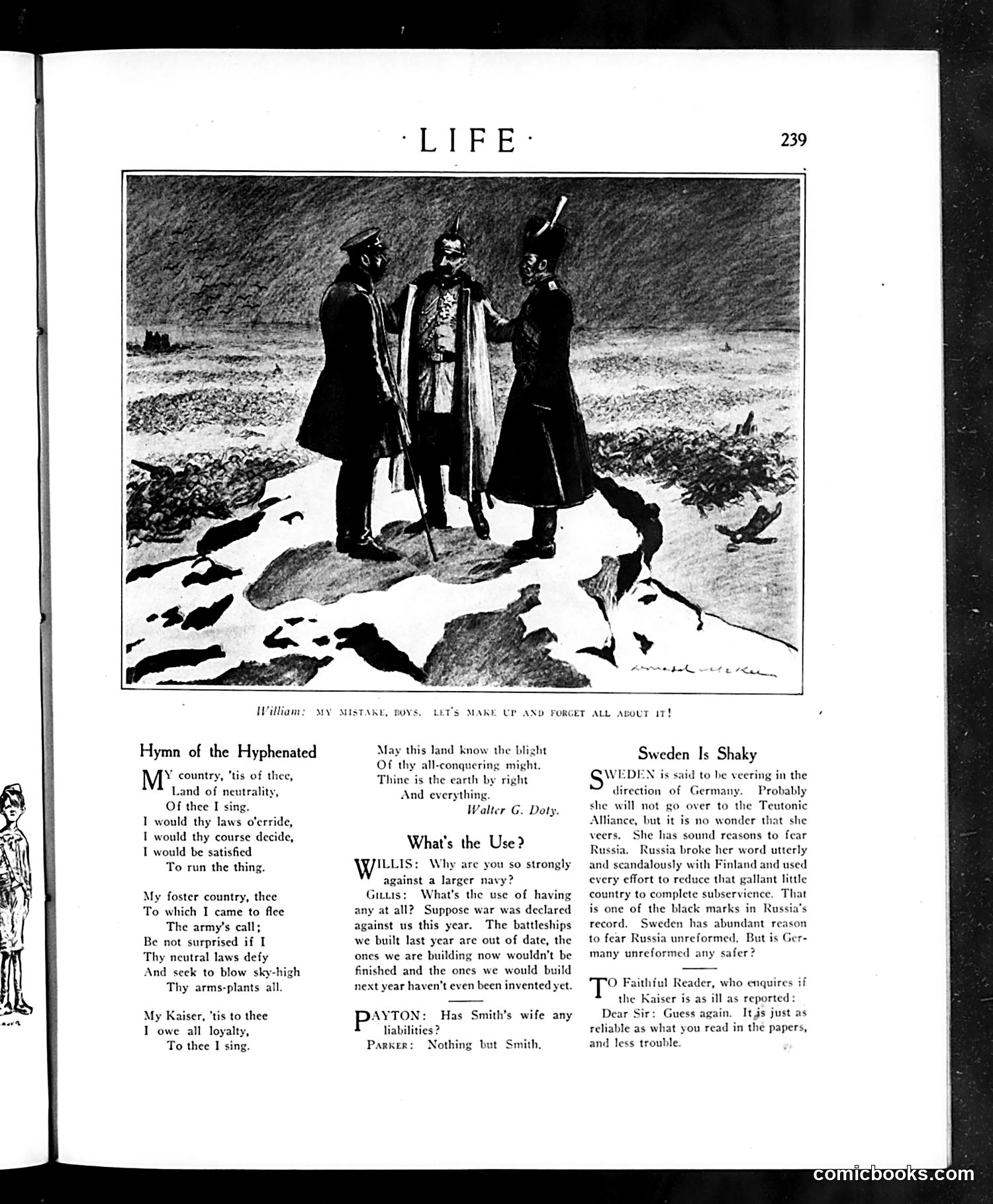
This page contains WWI-era satire about European neutrality and military preparedness. The cartoon depicts three military figures on a beach with the caption "My mistake, boys. Let's make up and forget all about it!"—mocking the impossibility of nations simply abandoning conflict. The surrounding text includes patriotic poetry ("Hymn of the Hyphenated") attacking neutrality and dual loyalties, and a section titled "Sweden Is Shaky" discussing Sweden's precarious position between Germany and Russia during the war. A humorous dialogue between characters named Willis, Gillis, and Payton satirizes naval military strategy and obsolete warship design. The overall message reflects American anxieties about European instability and arguments for military strength rather than neutrality—likely from 1916-1917, before U.S. entry into WWI.
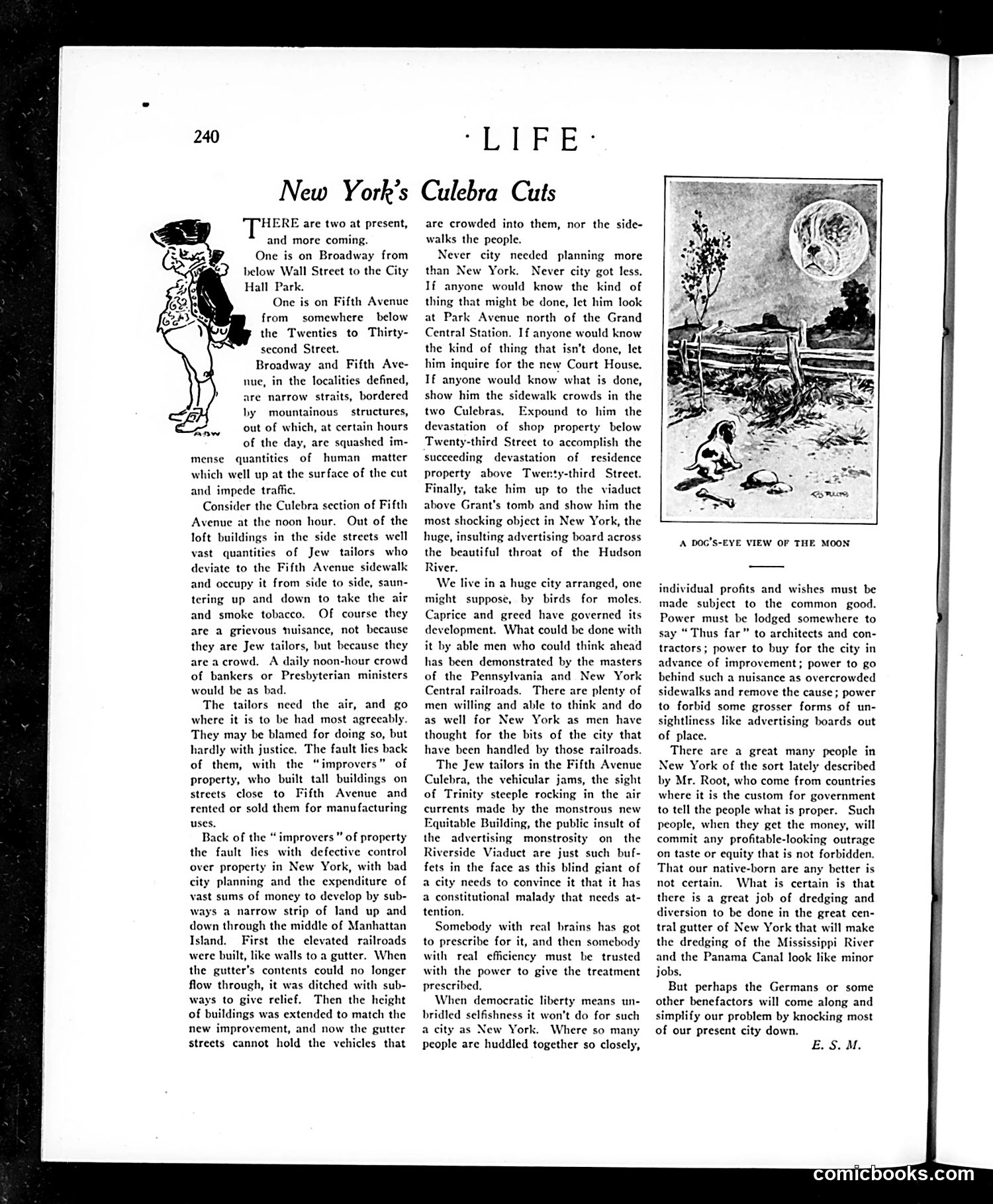
This satirical article critiques New York City's chaotic urban planning and overcrowding. The accompanying cartoon shows a figure examining the moon through a telescope—captioned "A DOG'S-EYE VIEW OF THE MOON"—likely satirizing the absurdity of looking elsewhere for solutions when New York's problems are earthbound. The article uses the Panama Canal's "Culebra Cut" as a metaphor for New York's narrow streets and building congestion. The author argues that just as the canal required bold excavation, New York needs systematic planning to address overcrowded sidewalks, inadequate street infrastructure, and excessive advertising billboards. The piece mocks politicians and property owners unwilling to make necessary changes, suggesting that only outside intervention (humorously mentioning "Germans") might force modernization—a cynical commentary on institutional paralysis in early 20th-century urban governance.
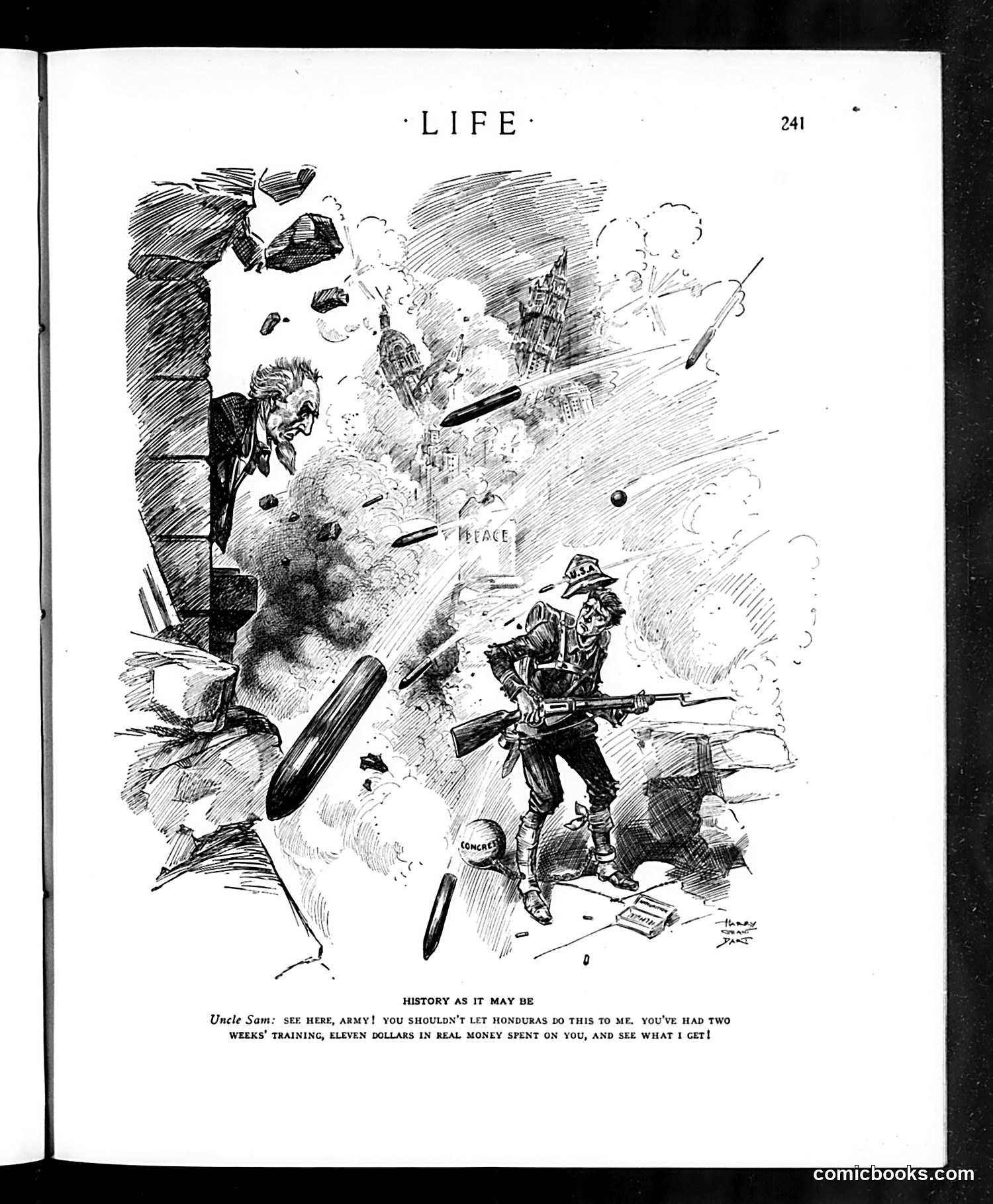
This political cartoon satirizes American military involvement in Honduras. Uncle Sam (representing the U.S. government) watches in shock as bombs destroy a cityscape labeled "PEACE." A soldier in combat gear fires a rifle amid explosions and destruction. The satire criticizes the contradiction between stated American intentions and actual outcomes: Uncle Sam complains that after investing two weeks's training and eleven dollars in the Honduran army, he's getting destruction instead of the promised peaceful result. This appears to reference early 20th-century U.S. military interventions in Central America, where American forces and funding were deployed ostensibly to promote stability but often resulted in violence and regime change.
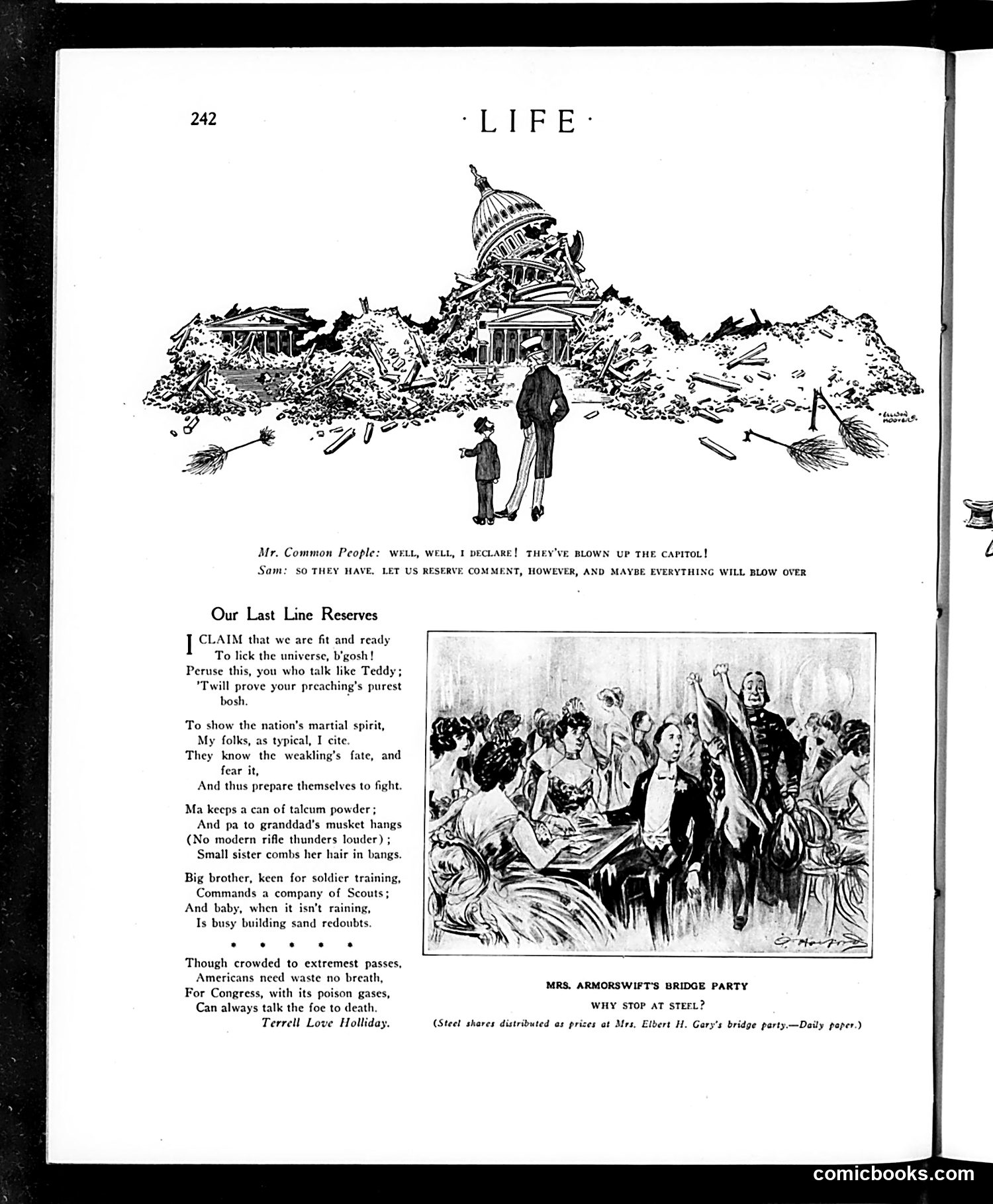
**Top Cartoon:** Depicts the U.S. Capitol in ruins. Two figures—labeled "Mr. Common People" and "Sam"—observe the destruction. Mr. Common People declares the Capitol "blown up"; Sam urges restraint and patience, suggesting "everything will blow over." This is **WWI-era political satire** mocking Americans who downplay catastrophic events or radical threats, assuming crises will naturally resolve without action. **Bottom Section:** "Our Last Line Reserves," a poem by Terrell Love Holliday, patriotically describes American civilians preparing for conflict—mothers, siblings, and children taking up defense roles. The accompanying illustration shows "Mrs. Armsworthy's Bridge Party," a social gathering where women discuss Steel stocks (likely war production investments). The caption's irony suggests civilians are simultaneously trivializing warfare through social pleasantries while profiting from it.
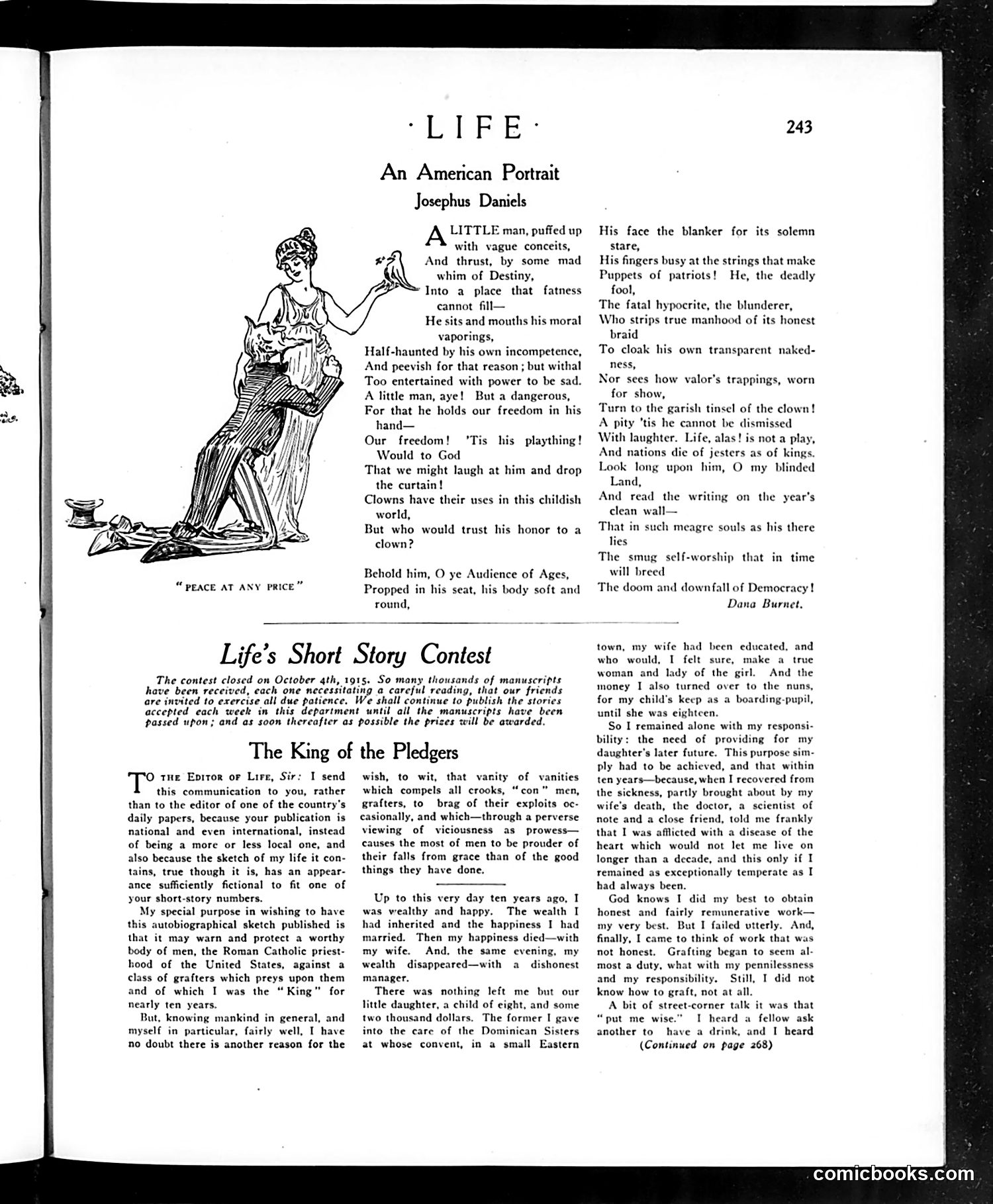
The page features "An American Portrait" by Josephus Daniels, accompanying an illustration of Lady Liberty holding a puppet. The satirical poem critiques American political leadership as incompetent and self-serving—a "little man, puffed up with vague conceits" who manipulates patriotic symbols while stripping away true honor and integrity. The figure represents corrupt politicians who hide behind nationalist rhetoric and theatrical displays ("garish tinsel of the clown") while pursuing selfish interests. The satire warns that such leaders will cause "the doom and downfall of Democracy." Below is "Life's Short Story Contest" and "The King of the Pledgers"—an autobiographical sketch about wealth, loss, and moral compromise. The page criticizes both political corruption and ethical failure in American society circa 1915.
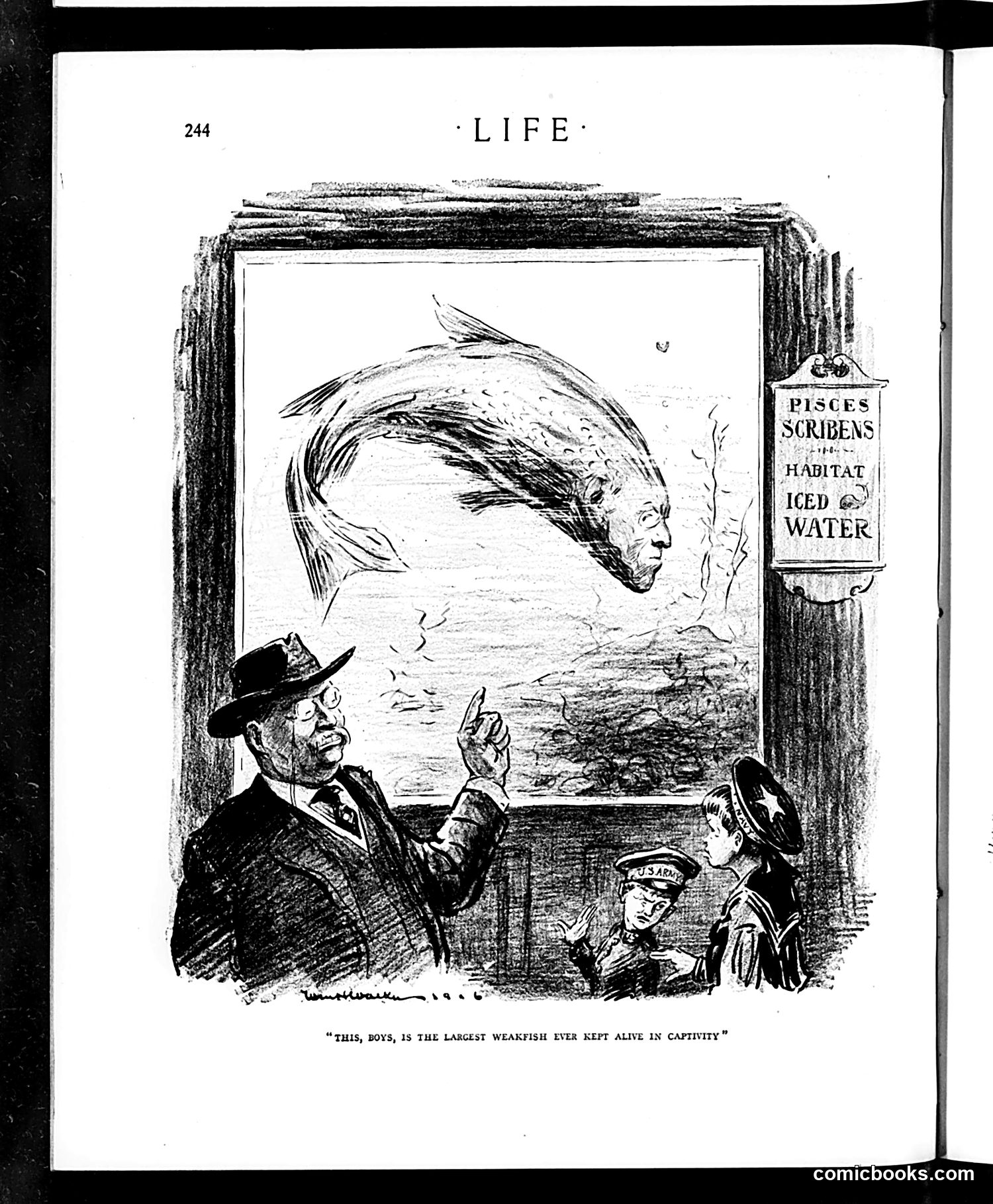
This is a satirical cartoon from Life magazine showing a man in a cowboy hat pointing at a large fish in an aquarium labeled "Pisces Scribens" (The Writing Fish) with "Habitat: Iced Water." The caption reads: "This, boys, is the largest weakfish ever kept alive in captivity." The joke appears to be a pun on "weakfish" (an actual fish species) applied to a writer or journalist. The "iced water habitat" suggests the subject is cold or has been given the cold shoulder—possibly a reference to a critic or writer whose work has been rejected or poorly received. The aquarium setting treats the writer as a specimen for public viewing, mocking either their work or their status. Without identifying the specific figure caricatured, the satire targets a notable writer or critic of the period through this zoological metaphor.
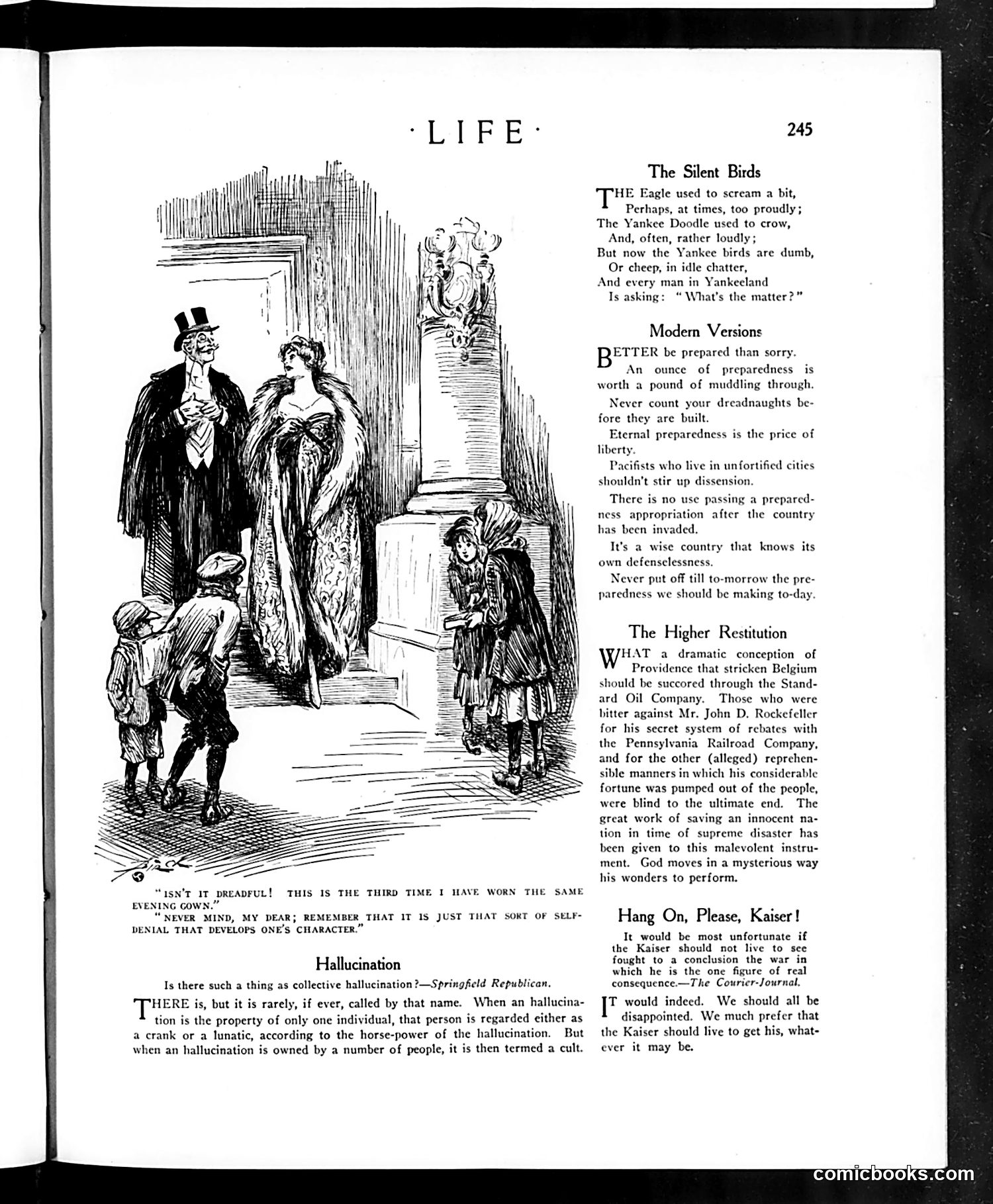
This page contains multiple satirical pieces from WWI-era America, likely 1914-1917: **"The Silent Birds"** mocks American loss of patriotic confidence—the eagle and "Yankee Doodle" (national symbols) have gone quiet instead of proudly vocal, leaving Americans confused about national purpose. **"Modern Versions"** sarcastically inverts old proverbs to mock contemporary military-preparedness rhetoric, suggesting paranoid over-preparation and contradictory defensive logic had become cultural obsessions. **"The Higher Restitution"** ironically praises Standard Oil Company's Belgian relief efforts as divine providence, while acknowledging John D. Rockefeller's notorious reputation for ruthless monopolistic practices. The satire: God apparently works through morally corrupt industrialists. **"Hang On, Please, Kaiser!"** darkly jokes that Americans want Kaiser Wilhelm II to survive the war to face justice, rather than die conveniently. It mocks wishful thinking about war's conclusion. The page reflects American anxieties about war, preparedness debates, and wartime morality circa 1914-1918.
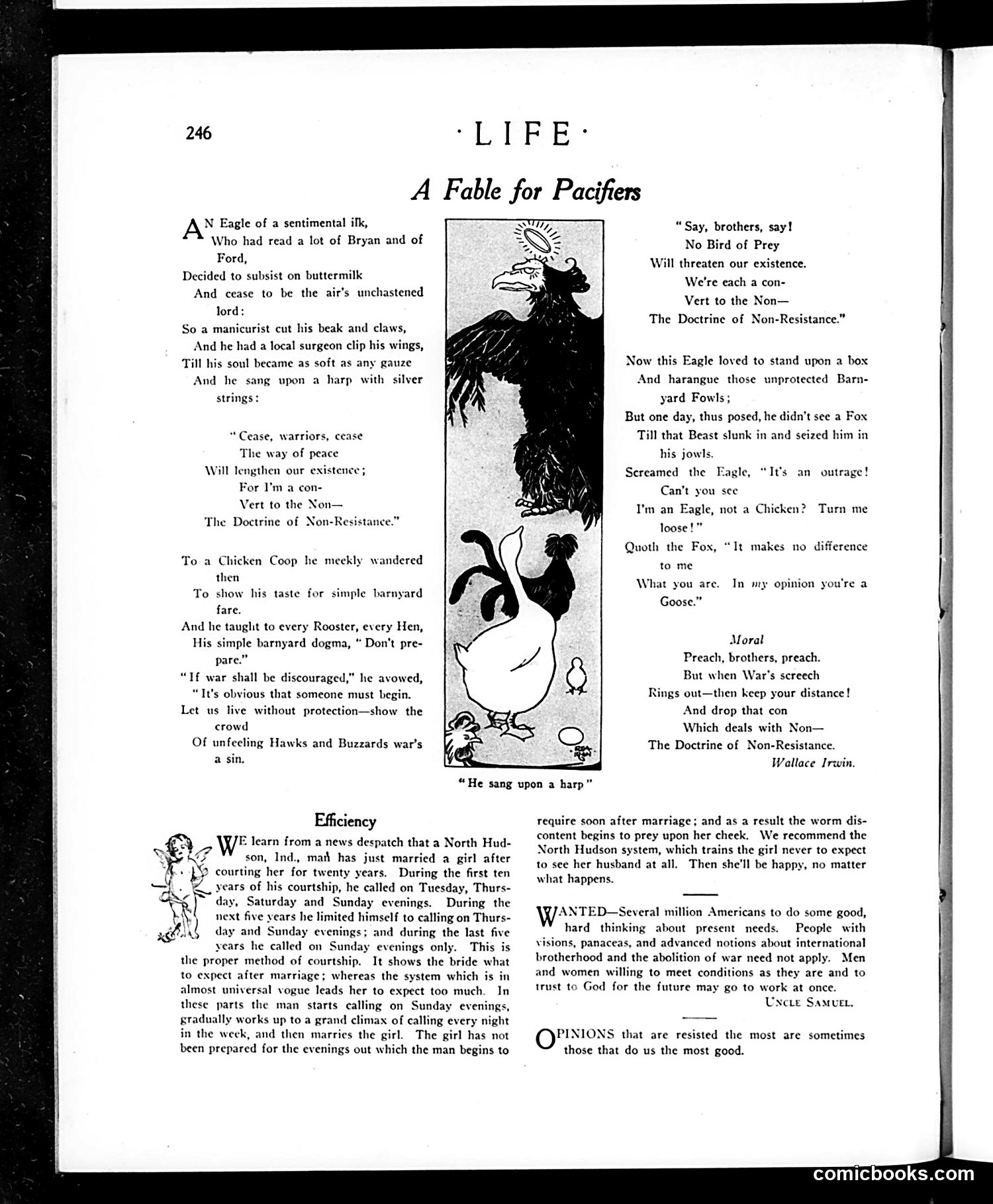
This fable satirizes American pacifism, likely referencing the peace movements and anti-war sentiment of the early 20th century. The references to "Bryan and Ford" suggest William Jennings Bryan (known for pacifist positions) and Henry Ford (who promoted peace efforts). An idealistic Eagle adopts pacifism—the "Doctrine of Non-Resistance"—and convinces barnyard fowl to abandon self-defense. He preaches disarmament to vulnerable creatures. A Fox then attacks and devours him. When the Eagle protests his mistreatment, the Fox dismisses the distinction between an Eagle and a Goose, treating him as easy prey. **The satire's point**: Pacifism works only if *all* parties embrace it. A pacifist remains vulnerable to predatory aggression. The moral warns that idealistic peace doctrine fails when confronted by ruthless adversaries who don't reciprocate restraint. The cartoon mocks naive pacifists as foolish as defenceless chickens.
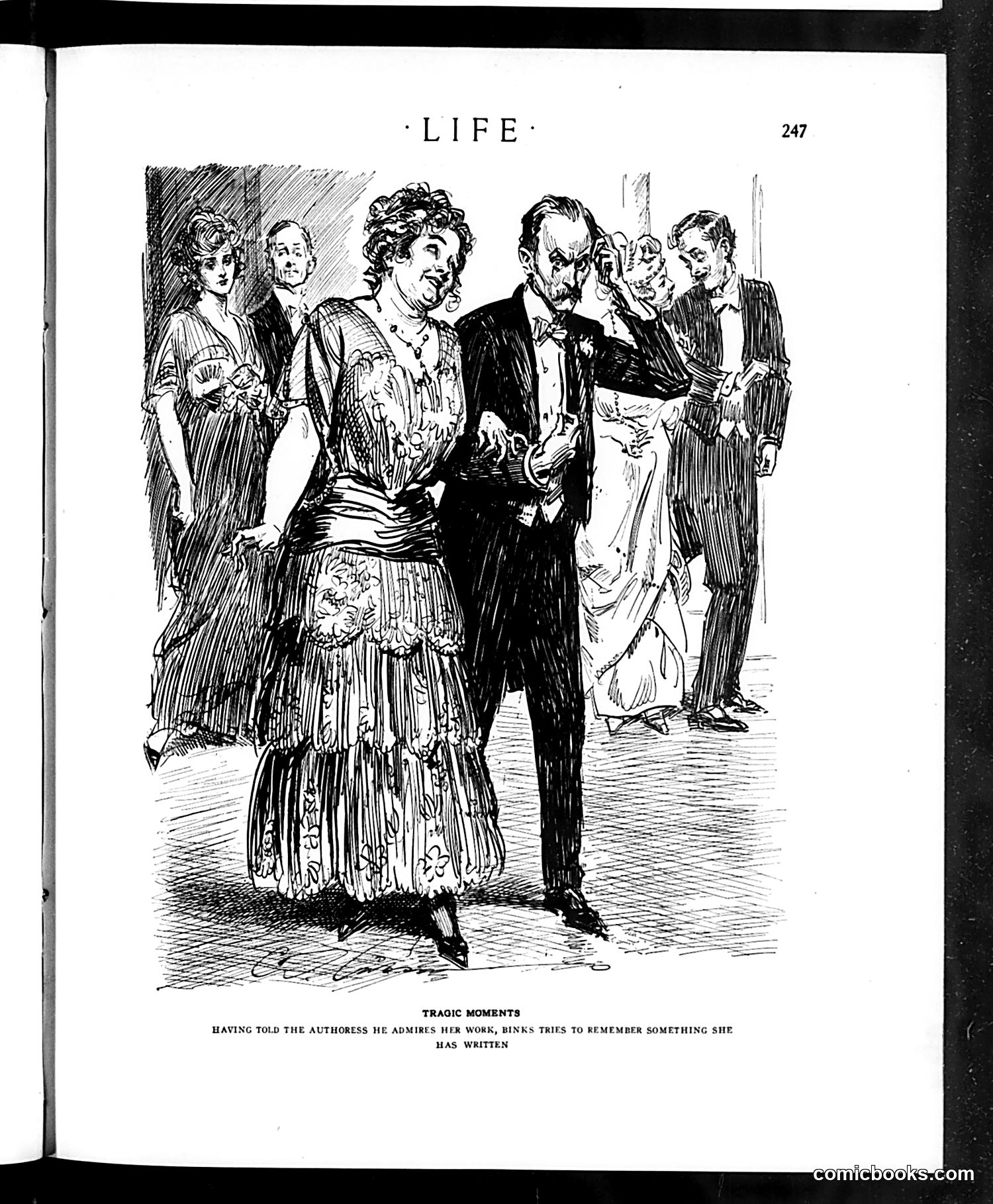
This cartoon depicts a social scene at what appears to be a formal gathering. The caption reads "Tragic Moments: Having told the Authoress he admires her work, Binks tries to remember something she has written." The satire targets a common social awkwardness: a man named "Binks" has complimented a female writer's work but cannot actually recall any of her writing. This jokes about both shallow social flattery and the invisibility or obscurity of women's literary contributions in the period. The "tragic moment" is his embarrassing predicament—he's praised her without substantive knowledge of her work. The illustration shows Binks in formal dress, visibly struggling to remember, while the authoress and other guests observe his discomfort, emphasizing the social embarrassment of his hollow compliment being exposed.
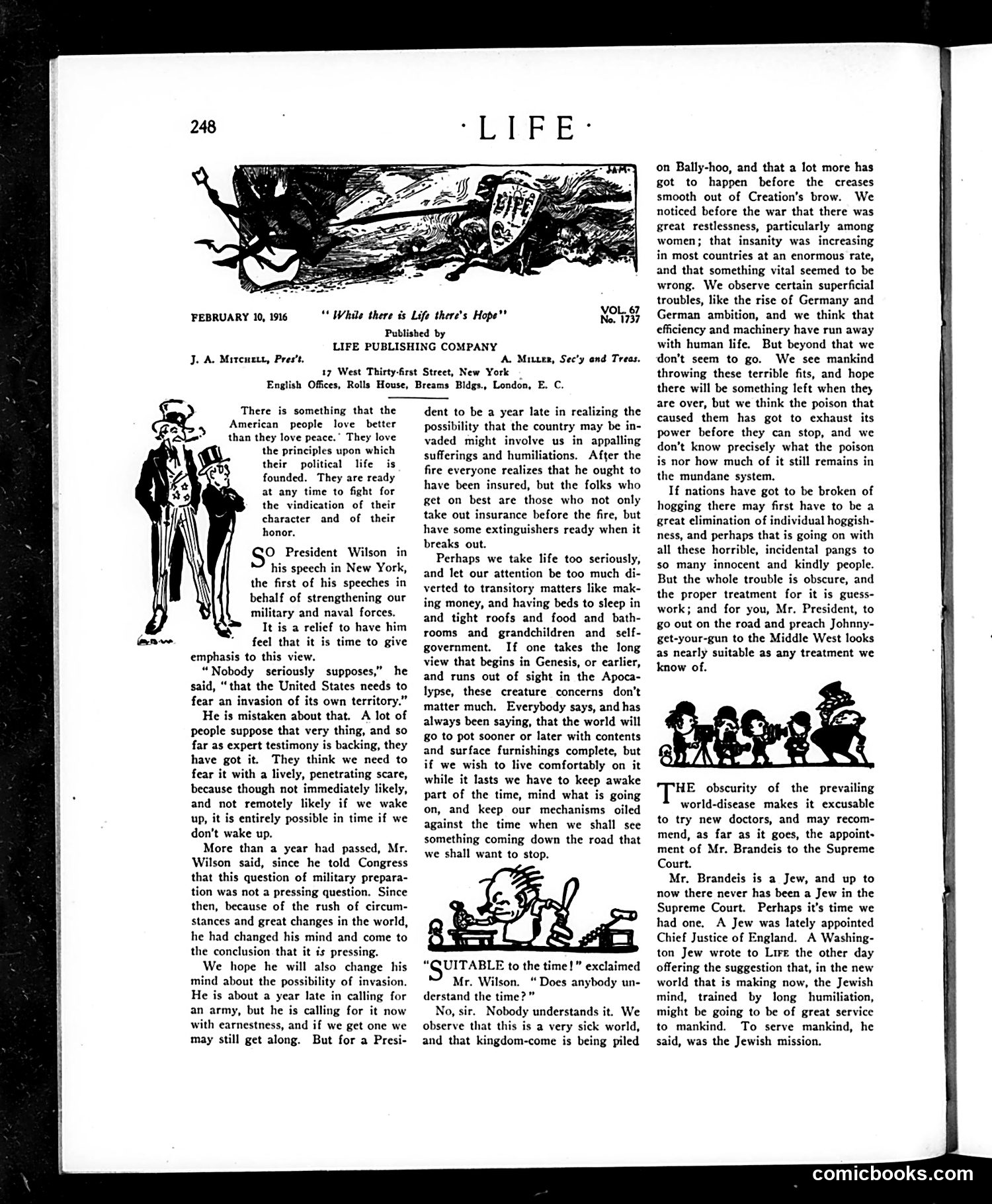
This page contains editorial commentary on President Wilson's military preparedness speeches. The central cartoon depicts Uncle Sam (identifiable by the starred top hat) looking concerned, illustrating the article's argument about national defense. The text critiques Wilson for being "a year late" in recognizing invasion risks from World War I. Though Wilson claimed Americans "need not fear invasion," the editors argue many citizens reasonably worry about vulnerability. They use an insurance metaphor: wise people buy protection *before* a fire, not after. The piece also reflects broader anxieties of 1916—German military expansion, widespread social unrest, and rising mental illness rates. The editorial advocates preparedness while mocking excessive concern about apocalyptic "creature concerns" (money, shelter, comfort). The final section discusses Brandeis's potential Supreme Court appointment, noting his would be the first Jewish justice—presented matter-of-factly as notable but appropriate. Overall, this is wartime-era advocacy for U.S. military readiness.
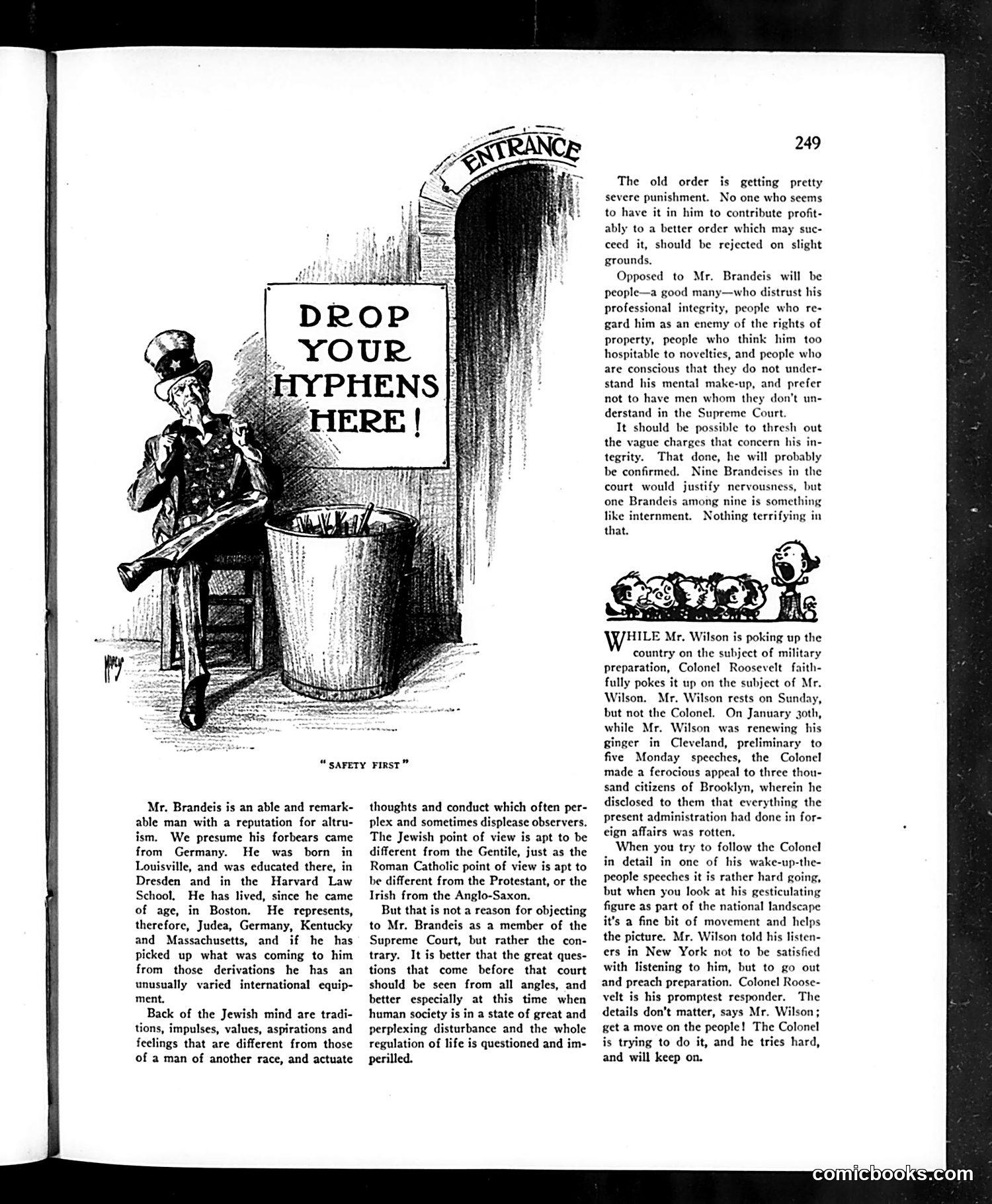
**The Cartoon ("Safety First"):** Shows a figure (likely a doorman or gatekeeper) at an entrance holding a sign "DROP YOUR HYPHENS HERE" above a large receptacle. The cartoon satirizes anxieties about immigrant loyalty and identity during a period of American nativism. **Main Content - Brandeis Confirmation Debate:** The page discusses Louis Brandeis's nomination to the Supreme Court. The text acknowledges anti-Semitic and xenophobic opposition to him—critics question his loyalty because of his Jewish heritage and German ancestry, viewing him as an outsider with divided loyalties ("hyphenated" identity). **The Magazine's Position:** Life defends Brandeis, arguing that diverse perspectives on the Court strengthen it, especially during social upheaval. The text dismisses opposition based on his religion or background as unfounded. **Secondary Content:** Brief commentary contrasts President Wilson's and Colonel Theodore Roosevelt's public activities—Wilson speaking on military preparedness while Roosevelt simultaneously criticizes the administration's foreign policy. The page reflects early 20th-century debates over assimilation, loyalty, and whether minorities could hold high office.
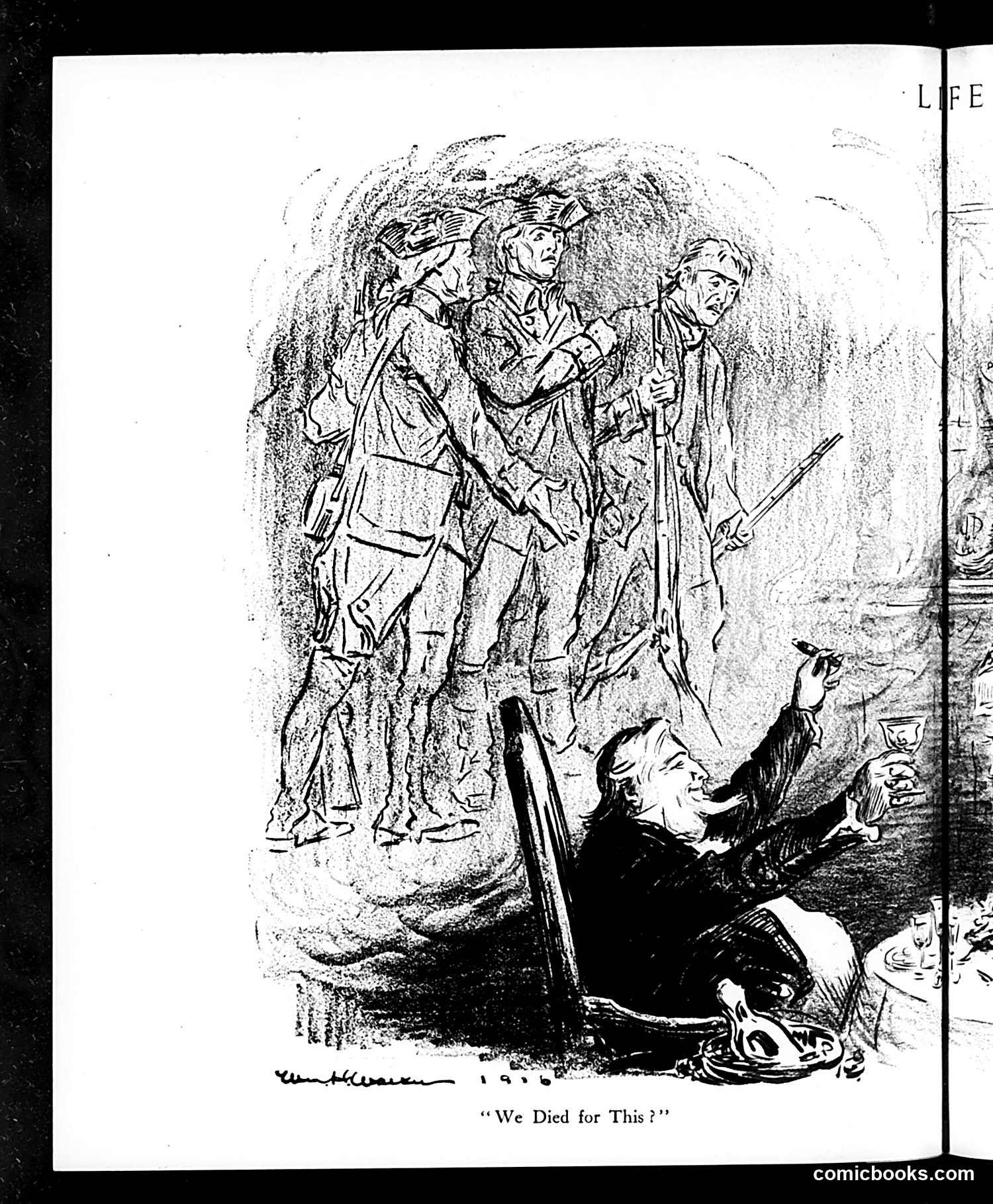
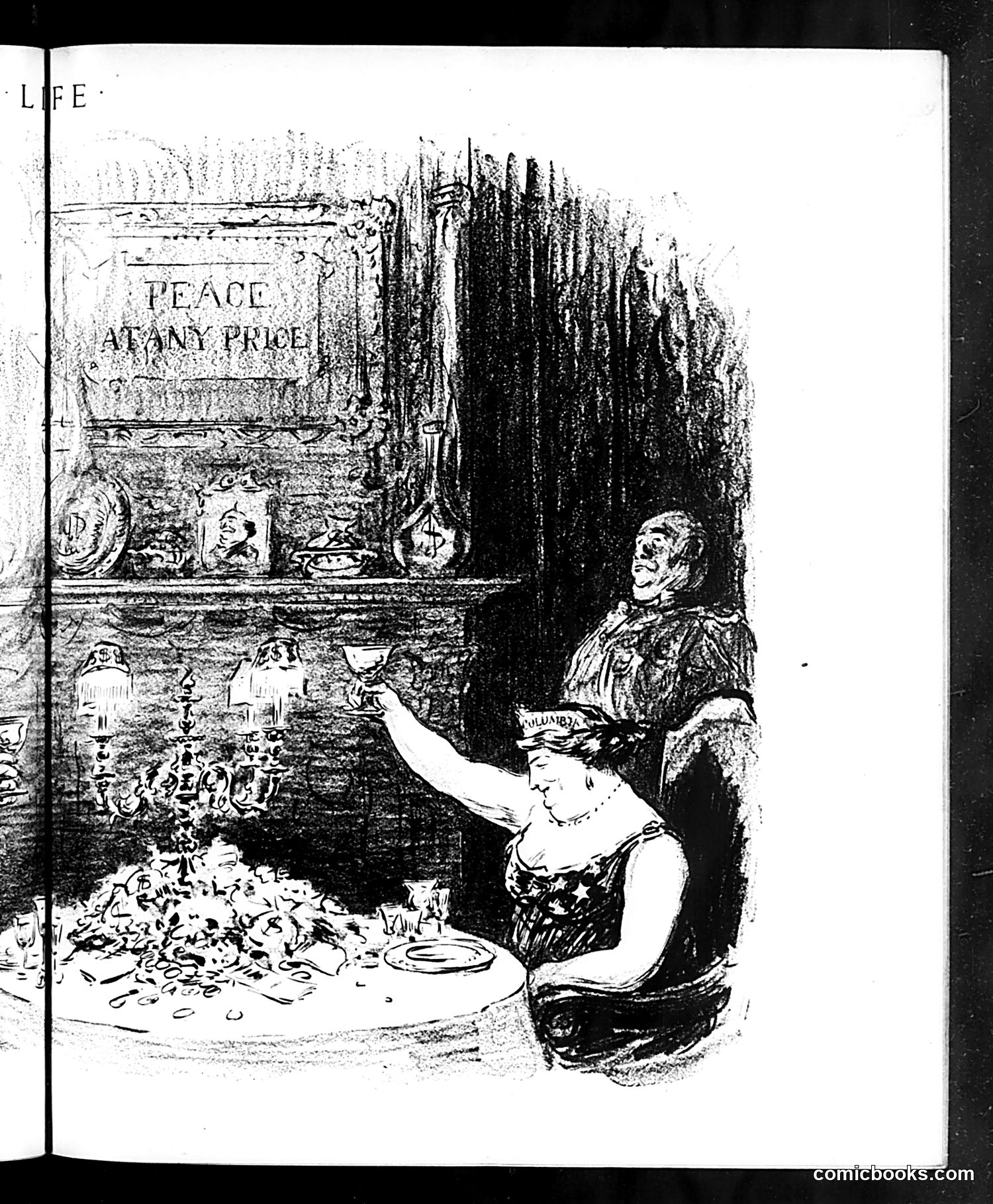
This is a political cartoon critiquing post-war disillusionment, likely from the 1920s-1930s (the signature appears to be dated 1920s). The image shows three soldiers in WWI military uniforms appearing ghostly or ethereal above, while below sits a figure (appearing to be a politician or businessman) who seems indifferent or dismissive of them. The caption "We Died for This?" suggests the soldiers are questioning what their sacrifice accomplished. The satire likely targets post-war corruption, political neglect of veterans, or the perceived betrayal of war aims—possibly satirizing how politicians squandered the peace or failed to deliver on promises made during the war. The contrast between the fallen soldiers' solemn presence and the figure below's apparent apathy drives the cartoon's bitter commentary on war's human cost versus its political aftermath.
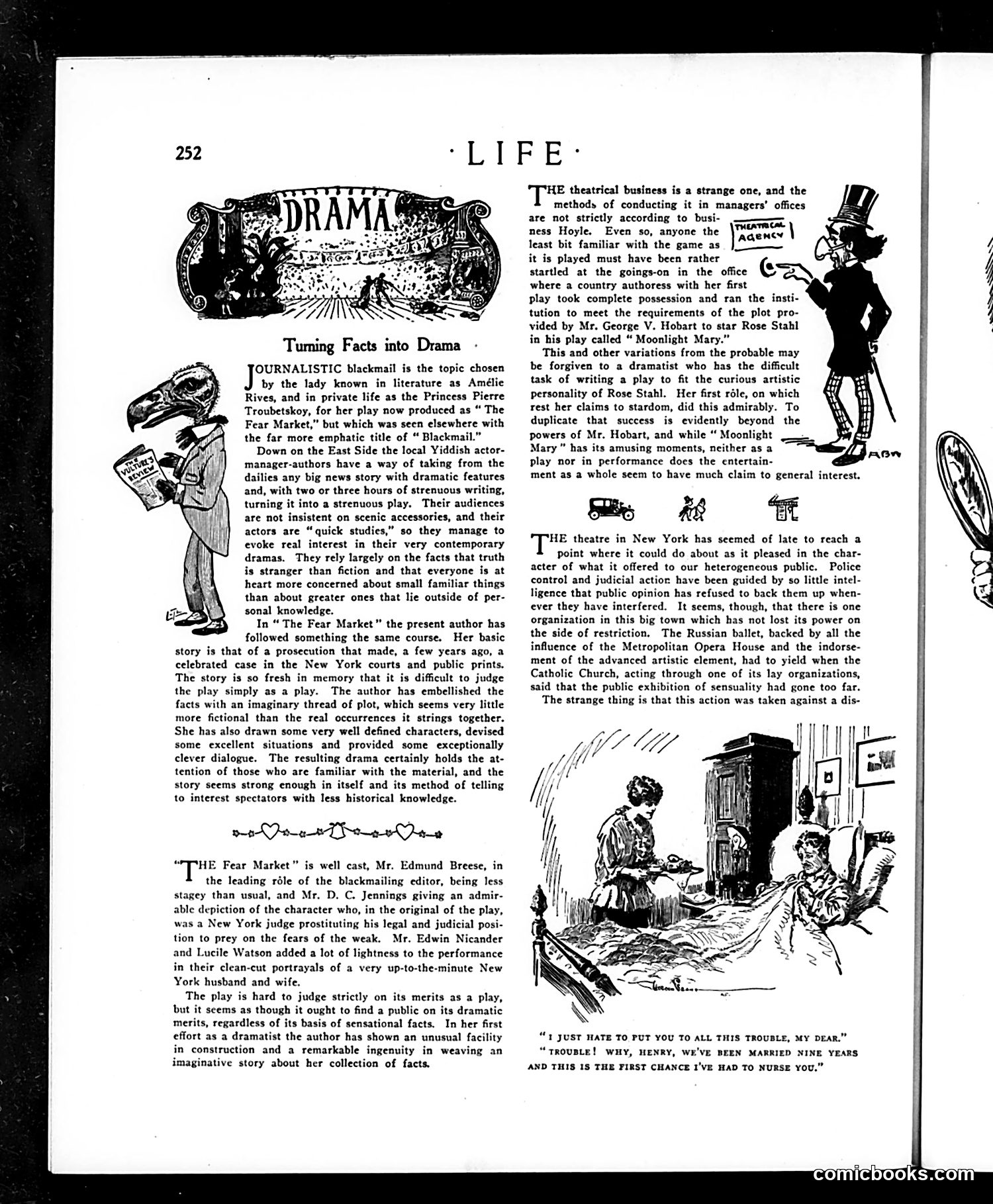
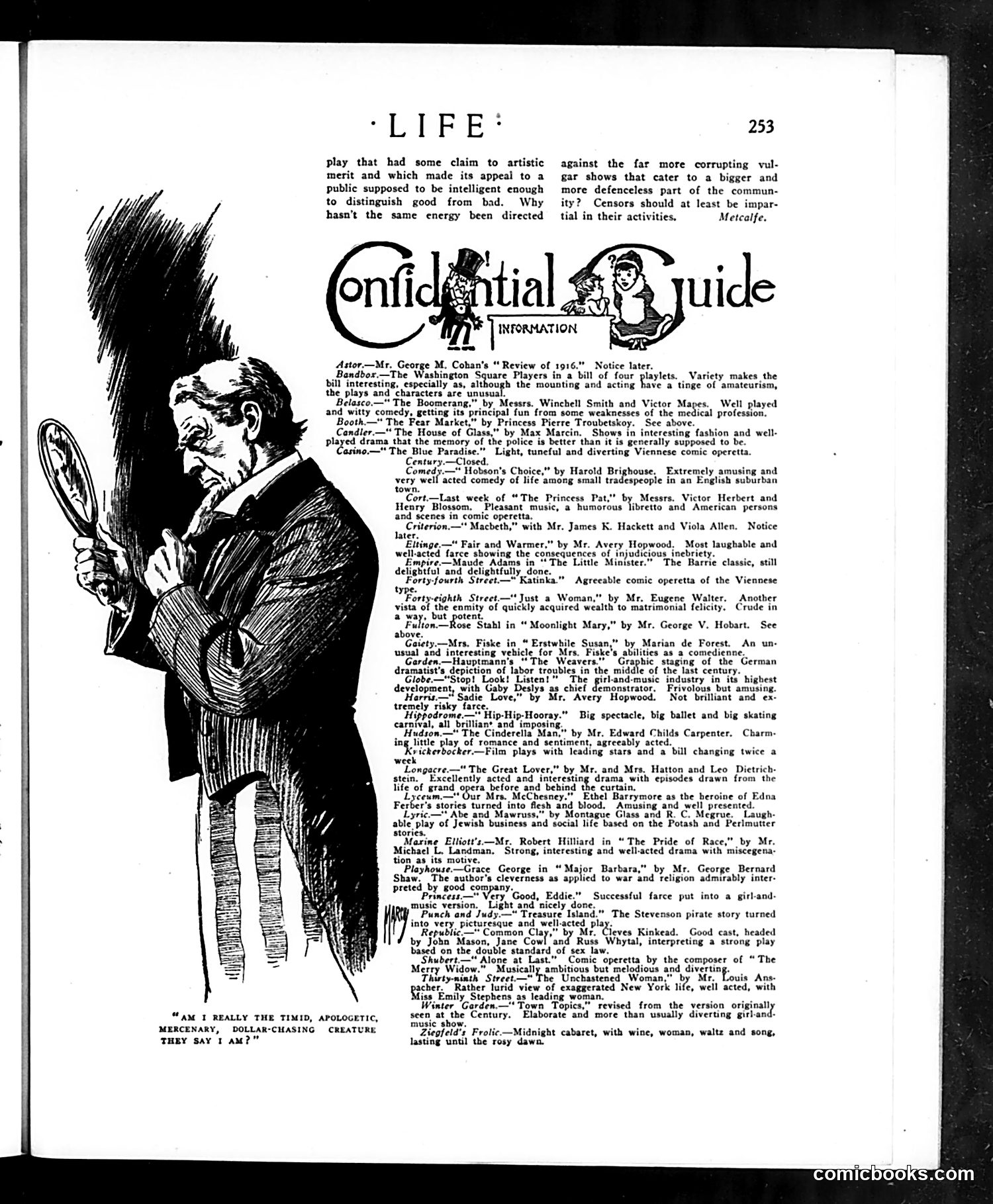
This page is primarily a theater review section titled "Confidential Guide," not a political cartoon. The illustrated figure on the left—a caricatured man in formal dress asking "Am I really the timid, apologetic, mercenary, dollar-chasing creature they say I am?"—likely represents a theatrical producer or impresario defending himself against public criticism. The bulk of the page contains brief reviews of Broadway productions from 1916, organized by theater name. Reviews reference popular entertainments: comedies, operettas, dramas, and spectacles. The commentary reveals period attitudes—praise for "well-acted" serious drama, dismissal of frivolous "girl-and-music" shows as "amusing" but shallow. The opening text criticizes censors for inconsistency: why scrutinize artistic plays while allowing vulgar mass entertainment? This frames the cartoon figure's defensive posture—theater people felt unfairly attacked while critics ignored broader problems.
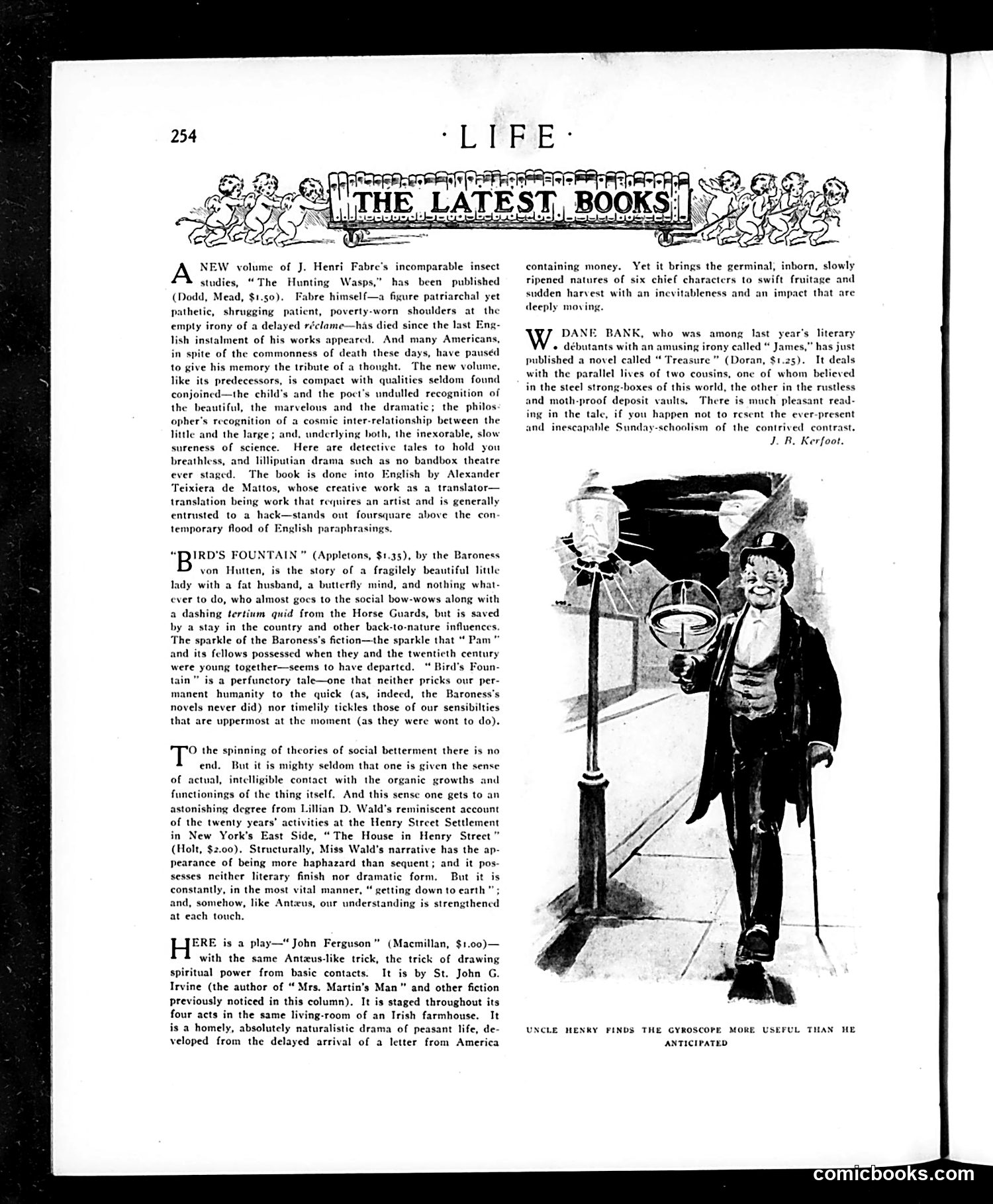
This is a literary review page featuring four new book releases. The single illustration shows a humorous cartoon captioned "Uncle Henry Finds the Gyroscope More Useful Than He Anticipated"—depicting an elderly man using a gyroscope as a street lamp or lamp post, a visual pun on the device's spinning properties. The reviews themselves discuss serious literary works: J. Henri Fabre's entomology studies, the Baroness von Hutten's society novel, Lillian D. Wald's memoir about Henry Street Settlement social work, and St. John G. Irvine's Irish farmhouse drama. The tone is appreciative yet critical, praising Fabre's naturalistic observation and Wald's practical social engagement while dismissing von Hutten's work as dated and superficial. The cartoon provides light relief on an otherwise text-heavy page of intellectual literary criticism.
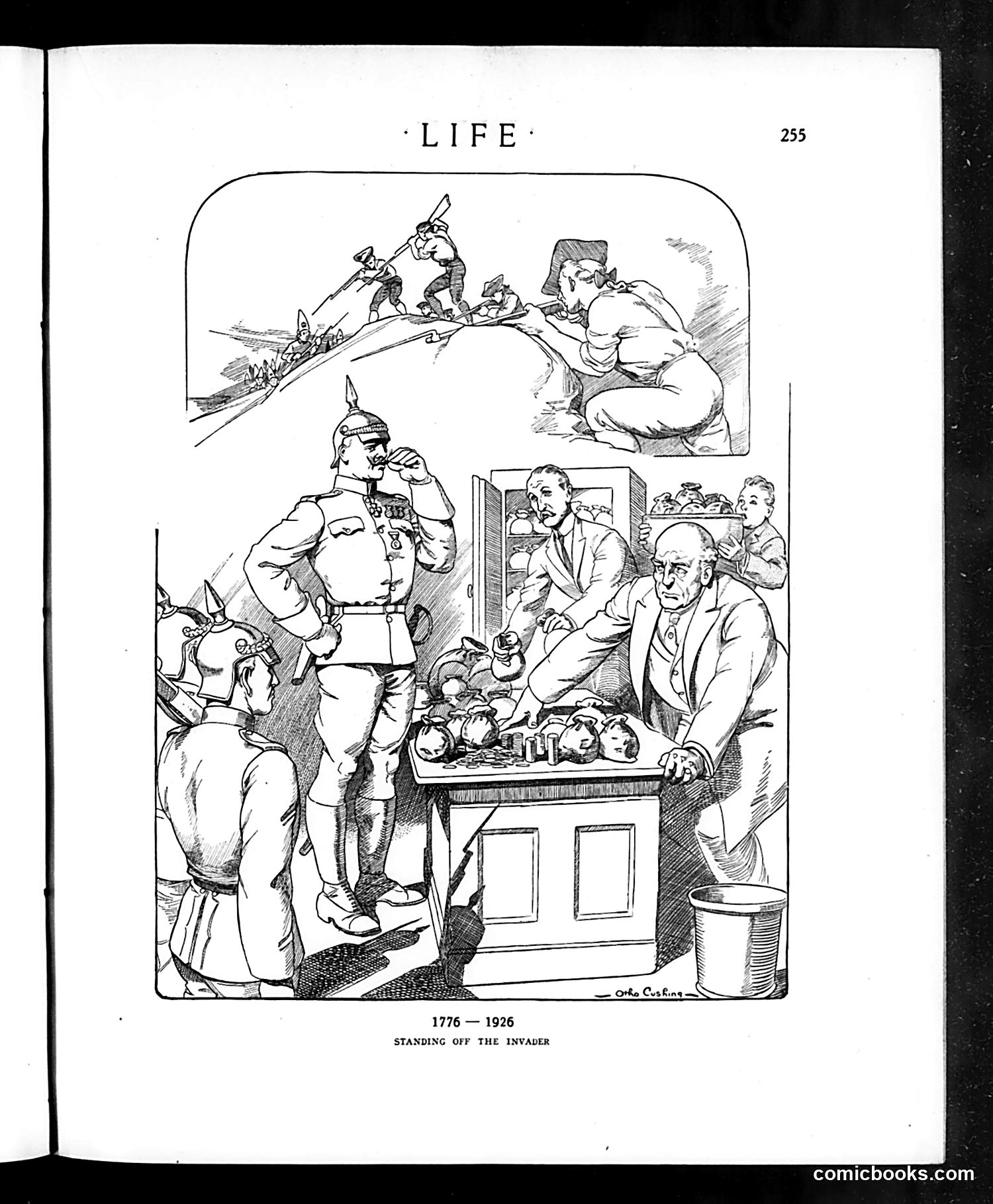
This Oho Cusacas cartoon commemorates America's 150th anniversary by contrasting two historical moments. The upper panel depicts Revolutionary War soldiers defending against British invasion. The lower panel shows a modern (1926) German military officer in a spiked Prussian helmet confronting American businessmen around a table displaying consumer goods. The satire suggests that America now faces economic rather than military invasion—specifically from German commercial interests. The contrast implies that while Americans successfully repelled foreign military conquest in 1776, they may be vulnerable to foreign economic penetration through trade and commerce in 1926. The well-fed businessman figures appear unprepared for this new type of "invasion," contrasting sharply with the vigilant Revolutionary soldiers above.
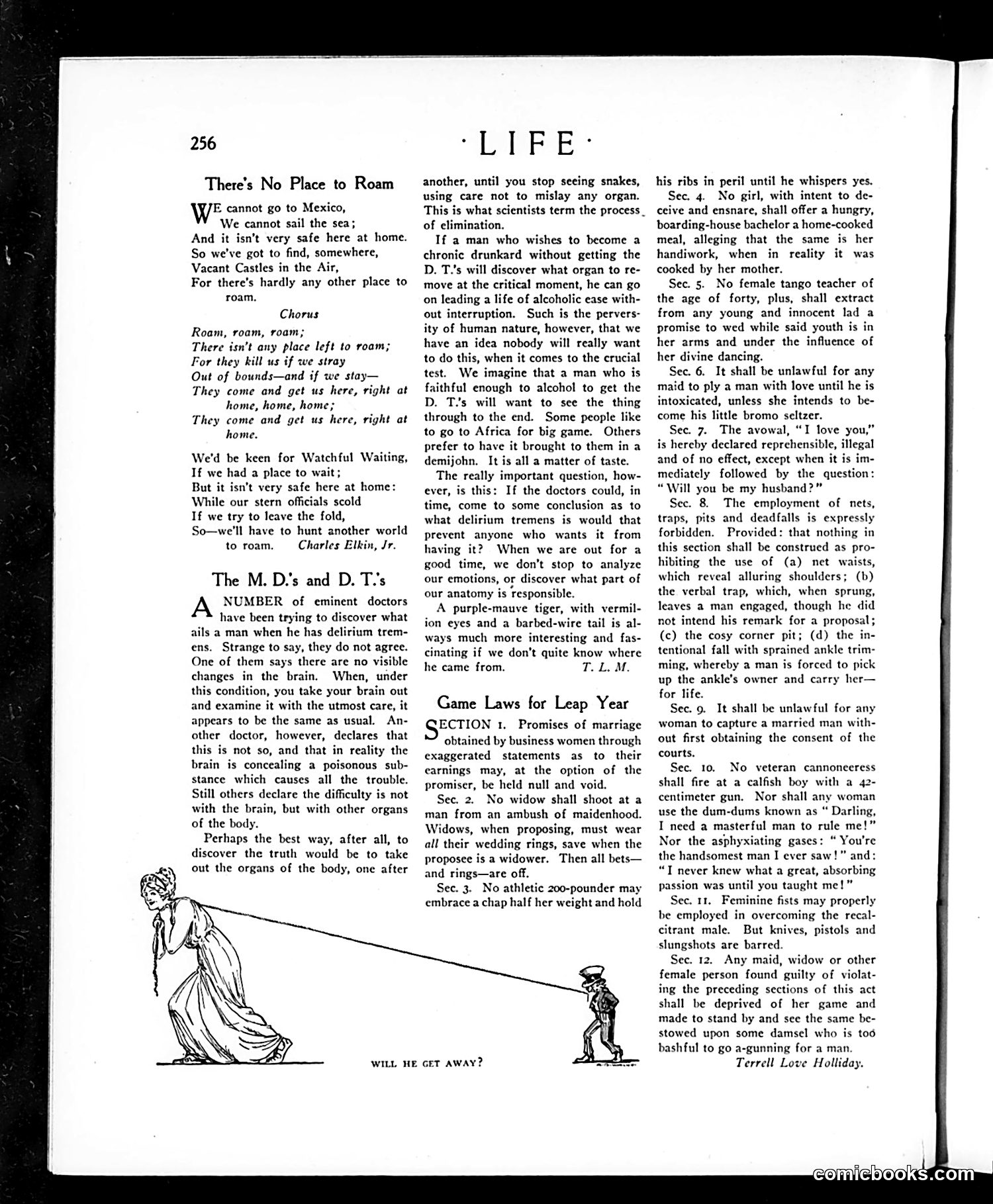
This 1910s-era Life page contains three satirical pieces commenting on contemporary American anxieties: **"There's No Place to Roam"** (song/poem) mocks restrictive social controls—citizens are trapped between government officials forbidding travel abroad and surveillance at home. References "Watchful Waiting" (likely Wilson-era foreign policy) and suggests Americans have nowhere to escape societal constraints. **"The M.D.'s and D.T.'s"** ridicules medical incompetence regarding delirium tremens (alcohol withdrawal). Doctors can't agree on its cause, so the satirist mockingly suggests "elimination"—surgically removing organs until hallucinations stop. The piece sardonically notes alcoholics won't stop drinking regardless of medical warnings, comparing their commitment to hunting big game. **"Game Laws for Leap Year"** parodies 1920s dating customs during leap year (when women traditionally propose). It humorously "legislates" female courtship tactics: widows can't ambush men, athletic women shouldn't crush fragile suitors, and women shouldn't deceive bachelors with false homecooked meals. The cartoon asks "WILL HE GET AWAY?"—depicting a woman pursuing a fleeing man. All three pieces satirize social constraints and changing gender dynamics of the era.
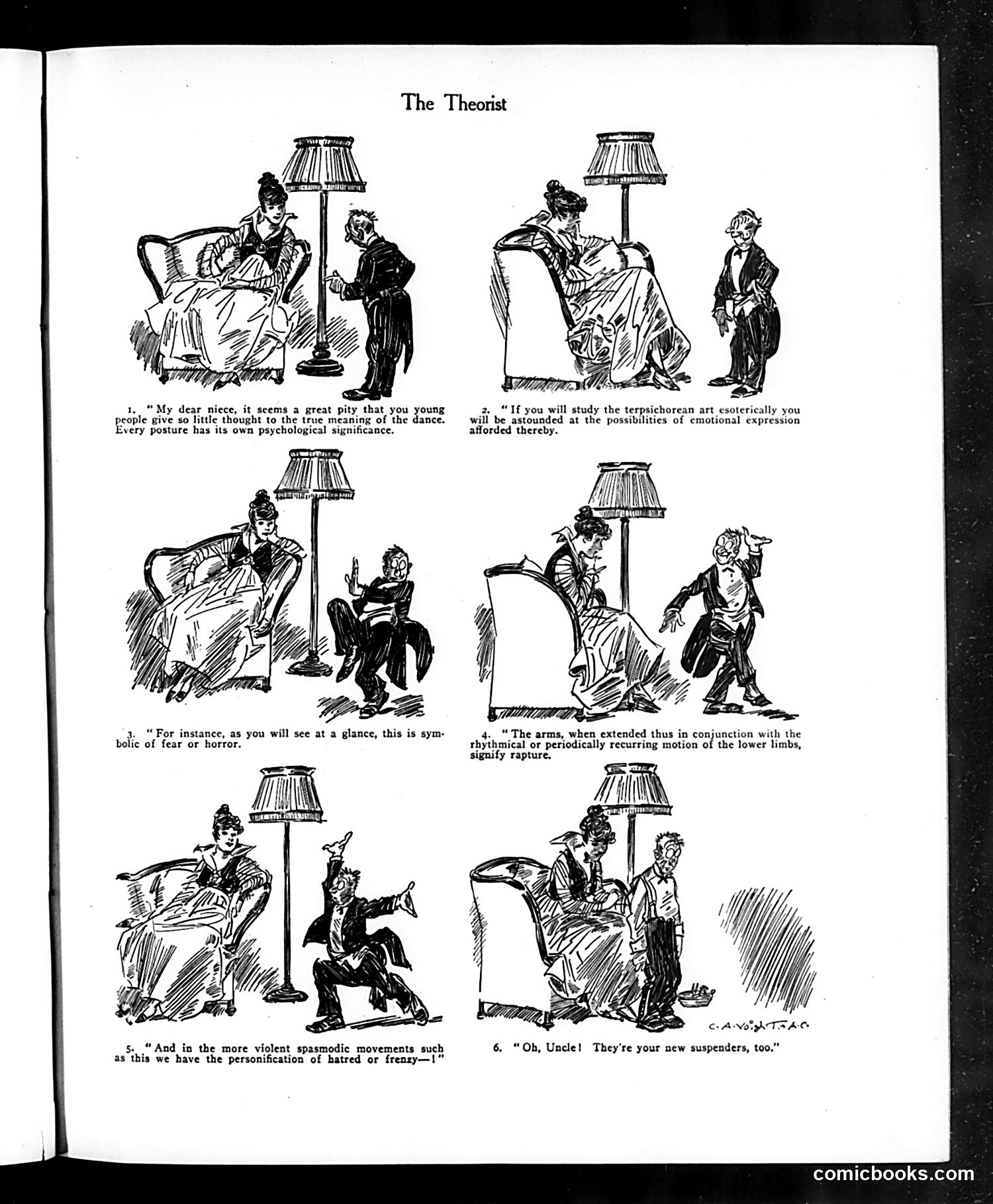
This six-panel comic mocks pretentious pseudo-intellectual analysis of dance. An elderly uncle lectures his young niece with absurdly overwrought theoretical jargon ("terpsichorean art esoterically"), claiming each dance movement symbolizes specific emotions—fear, hatred, rapture, etc. The humor escalates through panels 3-5 as his exaggerated interpretations grow increasingly grandiose. The punchline in panel 6 deflates his pomposity entirely: the niece points out his "new suspenders" are tangled around him during his demonstration. This satirizes early-20th-century intellectual pretension—the affectation of studying ordinary activities (like social dancing) through ornate psychological or artistic frameworks. The pratfall ending suggests such theory-obsessed analysis misses obvious, mundane reality. The cartoonist mocks both the uncle's absurdity and, implicitly, the broader cultural fashion for overcomplicating simple things.
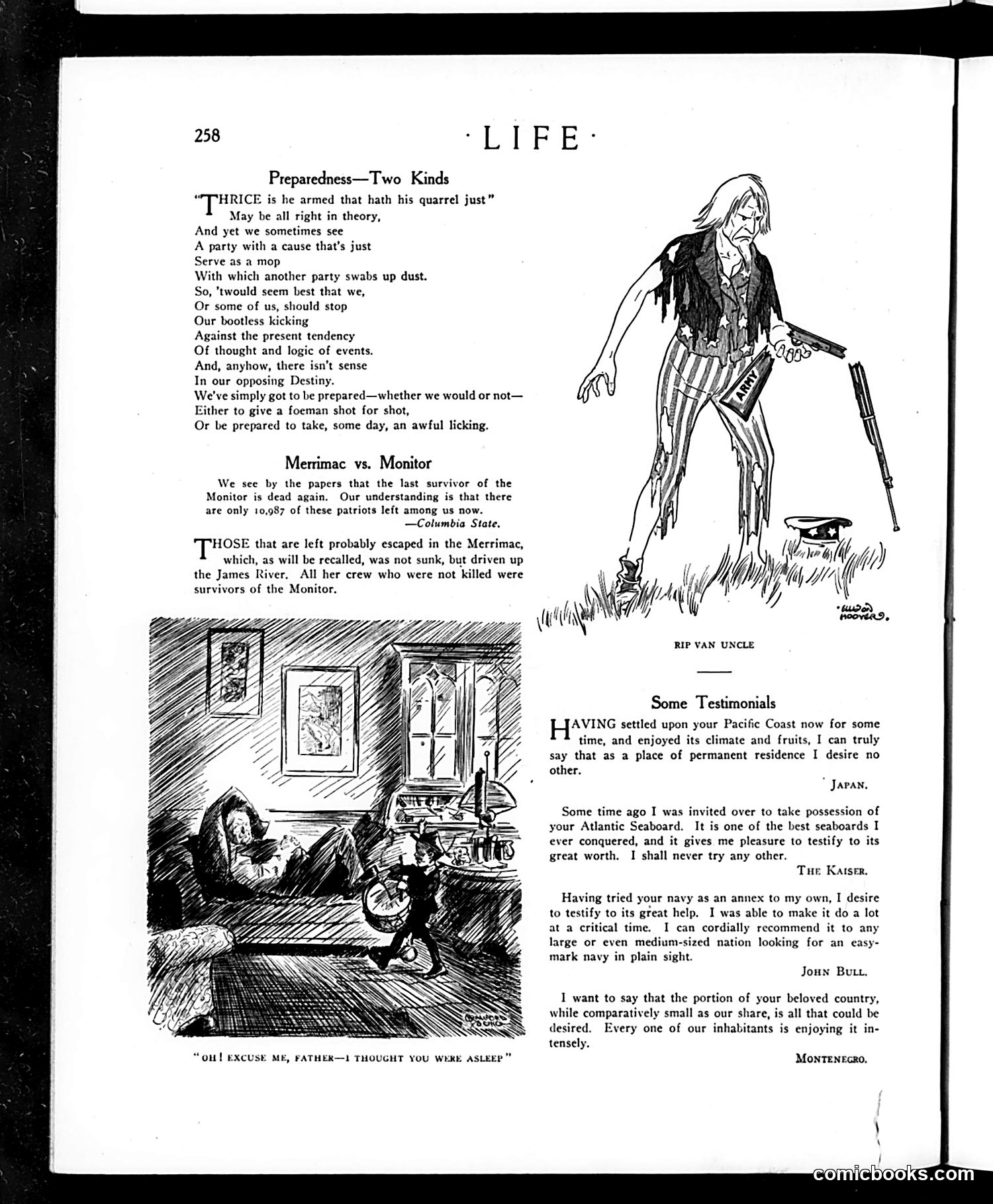
This page satirizes American military preparedness circa 1910-1912. The opening poem argues the U.S. must prepare for war regardless of moral righteousness—the practical reality matters more than ideology. The "Merrimac vs. Monitor" section is a joke about inflated survivor claims: newspapers reported the last Monitor survivor died, yet thousands claimed Monitor service. The irony suggests either mass fraud or absurd record-keeping. "Rip Van Uncle" (illustrated right) depicts America as a sleeping figure awakening to military reality—a reference to Washington Irving's tale of prolonged slumber. "Some Testimonials" sarcastically presents endorsements from foreign powers—Japan, Kaiser Wilhelm II, and Montenegro—praising American naval and territorial assets. The joke: these nations "recommend" American military strength to other nations seeking easy targets, implying U.S. forces are actually vulnerable despite claims of preparedness. The overall message: America must genuinely prepare militarily, not merely theorize about it.
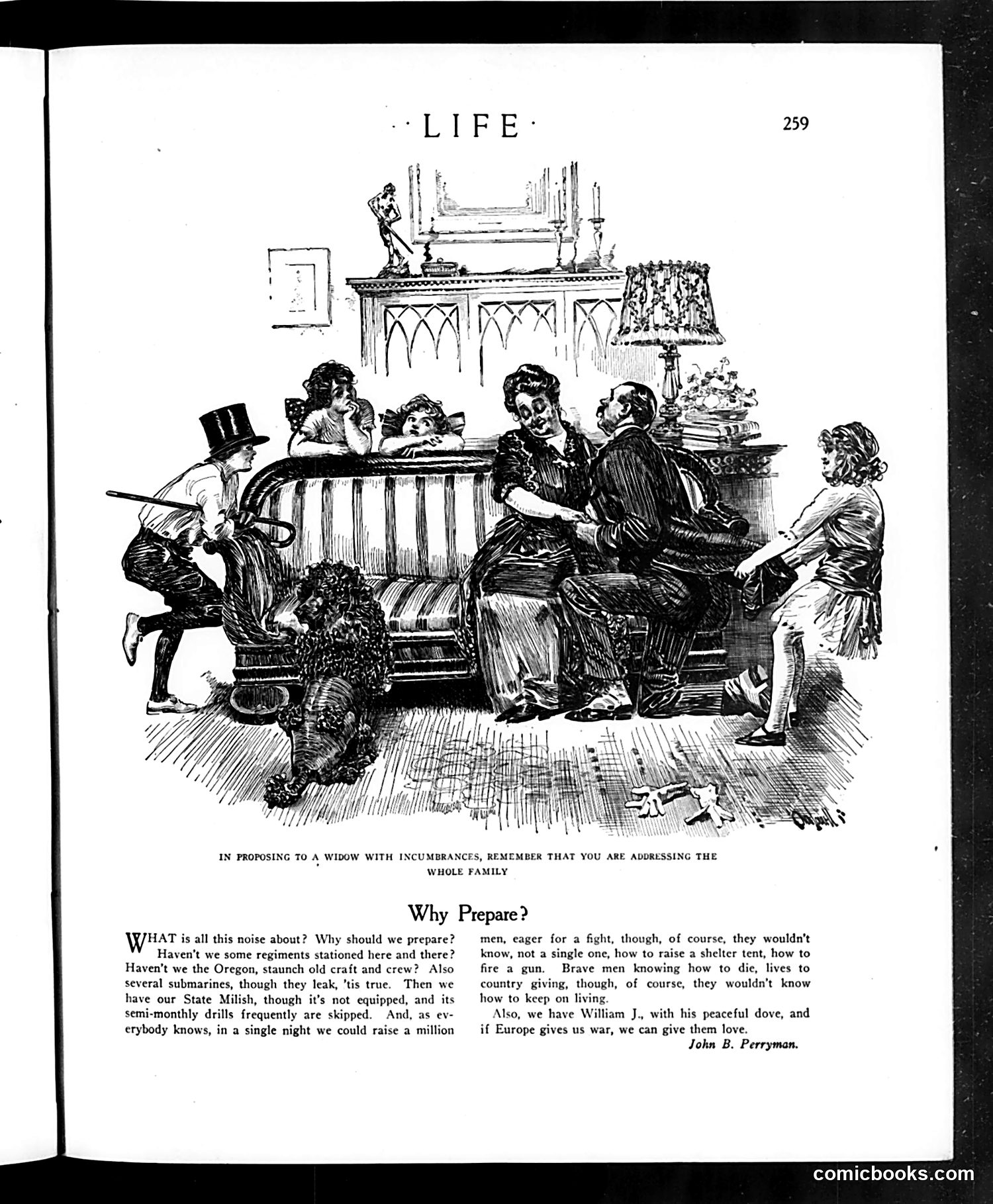
This 1910s-era satirical piece mocks American military unpreparedness using two connected critiques: **The cartoon** shows a man proposing marriage to a widow surrounded by her children—a visual metaphor for taking on unwanted "incumbrances" (burdens). The caption warns suitors they're accepting the whole package. **The text**, by John B. Perryman, applies this logic to American military preparedness. The author sarcastically catalogs America's supposed defenses—scattered regiments, the USS Oregon, leaky submarines, poorly-equipped state militias with skipped drills—and concludes mockingly that America could "raise a million men" overnight who wouldn't know how to survive peacetime. The final jab at "William J." (likely William Jennings Bryan, pacifist politician) and his "peaceful dove" suggests relying on love instead of military strength is folly. **The point**: America cannot simply improvise military capability when war arrives. Preparedness requires actual training, equipment, and planning—not wishful thinking or pacifism. This reflects pre-WWI anxieties about American military readiness.
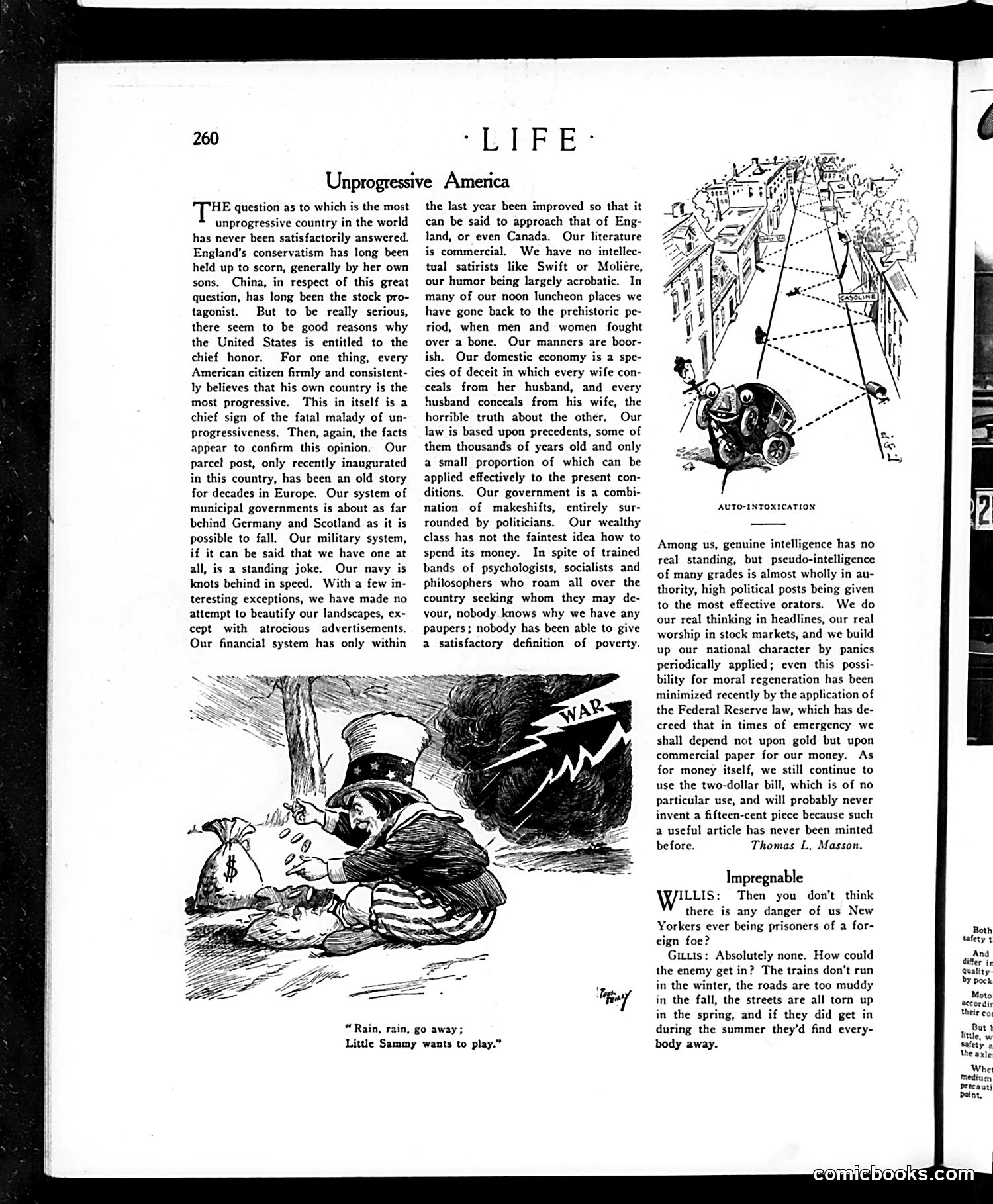
This page satirizes American complacency and backwardness disguised as progress. The main essay "Unprogressive America" by Thomas L. Masson attacks American self-delusion: citizens believe their country is most progressive while evidence suggests otherwise. Masson catalogs American failures—outdated postal systems, primitive municipal governance, chaotic military and navy, tasteless landscapes cluttered with advertisements, and domestic dishonesty. The two cartoons reinforce this critique. The top illustration labeled "AUTO-INTOXICATION" shows a figure intoxicated or poisoned by America itself, visually representing how national self-deception becomes toxic. The bottom cartoon depicts Uncle Sam (identifiable by his hat and patriotic symbolism) defeated or collapsed, with the caption "Rain, rain, go away; Little Sammy wants to play"—mocking American childishness. The brief dialogue "Impregnable" jokes that New York City is unconquerable not through strength but through incompetence: trains, roads, and infrastructure are so dysfunctional that invaders couldn't navigate the city.
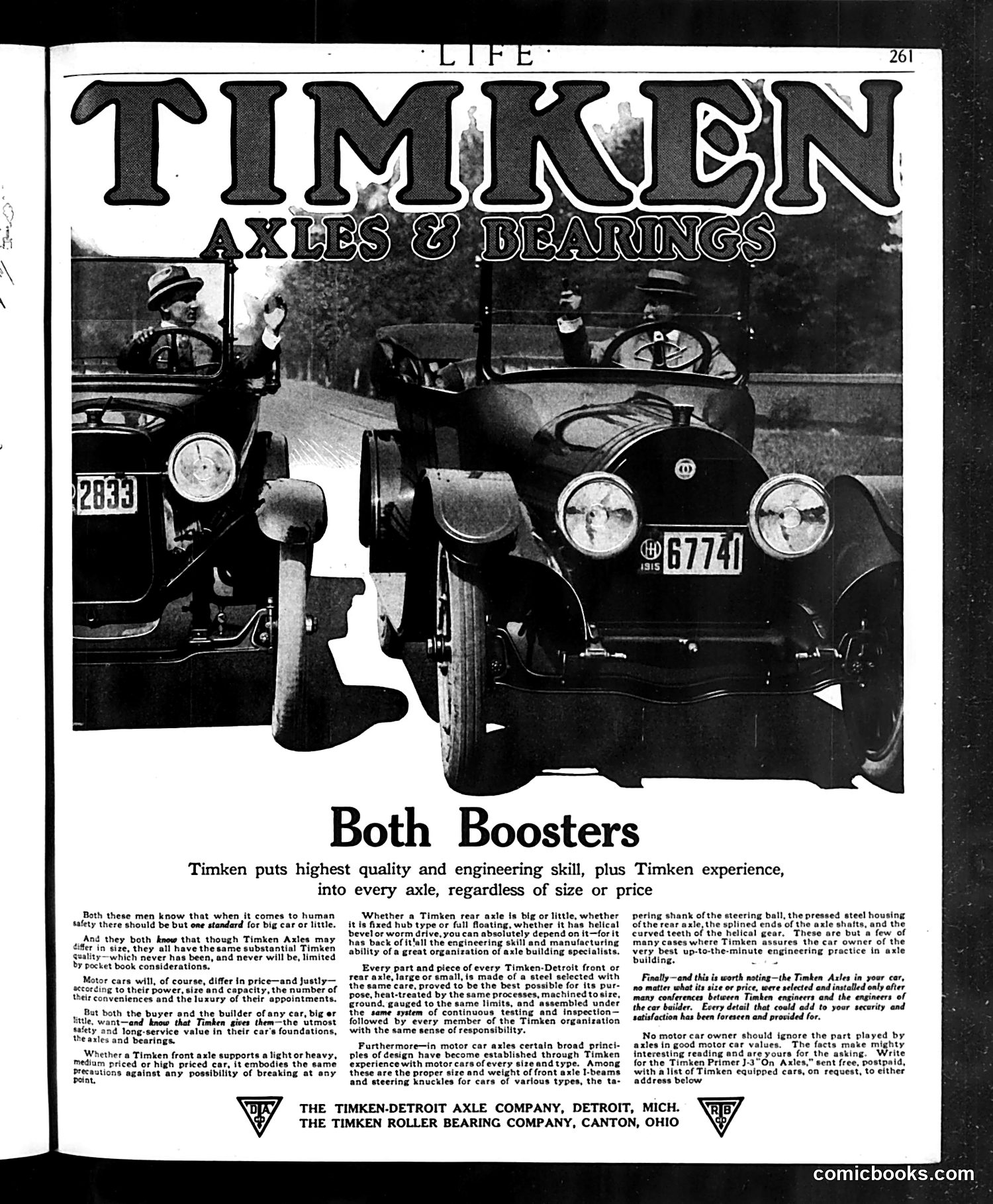
This is **not a cartoon or satire**—it's a **straight advertisement** for Timken axles and bearings, appearing in Life magazine (page 261). The page shows two automobiles of different sizes with well-dressed men, illustrating Timken's marketing message: that quality engineering standards apply equally to both large and small vehicles, regardless of price point. The headline "Both Boosters" refers to both car owners being advocates for Timken products. The lengthy text emphasizes that Timken uses identical manufacturing rigor, materials testing, and engineering principles across all axle sizes. This was important messaging in the 1920s-30s era when automotive reliability was still a significant concern. **No satire is present.** This is corporate brand-building rhetoric claiming democratic access to quality—"one standard for big car or little"—which would appeal to middle-class automobile buyers during the era when car ownership was expanding beyond the wealthy.
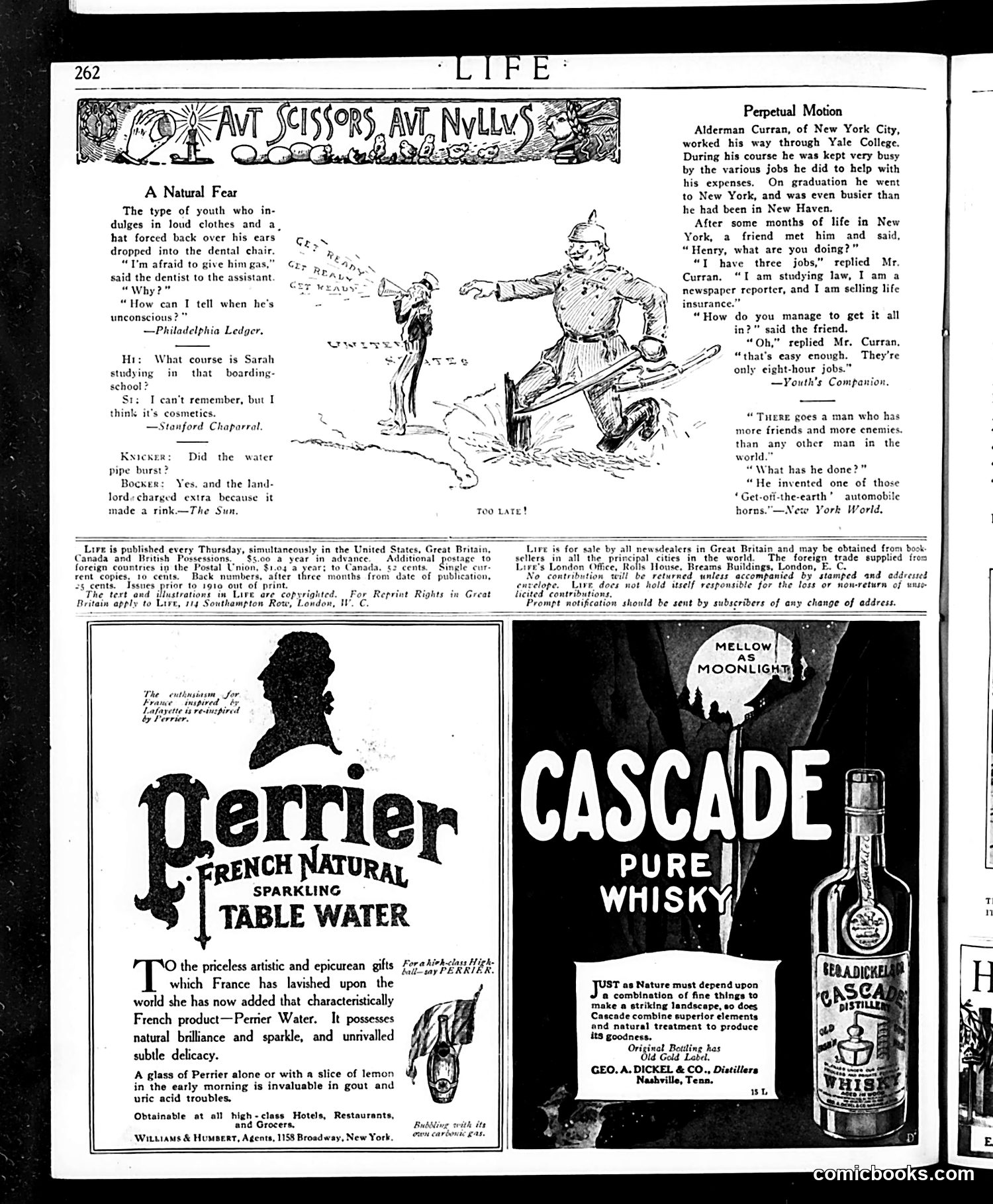
This page contains several brief satirical jokes typical of *Life* magazine's humor section, plus two period advertisements. **The Cartoons/Jokes:** The main cartoon shows a dentist unable to determine if an anxious young patient is unconscious during treatment—the joke being the patient's "loud clothes" and hat worn so far back make him look perpetually unconscious anyway. Other short jokes mock: - A boarding school student studying "cosmetics" (implying frivolous education) - A landlord charging extra when a water pipe burst and froze, creating an ice rink - An overly busy New York alderman juggling law school, newspaper reporting, and life insurance sales—all "only eight-hour jobs" - A man universally disliked for inventing the loud car horn **The Advertisements:** Perrier water is promoted as a French luxury product; Cascade whisky emphasizes its purity and natural ingredients. Both reflect early 20th-century marketing targeting affluent consumers. The humor is gentle, observational satire about urban life, excess busyness, and modern annoyances—particularly the newly invented automobile horn.
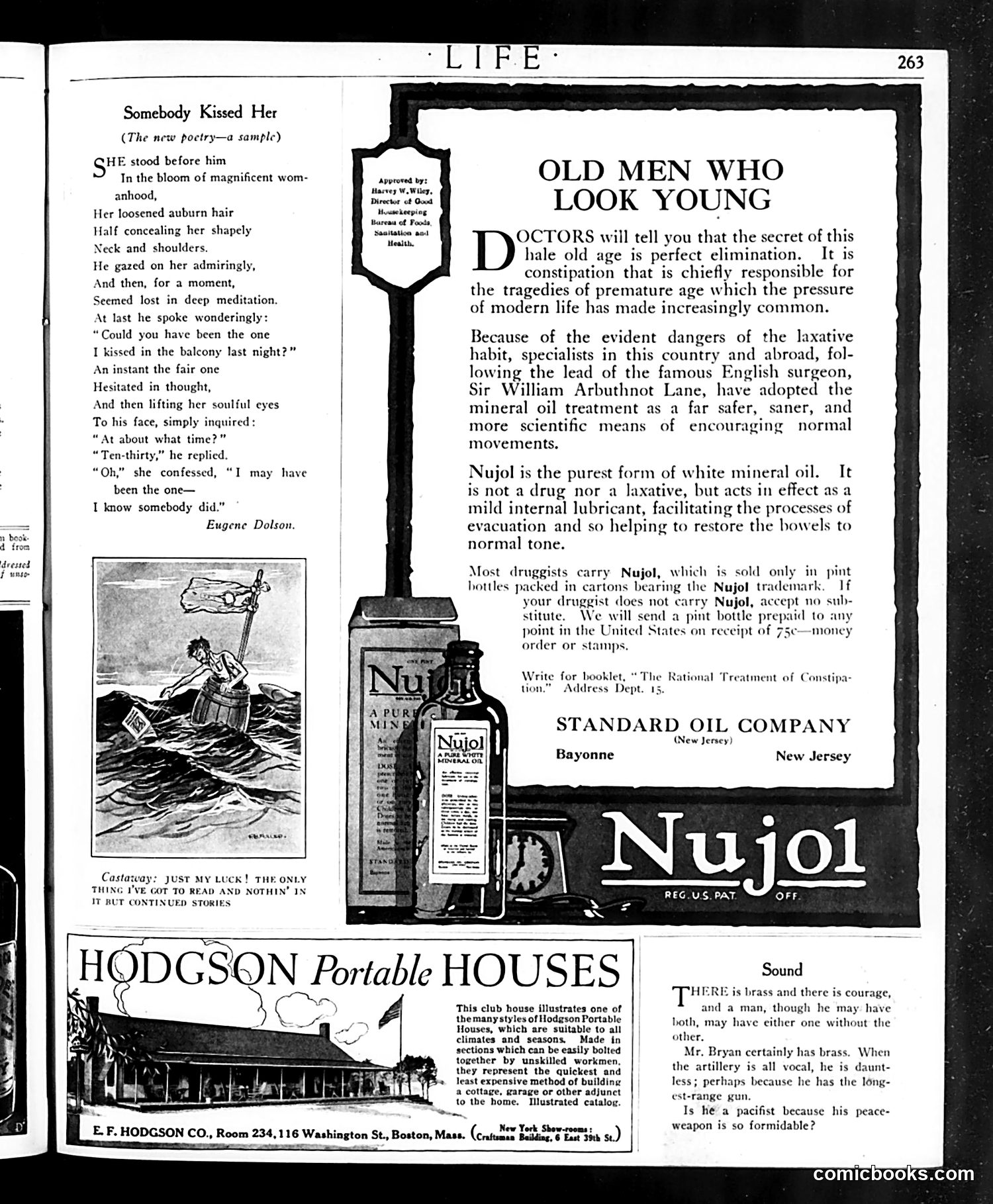
This page contains three distinct elements: **"Somebody Kissed Her" (top left):** A satirical poem by Eugene Dolson mocking contemporary "modern poetry." The joke is the contrast between romantic, flowery verse about a woman and her mundane response—when asked "at about what time?" she admits uncertainty, having kissed multiple men. It's a commentary on both pretentious modern poetry and, implicitly, changing sexual morality of the era. **Nujol Advertisement (center/right):** A straightforward commercial for mineral oil as a constipation remedy, invoking medical authority (Sir William Arbuthnot Lane) to market it as scientifically superior to laxatives. **Bryan Reference (bottom right):** A brief satirical commentary on William Jennings Bryan (likely referring to his 1920s activities as a public speaker and anti-evolution campaigner). The joke equates his rhetorical "brass" with pacifism, suggesting his verbal power makes actual weapons unnecessary—a somewhat unclear political jab. The page is primarily advertising-driven rather than satirical content.
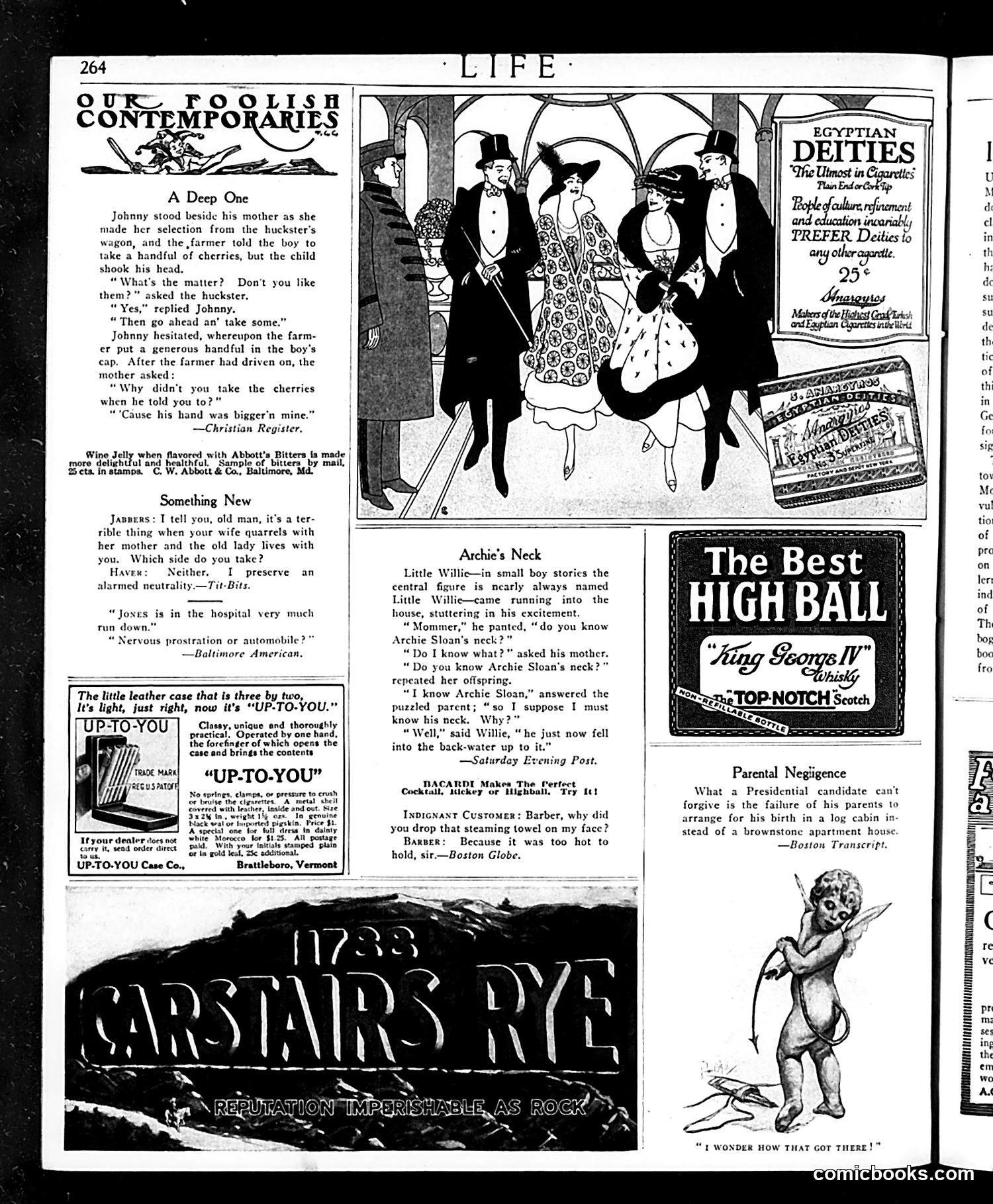
This page from *Life* magazine collects brief satirical jokes under "Our Foolish Contemporaries." The content includes: **"A Deep One"**: A child refuses free cherries because the farmer's hand is larger than his own—satirizing childish logic and misunderstanding of generosity. **"Something New"**: A man caught between his wife and mother-in-law claims "alarmed neutrality"—mocking domestic marital conflict and cowardly neutrality. **"Archie's Neck"**: A boy reports his friend fell into water "up to" his neck, but the phrase confuses his mother—gentle wordplay humor. **"Parental Negligence"**: The final joke critiques Presidential candidates who regret not being born in log cabins (suggesting frontier authenticity and humble origins) rather than brownstone apartments—satirizing artificial political image-building and candidates' attempts to appear self-made. The page also includes period advertisements and product promotions typical of the era.
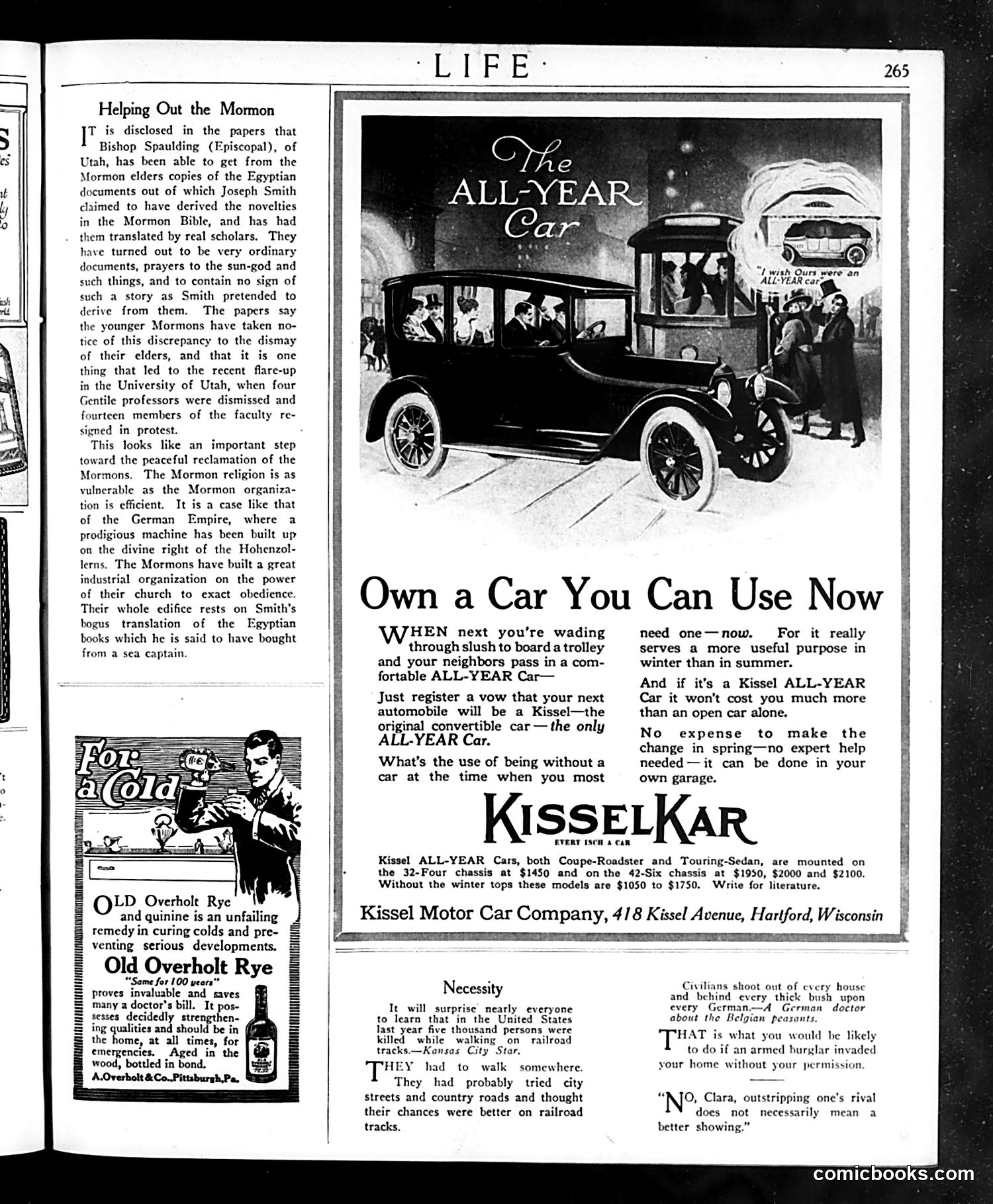
This page combines a serious editorial critique with period advertisements. **"Helping Out the Mormon"** is a satirical commentary on the Mormon church's foundational claims. It reports that Bishop Spaulding obtained Egyptian documents Joseph Smith allegedly used to create the Book of Mormon. When real scholars translated them, they revealed only ordinary religious texts—prayers to the sun-god—contradicting Smith's claims of divine revelation. The piece compares Mormon institutional power to the German Empire: both rest on fabricated authority. The satire's point: Mormonism's rigid organizational control depends entirely on Smith's false translation; exposing this fraud could undermine the entire structure. The page also includes two period advertisements (Kissel ALL-YEAR Cars and Old Overholt Rye whiskey) and brief filler items on railway fatalities and wartime Belgian civilians. The satire reflects early 20th-century skepticism toward Mormon claims while respecting their organizational efficiency—a backhanded compliment typical of *Life's* irreverent style.
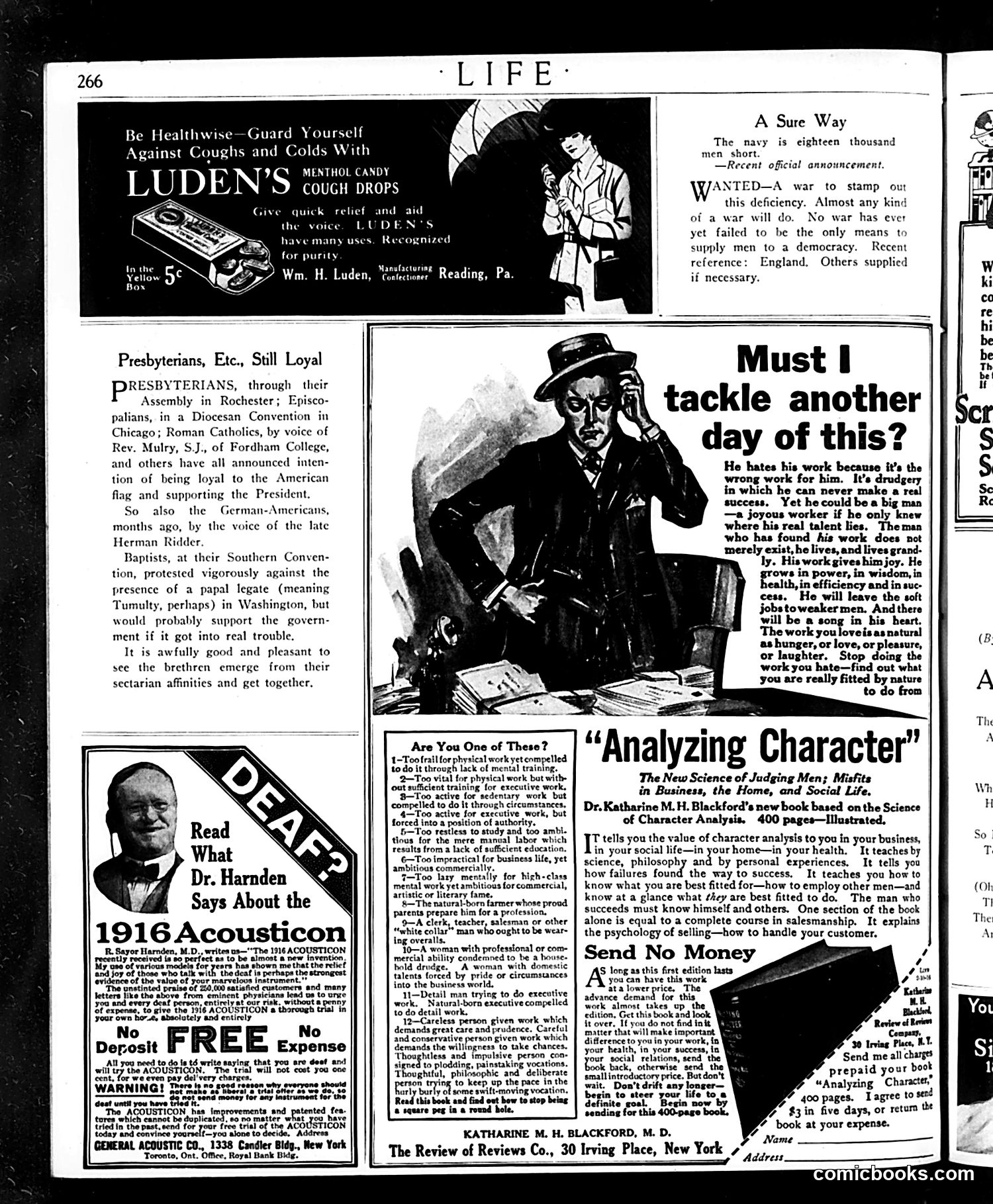
This page mixes advertisements with editorial content critiquing American institutions and employment mismatches. **Main Editorial Content:** The top section notes that various religious groups—Presbyterians, Episcopalians, Roman Catholics, and Baptists—have publicly pledged loyalty to the American flag and President, setting aside sectarian differences. The tone suggests approval of this patriotic unity, likely written during WWI era when such declarations mattered. **"A Sure Way" Satire:** This brief piece sarcastically proposes war as a solution to the Navy's recruitment shortfall (18,000 men needed). It cynically notes that war has historically been "the only means to supply men to a democracy," citing Britain as precedent. The satire critiques how nations use conflict to solve domestic problems. **Character Analysis Advertisement:** The large Dr. Katharine Blackford ad promotes a book claiming to identify which of twelve personality types you belong to, promising to reveal your ideal occupation. It represents period pseudo-scientific "character analysis" movements claiming to scientifically match people to careers—implying many people are in wrong jobs.
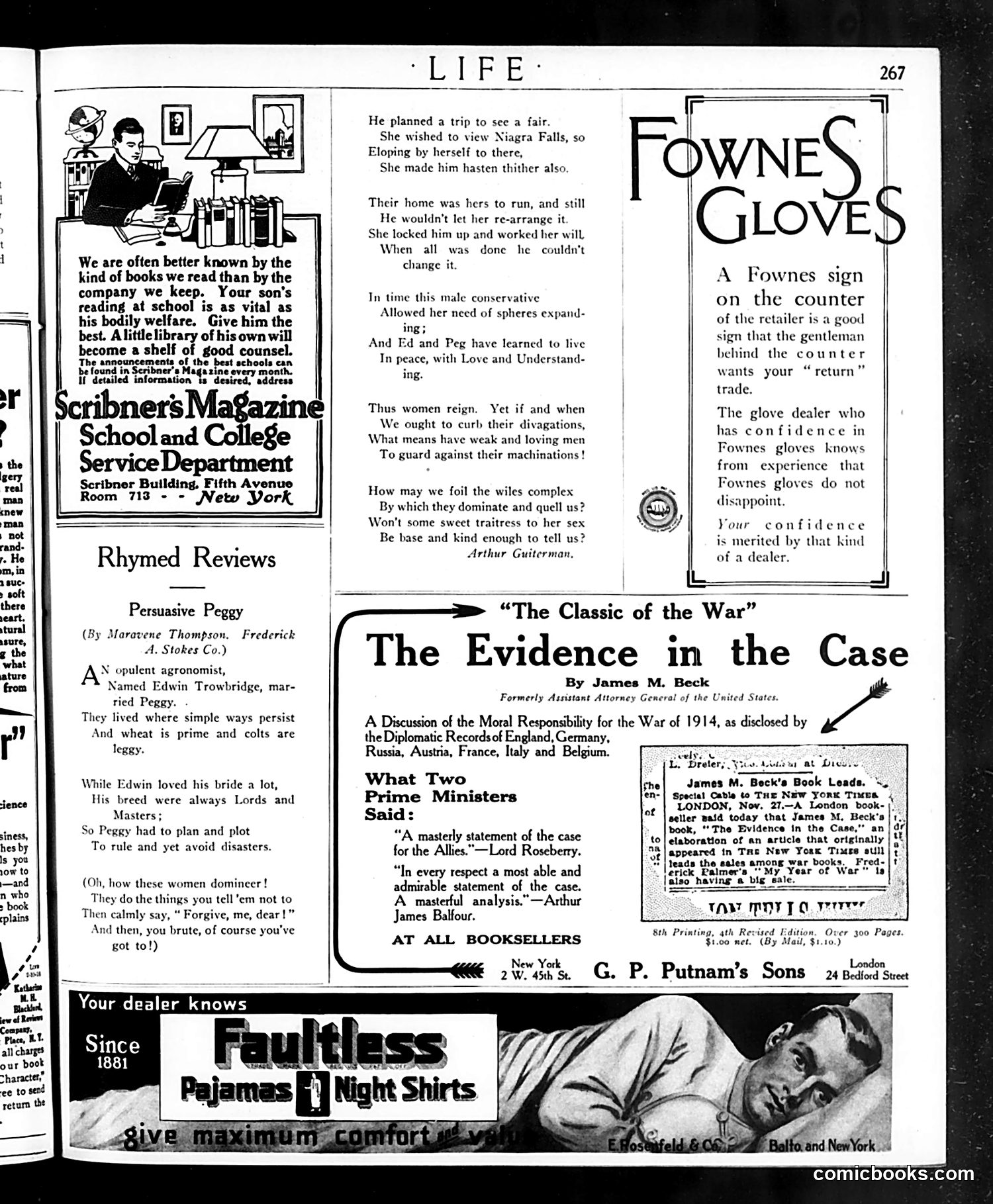
This page combines advertising with satirical poetry about gender dynamics in marriage. **"Rhymed Reviews" (Arthur Guiterman's poem):** The verse satirizes the tension between traditional male authority and female agency in marriage. Edwin Trowbridge, a conservative farmer, initially dominates his wife Peggy, but she systematically outmaneuvers him—choosing destinations, reorganizing their home, locking him away—until he accepts her autonomy. The poem's closing couplet reveals the satire's target: men lamenting their inability to control wives' "machinations," asking another woman to betray her sex and reveal how to suppress female independence. This reflects 1920s-era gender anxiety—women had recently gained voting rights (1920), and traditional male authority was visibly eroding. The satire mocks men's helplessness and their resentment of female empowerment. **Supporting advertisements** (Scribner's Magazine, Fownes Gloves, book promotions) fill the remaining space—typical for this magazine format.
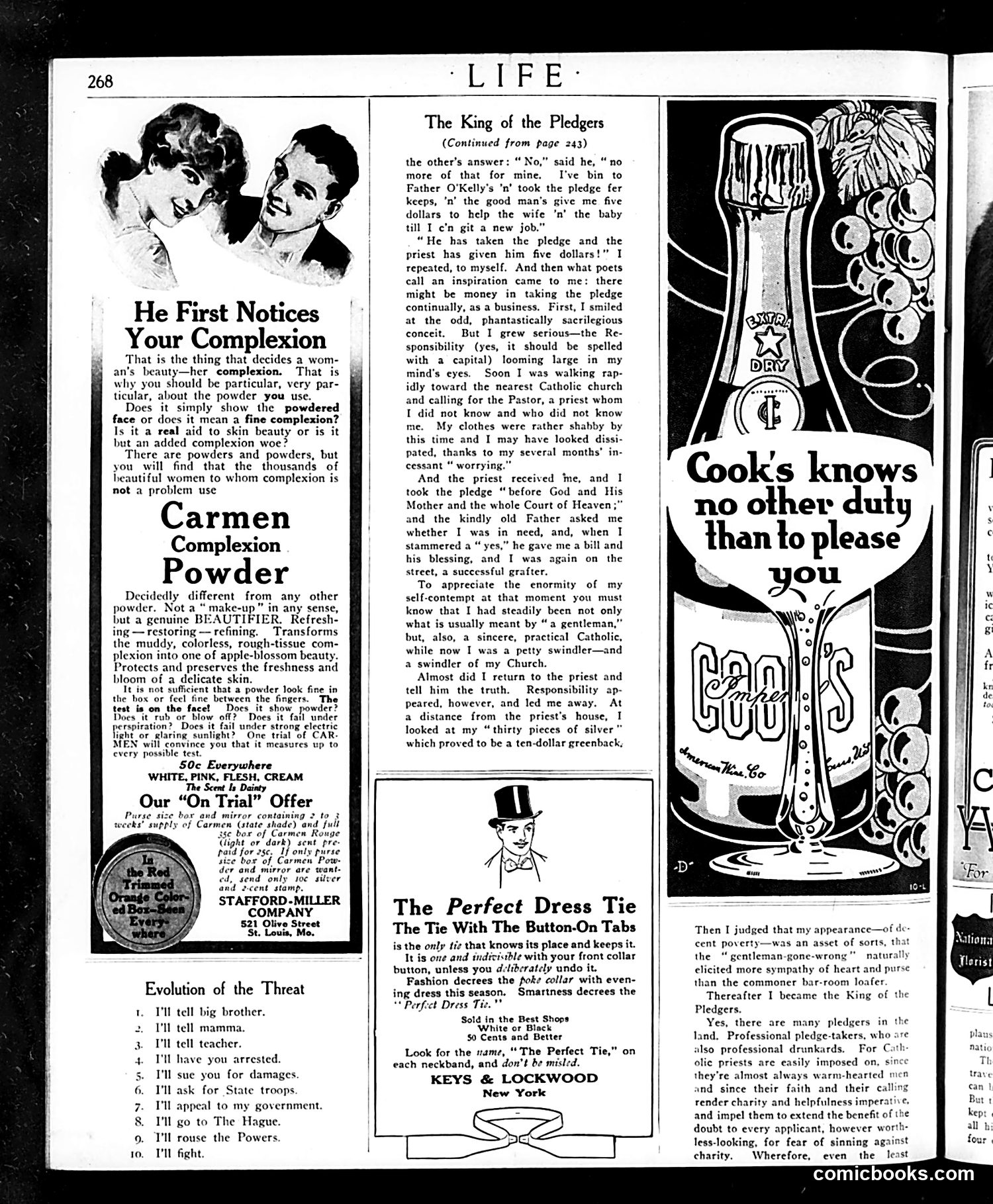
This page contains mostly **advertisements and filler content** rather than political satire. The main features are: 1. **Carmen Complexion Powder ad** (left): A beauty product advertisement emphasizing that complexion determines a woman's beauty—typical early 20th-century marketing targeting female vanity. 2. **"Evolution of the Threat"** (bottom left): A humorous numbered list showing escalating threats from personal ("I'll tell big brother") to international ("I'll go to The Hague"). This likely satirizes how disputes escalate, mocking both personal disputes and international diplomacy as following similar patterns. 3. **"The King of the Pledgers"** (center/right): A continued story about a man who exploits Catholic priests by repeatedly taking temperance pledges in exchange for monetary donations. It's satirical commentary on both alcoholism relief programs and religious exploitation—mocking someone who cynically manipulates clerical charity. 4. Additional product advertisements for dress ties and other goods. The page is primarily commercial, with light social satire rather than hard political commentary.
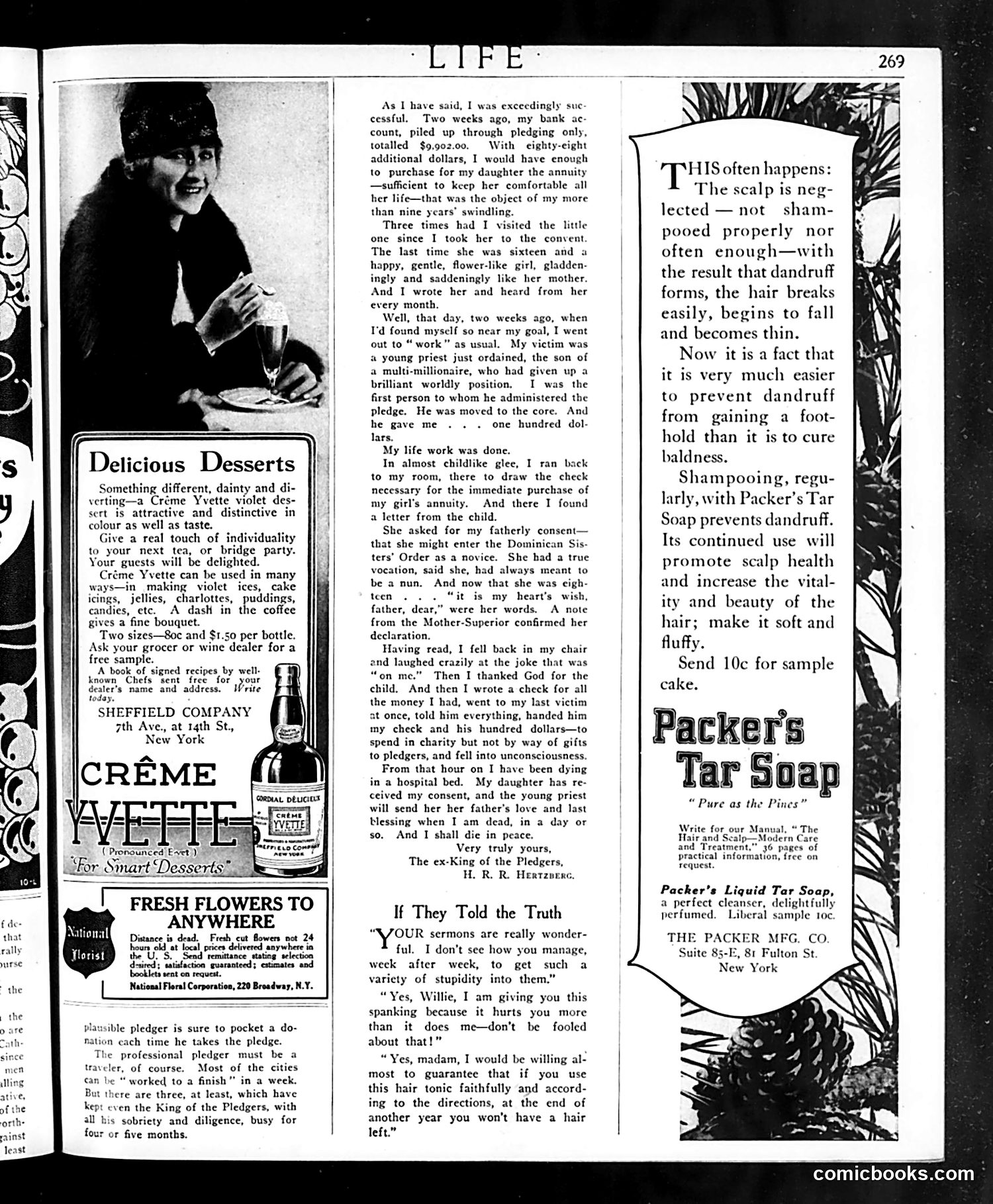
This page contains primarily **advertisements and a short story**, not political cartoons. The main narrative, "If They Told the Truth," is a brief humorous exchange where a parishioner compliments a preacher's sermons while inadvertently insulting him by praising the "variety of stupidity" in them. The joke is that the compliment-giver doesn't realize he's being rude, while the preacher responds diplomatically. The longer featured story concerns a "professional pledger"—a man who solicits donations for temperance/sobriety pledges and pockets money from wealthy donors. After years of this scheme, he finally accumulates enough to buy his daughter an annuity. However, she writes asking his consent to become a nun instead, negating his financial goal. The irony and his spiritual acceptance form the story's moral conclusion. The remaining content is **commercial advertising** for Crème Yvette dessert liqueur, floral delivery service, and Packer's Tar Soap—typical early 20th-century magazine fare with no satirical intent.
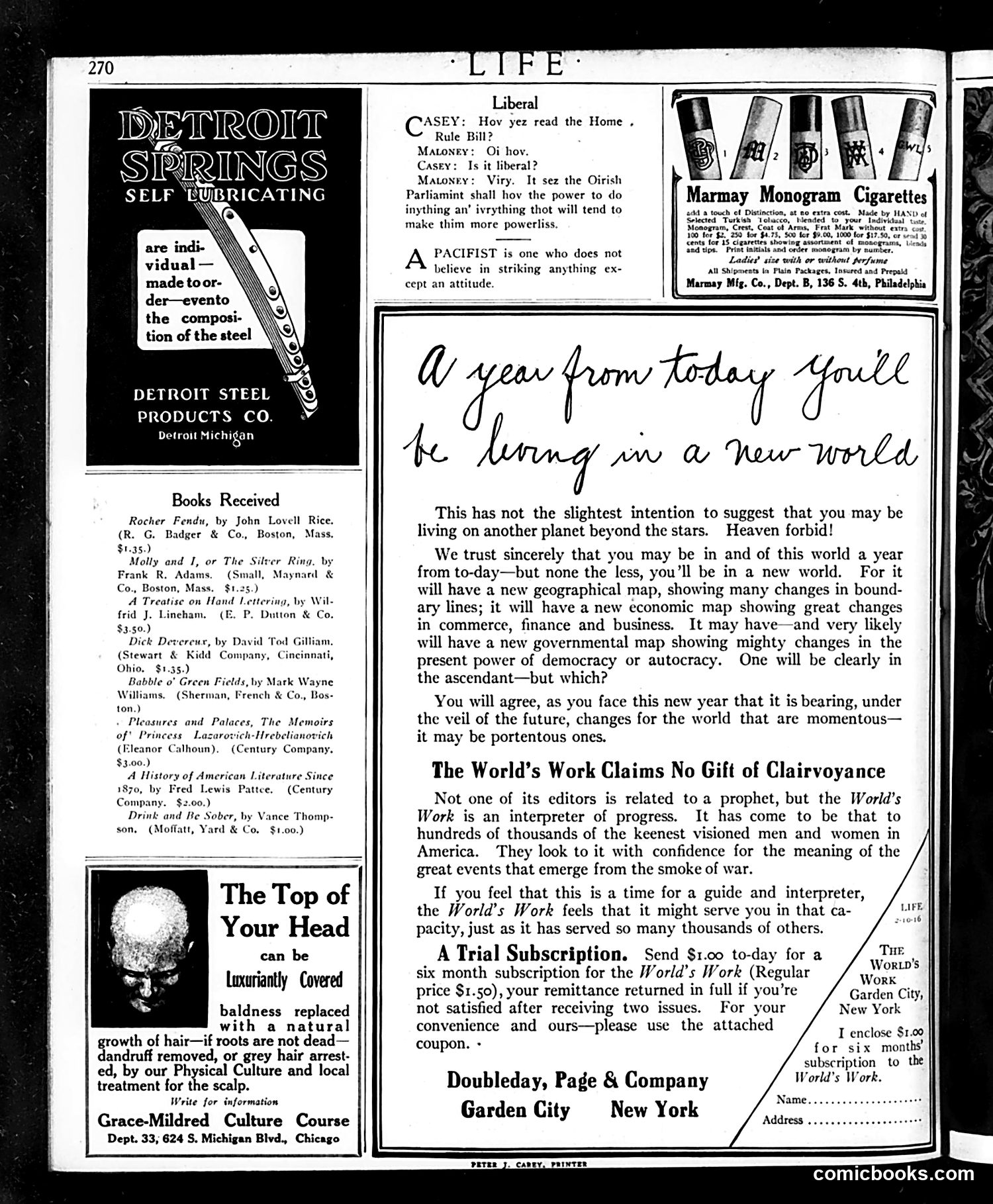
This page contains a political joke about Irish Home Rule, a hotly debated topic in early 20th-century British politics. The cartoon dialogue mocks Irish Home Rule legislation through stereotyped Irish characters (Casey and Maloney, indicated by their phonetic dialect spelling). Maloney sarcastically praises the Home Rule Bill as "liberal" because it supposedly grants the Irish Parliament power to do "inything" that will make Ireland "more powerless"—a contradiction highlighting skepticism that the bill provided genuine Irish independence. The accompanying joke defines a "pacifist" as someone who won't strike anything "except an attitude"—likely mocking pacifists as all talk and no action, relevant during the pre-WWI period when pacifism was debated. The page is otherwise filled with book advertisements, product ads (hair growth treatments, cigarettes), and a subscription offer for *The World's Work* magazine, reflecting typical Life magazine content of the era.
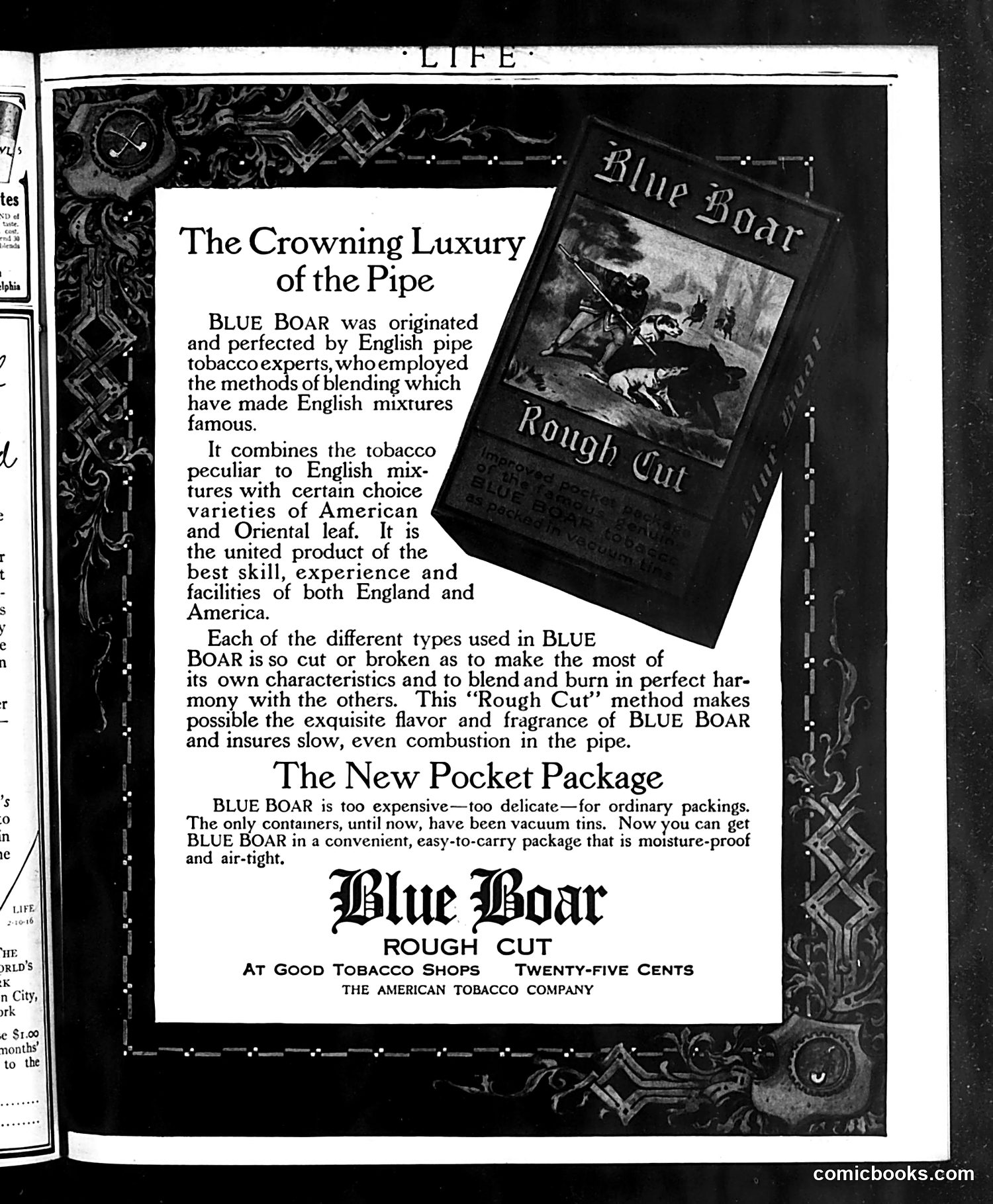
This is a **full-page advertisement**, not a cartoon or satire. It promotes Blue Boar pipe tobacco by The American Tobacco Company. The ad uses elegant marketing language to position the product as a luxury item. It emphasizes that Blue Boar combines English blending expertise with American and Oriental tobaccos—a "united product" of both nations' skills. The "Rough Cut" method is highlighted as enabling superior flavor and even burning. The accompanying package image shows Blue Boar's "Rough Cut" variant in what appears to be a decorative tin or pouch with hunting/sporting imagery. The significant detail is the announcement of a new "pocket package" format—previously only available in vacuum tins, now offered in a convenient, moisture-proof package. This modernization is presented as a major innovation making the premium product more accessible. The price (twenty-five cents) and distribution ("at good tobacco shops") reflect early-to-mid 20th-century tobacco marketing, when pipe smoking remained a respectable, aspirational habit.
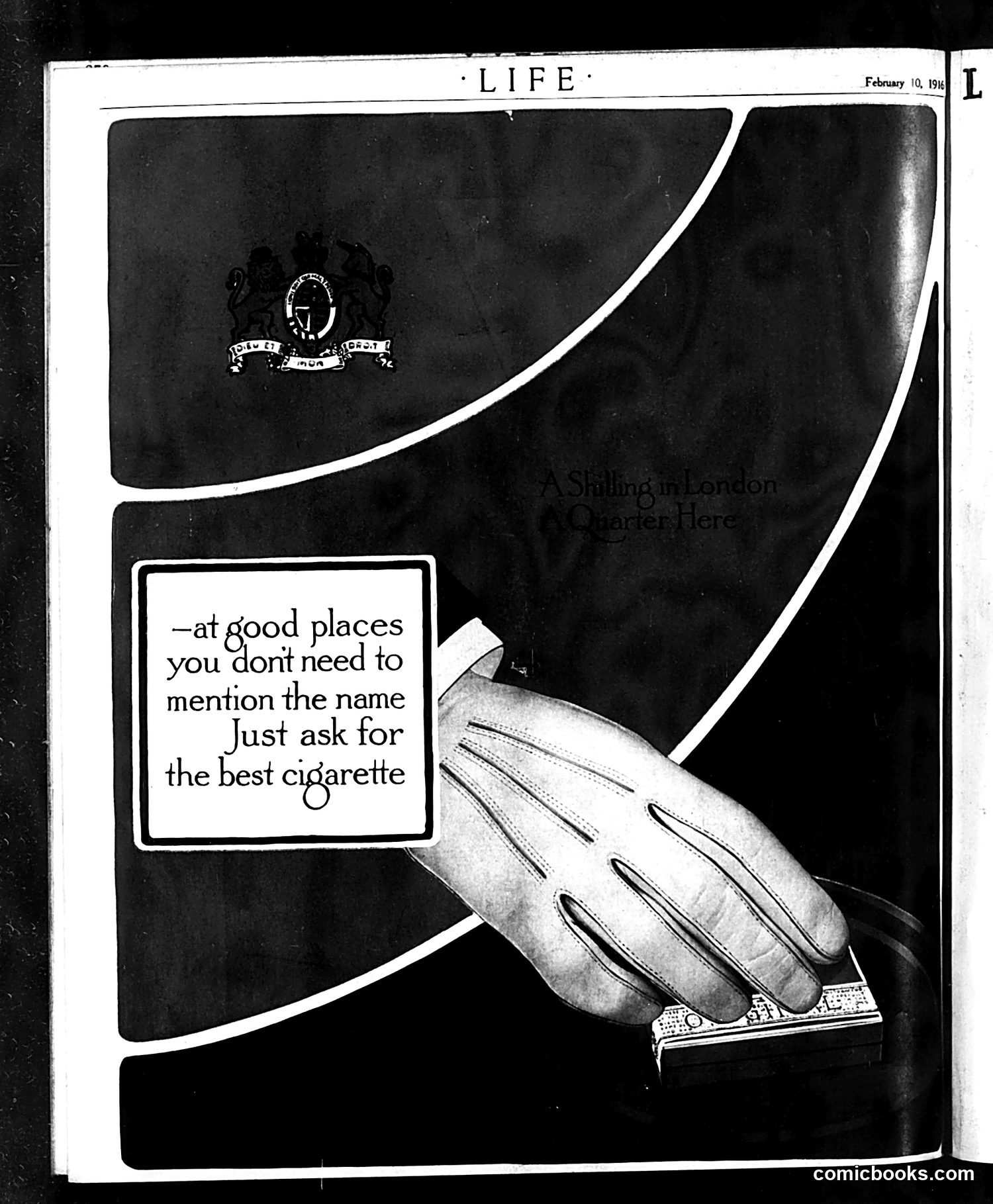
This is a **cigarette advertisement** from *Life* magazine (February 10, 1914), not political satire or comics. The page features an elegant hand holding a cigarette pack against a dark background, with a heraldic crest visible at top. The ad's message suggests the product's prestige: at upscale establishments ("good places"), the brand is so well-known that customers need only request "the best cigarette" without naming it. This marketing strategy appeals to sophistication and social status—implying the cigarette is the recognized standard among the wealthy. The brand name itself remains obscured in this OCR'd version, though the heraldic imagery suggests a premium, possibly British-import product targeting affluent Americans during the pre-regulation cigarette advertising era.