
Life, 1916-02-10 · page 9 of 44
Life — February 10, 1916 — page 9: what you’re looking at
What you’re looking at
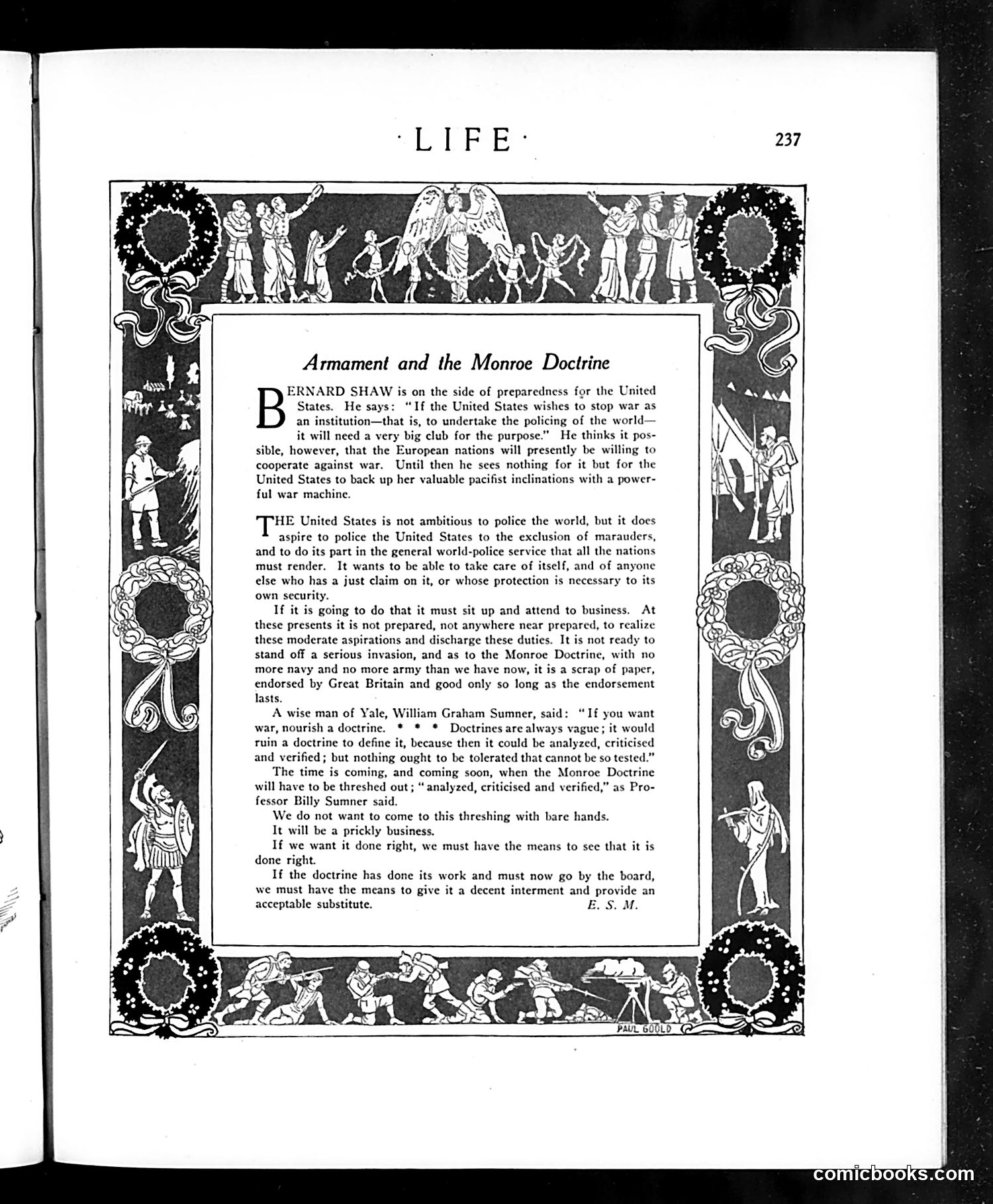
This editorial piece discusses U.S. military preparedness and foreign policy, specifically addressing Bernard Shaw's arguments about world policing. The text argues that while the U.S. doesn't seek to police the world, it must maintain armed forces to protect itself and the Monroe Doctrine (preventing foreign intervention in the Americas). The piece quotes Yale professor William Graham Sumner's caution that doctrines require rigorous testing and analysis before implementation. The author (E.S.M.) warns that enforcing the Monroe Doctrine without adequate military strength is meaningless—it would be merely "a scrap of paper" without backing from Great Britain. The ornamental border contains classical and allegorical figures, typical of *Life* magazine's design aesthetic of this era (appears early 20th century).
📄 Transcribed text from this page (OCR, searchable)
Machine-transcribed from the original scan — historical spelling and the odd misread are preserved.
Armament and the Monroe Doctrine NARD SHAW is on the side of preparedness for the United States. He says: “If the United States wishes to stop war as an institution—that is, to undertake the policing of the world— it will need a very big club for the purpose.” He thinks it pos- sible, however, that the European nations will presently be willing to cooperate against war. Until then he sees nothing for it but for the United States to back up her valuable pacifist inclinations with a power- ful war machine. THE United States is not ambitious to police the world, but it does aspire to police the United States to the exclusion of marauders, and to do its part in the general world-police service that all the nations must render. It wants to be able to take care of itself, and of anyone else who has a just claim on it, or whose protection is necessary to its own security. If it is going to do that it must sit up and attend to business. At these presents it is not prepared, not anywhere near prepared, to realize these moderate aspirations and discharge these duties. It is not ready to stand off a serious invasion, and as to the Monroe Doctrine, with no more navy and no more army than we have now, it is a scrap of paper, endorsed by Great Britain and good only so long as the endorsement lasts. A wise man of Yale, William Graham Sumner, said: “If you want war, nourish a doctrine. * * ® Doctrines are always vague; it would ruin a doctrine to define it, because then it could be analyzed, criticised and verified; but nothing ought to be tolerated that cannot be so tested.” The time is coming, and coming soon, when the Monroe Doctrine will have to be threshed out ; “analyzed, criticised and verified,” as Pro- fessor Billy Sumner said. We do not want to come to this threshing with bare hands. It will be a prickly business. If we want it done right, we must have the means to see that it is done right. If the doctrine has done its work and must now go by the board, we must have the means to give it a decent interment and provide an acceptable substitute.