
Life, 1916-02-10 · page 26 of 44
Life — February 10, 1916 — page 26: what you’re looking at
What you’re looking at
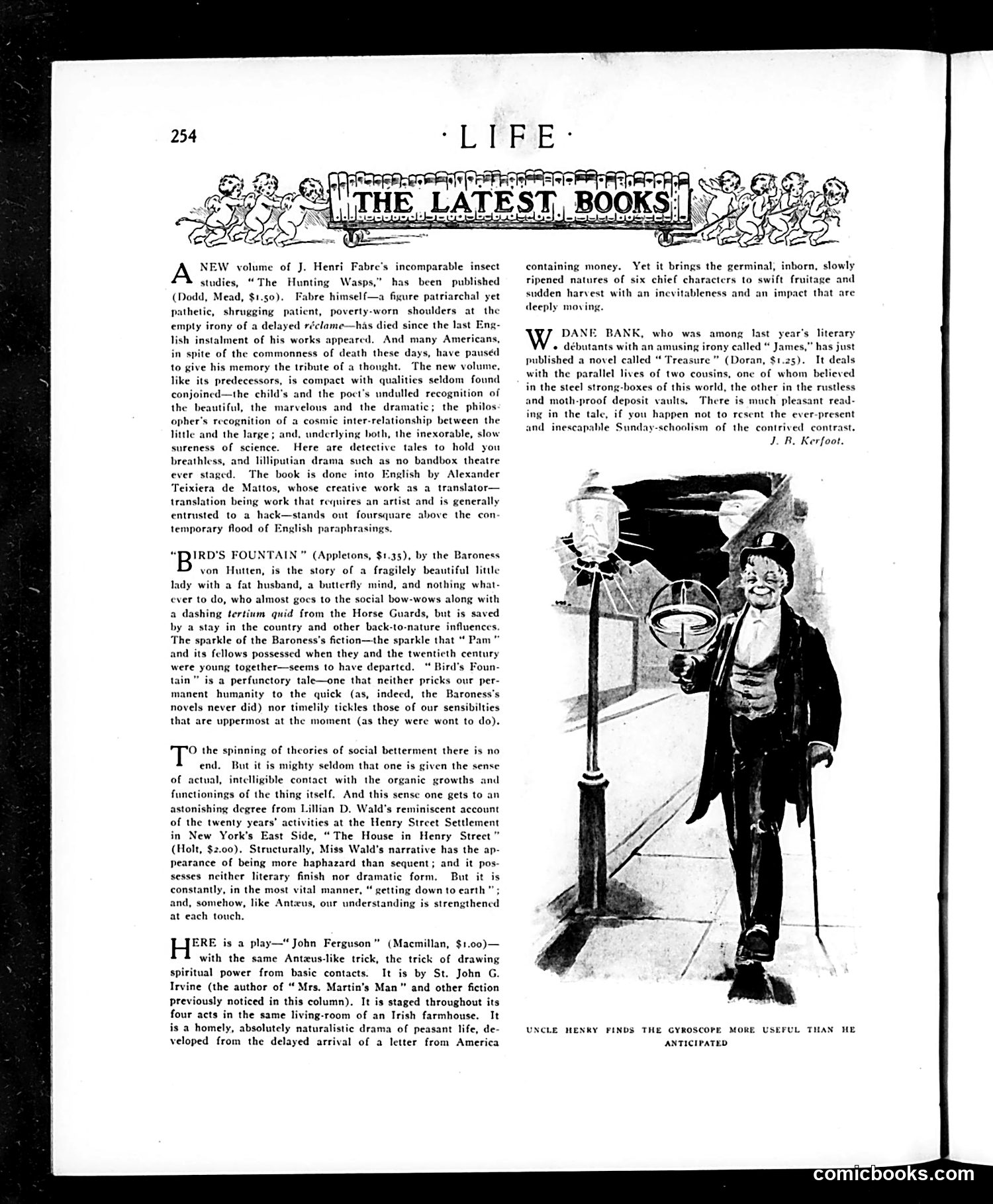
This is a literary review page featuring four new book releases. The single illustration shows a humorous cartoon captioned "Uncle Henry Finds the Gyroscope More Useful Than He Anticipated"—depicting an elderly man using a gyroscope as a street lamp or lamp post, a visual pun on the device's spinning properties. The reviews themselves discuss serious literary works: J. Henri Fabre's entomology studies, the Baroness von Hutten's society novel, Lillian D. Wald's memoir about Henry Street Settlement social work, and St. John G. Irvine's Irish farmhouse drama. The tone is appreciative yet critical, praising Fabre's naturalistic observation and Wald's practical social engagement while dismissing von Hutten's work as dated and superficial. The cartoon provides light relief on an otherwise text-heavy page of intellectual literary criticism.
📄 Transcribed text from this page (OCR, searchable)
Machine-transcribed from the original scan — historical spelling and the odd misread are preserved.
NEW volume of J. Henri Fabre’s incomparable insect studies, “The Hunting Wasps,” has been published (Dodd, Mead, $1.50). Fabre himself—a figure patriarchal yet pathetic, shrugging patient, poverty-worn shoulders at the emply irony of a delayed réclame—has died since the last lish instalment of his works appeared. And many Ameri in spite of the commonness of death these days, have paused to give his memory the tribute of a thought. The new volume, like its predecessors, is compact with qualities seldom found conjoincd—the child’s and the poct’s undulled recognition of the beautiful, the marvelous and the dramatic; the philos opher’s recognition of a cosmic inter-relationship between the little and the large; and, underlying both, the inexorable, slow sureness of science. Here are detective tales to hold you breathless, and lilliputian drama such as no bandbox theatre ever staged. The book is done into English by Alexander Teixiera de Mattos, whose creative work as a translator— translation being work that requires an artist and is generally entrusted to a hack—stands out foursquare above the con temporary flood of nglish_ paraphrasings. “DIRD'S FOUNTAIN ” (Appletons, $1.35), by the Baroness von Hutten, is the story of a fragilely beautiful little lady with a fat husband, a butterfly mind, and nothing what- ever to do, who almost gocs to the social bow-wows along with a dashing tertinm quid from the Horse Guards, but is saved by a stay in the country and other back-to-nature influences The sparkle of the Baroness’s fiction—the sparkle that “ Pam and its fellows possessed when they and the twentieth century were young together—seems to have departed. “ Bird's Foun- tain” is a perfunctory tale—one that neither pricks our per- manent humanity to the quick (as, indeed, the Baroness’s novels never did) nor timelily tickles those of our sensibilties that are uppermost at the moment (as they were wont to do). ‘0 the spinning of theories of social betterment there is no end. But it is mighty seldom that one is given the sense of actual, intelligible contact with the organic growths and functionings of the thing itself. And this sense one gets to an astonishing degree from Lillian D. Wald’s reminiscent account of the twenty years’ activities at the Henry Street Settlement in New York’s East Side, “The House in Henry Street” (Holt, $2.00). Structurally, Miss Wald’s narrative has the ap- pearance of being more haphazard than sequent; and it pos- sesses neither literary finish nor dramatic form. But it is constantly, in the most vital manner, getting down to earth " and, somehow, like Anticus, our understanding is strengthened at each touch. H ERE is a play— John Ferguson” (Macmillan, $1.00)— with the same Anteus-like trick, the trick of drawing spiritual power from basic contacts. It is by St. John G. Irvine (the author of “ Mrs. Martin’s Man” and other fiction previously noticed in this column). It is staged throughout its four acts in the same living-room of an Irish farmhouse. It a homely, absolutely naturalistic drama of peasant life, de- veloped from the delayed arrival of a letter from America containing money. Yet it brings the germinal, inborn, slowly ripened natures of six chief characters to swift fruitage and sudden harvest with an incvitableness and an impact that are deeply mov DANE BANK, who was among last year’s literary débutants with an amusing irony called “ James,” has just published a novel called “ Treasure” (Doran, $1.25). It deals with the parallel lives of two cousins, one of whom believed in the steel strong-boxes of this world, the other in the rustless and moth-proof deposit vaults, There is much pleasant read- ing in the tale, if you happen not to resent the ever-present and inescapable Sunday-schoolism of the contrived contrast. J.B. Kerfoot. UNCLE MENKY PINDS THE GYROSCOPE MORE USEFUL THAN HE ANTICIPATED comicbooks.com