
Life, 1916-02-10 · page 25 of 44
Life — February 10, 1916 — page 25: what you’re looking at
What you’re looking at
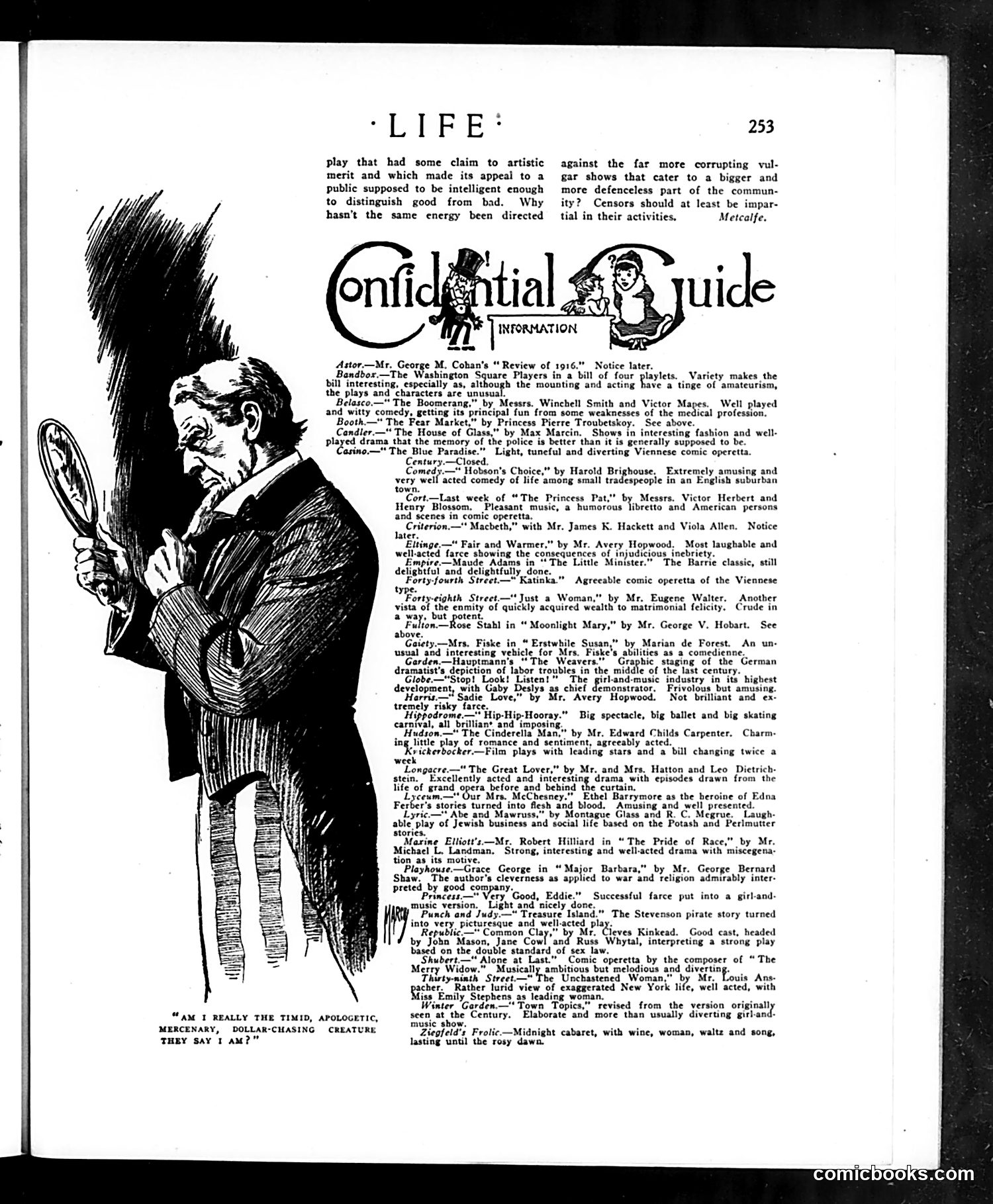
This page is primarily a theater review section titled "Confidential Guide," not a political cartoon. The illustrated figure on the left—a caricatured man in formal dress asking "Am I really the timid, apologetic, mercenary, dollar-chasing creature they say I am?"—likely represents a theatrical producer or impresario defending himself against public criticism. The bulk of the page contains brief reviews of Broadway productions from 1916, organized by theater name. Reviews reference popular entertainments: comedies, operettas, dramas, and spectacles. The commentary reveals period attitudes—praise for "well-acted" serious drama, dismissal of frivolous "girl-and-music" shows as "amusing" but shallow. The opening text criticizes censors for inconsistency: why scrutinize artistic plays while allowing vulgar mass entertainment? This frames the cartoon figure's defensive posture—theater people felt unfairly attacked while critics ignored broader problems.
📄 Transcribed text from this page (OCR, searchable)
Machine-transcribed from the original scan — historical spelling and the odd misread are preserved.
“AM I REALLY THE TIMID, APOLOGETIC, MERCENARY, DOLLAR-CMASING THEY SAY 1 aM?" “LIFE> 253 play that had some claim to artistic against the far more corrupting vul- merit and which made its appeal to a gar shows that cater to a bigger and public supposed to be intelligent enough more defenceless part of the commun- to distinguish good from bad. Why ity? Censors should at least be impar- hasn't the same energy been directed tial in their activiti Metcalfe. onfi distor —Mr, George M. Cohan’s “Review of 1916." | Notice later. _Bandbox.—The Washington Square Players in a bill of four playlets. Variety makes the bill interesting, especially as, although the mounting and acting have a tinge of amateurism, the plays and characters are unusual. Belasco—" The Boomerang,” by Messrs. Winchell Smith and Victor Mapes. Well played and witty comedy, getting its principal fun from some weaknesses of the medical profession. Booth.—" The Fear Market,” by Princess Pierre Troubetskoy. See above. Candier.— The House of Glass," by Max Marcin. Shows in interesting fashion and well- played drama that the memory of the police is better than it is generally supposed to be. ‘sino.—" The Blue Paradise.” Light, tuneful and diverting Viennese comic operetta. Century.—Closed. Hobson's Choice,” by Harold Brighouse, Extremely amusing and ted comedy of life among small tradespeople in an English suburban .—Last week of “The Princess Pat,” by Messrs. Victor Herbert and Henry Blossom. Pleasant music, a humorous Yivretto and American persons and scenes in comic operetta, Criterion.—"* Macbeth,” with Mr. James K. Hackett and Viola Allen. Notice inge.—" Fair and Warmer," by Mr. Avery Hopwood, Most laughable and well-acted farce showing the consequences of injudicious inebriety. i laude Adams in “The Little Minister.” The Barrie classic, still delightfully done. Forty-fourth Street.—* Katinka.” Agreeable comic operetta of the Viennese type. Forty-eighth Street." Just_a Woman,” by Mr. Eugene Walter. Another vista of the enmity of quickly acquired wealth to matrimonial felicity. Crude in a way, but potent. Filion jose Stahl in “ Moonlight Mary," by Mr. George V. Hobart. See above. Gaiety.—Mrs, Fiske in “ Erstwhile Susan,” by Marian de Forest. An un- usual and interesting vebicle for F abilities as a comedienne. Garden.—Hauptmann’s “The Weavers.” Graphic staging of the German dramatist’s, depiction of labor troubles in the middle of the last century. Globe-—"Stop! Look! Listen!" The girl-and-music industry in its highest development, with Gaby Deslys as chief demonstrator. Frivolous but amusing. ‘Harris.—" Sadie Love,” by Mr. Avery Hopwood. Not brilliant and ex- tremely risky farce. . Hippodrome.—" Hip-Hip-Hooray.” Big spectacle, big ballet and big skating brilliant and imposin, “The Cinderella Man,” by Mr. Edward Childs Carpenter. Charm: ing little play of romance and sentiment, agreeably acted. Ke teterbocker Film plays with leading stars and a bill changing twice a wee Longacre.—" The Great Lover,” by Mr. and Mrs, Hatton and Leo Dietrich- stein. Excellently acted and interesting drama with episodes drawn from the opera before and behind the curtain, . ur Mrs. McChesney.” Ethel Barrymore as the heroine of Edna 1's stories turned into flesh and blood. Amusing and well presented. Lyric.—* Abe and Mawruss,” by Montague Glass and R. C. Megrue. Laugh able play of Jewish business and social life based on the Potash and Perlmutter stories. Marine Eltiott's—Mr. Robert Hilliard in “The Pride of Race,” by Mr. Michael L. Landman. Strong, interesting and well-acted drama with ‘miscegena- tion as its motive. Playhouse—Grace George in “ Major, Barbara,” by Mr. George Bernard Shaw, The author's cleverness as applied to war and religion admirably inter- preted by good company, Princess—" Very Good, Eddie.” Successful farce put into a girl-and- music version. Light and nicely done. Punch and Judy.— Treasure Island.” The Stevenson pirate story turned into very. picturesque and well-acted play, Republic —" Common Clay,” by Mr. Cleves Kinkead. Good cast, headed by John Mason, Jane Cowl and Russ Whytal, interpreting a strong play based on the double standard of sex law. Shubert—" Alone at Last.” Comic operetta by the composer of “The Merry Widow." - Musically ambitious but melodious and diverting. Thirty-ninth Street—" The Unchastened Woman.” by Mr. Louis Ans- acher. Rather lurid view of exaggerated New York life, well acted, with Miss Emily Stephens as leading woman. es Winter Garden—'* Town Topics,” revised from the yersion originally seen at the Century, Elaborate and more than usually diverting girland: music show. coznruse Ziegfeld’s Frolic—Midnight cabaret, with wine, woman, waltz and song, lasting until the rosy dawn.