
Life, 1916-02-10 · page 12 of 44
Life — February 10, 1916 — page 12: what you’re looking at
What you’re looking at
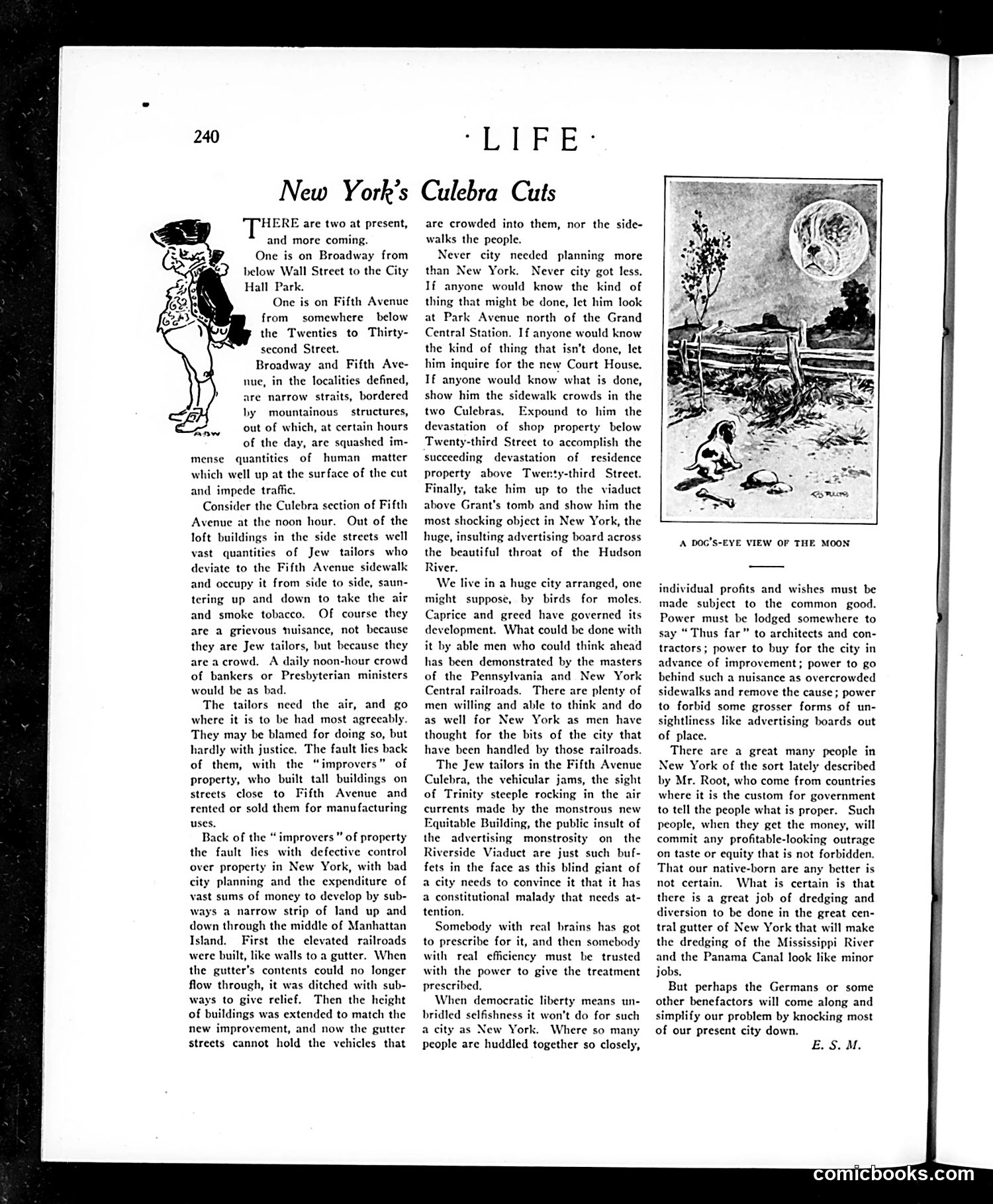
This satirical article critiques New York City's chaotic urban planning and overcrowding. The accompanying cartoon shows a figure examining the moon through a telescope—captioned "A DOG'S-EYE VIEW OF THE MOON"—likely satirizing the absurdity of looking elsewhere for solutions when New York's problems are earthbound. The article uses the Panama Canal's "Culebra Cut" as a metaphor for New York's narrow streets and building congestion. The author argues that just as the canal required bold excavation, New York needs systematic planning to address overcrowded sidewalks, inadequate street infrastructure, and excessive advertising billboards. The piece mocks politicians and property owners unwilling to make necessary changes, suggesting that only outside intervention (humorously mentioning "Germans") might force modernization—a cynical commentary on institutional paralysis in early 20th-century urban governance.
📄 Transcribed text from this page (OCR, searchable)
Machine-transcribed from the original scan — historical spelling and the odd misread are preserved.
“EPP E * New York’s Culebra Cuts ‘HERE are two at present, and more coming. One is on Broadway from below Wall Street to the City Hall Park. One is on Fifth Avenue from somewhere below the Twenties to Thirty- second Street. Broadway and Fifth Ave- nue, in the localities defined, are narrow straits, bordered by mountainous — structures, out of which, at certain hours of the day, are squashed im- mense quantities of human matter which well up at the surface of the cut and impede traffic. Consider the Culebra section of Fifth Avenue at the noon hour. Out of the loft buildings in the side streets well vast quantities of Jew tailors who deviate to the Fifth Avenue sidewalk and occupy it from side to side, saun- tering up and down to take the air and smoke tobacco. Of course they are a grievous ‘nuisance, not because they are Jew tailors, but because they are acrowd. A daily noon-hour crowd of bankers or Presbyterian ministers would be as bad. The tailors need the air, and go where s to be had most agreeably. They may be blamed for doing so, but hardly with justice. The fault lies back of them, with the “improvers” of property, who built tall buildings on streets close to Fifth Avenue and rented or sold them for manufacturing uses. Back of the “improvers” of property the fault lies with defective control over property in New York, with bad. city planning and the expenditure of vast sums of money to develop by sub- ways a narrow strip of land up and down through the middle of Manhattan Island. First the elevated railroads were built, like walls to a gutter. When the gutter’s contents could no longer flow through, it was ditched with sub- ways to give relief. Then the height of buildings was extended to match the new improvement, and now the gutter streets cannot hold the vehicles that tacrswe are crowded into them, nor the side- walks the people. Never city needed planning more than New York. Never city got less. If anyone would know the kind of thing that might be done, let him look at Park Avenue north of the Grand Central Station. If anyone would know the kind of thing that isn’t done, let him inquire for the new Court House. If anyone would know what is done, show him the sidewalk crowds in the two Culebras. Expound to him the devastation of shop property below Twenty-third Street to accomplish the succeeding devastation of residence property above Twenty-third Street. Finally, take him up to the viaduct above Grant's tomb and show him the most shocking object in New York, the huge, insulting advertising board across the beautiful throat of the Hudson River. We live in a huge city arranged, one might suppose, by birds for moles. ‘aprice and greed have governed its development. What could be done with it by able men who could think ahead has been demonstrated by the masters of the Pennsylvania and New York Central railroads. There are plenty of men willing and able to think and do as well for New York as men have thought for the bits of the city that have been handled by those railroads. The Jew tailors in the Fifth Avenue Culebra, the vehicular jams, the sight of Trinity steeple rocking in the air currents made by the monstrous new Equitable Building, the public insult of the advertising monstrosity on the Riverside Viaduct are just such buf- fets in the face as this blind giant of a city needs to convince it that it has a constitutional malady that needs at- tention. Somebody with real brains has got to prescribe for it, and then somebody with real efficiency must be trusted with the power to give the treatment prescribed. When democratic liberty means un- bridled selfishness it won't do for such a city as New York. Where so many people are huddled together so closely, ‘A DOG'S-EYE VIEW OF THE MOON individual profits and wishes must be made subject to the common good. Power must be lodged somewhere to say “ Thus far” to architects and con- tractors; power to buy for the city in advance of improvement; power to go behind such a nuisance as overcrowded sidewalks and remove the cause; power to forbid some grosser forms of un- sightliness like advertising boards out of place. There are a great many people in New York of the sort lately described by Mr. Root, who come from countries where it is the custom for government to tell the people what is proper. Such people, when they get the money, will commit any profitable-looking outrage on taste or equity that is not forbidden. That our native-born are any better is not certain. What is certain is that there is a great job of dredging and diversion to be done in the great cen- tral gutter of New York that will make the dredging of the Mississippi River and the Panama Canal look like minor jobs, But perhaps the Germans or some other benefactors will come along and simplify our problem by knocking most of our present city down. E.S.M. comicbooks.com