
Life, 1916-02-10 · page 20 of 44
Life — February 10, 1916 — page 20: what you’re looking at
What you’re looking at
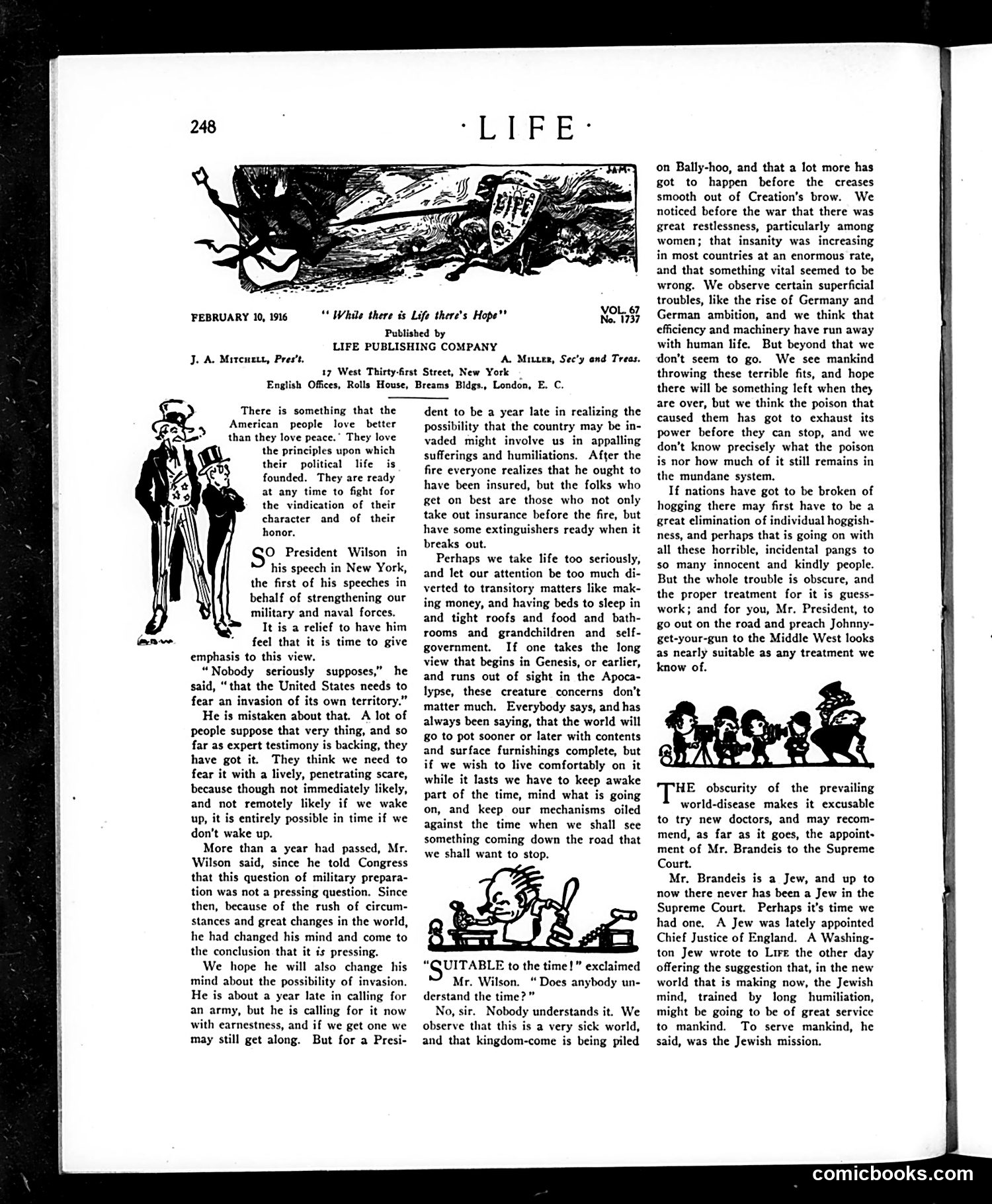
This page contains editorial commentary on President Wilson's military preparedness speeches. The central cartoon depicts Uncle Sam (identifiable by the starred top hat) looking concerned, illustrating the article's argument about national defense. The text critiques Wilson for being "a year late" in recognizing invasion risks from World War I. Though Wilson claimed Americans "need not fear invasion," the editors argue many citizens reasonably worry about vulnerability. They use an insurance metaphor: wise people buy protection *before* a fire, not after. The piece also reflects broader anxieties of 1916—German military expansion, widespread social unrest, and rising mental illness rates. The editorial advocates preparedness while mocking excessive concern about apocalyptic "creature concerns" (money, shelter, comfort). The final section discusses Brandeis's potential Supreme Court appointment, noting his would be the first Jewish justice—presented matter-of-factly as notable but appropriate. Overall, this is wartime-era advocacy for U.S. military readiness.
📄 Transcribed text from this page (OCR, searchable)
Machine-transcribed from the original scan — historical spelling and the odd misread are preserved.
FEBRUARY 10, 1916 “* While there ts Life there's Hope"* No. 1737 Published by LIFE PUBLISHING COMPANY J. A. Mircette, Pres’t, There is something that the American people love better than they love peace.” They love the principles upon which their political life is founded. They are ready at any time to fight for the vindication of their character and of their honor. O President Wilson in his speech in New York, the first of his speeches in behalf of strengthening our military and naval forces. It is a relief to have him feel that it is time to give emphasis to this view. “Nobody seriously supposes,” he said, “that the United States needs to fear an invasion of its own territory.” He is mistaken about that. A lot of people suppose that very thing, and so far as expert testimony is backing, they have got it. They think we need to fear it with a lively, penetrating scare, because though not immediately likely, and not remotely likely if we wake up, it is entirely possible in time if we don’t wake up. More than a year had passed, Mr. Wilson said, since he told Congress that this question of military prepara- tion was not a pressing question. Since then, because of the rush of circum- stances and great changes in the world, he had changed his mind and come to the conclusion that it is pressing. We hope he will also change his mind about the possibility of invasion. He is about a year late in calling for an army, but he is calling for it now with earnestness, and if we get one we may still get along. But for a Presi- A. Mutter, Sec’y ond Treas. 17 West Thirty-first Street, New York — English Offices, Rolls House, Breams Bldgs, London, E. C. dent to be a year late in realizing the possibility that the country may be in- vaded might involve us in appalling sufferings and humiliations. After the fire everyone realizes that he ought to have been insured, but the folks who get on best are those who not only take out insurance before the fire, but have some extinguishers ready when it breaks out. Perhaps we take life too seriously, and let our attention be too much di- verted to transitory matters like mak- ing money, and having beds to sleep in and tight roofs and food and bath- rooms and grandchildren and self- government. If one takes the long view that begins in Genesis, or earlier, and runs out of sight in the Apoca- lypse, these creature concerns don’t matter much. Everybody says, and has always been saying, that the world will go to pot sooner or later with contents and surface furnishings complete, but if we wish to live comfortably on it while it lasts we have to keep awake part of the time, mind what is going on, and keep our mechanisms oiled against the time when we shall see something coming down the road that we shall want to stop. ) “GUITABLE to the time!” exclaimed Mr. Wilson. “ Does anybody un- derstand the time?” No, sir. Nobody understands it. We observe that this is a very sick world, and that kingdom-come is being piled on Bally-hoo, and that a lot more has got to happen before the creases smooth out of Creation’s brow. We noticed before the war that there was great restlessness, particularly among women; that insanity was increasing in most countries at an enormous rate, and that something vital seemed to be wrong. We observe certain superficial troubles, like the rise of Germany and German ambition, and we think that efficiency and machinery have run away with human life. But beyond that we don’t seem to go. We see mankind throwing these terrible fits, and hope there will be something left when they are over, but we think the poison that caused them has got to exhaust its power before they can stop, and we don’t know precisely what the poison is nor how much of it still remains in the mundane system. If nations have got to be broken of hogging there may first have to be a great elimination of individual hoggish- ness, and perhaps that is going on with all these horrible, incidental pangs to so many innocent and kindly people. But the whole trouble is obscure, and the proper treatment for it is guess- work; and for you, Mr. President, to go out on the road and preach Johnny- get-your-gun to the Middle West looks as nearly suitable as any treatment we know of. HE obscurity of the prevailing world-disease makes it excusable to try new doctors, and may recom- mend, as far as it goes, the appoint- ment of Mr. Brandeis to the Supreme Court. Mr. Brandeis is a Jew, and up to now there never has been a Jew in the Supreme Court. Perhaps it’s time we had one. A Jew was lately appointed Chief Justice of England. A Washing- ton Jew wrote to Lire the other day offering the suggestion that, in the new world that is making now, the Jewish mind, trained by long humiliation, might be going to be of great service to mankind. To serve mankind, he said, was the Jewish mission. comicbooks.com