
Life, 1916-02-10 · page 21 of 44
Life — February 10, 1916 — page 21: what you’re looking at
What you’re looking at
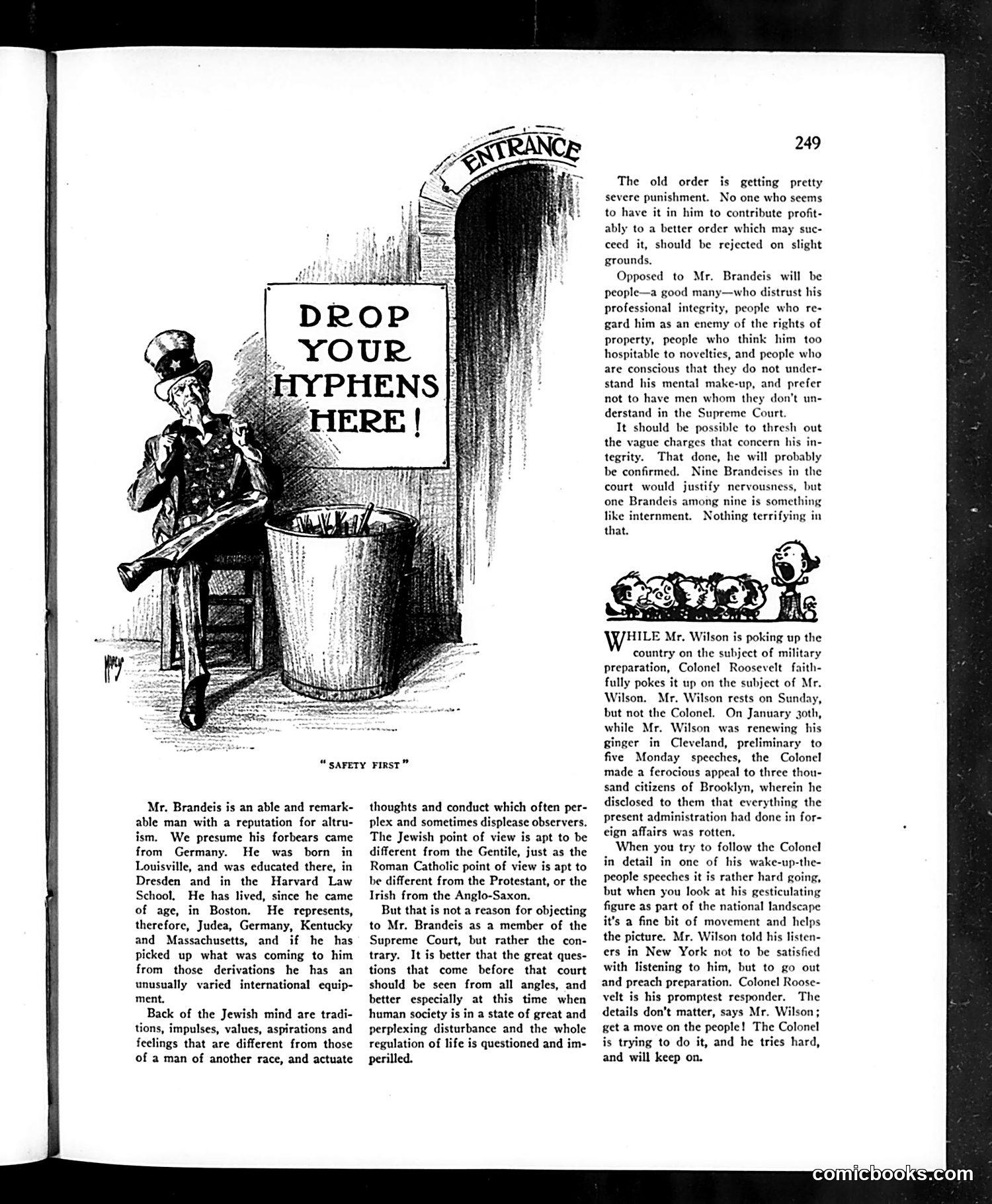
**The Cartoon ("Safety First"):** Shows a figure (likely a doorman or gatekeeper) at an entrance holding a sign "DROP YOUR HYPHENS HERE" above a large receptacle. The cartoon satirizes anxieties about immigrant loyalty and identity during a period of American nativism. **Main Content - Brandeis Confirmation Debate:** The page discusses Louis Brandeis's nomination to the Supreme Court. The text acknowledges anti-Semitic and xenophobic opposition to him—critics question his loyalty because of his Jewish heritage and German ancestry, viewing him as an outsider with divided loyalties ("hyphenated" identity). **The Magazine's Position:** Life defends Brandeis, arguing that diverse perspectives on the Court strengthen it, especially during social upheaval. The text dismisses opposition based on his religion or background as unfounded. **Secondary Content:** Brief commentary contrasts President Wilson's and Colonel Theodore Roosevelt's public activities—Wilson speaking on military preparedness while Roosevelt simultaneously criticizes the administration's foreign policy. The page reflects early 20th-century debates over assimilation, loyalty, and whether minorities could hold high office.
📄 Transcribed text from this page (OCR, searchable)
Machine-transcribed from the original scan — historical spelling and the odd misread are preserved.
“ SAFETY FIRST” Mr. Brandeis is an able and remark- able man with a reputation for altru- ism. We presume his forbears came from Germany. He was born in Louisville, and was educated there, in Dresden and in the Harvard Law School. He has lived, since he came of age, in Boston. He represents, therefore, Judea, Germany, Kentucky and Massachusetts, and if he has picked up what was coming to him from those derivations he has an unusually varied international equip- ment. Back of the Jewish mind are tradi- tions, impulses, values, aspirations and feelings that are different from those of a man of another race, and actuate thoughts and conduct which often per- plex and sometimes displease observers. The Jewish point of view is apt to be different from the Gentile, just as the Roman Catholic point of view is apt to be different from the Protestant, or the Irish from the Anglo-Saxon. But that is not a reason for objecting to Mr. Brandeis as a member of the Supreme Court, but rather the con- trary. It is better that the great ques- tions that come before that court should be seen from all angles, and better especially at this time when human society is in a state of great and perplexing disturbance and the whole regulation of life is questioned and im- perilled. 249 The old order is getting pretty severe punishment. No one who seems to have it in him to contribute profit- ably to a better order which may suc- ceed it, should be rejected on slight grounds. Opposed to Mr. Brandeis will be people—a good many—who distrust his professional integrity, people who re- gard him as an enemy of the rights of property, people who think him too hospitable to novelties, and people who are conscious that they do not under- stand his mental make-up, and prefer not to have men whom they don’t un- derstand in the Supreme Court. It should be possible to thresh out the vague charges that concern his in- tegrity. That done, he will probably be confirmed. Nine Brandcises in the court would justify nervousness, but one Brandeis among nine is something like internment. Nothing terrifying in HILE Mr. Wilson is poking up the country on the subject of military preparation, Colonel Roosevelt faith- fully pokes it up on the subject of Mr. Wilson. Mr. Wilson rests on Sunday, but not the Colonel. On January 30th, while Mr. Wilson was renewing his ginger in Cleveland, preliminary to five Monday speeches, the Colonel made a ferocious appeal to three thou- sand citizens of Brooklyn, wherein he disclosed to them that everything the present administration had done in for- eign affairs was rotten. When you try to follow the Colonel in detail in one of his wake-up-the- people speeches it is rather hard going, but when you look at his gesticulating figure as part of the national landscape it's a fine bit of movement and helps the picture. Mr. Wilson told his listen- ers in New York not to be satisfied with listening to him, but to go out and preach preparation. Colonel Roose- velt is his promptest responder. The details don’t matter, says Mr. Wilson; get a move on the people! The Colonel is trying to do it, and he tries hard, and will keep on.