
Life, 1916-02-10 · page 24 of 44
Life — February 10, 1916 — page 24: what you’re looking at
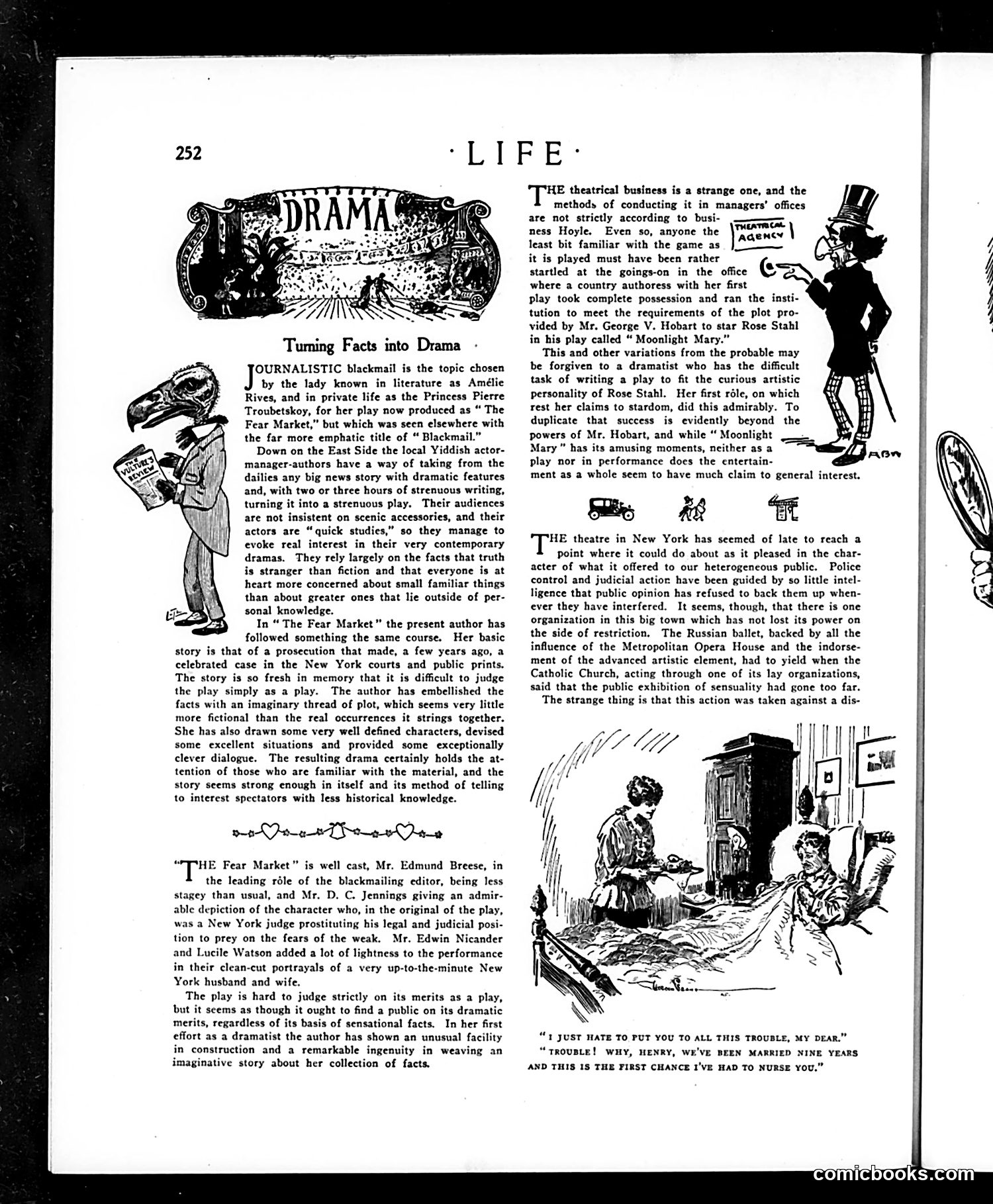
A restored page from Life, 1916-02-10. Page through the whole issue in the reader above.
📄 Transcribed text from this page (OCR, searchable)
Machine-transcribed from the original scan — historical spelling and the odd misread are preserved.
LIFE Tuming Facts into Drama OURNALISTIC blackmail is the topic chosen by the lady known in literature as Amélie Rives, and in private life as the Princess Plerre Troubetskoy, for her play now produced as “ The Fear Market,” but which was seen elsewhere. with the far more emphatic title of “ Blackmail. Down on the East Side the local Yiddish actor- manager-authors have a way of taking from the dailies any big news story with dramatic features and, with two or three hours of strenuous writing, turning it into a strenuous play. Their audiences are not insistent on scenic accessories, and their actors are “quick studies,” so they manage to evoke real interest in their very contemporary dramas. They rely largely on the facts that truth is stranger than fiction and that everyone is at heart more concerned about small familiar things than about greater ones that lie outside of per- sonal knowledge. In “ The Fear Market” the present author has followed something the same course. Her basic story is that of a prosecution that made, a few years ago, a celebrated case in the New York courts and public prints. The story is so fresh in memory that it is difficult to judge the play simply as a play. The author has embellished the facts with an imaginary thread of plot, which seems very little more fictional than the real occurrences it strings together. She has also drawn some very well defined characters, devised some excellent situations and provided some exceptionally clever dialogue. The resulting drama certainly holds the at- tention of those who are familiar with the material, and the story seems strong enough in itself and its method of telling to interest spectators with less historical knowledge. woe Tee ae HE Fear Market” is well cast, Mr. Edmund Breese, in the leading réle of the blackmailing editor, being less stagey than usual, and Mr. D. C. Jennings giving an admir- able depiction of the character who, in the original of the play, was a New York judge prostituting his legal and judicial posi- tion to prey on the fears of the weak. Mr. Edwin Nicander and Lucile Watson added a lot of lightness to the performance in their clean-cut portrayals of a very up-to-the-minute New York husband and wife. The play is hard to judge strictly on its merits as a play, but it seems as though it ought to find a public on its dramatic merits, regardless of its basis of sensational facts, In her first effort as a dramatist the author has shown an unusual facility in construction and a remarkable ingenuity in weaving an imaginative story about her collection of facts, E theatrical business is a strange one, and the methods of conducting it in managers’ offices are not strictly according to busi- SrERTRCAL ATR ness Hoyle, Even so, anyone the nae Ncw least bit familiar with the game as — it is played must have been rather startled at the goings-on in the office CaN where a country authoress with her first play took complete possession and ran the insti- tution to meet the requirements of the plot pro- vided by Mr. George V. Hobart to star Rose Stahl in his play called “ Moonlight Mary.” This and other variations from the probable may be forgiven to a dramatist who has the difficult task of writing a play to fit the curious artistic personality of Rose Stahl. Her first réle, on which rest her claims to stardom, did this admirably. To duplicate that success is evidently beyond the powers of Mr. Hobart, and while “ Moonlight ___. Mary” has its amusing moments, neither as a play nor in performance does the entertain- ment as a whole seem to have much claim to general interest. Sis eR HE theatre in New York has seemed of late to reach a point where it could do about as it pleased in the char- acter of what it offered to our heterogeneous public. Police control and judicial action have been guided by so little intel- ligence that public opinion has refused to back them up when- ever they have interfered. It seems, though, that there is one organization in this big town which has not lost its power on the side of restriction, The Russian ballet, backed by all the influence of the Metropolitan Opera House and the indorse- ment of the advanced artistic element, had to yield when the Catholic Church, acting through one of its lay organizations, said that the public exhibition of sensuality had gone too far. The strange thing is that this action was taken against a dis- “(1 JUST MATE TO PUT YOU TO ALL THIS TROUBLE, MY DEAR.” “TROUBLE! WHY, HENRY, WE'VE BEEN MARRIED NINE YEARS AND THIS IS THE FIRST CHANCE I'VE HAD TO NURSE YOU.”