
Life, 1916-02-10 · page 32 of 44
Life — February 10, 1916 — page 32: what you’re looking at
What you’re looking at
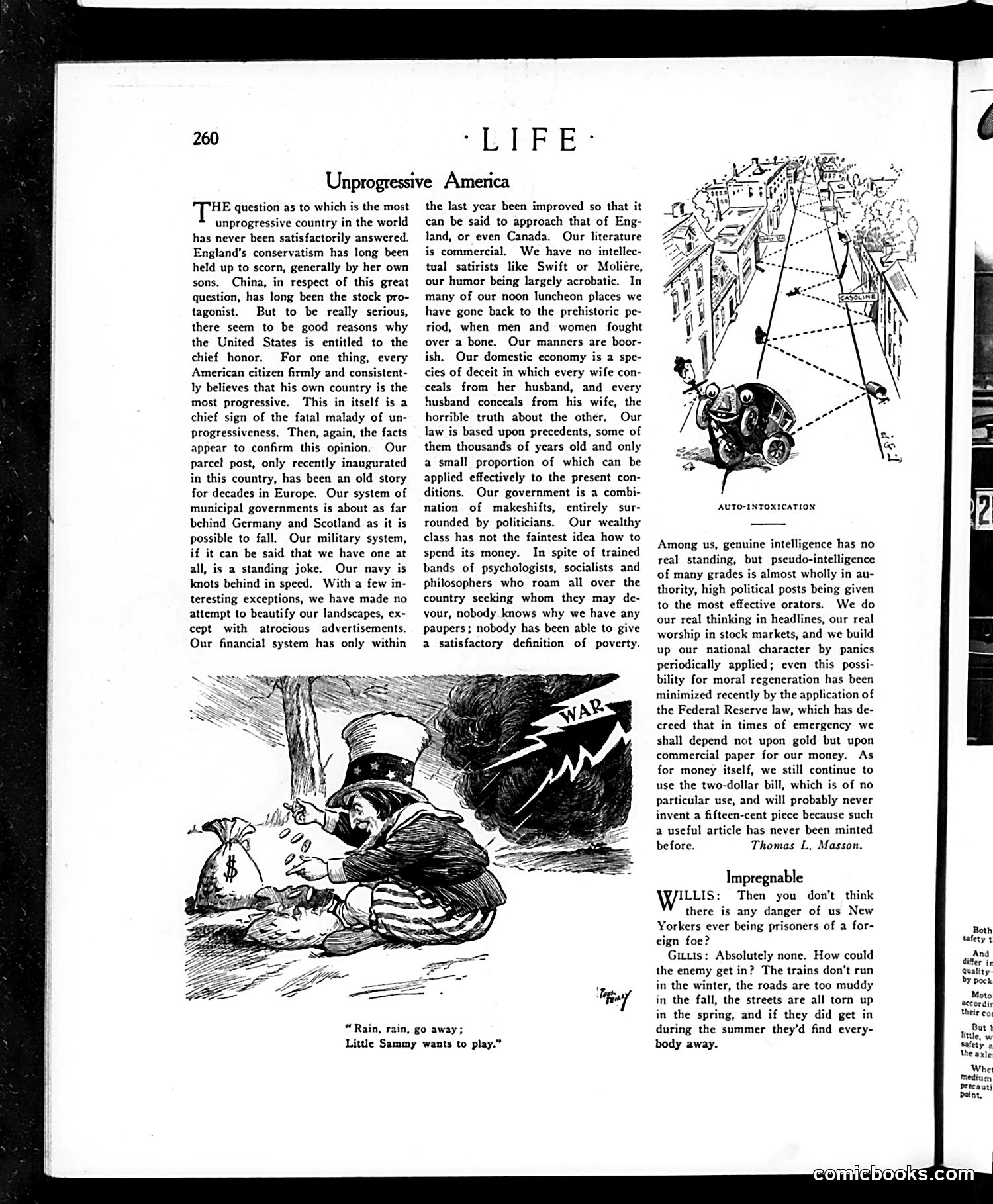
This page satirizes American complacency and backwardness disguised as progress. The main essay "Unprogressive America" by Thomas L. Masson attacks American self-delusion: citizens believe their country is most progressive while evidence suggests otherwise. Masson catalogs American failures—outdated postal systems, primitive municipal governance, chaotic military and navy, tasteless landscapes cluttered with advertisements, and domestic dishonesty. The two cartoons reinforce this critique. The top illustration labeled "AUTO-INTOXICATION" shows a figure intoxicated or poisoned by America itself, visually representing how national self-deception becomes toxic. The bottom cartoon depicts Uncle Sam (identifiable by his hat and patriotic symbolism) defeated or collapsed, with the caption "Rain, rain, go away; Little Sammy wants to play"—mocking American childishness. The brief dialogue "Impregnable" jokes that New York City is unconquerable not through strength but through incompetence: trains, roads, and infrastructure are so dysfunctional that invaders couldn't navigate the city.
📄 Transcribed text from this page (OCR, searchable)
Machine-transcribed from the original scan — historical spelling and the odd misread are preserved.
“E PPFE ¢ Unprogressive America THE question as to which is the most unprogressive country in the world has never been satisfactorily answered. England's conservatism has long been held up to scorn, generally by her own sons. China, in respect of this great question, has long been the stock pro- tagonist. But to be really serious, there seem to be good reasons why the United States is entitled to the chief honor. For one thing, every American citizen firmly and consistent- ly believes that his own country is the most progressive. This in itself is a chief sign of the fatal malady of un- progressiveness, Then, again, the facts appear to confirm this opinion. Our parcel post, only recently inaugurated in this country, has been an old story for decades in Europe. Our system of municipal governments is about as far behind Germany and Scotland as it is possible to fall. Our military system, if it can be said that we have one at all, is a standing joke. Our navy is knots behind in speed. With a few in- teresting exceptions, we have made no attempt to beautify our landscapes, ex- cept with atrocious advertisements. Our financial system has only within the last ycar been improved so that it can be said to approach that of Eng- land, or even Canada. Our literature is commercial. We have no intellec- tual satirists like Swift or Moliére, our humor being largely acrobatic. In many of our noon luncheon places we have gone back to the prehistoric pe- riod, when men and women fought over a bone. Our manners are boor- ish, Our domestic economy is a spe- cies of deceit in which every wife con- ceals from her husband, and every husband conceals from his wife, the horrible truth about the other. Our law is based upon precedents, some of them thousands of years old and only a small proportion of which can be applied effectively to the present con- ditions. Our government is a combi- nation of makeshifts, entirely sur- rounded by politicians, Our wealthy class has not the faintest idea how to spend its money. In spite of trained bands of psychologists, socialists and philosophers who roam all over the country secking whom they may de- your, nobody knows why we have any paupers; nobody has been able to give a satisfactory definition of poverty. “Rain, rain, go away; Little Sammy wants to play.” AUTO-INTOXICATION Among us, genuine intelligence has no real standing, but pseudo-intelligence of many grades is almost wholly in au- thority, high political posts being given to the most effective orators. We do our real thinking in headlines, our real worship in stock markets, and we build up our national character by panics periodically applied; even this possi- bility for moral regeneration has been minimized recently by the application of the Federal Reserve law, which has de- creed that in times of emergency we shall depend not upon gold but upon commercial paper for our money. As for money itself, we still continue to use the two-dollar bill, which is of no particular use, and will probably never invent a fifteen-cent piece because such a useful article has never been minted before. Thomas L, Masson. Impregnable ILLIS: Then you don’t think there is any danger of us New Yorkers ever being prisoners of a for- eign foe? Guus: Absolutely none. How could the enemy get in? The trains don’t run in the winter, the roads are too muddy in the fall, the streets are all torn up in the spring, and if they did get in during the summer they'd find every- body away. in guality. by pock Moto acer dis their coy But t little, w safety a the axle Whei mediun otnt,