
A complete issue · 44 pages · 1915
Life — December 16, 1915
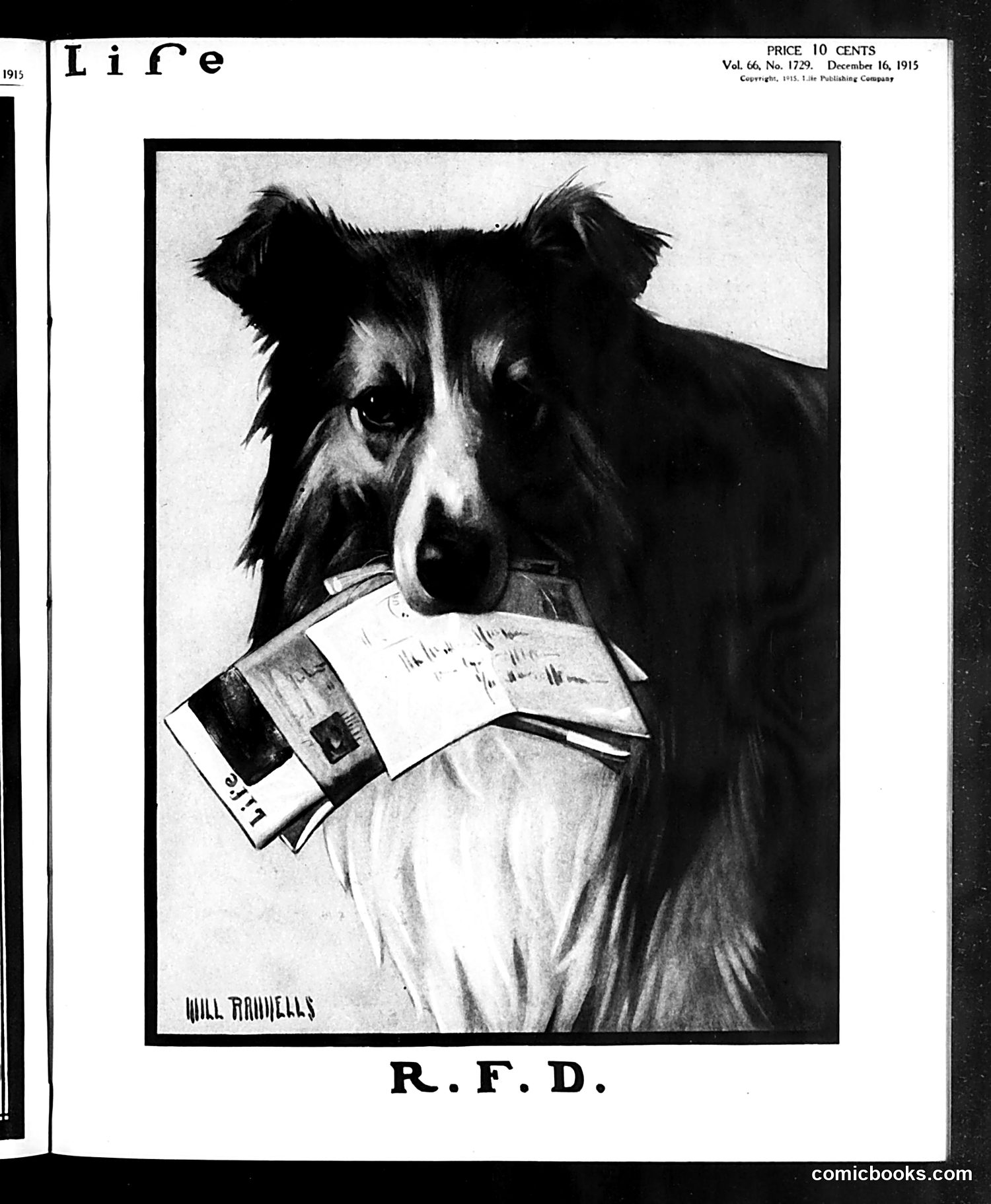
This cartoon by Will Ranwell depicts a dog wearing what appears to be a mail pouch or delivery bag labeled "R.F.D." (Rural Free Delivery). The dog's serious expression and formal presentation suggest satirical commentary on the U.S. Postal Service's Rural Free Delivery program. R.F.D., established in 1896, extended mail service to rural areas previously underserved by the post office. The cartoon likely mocks either the reliability of rural mail delivery, the somewhat absurdist notion of using dogs as actual mail carriers, or possibly criticizes the postal service's efficiency. The dog's dignified pose with the mail pouch creates humorous contrast—treating the canine as a serious postal worker or commenting on who actually handled mail delivery in remote areas.
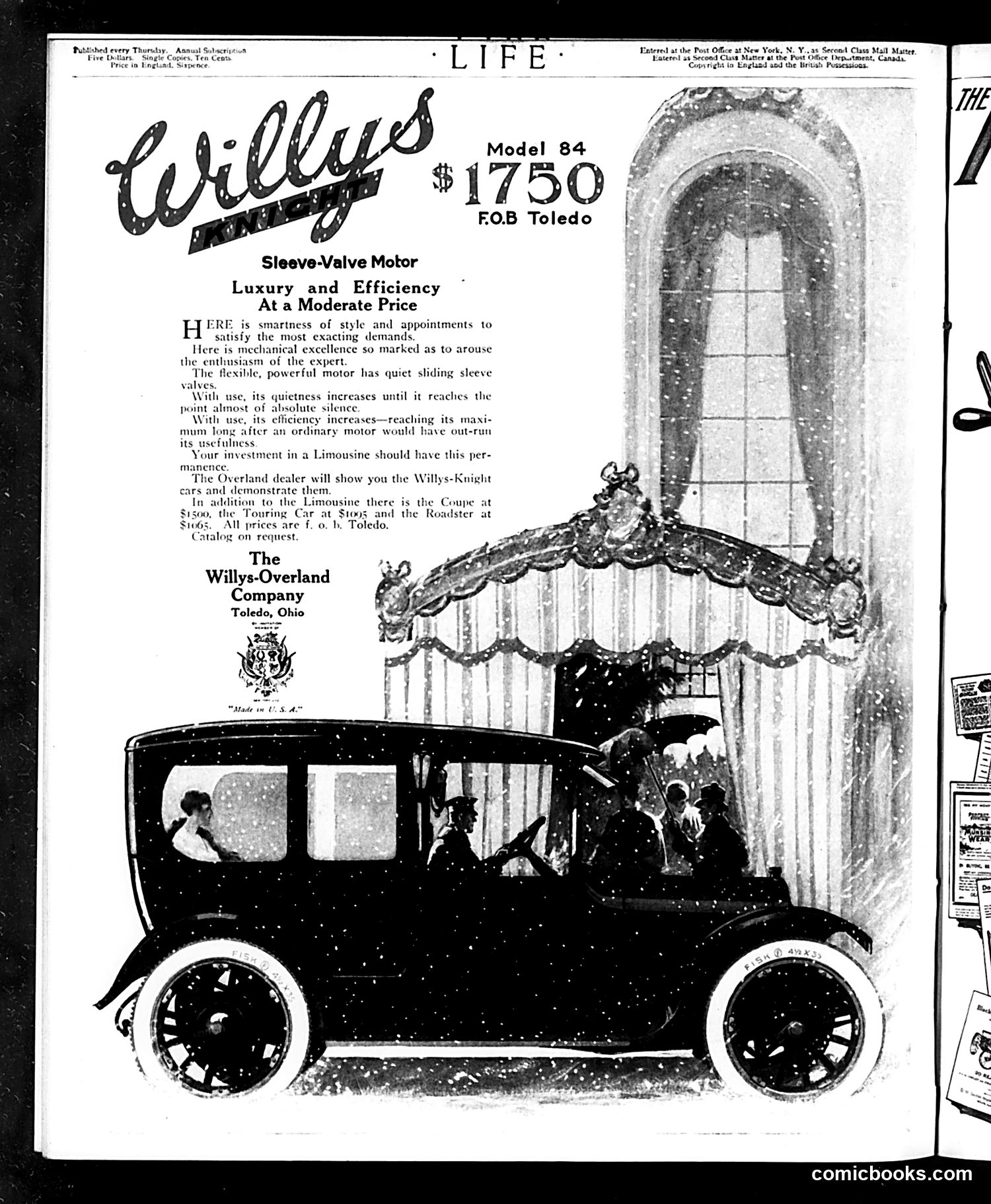
This is primarily **advertising, not political satire**. The page is a full-page advertisement for the Willys-Overland Company, promoting their Model 84 automobile at $1,750 F.O.B. Toledo, Ohio. The ad emphasizes the car's "Sleeve-Valve Motor" featuring "Luxury and Efficiency At a Moderate Price." The illustration shows a well-dressed couple in the vehicle, positioned in front of an ornate archway—suggesting the car represents middle-class aspirational luxury. The copy highlights the motor's quietness and efficiency, claiming it improves with use and reaches "almost absolute silence." This is a straightforward product pitch aimed at prosperous consumers, with no political commentary or satire evident. The elegant illustration style was typical of early 1910s automotive advertising.
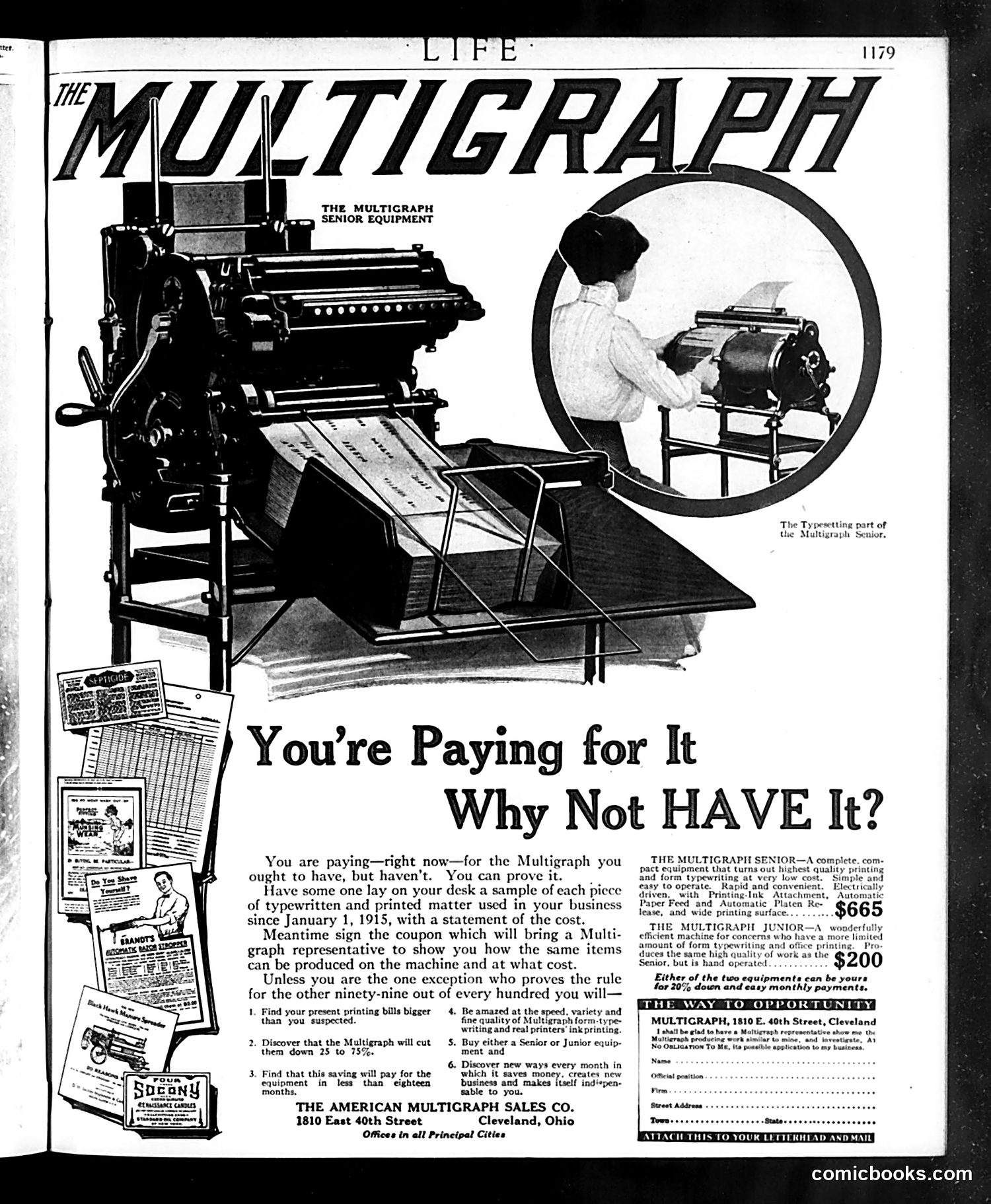
This page is **primarily an advertisement**, not satire or political commentary. It promotes the Multigraph, an early printing and copying machine manufactured by the American Multigraph Sales Co. of Cleveland, Ohio. The ad uses a sales-pitch strategy rather than humor or satire: it presents the machine's capabilities through photographs and testimonials, then argues that businesses are already paying for printing costs, so they should invest in a Multigraph ($665 for the Senior model, $200 for the Junior) to control those expenses in-house. The "You're Paying for It—Why Not HAVE It?" headline employs persuasive framing common to period business advertising. No political figures or satirical commentary are present; this is straightforward commercial promotion targeting business owners.
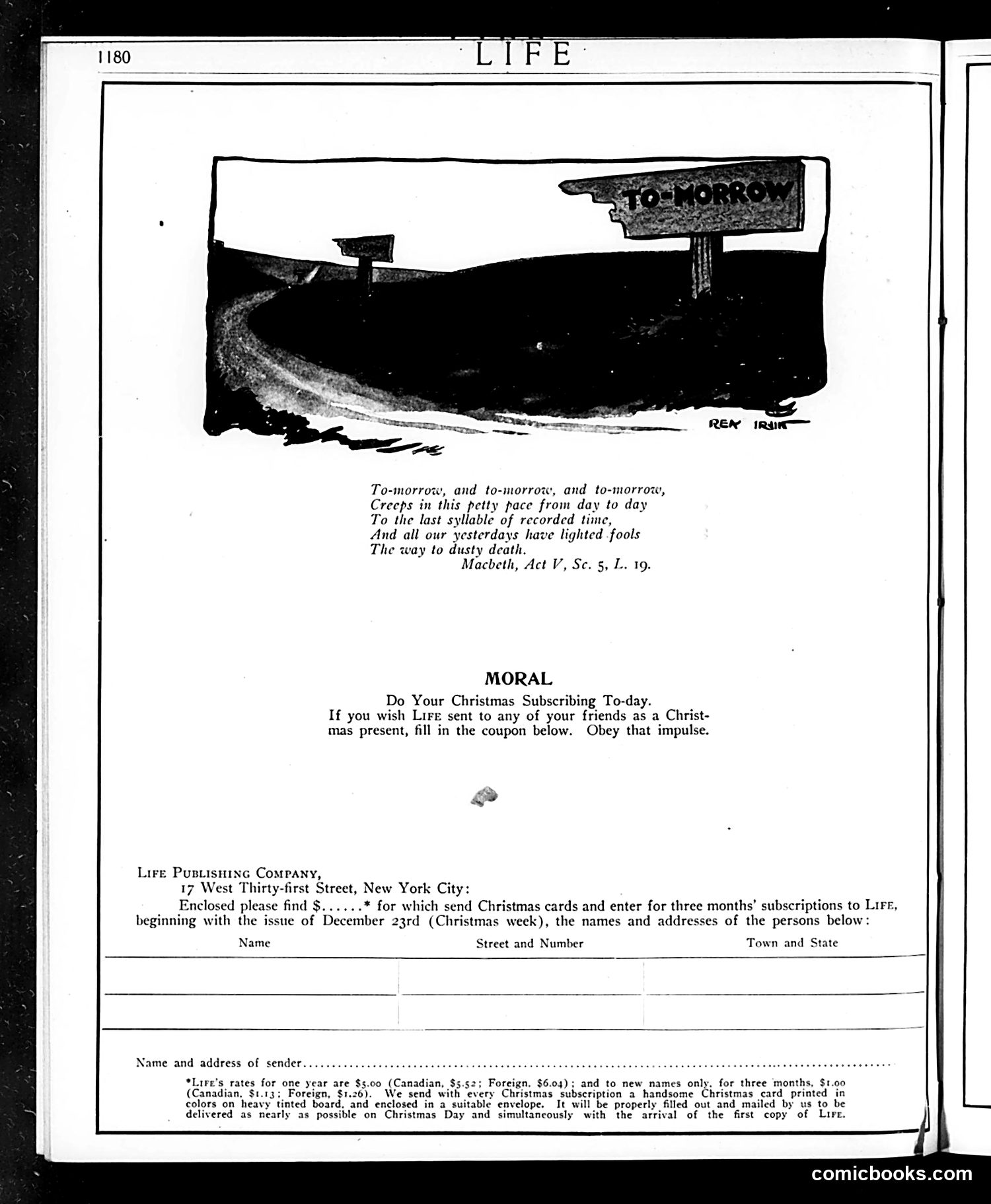
This page is primarily a **Christmas subscription advertisement** for Life magazine, not a political cartoon. The illustration shows a signpost reading "TO-MORROW" in a dark, barren landscape, accompanied by a quote from Macbeth about time creeping toward death. The visual metaphor suggests life's relentless forward march toward mortality. The "moral" below urges readers to give Life magazine subscriptions as Christmas gifts, framing it as an impulse to obey. The advertisement offers three-month subscriptions beginning December 23rd (Christmas week). Subscription rates are listed at bottom: domestic ($1.00 yearly) and foreign rates vary. This is essentially a merchandising pitch using existential imagery—the approach of "tomorrow" and death—to encourage holiday gift-giving.
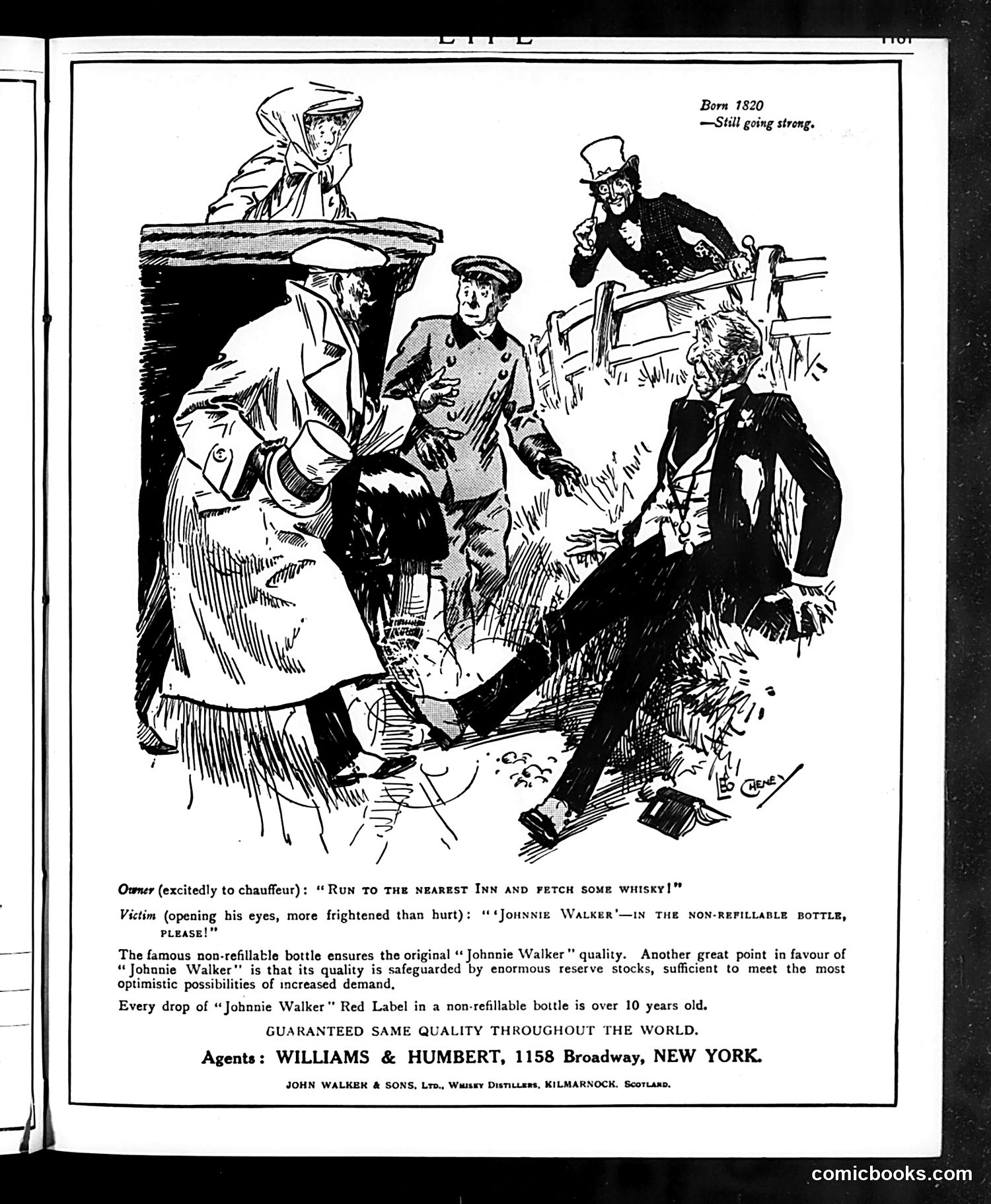
This is primarily a **Johnnie Walker whisky advertisement** disguised as satirical comic content. The illustration depicts a coach accident scenario where an injured victim requests "Johnnie Walker—in the non-refillable bottle, please!" as emergency treatment. The satire plays on the whisky's reputation as a remedy for shock and injury—a common trope in early 20th-century advertising. The "Born 1820—Still going strong" caption references the brand's longevity and consistency. The advertisement emphasizes the non-refillable bottle's guarantee of authenticity and quality, addressing concerns about counterfeiting. The agents listed (Williams & Humbert) distributed the Scottish whisky in New York. This blends humor with product promotion in a manner typical of 1920s-era Life magazine advertising.
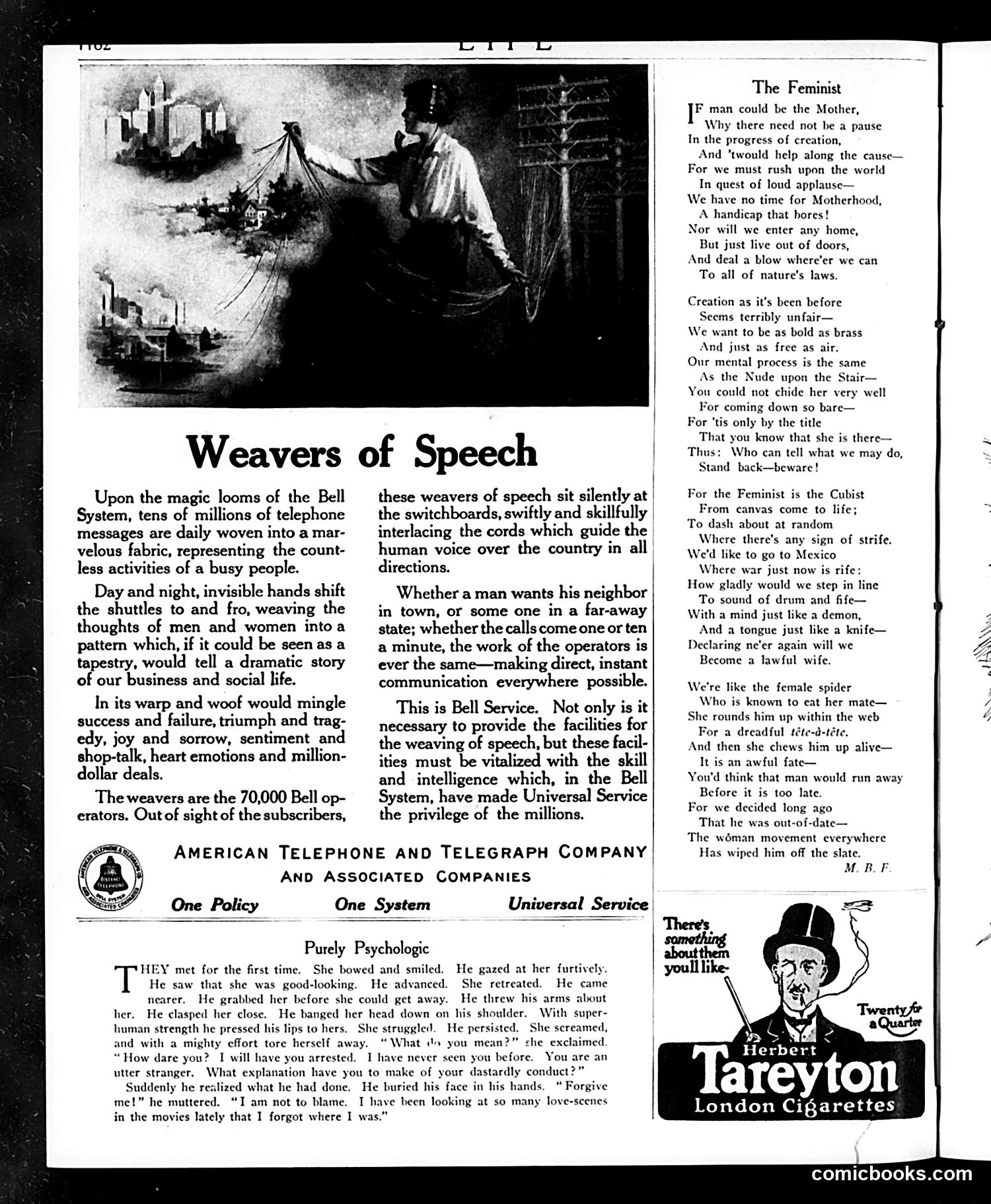
This Life magazine page contains **two distinct pieces**: **Left side:** A Bell Telephone System advertisement celebrating female telephone operators ("weavers of speech") who manually connected calls on switchboards. The ad romanticizes their invisible labor connecting millions of messages daily, framing it as essential "Universal Service." **Right side:** A poem titled "The Feminist" **satirizing** the women's movement. The verse mocks feminists for rejecting motherhood and domesticity in pursuit of public ambitions, comparing them unfavorably to spiders and warning that the "woman movement" has made men obsolete. The satirist (M.B.F.) presents this as cautionary social commentary. The juxtaposition is notable: the ad celebrates women workers as heroines of commerce, while the poem attacks women seeking equality. This reflects early 20th-century ambivalence toward female independence—acceptable within corporate structures, but threatening when women claimed broader autonomy.
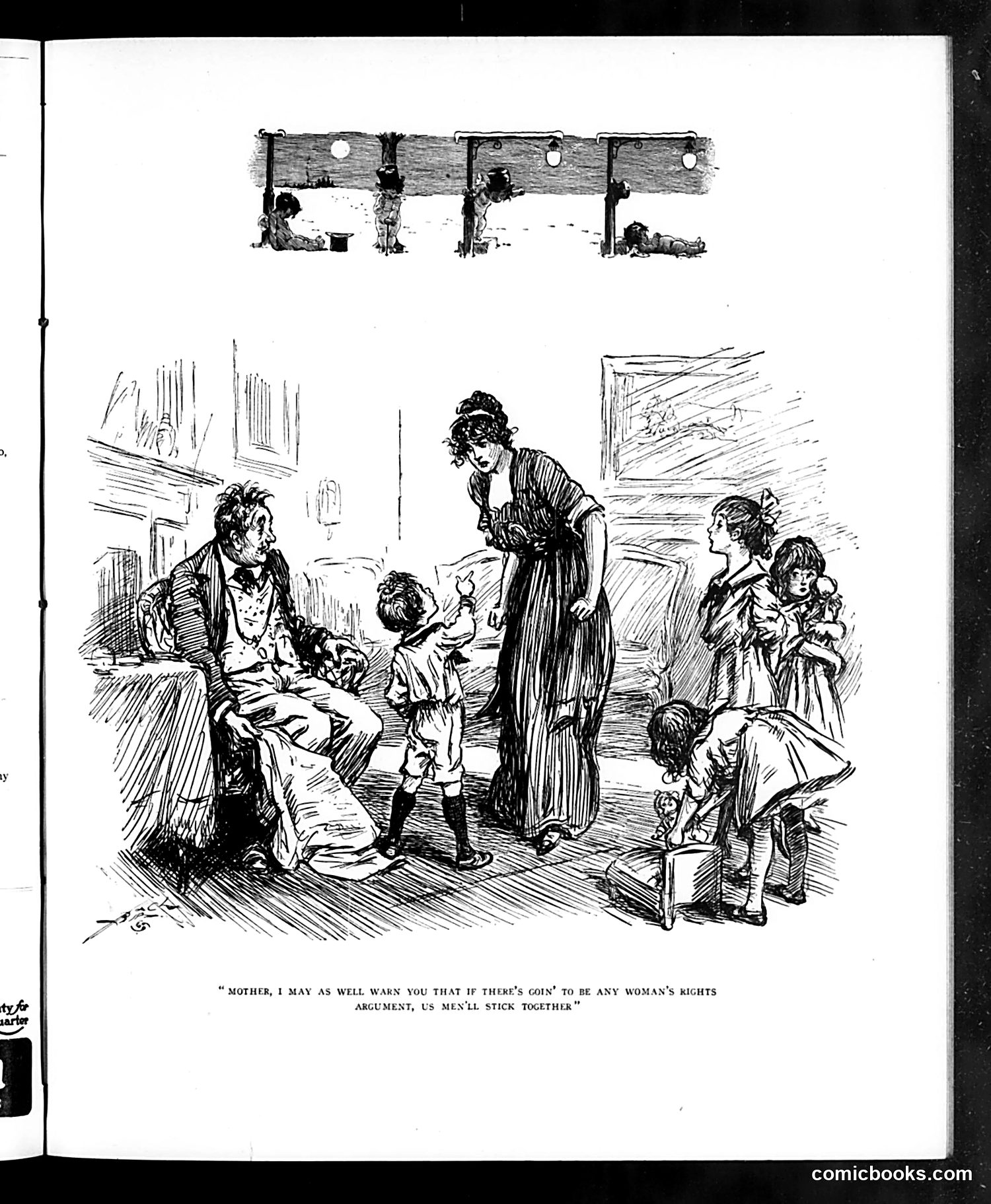
This cartoon satirizes opposition to women's rights, likely from the early 20th century suffrage era. The scene shows a mother addressing her children in a domestic interior. The caption reads: "Mother, I may as well warn you that if there's goin' to be any woman's rights argument, us men'll stick together." The satire mocks male solidarity against women's equality. By having a young boy declare that men will unite against women's rights arguments, the cartoonist ridicules how men band together to resist women's advancement—framing this male coalition as defensive and somewhat petulant, comparable to schoolyard loyalty rather than reasoned debate. The illustration appears designed to undermine the anti-suffrage male perspective by making it look childish and exclusionary.
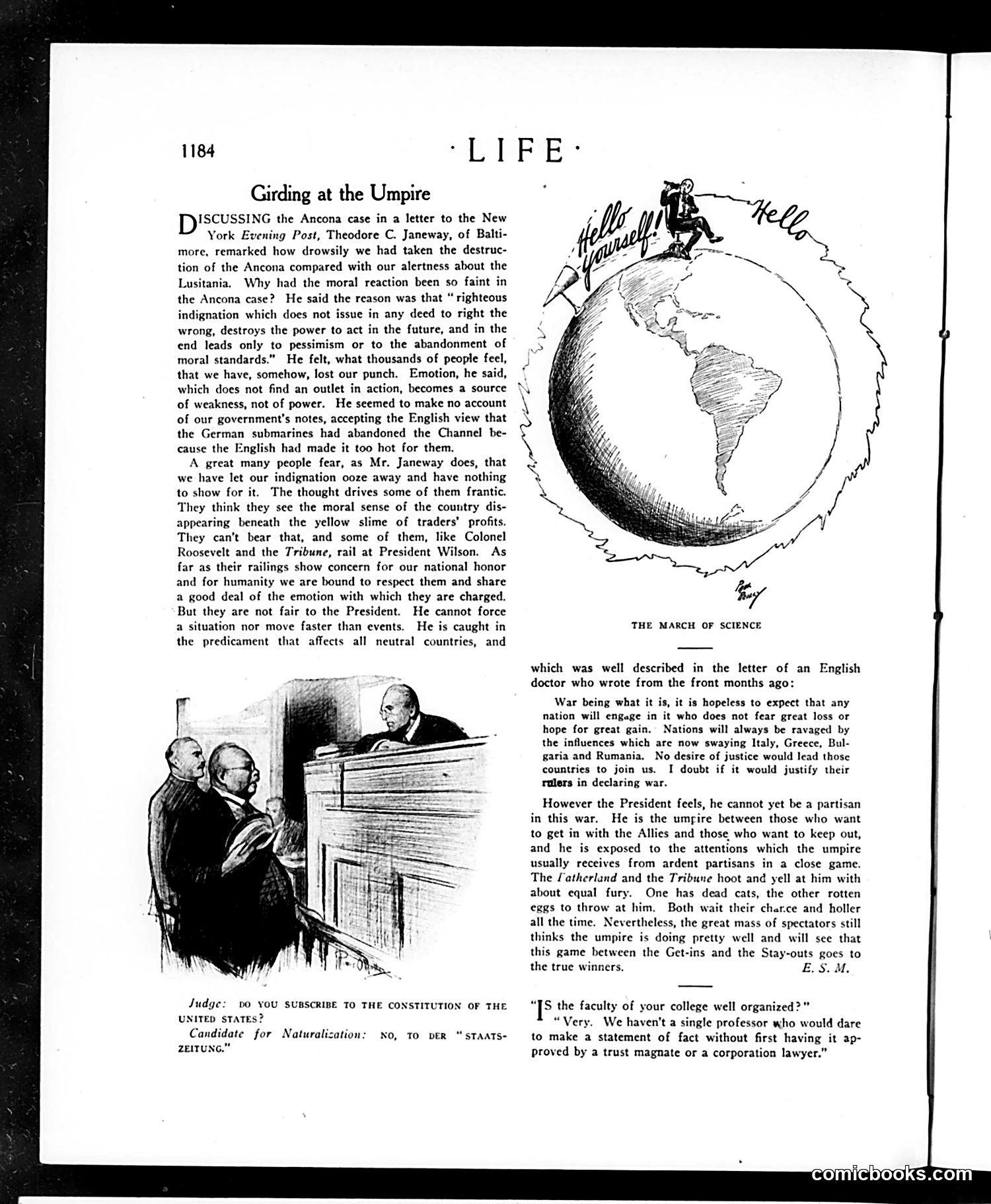
This page critiques American neutrality during World War I. The main article, referencing the *Ancona* sinking and *Lusitania* disaster, discusses why Americans have restrained their moral outrage despite German submarine attacks. The lower cartoon shows a judge questioning a naturalization candidate about subscribing to the U.S. Constitution. The candidate (labeled as from "Der Staatszeitung," a German-American newspaper) answers "No," satirizing German-American resistance to full American civic participation during wartime tensions. "The March of Science" illustration (globe with "Hello" greeting) appears unrelated to the political content. The satire targets perceived German-American disloyalty and questions whether such immigrants could genuinely commit to American constitutional principles during the war.
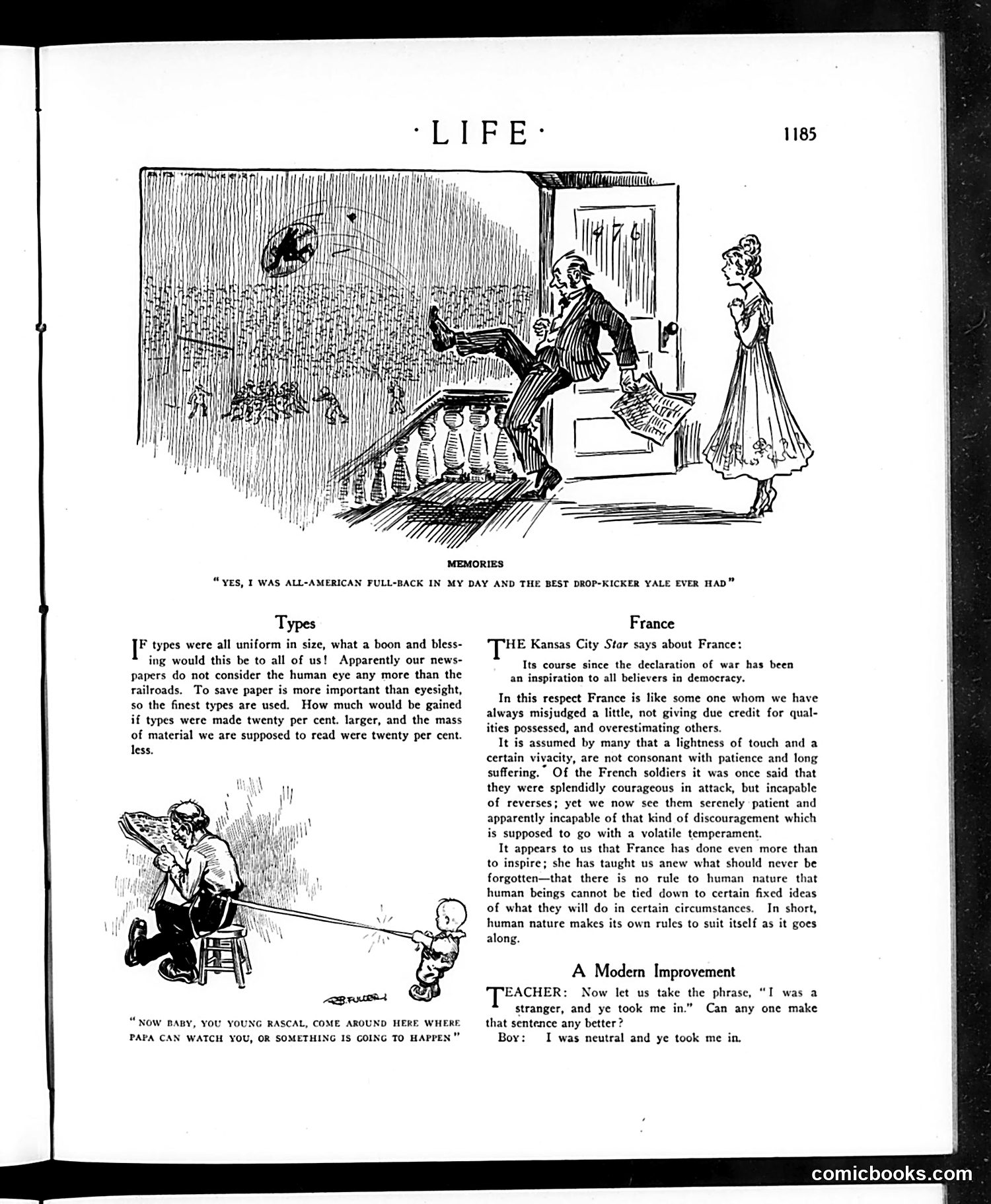
**Top Cartoon ("Memories"):** A man reclines in an armchair, apparently daydreaming or reminiscing. He's boasting about being "an all-American full-back" and "the best drop-kicker Yale ever had"—likely satirizing men who nostalgically exaggerate their athletic glory days. **"Types" Section:** Critiques newspapers' disregard for readability. The text argues that if all typefaces were uniform and larger, papers would be more legible, yet publishers prioritize saving paper costs over reader comfort. **"France" Section:** Commentary on France's national character, praising French courage while suggesting the French are emotionally volatile and unpredictable—capable of both heroism and sudden reversals. **Bottom Cartoon:** A father warns his mischievous child to behave, suggesting parental supervision prevents trouble.
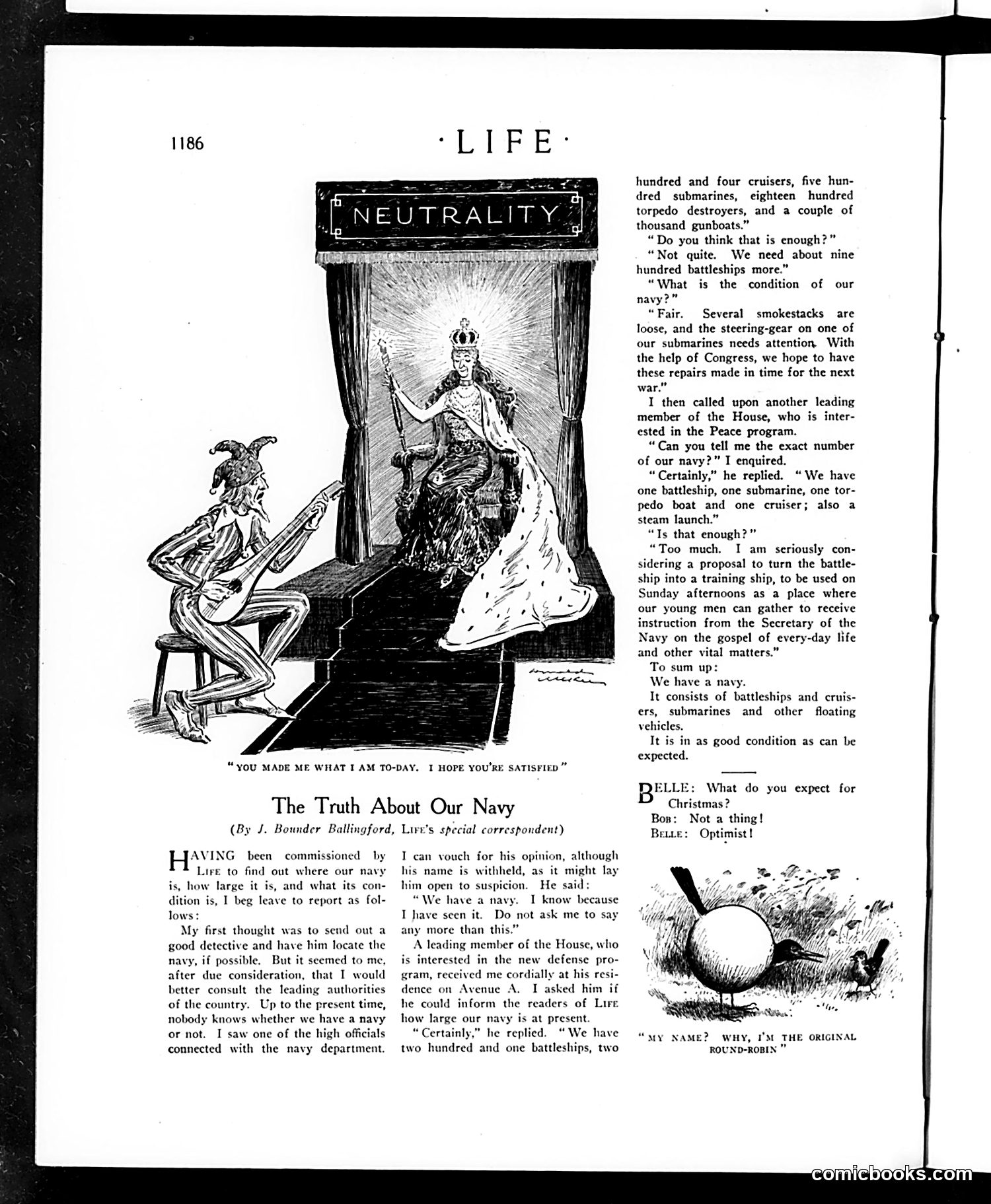
This satirical piece by J. Hounder Baltimorford examines claims about American naval strength during what appears to be a peace/disarmament period. The main cartoon shows **Lady Liberty/Britannia seated on a throne labeled "Neutrality,"** while a jester figure below her gestures dismissively—likely representing political figures or public opinion minimizing military preparedness. The accompanying article humorously documents conversations with government officials about actual naval capacity. Officials claim the navy consists of "two hundred and one battleships, two hundred and four cruisers, five hundred submarines"—figures that seem exaggerated or fictional. The satire mocks both the vagueness of official statements and public complacency about military readiness. The smaller cartoon jokes: "My name? Why, I'm the original round-robin!"
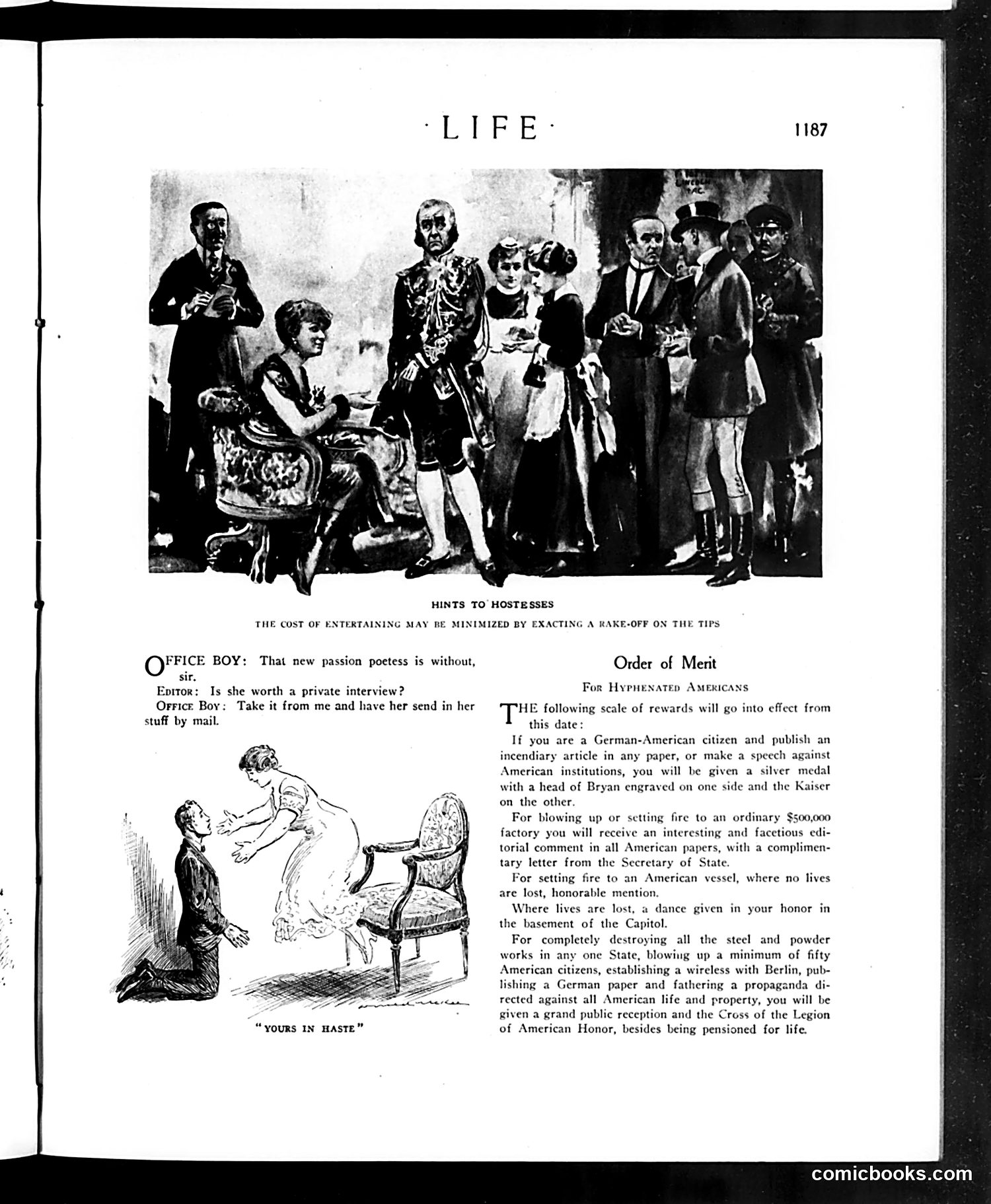
This page contains **anti-German propaganda** from World War I. The top illustration ("Hints to Hostesses") satirizes the expense of entertaining during wartime. The "Order of Merit for Hyphenated Americans" is savage political satire mocking German-Americans. It sarcastically "rewards" acts of sabotage and treason—blowing up factories, destroying American vessels, and publishing anti-American propaganda—with medals featuring Bryan and the Kaiser. The cartoon titled "Yours in Haste" (bottom) depicts a woman urgently demanding a man's attention, likely referencing wartime anxiety or romantic/social pressure. **Context**: This reflects American hostility toward German-Americans during WWI, when they faced suspicion of disloyalty. The term "hyphenated Americans" referred derisively to immigrants retaining ethnic identity.
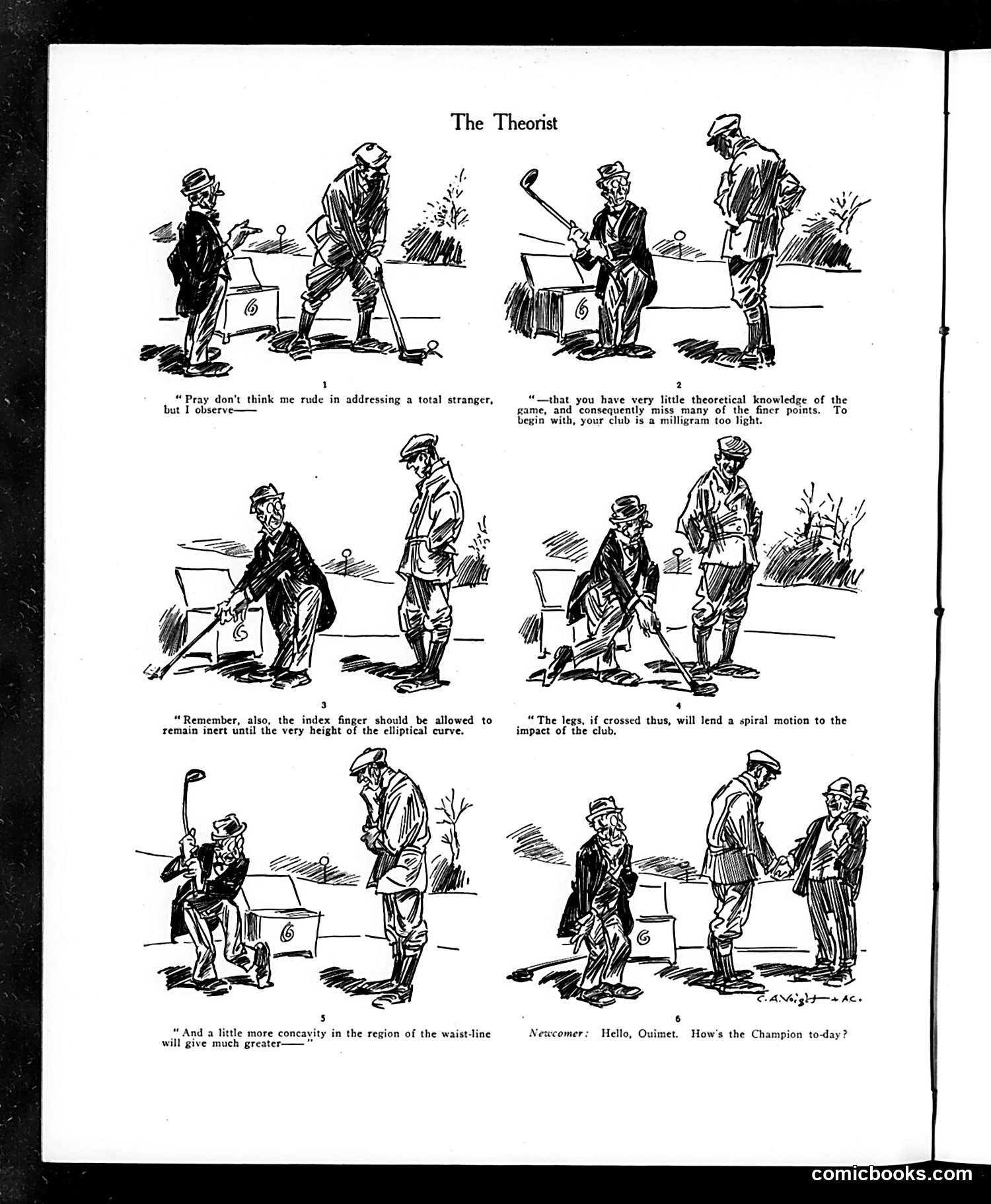
This is a humorous six-panel comic about golf instruction. A "theorist" (an overly intellectual instructor) lectures a student golfer on technical details while demonstrating poor actual performance. The satire mocks experts who rely on abstract theory rather than practical skill. Panel 2 establishes the joke: the theorist claims the student has "very little theoretical knowledge" and needs to understand "finer points," yet panel 6 reveals the theorist himself is apparently not a champion golfer. The comic ridicules the gap between theoretical expertise and actual competence—a common target of satire. The theorist pontificates about grip, finger positioning, leg motion, and waist mechanics while apparently being a mediocre player himself, embodying the contradiction of teaching what one cannot do well.
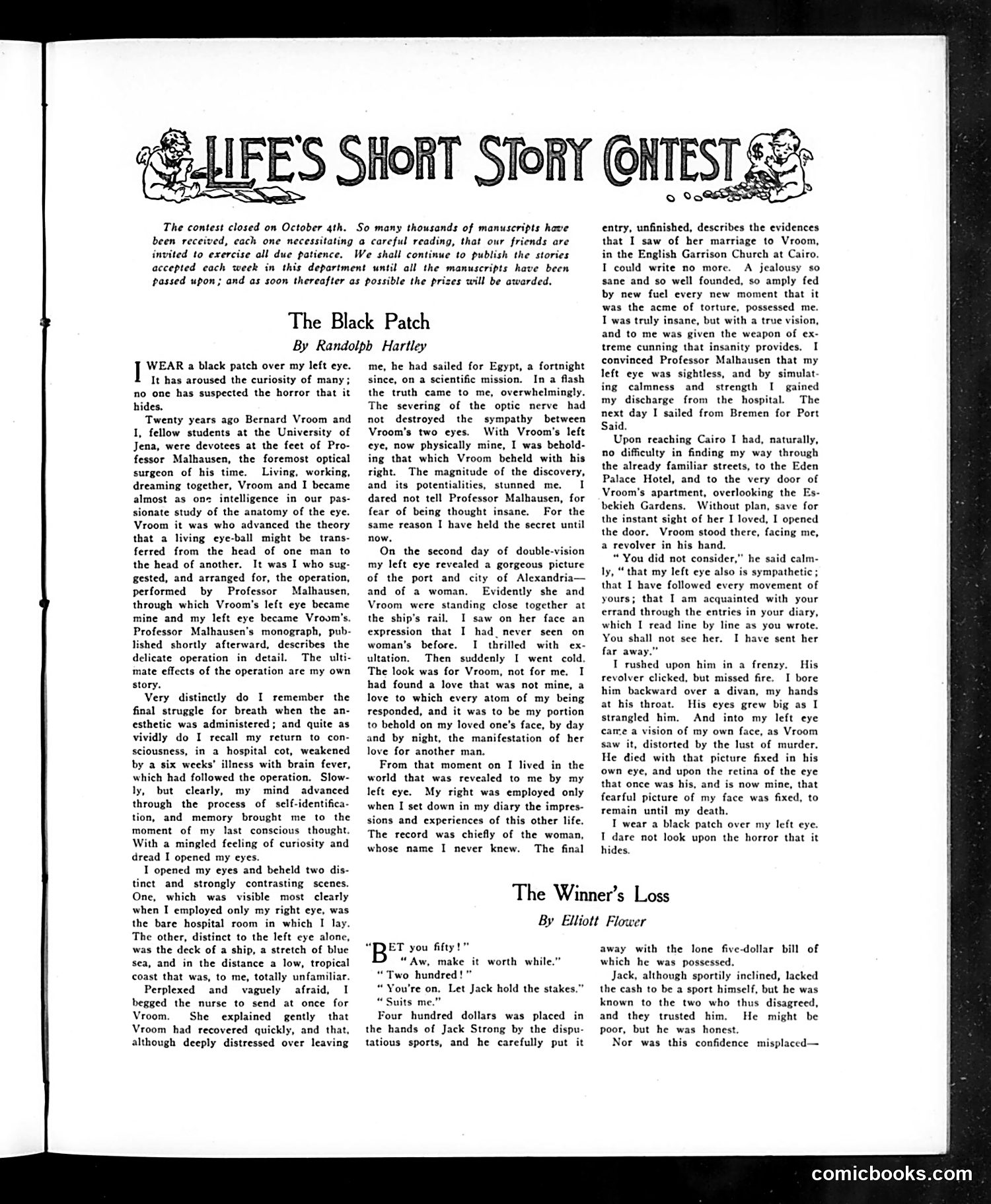
This page presents the results of Life magazine's short story writing contest, which closed October 4th. The page contains two complete short stories: 1. **"The Black Patch"** by Randolph Hartley — a narrative about a man who lost his left eye in a medical operation performed by Professor Malhausen. The story involves strange visions of Egyptian scenes and a woman, creating psychological horror around the protagonist's obsession with these images. 2. **"The Winner's Loss"** by Elliott Flower — a brief tale about Jack Strong, an honest man entrusted with $400 in gambling stakes by two disputatious sports figures. These appear to be genuine literary submissions rather than satirical content. The page serves as a literary showcase for Life's readership.
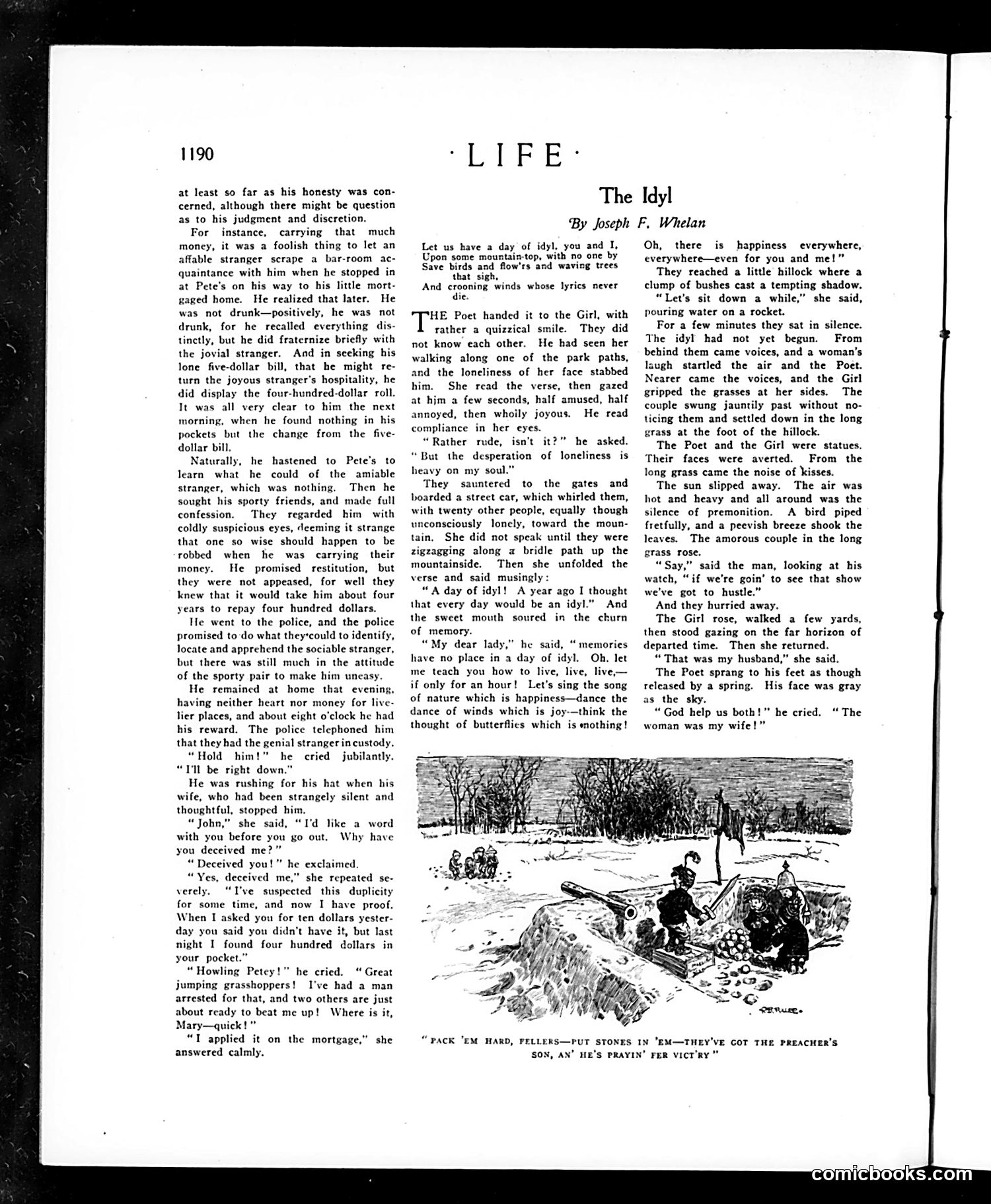
This is a short story, not a political cartoon. The narrative describes a poet and a girl meeting on a mountain, sharing romantic verses about escaping to an idyllic day free from worldly concerns. The couple later returns to ordinary life where the man discovers he's been robbed of four hundred dollars—money he'd apparently left in his pocket during their romantic interlude. The illustration shows them in a pastoral landscape. The story's satire targets the contrast between romantic idealism and harsh reality: the couple's poetic escape into nature and love is undercut by practical, mundane consequences. The irony suggests that romantic notions, however beautiful, cannot protect one from life's actual hardships and losses.
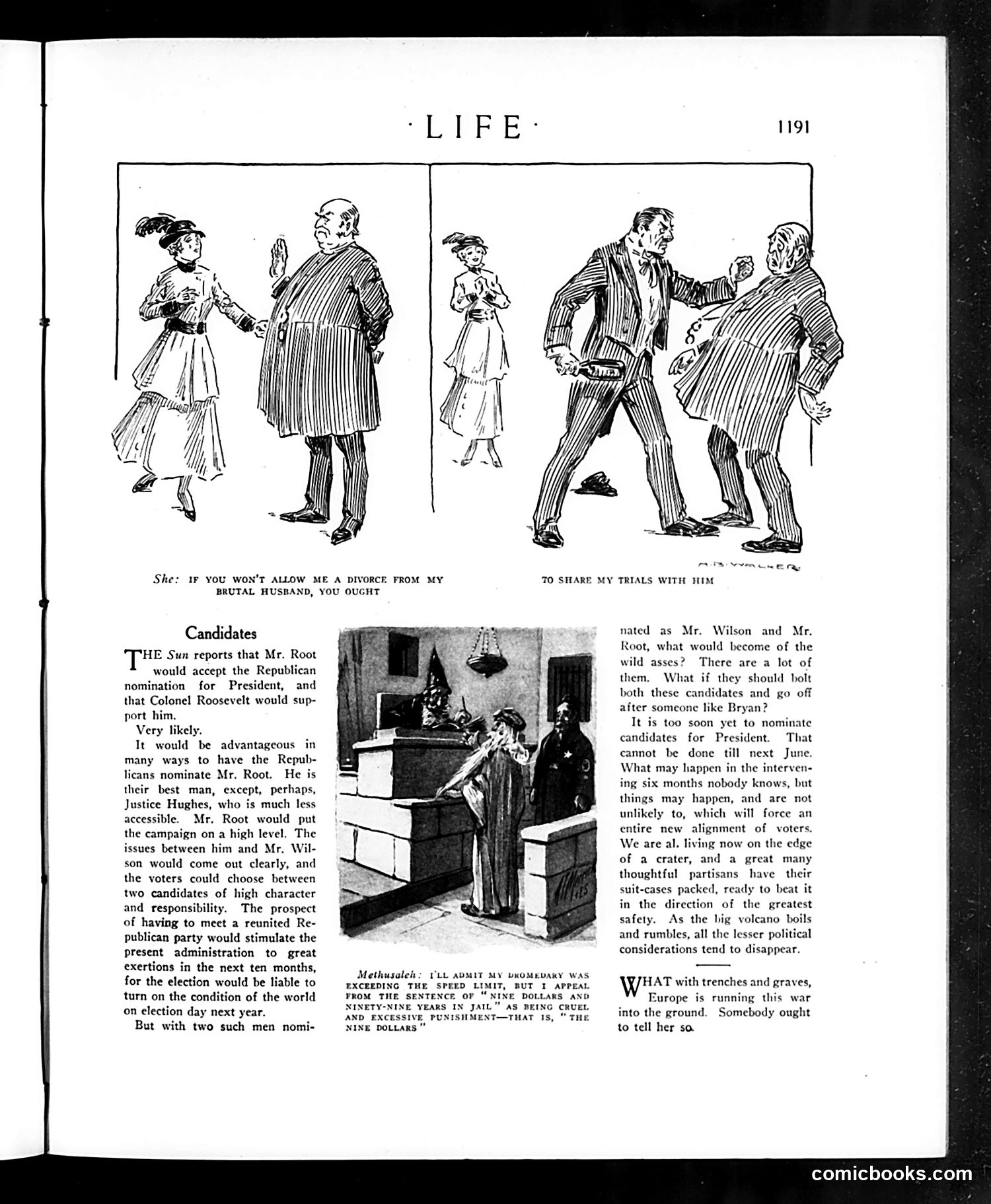
**Top Cartoons:** Two satirical sketches depict marital discord. The left shows a woman demanding a divorce from her "brutal husband," while the right depicts two men arguing over "sharing trials" with the woman—likely mocking the complications and social awkwardness of divorce proceedings in an era when divorce carried significant stigma. **"Candidates" Section:** The article discusses potential Republican presidential nominees, specifically mentioning Mr. Root and Colonel Roosevelt as candidates being considered. The text humorously speculates about their viability and notes the uncertainty of the political landscape, comparing current political tensions to a volcano about to erupt. **Center Photograph:** Shows what appears to be a formal proceeding, possibly legal or political, though the specific context is unclear from the visible text. The page satirizes early 20th-century American politics and social conventions.
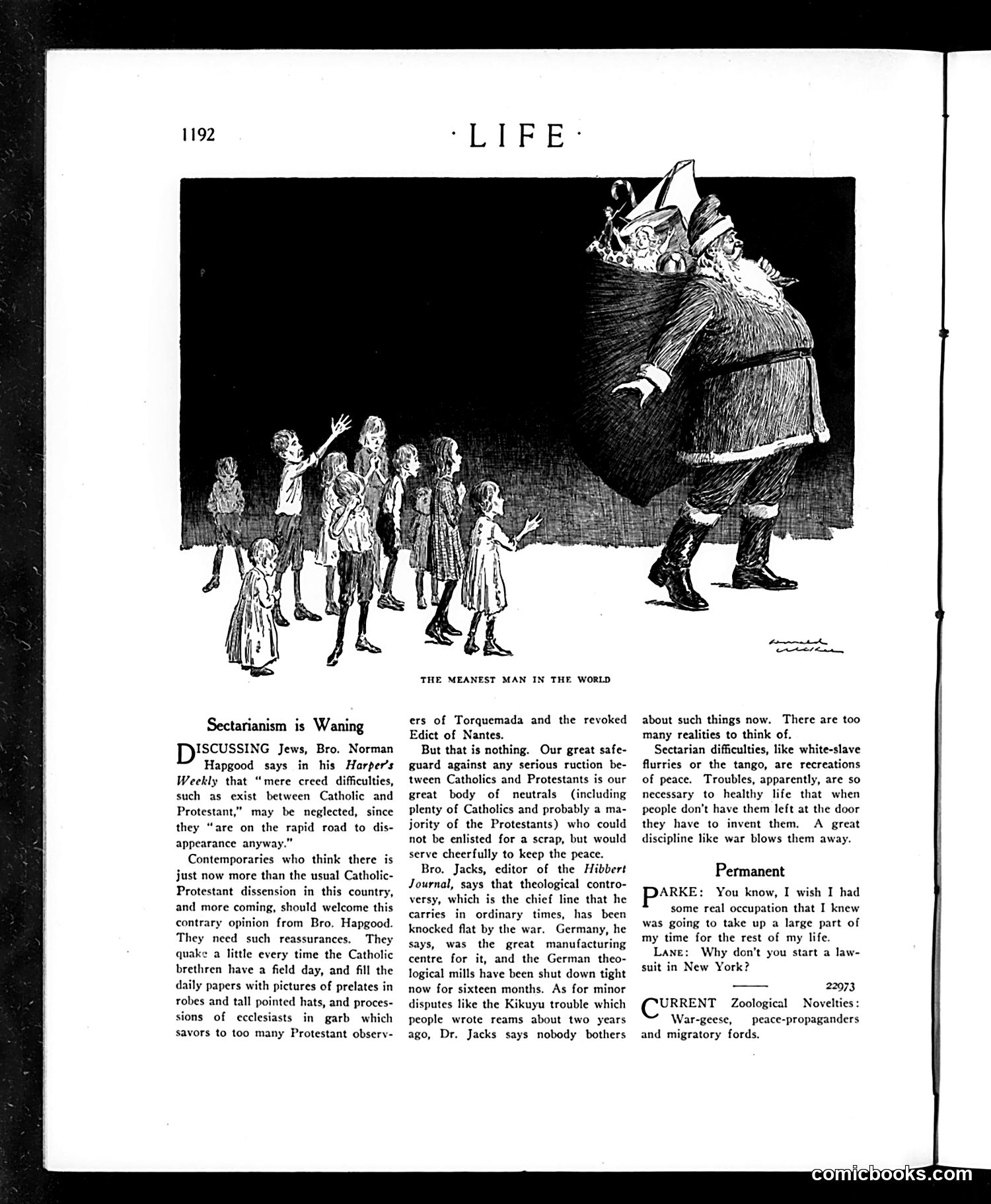
The large cartoon depicts a towering, menacing figure looming over a group of children. The caption identifies this as "The Meanest Man in the World," likely representing a general archetype of cruelty or malevolence rather than a specific historical figure. The accompanying article discusses religious sectarianism waning due to World War I. The text argues that Catholic-Protestant tensions and theological disputes have been overshadowed by war's urgency. References to German theological "manufacturing" being shut down and the Kikuyu religious controversy being forgotten illustrate how conflict redirects attention from denominational quarrels. The cartoon's meaning appears to connect: war itself functions as "the meanest man," a destructive force that paradoxically unites people by eclipsing their internal religious divisions. The children's vulnerability emphasizes war's indiscriminate cruelty overshadowing sectarian conflict. The page's tone is darkly satirical—suggesting society needs manufactured troubles (theological disputes, dance crazes) during peacetime, but war provides "discipline" that eliminates such petty concerns through sheer destructiveness.
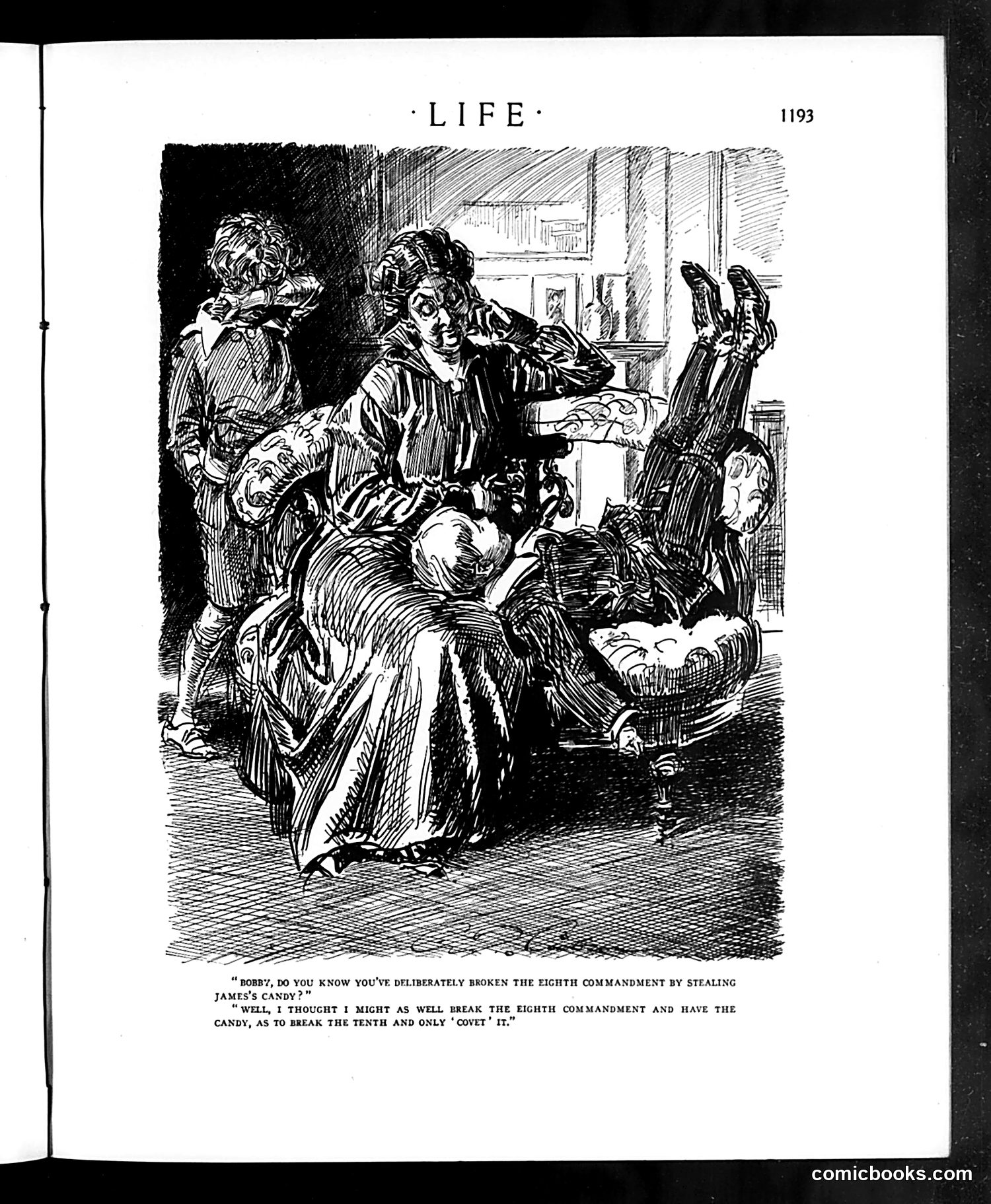
This is a humorous domestic scene depicting a child's cheeky moral logic. An adult (likely a parent) confronts a boy named Bobby for stealing his brother James's candy, pointing out he's violated the Eighth Commandment ("Thou shalt not steal"). Bobby's retort applies clever biblical reasoning: he argues that since he'll break a commandment anyway, he might as well actually steal the candy rather than merely *covet* it (the Tenth Commandment: "Thou shalt not covet"). His logic suggests committing the act is somehow preferable to harboring the desire—a playful inversion of moral teaching. The cartoon satirizes childhood sophistry and how children rationalize misbehavior through twisted reasoning. It's gentle domestic humor typical of early 20th-century American satire, using religious framework for comedic effect.
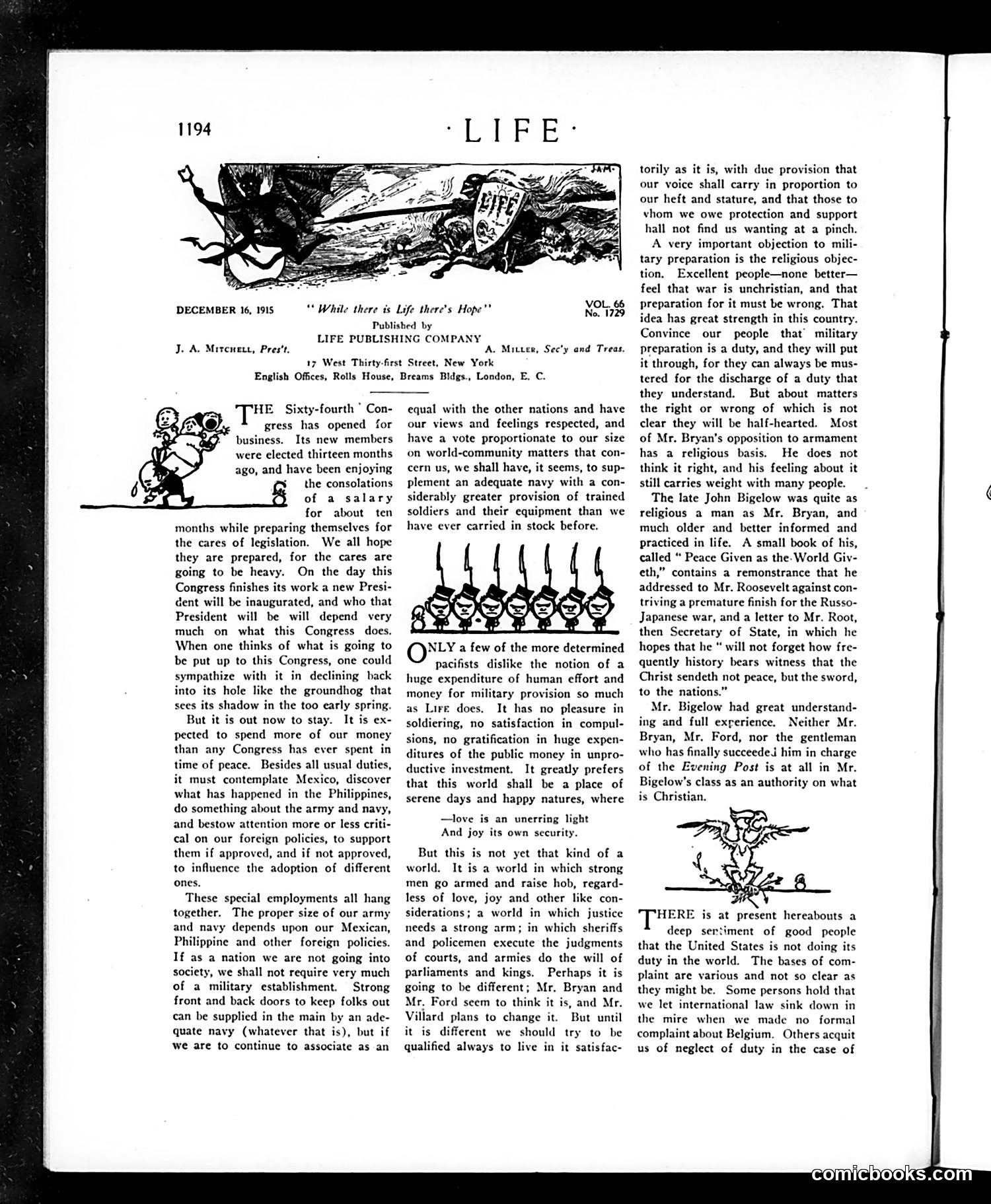
**The Cartoon:** The masthead illustration depicts a skeletal or death-like figure labeled "LIFE" amid chaos and destruction, with the caption "While there is Life there's Hope." **Context:** This page addresses the newly convened 64th Congress during WWI (though America hadn't yet entered). The editorial argues that military preparedness is necessary and unavoidable, despite pacifist opposition. **Key References:** The text mentions pacifists **William Jennings Bryan** (three-time presidential candidate and peace advocate) and **Henry Ford** as opponents of military spending. It also references **Oswald Garrison Villard**, a prominent pacifist editor. **The Satire:** Life's ironic position: while it dislikes war and military spending, it argues the world isn't yet peaceful enough to avoid them. The skeletal "Life" figure sardonically suggests that maintaining hope requires accepting military necessity—a grim commentary on realistic geopolitics versus idealistic pacifism that would resonate with pre-1917 America debates.
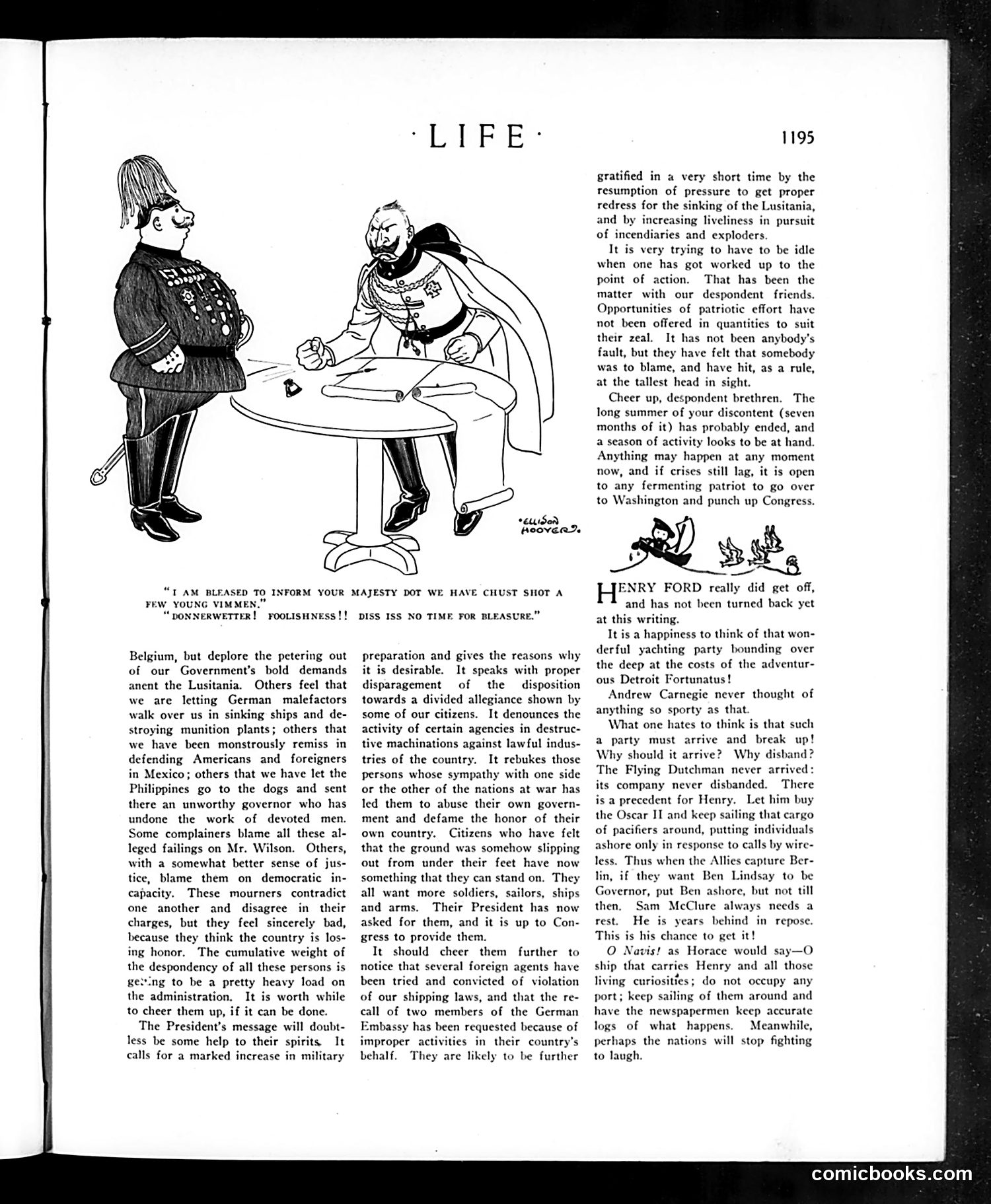
The cartoon satirizes German-American tensions during WWI. The figure on the left appears to be a caricatured German official (identifiable by exaggerated features and military uniform), reporting to someone seated at a table—likely representing German leadership or the Kaiser. The caption's broken English ("CHUST SHOT A YOUNG VIMMEN") mocks German accent and reports alleged German atrocities. The accompanying article addresses American frustration with President Wilson's cautious response to the *Lusitania* sinking (1915) and German sabotage. It defends Wilson's gradualist approach while acknowledging public anger. The text mentions convictions of foreign agents violating shipping laws and recalled German Embassy officials for "improper activities"—espionage and sabotage operations. The satire's point: Germans were conducting covert operations on American soil, yet the U.S. government moved slowly toward confrontation, frustrating those demanding stronger action.
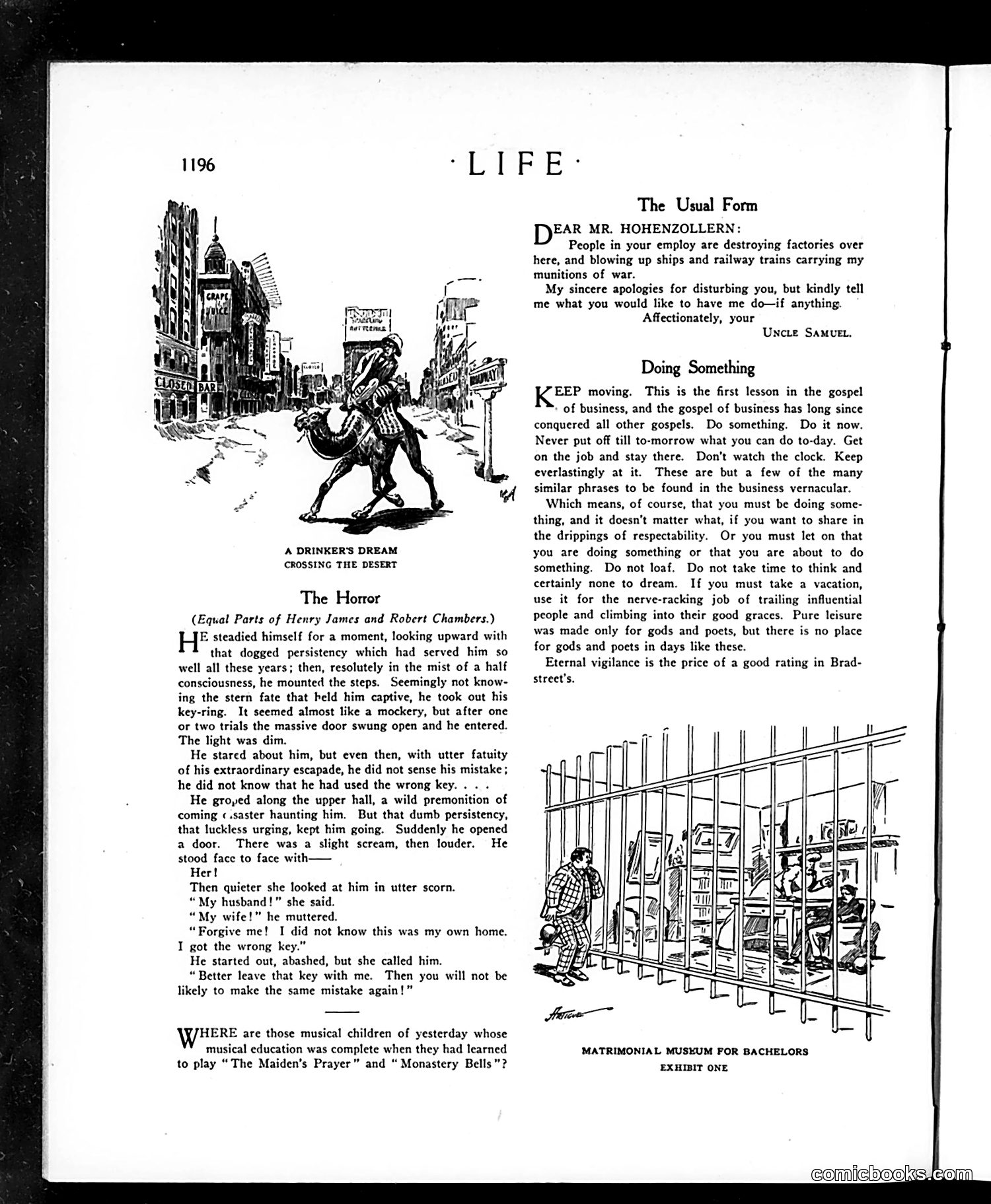
This page contains satirical commentary on World War I and American social attitudes: **"A Drinker's Dream"**: A darkly humorous cartoon depicting an intoxicated man navigating a desert wasteland, likely representing the chaos and destruction of the war itself. **"The Usual Form"**: A bitter mock-letter where "Uncle Samuel" (personification of the U.S.) sarcastically apologizes to the German Kaiser for sabotage of American war production, asking what he'd "like to have me do—if anything." The satire mocks the Kaiser's apparent indifference to civilian casualties and war destruction. **"Doing Something"**: A biting essay critiquing American business culture's obsession with constant productivity and appearing busy, arguing this ethos leaves no room for genuine leisure, thought, or rest—especially contrasted with the war's real demands. **"Matrimonial Museum"**: A cartoon about a bachelor museum exhibit, satirizing bachelor culture (the caption references "Exhibit One"). The page reflects wartime America's complex attitudes toward the conflict and industrial society's demands.
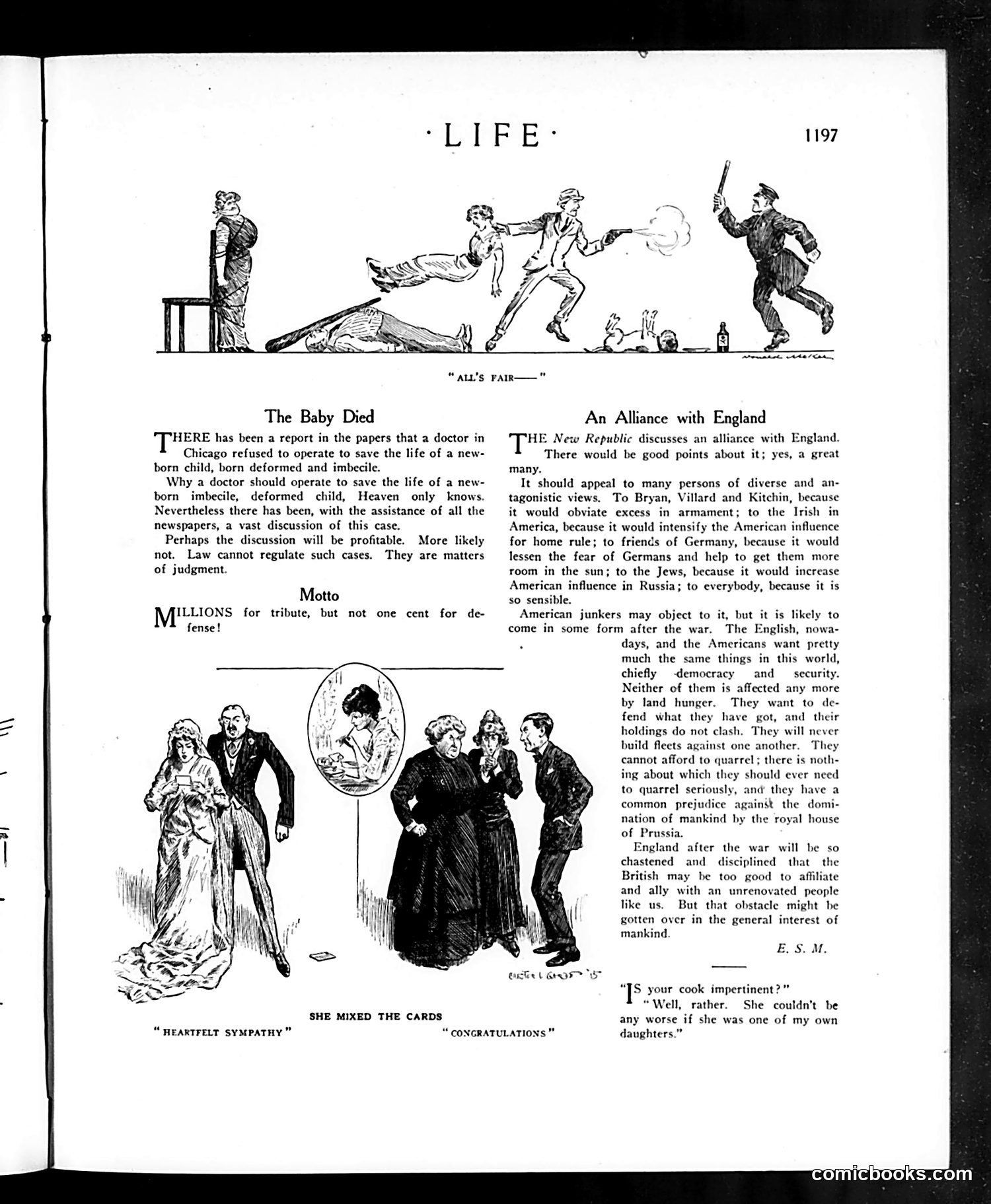
This page from *Life* magazine (circa WWI era, based on references) contains two distinct pieces of political commentary: **"The Baby Died"** addresses a Chicago medical ethics case: a doctor refused surgery on a severely deformed, imbecile newborn. The piece argues law cannot regulate such personal judgments, though newspapers sensationalized the debate. **"An Alliance with England"** discusses a potential U.S.-British alliance. The author argues it appeals across political divides—Bryan and pacifists would support it (reducing armament), Irish-Americans would favor it (strengthening home rule leverage), even German sympathizers might accept it (limiting anti-German sentiment). The piece suggests both nations now share interests in democracy and security rather than territorial expansion, and both fear Prussian domination. The cartoon "All's Fair" depicts cricket (or similar sport), while "She Mixed the Cards" shows ambiguous social commentary about sympathy versus congratulations in unclear circumstances. The page reflects American isolationist/interventionist debates of the WWI period.
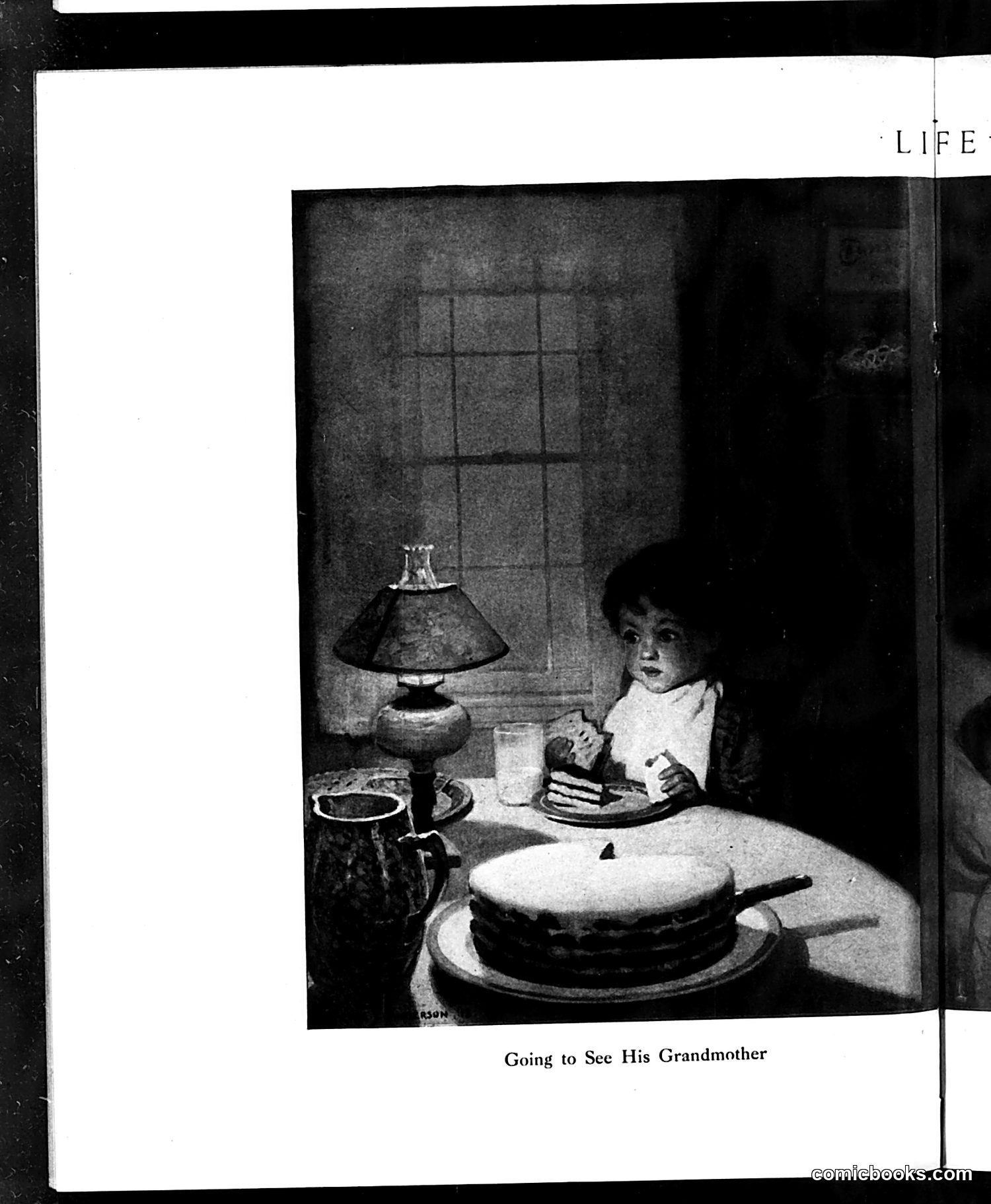
This appears to be a humorous domestic scene from an early Life magazine, titled "Going to See His Grandmother." The black-and-white photograph shows a young child at a table with a large pie or cake and a lamp, looking somewhat guilty or apprehensive. The image likely satirizes childhood behavior—specifically the anticipation and anxiety a child might feel before visiting a grandmother, perhaps suggesting nervousness about etiquette, behavior expectations, or the prospect of being scrutinized. The humor seems to play on the contrast between the child's anxious expression and the innocent domestic setting. Without additional context from the magazine's date or surrounding articles, the specific social commentary remains unclear, though it appears to gently mock generational family dynamics or childhood social obligations of the era.
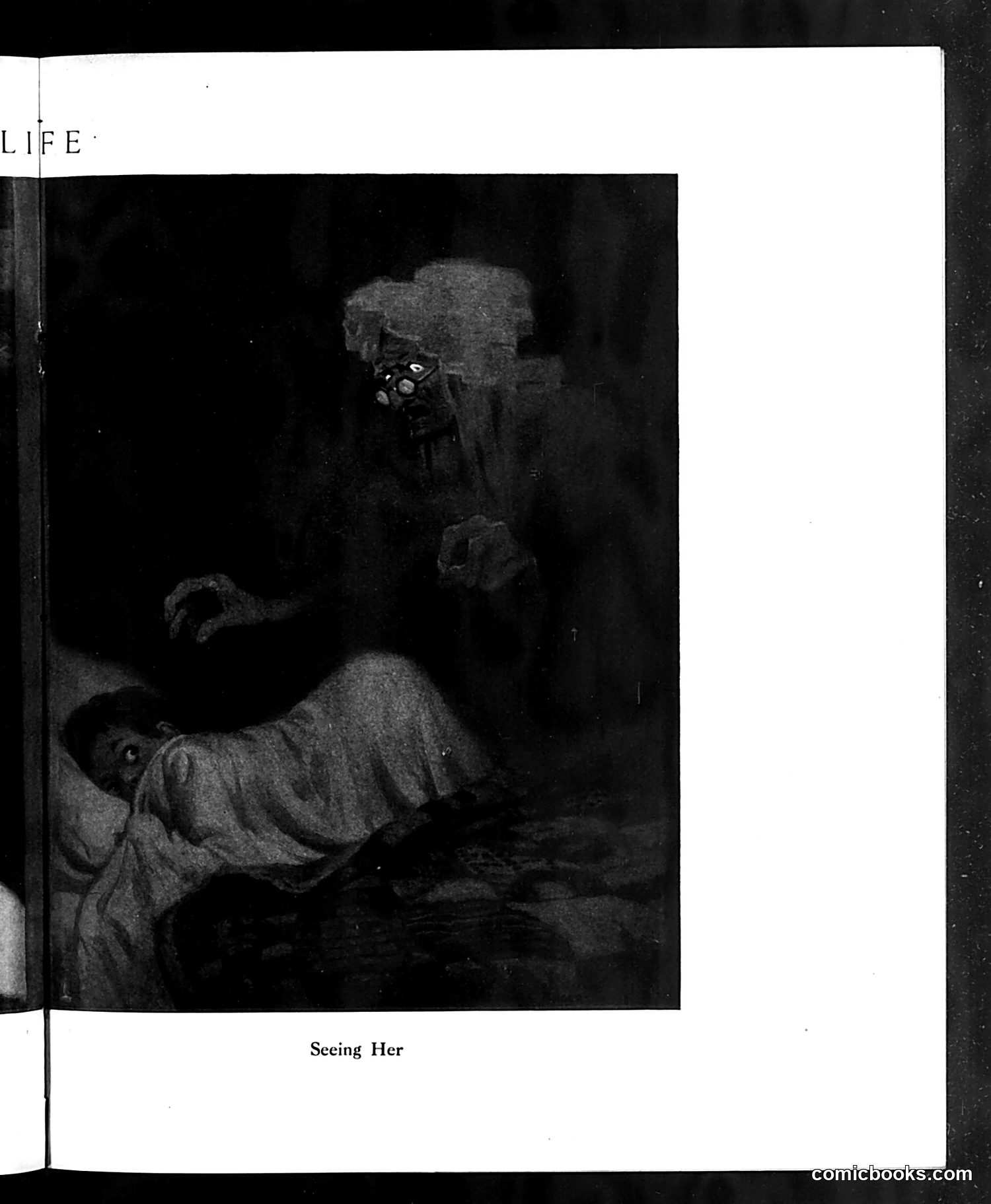
This appears to be a satirical illustration from Life magazine titled "Seeing Her." The black-and-white image depicts two figures in what looks like a darkened interior space. One figure stands elevated while another reclines below, wearing what appears to be period clothing suggesting early 20th-century dress. Without additional context or visible text identifying the specific figures or reference, I cannot confidently determine which political or social situation this cartoon satirizes. The composition and dramatic lighting suggest it's commenting on a power dynamic or social relationship of some kind, but the specific target of the satire—whether political, social, or personal—remains unclear from the image and caption alone.
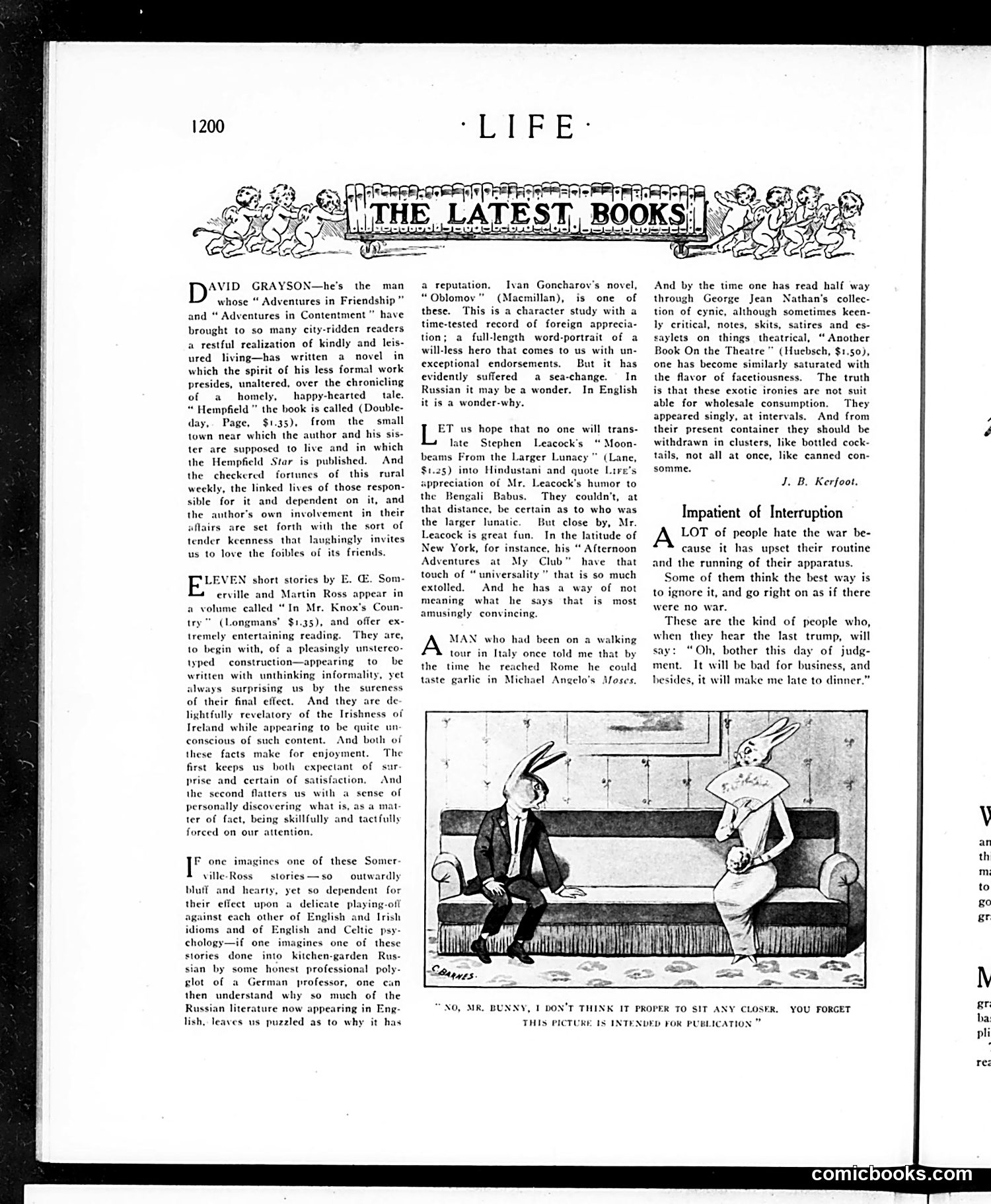
This page from *Life* magazine presents book reviews of contemporary literature. The main cartoon depicts two anthropomorphic rabbits on a sofa—one in business attire, one in feminine dress—with the caption sarcastically warning that the picture "is intended for publication," suggesting the image is too risqué or improper for the magazine's readers. The reviews discuss works by David Grayson, E.OE. Somerville and Martin Ross, Ivan Goncharov, and Stephen Leacock. A running joke emerges: the critic warns against translating Stephen Leacock's humor into other languages or cultures, joking that distant readers couldn't determine "who was the larger lunatic." This reflects period anxieties about whether American/English humor and literary sensibilities could successfully translate across cultural boundaries—a concern about the universality of satire and wit.
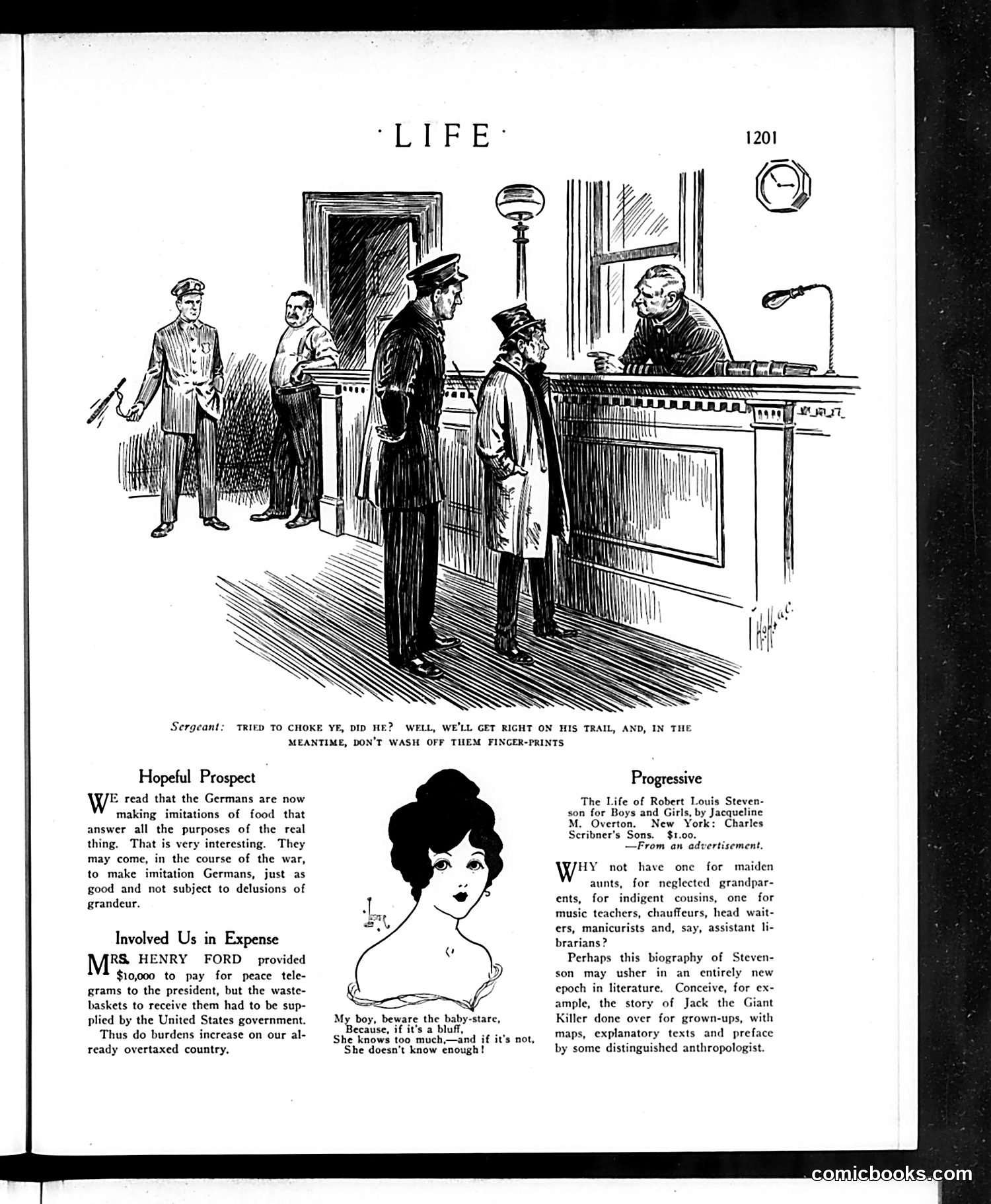
This page contains three satirical pieces from WWI-era Life magazine: **Main Cartoon (top):** A police sergeant interrogates a suspect about an attempted choking, instructing him not to wash fingerprints. This appears to be a straightforward detective/crime joke with no political reference. **"Hopeful Prospect":** Satire on German wartime food substitutes. The joke: Germans might eventually manufacture fake Germans "just as good and not subject to delusions of grandeur"—mocking German militarism and superiority complex as pathological "delusion." **"Involved Us in Expense":** Henry Ford donated $10,000 for peace telegrams to the president, but the government had to supply wastebaskets to receive them. The satire: mocking both Ford's peace activism as futile and the government's waste during wartime. **"Progressive":** Ridicules a children's biography of Robert Louis Stevenson, sarcastically suggesting similar books should exist for other professions (manicurists, librarians), implying the concept of specialized children's literature is absurd.
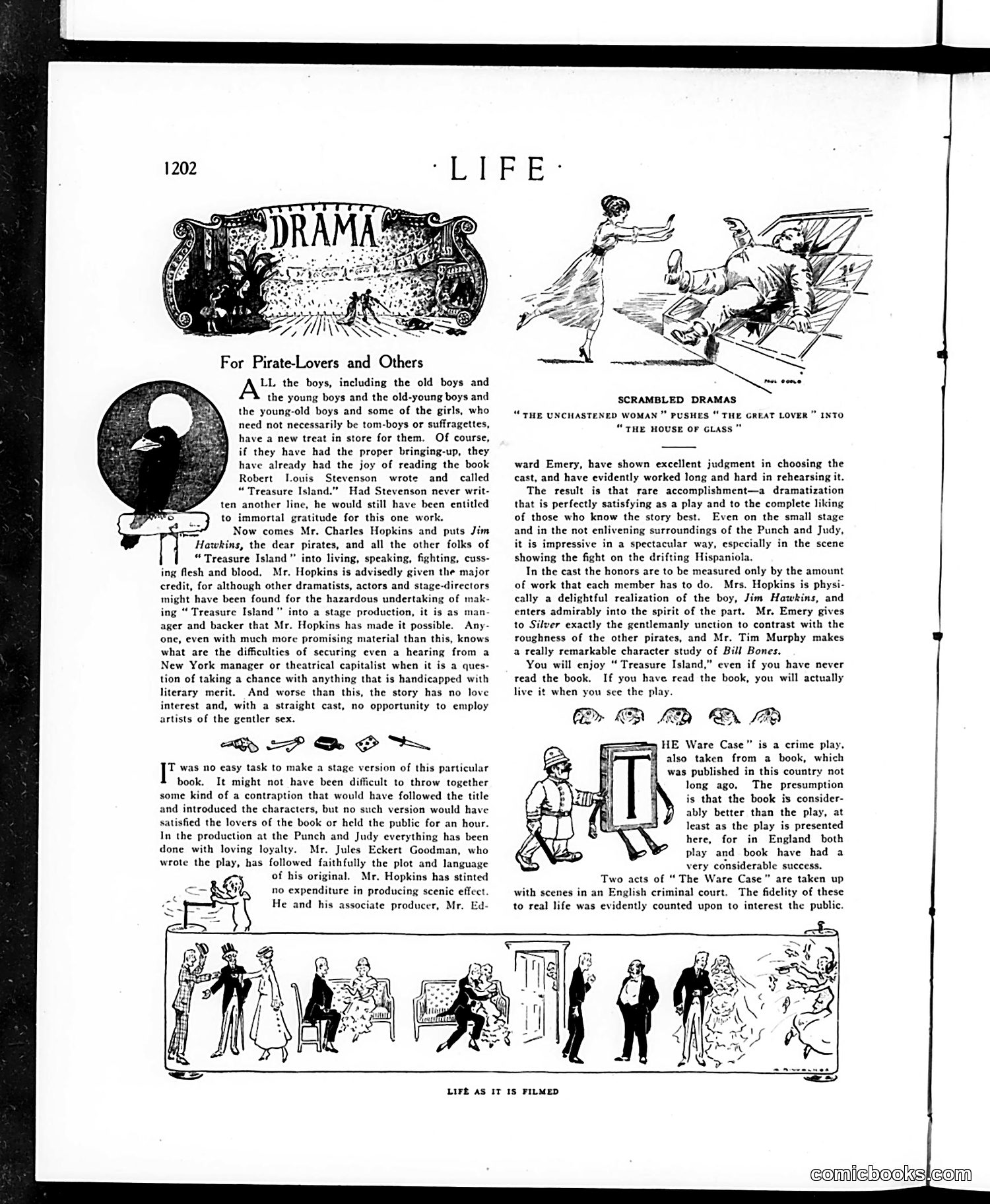
This page reviews theatrical adaptations of literary works. The main focus is Charles Hopkins's stage production of Robert Louis Stevenson's *Treasure Island* at the Punch and Judy Theatre. **The central argument:** The critic praises Hopkins for successfully adapting beloved literature to stage despite genuine obstacles—New York theatrical managers typically avoid investing in literary properties lacking romantic subplots or roles for female performers. The *Treasure Island* adaptation is celebrated as rare: faithful to source material while remaining theatrically impressive, with notably effective casting (Mrs. Hopkins plays Jim Hawkins; Tim Murphy plays Bill Bones). A secondary review discusses *The Ware Case*, a crime play adapted from a recent book, suggesting the book is superior to this theatrical presentation. The "Scrambled Dramas" cartoon sketch humorously depicts theatrical chaos—plots colliding and overlapping—reflecting the page's focus on adaptation challenges. The tone is congratulatory toward Hopkins for achieving what the critic considers nearly impossible: a literary dramatization satisfying both book-lovers and theatre audiences.
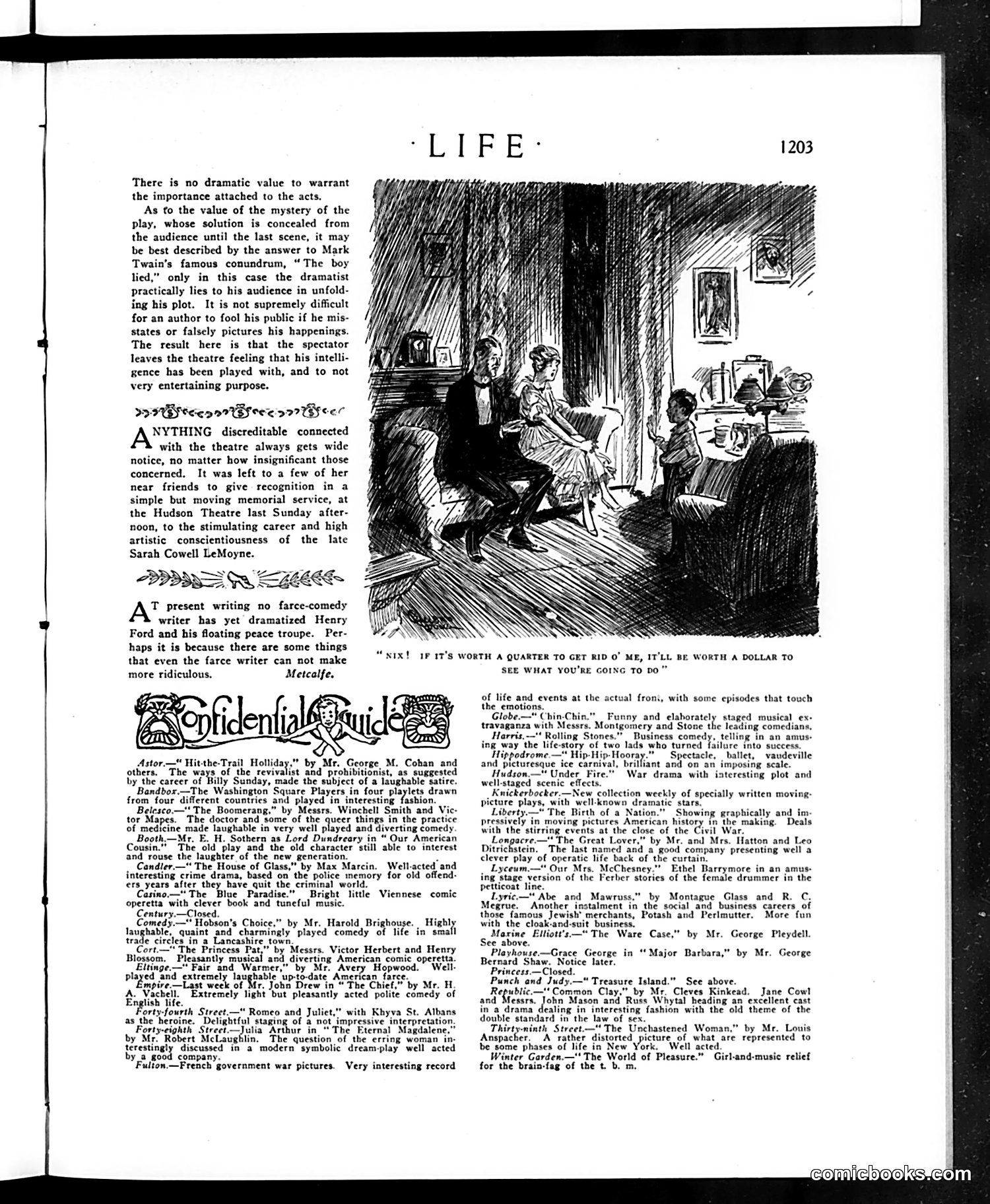
This page contains theater criticism and reviews rather than political cartoons. The single illustration shows a domestic scene: a woman sits while a man stands nearby, with the caption referencing someone offering money to leave ("If it's worth a quarter to get rid o' me..."). This appears to be from a play review or advertisement. The bulk of the page critiques contemporary Broadway productions—operettas, farces, dramas, and comedies. The text at top dismisses a play for deceiving its audience with false plot developments, comparing it unfavorably to Mark Twain's wit. A notable paragraph mourns Sarah Cowell LeMoyne, a theater figure, and criticizes how theater scandals receive disproportionate attention. The final section sardonically notes that Henry Ford's peace movement is too absurd for even farce writers to satirize effectively—a direct contemporary reference to Ford's famous 1915 Peace Ship initiative. The page reflects early 20th-century theatrical culture and social commentary on current events.
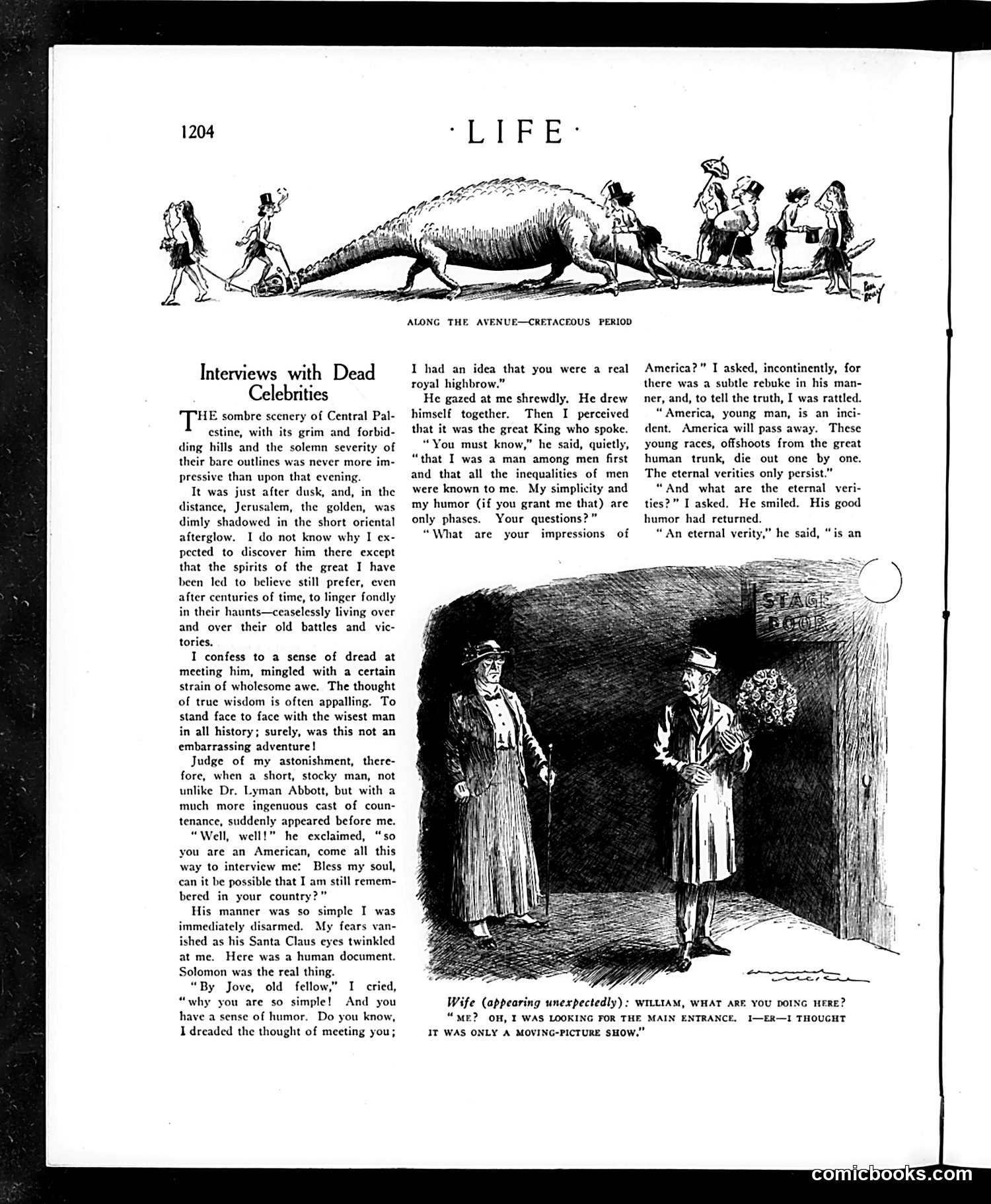
This Life magazine page features two distinct satirical pieces: **Main Article**: A fictional interview with the biblical King Solomon in Jerusalem. The narrator expects pompous wisdom but finds Solomon refreshingly humble and humorous. Solomon's key message—that America is merely a temporary "incident" among young races that will pass away while "eternal verities" persist—serves as social commentary. The piece gently mocks American exceptionalism and youthful arrogance through the voice of ancient wisdom. **Bottom Cartoon**: A domestic humor sketch showing a man caught in a theater, claiming to his suspicious wife he was "looking for the main entrance" when actually attending a "moving-picture show." The joke plays on changing social attitudes toward cinema as entertainment—suggesting husbands felt compelled to hide or justify attending films, perhaps viewing them as frivolous or undignified. **Top Illustration**: "Along the Avenue—Cretaceous Period" depicts prehistoric humans alongside a dinosaur, likely commenting on evolutionary theory or primitive social behavior.
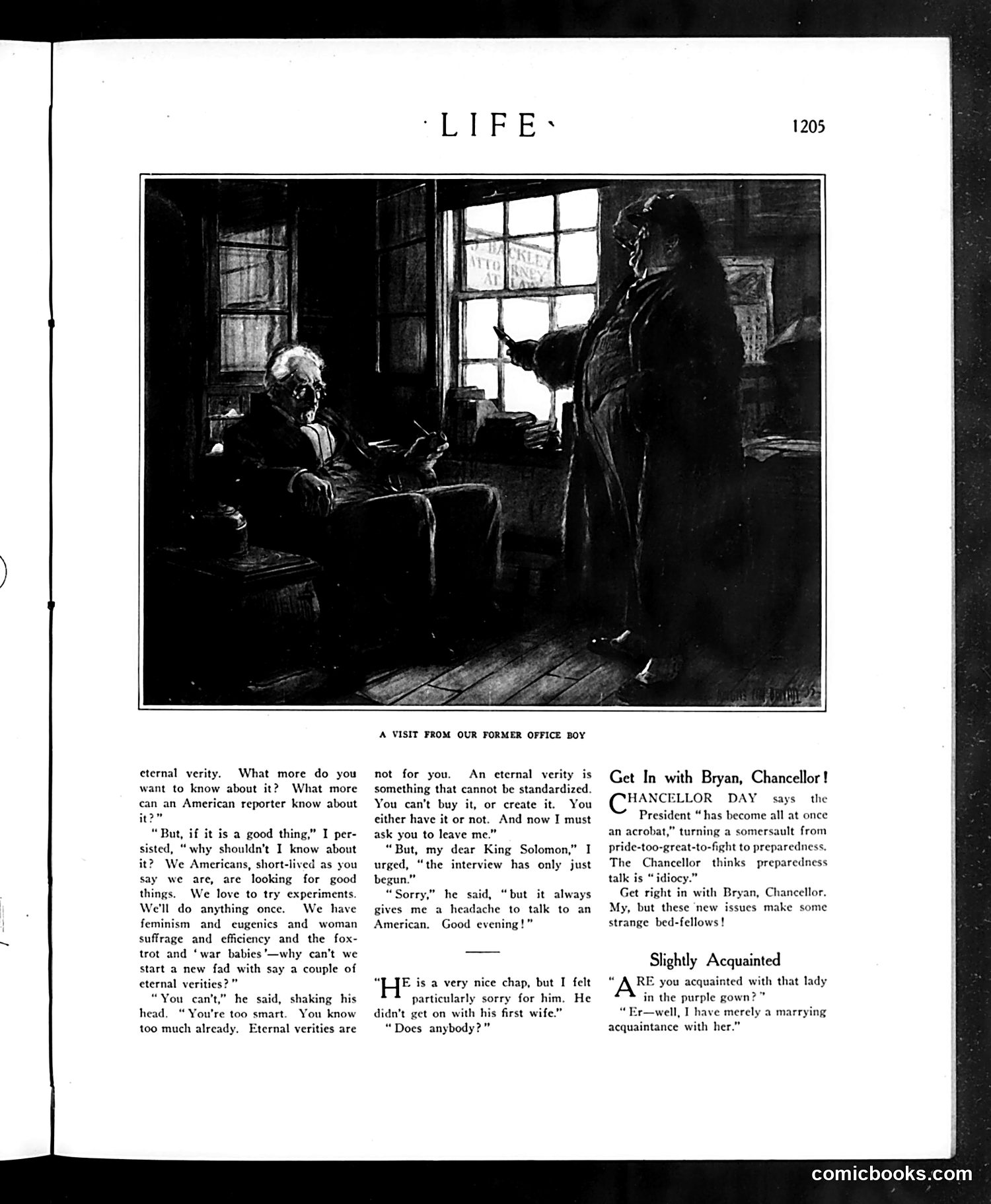
This page contains two distinct pieces of satirical commentary: **"A Visit from Our Former Office Boy"** (main illustration): A dialogue mocking American materialism and impatience. An American reporter interviews a wise figure (described as "King Solomon") about "eternal verities." The satire targets American culture's obsession with standardization, efficiency, and quick trends—feminism, eugenics, woman suffrage, the fox-trot—treating serious philosophical concepts as commodities. The reporter's inability to understand that some truths cannot be bought or manufactured becomes the joke. **"Get In with Bryan, Chancellor!"**: Political commentary on William Jennings Bryan and Chancellor Day (likely William Oxley Thompson, Ohio State's chancellor). The satire criticizes sudden political realignments around preparedness issues, suggesting strange political bedfellows are forming. The implication is that previously opposed figures now find common ground on military preparedness—an ironic political shift the cartoonist finds ridiculous. **"Slightly Acquainted"**: A brief joke about marriage as a shallow social arrangement.
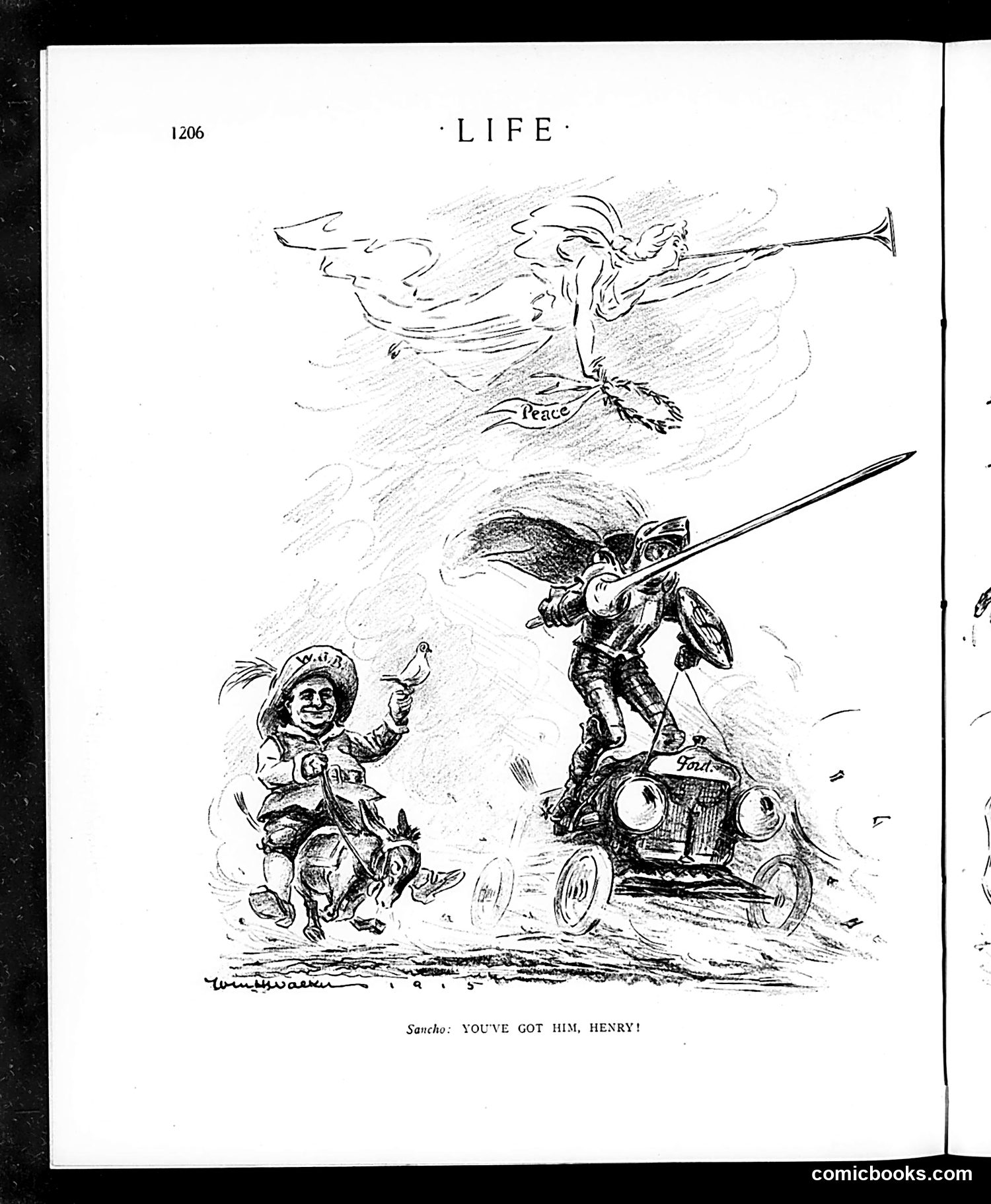
This cartoon depicts a military scene with clear Don Quixote references. A character labeled "Sancho" cheers on "Henry" (likely a military or political figure of the era) who rides in an automobile-like vehicle wielding a sword against an armored opponent descending from the sky labeled "Peace." The satire appears to critique someone named Henry for pursuing conflict rather than peace. The Don Quixote allusion—with its themes of tilting at windmills and mistaking illusions for reality—suggests the cartoon mocks Henry's military ambitions as foolish or misguided. The figure descending as "Peace" being treated as an enemy implies Henry actively rejects peaceful solutions. The automobile contrasts modern warfare with Quixotic medievalism, emphasizing the absurdity of the conflict.
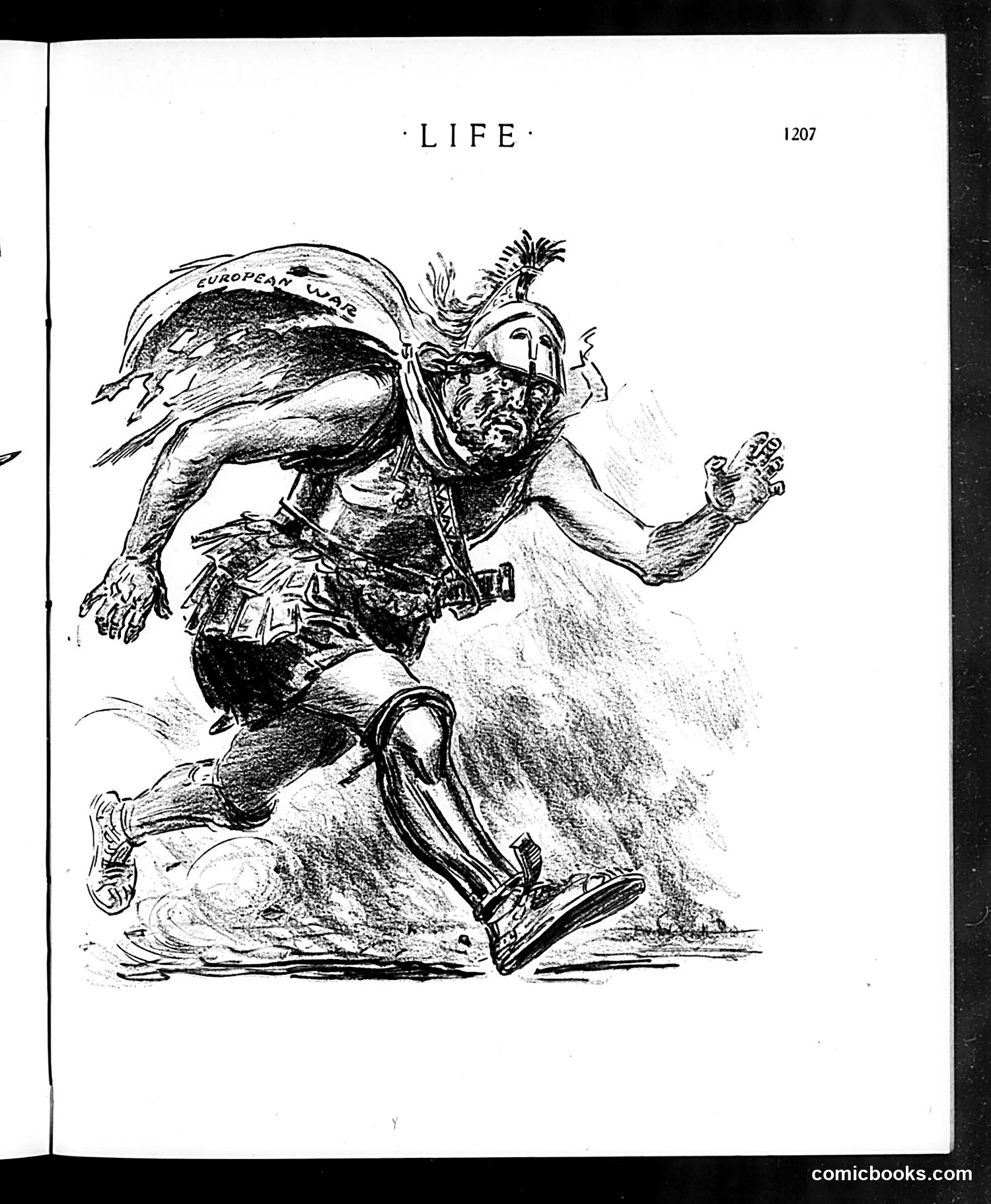
This political cartoon from Life magazine (page 1207) depicts a German soldier in World War I military gear, labeled "EUROPEAN WAR," running in panic or retreat. The figure carries a large cannon or artillery piece on his back while fleeing, suggesting Germany's military burden or the weight of war effort. The exaggerated, grotesque caricature style was typical of American satirical commentary during WWI, portraying the enemy as both threatening and ridiculous. The cartoon likely comments on either German military overextension, the futility of their war effort, or America's perspective on European conflict—though the exact historical moment remains unclear without publication date context.
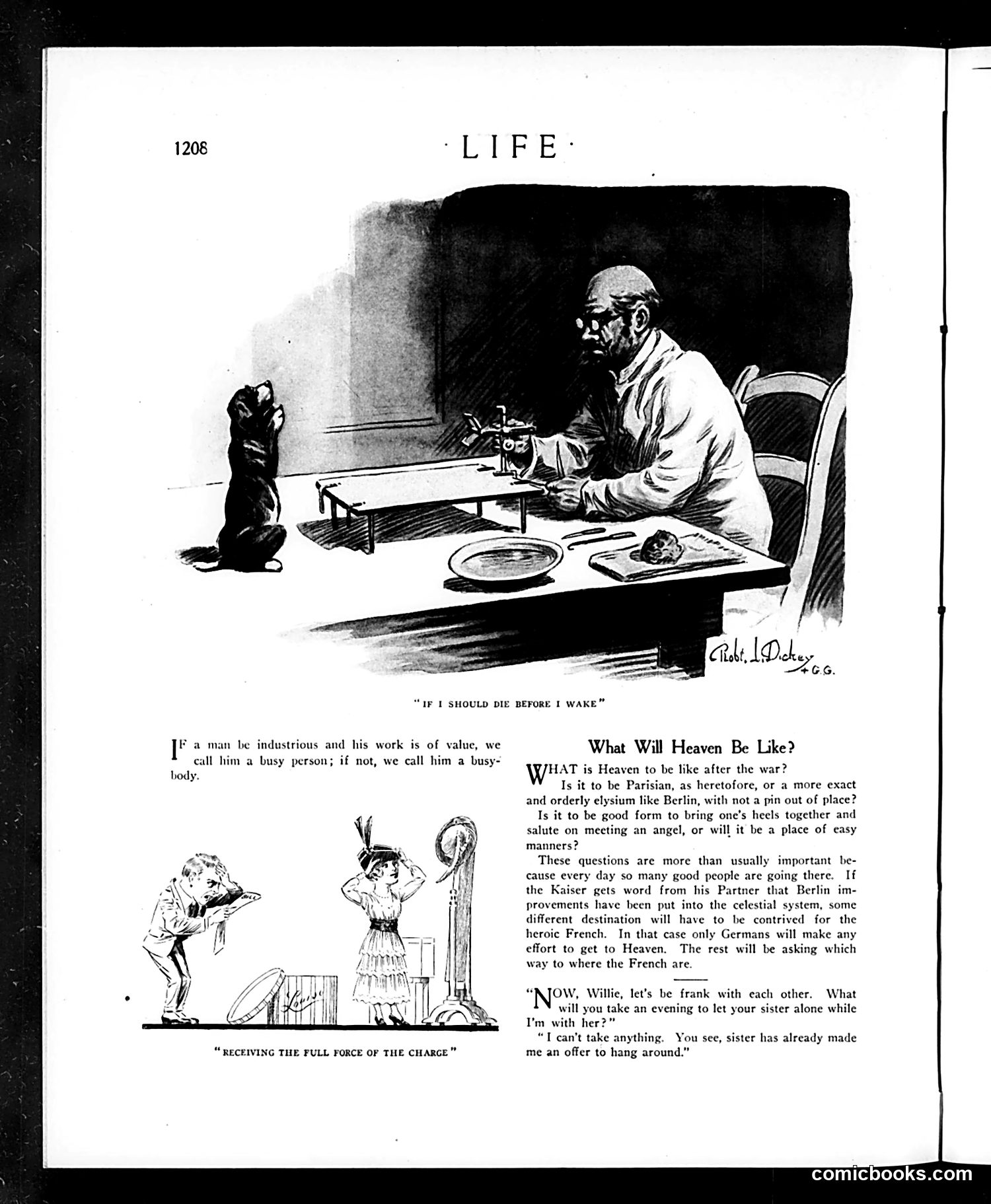
This page from *Life* magazine satirizes World War I attitudes, particularly regarding the Kaiser and German militarism. **Top cartoon** ("If I Should Die Before I Wake"): A man at a desk with a rat watches scales of justice, suggesting moral reckoning or the weighing of souls—likely commentary on wartime morality. **Main article** ("What Will Heaven Be Like?"): Satirical piece questioning whether Heaven will adopt Parisian customs or German "order and efficiency" after the war. The joke: Germans are so militaristic that only they'd want to go to Heaven if it operated like Berlin; the French would prefer their own destination. This mocks German rigidity and discipline as culturally unappealing. **Bottom cartoon** ("Receiving the Full Force of the Charge"): A domestic scene where a young man tries bribing someone to leave him alone with a woman, but she's already offered him money to stay—a joke about social awkwardness and romantic entanglement. The page's overarching theme contrasts American/French informality with perceived German severity during wartime.

This is a **Goodyear Tire advertisement**, not a political cartoon. The page features promotional copy claiming All-WeatherTread Goodyears offer superior durability and longevity for heavy vehicles, highlighting their strong fabric and tough tread. The only visual element is a photograph of an actual tire displayed at an angle, showing the tread pattern. This was standard advertising practice in early 20th-century magazines like *Life*—the publication carried both satirical content and paid advertisements. There is no satire, caricature, or political reference on this page. It's straightforward product marketing from the Goodyear Tire & Rubber Company (Akron, Ohio), emphasizing manufacturing quality as a selling point during an era when tire reliability was a significant consumer concern.
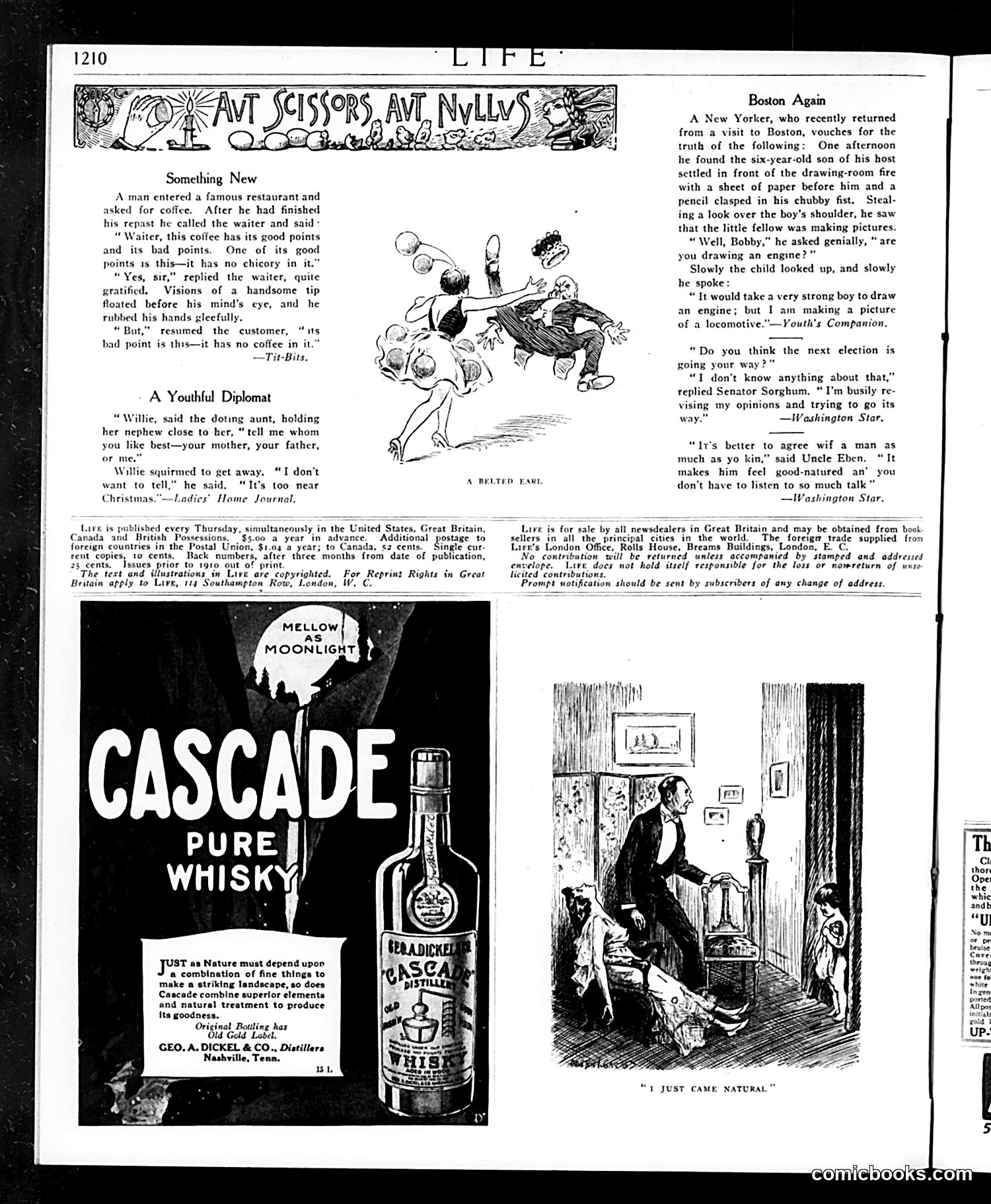
This page contains three unrelated humorous anecdotes and advertisements typical of Life's format: **"Something New"**: A restaurant joke where a customer compliments coffee for lacking chicory, then undercuts himself by noting it also lacks coffee—satirizing backhanded compliments and the futility of finding quality service. **"A Youthful Diplomat"**: A child avoids choosing between parents and aunt by claiming it's "too near Christmas," implying he wants gifts from all three. The humor depends on recognizing childhood self-interest masked as social grace. **"Boston Again"**: A precocious six-year-old corrects an adult's assumption, explaining he's drawing "a locomotive" rather than "an engine," suggesting refined Boston child-rearing produces pedantic youngsters. The page also includes: - A political joke about Senator Sorghum revising opinions before elections - Uncle Eben's folk wisdom about agreeing with people - A **Cascade Pure Whisky advertisement** emphasizing natural ingredients The overall tone reflects Life's satirical focus on American social pretension, political hypocrisy, and domestic humor aimed at educated, middle-class readers.
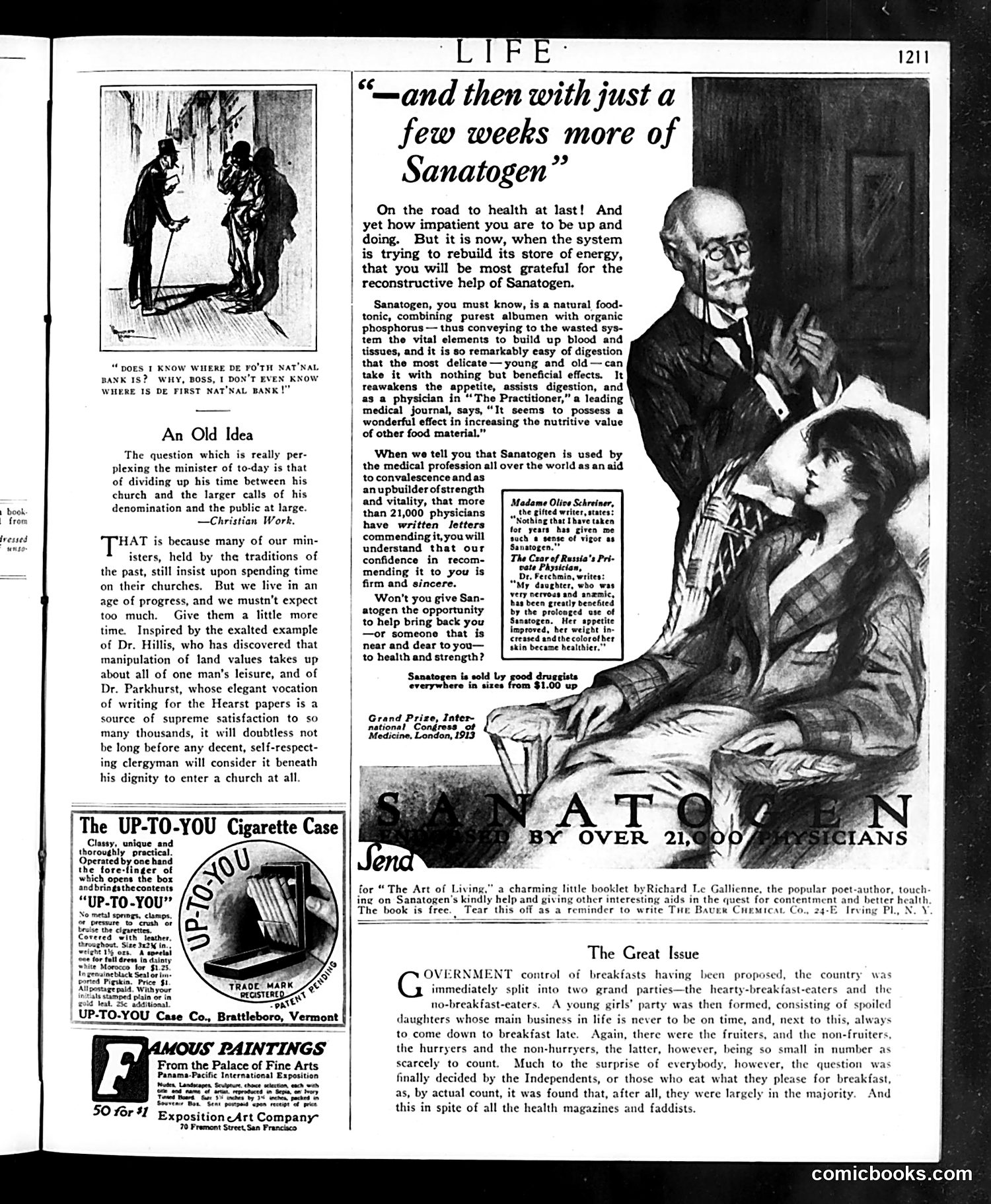
This page primarily showcases **advertising disguised as editorial content**, a common early 20th-century practice. The main cartoon "An Old Idea" satirizes **Progressive Era clergy** who neglect church duties for secular pursuits. It references Dr. Hillis (land speculation) and Dr. Parkhurst (Hearst newspaper writing), mocking ministers who prioritize profit-making over pastoral work. The satire suggests modern clergy have abandoned traditional duties. The bulk of the page is a **Sanatogen advertisement**—a patent medicine marketed as a "food-tonic" for convalescence. It claims endorsement by 21,000 physicians (likely inflated), exploiting public trust in medical authority. This was typical fraudulent health marketing of the era, before FDA regulations. The bottom piece, "The Great Issue," appears to mock trivial social debates (breakfast timing, eating preferences) as distraction from serious governance—likely satirizing contemporary political preoccupations. The **UP-TO-YOU cigarette case** and art company ads are supplementary commercial content. Overall, the page conflates satirical journalism with aggressive product promotion.
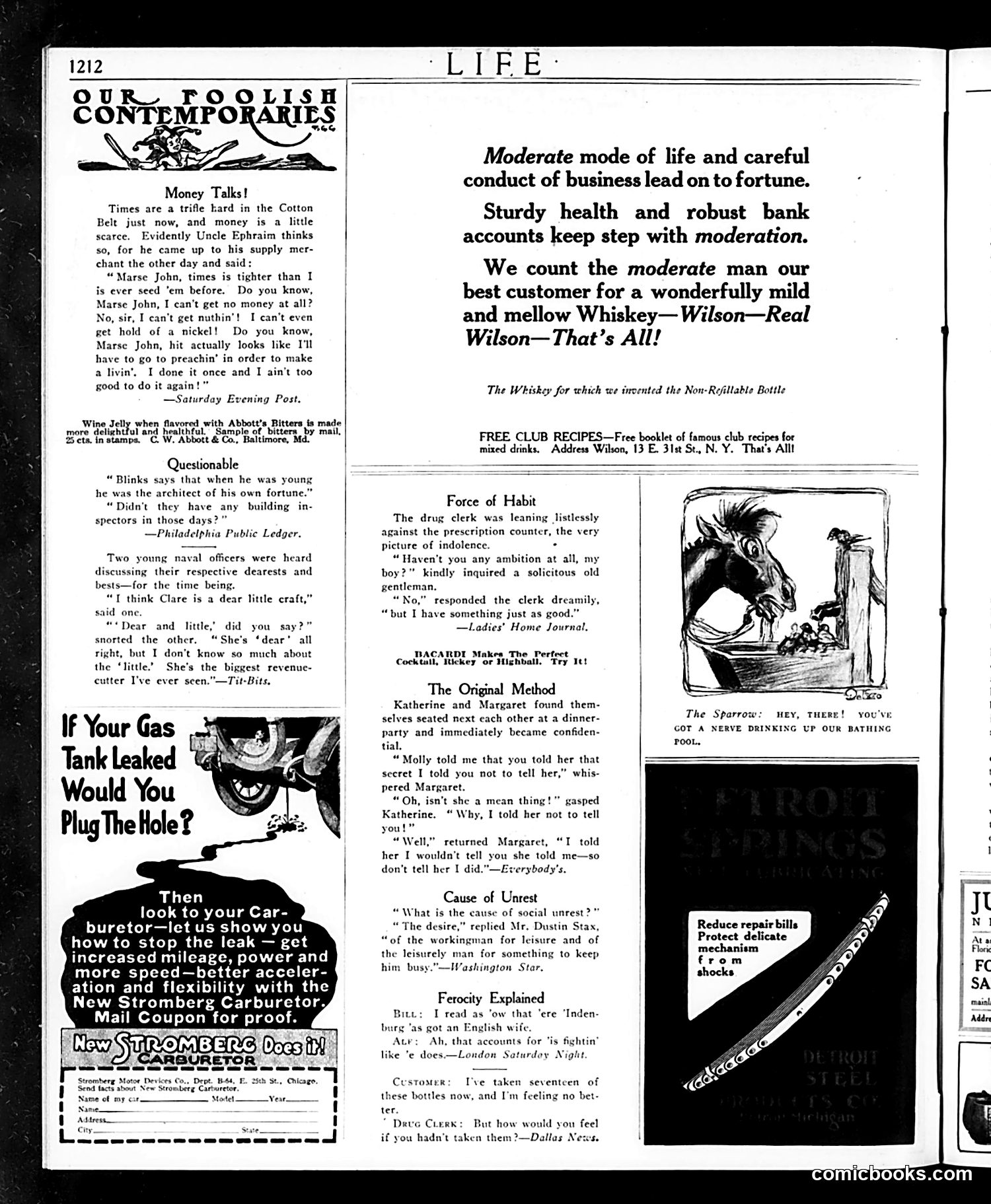
This page from *Life* magazine is primarily **advertising and humor**, not political commentary. The main content includes: 1. **"Money Talks"** – A dialect humor piece about an impoverished Southern farmer (Uncle Ephraim) claiming he's so broke he might become a preacher. This reflects early 20th-century rural economic hardship, particularly in the Cotton Belt. 2. **Wilson Whiskey advertisement** – Promotes "moderate" drinking as wholesome and good for business. 3. **Short humorous anecdotes** on various topics: a joke about a woman being a large naval vessel ("revenue-cutter"); gossip between dinner guests; a drug clerk's apathy; and wordplay about an "Inden" (German) wife making her husband fierce. 4. **Carburetor and automobile ads** – Common for the era. The satire is gentle and domestic rather than political—poking fun at human nature, laziness, and social pretension rather than current events or political figures. The racial dialect humor reflects period attitudes now considered offensive.
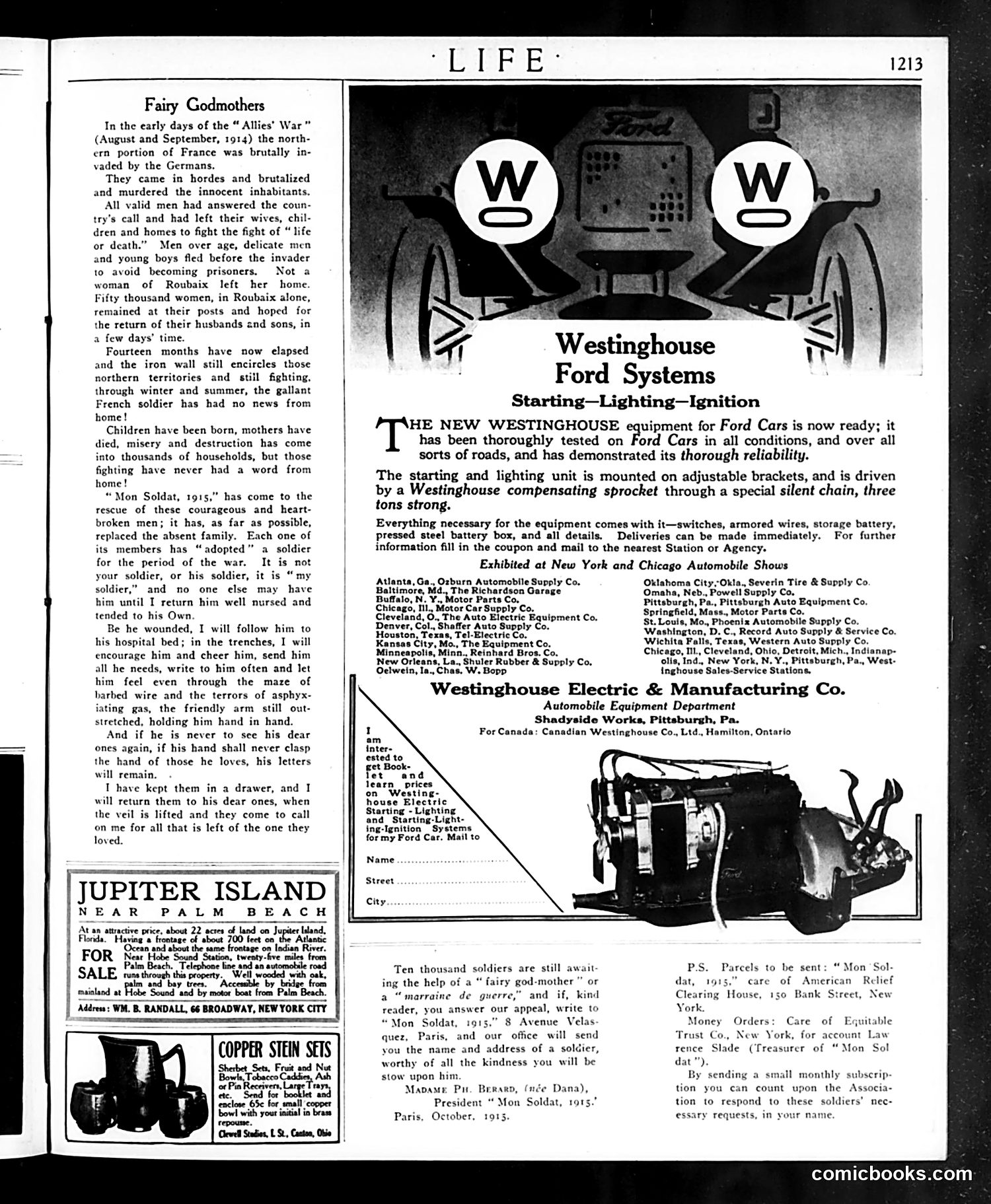
This page combines a sentimental wartime appeal with automotive advertising. **"Fairy Godmothers" article**: Written during WWI (the text references August-September 1914), this piece describes the "Mon Soldat, 1915" program—a French charitable initiative where women "adopted" soldiers fighting in the trenches. With husbands and sons absent at the front and occupied territories cut off from communication, these women provided letters, packages, and emotional support to soldiers they'd never met, becoming symbolic "fairy godmothers." The piece celebrates this as a way French women maintained morale and family connection across the horror of trench warfare. **Westinghouse Ford Systems advertisement**: The remainder of the page promotes electrical starting and lighting equipment for Ford automobiles, listing distributors across America. This juxtaposition—intimate wartime sacrifice beside consumer product marketing—reflects how American magazines balanced patriotic content with commercial interests during the war years.
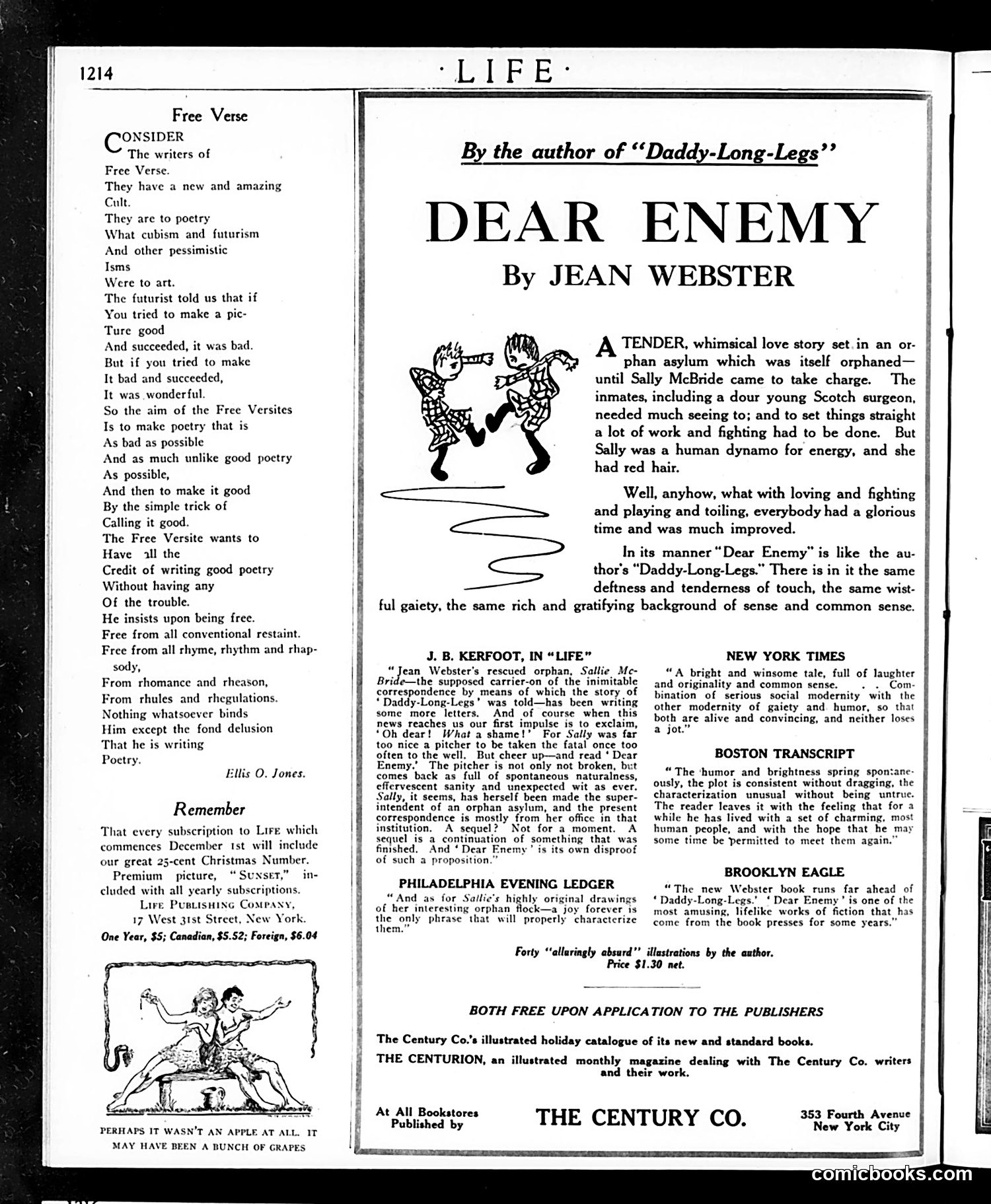
This page combines literary criticism with book advertising. **Left column:** A satirical essay attacking the "Free Verse" movement in poetry. The author (Ellis O. Jones) mocks modernist poets who rejected traditional rules (rhyme, rhythm, meter) as following a contradictory philosophy: they aim to write poetry "as bad as possible," then call it good through mere assertion rather than craft. The satire suggests free versists want credit for writing poetry without the actual work of mastering poetic form—they're "free from all conventional restraint" but have nothing binding them except self-delusion. **Right side:** An advertisement for Jean Webster's novel *Dear Enemy*, a sequel to her popular *Daddy-Long-Legs*. The ad includes enthusiastic reviews from major newspapers praising the book's humor, originality, and social awareness. A small illustration shows two playful figures. **Context for modern readers:** This page reveals early-20th-century literary gatekeeping—establishment critics dismissing experimental modernism as lazy pretension. The juxtaposition with commercial fiction advertising suggests tension between "serious" literary criticism and popular entertainment.
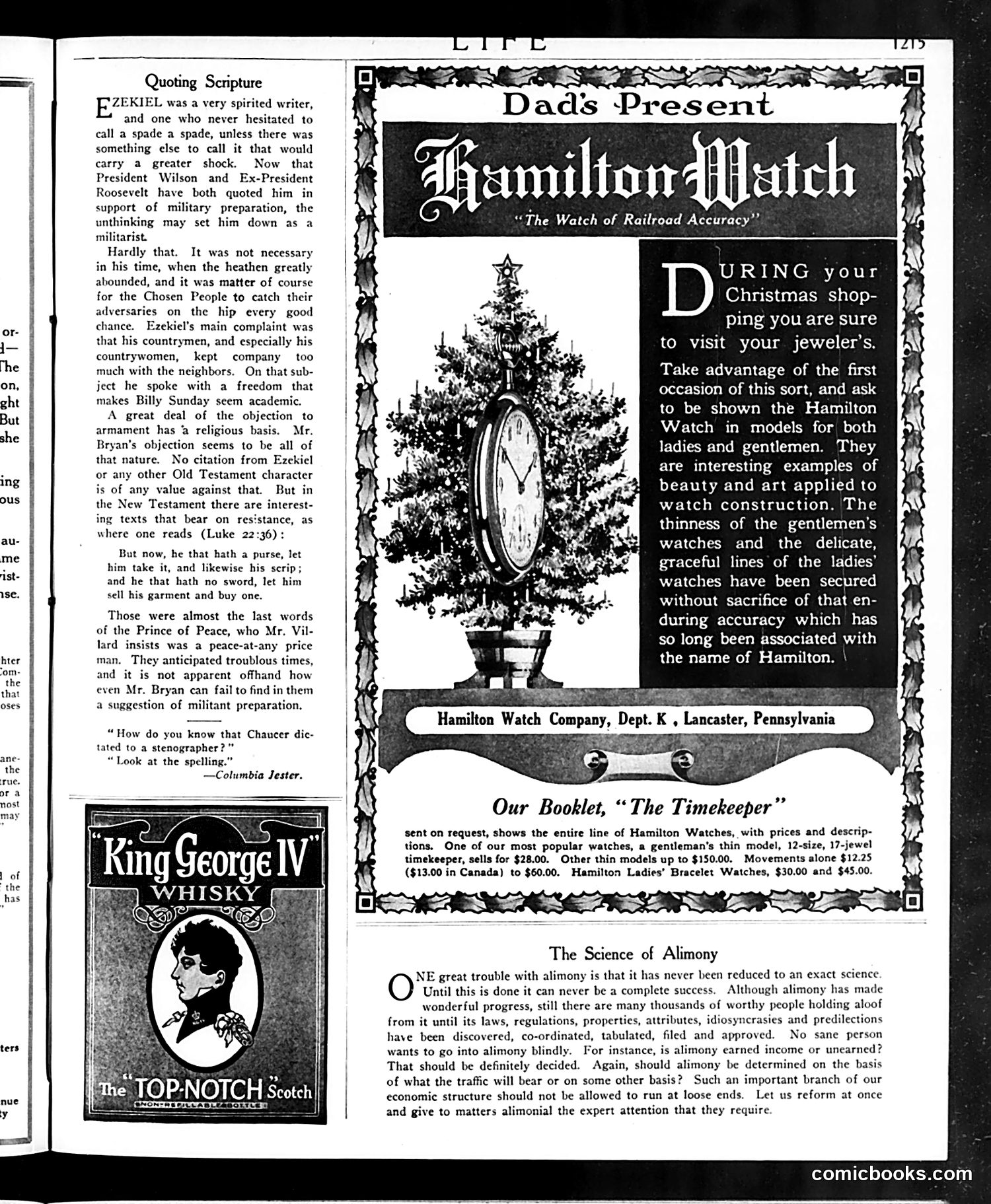
This page contains three distinct pieces: **"Quoting Scripture"** — A brief satirical essay defending military preparedness by invoking biblical references. It argues that pacifists like William Jennings Bryan misuse scripture; the author points out that even Jesus advised his disciples to carry swords (Luke 22:36), suggesting military preparation isn't un-Christian. This reflects WWI-era debate over U.S. armament, with President Wilson and Theodore Roosevelt supporting military buildup against pacifist opposition. **Hamilton Watch Advertisement** — A straightforward Christmas gift ad emphasizing precision and elegant design for both men and women. **"The Science of Alimony"** — Satirical commentary on divorce settlements, treating alimony as an unscientific, chaotic system. The author humorously argues it needs standardization and expert regulation—likely reflecting 1910s-20s concerns about rising divorce rates and unpredictable spousal support payments. The page is primarily advertising with two short satirical pieces typical of *Life* magazine's social commentary.
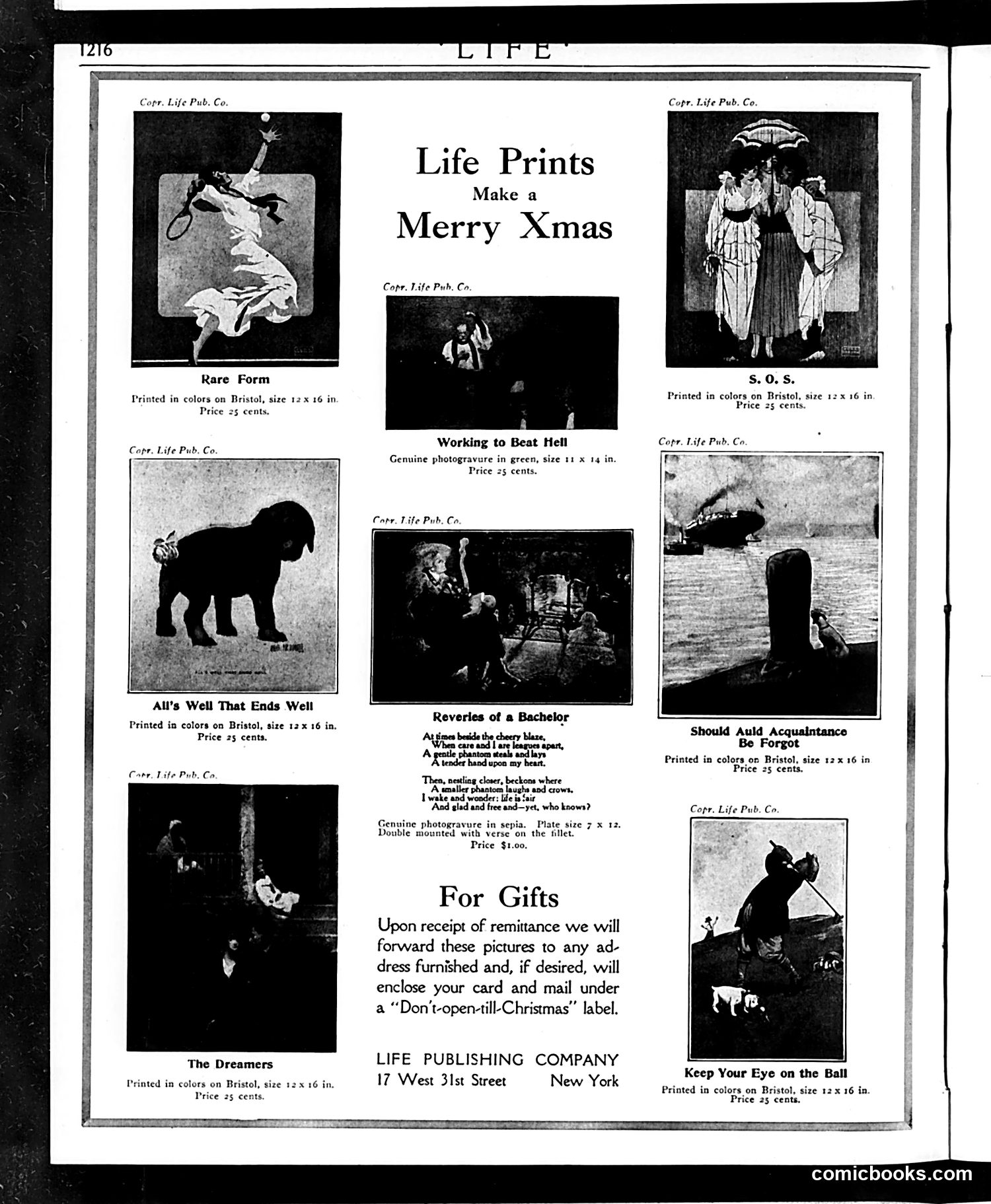
This is primarily a **product advertisement**, not political satire. Life Publishing Company is marketing decorative art prints as Christmas gifts. The page displays eight different prints available for purchase, priced at 25 cents to $1.00. The prints feature sentimental or humorous domestic scenes typical of the era: "Rare Form" (woman in flowing dress), "All's Well That Ends Well" (dog with bone), "The Dreamers" (intimate couple), "Reveries of a Bachelor" (romantic musings with accompanying verse), "Working to Beat Hell" (man at labor), "S.O.S." (two figures), "Should Auld Acquaintance Be Forgot" (figures by water), and "Keep Your Eye on the Ball" (child with dog). The company offered mail delivery with special "Don't-open-till-Christmas" labeling for gift-giving convenience. This reflects early consumer retail marketing strategies and the era's aesthetic preferences for romanticized, sentimental imagery.
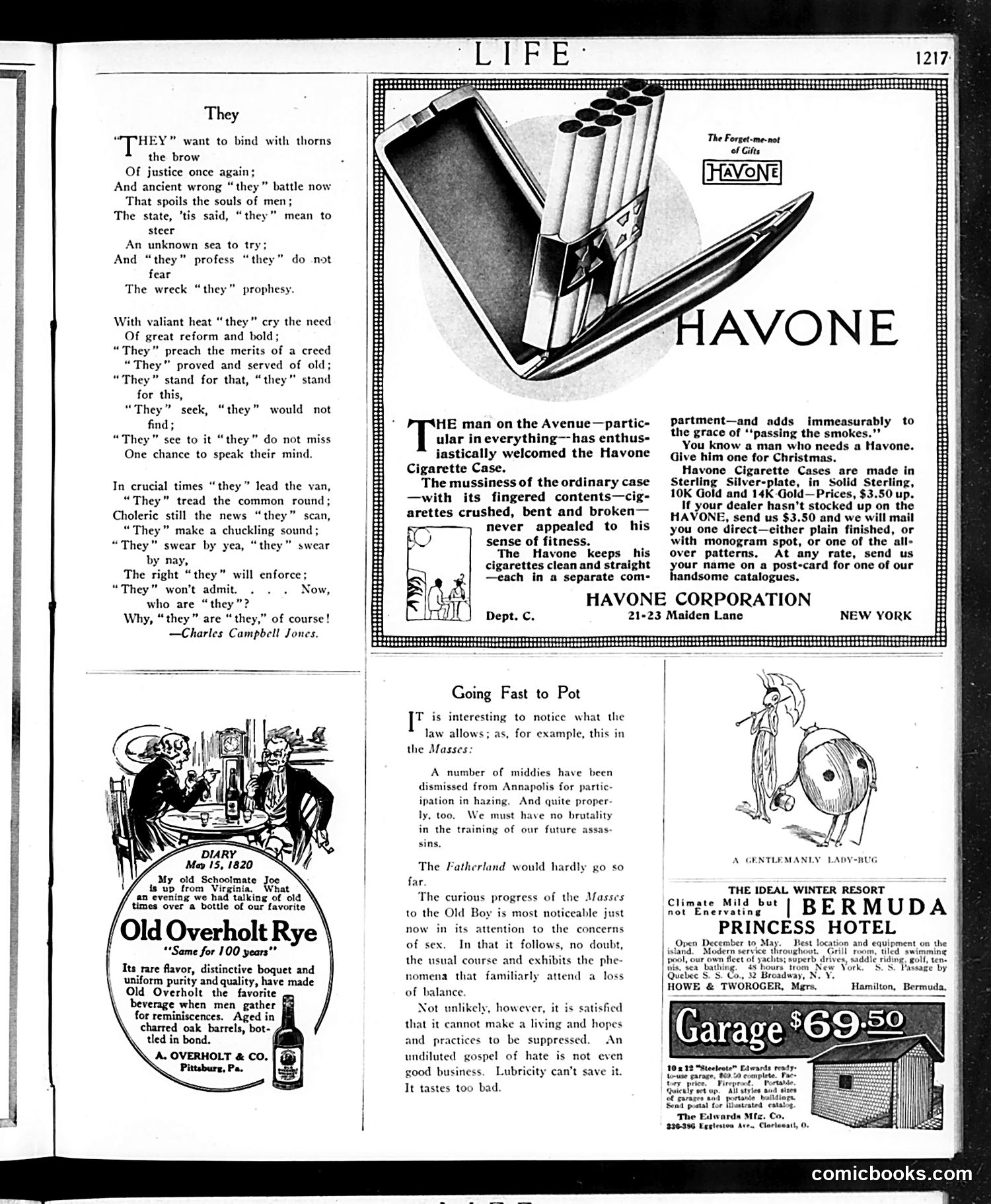
This page primarily contains **advertisements and light social commentary** rather than political satire. The poem "They" by Charles Campbell Jones is a gentle satirical jab at vague political rhetoric—mocking those who speak in abstractions about reform and justice without clarity, repeatedly invoking "they" without defining who or what "they" actually are. It's social commentary on political evasiveness rather than targeting specific figures or events. The "Going Fast to Pot" section critiques *The Masses* magazine (a radical publication) for shifting focus toward sexual content and scandals. The reference to Annapolis hazing dismissals and a sarcastic comment about "training our future assassins" suggests contemporary debates about military discipline and the magazine's radical editorial stance. The rest is commercial: advertisements for Old Overholt Rye whiskey, Havone cigarette cases (luxury gift items), Bermuda tourism, and a garage kit. **For modern readers:** This reflects 1920s-era concerns about radical publications and political vagueness, presented without urgency—typical of *Life's* mild satirical tone.
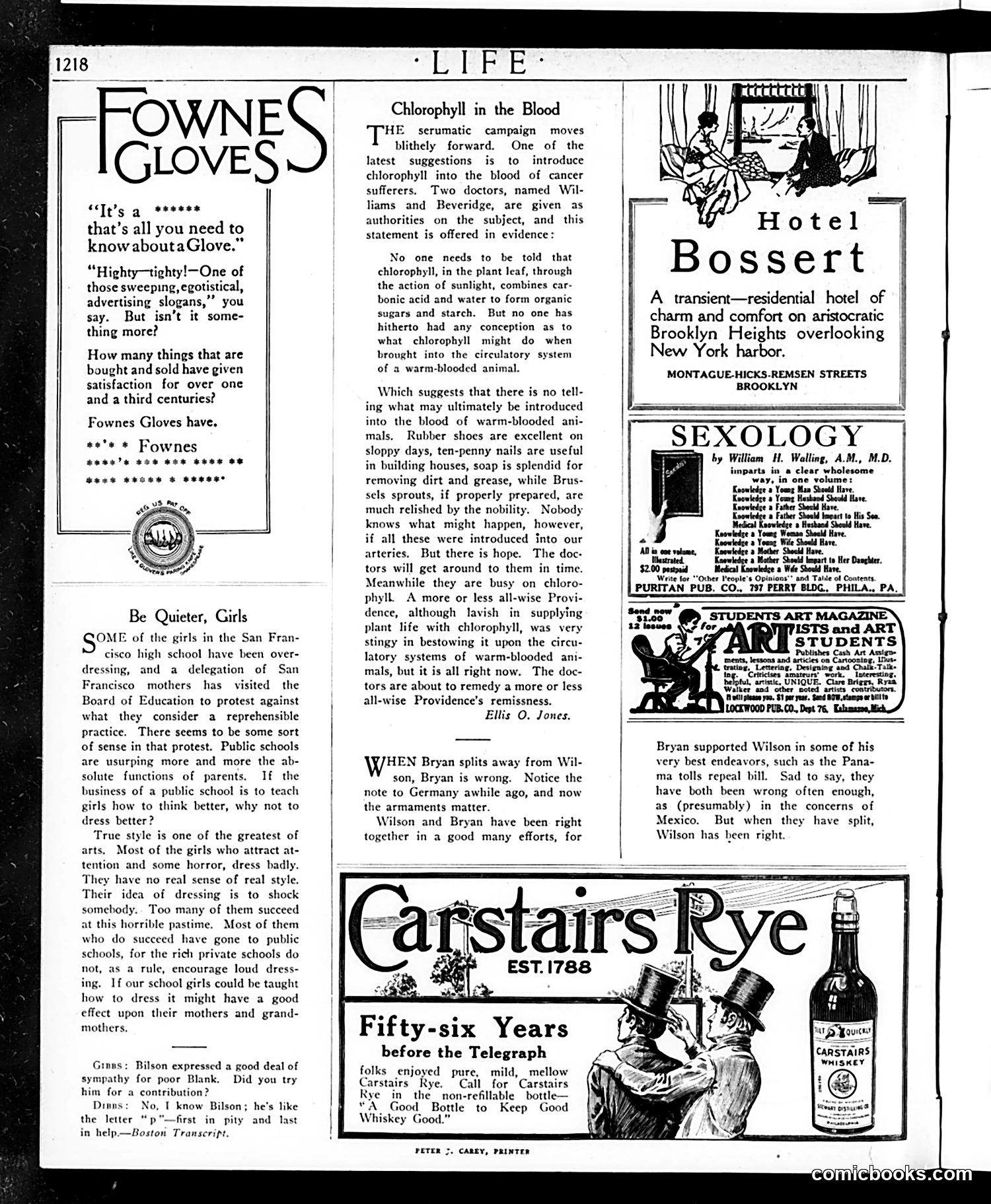
This page contains **social commentary and advertisements** rather than traditional cartoons. **"Be Quieter, Girls"** criticizes San Francisco high school girls for overdressing. The author argues that public schools should teach style and proper dress—presented as an art form—to benefit girls' character and their mothers' example. The piece satirizes excessive, attention-seeking fashion as tasteless while defending refined style education. **"Chlorophyll in the Blood"** mocks a contemporary medical fad. Doctors Williams and Beveridge allegedly proposed injecting chlorophyll into cancer patients' blood. The author absurdly extends this logic, humorously suggesting why not also inject rubber shoes, nails, and brussels sprouts? The satire critiques gullible acceptance of unproven medical trends and "Providence's remissness" in not naturally equipping humans with chlorophyll. The remaining content concerns **Wilson and Bryan's political alignment** regarding Germany and armaments, plus period advertisements for gloves, hotels, and a sexology textbook.
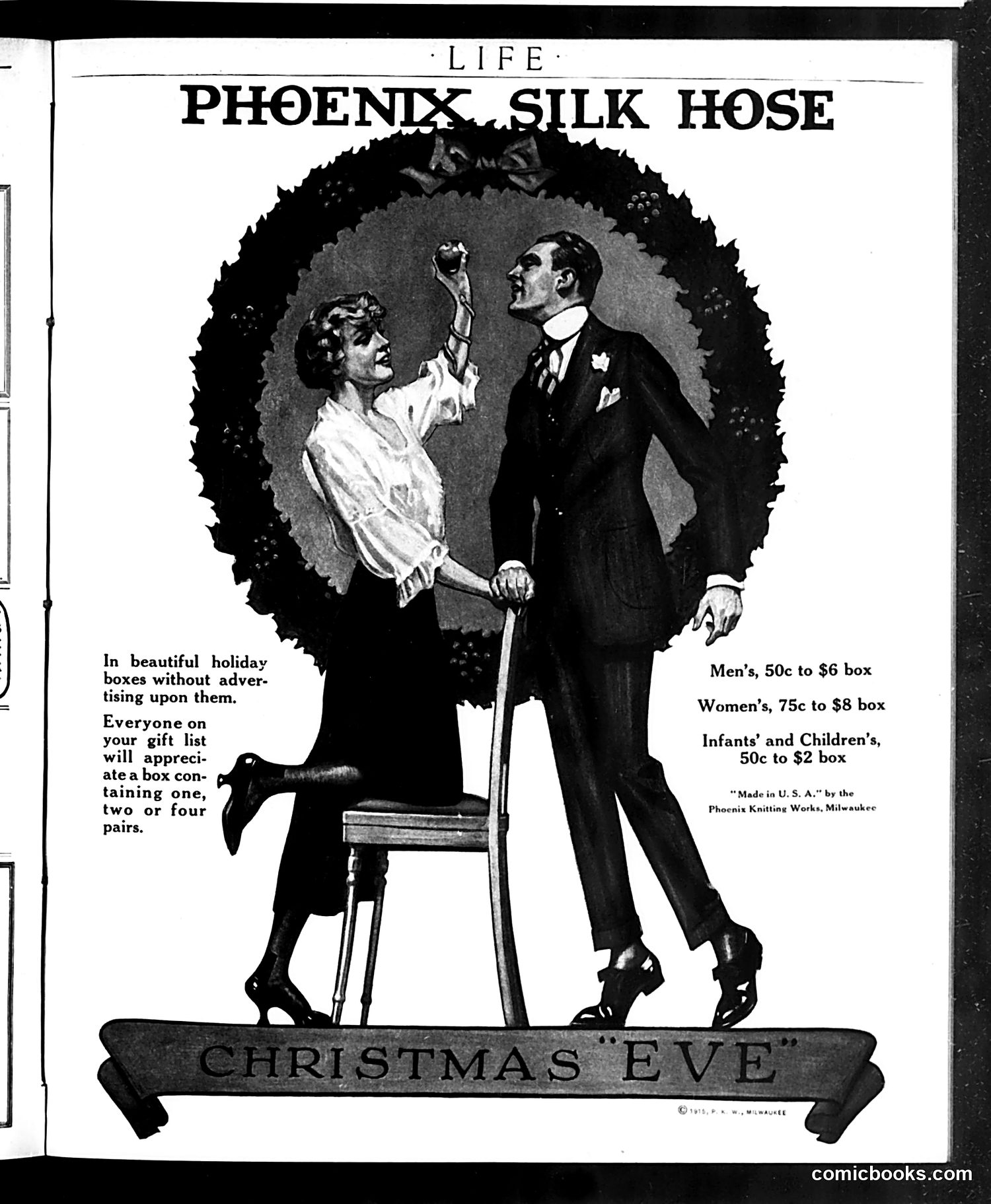
This is a product advertisement for silk stockings, not political satire. It depicts an elegantly dressed couple in formal attire—a woman in white and a man in black tuxedo—posed playfully on a ladder beneath mistletoe, suggesting romance and Christmas gift-giving. The ad's pitch targets holiday shoppers: silk stockings make ideal gifts across all demographics (men's, women's, children's sizes at varying price points). The emphasis on "beautiful holiday boxes without advertising" suggests premium presentation—gifts wrapped tastefully for giving. The woman's lifted leg and mistletoe setting evoke flirtation and intimacy, marketing hosiery as a luxurious, somewhat suggestive gift. "Made in U.S.A." emphasizes domestic manufacturing by Phoenix Knitting Works in Milwaukee, a sales point during this era.
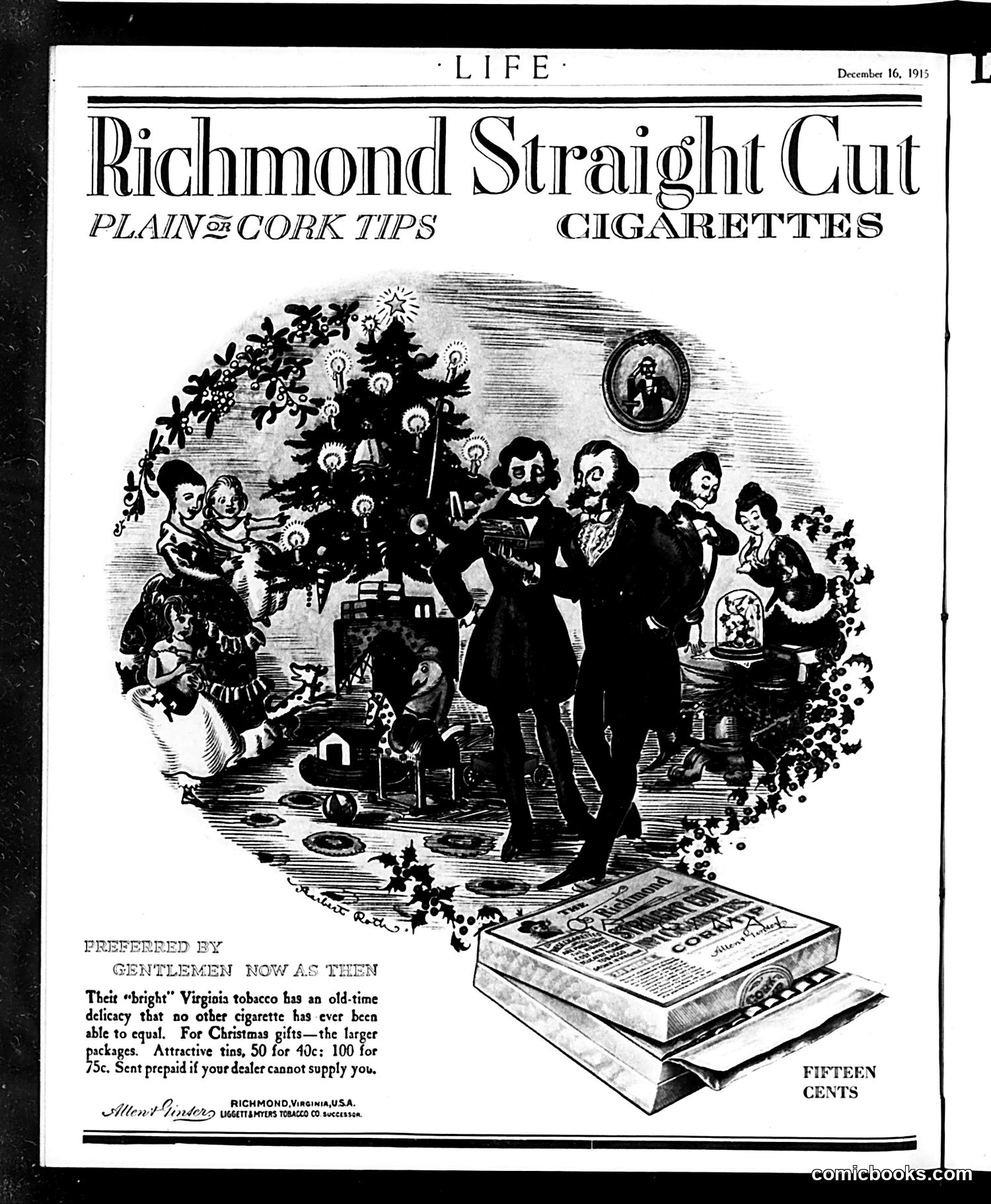
This is a **cigarette advertisement**, not political satire. It promotes Richmond Straight Cut cigarettes as a Christmas gift, priced at fifteen cents. The illustration depicts a festive Victorian-era Christmas scene with well-dressed gentlemen and families enjoying the holiday around a decorated tree and gifts—establishing the product as a luxury item suitable for gift-giving to "gentlemen." The ad emphasizes the cigarettes' "bright" Virginia tobacco and claims superior quality compared to competitors. Distribution details and pricing ($0.40 for 50, $0.75 for 100) suggest mail-order availability. The historical interest lies in the **casual promotion of cigarettes as respectable holiday gifts** to modern readers—reflecting early 20th-century attitudes before tobacco's health risks became widely acknowledged. This represents marketing from an era when such advertising was unrestricted in American publications.