
Life, 1915-12-16 · page 24 of 44
Life — December 16, 1915 — page 24: what you’re looking at
What you’re looking at
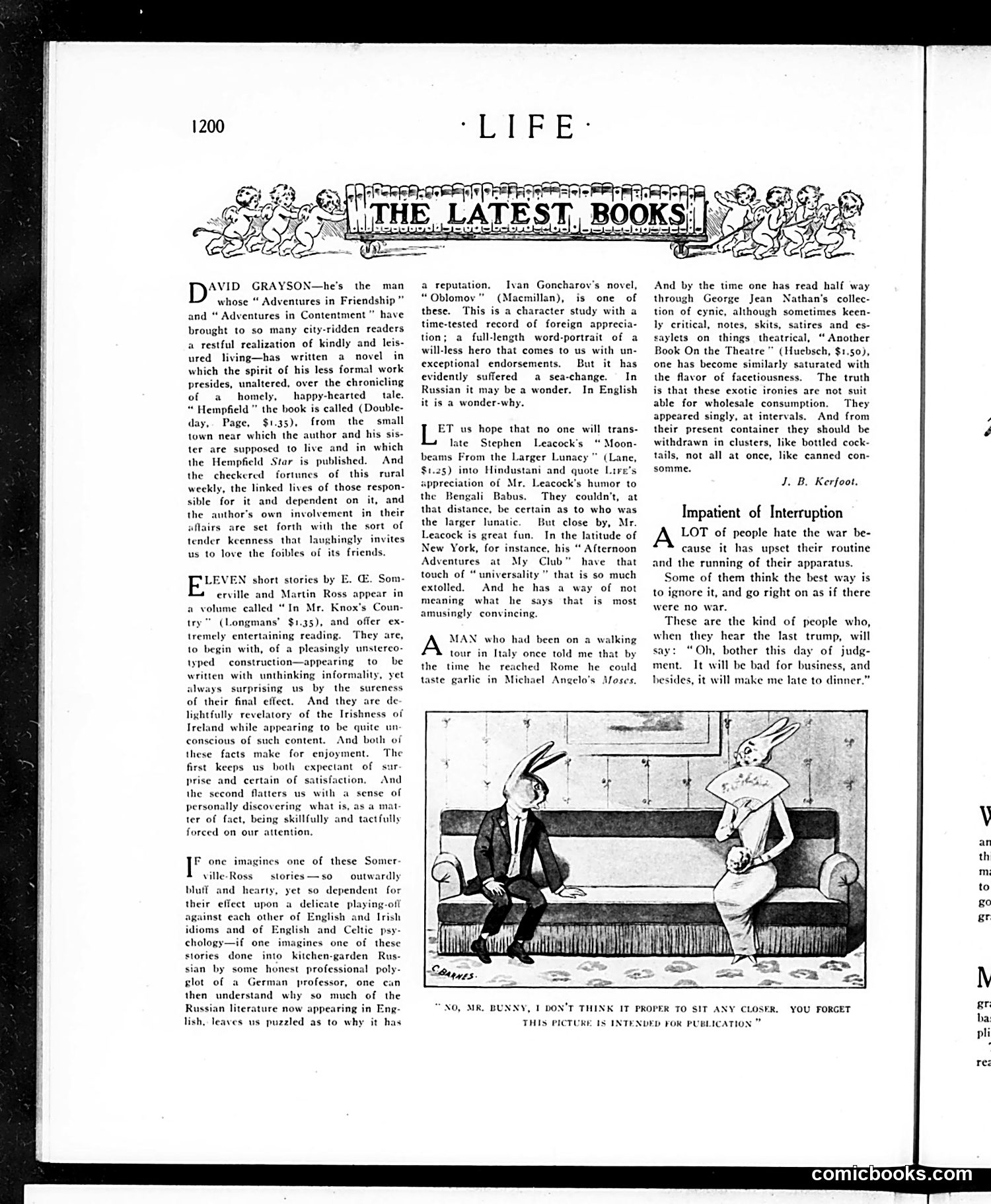
This page from *Life* magazine presents book reviews of contemporary literature. The main cartoon depicts two anthropomorphic rabbits on a sofa—one in business attire, one in feminine dress—with the caption sarcastically warning that the picture "is intended for publication," suggesting the image is too risqué or improper for the magazine's readers. The reviews discuss works by David Grayson, E.OE. Somerville and Martin Ross, Ivan Goncharov, and Stephen Leacock. A running joke emerges: the critic warns against translating Stephen Leacock's humor into other languages or cultures, joking that distant readers couldn't determine "who was the larger lunatic." This reflects period anxieties about whether American/English humor and literary sensibilities could successfully translate across cultural boundaries—a concern about the universality of satire and wit.
📄 Transcribed text from this page (OCR, searchable)
Machine-transcribed from the original scan — historical spelling and the odd misread are preserved.
VID GRAYSON—he's the whose “ Adventures in Friendship” and “ Adventures in Contentment" have brought to so many city-ridden readers a restful realization of kindly and leis ured living—has written a novel in which the spirit of his less formal work presides, unaltered, over the chronicling of a homely, happy-hearted tale. “ Hempfield” the book is called (Double- day, Page, $1.35), from the — small town near which the author and his sis- ter are supposed to live and in which the Hempfield Star is published. And the checkered fortunes of this rural weekly, the linked lives of those respon- sible for it and dependent on it, and the author's own involvement in their aflairs are set forth with the sort of tender keenness that laughingly invites us to love the foibles of its friends. man LEVEN short stories by E. GE. Som- erville and Martin Ross a i a volume called “In Mr. Knox's Coun- try (Longmans’ $1.35), and offer ex- tremely entertaining reading. They are, to begin with, of a pleasingly unstereo- typed construction—appearing to be written with unthinking informality, yet always surprising us by the sureness of their final effect. And they are de lightfully revelatory of the Irishness of Ireland while appearing to be quite un conscious of such content. And both of these facts make for enjoyment. The first keeps us both expectant of sur prise and certain of sat And the second flatters us with a sense of personally discovering what is, as a mat ter of fact, being skillfully and tactfully forced on our attention, action, F one imagines one of these Somer- ville-Ross outwardly blufl and hearty, yet so dependent for their effect upon a delicate playing-ofl against each other of English and Irish idioms and of English and Celtic psy- chology—if one imagines one of these stories done into kitchen-garden Rus- sian by some honest professional poly- glot of a German professor, one can then understand why so much of the Russian literature now appearing in Eng- stories — so a reputation, Ivan Goncharov’s novel, “Oblomoy"” (Macmillan), is one of these. This is a character study with a time-tested record of foreign apprecia- tion; a full-length word-portrait of a will-less hero that comes to us with un- exceptional endorsements. But it has evidently suffered a sea-change. In Russian it may be a wonder, In English it is a wonder-why. ET us hope that no one will trans- late Stephen Leacock’s “ Moon- beams From the Larger Lunacy ” (Lane, $1.25) into Hindustani and quote Lire’s appreciation of Mr, Leacock’s humor to the Bengali Babus. They couldn't, at that distance, be certain as to who was the larger lunatic. But close by, Mr. Leacock is great fun. In the latitude of New York, for instance, his “ Afternoon at My Club” have that universality” that is so much extolled. And he has a way of not meaning what he says that is most amusingly convincing. touch of “ MAN who had been on a walking tour in Italy once told me that by the time he reached Rome he could taste garlic in Michael Angelo’s Moses. 5 Ee Id And by the time one has read half way through George Jean Nathan's collec- tion of cynic, although sometimes keen- ly critical, notes, skits, satires and es- saylets on things theatrical, “ Another Book On the Theatre" (Huebsch, $1.50), one has become similarly saturated with the flavor of facetiousness. The truth is that these exotic ironies are not suit able for wholesale consumption. They appeared singly, at intervals, And from their present container they should be withdrawn in clusters, like bottled cock- tails, not all at once, like canned con- somme. J. B. Kerfoot. Impatient of Interruption LOT of people hate the war be- cause it has upset their routine and the running of their apparatus. Some of them think the best way is to ignore it, and go right on as if there were no war. These are the kind of people who, when they hear the last trump, will say: “Oh, bother this day of judg- ment. It will be bad for business, and hesides, it will make me late to dinner.” “NO, MR, BUNNY, I DON'T THINK IT PROPER TO SIT ANY CLOSER. YOU FORGET lish, leaves us puzzled as to why it has THIS PICTURE 1S INTENDED YOR PUBLICATION ” comicbooks.com