
Life, 1915-12-16 · page 16 of 44
Life — December 16, 1915 — page 16: what you’re looking at
What you’re looking at
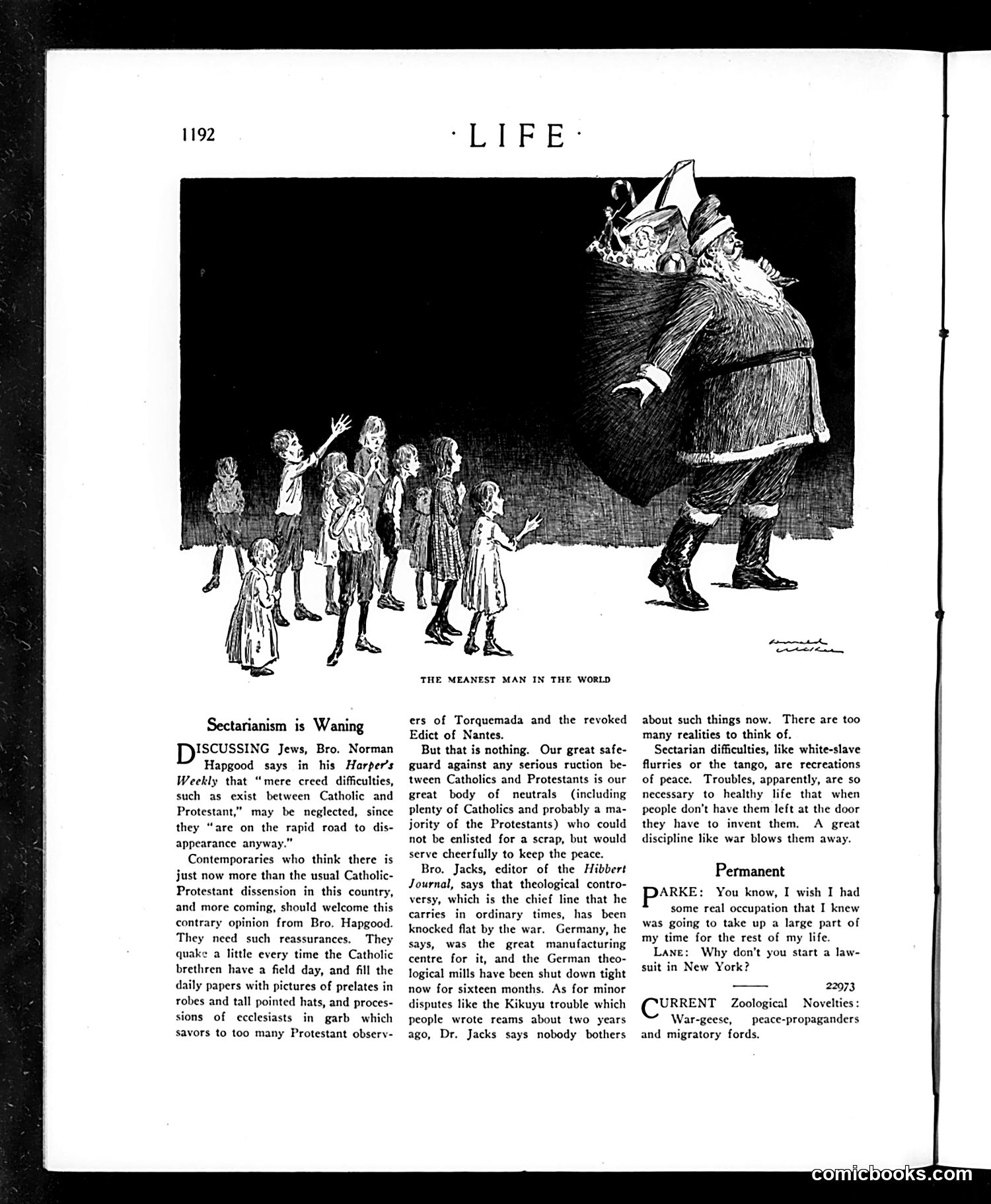
The large cartoon depicts a towering, menacing figure looming over a group of children. The caption identifies this as "The Meanest Man in the World," likely representing a general archetype of cruelty or malevolence rather than a specific historical figure. The accompanying article discusses religious sectarianism waning due to World War I. The text argues that Catholic-Protestant tensions and theological disputes have been overshadowed by war's urgency. References to German theological "manufacturing" being shut down and the Kikuyu religious controversy being forgotten illustrate how conflict redirects attention from denominational quarrels. The cartoon's meaning appears to connect: war itself functions as "the meanest man," a destructive force that paradoxically unites people by eclipsing their internal religious divisions. The children's vulnerability emphasizes war's indiscriminate cruelty overshadowing sectarian conflict. The page's tone is darkly satirical—suggesting society needs manufactured troubles (theological disputes, dance crazes) during peacetime, but war provides "discipline" that eliminates such petty concerns through sheer destructiveness.
📄 Transcribed text from this page (OCR, searchable)
Machine-transcribed from the original scan — historical spelling and the odd misread are preserved.
Sectarianism is Waning ISCUSSING Jews, Bro. Norman Hapgood says in his Harper's Weekly that “mere creed difficulties, such as exist between Catholic and Protestant,” may be neglected, since they “are on the rapid road to dis- appearance anyway.” Contemporaries who think there is just now more than the usual Catholic- Protestant dissension in this country, and more coming, should welcome this contrary opinion from Bro. Hapgood. They need such reassurances. They quake a little every time the Catholic brethren have a field day, and fill the daily papers with pictures of prelates in robes and tall pointed hats, and proces- sions of ecclesiasts in garb which savors to too many Protestant observ- THE MEANEST MAN IN THE WORLD ers of Torquemada and the revoked Edict of Nantes. But that is nothing. Our great safe- guard against any serious ruction be- tween Catholics and Protestants is our great body of neutrals (including plenty of Catholics and probably a ma- jority of the Protestants) who could not be enlisted for a scrap, but would serve cheerfully to keep the peace. Bro, Jacks, editor of the Hibbert Journal, says that theological contro- versy, which is the chief line that he carries in ordinary times, has been knocked flat by the war. Germany, he says, was the great manufacturing centre for it, and the German theo- logical mills have been shut down tight now for sixteen months. As for minor disputes like the Kikuyu trouble which people wrote reams about two years ago, Dr. Jacks says nobody bothers about such things now. There are too many realities to think of. Sectarian difficulties, like white-slave flurries or the tango, are recreations of peace. Troubles, apparently, are so necessary to healthy life that when people don’t have them left at the door they have to invent them. A great discipline like war blows them away. Permanent AARKE: You know, I wish I had some real occupation that I knew was going to take up a large part of my time for the rest of my life. Lane: Why don't you start a law- suit in New York? 22073 URRENT Zoological Novelties: War-geese, peace-propaganders and migratory fords.