
Life, 1915-12-16 · page 18 of 44
Life — December 16, 1915 — page 18: what you’re looking at
What you’re looking at
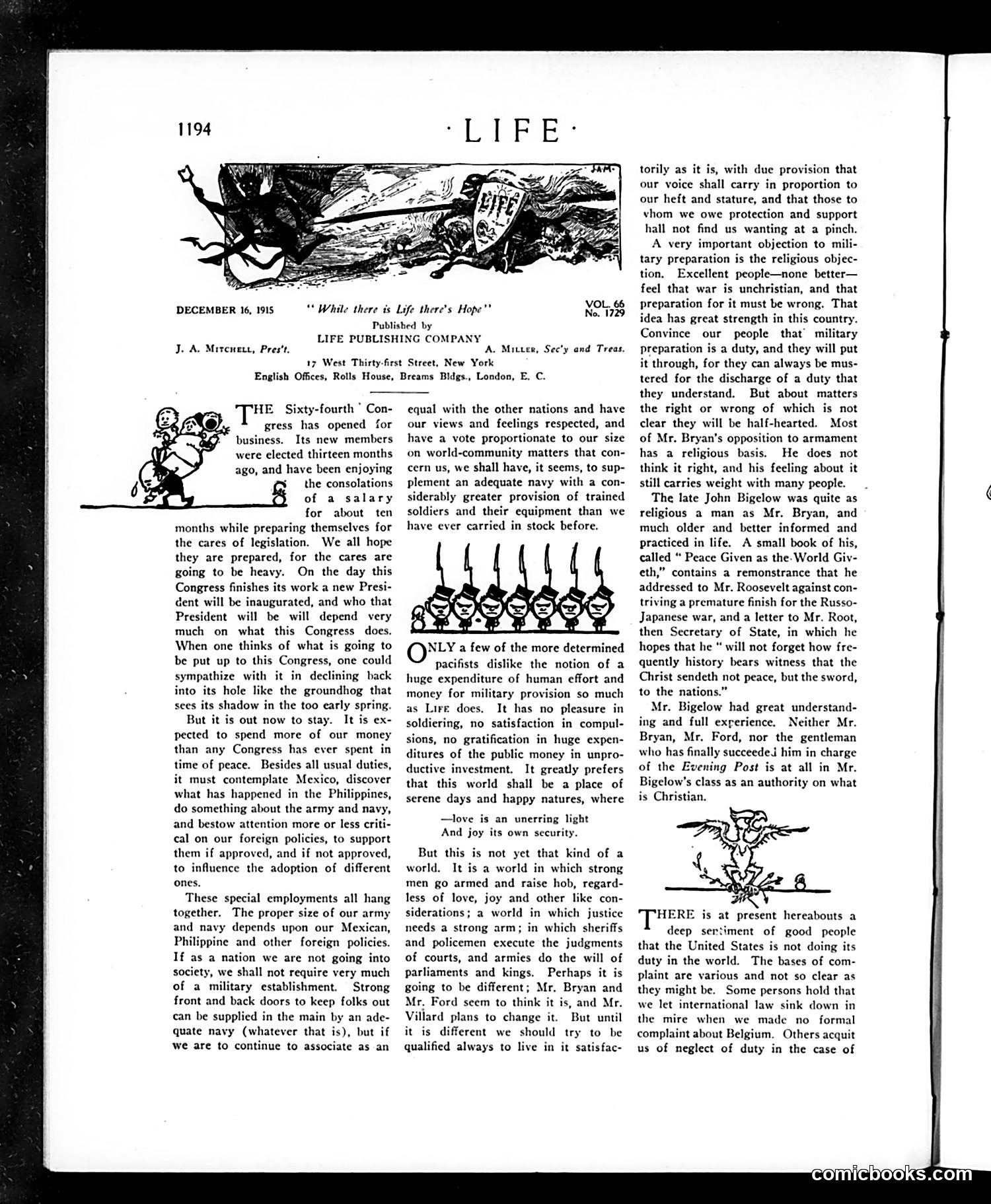
**The Cartoon:** The masthead illustration depicts a skeletal or death-like figure labeled "LIFE" amid chaos and destruction, with the caption "While there is Life there's Hope." **Context:** This page addresses the newly convened 64th Congress during WWI (though America hadn't yet entered). The editorial argues that military preparedness is necessary and unavoidable, despite pacifist opposition. **Key References:** The text mentions pacifists **William Jennings Bryan** (three-time presidential candidate and peace advocate) and **Henry Ford** as opponents of military spending. It also references **Oswald Garrison Villard**, a prominent pacifist editor. **The Satire:** Life's ironic position: while it dislikes war and military spending, it argues the world isn't yet peaceful enough to avoid them. The skeletal "Life" figure sardonically suggests that maintaining hope requires accepting military necessity—a grim commentary on realistic geopolitics versus idealistic pacifism that would resonate with pre-1917 America debates.
📄 Transcribed text from this page (OCR, searchable)
Machine-transcribed from the original scan — historical spelling and the odd misread are preserved.
DECEMBER 16, 1915 “While there ts Life there's Hope"" VOL. 66 No. 1729 Published by LIFE PUBLISHING COMPANY J. A. Mircnent, Pres't, A. Mitter, Sec’y and Treas. 17 West Thirty-first Street, New York English Offices, Rolls House, Breams Bldgs., London, E. C. THE Sixty-fourth ' Con- gress has opened for business. Its new members were elected thirteen months ago, and have been enjoying the consolations of a salary for about ten months while preparing themselves for the cares of legislation. We all hope they are prepared, for the cares are going to be heavy. On the day this Congress finishes its work a new Presi- dent will be inaugurated, and who that President will be will depend very much on what this Congress does. When one thinks of what is going to be put up to this Congress, one could sympathize with it in declining back into its hole like the groundhog that sees its shadow in the too early spring. But it is out now to stay. It is ex- pected to spend more of our money than any Congress has ever spent in time of peace. Besides all usual duties, it must contemplate Mexico, discover what has happened in the Philippines, do something about the army and navy, and bestow attention more or less criti- cal on our foreign policies, to support them if approved, and if not approved, to influence the adoption of different ones. These special employments all hang together. The proper size of our army and navy depends upon our Mexican, Philippine and other foreign policies. If as a nation we are not going into society, we shall not require very much of a military establishment. Strong front and back doors to keep folks out can be supplied in the main by an ade- quate navy (whatever that is), but if we are to continue to associate as an equal with the other nations and have our views and feelings respected, and have a vote proportionate to our size on world-community matters that con- cern us, we shall have, it seems, to sup- plement an adequate navy with a con- siderably greater provision of trained soldiers and their equipment than we have ever carried in stock before. fe NLY a few of the more determined pacifists dislike the notion of a huge expenditure of human effort and money for military provision so much as Lire does. It has no pleasure in soldiering, no satisfaction in compul- sions, no gratification in huge expen- ditures of the public money in unpro- ductive investment. It greatly prefers that this world shall be a place of serene days and happy natures, where —love is an unerring light And joy its own security, But this is not yet that kind of a world. It is a world in which strong men go armed and raise hob, regard- less of love, joy and other like con- siderations; a world in which justice needs a strong arm; in which sheriffs and policemen execute the judgments of courts, and armies do the will of parliaments and kings. Perhaps it is going to be different; Mr. Bryan and Mr. Ford seem to think it is, and Mr. Villard plans to change it. But until it is different we should try to be qualified always to live in it satisfac- torily as it is, with due provision that our voice shall carry in proportion to our heft and stature, and that those to vhom we owe protection and support hall not find us wanting at a pinch. A very important objection to mili- tary preparation is the religious objec- tion. Excellent people—none better— feel that war is unchristian, and that preparation for it must be wrong. That idea has great strength in this country. Convince our people that’ military preparation is a duty, and they will put it through, for they can always be mus- tered for the discharge of a duty that they understand. But about matters the right or wrong of which is not clear they will be half-hearted. Most of Mr. Bryan’s opposition to armament has a religious basis. He does not think it right, and his feeling about it still carries weight with many people. The late John Bigelow was quite as religious a man as Mr. Bryan, and much older and better informed and practiced in life. A small book of his, called “ Peace Given as the-World Giv- eth,” contains a remonstrance that he addressed to Mr. Roosevelt against con- triving a premature finish for the Russo- Japanese war, and a letter to Mr. Root, then Secretary of State, in which he hopes that he “ will not forget how fre- quently history bears witness that the Christ sendeth not peace, but the sword, to the nations.” Mr. Bigelow had great understand- ing and full experience. Neither Mr. Bryan, Mr. Ford, nor the gentleman who has finally succeeded him in charge of the Evening Post is at all in Mr. Bigelow’s class as an authority on what is Christian, HERE is at present hereabouts a deep sertiment of good people that the United States is not doing its duty in the world. The bases of com- plaint are various and not so clear as they might be. Some persons hold that we let international law sink down in the mire when we made no formal complaint about Belgium. Others acquit us of neglect of duty in the case of