
Life, 1915-12-16 · page 8 of 44
Life — December 16, 1915 — page 8: what you’re looking at
What you’re looking at
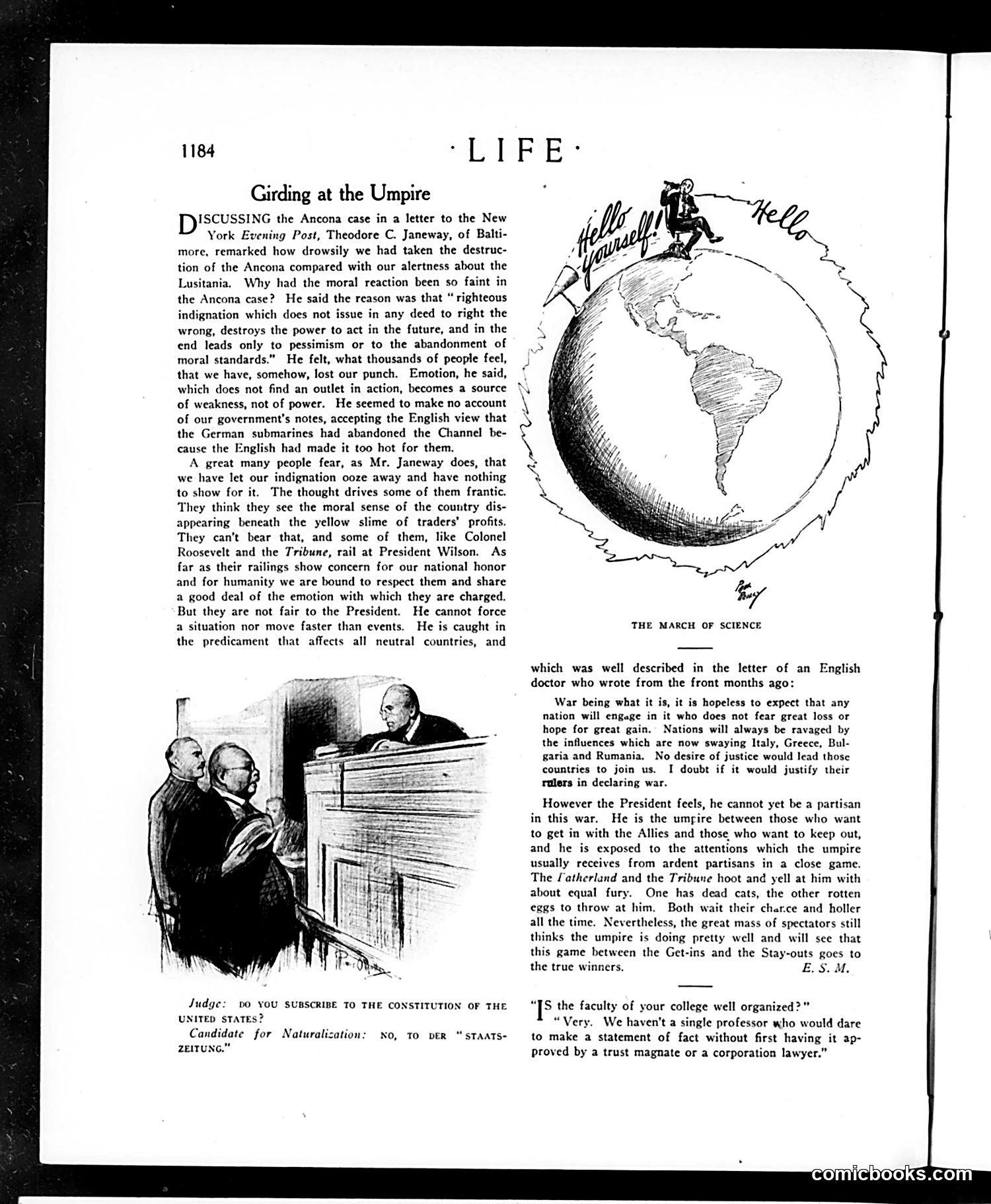
This page critiques American neutrality during World War I. The main article, referencing the *Ancona* sinking and *Lusitania* disaster, discusses why Americans have restrained their moral outrage despite German submarine attacks. The lower cartoon shows a judge questioning a naturalization candidate about subscribing to the U.S. Constitution. The candidate (labeled as from "Der Staatszeitung," a German-American newspaper) answers "No," satirizing German-American resistance to full American civic participation during wartime tensions. "The March of Science" illustration (globe with "Hello" greeting) appears unrelated to the political content. The satire targets perceived German-American disloyalty and questions whether such immigrants could genuinely commit to American constitutional principles during the war.
📄 Transcribed text from this page (OCR, searchable)
Machine-transcribed from the original scan — historical spelling and the odd misread are preserved.
1184 Girding at the Umpire ISCUSSING the Ancona case in a letter to the New York Evening Post, Theodore C. Janeway, of Balti- more, remarked how drowsily we had taken the destruc- tion of the Ancona compared with our alertness about the Lusitania. Why had the moral reaction been so faint in the Ancona case? He said the reason was that “righteous indignation which does not issue in any deed to right the wrong, destroys the power to act in the future, and in the end leads only to pessimism or to the abandonment of moral standards.” He felt, what thousands of people feel, that we have, somehow, lost our punch. Emotion, he said, which does not find an outlet in action, becomes a source of weakness, not of power. He seemed to make no account of our government's notes, accepting the English view that the German submarines had abandoned the Channel be- cause the English had made it too hot for them. A great many people fear, as Mr. Janeway does, that we have let our indignation ooze away and have nothing to show for it. The thought drives some of them frantic. They think they see the moral sense of the country dis- appearing beneath the yellow slime of traders’ profits. They can’t bear that, and some of them, like Colonel Roosevelt and the Tribune, rail at President Wilson. As far as their railings show concern for our national honor and for humanity we are bound to respect them and share a good deal of the emotion with which they are charged. But they are not fair to the President. He cannot force a situation nor move faster than events. He is caught in the predicament that affects all neutral countries, and Judge: 0 YOU SUBSCRIBE TO THE CONSTITUTION OF THE UNITED STATES? Candidate for Naturalization: No, to veR “ sTAaTs- ZEITUNG.” “LIP E* THE MARCH OF SCIENCE which was well described in the letter of an English doctor who wrote from the front months ago: War being what it is, it is hopeless to expect that any nation will engage in it who does not fear great loss or hope for great gain. Nations will always be ravaged by the influences which are now swaying Italy, Greece, Bul- garia and Ruma No desire of justice would lead those countries to join us. I doubt if it would justify their rolers in declaring war. However the President feels, he cannot yet be a partisan in this war. He is the umpire between those who want to get in with the Allies and those who want to keep out, and he is exposed to the attentions which the umpire usually receives from ardent partisans in a close game. The Fatherland and the Tribune hoot and yell at him with about equal fury. One has dead cats, the other rotten eggs to throw at him. Both wait their charce and holler all the time. Nevertheless, the great mass of spectators still thinks the umpire is doing pretty well and will see that this game between the Get-ins and the Stay-outs goes to the true winners. E.S.M. ae the faculty of your college well organized?” “Very. We haven't a single professor who would dare to make a statement of fact without first having it ap- Proved by a trust magnate or a corporation lawyer.”