
Life, 1915-12-16 · page 27 of 44
Life — December 16, 1915 — page 27: what you’re looking at
What you’re looking at
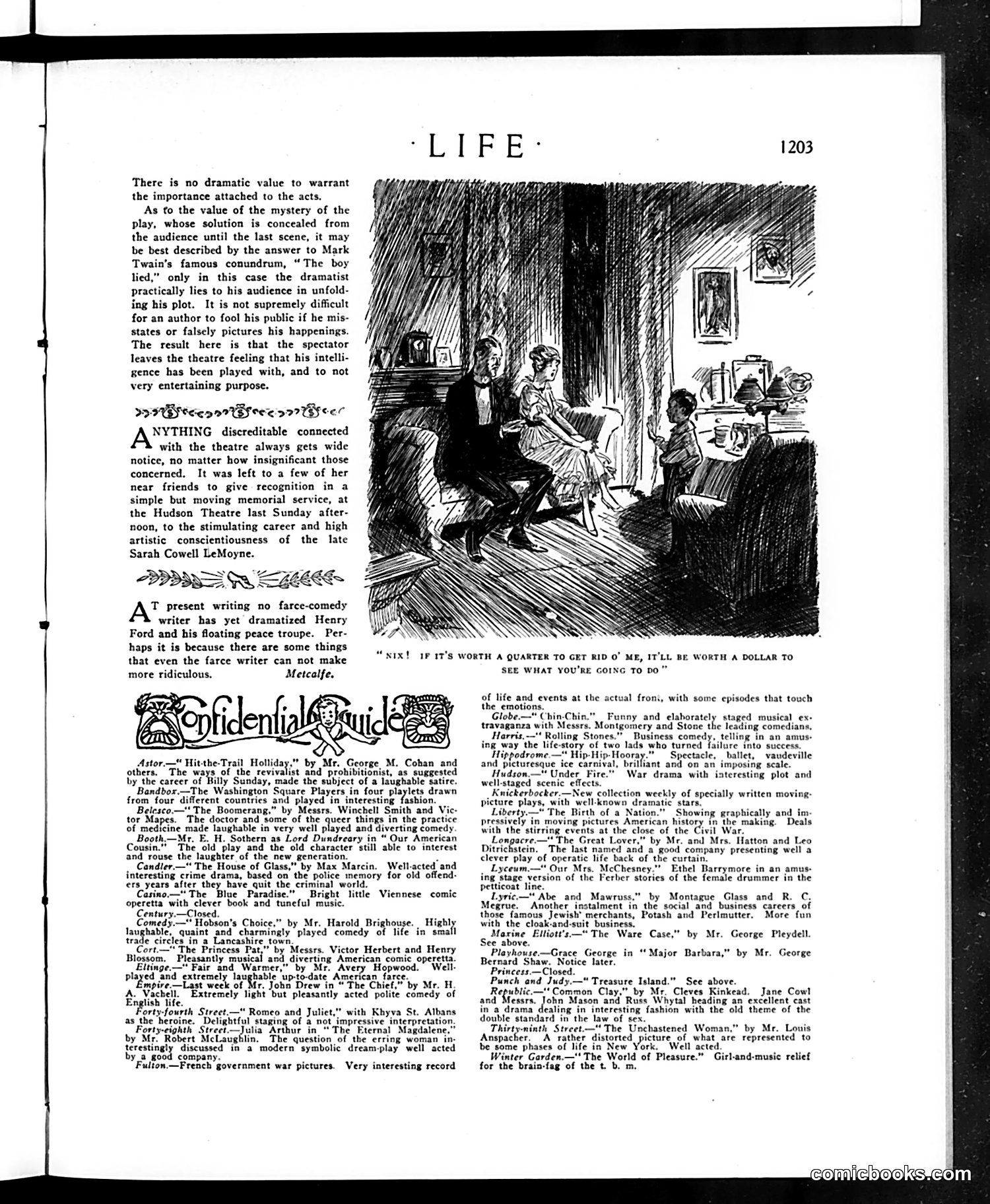
This page contains theater criticism and reviews rather than political cartoons. The single illustration shows a domestic scene: a woman sits while a man stands nearby, with the caption referencing someone offering money to leave ("If it's worth a quarter to get rid o' me..."). This appears to be from a play review or advertisement. The bulk of the page critiques contemporary Broadway productions—operettas, farces, dramas, and comedies. The text at top dismisses a play for deceiving its audience with false plot developments, comparing it unfavorably to Mark Twain's wit. A notable paragraph mourns Sarah Cowell LeMoyne, a theater figure, and criticizes how theater scandals receive disproportionate attention. The final section sardonically notes that Henry Ford's peace movement is too absurd for even farce writers to satirize effectively—a direct contemporary reference to Ford's famous 1915 Peace Ship initiative. The page reflects early 20th-century theatrical culture and social commentary on current events.
📄 Transcribed text from this page (OCR, searchable)
Machine-transcribed from the original scan — historical spelling and the odd misread are preserved.
“LIP E* There is no dramatic value to warrant the importance attached to the acts. As fo the value of the mystery of the play, whose solution is concealed from the audience until the last scene, it may be best described by the answer to Mark Twain’s famous conundrum, “The boy lied,” only in this case the dramatist practically lies to his audience in unfold- ing his plot. It is not supremely difficult for an author to fool his public if he mis- states or falsely pictures his happenings. The result here is that the spectator leaves the theatre feeling that his intelli- gence has been played with, and to not very entertaining purpose. DIU cen VV cee 977 CEO NYTHING discreditable connected with the theatre always gets wide notice, no matter how insignificant those concerned, It was left to a few of her near friends to give recognition in a simple but moving memorial service, at the Hudson Theatre last Sunday after- noon, to the stimulating career and high artistic conscientiousness of the late Sarah Cowell LeMoyne. S oy Z T present writing no farce-comedy writer has yet dramatized Henry Ford and his floating peace troupe. Per- haps it is because there are some things that even the farce writer can not make more ridiculous. Metcalfe. Astor" Hitthe-Trail Holliday," by Mr. George M. Cohan and others, The ways of the revivalist and probibitionist, as suggested by the career of Billy Sunday, made the subject of a laughable satire. Bandbox.—The Washington Square Players in four playlets drawn from four different countries and played in interesting fashion. Belcsco.—" The Boomerang,” by Messrs. Winchell Smith and Vic- tor Mapes. The doctor and some of the queer things in the practice of medicine made laughable in very well played and diverting comedy Booth,—Mr. E. H. Sothern as Lord Dundreary in “ Our American Cousin." The oid play and the old character still able to interest and rouse the laughter of the new generation. Candler.—" The House of Glass," by Max Marcin. Well-acted and interesting crime drama, based on the police memory for old offend- era_yeare after they bate, quit the criminal world. Casino.—"The Blue Paradise.” Bright little Viennese comic operetta with clever book and tuneful music. Century.—Closed. Comedy.—" Hobson's Choice,” by Mr. Harold Brighouse. High! laughable, quaint and charmingly played comedy of life in small trade circles in a Lancashire, town, Cort.—" The Princess Pat,” by Messrs. Victor Herbert and Henry Blossom. Pleasantly musical and diverting American comic operetta. Eltinge.—" Fair and Warmer,” by Mr. Avery Hopwood. Well- played and extremely laughable uptodate American farce, ‘mpire.—Last week of Mr. John Drew in “ The Chief,” by Mr. H. A, Vachell. “Extremely light but pleasantly acted polite comedy of ‘nglish life. Forty-fourth Street_—" Romeo and Juliet,” with Khyva St. Albans as the ‘heroine. Delightful staging of a not impressive interpretation, Forty-eighth Street.—Julia Arthur in “The Eternal Magdalene,” by Mr. Robert McLaughlin. The question of the erring woman in- ferestingly discussed in a ‘modern symbolic dreamplay well acted by a good company. Fulton.—French government war pictures. Very interesting record SSN SSS SS = = IF IT'S WORTH A QUARTER TO GET RID O' ME, IT'LL BE WORTH A DOLLAR TO SEE WHAT YOU'RE GOING To DO” of life and events at the actual froni, with some episodes that touch the emotions. Globe.—" Chin-Chin."| Funny and elaborately staged musical ex- travaganza with Messrs. Montgomery and Stone the leading comedians, Harris,—"' Rolling Stones.” Business comedy, telling in an amus- ing way the life-story of two lads who turned failure into success. Hippodrome —* Hip-Hip-Hooray.” — Spectacle, ballet, vaudeville and picturesque ice carnival, brilliant and on an imposing scale. Hudson.—" Under Fire." War drama with interesting plot and well-staged scenic effects. Knickerbocker.—New collection weekly of specially written moving- picture plays, with well-known dramatic stars, Liberty.—" The Birth of a Nation.” Showing graphically and im: pressively in moving pictures American history in the making. Deals with the stirring events at the close of the Civil War, Longacre.—" The Great Lover,” by Mr. and Mrs. Hatton and Leo Ditrichstein, The last named and a good company presenting well a clever play of operatic life back of the curtain. Lyceum.—" Our Mrs. McChesney.” Ethel Barrymore in an amus- ing ‘stage version of the Ferber stories of the female drummer in the petticoat 1 Mawruss.” by Montague Glass and R. C, stalment in the social and business careers of those famous Jewish’ merchants, Potash and Perlmutter. More fun with the cloak-and-suit business. Maxine Elliott's—* The Ware Case,” by Mr. George Pleydell. See above. Playhouse.—Grace George in “Major Barbara,” by Mr. George Bernard Shaw. Notice later. Princess.—Closed. Punch and Judy.—" Treasure Island.” See above. Republic.—' Common Clay,” by Mr. Cleves Kinkead. Jane Cowl and Messrs. John Mason and Russ Whytal heading an excellent cast in a drama dealing in interesting fashion with the old theme of the double standard in the law of sex. Thirty-ninth Street.—" The Unchastened Woman,” by Mr. Louis Anspacher, A rather distorted picture of what are represented to be some phases of life in New York. Well acted, Winter Garden.— The World of Pleasure.” Girl-and-music relief for the brain-fag of the t. b. m.